 In my September 2, 2017 post I wrote about one of Gertrude Atherton’s last books entitled ‘My San Francisco – A Wayward Biography’. In one of the chapters, Atherton wrote about a mystery story by Mary Collins called ‘The Sister of Cain’ explaining that it’s set in “the weird old Humphrey-Giffen house on Chestnut Street.” Her review of the book was so enticing that I ordered a copy from the internet. It took three weeks to arrive but it was worth it; it’s a neat little mystery written and set in San Francisco during World War Two that captures the war time atmosphere of San Francisco deliciously! Spooky locations that the heroine visits to try to solve the mystery, usually during the middle of the night, are well described. I followed the adventures of Mrs. Collins main character around San Francisco visiting many of the locations as I read the book. It was a delightful mystery to read and from Mary Collin’s descriptions of areas in the book she writes about it’s clear that she went to these locations as she wrote the book, and leaves a descriptive map of the eerie and dangerous adventures of the book’s main character, Hilda Moreau. The book was published in 1943 and is set in September of 1942, exactly 75 years to the month before I first heard of it. Mrs. Collins at the time, like Hilda, was in the early stages of pregnancy, but I couldn’t find a lot of information about her except that she was born in St. Louis in 1908 and attended Miss Burke’s School for girls when she came to San Francisco. (What is it about that school that inspires such talented ladies?) Well, let’s get on with the mystery. I’ll try not to give anything too important away if anyone is interested in reading the story.
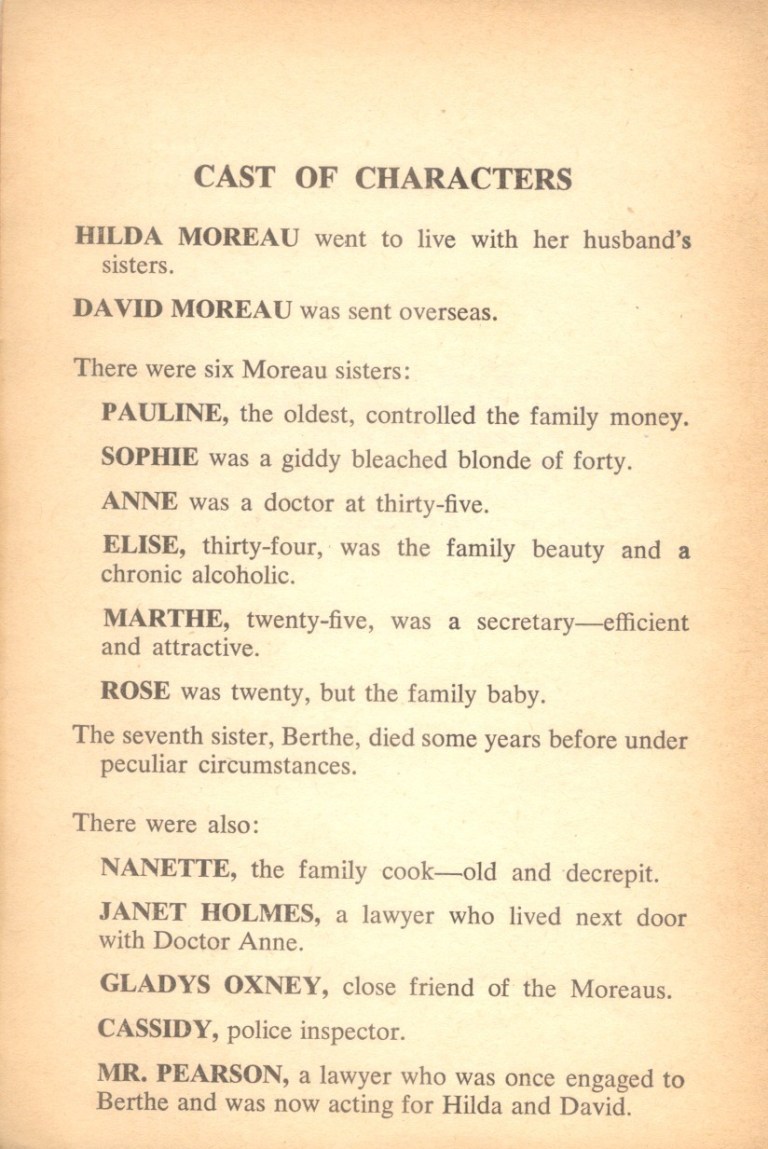 Above are the cast of characters and the Moreau sisters are deserving of a little background information. Pauline, the oldest sister, is wicked and controlling who continually interferes and ruins her other sisters chance to find love and happiness. It comes as no surprise that she’ll be the first one murdered. Sophie is the most pathetic of the girls. Because of Pauline’s control over her she no longer takes care of her looks and is the one the reader will feel the most sorry for. Anne is the most successful of the Moreau sisters and the strongest. She lives next door to the old Humphrey House and is not afraid to challenge Pauline. Elise is the most attractive of the girls, but she has one problem she’s a falling down drunk. She makes W. C. Fields look like a beautified candidate for sainthood! Marthe, pronounced “Mart”, I think she was my favorite. She’s pretty, a close tie with Elise as the prettiest, feisty, fun loving, and she likes to get plastered occasionally herself. That’s always a good sign. The baby of the family is Rose, easily frightened and often childlike, she has no will whatsoever to oppose Pauline. There was also a sister named Berthe, Collins doesn’t say if her name is pronounced “Bert”. Berthe is only referred to in flashbacks, or in a book I guess they’re called writebacks. Berthe fell, jumped or was pushed from the three stories back of the house many years before the current story takes place, and, obviously, this is something to keep in mind. Hilda Moreau has arrived by train from Cleveland, Ohio. She is married to David Moreau, the only Moreau brother in the family. Hilda has arrived in San Francisco to clear some legal matters up and she is recently pregnant with David’s child. David is in the North Atlantic on World War Two duty. The story takes place during the first few weeks of September in 1942 and Hilda’s baby is due in February.
 I wondered why Gertrude Atherton was so keen on the book until I saw Mary Collins’ dedication.
 Most of the story takes place inside an old house on the northeast corner of Chestnut Street at Hyde. At the time it was the oldest house in San Francisco, built in 1852. Efforts to save it failed and it was demolished in 1948, five years after ‘The Sister of Cain’ was published. Above is an old photo of the house and the apartment building that’s there today.
{“This is it lady.” The cab driver said over his shoulder. He swung his yellow taxi at right angles to the sidewalk. I can’t see no number, but the place next door is 980 so this must be 986 here on the corner.”} he tells Hilda. (Vintage picture from the San Francisco Library)
 {“We went up a flight of seven or eight crooked wooden stairs which led to a veranda that ran across the front of the house.”}
{“Old house, ain’t it lady?”} the cab driver remarks. Hilda makes it clear from the beginning that she does not like San Francisco. This is something to keep in mind when you reach the end of the book. Here are some of her thoughts.
{“It was bad enough to have my charming, affectionate, intelligent husband gone to the wars, but to have to come clear across the country to this steep, cold, grey, alien town and into this horrible house,”} or later on, {“I wanted to go home to Cleveland and never see the Moreau house or the city of San Francisco again!”}
I know what you’re thinking, “Well, that’s all we need to know about her.” but I’ve never been to Cleveland, and you can’t expect everyone to fall in love with San Francisco. Besides, as I hinted earlier, San Francisco has a way of winning visitors over.
 The above picture is the jacket cover for the hardback edition of the novel with the Humphrey house on the cover.
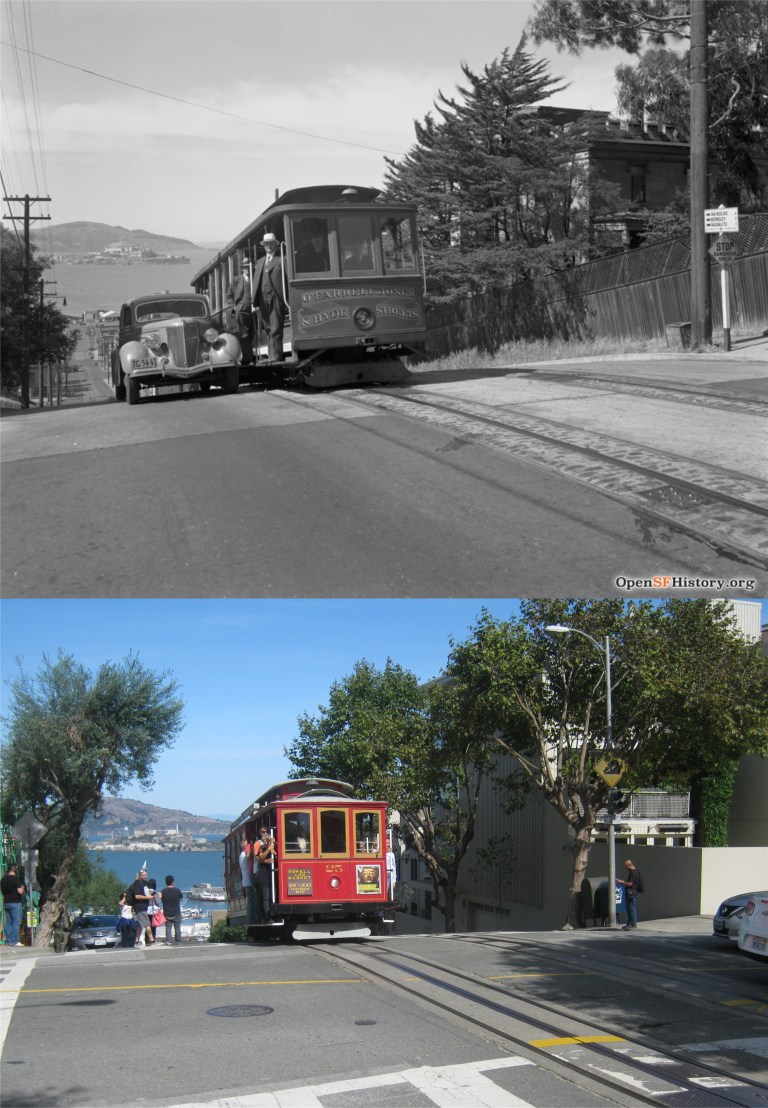 The vintage photo from OpenSFHistory.org shows a cable car approaching Chestnut Street at Hyde in 1938. The Humphrey house is clearly seen on the right.
 A little farther down Hyde in the 1920’s shows part of the back yard of the Humphrey house on the right. (OpenSFHistory.org)
 The top photo is the side of the old house that faced San Francisco Bay. This is where Berthe, fell, jumped or was pushed to her death. This is also where Hilda sneaks out of the house several times in the middle of the night looking for clues. Oh, yes, you guessed it, Mary Collins novel isn’t going to be overlooking this part of the house. The lower picture is my photo from the same spot looking up at the back of the apartment building that’s there now.
 A picture taken during the 1950’s a little up Hyde Street from Chestnut shows the apartment building on the northeast corner of Hyde and Chestnut that replaced the Humphrey house when it was demolished.
 Sophie Moreau is in love with a gentleman who works in a pharmacy at Union and Hyde Streets. Pauline through meanness has forbidden her to see him. In a rare moment of courage, Sophie sneaks out of the house to go to him while Pauline is away. Hilda narrates,
{“I was just in time to see Sophie scrambling nervously onto a Hyde Street cable car and disappear up the hill. Poor Sophie, when she got home there would be hell to pay.”}
This would be where Hilda watched Sophie make her dash. After Pauline is murdered, the first of three in the book, Hilda, herself, isn’t above sneaking out of the house in the middle of the night looking for clues. Both times she nearly gets herself killed.
 In the first of Hilda’s clandestine capers she sneaks out of the house through the back way at two o’clock in the morning to break into a house in the 200 block of Leavenworth Street. Hilda has learned that Pauline herself used to visit this house in the middle of the night. She goes down the corner of Chestnut Street and Columbus Avenue.
{“I found a taxi in front of a nightclub and told the driver to take me to the 400 block of Leavenworth.”}
Hilda is being clever here; she doesn’t want the cab driver to know the exact block in case he’s questioned later. Or maybe Mary Collins just forgot that she referred to the house as being on the 200 block of Leavenworth earlier. That may not be classified as a night club on the corner of Columbus and Chestnut in the top picture today, but it’ll fit. That looks like a fun place; I’ll have to get back there!
{“We bumped around past stores and bars and apartment buildings that looked remote and dismal in the dimmed-out city, and then we went through a long, noisy, white-tiled tunnel, and after a while we swung back to the right.”}
No guess work here what tunnel they entered at two in the morning. From Hilda’s route description they would have traveled south through the Stockton Tunnel, seen in the bottom picture. The white tiles are still there, although that paint job kind of worries me.
 Photographs from the San Francisco Library on the Calisphere website from the University of California have some old pictures taken inside the Humphrey House. Incidents from parts of the book take place where some of these photos were taken.
{“I got up and put on a robe and followed Marthe into Rose’s room, whose windows overlooked the bay. The wind had blown the fog away, and the view was superb. Alcatraz, the famous “Rock” stood out like something on a picture post card, and an enormous blue-grey battleship was just passing it.”}
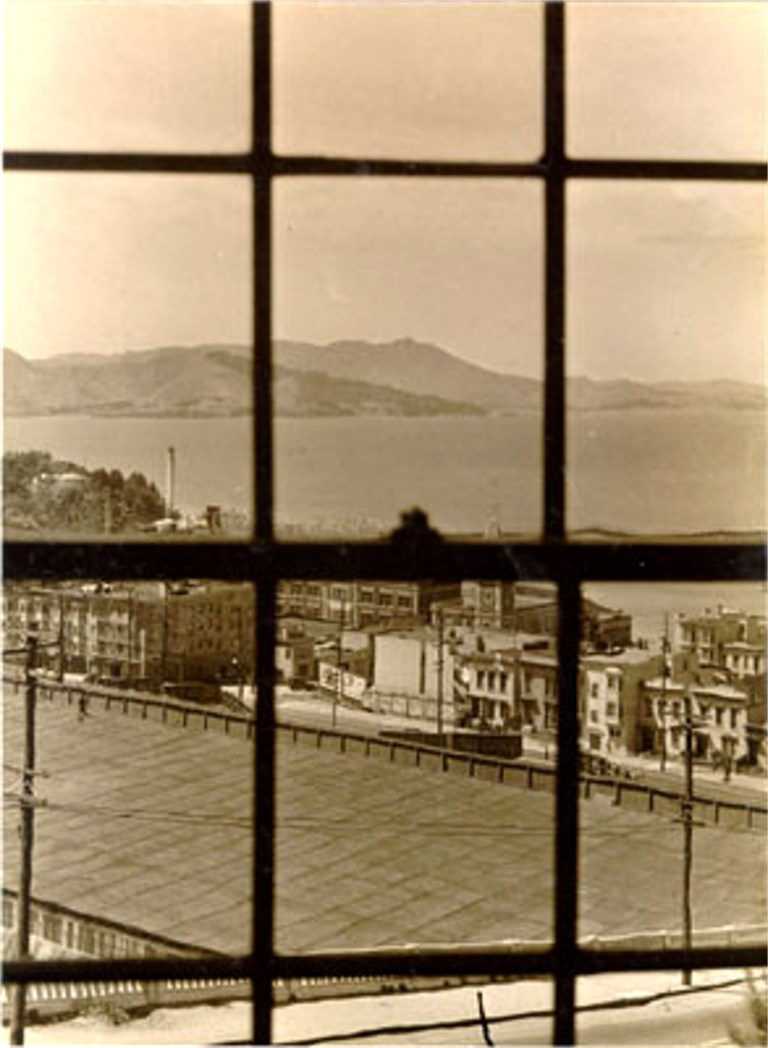 The girls watch as a parade of ships head past North Point to the Golden Gate Bridge. The Ghirardelli Tower can be seen. Cry-baby Rose had a nice view indeed!
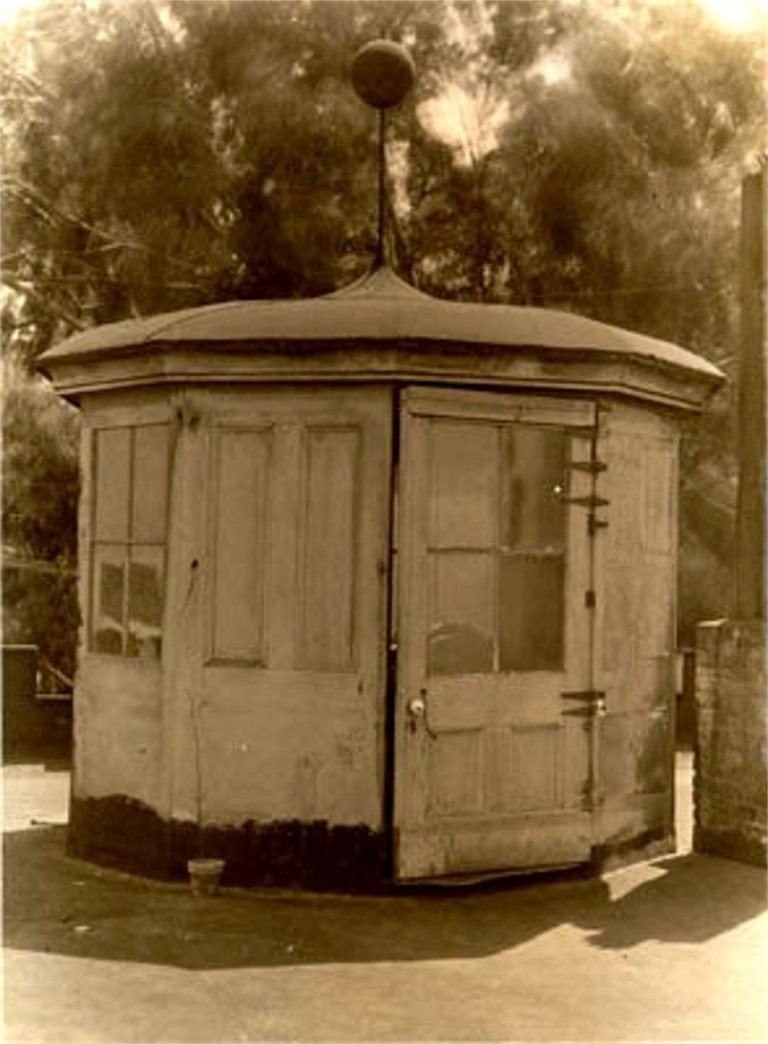 On the roof of the house was a cupola. The girls go up there a number of times and you just know that this little room is going to play an important part in this book before the story is over. In one chapter of the book Hilda is watching war time searchlights on San Francisco Bay at night from the cupola. These were some of her thoughts from here.
{“From every corner of the Bay the great long shafts of light stabbed the clear night sky.”
“I thought almost guiltily that here was one phase of war that was wonderful to watch, not ugly or grey or deadly.”
“My eyes swept the sky all around me. I must remember this I kept saying to myself. I must remember this to tell my grandchildren. The big searchlights on San Francisco Bay a few months after Pearl Harbor.”}
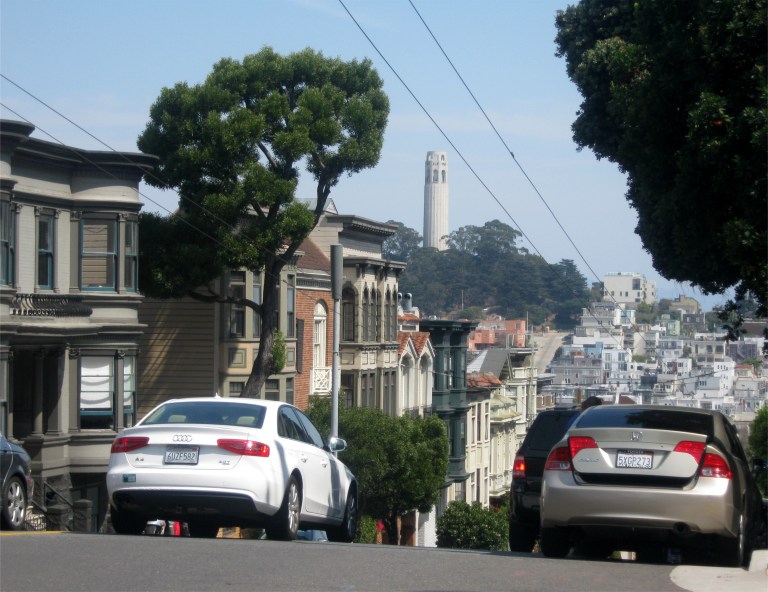 When Coit Tower was erected in 1933 it was not well received by many at first. Gertrude Atherton herself wrote that the “harmonious skyline is now distorted by Coit Tower on Telegraph Hill,” and “Today there is a small park on the crest of the hill where tourists may enjoy the view and that eyesore the Coit Tower which looks more like a lighthouse or an incinerator.” or “So there it stands, insulting the landscape. Lily Hitchcock deserved a better memorial.” When Inspector Cassidy is taking Hilda down to the Russ Building to meet with an attorney he tells her a little bit about North Beach.
{“He was being awfully nice to me in a sort of social way, so I thought I’d do him a good turn when he finished telling me about the North Beach District and a dreadful-looking thing sticking up on a hill which he said was Coit Tower. A long time afterward David told me the colloquial name for the tower which was obscene and funny.”}
It doesn’t take much imagination to guess what naughty little nickname for the tower her husband told Hilda that she got such a kick out of.
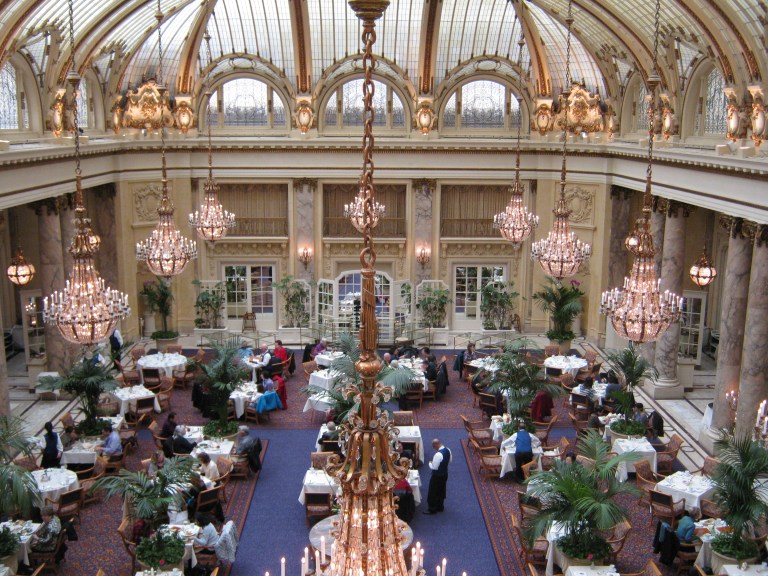 Hilda has lunch with Mr. Pearson at the Palace Hotel.
{“Mr. Pearson took me to the Palace Hotel for luncheon and recommended that I eat a delicious concoction called Palm Court Salad. I was suitable impressed with the great Palm Court and promised to read a book called Bonanza Inn which would tell me the history of the hotel before the fire, as Californians are pleased to call the 1906 Earthquake.”}
 I’ll finish up with the location of one of the key scenes in the book, and then you’re on your own. Janet Holmes, one of the suspects at this point along with Hilda, and a fugitive, sends a note to Hilda to meet her at a park near where the Moreau House is at midnight. Hilda, three months pregnant, decides to go, not because she’s a fool, but because she couldn’t reach a police officer to accompany her. Hilda’s in this pretty thick and she’s looking for any information she can find to clear herself.
{“I pulled out Janet’s note and looked at it carefully. According to the map, I was supposed to walk one block west, then one block south, go up some steps, wander down a path in the park, and meet Janet at a bench. All of this was to be accomplished at the witching hour of midnight.”}
I retraced the route from where the Humphrey house once stood. One block west and one block south took me to the steps that lead up to what is now called George Sterling Park, named after the poet who wrote of San Francisco as, “The cool, grey city of love.” When Hilda arrives at the park she comments on a memorial erected to George Sterling near the bench where she waits for Janet. I walked down a path to a bench where a girl was sitting and thought to myself that this may have been where Hilda was supposed to meet Janet Holmes. George Sterling Park is much better lit with tennis courts and a baseball diamond on top today than the dark, spooky park Hilda Moreau describes. Hilda has a knife thrown at her and stumbles on to another murdered body in the park on this night and becomes the number one suspect now, intensely disliked by the rest of the Moreau sisters. I’ll leave my readers in the dark here like Hilda was at midnight up on George Sterling Park or I’ll reveal too much of the book.
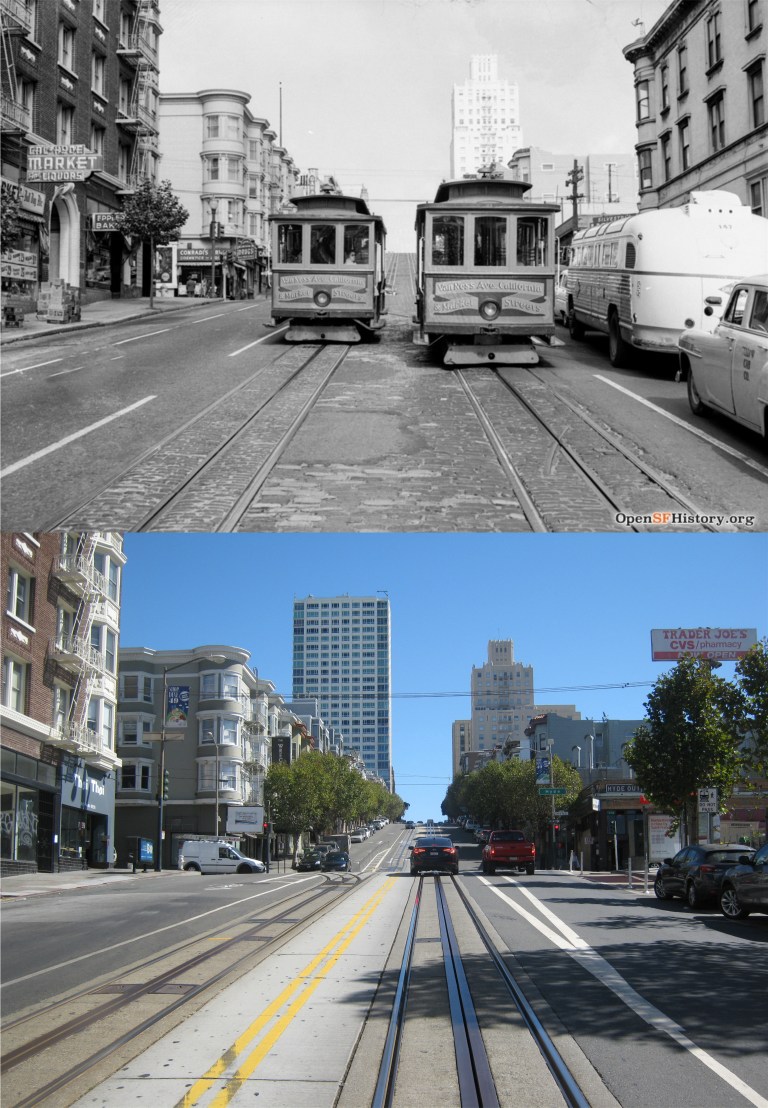 Two California Street cable cars pass and approach Hyde Street in 1954 in a picture from OpenSFHistory.org: The California Street cable car system was down for repairs this week so there were no passing cable cars at this location when I took my pictures. However, I’m going to mention more about this a little later in my post.
 Now you’re looking east at the intersection of California and Hyde in 1949 and this week. These tracks turning off California were laid down in the 1950’s when the cable cars were consolidated into one system and do not appear on older pictures of the area. Two tracks turn onto Hyde Street to accommodate both east and west bound cable cars. (OpenSFHistory.org)
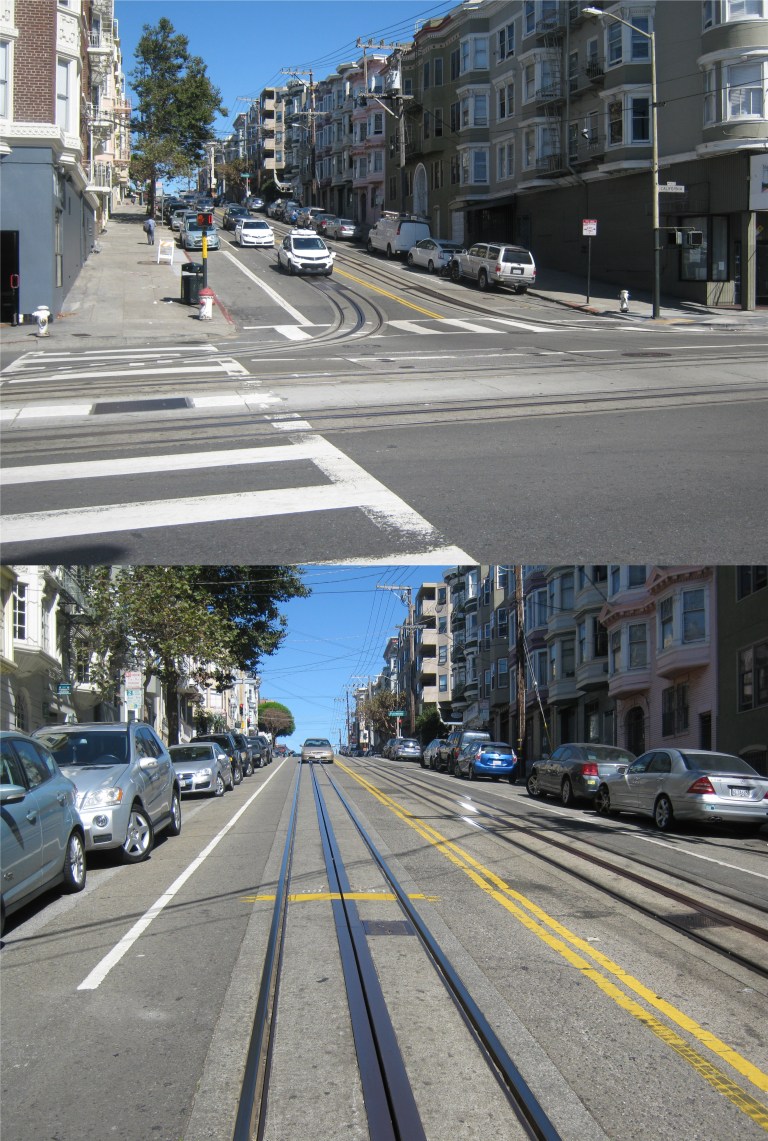 We’ll head north along the tracks starting from across California Street. The route heads uphill to Sacramento Street.
 We continue uphill to Clay Street and then the tracks drop down to Washington in the bottom picture.
 At the intersection of Hyde and Washington, in the top photo, the northbound California cars cross on to the tracks of the southbound Hyde Street cable cars that climb Russian Hill from Aquatic Park. They’ve now linked back up with a passenger section of the cable car system that we all love to ride. From here, the California Line cars back up to make the turn on to Washington Street. They don’t really back up because California cable cars can go either way, like Doctor Dolittle’s pushmi-pullyu. They now head down Washington Street toward the Cable Car Barn.
 I spoke with a gentleman named Fred who works at the Cable Car Museum, and asked him what the route was from here that the California Line cars use to return to the barn. He traced the route for me on a map; the cars continue east past Mason, seen here during World War Two, to Powell Street. They share the same track here as the Powell and Market Street cable cars seen in both pictures do. (OpenSFHistory.org)
 Near Powell Street a different set of tracks on the left branch off and California cable cars turn onto Powell Street from Washington and cross onto those tracks heading north. Passengers don’t make this turn either. The tracks and the turn on the right that the Powell-Hyde Street returning cars make like today and in 1973 is the one for the public. (OpenSFHistory.org)
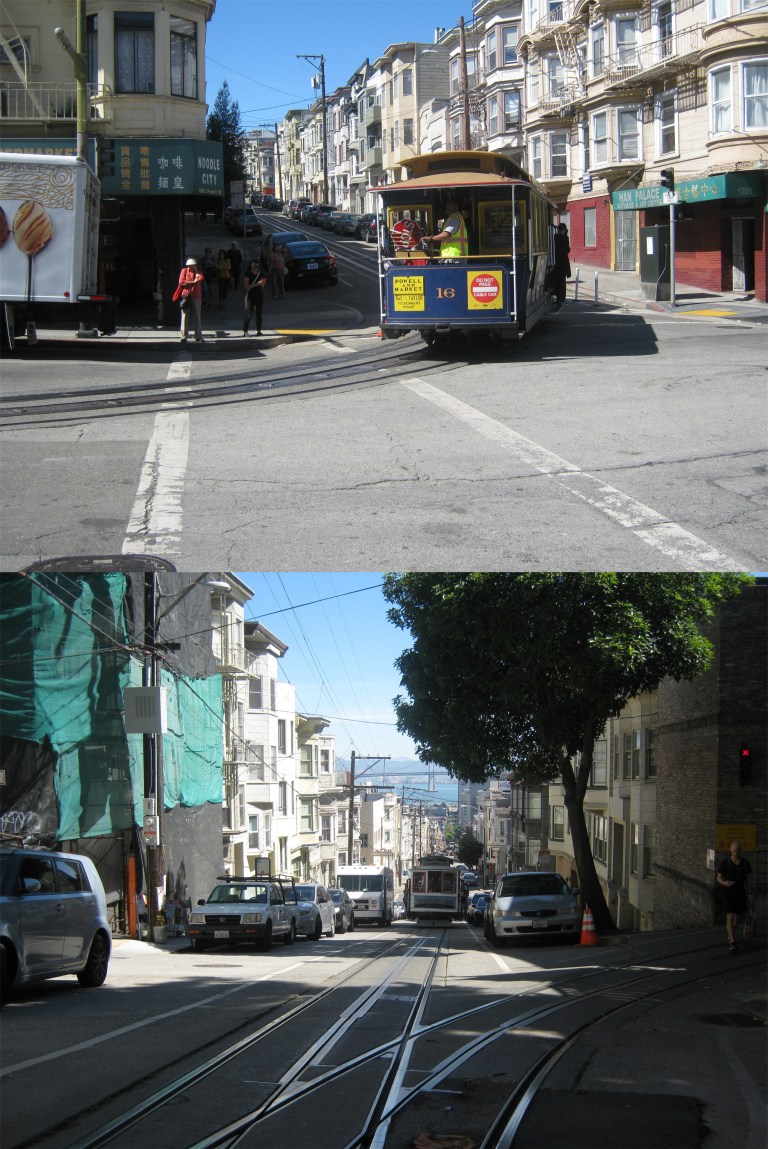 After heading one block north, the cars turn left and head up Jackson to the cable car barn where they back into it on the right in the bottom picture. The views from both the Washington and Jackson Street side of the cable car powerhouse are stunning!
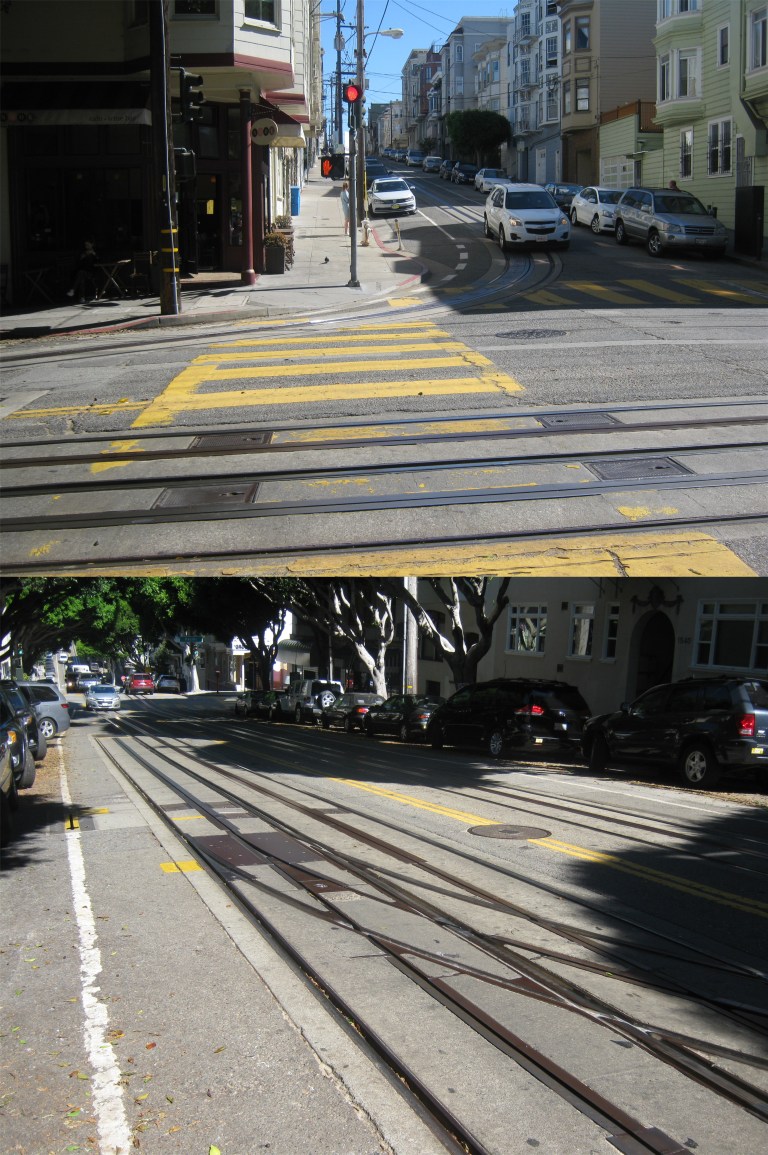 Now, we had the California Street cable cars in the powerhouse, but I had another question for Fred.
 I had a piece of luck here. Just as I was leaving, a California Street cable car turned onto Hyde from Jackson, crossed over the tracks for the return trip to California Street, and headed toward me. As I mentioned, the California Street cable line was closed for repairs during this week, so this must have been a test run.
 A few minutes after California car number 57 passed by me a Powell and Market number 15 car came by heading for Washington Street. It’s probably not a big deal, but I’ve never had a Powell and California Street cable car rattle past me on the same stretch of tracks and I was pretty excited about it.
 Number 57 headed back to California Street. The brakeman seemed to be looking at me and thinking, “What’s the matter, buddy? Haven’t you ever seen a cable car before?” and I thought back to him, “I’ve been riding them long before you were born, buddy, but never on this stretch!” The lower picture is where the cable car tracks that you and I will never ride on head back to California Street from Washington.
 Where the California Street and the Powell Street cable cars, get ready to roll out of bed and hit the streets to “Stack ‘em, pack ‘em , and rack ‘em.” (artist drawing by Yo Pedro)
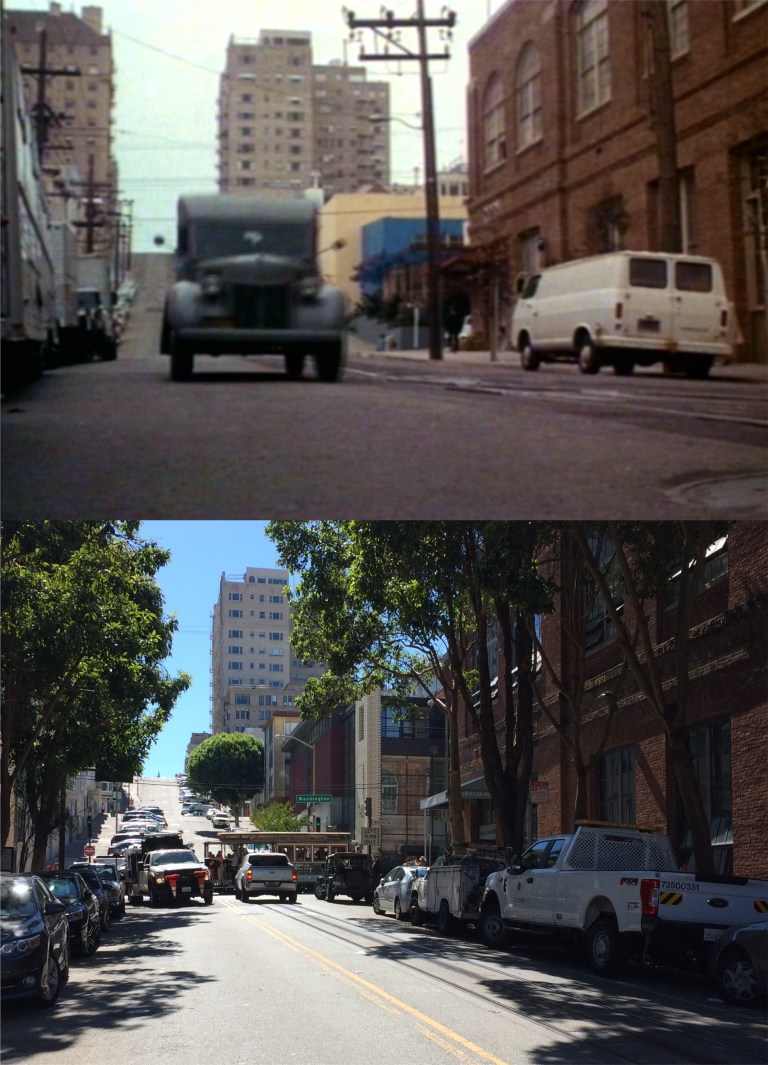 I never gave much thought to the old television show ‘Ironside’ with Raymond Burr until I started watching episodes on DVD lately. For the most part, they’re actually well made murder mysteries with occasional location filming at interesting San Francisco sites. In one 1968 episode “Ironside” (Burr) and crew are chasing a murder suspect near the cable car barn. Here, they’re heading north on Mason Street in Ironside’s armored truck past the powerhouse.
 They follow the suspect into the warehouse where one of Ironside’s team, Eve Whitfield, played by Barbara Anderson, isn’t about to let the murderess get away.
 The culpritess (Is that a word?) runs past a California Street cable car and pulls a gun.
 Eve blindsides her and roughs her up pretty good! I mean, it wasn’t like women’s mud wrestling, but it was still fun to watch.
 “Okay, I give up! Just get this +++++ off of me!”
 “No, Eve, you can’t shoot her! Due process, remember? Due process!”
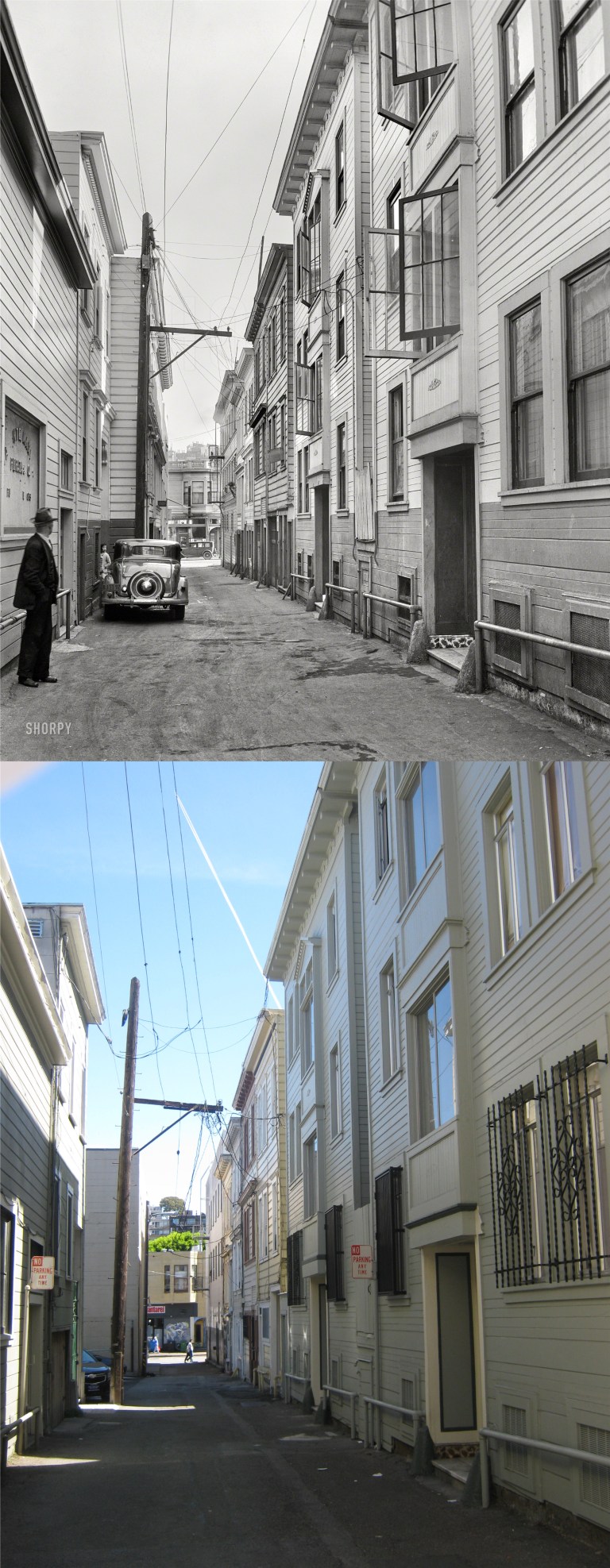 Ah, here’s someone in Card Alley in North Beach in 1936 that was able to find a little peace and quiet “far from the madding crowd”. (Shorpy.com)
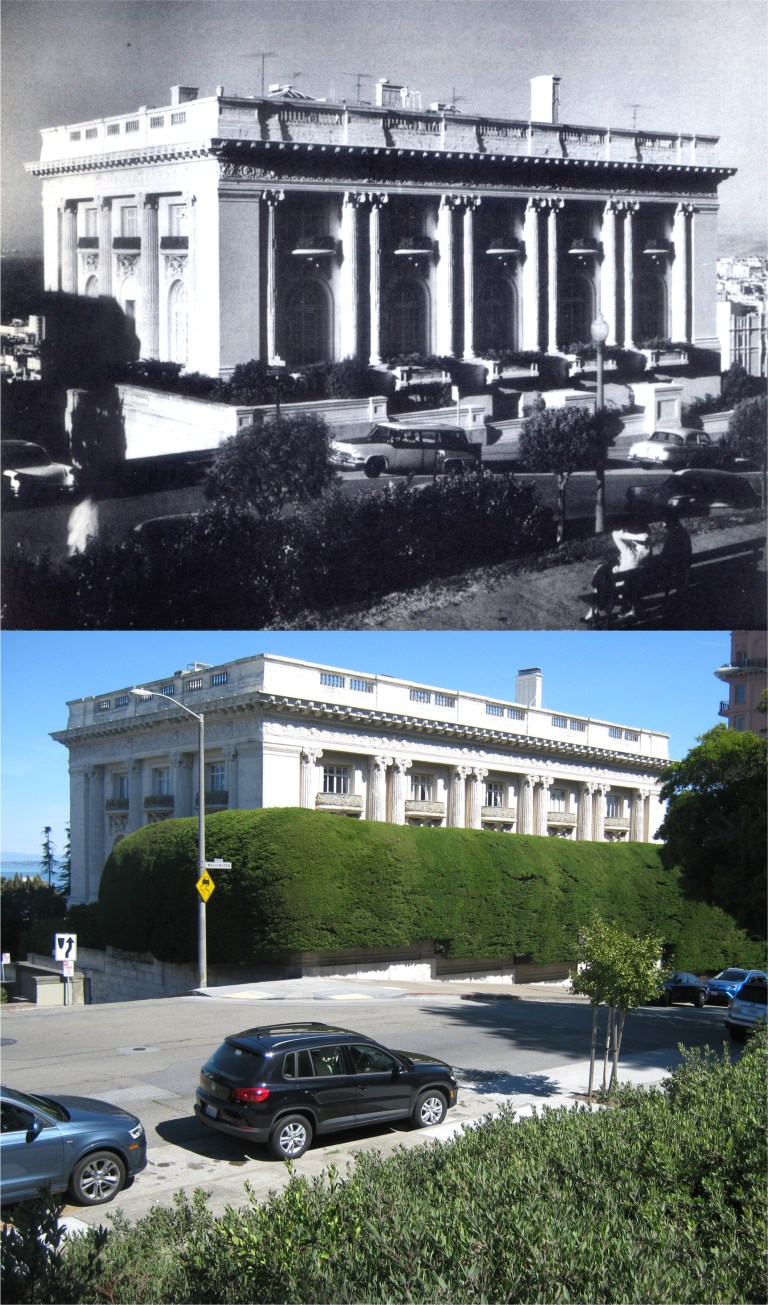 In Layette Park near Pacific Heights you can still sit in a quiet area to enjoy quality thinking time, such as, “Why can’t I live in a house like the Adolph Spreckel’s Mansion there?”
 Strawberry Hill at Stow Lake in Golden Gate Park is a peaceful place to meditate while walking through the woods; unless you’re Andre Moreau, played by Stewart Granger, being chased by the horsemen of Marquis de Maynes, played by Mel Ferrer in the movie ‘Scaramouche’ from 1952.
 The soldiers chase Moreau along Stow Lake to the Rustic Bridge.
 Moreau hides under the Rustic Bridge as de Maynes’ riders pass over.
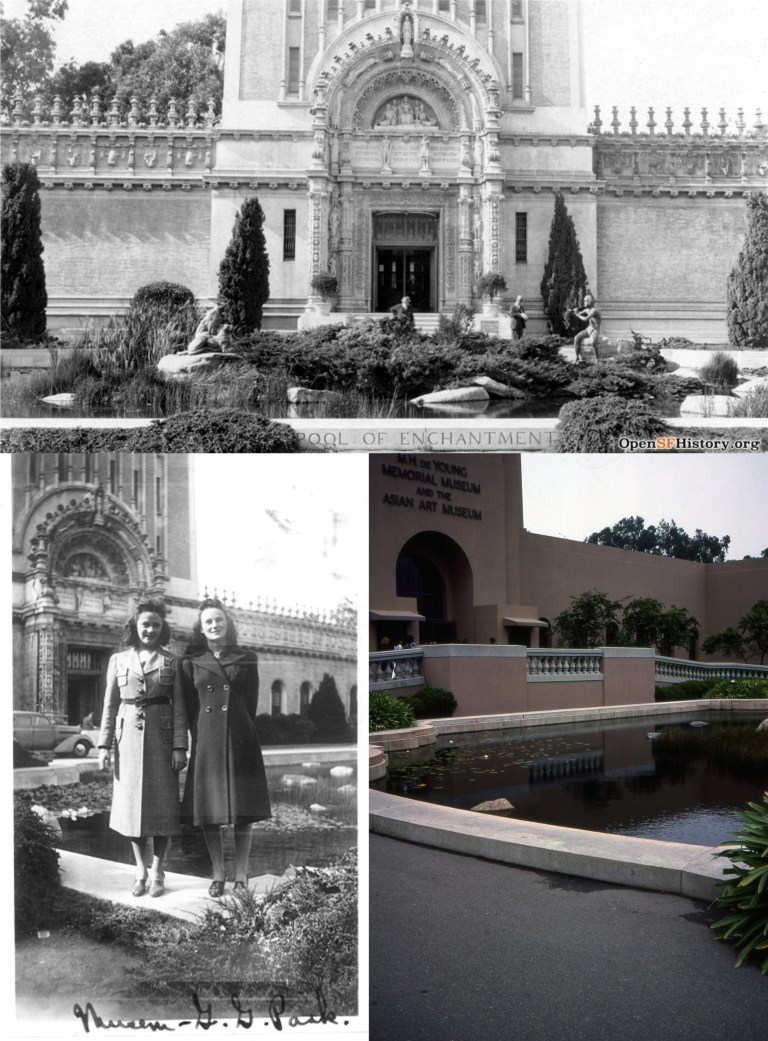 Also in Golden Gate Park is the Pool of Enchantment, originally located in front of the old de Young Museum. This picture is more a then and then. The top photo is an OpenSFHistory.org picture of the pool in the 1920’s. In the lower left is my 17 year old mom on the right standing with her cousin Frances at the pool in 1939. She looks older than 17 here, I wonder how often she was carded! In 1984 I wanted to find the spot where they were standing and took the picture at the lower right. The old museum was closed and demolished after the Loma Prieta Earthquake of 1989 and the Pool of Enchantment has been moved to the side of the new de Young Museum.
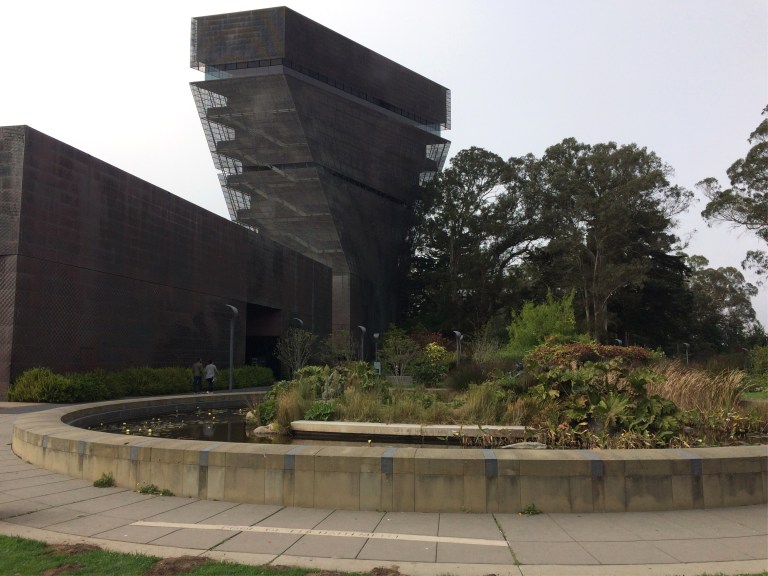 The Pool of Enchantment today:
 The Palace of Fine Arts is as peaceful and pretty of a place to relax or pose today as it was in the top photo from 1963. (The Cushman Collection)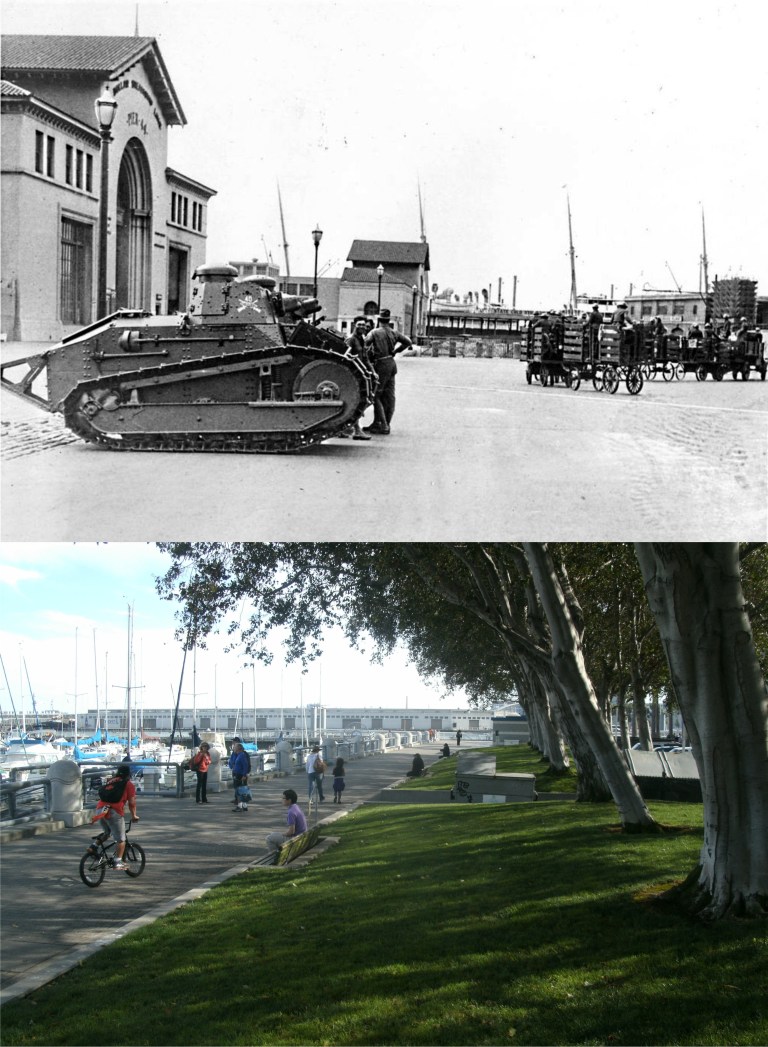
 The top picture may not be as casual as it looks. These are army soldiers with tanks at the old Pier 44 brought out to put down the violent dock workers strike in 1934. Pier 44 was at the southern end of the Embarcadero and was demolished in the 1980’s. The South Beach Marina next to AT&T Park is there now. It’s a quiet place to sit and dream about that yacht you’re going to own someday, except when the Giants are playing next door. The lower photo from the San Francisco History Center is Pier 44 in the late 1930’s.
 The old Presidio Army Hospital in 1860 in the top photo and when it was converted to a military museum in the lower picture, both from the Golden Gate National Recreation Association:
 The museum closed in the 1990’s and the building is now empty.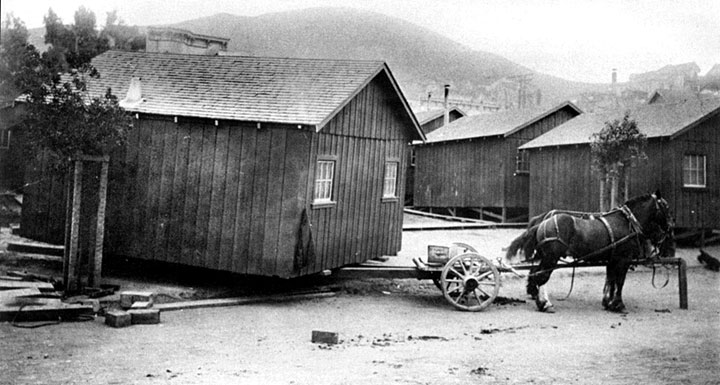
 Just behind the empty army hospital building are two earthquake shacks built for homeless or displaced San Franciscans after the 1906 Earthquake and Fire. Most of these homes were established for refugees right here in the Presidio. My two pictures are of the front and back of the houses. The top photo is from Foundsf.com.
 Fifth and Market Street in early January, 1945: They were probably returning all of those unwanted Christmas gifts, like that ugly sweater with the hearts on it from grandma. (SFGate San Francisco Chronicle images)
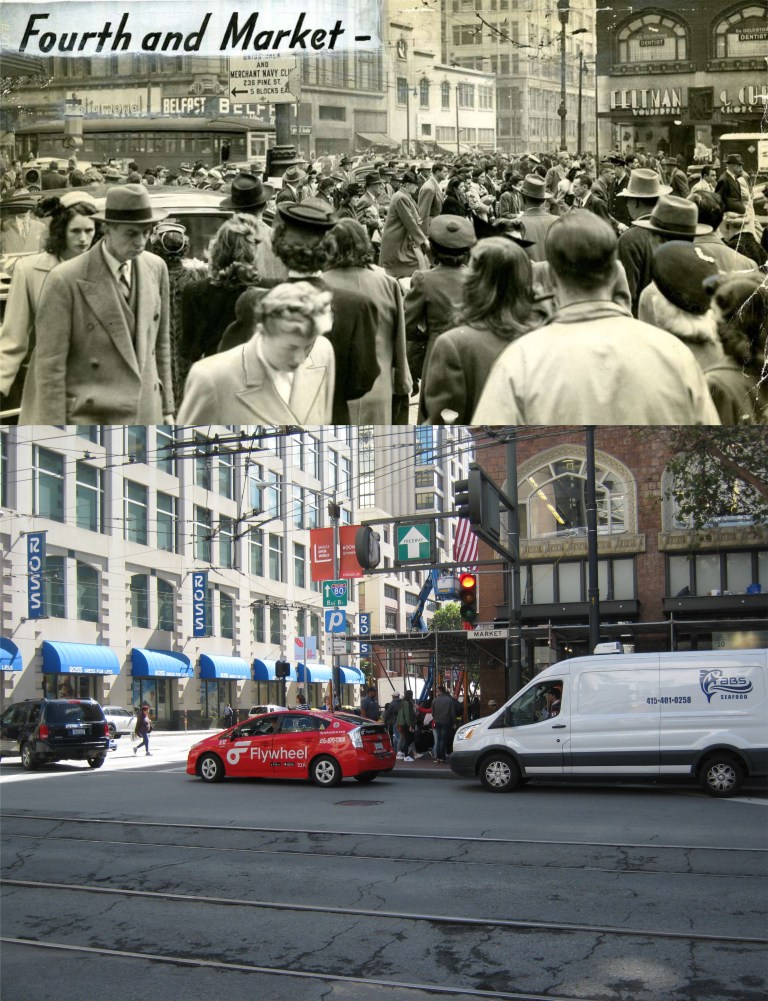 Hmmm, this must be Fourth and Market! Actually, the curved windows of the old Pacific Building on the right, built in 1907, would give it away, anyway. The vintage picture was taken on Christmas Eve, 1945. The girl on the far left doesn’t look like she’s in a very festive mood. (SFGate San Francisco Chronicle images)
 Looking east on Market Street from Fourth in April of 1960: The old State Theater on the right was getting ready for a visit from St. Francis, the patron saint of San Francisco. That must have been a special show! (OpenSFHistory.org)
 Looking west on Ellis Street between Powell and Stockton in the 1940’s: The historic John’s Grill is on the left in both photos. Opened in 1908 at this spot, the restaurant will be forever connected to Sam Spade and the Maltese Falcon because of a line from Dashiell Hammett’s book.
 Sutter Street looking west from Powell in the 1940’s:
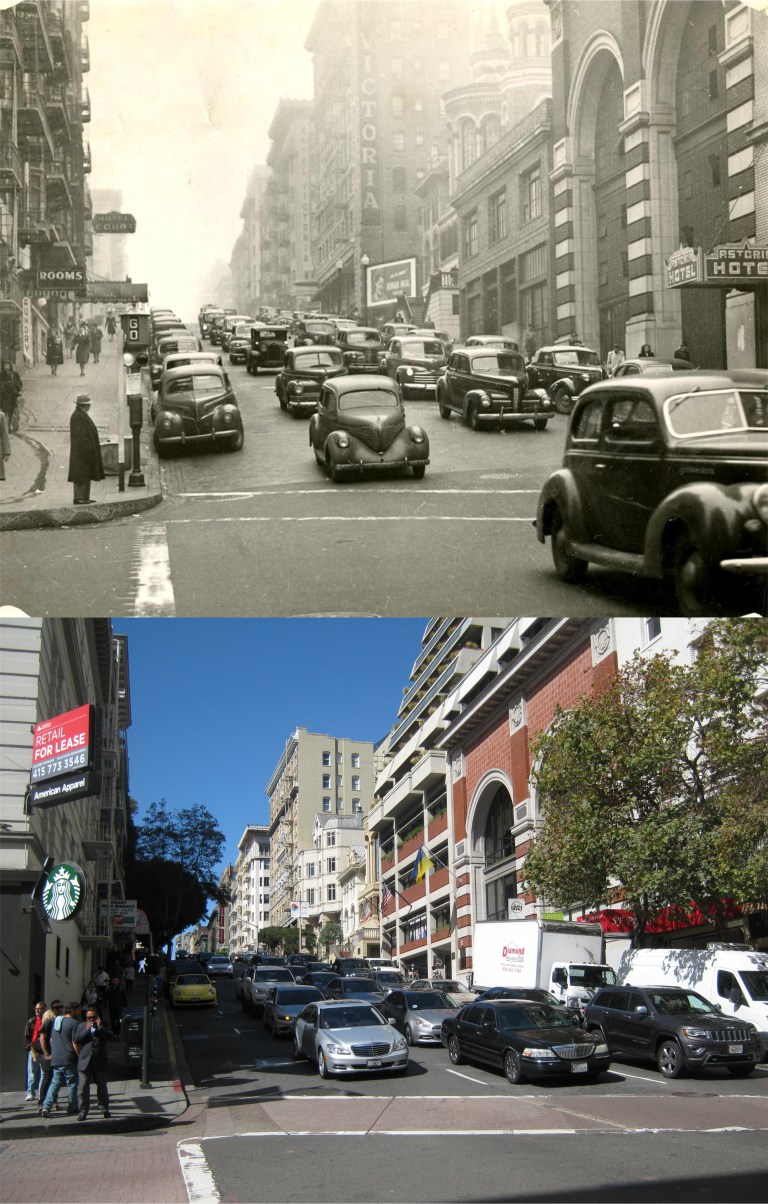 Bush Street at Grant Avenue as it crosses over the Stockton Tunnel in the 1940’s: This spot is mentioned in the ‘Maltese Falcon’ as well.
 A Parade on Montgomery Street just north of Sutter in April of 1960 welcoming Charles de Gaulle: “Viva la France!” (OpenSFHistory.org)
 Kearny and Market Streets, 1910:
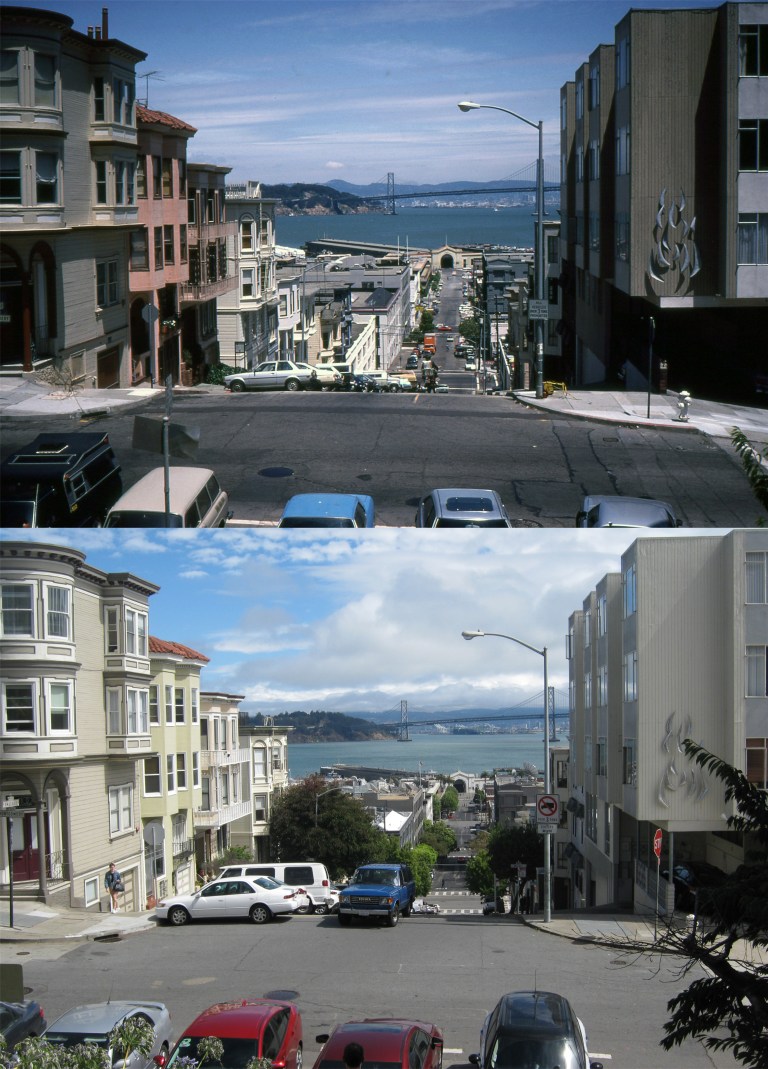 We’ll start at Vallejo and Montgomery Streets looking east. I’m trying to figure out what that giant grasshopper with wheels looking thing was next to the ALL VEHICLES OVER 3 TONS PROHIBITED sign on the right in my old picture.
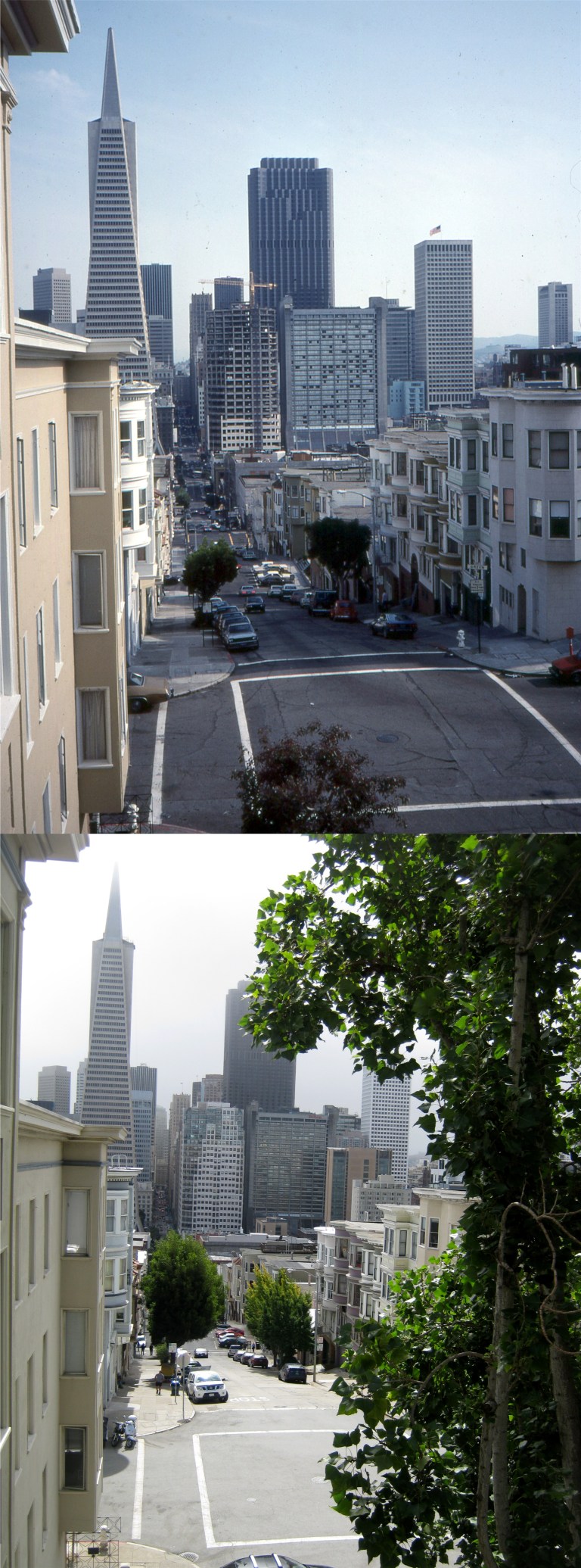 Now, here’s an interesting development. When I took the top picture looking south down Montgomery Street from Telegraph Hill in 1983 the camera was leaning slightly to the left. When I took the update in the bottom picture yesterday, I’m leaning a little to the right. However, I don’t think that this has anything to do with my political viewpoints.
 Calhoun Terrace looking east, one of those special views that a lot of people don’t know about: This was back when they painted the piers mellow yellow and baby blue. Down on the Embarcadero where that round see-through sculpture is located is where the Exploratorium is now. The Embarcadero still had a lot of that look of sea going-far away places and intrigue about it back then. Let’s get a little higher up now; we’ll take a trip to the top of Coit Tower.
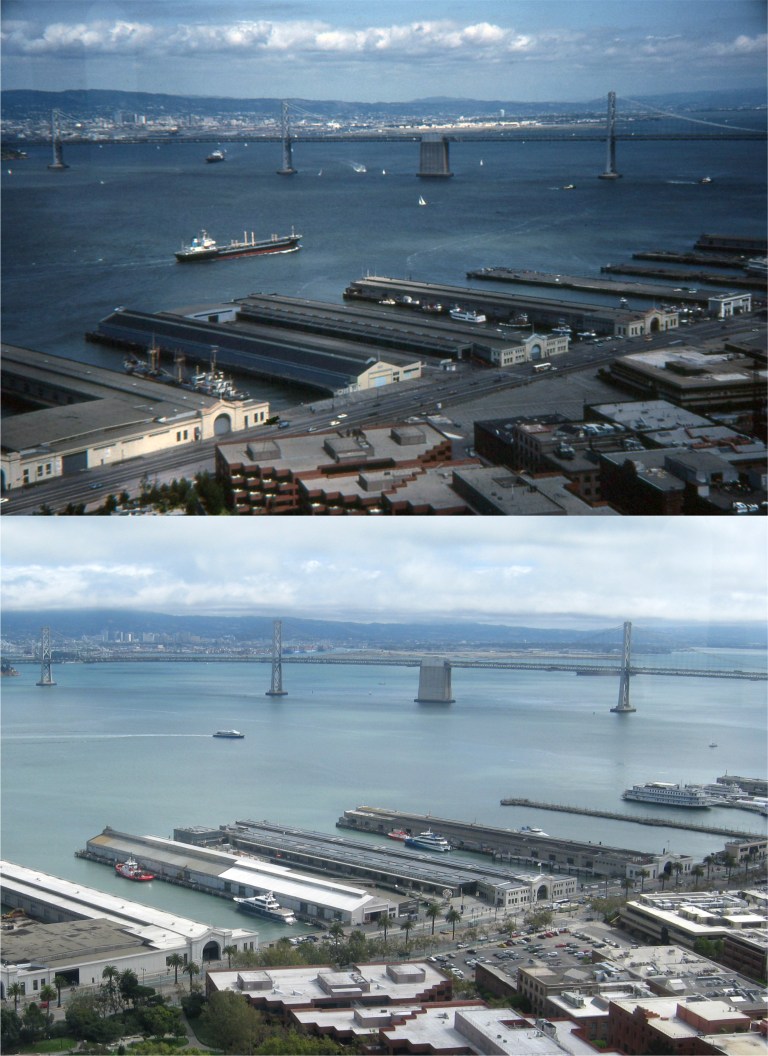 A 1983 view of the Embarcadero and the Bay Bridge: A tanker ship was sailing into the Bay, possibly from some far away location like Sumatra or Bora Bora, or even a more exotic place like Los Angeles!
 Zooming in closer to the city shows very little noticeable change in 34 years other than the removal of the Embarcadero Freeway.
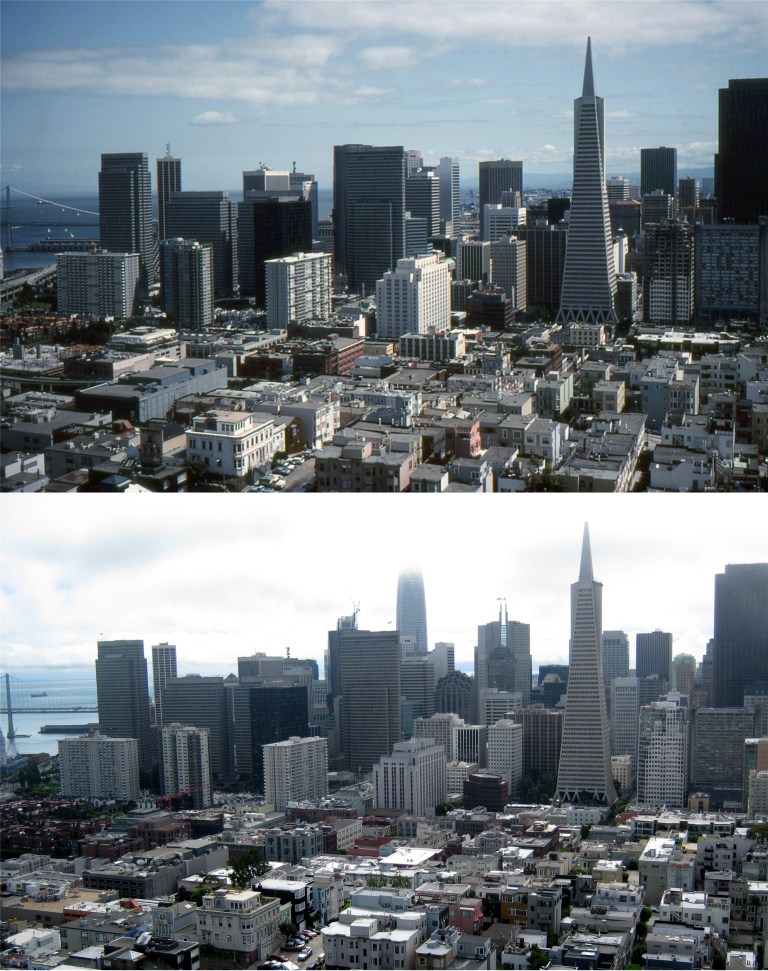 Easily the best view of Downtown San Francisco then or now is from this side of Coit Tower. The story goes here that when the skyscraper boom in San Francisco during the 1960’s was underway the developers wanted to continue as far north as possible. The residents of Telegraph Hill did not want their view of the Bay, the waterfront, the Bay Bridge or the Ferry Building to be blocked. They petitioned City Hall and got the northward skyscraper development stopped. I think the city of San Francisco owes them a debt of gratitude. Now the only thing that will block the views of San Francisco from Telegraph Hill is the fog, like it was trying to do yesterday.
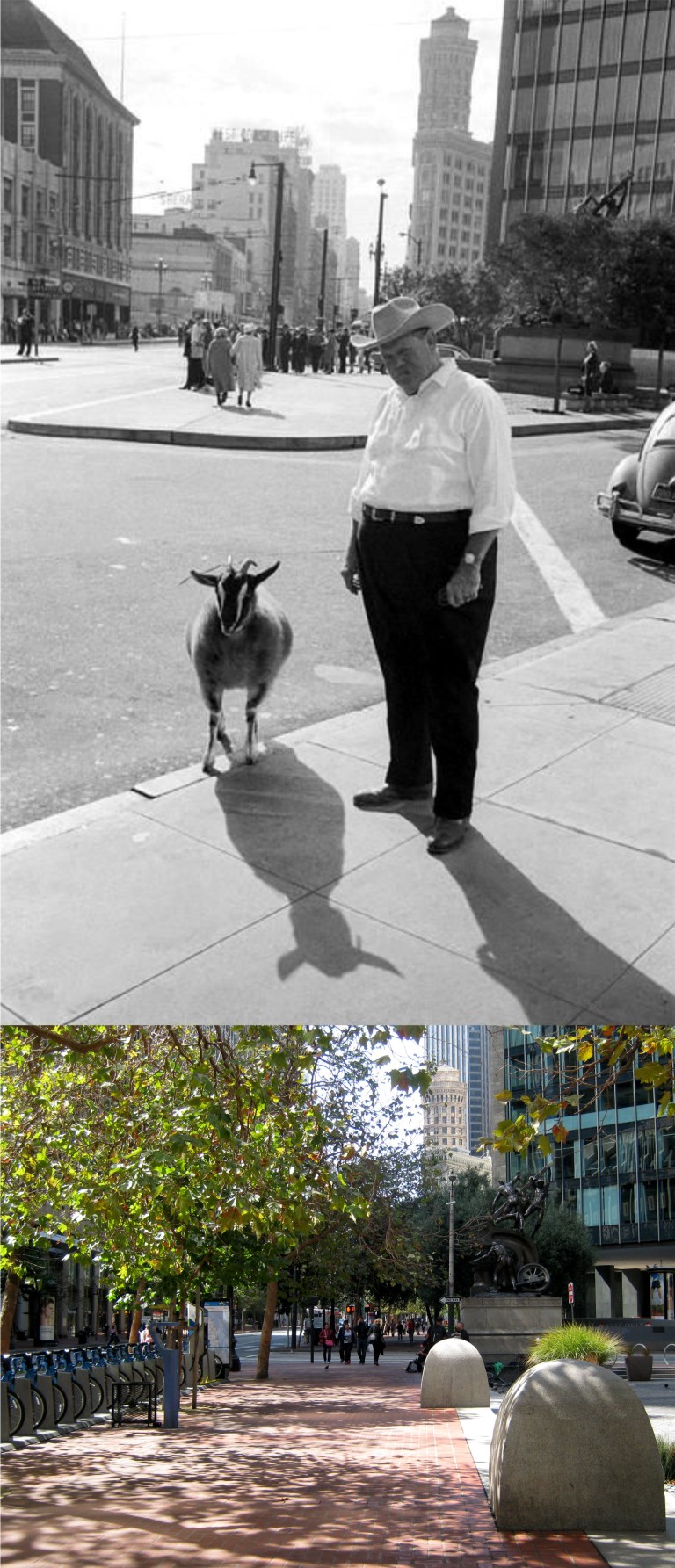 1960, where Bush Street used to cut into Market Street:
 Kids in 1947 on Kearny Street just up from Broadway: The photographer isn’t identified in the vintage picture posted on Pinterest, but it looks a Fred Lyon photo to me, as he was great at getting pictures like this.
 The old Fire Station #15 on California Street near Laguna: There’s still a fire station at this same spot only now it’s Fire Station #38, and as much as I love horses, they get to the problem a lot quicker now.
 Fisherman’s Wharf Boat Lagoon in June of 1987: One of these days they’ll invent a kid that doesn’t stick his or her tongue out when having their picture taken. That little tyke that’s on my left shoulder in the 1987 photo is the same grown up tyke on my right shoulder in the current picture.
 A 1970’s dude playing with his dogs on Ocean Beach: The bottom photo is my dog, Danny, on Ocean Beach in May of 2011. Danny was over twelve years old when I took this picture, but he ran along the beach like when he was a puppy, and he was still quite a “chick magnet” too!
 One of my slides at the foot of the Hyde Street Pier in 1985: I don’t know whose waif that was, but I vaguely remember that I thought it was pretty cool the way she was sitting up on that post just like Huckleberry Finn or something, so I took the picture.
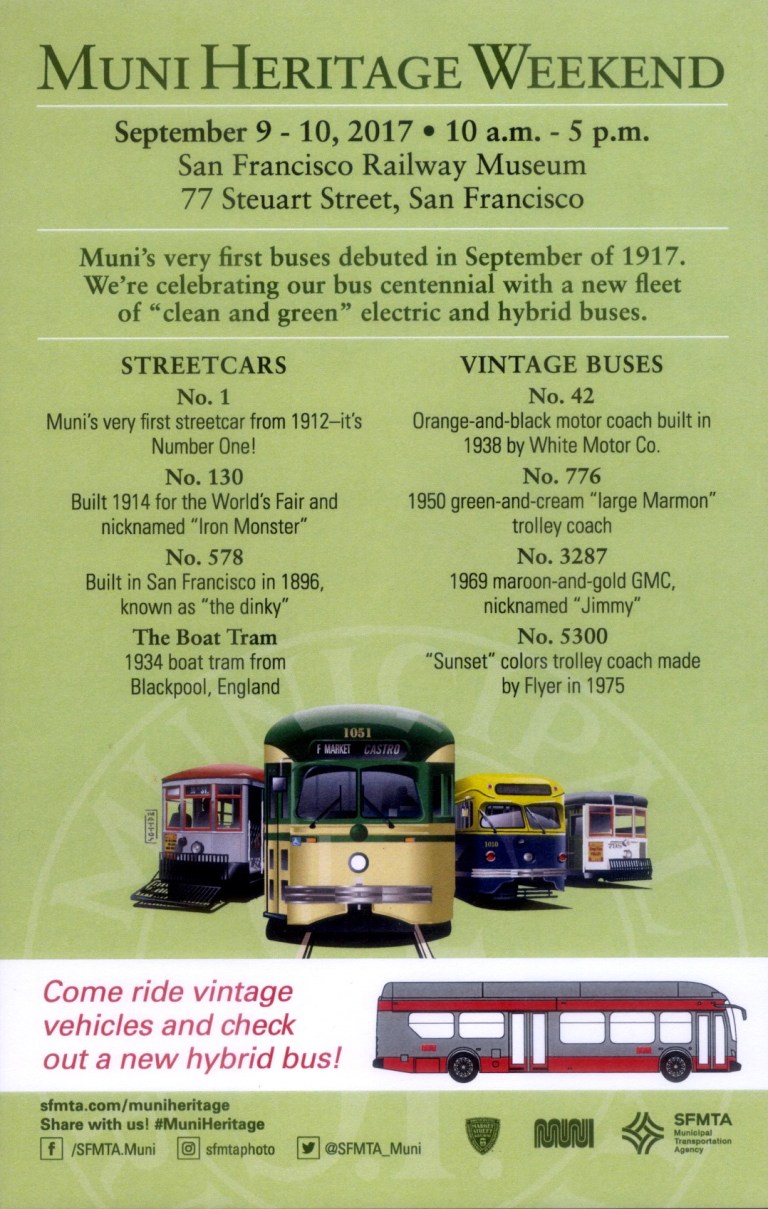 I got a chance to check out the second day of the Muni Heritage Weekend Festival today. Muni and the Market Street Railway brought out all of the old stuff to ride on, some of them for free. $2.75 was all it cost for unlimited riding on most of them with a transfer as they traveled from AT&T Park to Fisherman’s Wharf, to North Beach, and along Market Street.
 This clunker (not me) was a 1956 job and they got a lot older.
 The highlight for me was riding the #42 cable car from the Ferry Building to Van Ness Avenue and back. Built in 1906, it’s the oldest cable car in the world. It ran along the old O’Farrell-Jones Line that closed in 1954.
 We headed up California Street past Chinatown and when we got to the top of Nob Hill there was police activity everywhere!
 We rolled over Nob Hill to Van Ness and then headed back toward the dragnet. I didn’t like the way that guy on the left in the bottom picture was looking at me.
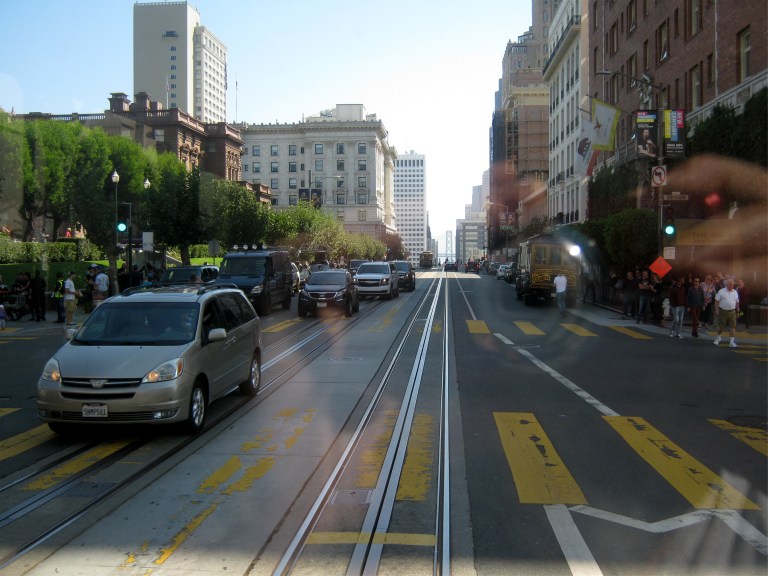 Turned out, they were filming a scene for a new Ant-Man movie coming out in July, 2018. I always get him mixed up with Atom Ant!
 Back to the Muni Festival: That thing on the right in the top picture is called a “Dinky”. They were combination cable car-streetcars that used to run along Market Street. The conductor in the bottom photo told me that this one built in 1896 is probably the oldest running streetcar in America. He wasn’t as grouchy as he looked, he was just doing that for my benefit.
 Naturally, everyone wanted to ride the 1934 Boat Tram from Blackpool, England, but I was more impressed with the orange and black Motor Coach built in 1938.
 Van Ness Avenue between Broadway and Vallejo in the 1920’s: The house on the far right is still there. (Vintage Showcase)
 In November of 1926 a gun battle between police and Joe Tanko, a gangster and murderer, took place on McAllister near Alamo Square that rivaled and predated the gangster gun battles of John Dillinger and Bonnie and Clyde. Police stormed the house just behind where the girls are standing in my photo and shot Tanko, the most wanted man in San Francisco at the time, to death. The bullets fired into him were at such close range it was reported that his clothes caught fire from the shells. The vintage photo was taken just after the gun battle.
 A Shorpy Collection photo taken at 11th and Mission Street in the 1920’s: The building is still there and they’re still selling tires!
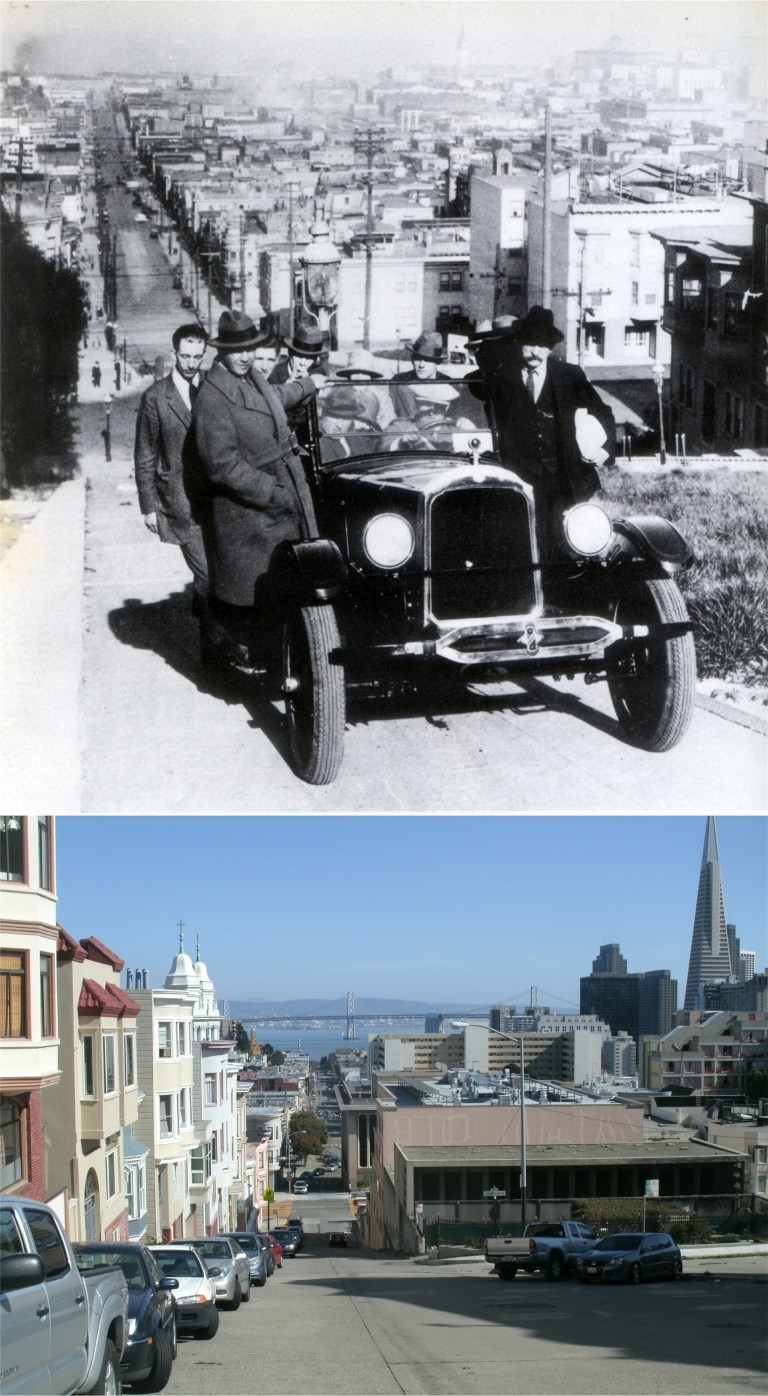 Joyriding where Broadway begins to climb Russian Hill in the 1920’s: You can just make out the Ferry Building in the background of the vintage picture. They’re near where the eastern entrance to the Broadway Tunnel is today.
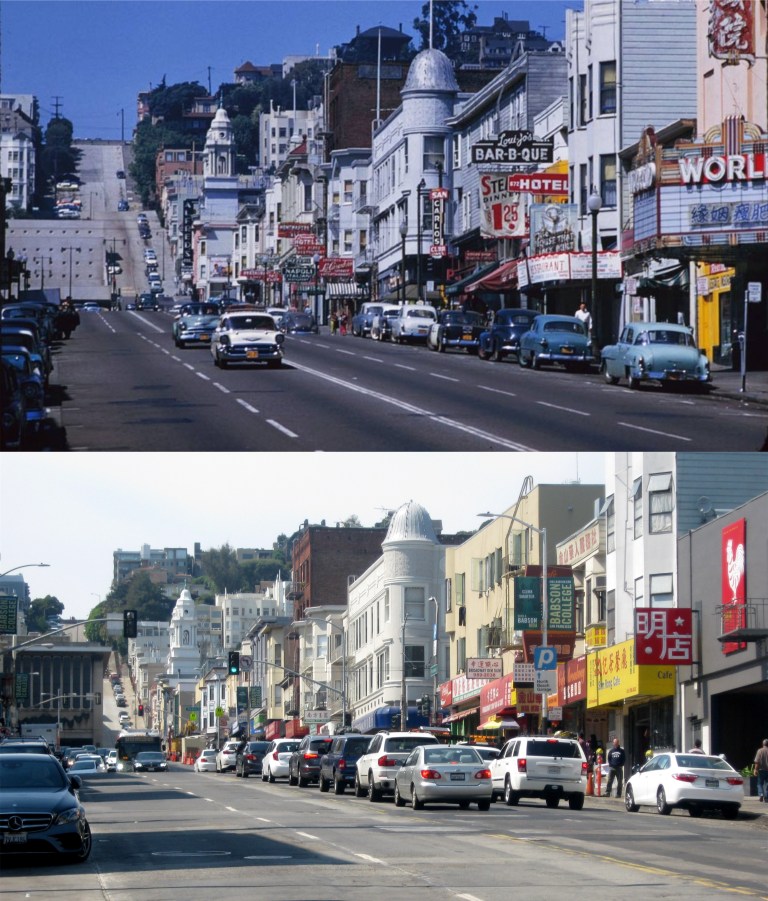 A Cushman Collection photo from the University of Indiana taken in the 1950’s is looking from the opposite view of Broadway than from the previous pictures. Many of the buildings are still there. The movie theater on the right was where the building with the white rooster is today.
 Another Shorpy photo taken at Larkin and Chestnut Streets during the 1920’s: That’s the clock tower of Ghirardelli Square built in 1911 in the background. This spot has a movie claim to fame as part of the famous chase scene from the 1968 film ‘Bullitt’. That’s Steve McQueen’s reflection in the rear view mirror of his Mustang as he chases the bad guys in the black Charger down Larkin Street.
 1983: We’ll start at Steuart and Market Streets looking west before all the street vendors came. Behind and above me would have been the Embarcadero Freeway.
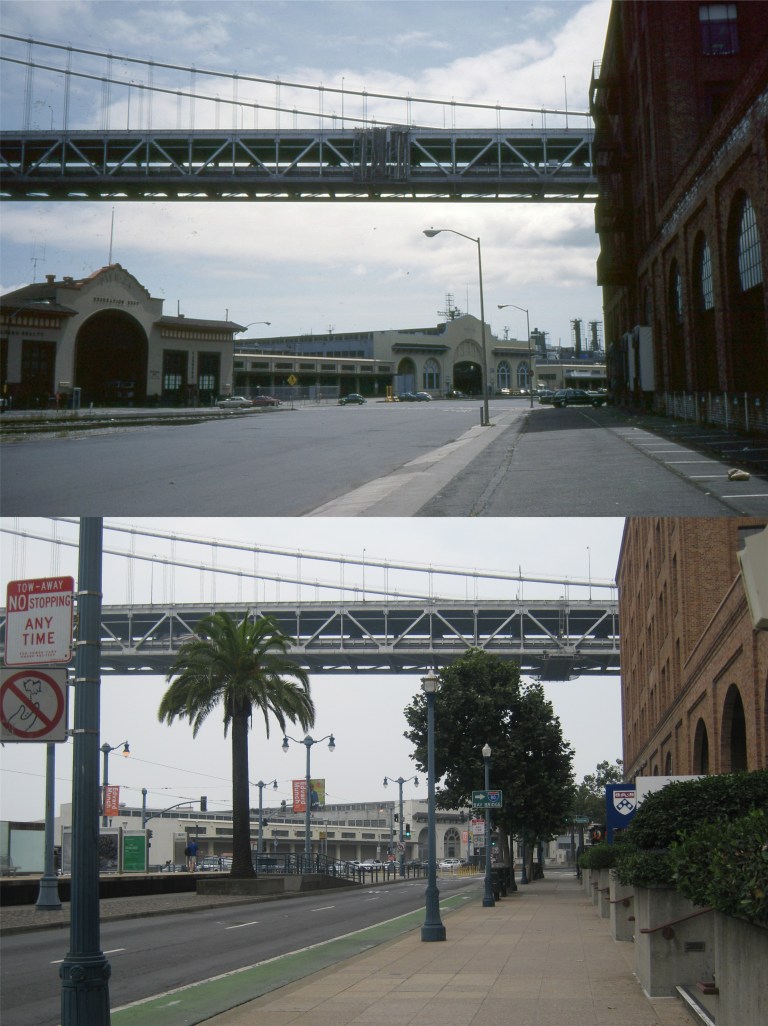 1983: The Embarcadero near Harrison Street. That’s the old Hills Brothers Coffee Factory on the right. Pier 24 on the left has been demolished.
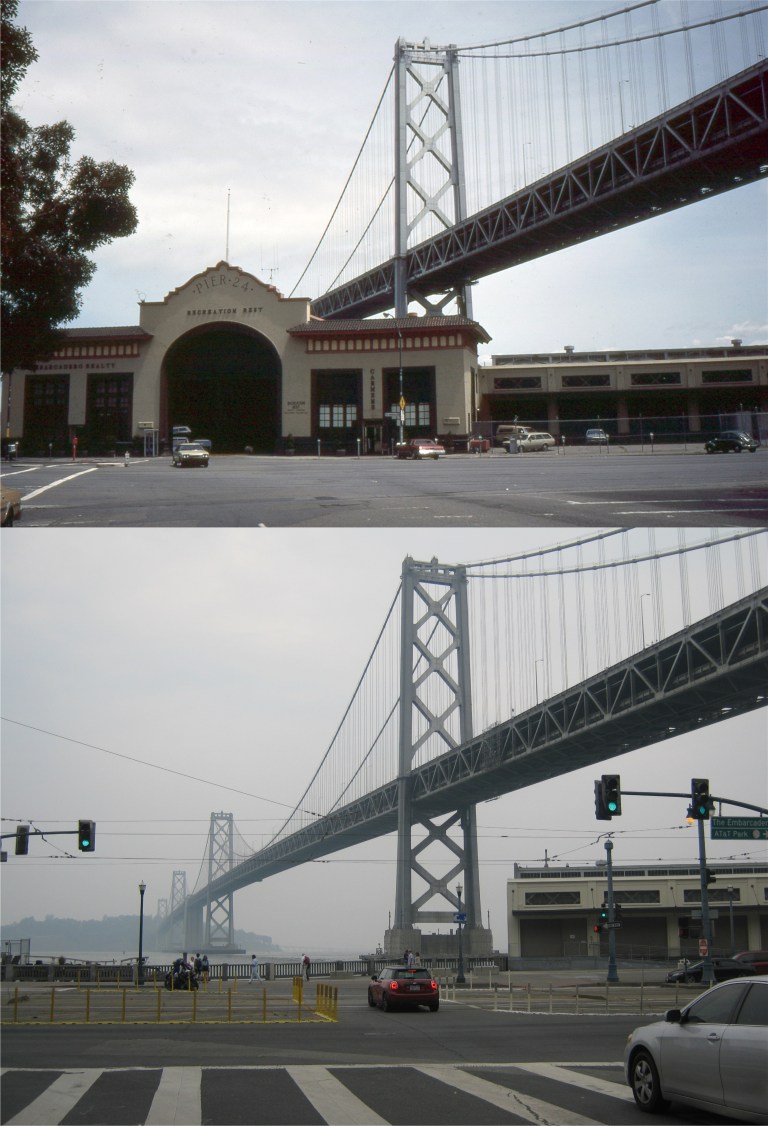 Let’s take a closer look at where Pier 24 was. What a perfect location this would have been when the pier was still there for a San Francisco film noir scene; Classy Gene Tierney drives out of Pier 24 in a 1947 Buick. She’s being followed by Dana Andrews who doesn’t know that he’s being followed by John Garfield who himself is being closely watched by Peter Lorre. Meanwhile, Lana Turner has hired Robert Mitchum to follow all four of them! Ah, it would have been a great movie.
 1983: The Embarcadero south of the Ferry Building. The old YMCA Building with the pointed roof, the Embarcadero Freeway, and the Ferry Building are in the center. The YMCA Building and the Ferry Building can still be seen from here today. Look close at the billboard on the left in the older picture. Like Cola was as a caffeine free cola marketed by 7Up in 1982. The cola didn’t catch on and it eventually flopped. After that, the word Like hired itself out to Facebook and made a fortune.
 1983: Stockton Street from above the Stockton Tunnel looking north. On the opposite side, looking south from the roof of this tunnel, was where Sam Spade in the book The Maltese Falcon “looked down into Stockton Street. An automobile popped out of the tunnel beneath him with a roaring swish, as if it had been blown out, and ran away.” I wonder if Sam Spade ever looked down on Stockton Street from this side.
 1983: Powell Street just up from Sutter Street: In 1982 all cable cars in the entire system were shut down for repairs until 1984. It’s hard to imagine San Francisco without cable cars, and it seemed at the time to last almost as long as it took the San Francisco Giants to win a World Series!
 The top picture is described as being of Gertrude Atherton in front of her San Francisco home. It probably isn’t the famous Atherton Mansion on California Street that she lived in until 1923 when it was then remodeled because the photo looks like it was taken close to the end of her run in 1948 long after she left there. The Atherton Mansion in the bottom picture is reputed to be haunted by a number of ghosts. Of course, there isn’t a house in San Francisco looking like this one that isn’t haunted. It simply isn’t allowed! Hmm, it didn’t look haunted to me!
 The book is autographed “To My San Franciscan” from who looks like someone named “Ann”. Don’t imagine I’ll ever know who they were.
 The vintage pictures are fun to look at and one of them cost me money! This one is looking down California Street from near Stockton with the Trafalgar Building, seen in Bob Hope’s 1948 movie ‘My Favorite Brunette’ on the right. It must have been a hotel once.
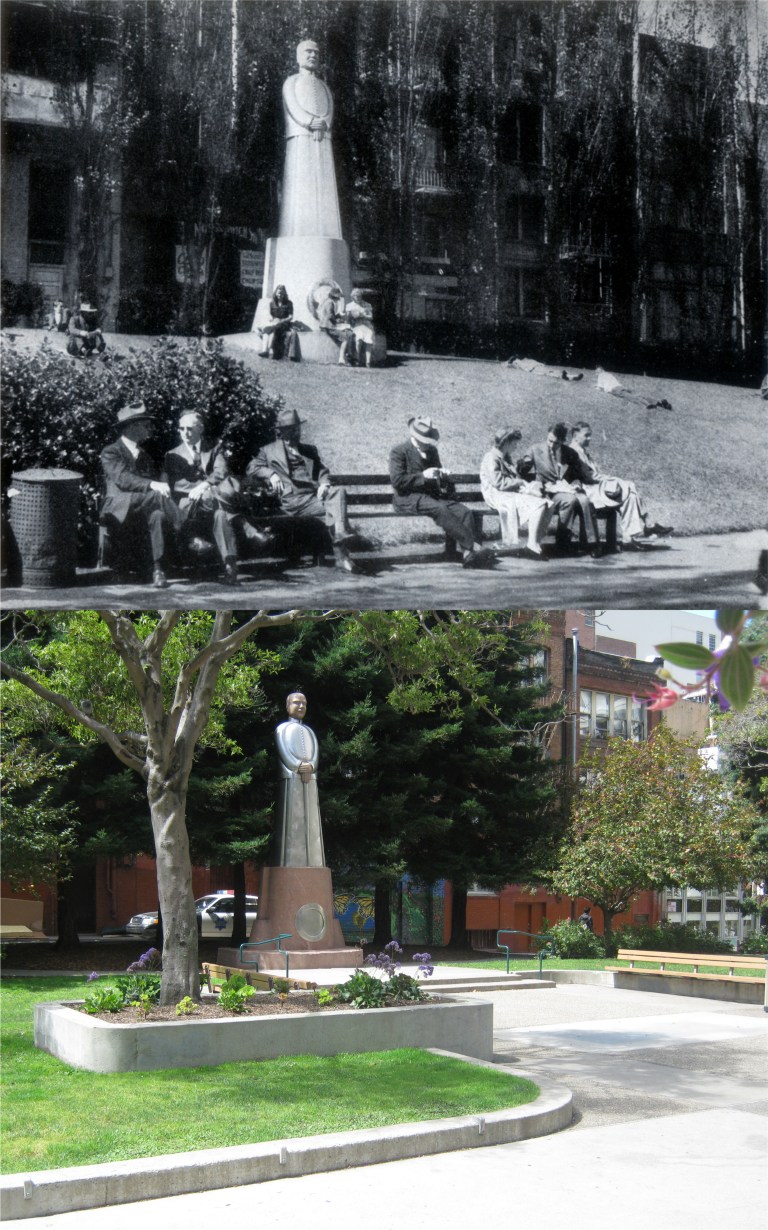 Sun Yat-sen sat on a hill. No, that’s not a proverb; Beniamino Bufano’s statue of Sun Yat-sen at St. Mary’s Square in Chinatown was once on a hill.
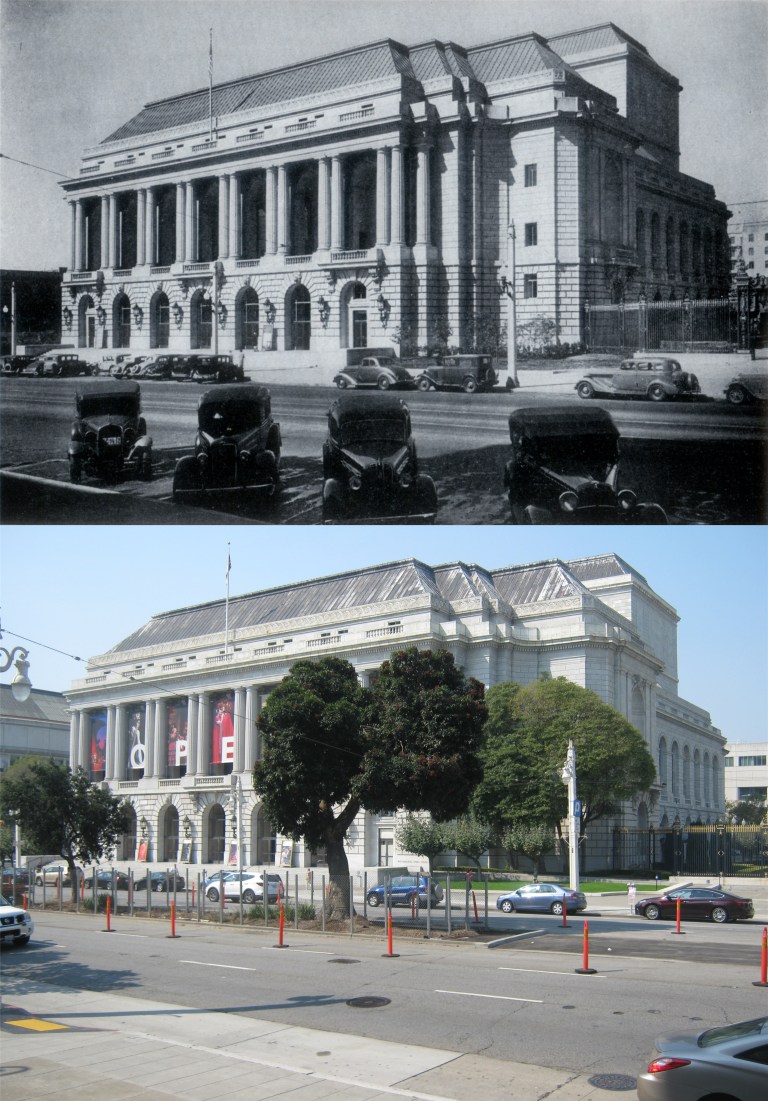 The old Opera House on Van Ness in what looks like the mid 1930’s. “Kill the wabbit! Kill the wabbit!” Who from my generation didn’t learn about the opera from Bugs Bunny and Elmer Fudd in ‘What’s Opera, Doc?’
 Of course it has the obligatory view of the Great Highway from Sutro Heights, also from the 1930’s. I’ll bet I’ve been to Ocean Beach hundreds of times, but I’ve never seen it that crowded, although, it may have been yesterday! I didn’t make it out there.
 The book has a photo from the Top of the Mark when dinner jackets were required and you didn’t go there unless you were dressed up. There was always an air of sophistication by most of the visitors. Obviously, the rules have relaxed a little up there today.
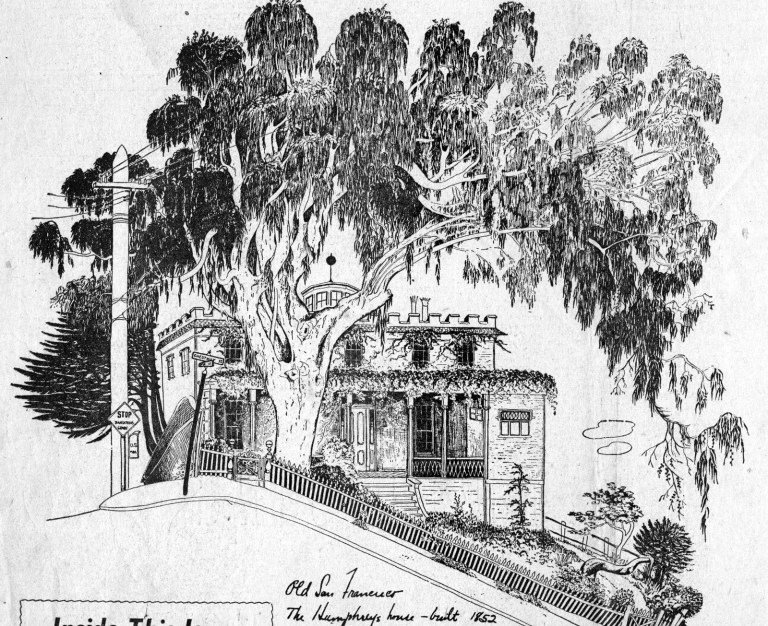 On page 128 of the book was a picture of something called the Giffen-Humphrey House of which I had never heard of. The picture is courtesy of Frank Giffen. While reading into the book I learned from Gertrude Atherton about an authoress named Mary Collins who wrote a murder mystery called ‘Sister of Cain’. Mrs. Atherton writes of the house and Mary Collins, “The scene of action of Sister of Cain is that weird old Humphrey-Giffen house on Chestnut Street and the sinister atmosphere she caught in such perfection that the book drove many readers to loiter past it and enjoy a renewal of those shudders beloved by the mystery fans.” That hooked me, and I knew I was going to be loitering past it soon myself once I found out where on Chestnut Street it was located at. A Kirkus Review of the book on the internet reads, “One of the best mysteries I have read in many a moon.” The key figure of the book is Hilda Moreau who “has gone to be near her Navy husband’s sisters and bear his child. Almost at once she is drawn into the vortex of a morbid situation, as the eldest sister attempts to block the carrying out of a strange will by violent and cruel means. She is killed and her secret life comes to light. Sex crazed Sophie, alcoholic Elise, terrified Rose, all are in thrall; only Ann, a doctor, has in part escaped her sister. There’s another death, and another– and an attempt on Hilda’s life before the killer is found.” That was all I needed to plunk down $16.69 on the internet for a copy of the book that I’m waiting for to arrive. I’ll let you know how it is. However, I had a hard time finding where the Giffen-Humphrey House was located at on the internet until I found a story about it from a October, 2011 blog called Alizee by a gentleman named James Williams who writes that he lived in the house around the time that Gertrude Atherton’s book was written, and who may have even been the boy on the porch in the photo from her book. He writes that it was built in 1852, and was the oldest house in San Francisco at the time. The house sat on the northeast corner of Hyde and Chestnut Streets and, unfortunately, was demolished in spite of efforts to save it. Included above are my picture yesterday of where the house once stood and a drawing of the house from the 1940’s by Evelyn Curro. So, there’s my Giffen-Humphrey House story; I don’t usually write passages this long on my blog. I guess a prolific writer like Gertrude Atherton brought that out in me, but she would have written it much better.
 San Francisco Film Locations Then & Now