 In 2011, the University of California Press reprinted a 1940 guide to San Francisco written by the Federal Writers Project (WPA) of the Works Project Administration (WPA). The Works Progress Administration was the result of Executive Order 7034, Signed by Franklin D. Roosevelt in 1935 to create jobs for unemployed workers, artists, musicians, etc. during the Great Depression of the 1930s. A lot of the San Francisco we appreciate today, such as the murals inside Coit Tower and the Beach Chalet, and the exhibits at the San Francisco Zoo came about because of WPA. The ‘San Francisco in the 1930s’ WPA Guide has numerical descriptions that correspond with maps in the book. The points of interest listed take in just about all of San Francisco with occasional outdated descriptions that were new in 1940. These are a collection of some of the descriptions of places from the book, (in brackets) with vintage pictures I updated of each location taken close to the period when the book was written.
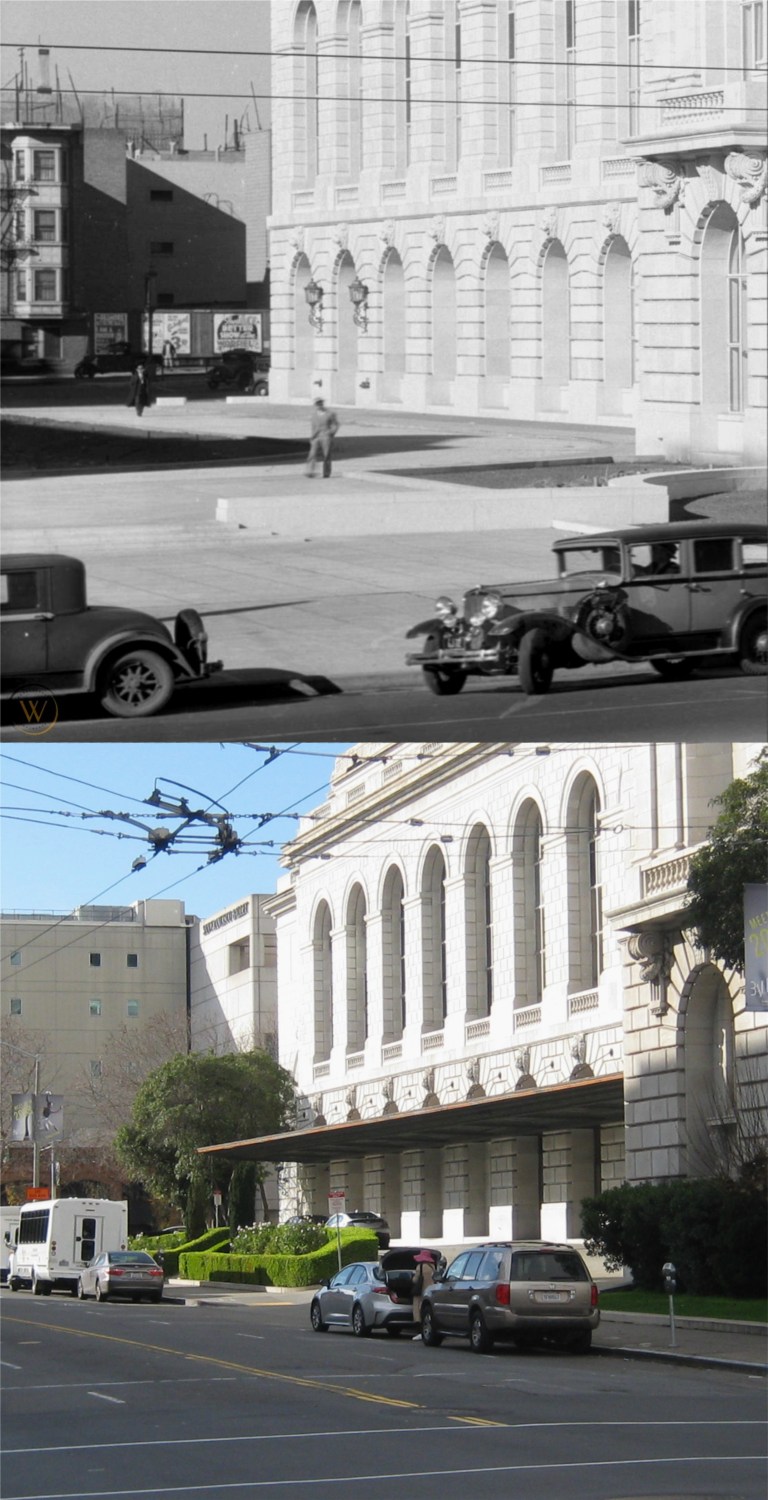 The south side of the Opera House on Van Ness with long gone buildings on Franklin Street in the background: (Vintage picture from worthpoint.com)
{The OPERA HOUSE (open weekdays 10 -4) NW corner Van Ness Ave. and Grove St., and the Veterans Building form the War Memorial of San Francisco, erected in 1932 as a tribute to the city’s war dead.}
{This, the Nations only municipally-owned opera house, represented the achievement of years of struggle by San Francisco music lovers for an opera house of their own. It was opened October 15, 1932 with Lily Pons singing Tosca. The auditorium, seating 3,285 persons, is richly decorated. The floor of the orchestra pit can be raised and lowered. The stage is 131 feet wide, 83 feet deep, and 120 feet from floor to roof.}
The dimensions of the stage area may have changed since 1940.
 The cable car turnaround at Powell and Market Streets:
{Traffic waits good naturedly at the CABLE CAR TURN-TABLE, Market, Powell, and Eddy Sts., where a careening southbound car comes to a halt every few minutes, while conductor and grip man dismount and push the car around until it faces north.}
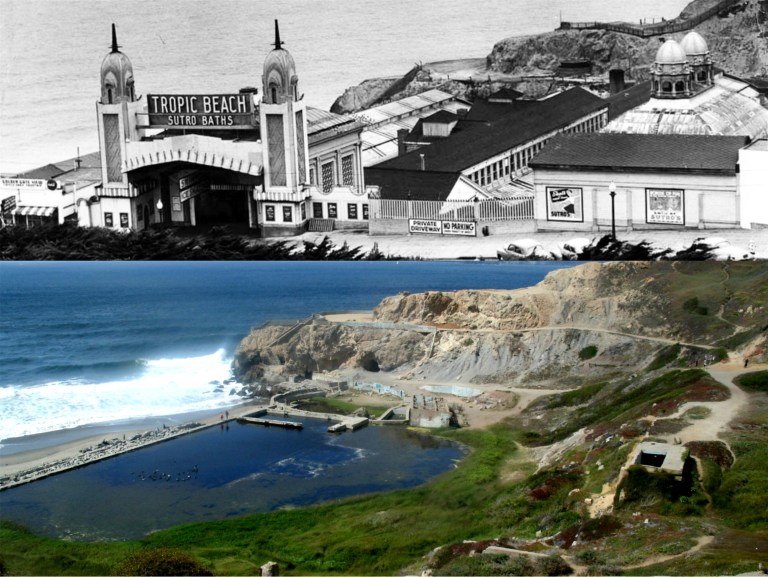 The old Sutro Bathhouse:
{The sprawling building of the SUTRO BATHS AND ICE RINK (open Mon.-Fri. 10 a.m. – 11 p.m.; Sat. , Sun., holidays 9 a. m. – 11 p. m.; skating 35 cents Sun. afternoon and every evening, 25 cents other times; skate rental 15 cents, swimming 50 cents) . Point Lobos Ave. near Great Highway, covering three acres of sloping beach in the lee of Point Lobos, were built in 1896 by Adolph Sutro. Long advertised as the world’s largest are the six indoor pools; of both fresh and salt water, these vary in size depth, and temperature. Also here, are a floodlighted ice rink and an indoor sand plot for sunbathing. It is said that 25,000 persons have visited “Sutro’s” in one day.}
Sutro Bathhouse burned down in 1966.
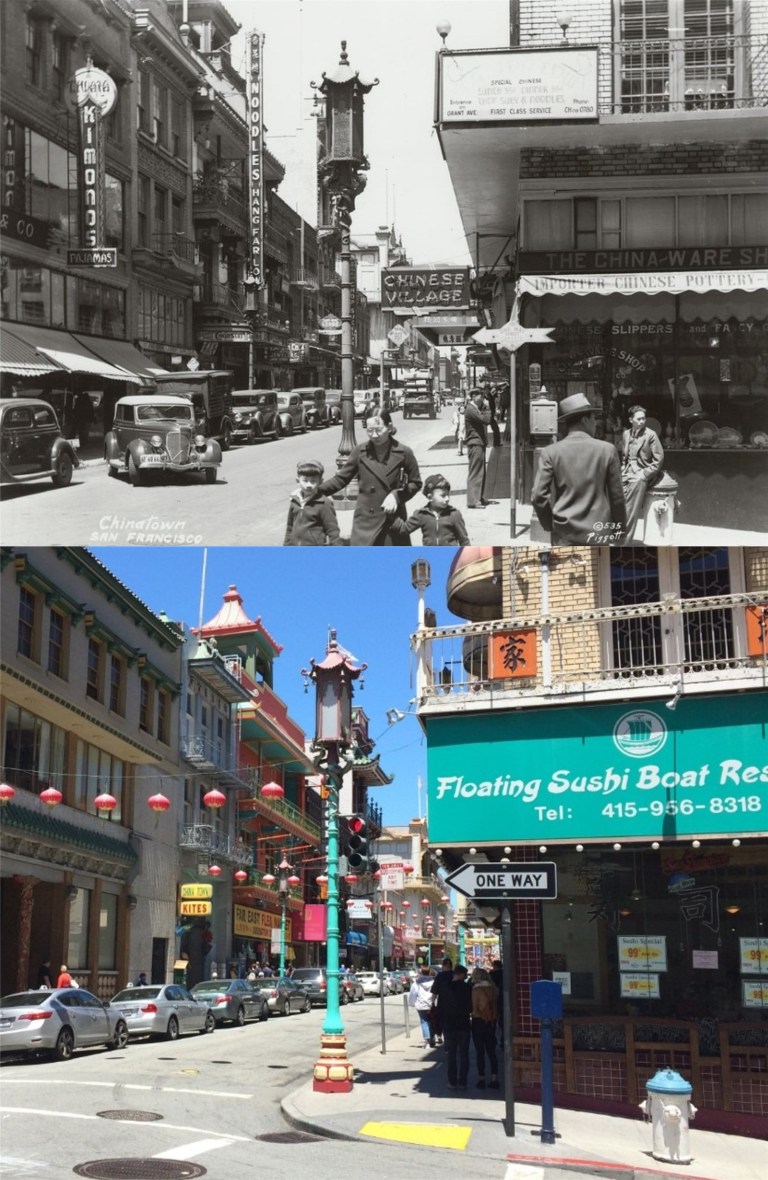 Grant Avenue looking north from Commercial Street:
{A quarter of old Canton, transplanted and transformed, neither quite oriental or wholly occidental, San Francisco’s Chinatown yields to the ways of the West while continuing to venerate a native civilization as ancient the Pyramids. Grant Avenue, its main thoroughfare, leads northward from Bush Street through a veritable city-within-a-city – alien in appearance to all the rest of San Francisco – hemmed within boundaries kept by tacit agreement with municipal authorities for almost a century.}
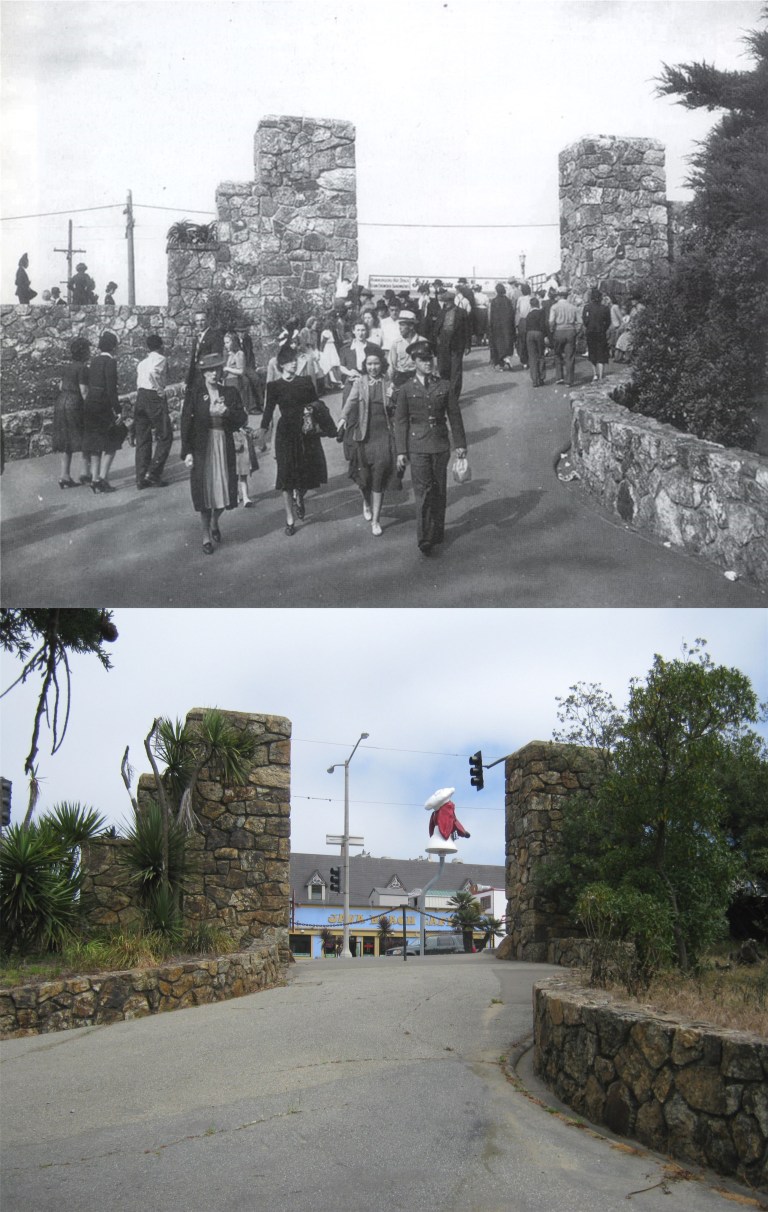 The old WPA built entrance to Fleishhacker Zoo on Sloat Ave.
{FLEISHHACKER PLAYFIELD AND ZOOLOGICAL GARDENS, foot of Great Highway at Sloat and Skyline Blvds. This recreation center dates from 1922, when the city acquired from the Spring Valley Water Company 60 acres on which to construct a playground and pool. Only 37 acres at first were developed; opened in 1924, the park was named for Herbert Fleishhacker , then president of the Park Commission, who donated the pool and the Mothers’ House. Adjoining the playground is the Zoo (open 10 – 4:30; free). Begun in 1929 with a few lion cubs and monkeys, gradually more animals were acquired (by purchase and donation) until the animal, bird and reptile population reached 1,000. Noted is the fine collection of “cats” which includes lions, tigers, leopards, lynxes, and panthers. In 1935 sixty-eight acres adjoining the zoo were purchased and here WPA labor constructed the fine ZOOLOGICAL GARDENS, modeled after Germany’s famous Hagenbeck Zoo. Here, among man-made streams, waterfalls, islands, cliffs and caves, are simulated natural habitats of many animals – separated (where practical) from spectators only by moats and designed to give the animals the illusion of freedom}
The vintage picture is the opening day of the WPA built entrance to the zoo in 1937. I was able to get some pictures there before they boarded it up. (Vintage picture from Images of America)
 One of the pictures I was able to get at the old stone entrance to the zoo on Sloat Blvd before they closed it off was the spot where my 17 year old mother on the left with her cousin Frances sat during a visit to San Francisco from North Dakota in 1939.
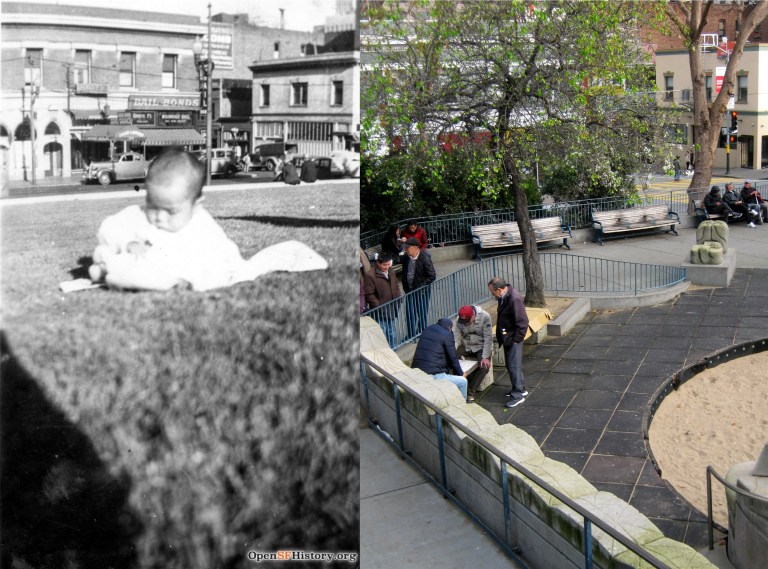 The southeast corner of Portsmouth Square:
{Upon the green, sloping lawns of PORTSMOUTH PLAZA, Kearny, Clay and Washington Streets, Candelario Miramontes, who resided at the Presidio, raised potatoes in the early 1830’s. When the plot became a plaza is not known.}
{Most of the stirring events from the 1840’s to the 1860’s took place here – processions, flag raisings, lynchings, May Day fetes.}
{Here terrified Chinese ran about beating gongs to scare of the fire demons during the earthquake and conflagration of 1906; here came exhausted firefighter to rest among milling refugees; here shallow graves held the dead; and thousands camped during reconstruction. The Board of Supervisors, in December of 1927, restored the square’s Spanish designation of “plaza”.}
Well, maybe so, but I read real San Franciscans prefer Portsmouth Square to Portsmouth Plaza, so that’s what I refer to it as. The buildings behind the vintage picture of the square taken in 1937 are still there today. (opensfhistory.org)
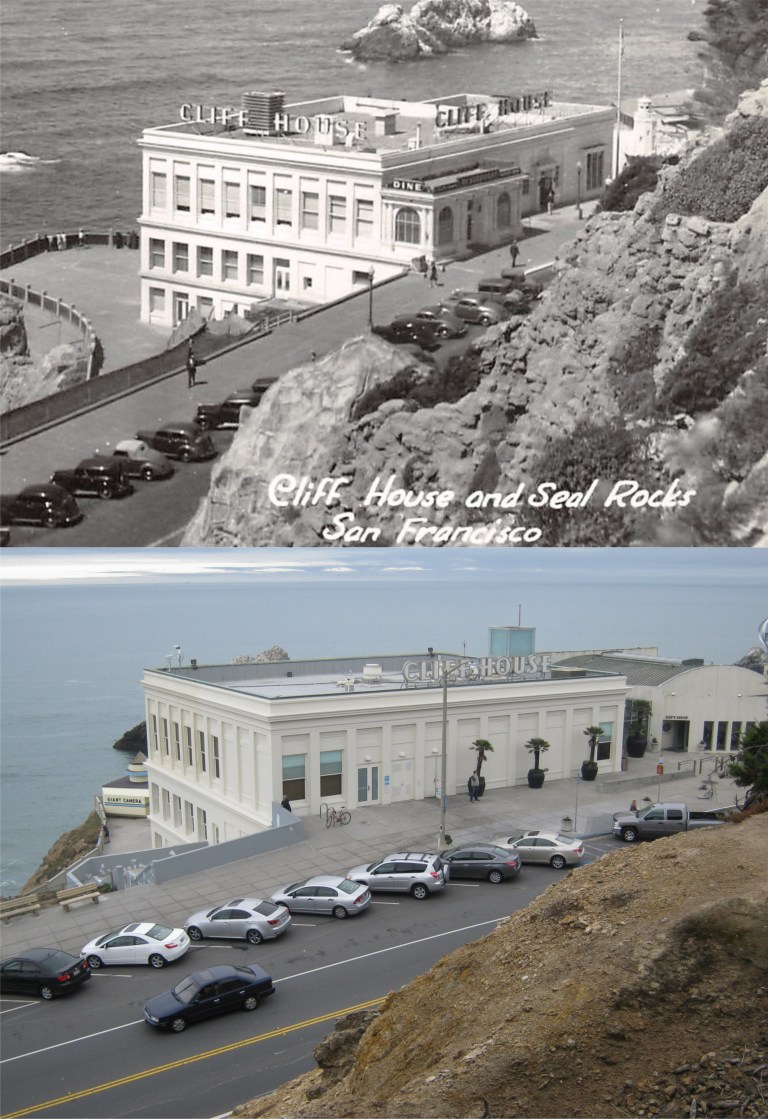 {The CLIFF HOUSE. Point Lobos Ave. at Great Highway, a white stuccoed building terraced along the edge of the cliff south of Sutro Baths, is a modern restaurant, bar, and gift shop. Both the barroom and the Sequoia Room – a cocktail lounge – are finished in redwood, from the smooth walls to rustic beamed ceilings, and both house huge fireplaces in which open fires glow on chilled days. From the lounge and the blue and white dining room in the rear of the building guests seated at the great plate glass windows on clear days look beyond Seal Rocks for miles across the Pacific.}
It’s a crowd pleaser still and you can’t stop progress, but I remember the Sequoia Room with its fireplace well, and I miss the Cliff House the way it was before the New Millennium restoration. (Vintage picture, hippostcard.com)
 The De Young Museum and the Pool of Enchantment:
{On the NW. side of the Music Concourse, flanked by trim lawns and stately Irish yews, is the M. H. DE YOUNG MEMORIAL MUSEUM (open daily 10 – 5). Of Sixteenth- Century Spanish Renaissance design, the buildings pale salmon-colored facades are burdened with rococo ornamentation. Its two wings extend from either side of the 134 foot tower facing a landscaped court. In the court, before the main entrance, lies the POOL OF ENCHANTMENT, in which a sculptured Indian boy pipes to two listening mountain lions on a rocky island.}
Before the De Young Museum was demolished and rebuilt in the New Millennium, I had a chance to take a comparison picture at the spot in front of the museum next to the Pool of Enchantment where my mother, on the right with her cousin Frances posed during her 1939 trip to San Francisco by train while she was in high school. The Pool of Enchantment is now on the eastern side of the De Young Museum.
 The Fisherman’s Wharf Lagoon:
{Twentieth-Century commercialism and Old World tradition go hand in hand at FISHERMAN’S WHARF, foot of Taylor St., where are moored in serried ranks the tiny, bright-painted gasoline boats of the crab fishermen and the tall-masted 70 foot Diesel-engined trawlers of the sardine fleet.}
{The boats of the crab fishing fleet, like their larger sisters of the sardine fleet, are brightly painted, with blue and white predominating hues. During the fishing season (November through August) the crab fleet usually leaves the wharf with the tide – between two or three o’clock in the morning – bound for fishing grounds between three and six miles outside the gate, where each boat anchors within hailing distance of its neighbor. In mid-afternoon they return laden from one to four dozen crabs apiece, accompanied by screaming hordes of gulls.}
Most of the boats in the lagoon in the 1940 picture from the Charles Cushman Collection do appear to be blue and white, and even a number of them today.
 The Embarcadero near Green Street, looking south:
{Even before the eight o’clock wail of the Ferry Building siren, the Embarcadero comes violently to life. From side streets great trucks roll through the yawning doors of the piers. The longshoremen, clustered in groups before the pier gates, swarm up ladders and across gangplanks.}
{Careening taxis, rumbling under slung vans and drays, and scurrying pedestrians suddenly transform the waterfront into a traffic thronged artery.}
{Stored in the Embarcadero’s huge warehouses are sacks of green coffee from Brazil; ripening bananas from Central America; copra and spices from the South Seas; tea, sugar, and chocolate; cotton and kapok; paint and oil; and all the thousand varieties of products offered by a world market.}
Maybe a long time ago, but not anymore. You can’t see the Ferry Building from this spot anymore through the palm trees either, but you can still see the pointed YMCA Building in the far background.
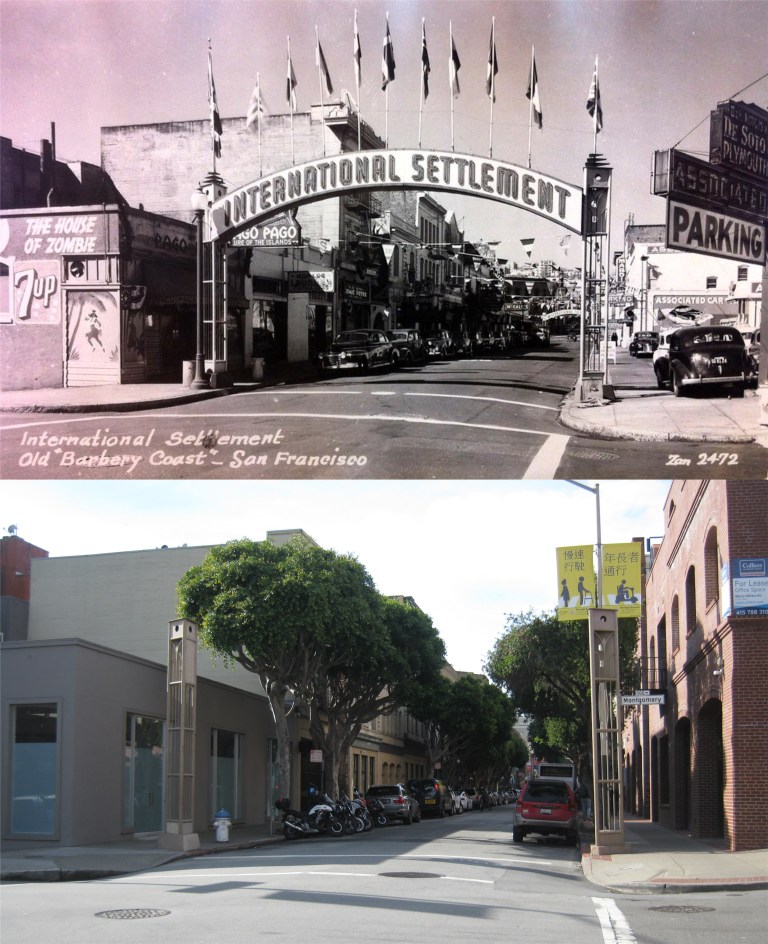 Pacific Avenue and Montgomery Street looking west and the old signposts of the eastern side of the International Settlement:
{The “Terrific Street” of the 1890’s – that block of Pacific Street, SITE OF THE BARBARY COAST, running east from the once-famous “Seven Points” where Pacific, Columbus Avenue, and Kearny Street intersect – is set off now at each end by concrete arches labeled “INTERNATIONAL SETTLEMENT”.}
{Where gambling halls, saloons, beer dens, dance halls, and brothels once crowded side by side, a Chinese restaurant, a night club and cocktail bar, a Latin American café, and an antique shop now appear,}
World War Two would change all that after this passage was written when soldiers and sailors on leave brought back the “gambling halls, saloons, beer dens, dance halls, and brothels”. It’s interesting how they referred to it as Pacific Street in the book rather than Pacific Avenue. The House of Zombie and Pago, Pago Buildings on the left are still there. (Vintage picture, Flickr)
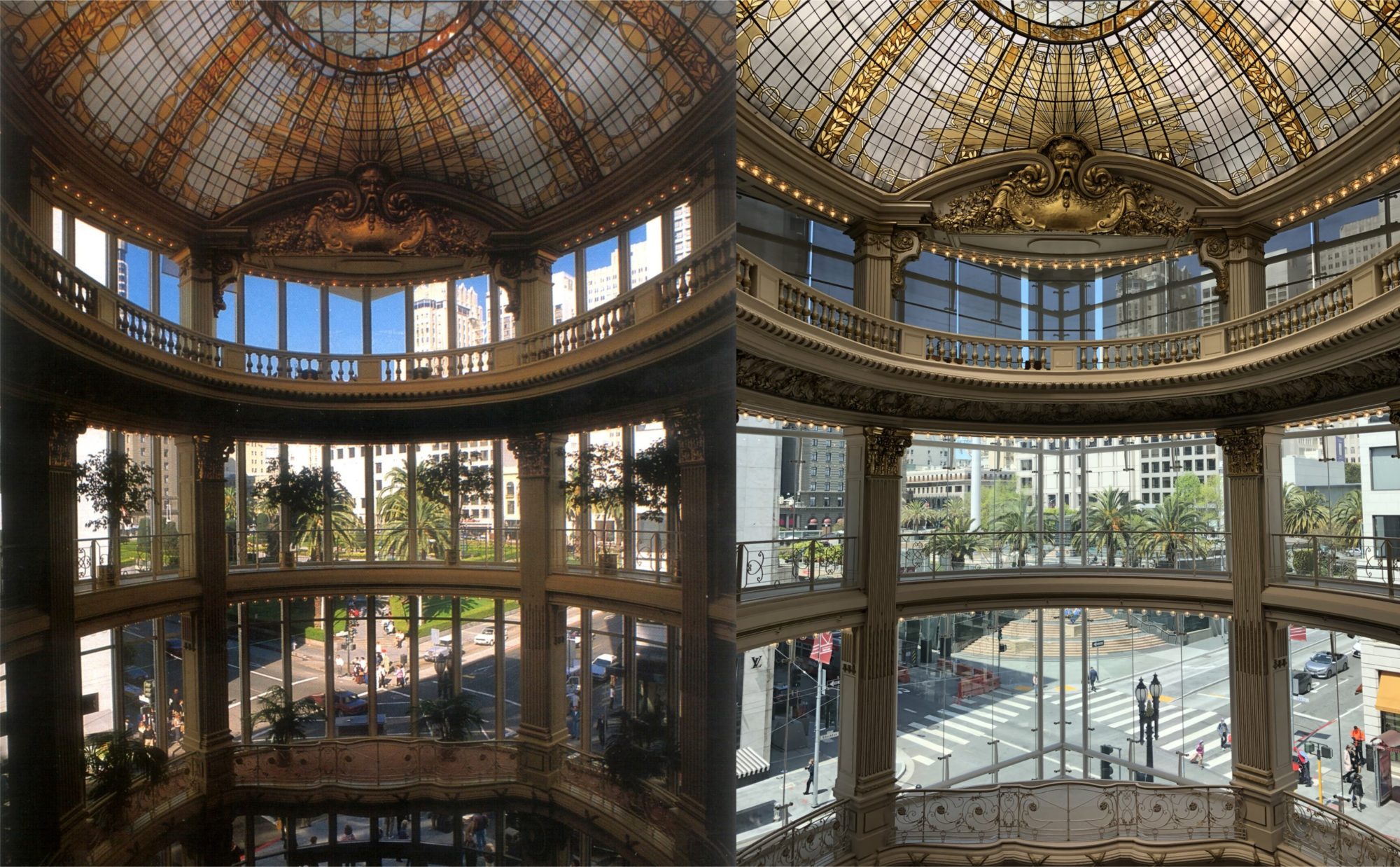
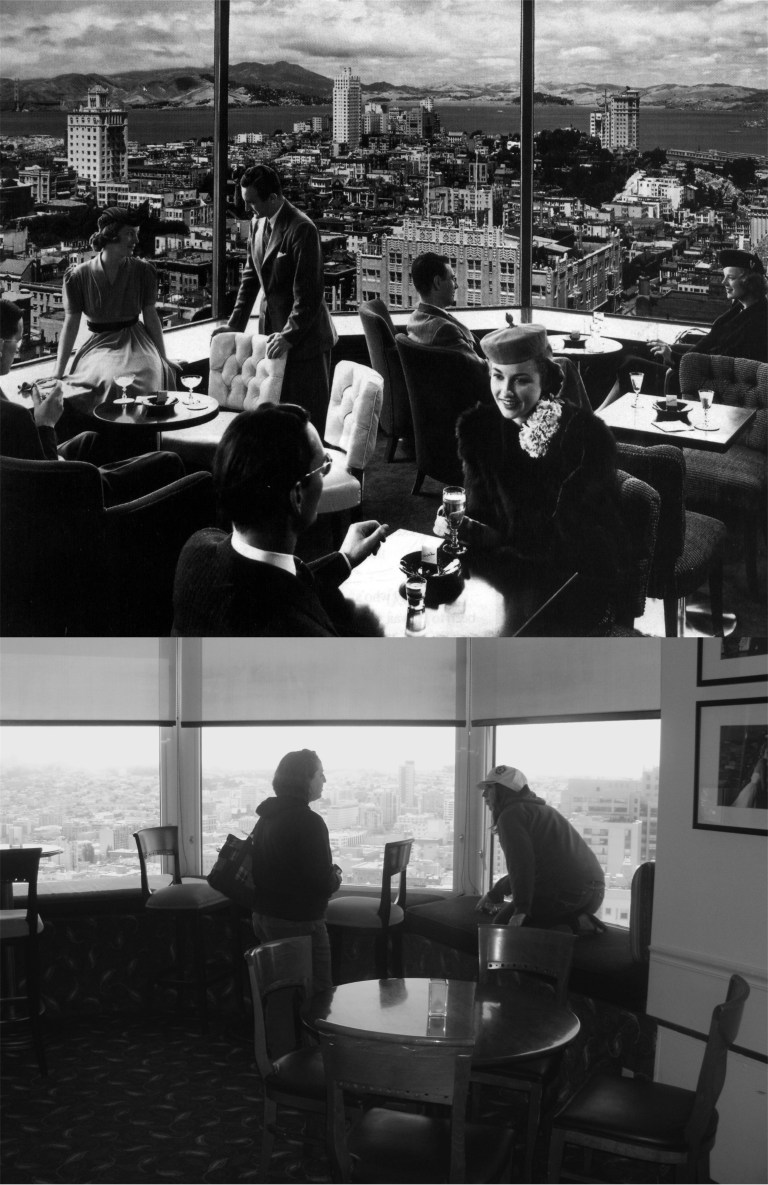 The northwest corner at the Top of the Mark, “Weeper’s Corner”, looks like the 1940’s or early 1950’s: “Weeper’s Corner” got its nickname during World War Two when mothers, wives and sweethearts sat in this corner watching their loved ones sail off to the Pacific Theater of the war. The Top of the Mark is still a special place to take a break; visitors are no longer required to dress up to come up here, and as far as I know, weeping in this corner is still allowed.
 The old Redwood Room at the Clift Hotel, seen here in the 1950s, is another historic place to relax with a cold one and try to forget about all of the money you’re spending on your visit to San Francisco. (hippostcard.com)
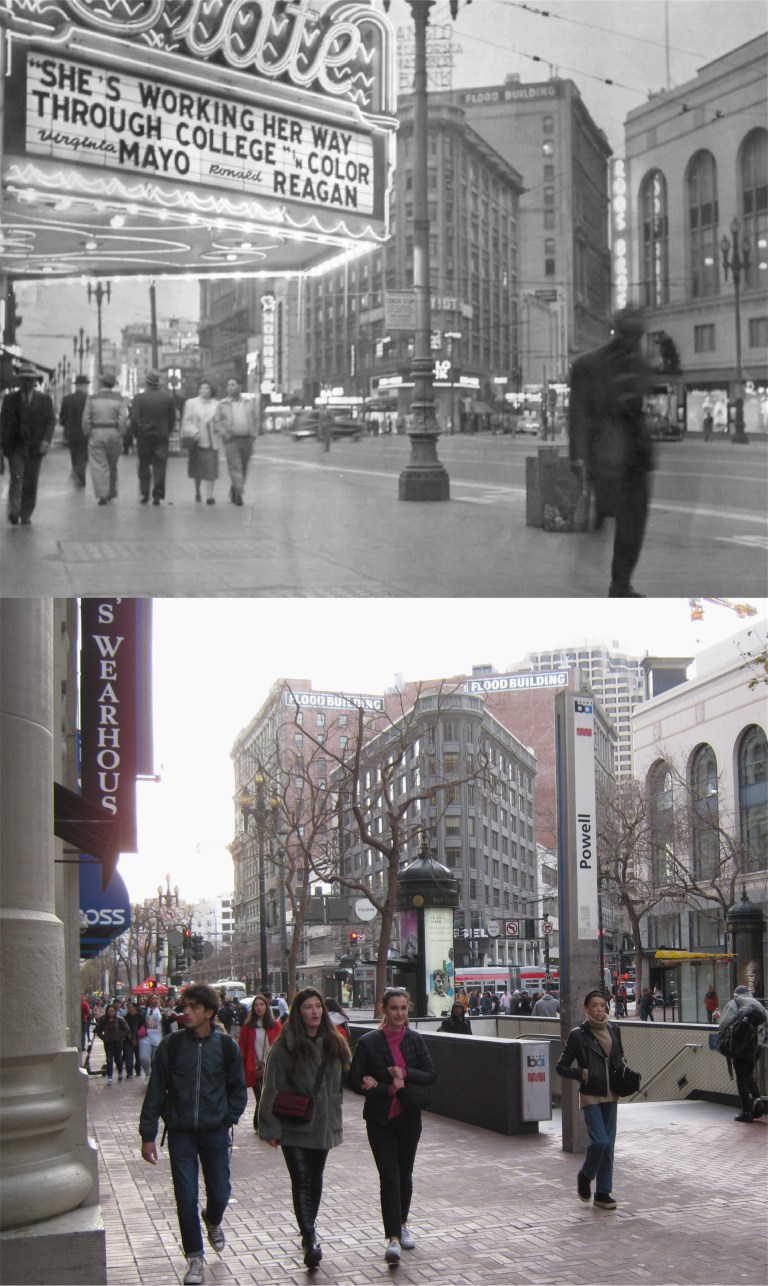 Checking out a flick on Market Street to get away from it all, like here at the State Theater at 4th and Market Streets in 1952, isn’t going to work anymore; all of the theaters in this area have been demolished. (tumblr.com)
 Now, if you really want to make it a special afternoon, lunch in the Garden Court of the Palace Hotel is one of the best ideas for a breather; although, sometimes it’s prettier and cheaper just to sneak upstairs and take a picture of the hotel court. (ebay)
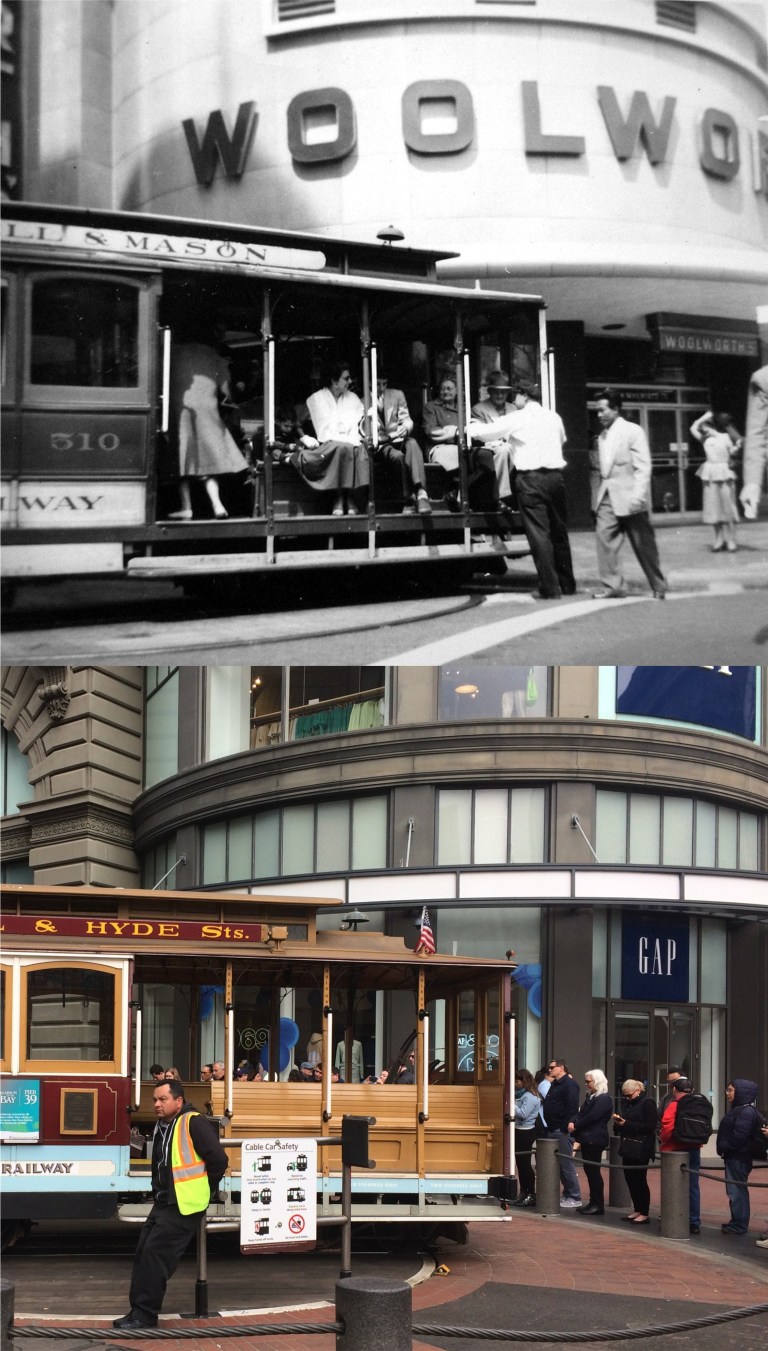 A relaxing cable car ride at Powell and Market Streets might bring the energy back to your feet, but the problem is that the wait standing in the long line to catch a car can sometimes be longer than the walk you took around San Francisco.
 Hotels like the Fairmont, St. Francis, and here at the Sir Francis Drake lobby, seen here in 1928 in the vintage picture, usually don’t mind visitors sitting awhile to relax in their lobbies. Sometimes, they even encourage people to stop and browse on occasions like holidays. (North Point Press)
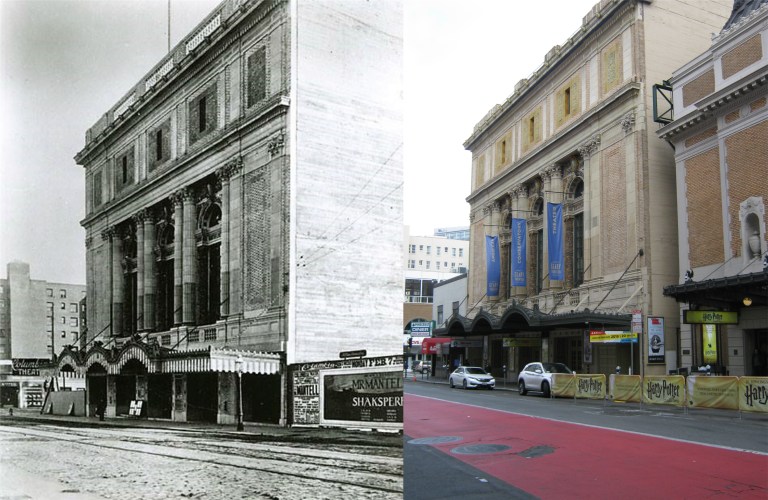 And if you need a long rest, you can catch a play at the Geary Theater on Geary St.. near Mason Street, seen here in 1910, the year the theater opened. The Curran Theater, west of the Geary Theater, had not been built yet in the vintage picture. (San Francisco Theaters / blogspot.com)
 The Geary and Curran Theaters looking west in 1958: Notice what was playing at the Curran Theater. (blogspot.com)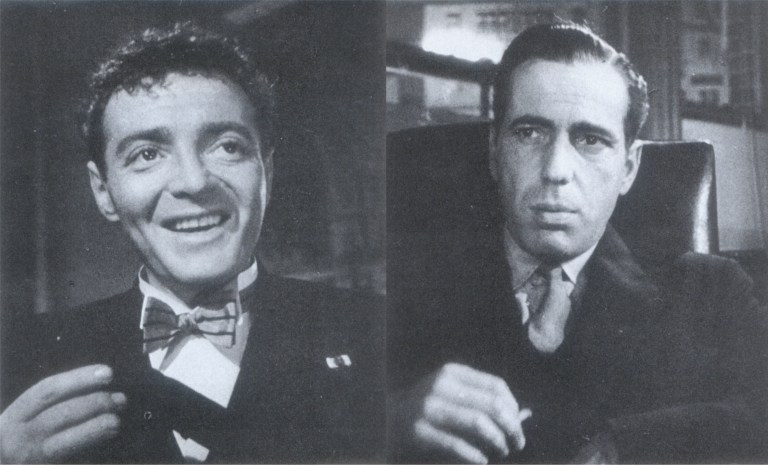
 I’ll pause for five seconds while movie buffs spot what’s going on here….. Joel Cairo (Peter Lorre) in attempting to search the office of Sam Spade (Humphrey Bogart) in the 1941 film ‘The Maltese Falcon’ is knocked out by Spade. In searching through the pockets of the unconscious Cairo, Spade finds, among other things, that Joel will be attending a play that evening at the Geary Theater. This was where Cairo was planning on being that night in the novel by Dashiell Hammett, as well. (Flare Books / Richard Anobile)
 Executive Order Number 9066, signed by Franklin D. Roosevelt on February 19th, 1942, forced Japanese citizens on the West Coast to leave their homes and businesses for internment after Pearl Harbor in fear that some may create acts of sabotage in support of Japan’s military machine. The Japanese owners of this business on Grant Avenue south of Pine Street in Chinatown, (there were several Japanese owned businesses on Grant Avenue between California and Bush Streets in 1942) are selling off as much of their inventory as possible before being relocated. Ironically, their shop was the one with the green BLOWOUT SALE sign in the window behind the California flag in my update.
 South of the Ferry Building, around 1984: I was standing in the shadow of the Embarcadero Freeway. Looks like I got here close to the same time as I did thirty six years ago. They’re doing some work on the south wing of the Ferry Building lately, but I haven’t had a chance to find out what that’s all about yet.
 The Embarcadero just south of Levi Plaza around 1985: Although the old Belt Line Trains were long gone by then, the tracks still ran down the Embarcadero all the way to China Basin. The Embarcadero Freeway, where it stopped at Broadway, is in the center. One of the buildings the Exploratorium is housed in now is on the far left.
 Pier 33, on the left, on a rainy day: I’m not sure when I took this picture; some of those cars look newer than the 1980’s. Might have been in the 1990’s; neither one of those decades seems that long ago to me! I remember the Peer Inn Restaurant, though; it was where the restaurant with the pink awning is now.
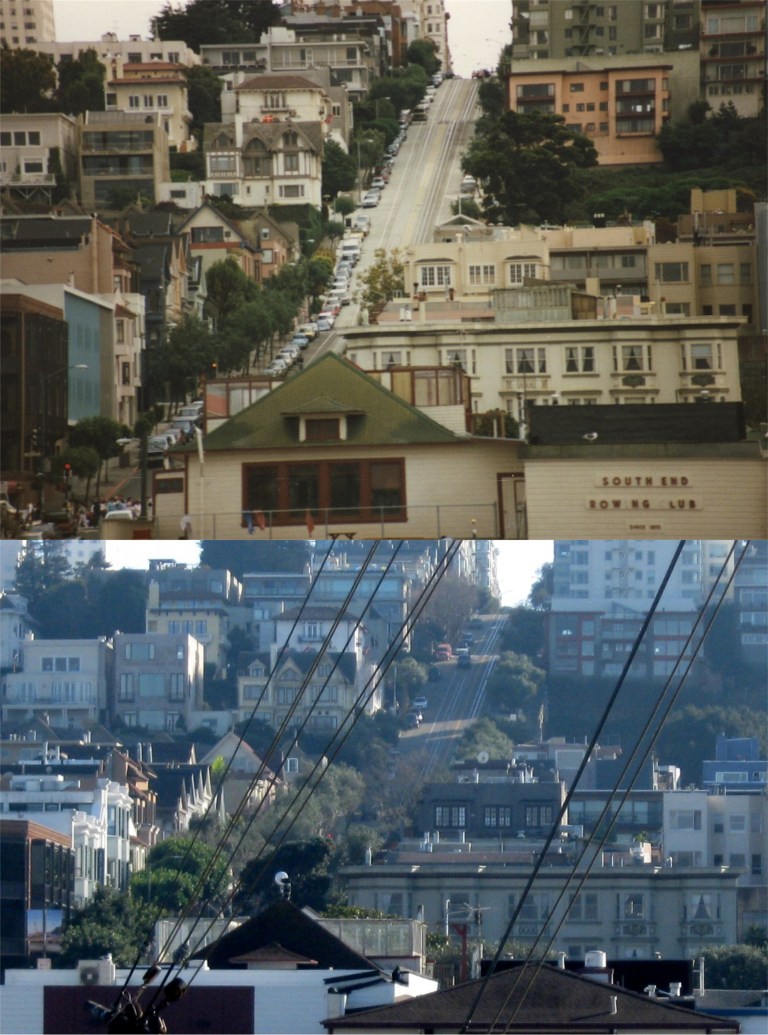 I had to do a little detective work to locate where I took these two photos. They were taken around 1985. I wasn’t even sure if I took them on the same day, but Hyde Street coming down Russian Hill in the second picture was my guideline. They were both taken from the second deck of the old ferryboat the Eureka at the Historical Hyde Street Pier. I was able to find the same spot I took my old pictures from on a visit to the Eureka last Saturday; maybe the first time I’ve been on board that old ferryboat since then. The top one, of course, is looking toward Telegraph Hill, the bottom one is Russian Hill, with a close up of Hyde Street where the cable cars plunge down from the top of the hill.
 I took the top picture in 1985; some vistas don’t change much with the passing of time.
 {San Francisco
 The main character is Gregory Richards, eighteen years old and down-and-out, trying to get a job on one of the many ships docked along the Embarcadero in 1936. His two main troubles are a pending waterfront strike, and the fact that none of the ship crews are willing to hire someone who hasn’t shipped out and hasn’t had ship sailing experience. He meets a fellow named John Brant who is willing to sell him a phony discharge certificate proving he has had sea experience and tells him where a ship named the SS Araby, that will hire him if he’s willing to cross a picket line, is docked.
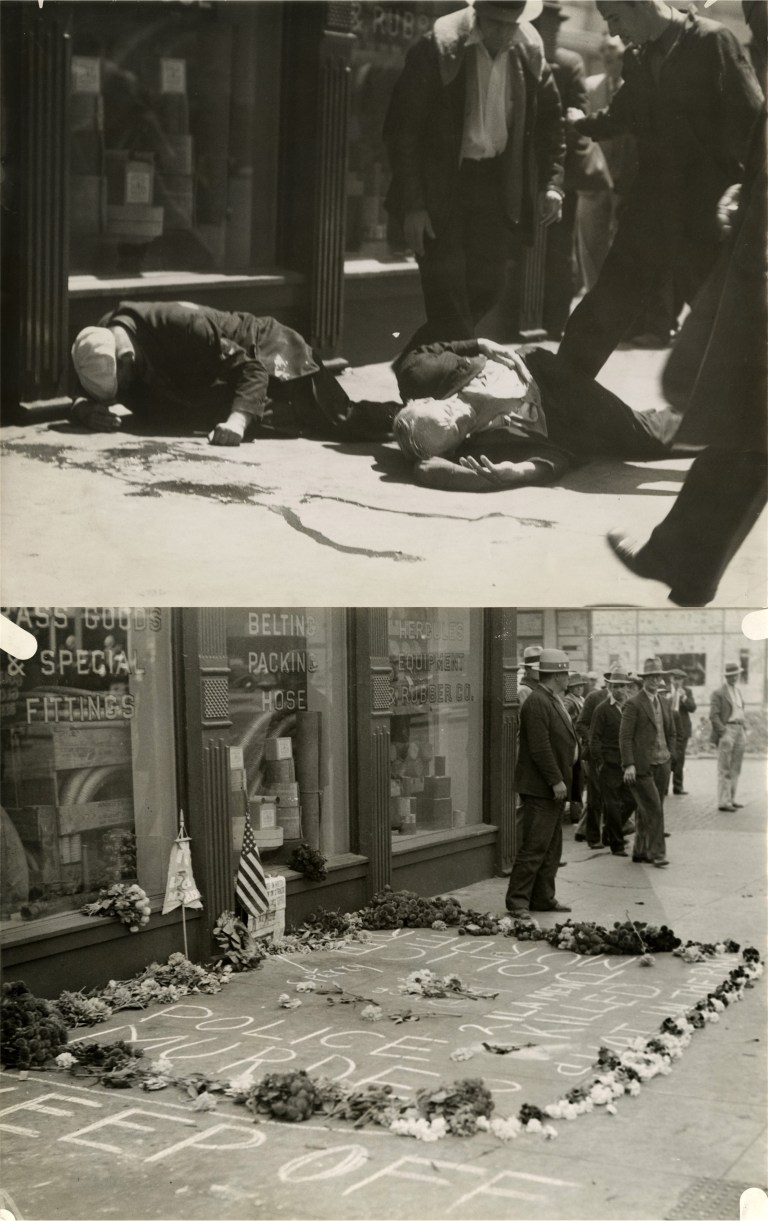 Before Richards runs into John Brant, he is warned of the dangers along the waterfront by a gentleman at a sailor’s hiring hall, particularly for strike breakers. When Richards inquires about police protection, the fellow tells him,
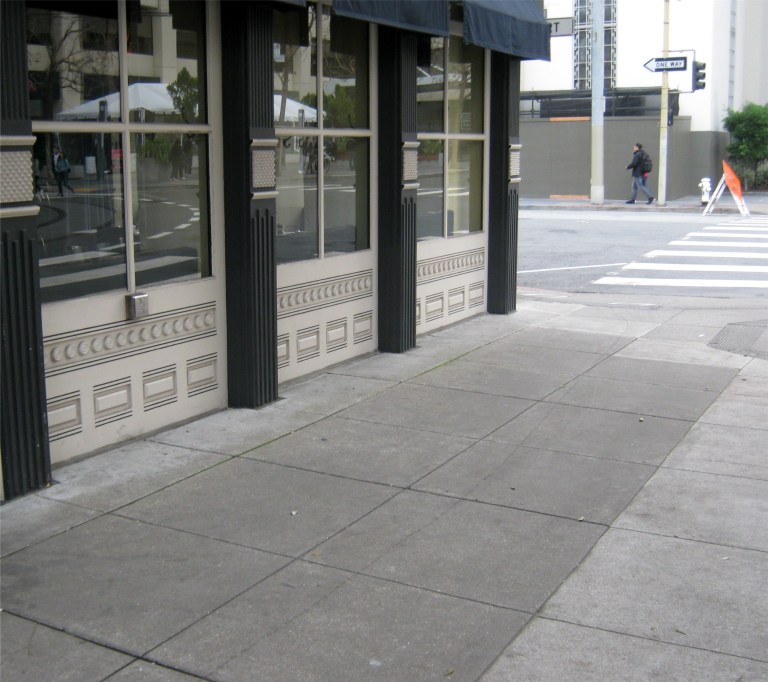 The spot where the previous two pictures were taken today:
 There is a marker describing the incident on a building at Steuart and Mission Streets today.
 The “Bloody Thursday” incident is still commemorated today on the sidewalk in front of the Longshoremen’s Hall on North Point Street.
 Greg counts the piers as he walks from Mission Street to Pier 43.
 Having been discouraged by the picketers in front of Pier 43, Greg requests assistance from a police officer watching from across the street to cross through the picket line and board the Araby.
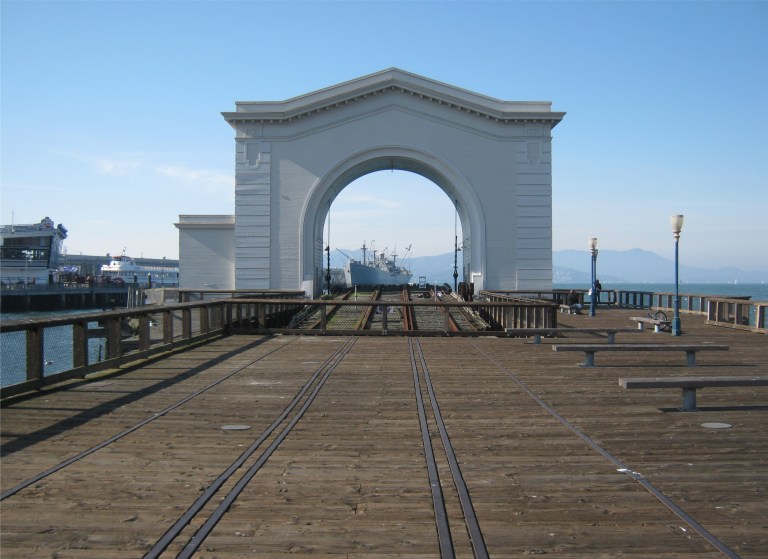 The top vintage picture above from opensfhistory.org is Pier 43 with a ship docked there in 1939. The picture below it I took looking through Pier 43 toward the Liberty Ship Jeremiah O’Brien:
 Greg is hired on to the crew of the Araby, but shortly after, an arsonist fire is started in the cargo hold. A series of clues leads Richards to believe that John Brant, who gave him his phony discharge certificate, is involved. He confesses to Captain Jarvis, master of the freighter, and Third Mate, Tod Moran in order to warn them of his suspicions. Partly because of his honesty, and partly because he can identify John Brant, they keep him on the crew. They leave the ship to search the waterfront for John Brant.
 The Ferry Building is mentioned often in ‘Foghorns’.
 Richards, Moran, and Captain Jarvis go back to the waterfront hotel where Brant sold Richards his phony discharge certificate on the corner of Mission Street at the Embarcadero and called the Bay View Hotel, and break into a room Brant was occupying when they made the sale looking for clues. They find a message that leads them to believe Brant will be meeting a confederate at the Canton Low Restaurant in Chinatown.
 But John Brant, sensing a trap bolts out the back door of the restaurant, as Greg takes after him. He follows Brant out to St. Mary’s Square at Quincy Street.
 Throughout the book is mentioned a foreboding possibility of another waterfront strike like the one in 1934 that shut down the entire San Francisco waterfront. In 1937, Longshoremen led by Harry Bridges were establishing a union along the San Francisco waterfront that was opposed by many ship company owners. In August of 1937 they founded the International Longshore and Warehouse Union. This 1937 picture from opensfhistory.org shows longshoremen gathering in front of Pier 15.
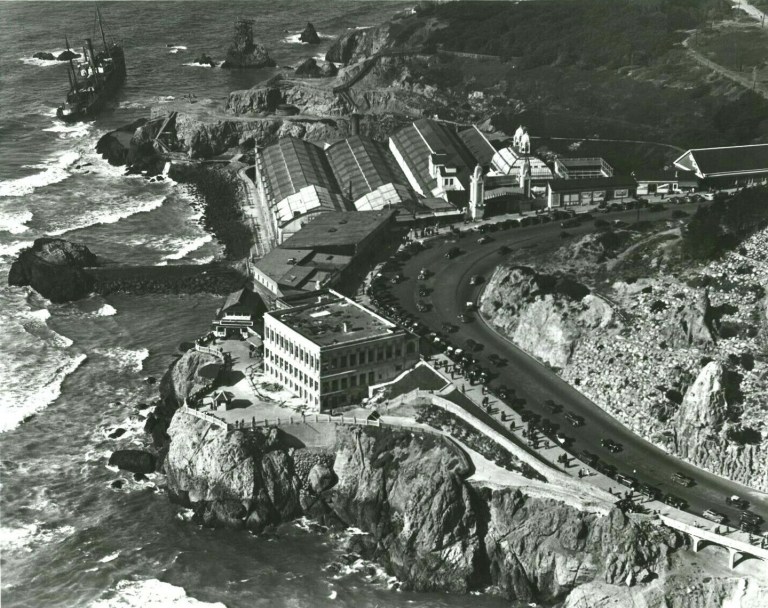 I’ll close with another reference in the book to an historical San Francisco incident taking place when the book was written. In October of 1936, the cargo ship the SS Ohioan ran aground on the rocks near the Sutro Bathhouse and the Cliff House. The crew, much of the cargo, and parts of the ship were salvaged, but in March of 1937 the ship caught fire and was eventually smashed to pieces by the surf. The photo above is an aerial view of the Cliff House and Sutro’s Bathhouse showing the stranded SS Ohioan at the upper left. (ebay)
 A closer look at the stranded Ohioan and the area behind Sutro’s where she ran aground: (Vintage photo from worthpoint.com)
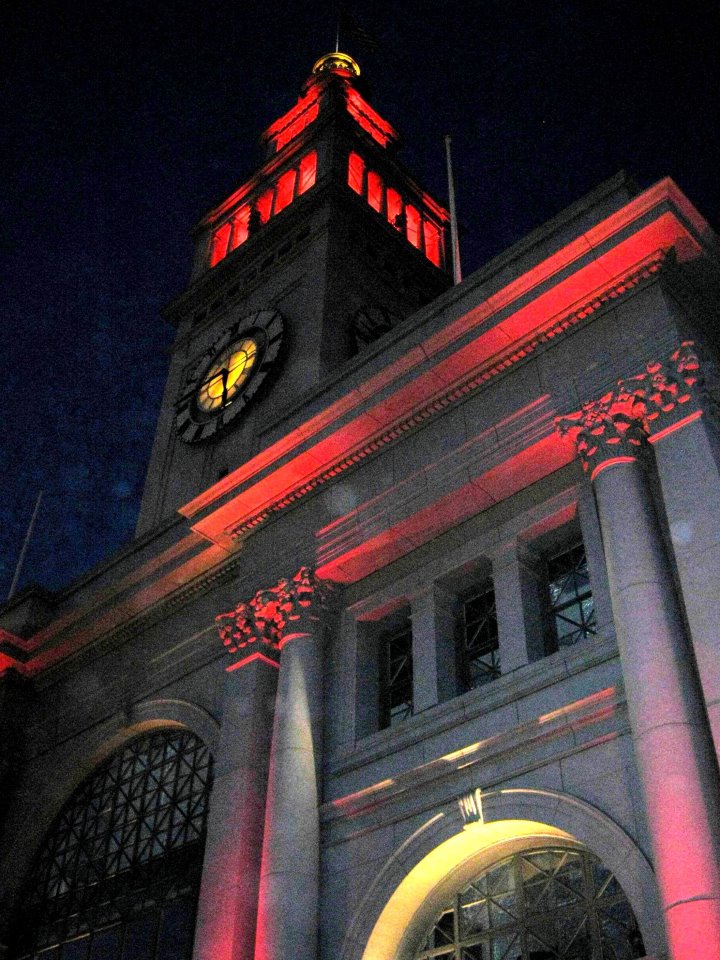
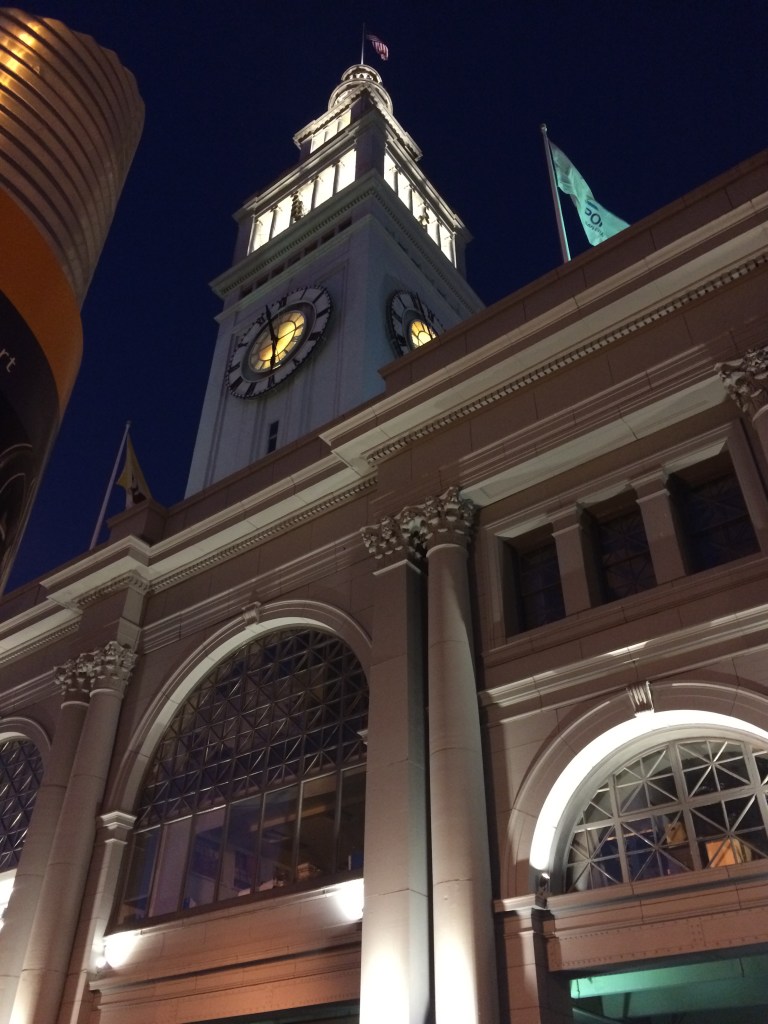 The old Southern Pacific Building on Market Street is getting into the fun, but the Ferry Building, all aglow in red in 2013, didn’t change its color this time.
 The sidewalk lights on the Embarcadero, (Herb Caen Way) were changed to red back in 2013 and you could stand in the glow. No red sidewalk lights at Pier 1 this time. “I wore a younger man’s clothes” back then. Oh, wait; those are the same clothes I was wearing last Sunday!
 The Billy Graham Civic Auditorium is in gold and red this year.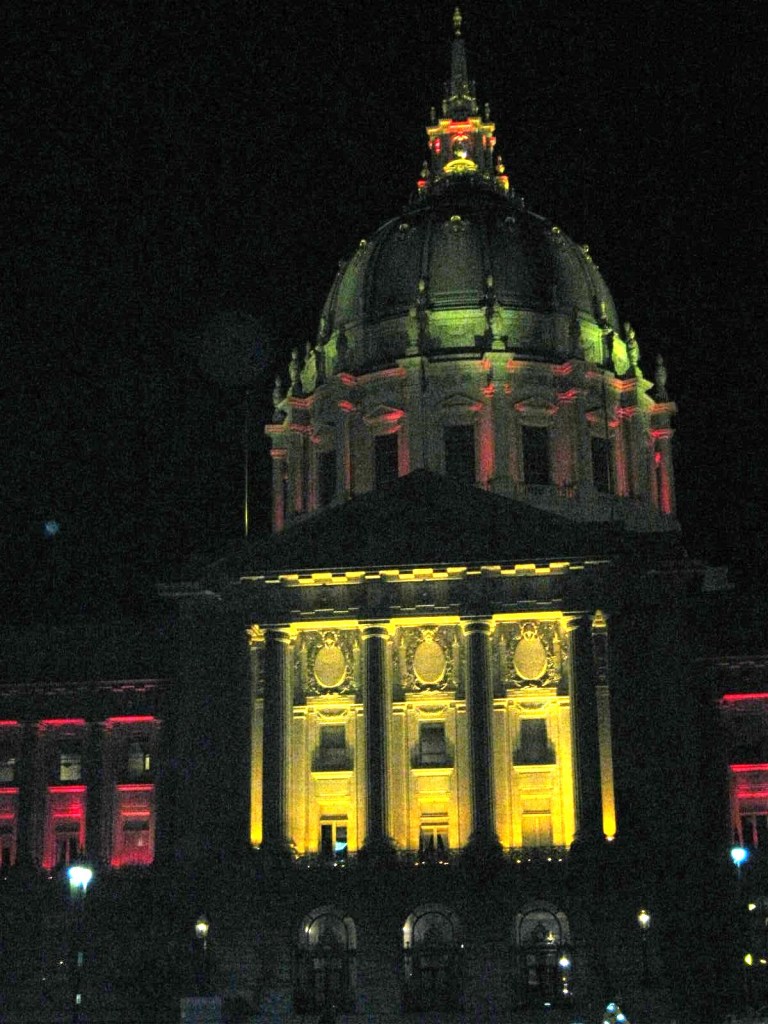
 I got a fuzzy picture of City Hall on that January Saturday night in 2013 and another last night. It’s not that I’m a better photographer since seven years ago; I just have a better camera now.
 A MUNI bus coming along Post Street in January, 2013: We won’t see that this year.
 Mason and Sacramento Streets looking west in 1956: I think I’m far enough out in Sacramento Street with my picture; the traffic lanes were just different back in 1956. (San Francisco Pictures)
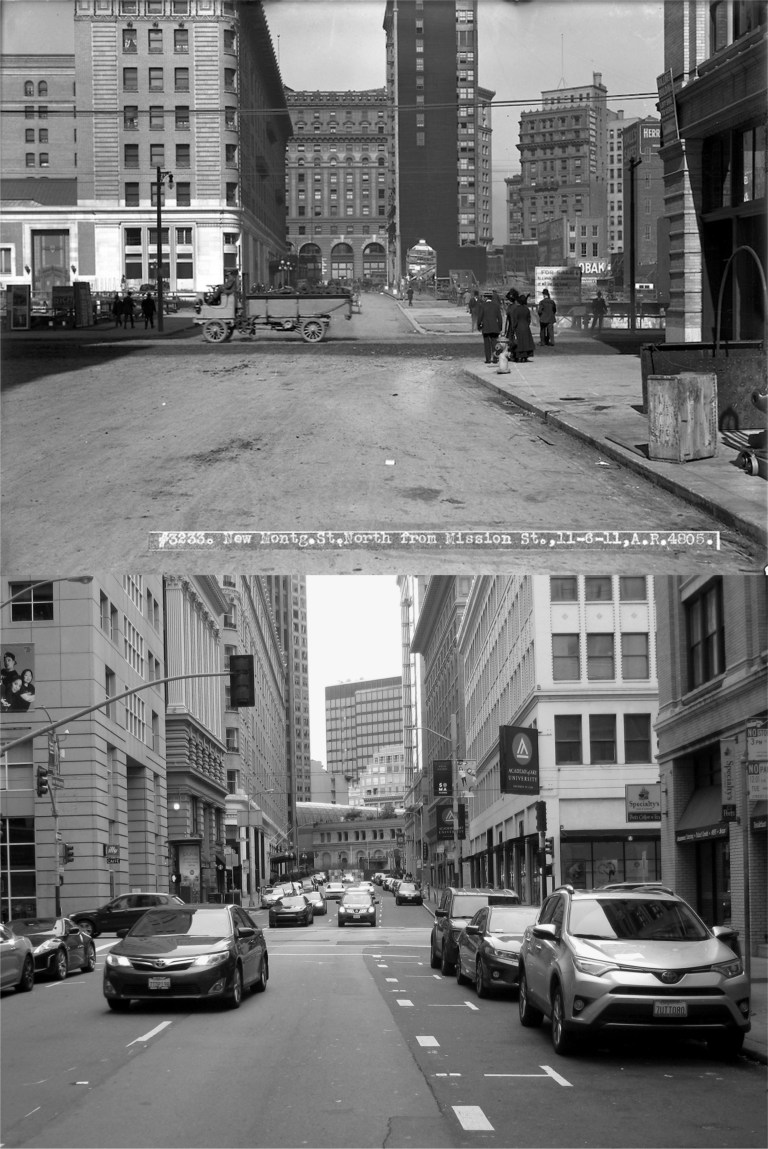 New Montgomery Street, looking north toward Mission Street in 1911: The Palace Hotel, which is the prominent building on the left in the vintage photo, can just barely be seen from here today. The Number One Montgomery Building, built in 1908 and seen in the far background in my picture, had its top portion removed in the 1970s. It angles differently and appears farther away than the old building on the corner of Market and Montgomery Streets in the vintage picture because they’re not on the same block. The old Crocker Building in the background of the old photo was demolished and Number One Montgomery is actually on the corner of Post and Montgomery Streets, which cuts in a different direction. (San Francisco Pictures / SFMTA Photo Archives)
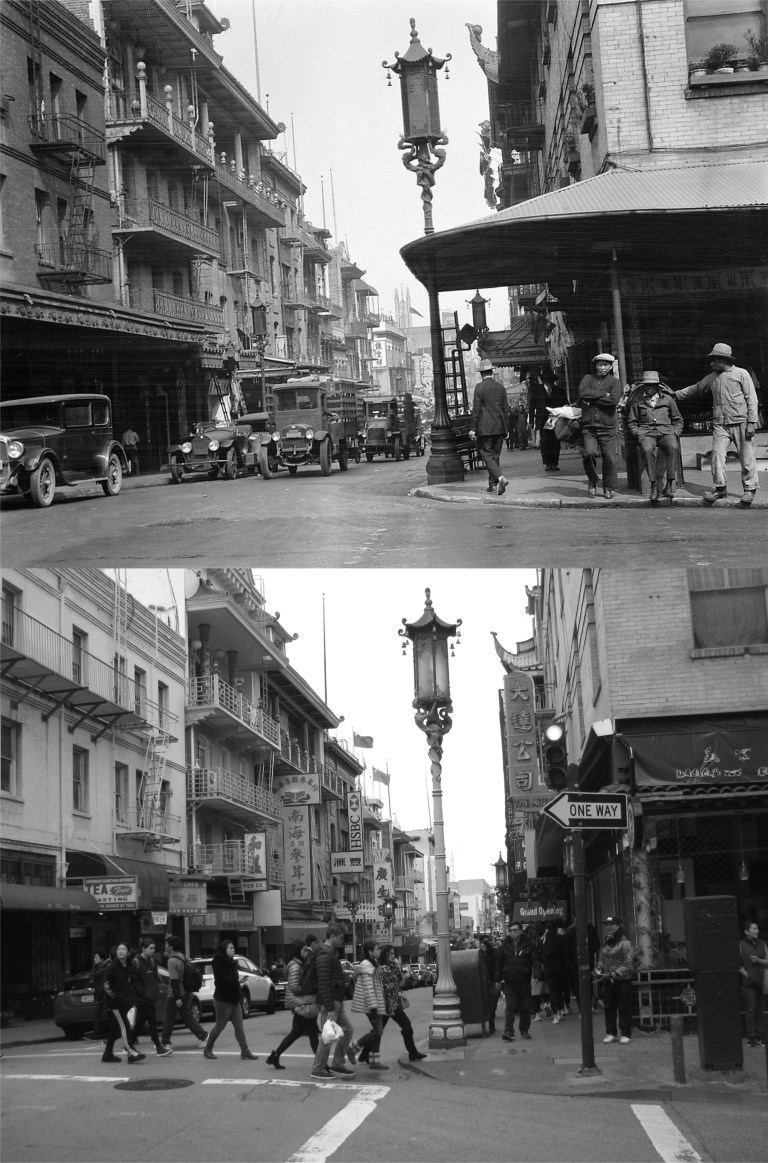 Grant Avenue at Washington Street: The blog lists the vintage picture as from 1920. I’m sure I’m standing in the same spot, but the old and same buildings on the west side of Grant Avenue on the left don’t line up. I’ll put it down to an optical illusion. (San Francisco Pictures)
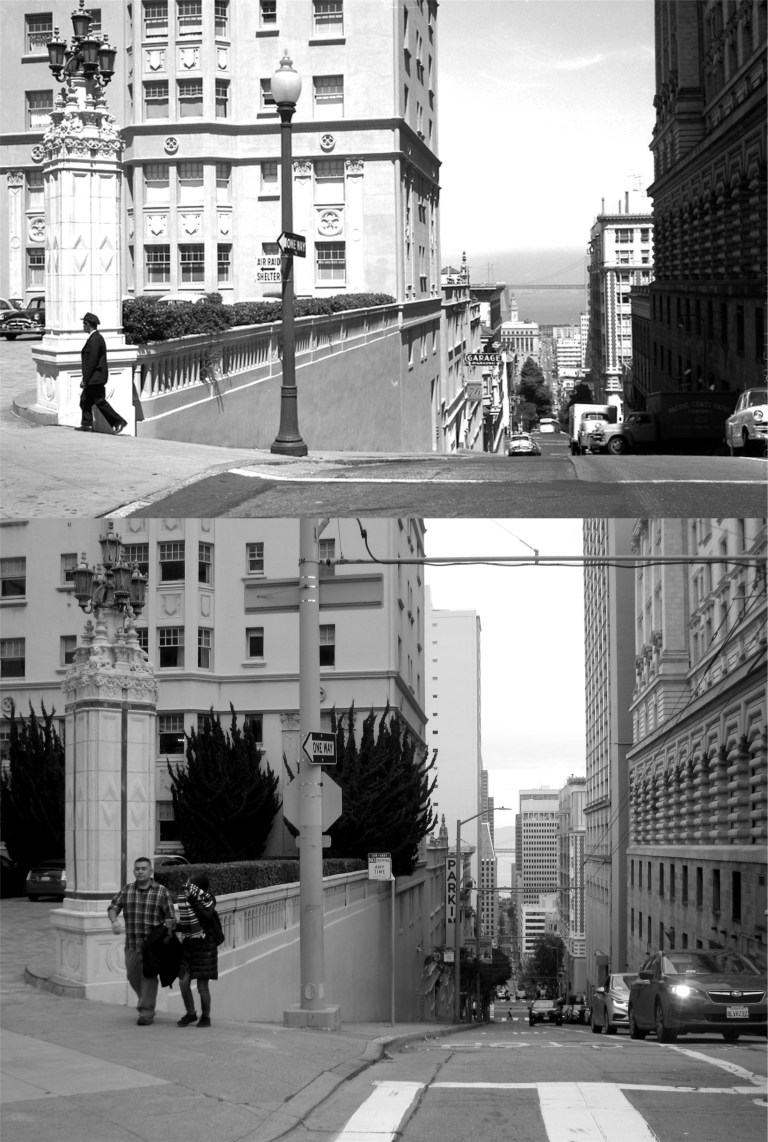 Mason and Sacramento Streets looking east in 1956: Sometimes I’ll do an update photo and think I got the picture at just the right spot, and then when I put it together with the vintage picture I’ll say to myself, “Darn, I should have been more to the left!” or “Darn, I should have been more to the right!” or “Darn, I should have been closer!” or “Darn, I should have been farther back!”. I don’t always say “darn” either. I missed this one, alright. I should have been farther out in the intersection, but it’s a busy crossing and I never get a good line up when I’m looking back over my shoulder while I take the picture. (San Francisco Pictures)
 Washington Street at Hyde looking east in 1957: I got a pretty good line up on this one, but that’s not the interesting thing about the picture. The Washington Street cable car line used to run west past Hyde Street all the way to Steiner Street. The line had been discontinued by 1957 but you can still see the cable car tracks at the bottom of the vintage picture. (San Francisco Pictures / SFMTA Photo Archives)
 Looking north along Hyde Street in 1957 from the same intersection at Washington Street as the previous picture: Trees block most of the view along Hyde Street today. The vintage picture was probably taken from the back of a cable car, and the tracks curve a little differently today due to the O’Farrell Line that used to continue south along Hyde as far as Pine Street once, and the cable car overhaul of 1982 and 1983. (San Francisco Pictures / SFMTA Photo Archives)
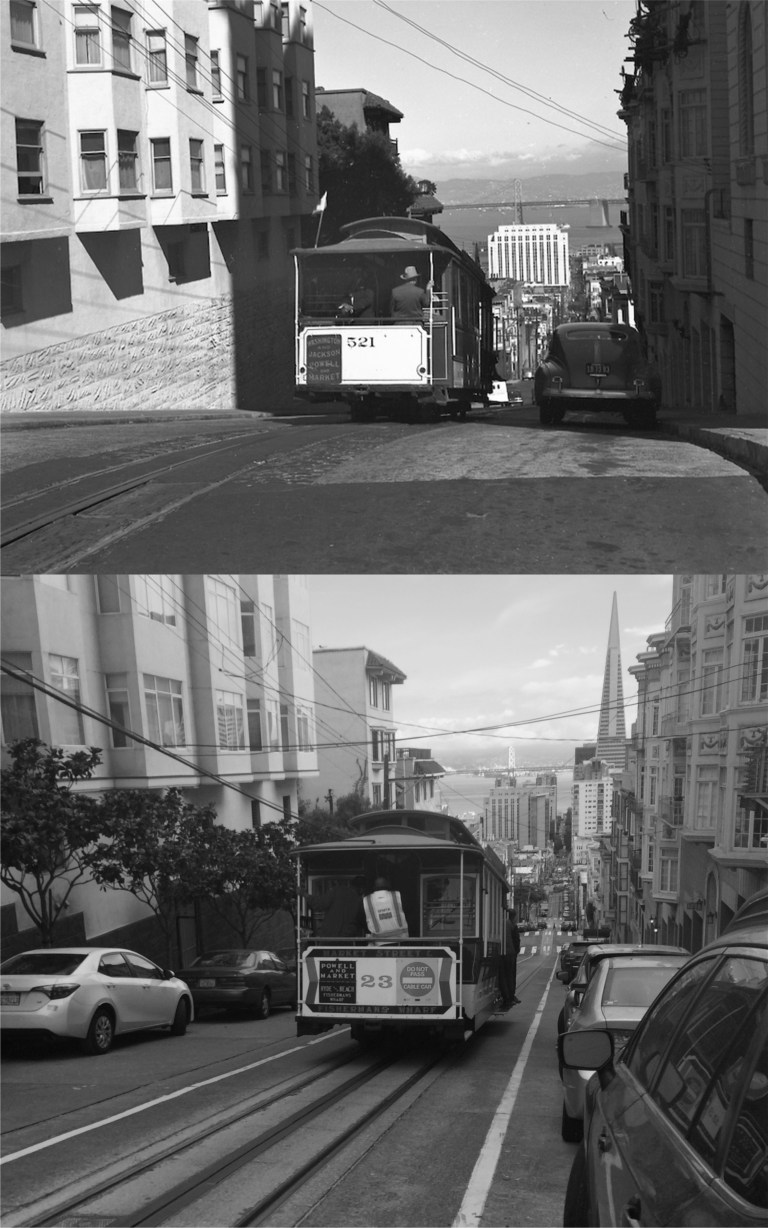 A cable car plunging down Washington Street from Jones in 1947: I gave it a try; “Close but no cigar”, or cigarette, or even a vape! (San Francisco Pictures / SFMTA Photo Archives)
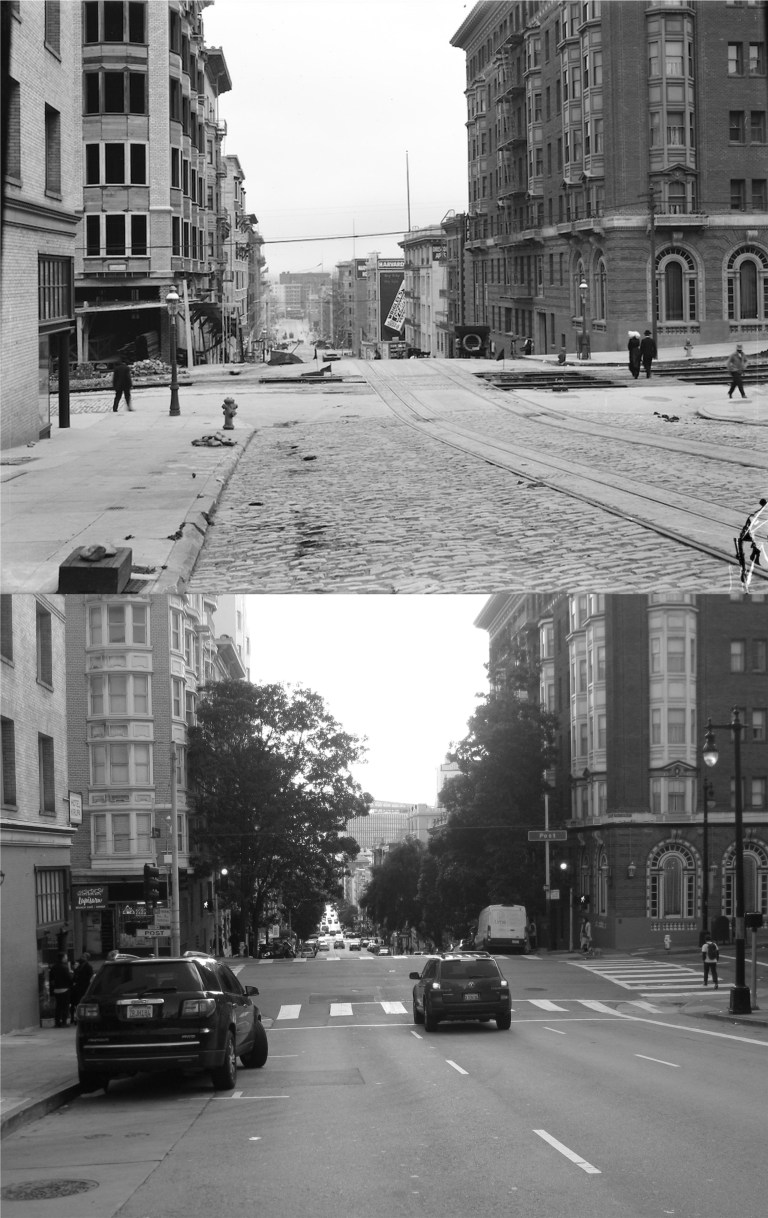 Jones Street looking south toward Post Street in 1913: This one was a pleasant surprise; usually I’m not far enough out into traffic when I take my picture, on this one I was too far out in the street. The construction work on Post Street was probably for the laying of streetcar tracks that by then began to replace cable car lines. However, you can still see the Jones Street cable car lines heading up Nob Hill. Good 1913 advertising; I suddenly have a craving for a stick of Wrigley’s Spearmint Gum! (San Francisco Pictures / SFMTA Photo Archives)
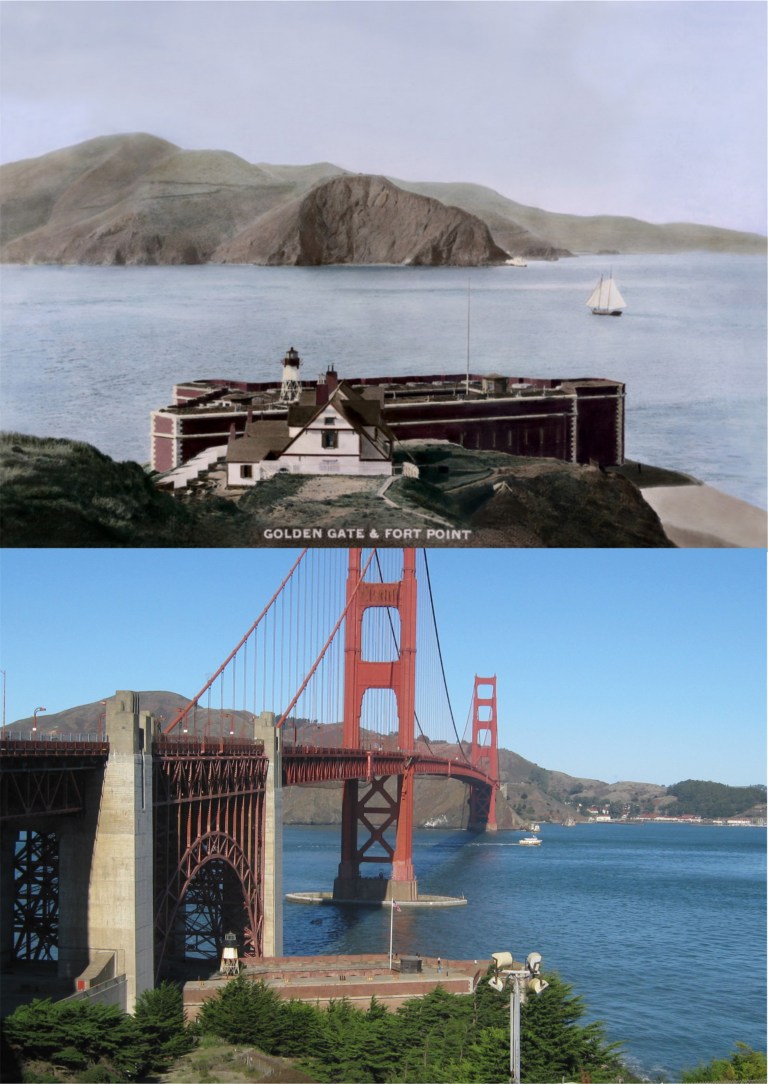 The Golden Gate and Fort Point in the 1880s:
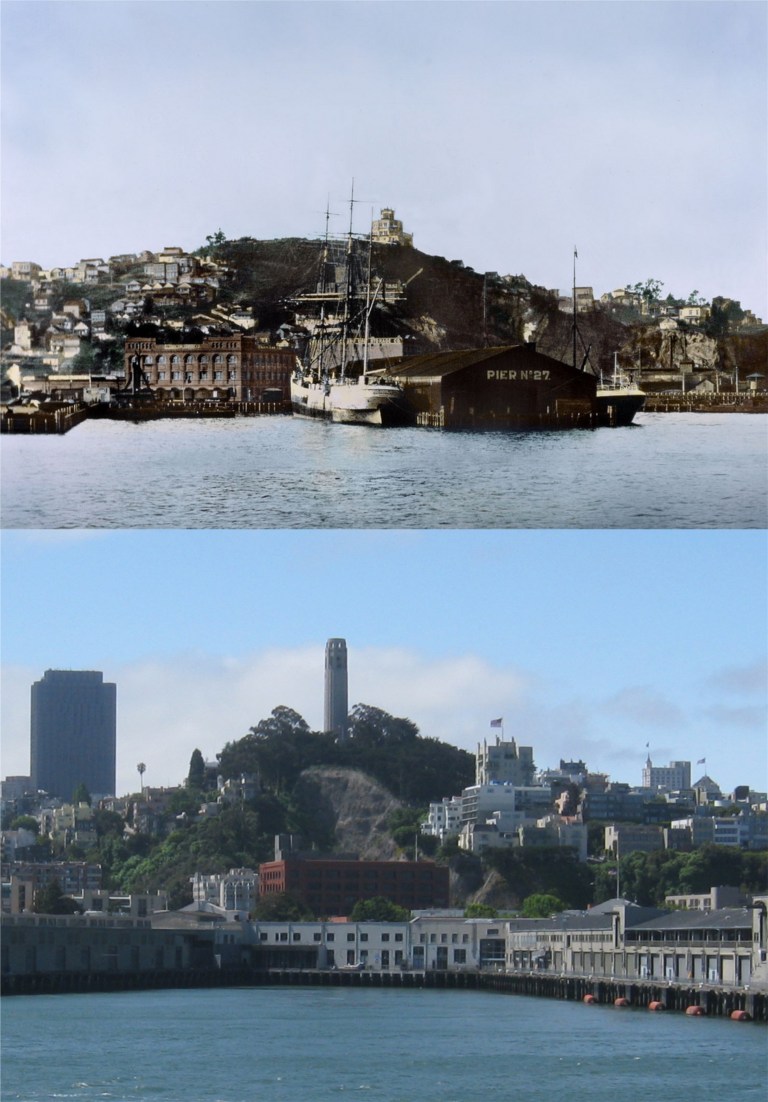 The San Francisco waterfront beneath Telegraph Hill in 1885 before the Embarcadero Piers were built: Dynamite blasting of Telegraph Hill in the late Nineteenth Century, particularly by the brothers George and Harry Gray for their stone quarry, removed the natural slope of the eastern side of the hill before it was stopped early in the Twentieth Century. You can see the damage the Gray Brothers caused in my picture.
 The area that used to be called Meiggs Wharf but is today’s northern waterfront and Fisherman’s Wharf in the 1870s: Alcatraz Island, the Tiburon Peninsula, Angel Island and Sausalito can be seen in both pictures.
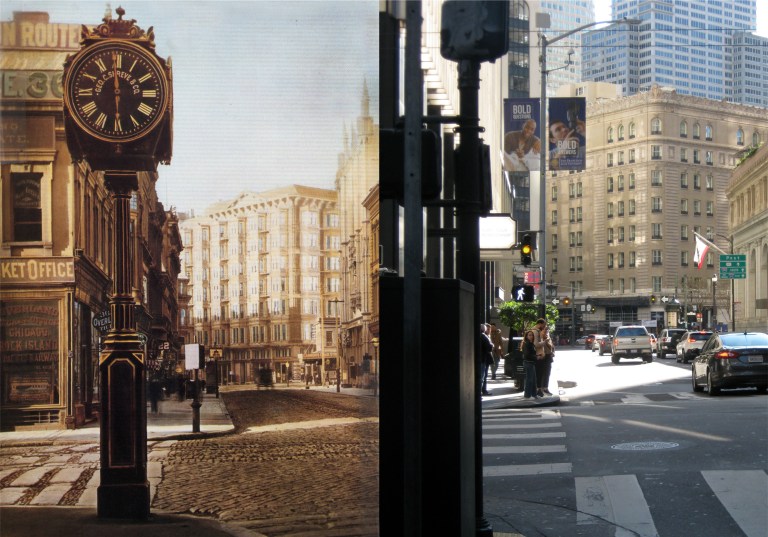 Montgomery Street at Sutter looking south toward the old Palace Hotel in the late 1870s:
 The waterfront looking down from Telegraph Hill in 1865:
 The Vallejo Street Wharf looking toward Telegraph Hill in 1866: Much of this area has been filled in now.
 Looking down from Telegraph Hill toward Vallejo Street and Broadway, where most of the ships docked back in 1865:
 The wharf near Broadway, the opposite view of the previous photos, looking back toward Telegraph Hill: The picture is dated 1850, which would make it one of the oldest pictures or daguerreotypes of San Francisco known.
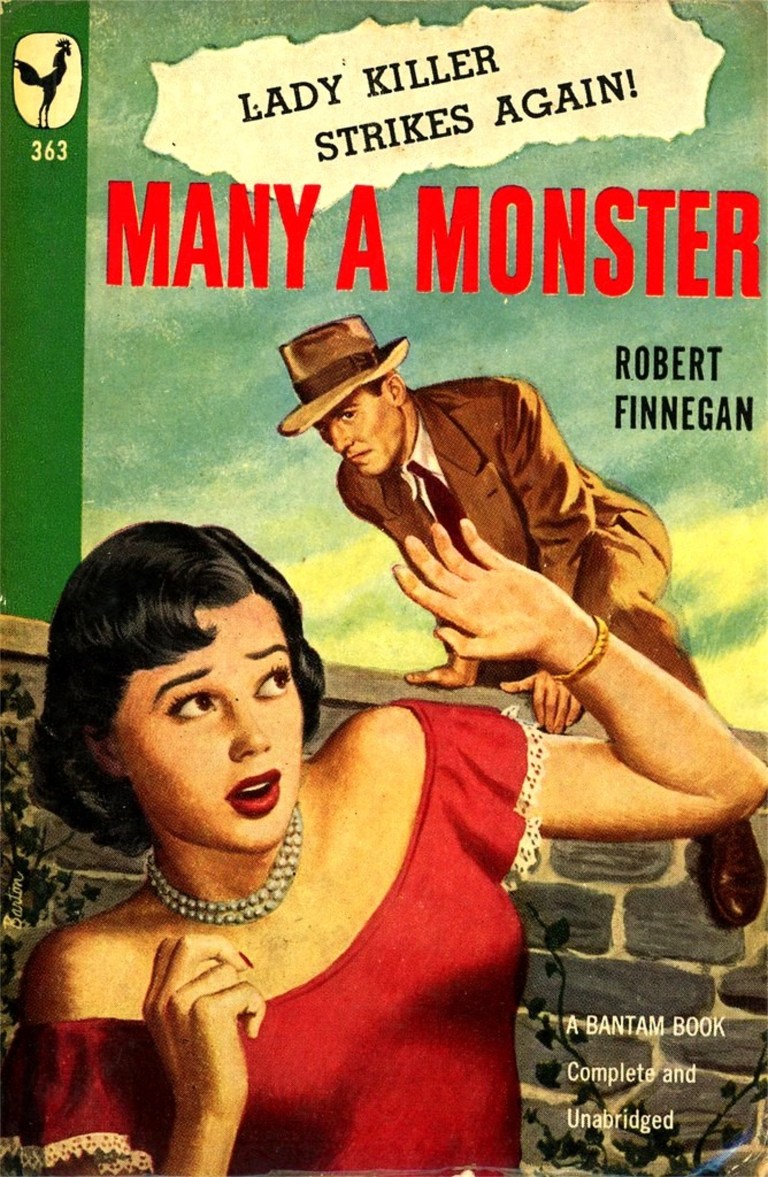 In ‘Many a Monster’ written in 1948 by Robert Finnegan, Dan Banion is a newspaper reporter trying to prove the innocence of a fugitive from the police, hiding in San Francisco and wanted for the gruesome serial killings of four women.
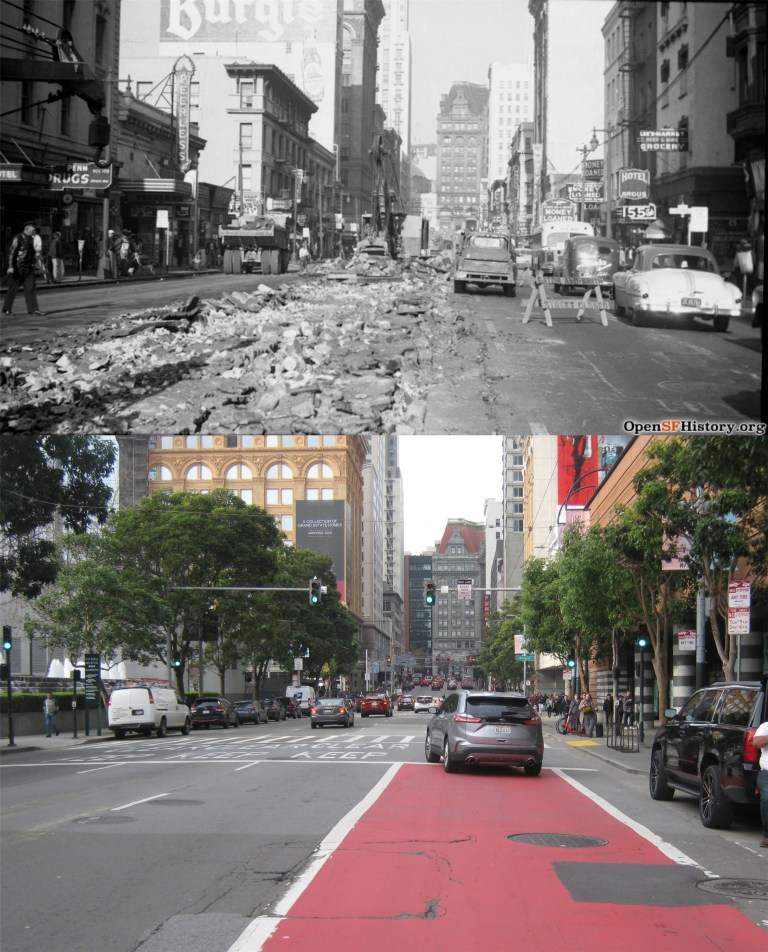 Read Banion’s dreary description of 3rd Street as he turns onto it from Market Street looking for clues.
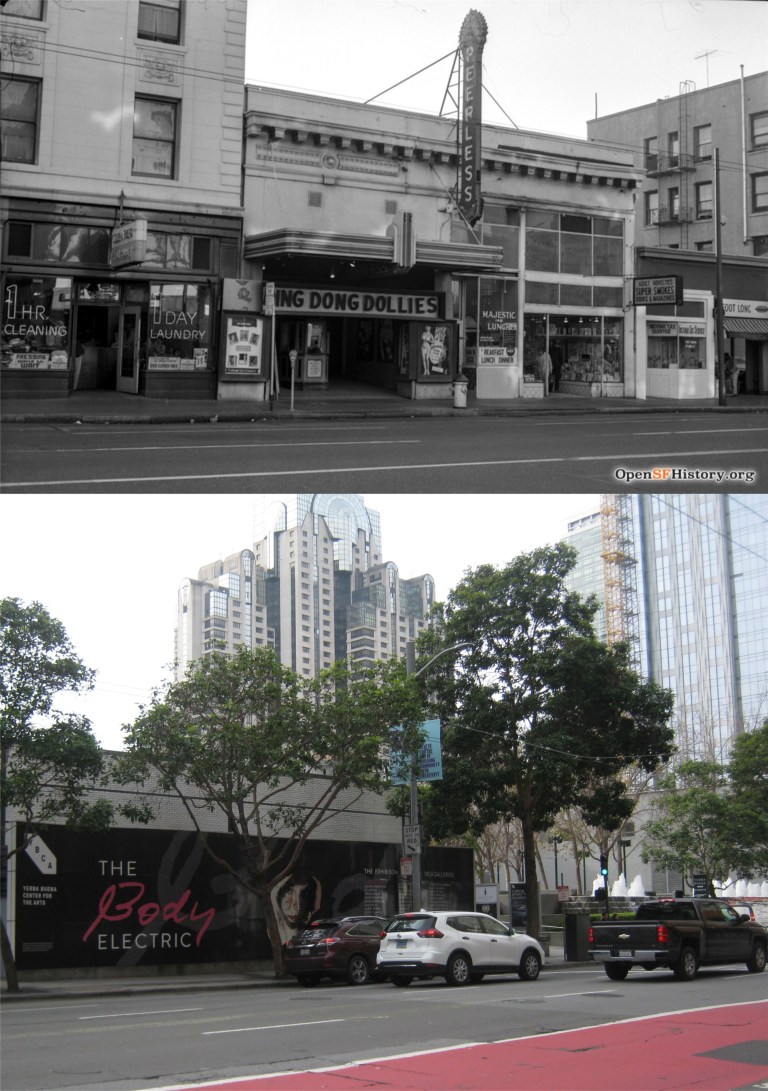 {Farther up the street, Dan could see the neon sign of the Regent Theater projecting over the sidewalk.}
 In ‘My Dead Wife’ (Is that a grabber title or what?) written in 1948 by William Worley, Frank Terrance who lives on the Telegraph Hill part of Kearny Street, (Curiously, the author spells it Kearney Street) is a depressed and lonely man in love with his unfaithful wife who has left him. His wife, Jessie, shows up at his apartment in the first chapter broke and obviously in some type of trouble. Torn between his feeling for her and aware that she doesn’t love him, he begins drawing back to her in spite of himself. Hey, we’ve all been there. The reunion doesn’t last long because while he’s in the kitchen mixing Jessie a drink she’s shot to death while sitting in his arm chair. Well, at least Frank had the sense enough to slam down the drink he made for Jessie when he saw her bleeding in the chair. After kneeling on the floor by her to make sure she’s dead, Frank panics fearing he may be blamed and quickly leaves his apartment.
 {I walked down to Columbus and turned into Grant Avenue. I walked at a steady, easy pace through Chinatown towards Market Street. I went past the wailing and whining of the Chinese theater, past the night clubs and their displays of Chinese fan dancers, past the bars and chop suey parlors, the joss houses, the entrances where tourists never go, past the glittering Chinese art stores and the stench of poultry and fish markets.}
 Terrance stops at his walk along Grant Avenue here at Grant and Geary Blvd. and goes into a cocktail lounge and begins to drink heavily until he notices the other customers staring at him with curious looks. He discovers that he has blood on his face and clothes from his murdered wife. The vintage picture is from 1957.
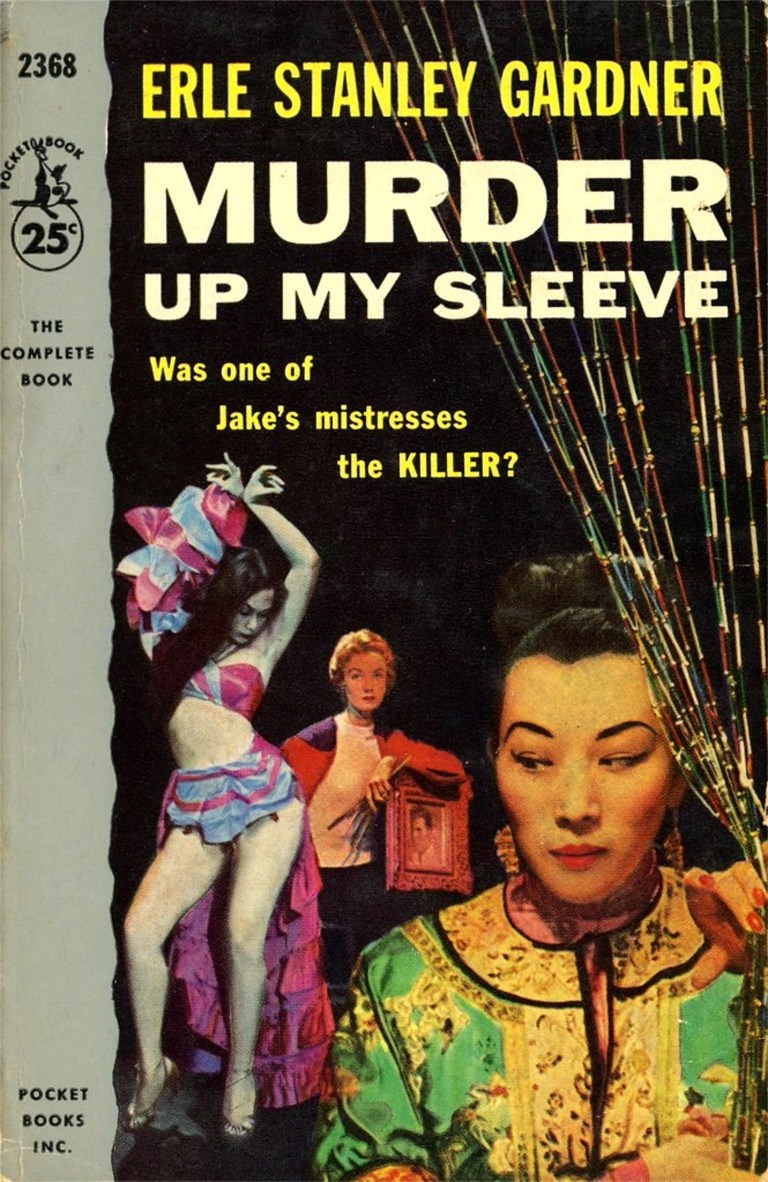 ‘Murder Up My Sleeve’ was written in 1937 by Erle Stanley Gardner, the creator of Perry Mason, although Perry Mason isn’t in this book. I liked this one the best; however, some readers might find it lacking in action. Much of the dialogue between the characters is surprisingly contemporary, and I developed a crush on Cynthia Renton right from the first page she appears in. Our hero is Terry Clane who is often referred in the book as an “adventurer”. Clane is summoned to the District Attorney’s office in the opening of the book because a blackmailer named Jacob Mandra has been murdered with a “sleeve gun”. A sleeve gun is a weapon that can be hidden in the sleeve and fires a deadly dart that can be launched by pressing your arm against a solid object, such as a desk. Terry Clane owns such a weapon.
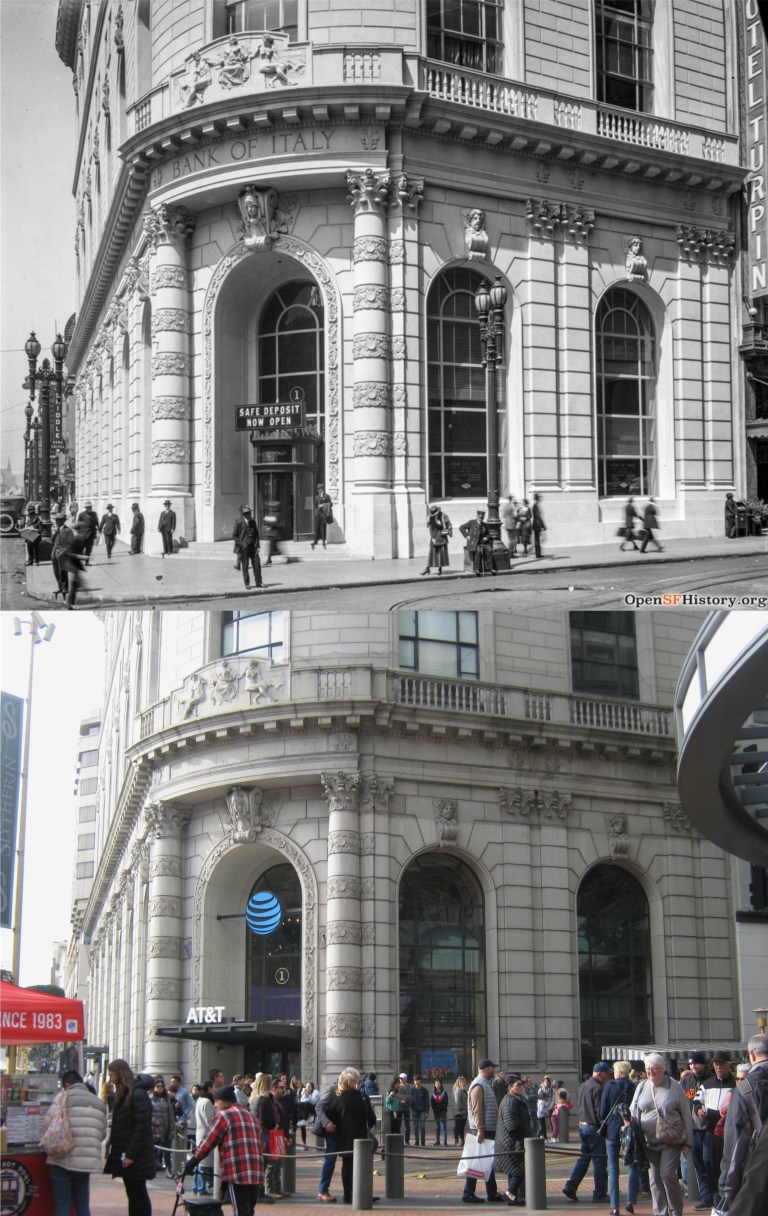 The District Attorney tries to intimidate Clane by reading to him from a dossier his office has collected on our “adventurer”, including this information.
 Clane travels through the Stockton Tunnel to Chinatown to visit Chu Kee who lives on Stockton Street. Chu Kee’s daughter, Sou Ha, knew Jacob Mandra and was one of the last people to see him alive. Clanes’s encounter with Chu Kee and Sou Ha has an atmosphere of danger that reminded me of when Bette Davis goes to meet mysterious Gale Sondergaard to purchase a letter that will incriminate her in the murder of her lover in the 1940 film ‘The Letter’. Clane describes coming out of the north end of the Stockton Tunnel and entering Chinatown.
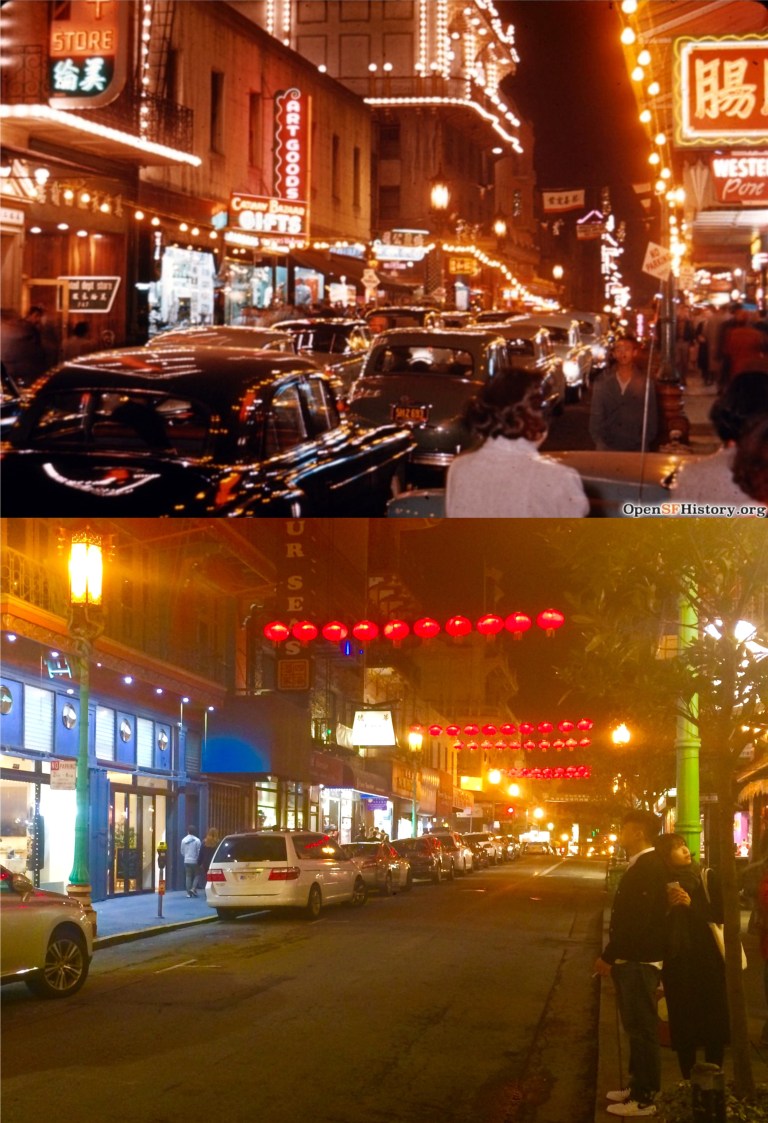 Later on Clane drives along Grant Avenue in Chinatown at night with Sou Ha.
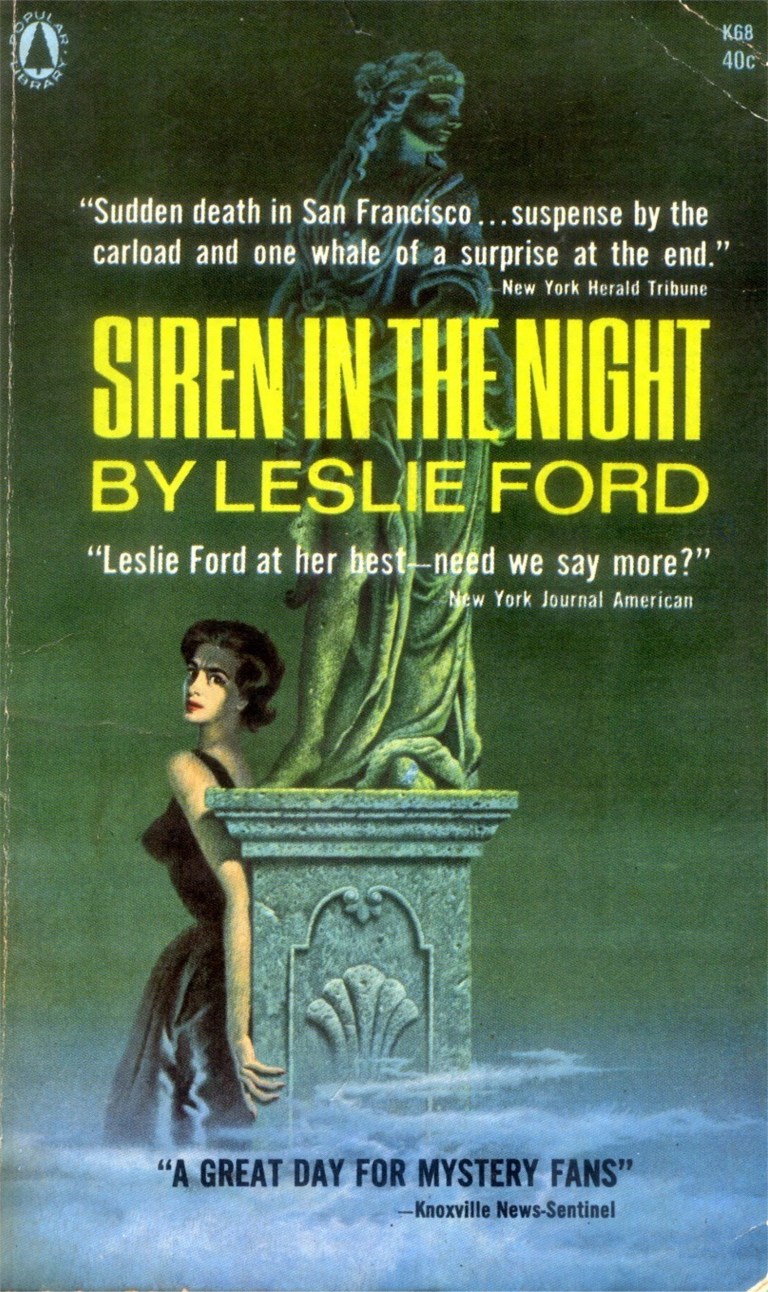 ‘Siren in the Night’ written in 1942 by Leslie Ford received the best reviews of the books I read, but I found it really slow in parts. It concerns a murder committed during a blackout and siren warning alerting San Franciscans of a possible air raid that was common in the city in 1942. In one chapter the heroine, lady detective Grace Latham, walks down Nob Hill with a Colonel John Primrose from the Mark Hopkins Hotel to Jack’s Restaurant on Sacramento near Montgomery Streets. Written in first person, Detective Latham describes the San Francisco sites as they walk along.
 {We walked down California Street. The cable cars clanging up the hill were jammed with people sticking on like caviar on a forty –five degree oblong of toast.}
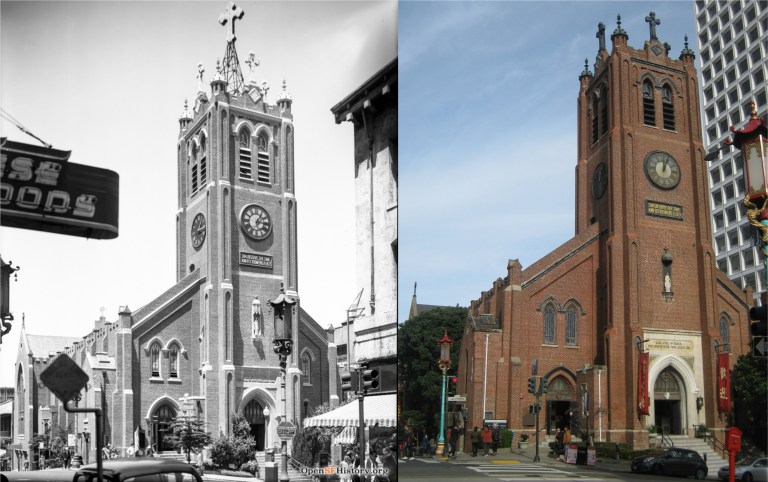 {The clock on the square dark tower of St. Mary’s was striking seven. The gold inscription above it – “Son Behold the Time and Fly From Evil” – was glistening in the low shafts of sunlight through the Square across the street.}
 {The sun shone too on the stainless steel robe of Sun Yat-sen , his rose marble face , benign and placid, gazing out over the green Square.}
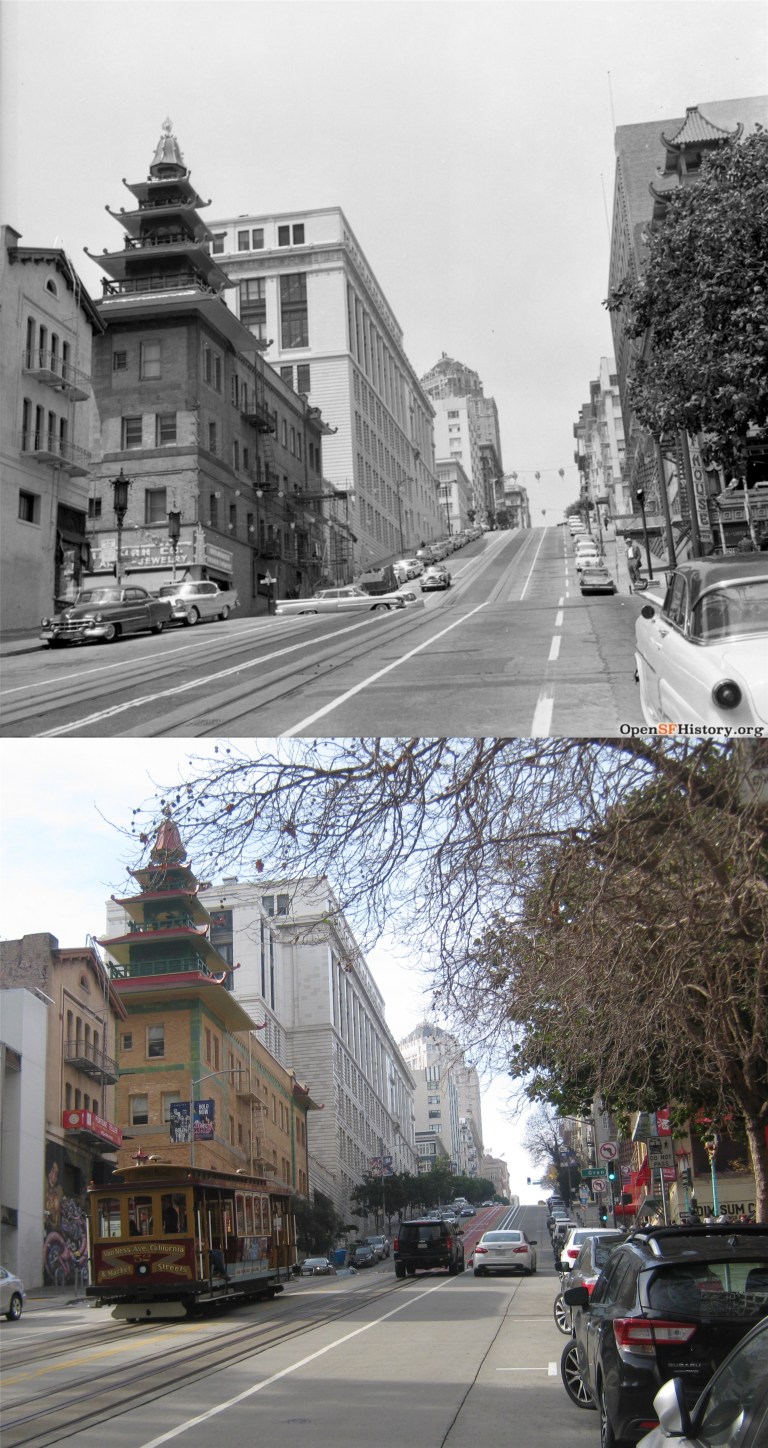 {We turned the corner where the five-tiered pagoda towers stand, green and yellow faded to chartreuse.}
 {We turned down Sacramento Street through the crowded section where Chinatown streams across it into the deserted stretch toward Montgomery Street. There was a parking lot on either side of the restaurant we were going to.}
 ‘Murder Loves Company’ is a long out of print book written in 1940 by John Mersereau. It takes place during the second year of the Golden Gate International Fair on Treasure Island. Although, corny at times, it’s page-packed with descriptions of many of the fair’s attractions and the best first-hand account of the world’s fair you’ll get in a book of fiction.
 The book opens up with a deadly accident just east of the Yerba Buena Tunnel that nearly involves Professor Biddle and a lady reporter named Kay Ritchie as they exit the tunnel while driving across the Bay Bridge to Berkeley.
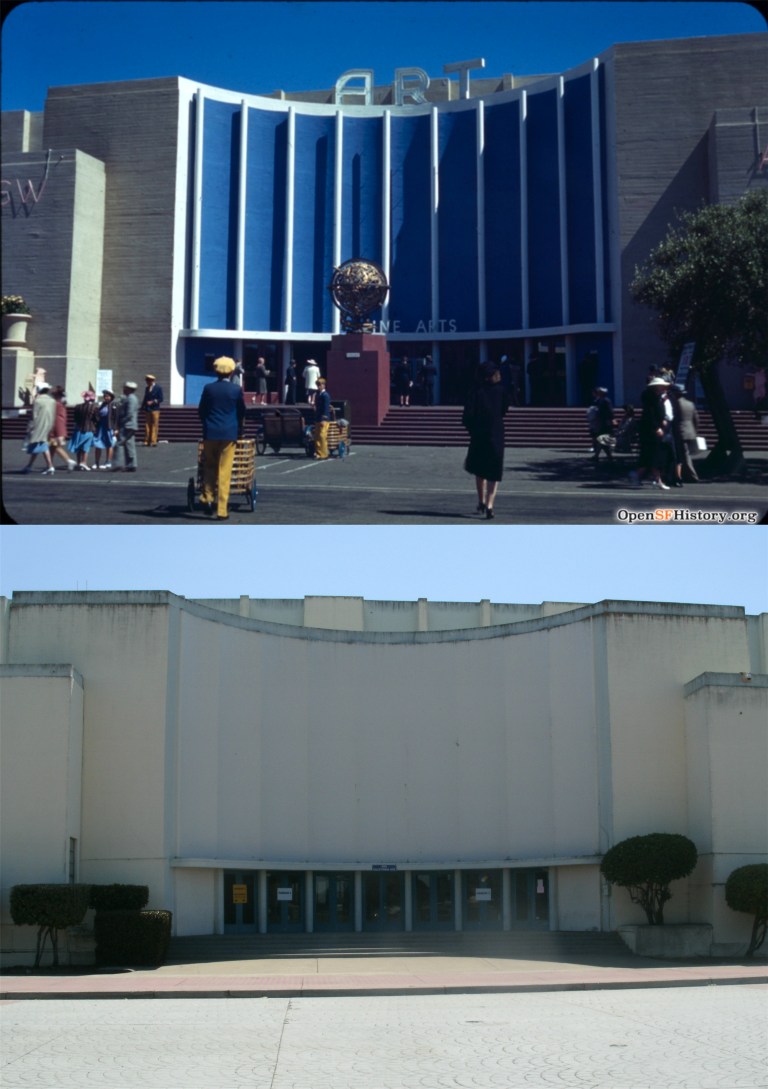 Later on in a visit to the fair, the book describes the Treasure Island attraction this way as Professor Biddle takes a ferryboat to the fair
 The film stars George Raft. Raft originally made it on the map with his coin flipping gangster scenes in the 1932 movie ‘Scarface’ with Paul Muni. Check out Bugs Bunny’s George Raft impersonation on the link below.
 Raft’s girlfriend is Marilyn Maxwell, who helped introduce the song ‘Silver Bells’ with Bob Hope in ‘The Lemon Drop Kid’ from 1951.
 The film also co-stars Harry Morgan, probably most famous as Colonel Potter in the television show ‘M*A*S*H’.
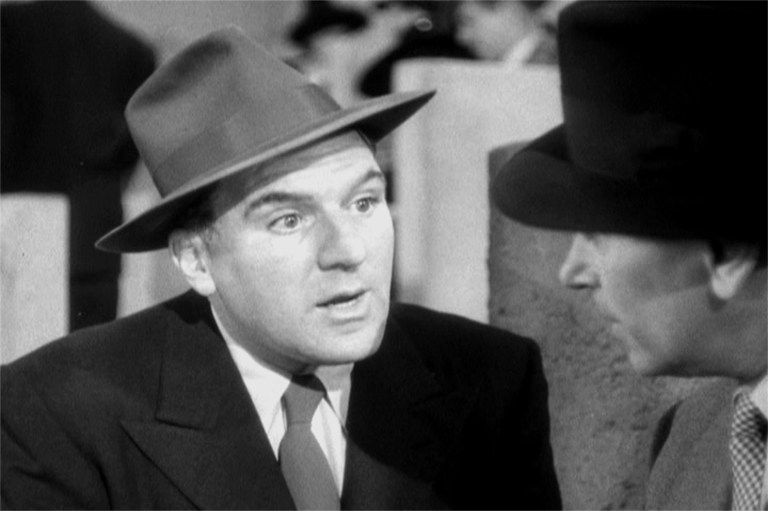 But to me the star of the movie is the character actor William Bendix. I like him in everything he was in. His best role was probably Gus in Alfred Hitchcock’s 1944 film ‘Lifeboat’. “Give us a kiss, toots.” Gus says to Tallulah Bankhead as she’s about to assist in amputating his leg. (She does) Bendix plays a nice guy cop trying to keep Raft out of trouble.
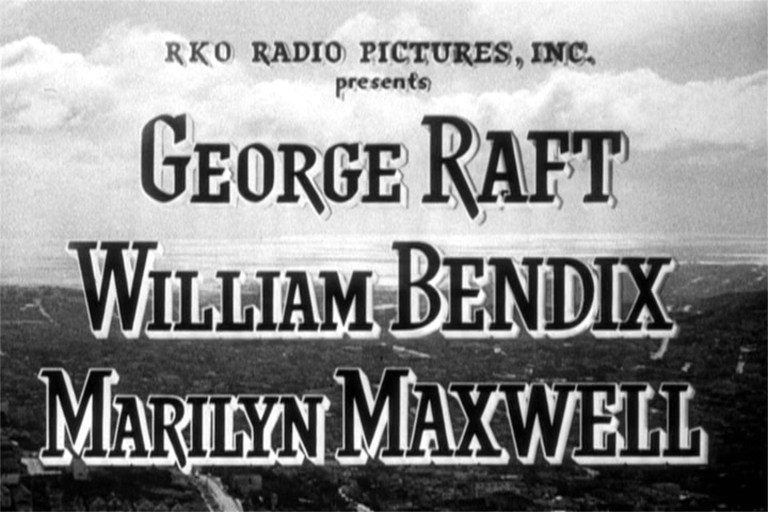
 The movie shows a panoramic sweep of San Francisco from Twin Peaks behind the opening credits.
 The view from Twin Peaks now:
 The movie opens up with a 1948 view from the Top of the Mark.
 The story starts out showing a number of San Francisco locations. This is the cable car turnaround at Powell and Market Streets looking toward Eddy Street. The building with the Gray’s Suits advertisement was demolished and Eddy no longer cuts through to Market Street. This is where Hallidie Plaza is now. You can see the old JC Penny’s Store building on the corner of 5th and Market Streets in both pictures.
 This is Montgomery Street at Market Street looking north.
 The action starts with a customer going into the clothes store front for Raft’s bookie business on Post Street across from Union Square. The building the clothes store was in may have been the fashionable men’s store, Bullock & Jones, which is now Williams-Sonora. The building is still there.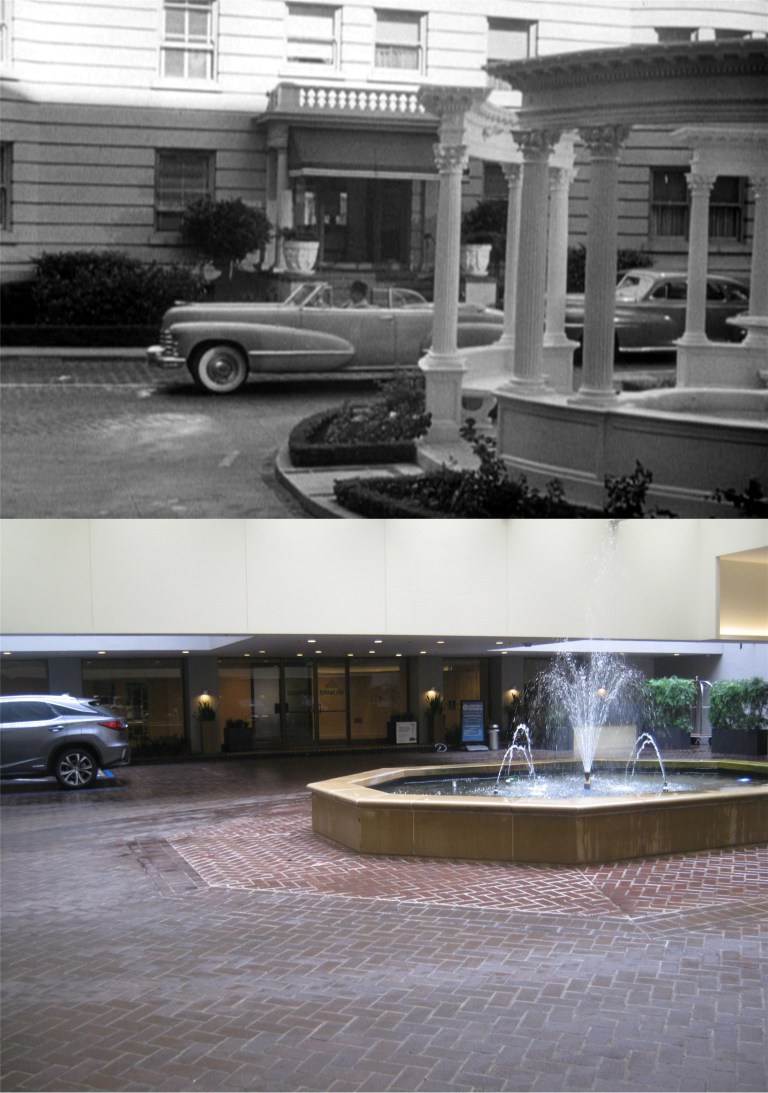
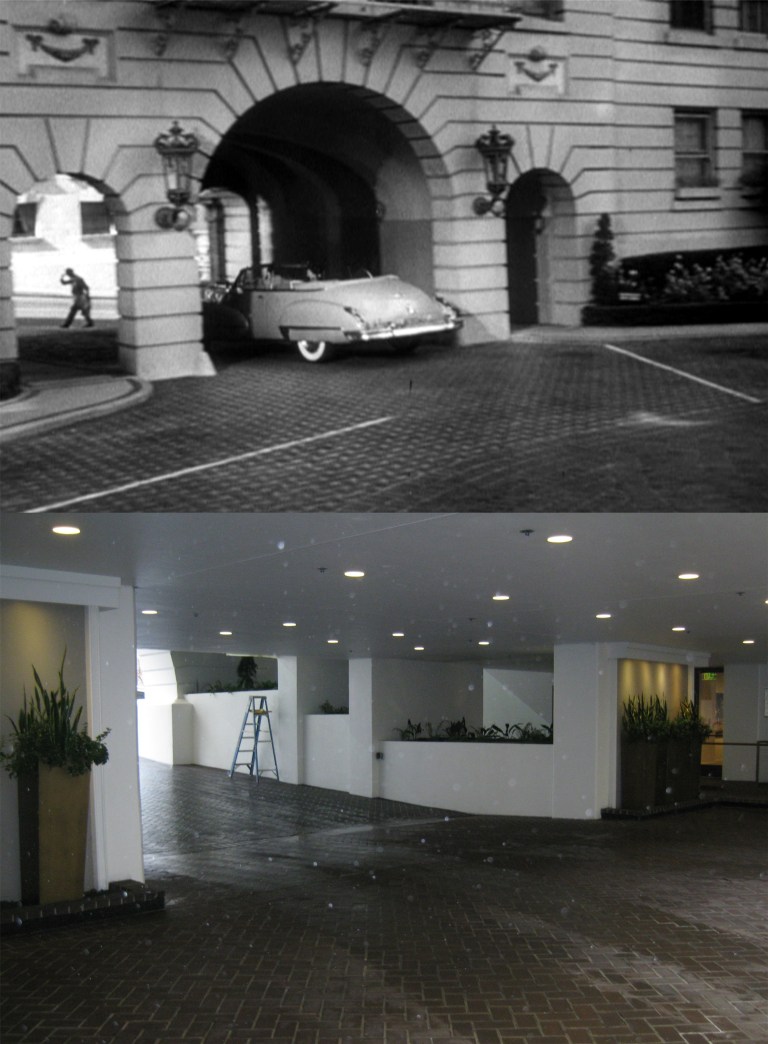 Raft’s squeeze, Marilyn Maxwell, lives in the Stanford Court Building on Nob Hill on California Street. Here, they’re leaving the courtyard, still there but not as fancy.
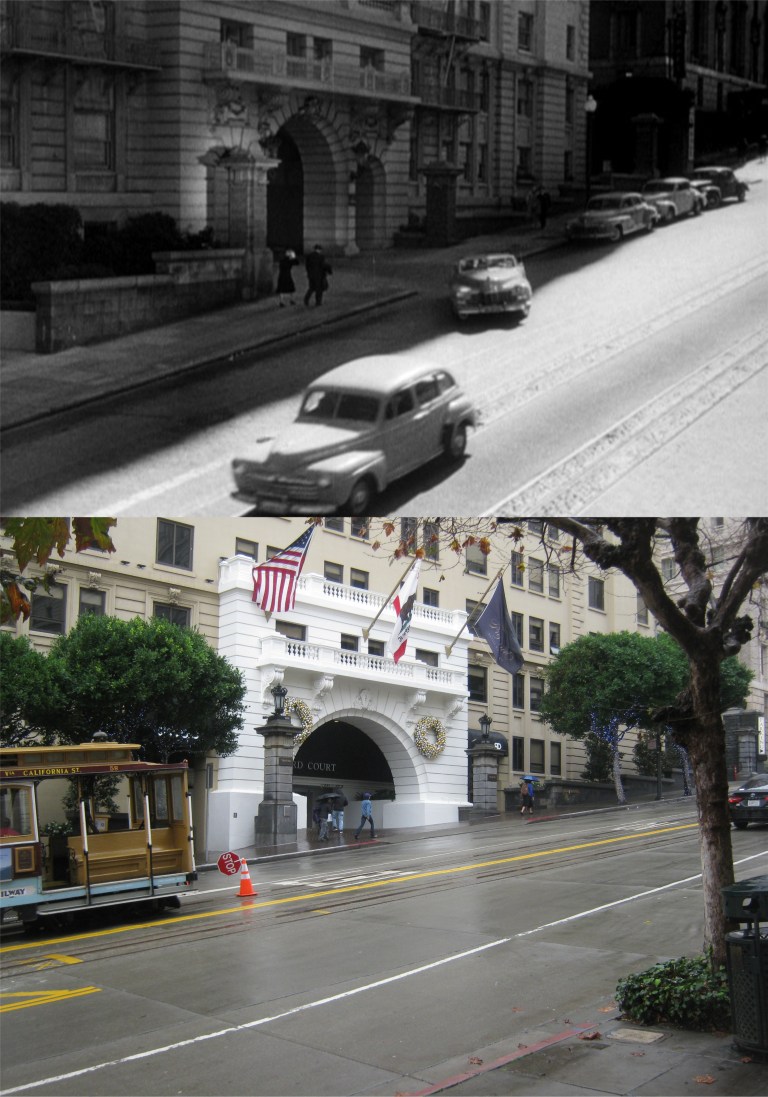 They merge onto California Street across from the Fairmont Hotel.
 They cross Powell Street at California Street, the only place where the three remaining cable car lines cross each other.
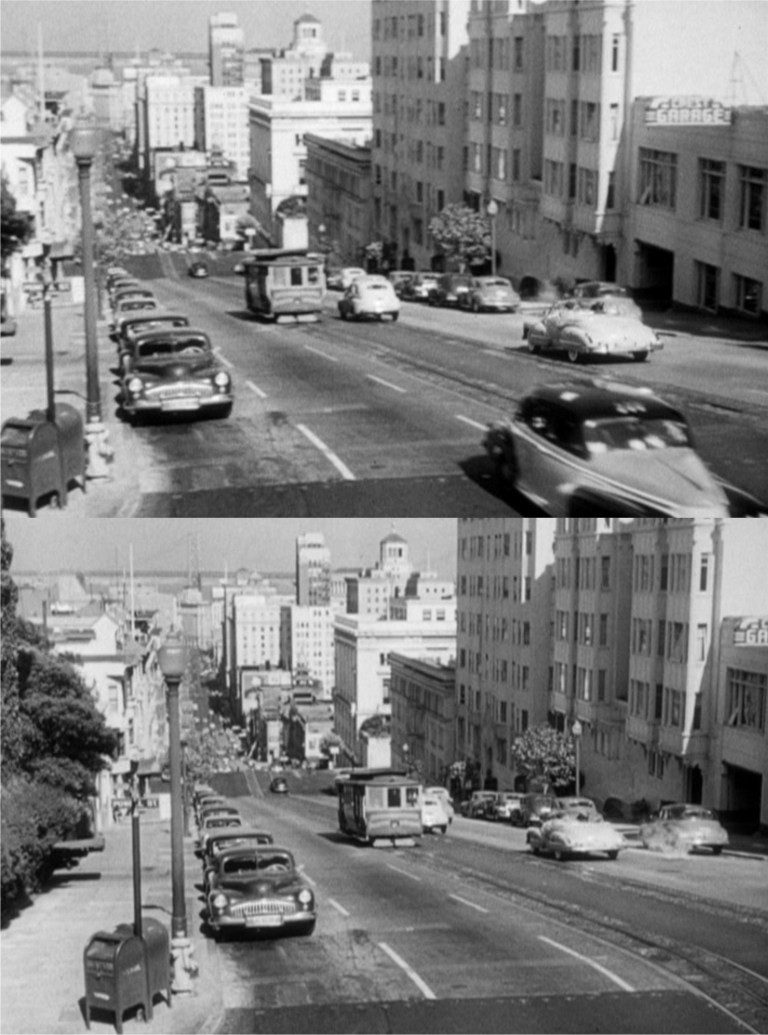 The two head down California Street past the old Crest Garage, demolished in 2018.
 The view down California Street from here now:
 Raft lives on Nob Hill as well at an apartment building on the southwest corner of Jones and California Streets. The tall building in the far background is the old Empire Hotel Building in the Civic Center area. You can just barely see it through the rainy mist in my picture.
 He drives down the west side of Nob Hill and turns into his parking garage.
 I’ll have to ask my arborist friend, Tony, if that could possibly be the same hedge that was growing there in 1948. He’ll probably think that’s a ridiculous question, but I have vines growing in the back yard of my house that go back to the 1960s.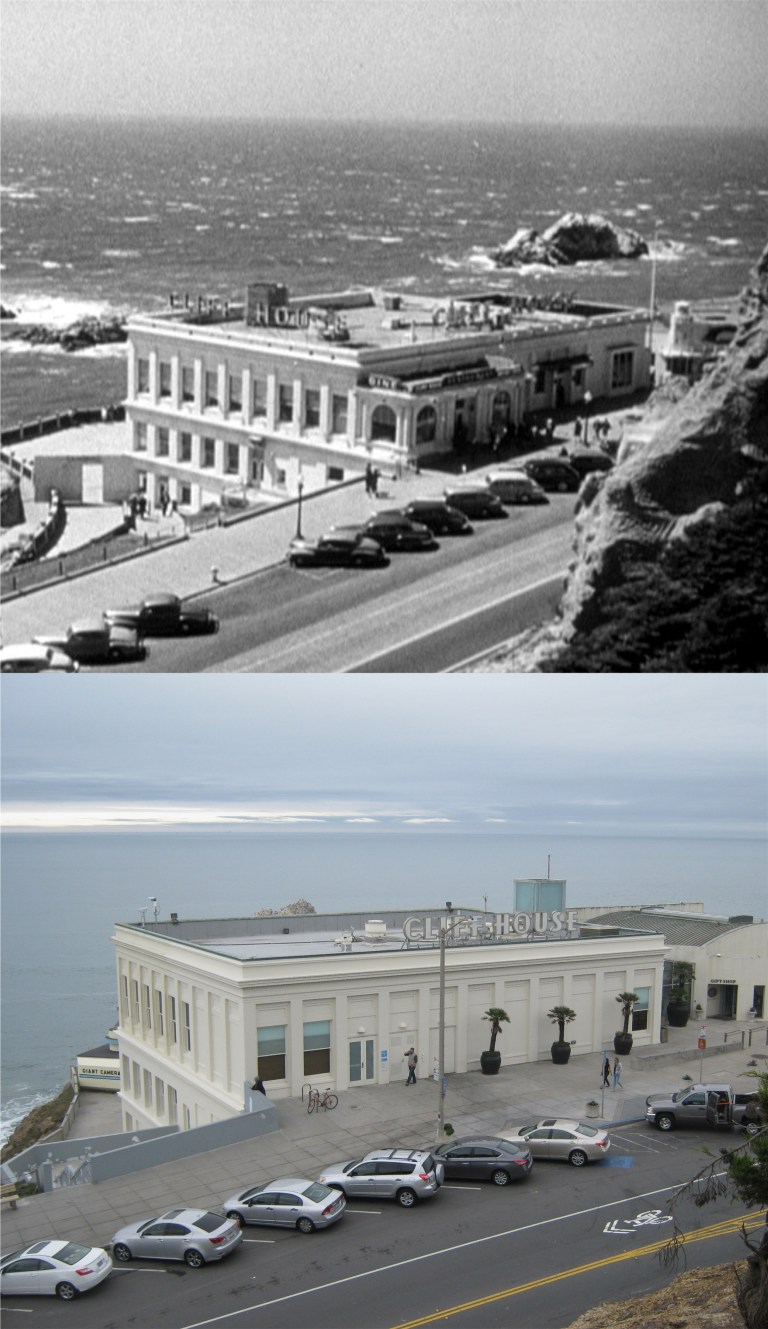
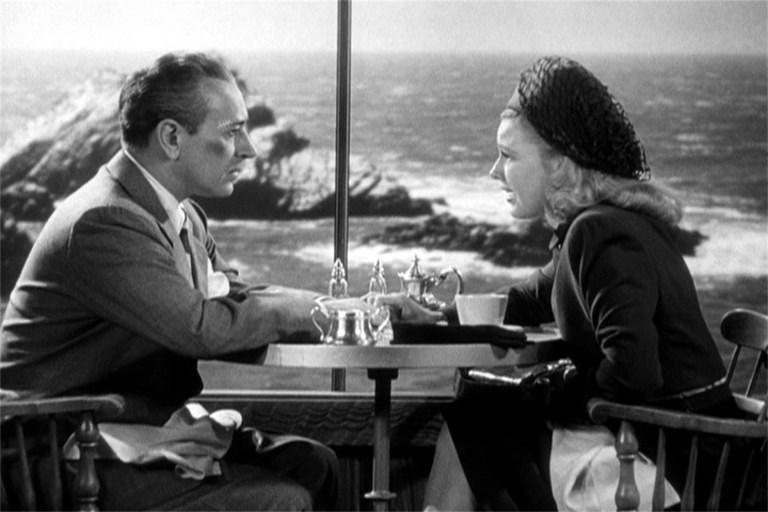 The movie even takes a trip out to the Cliff House where Raft has lunch with his sister who is worried about his prospects for bucking the mob. Seal Rocks are in the background of the lunch scene.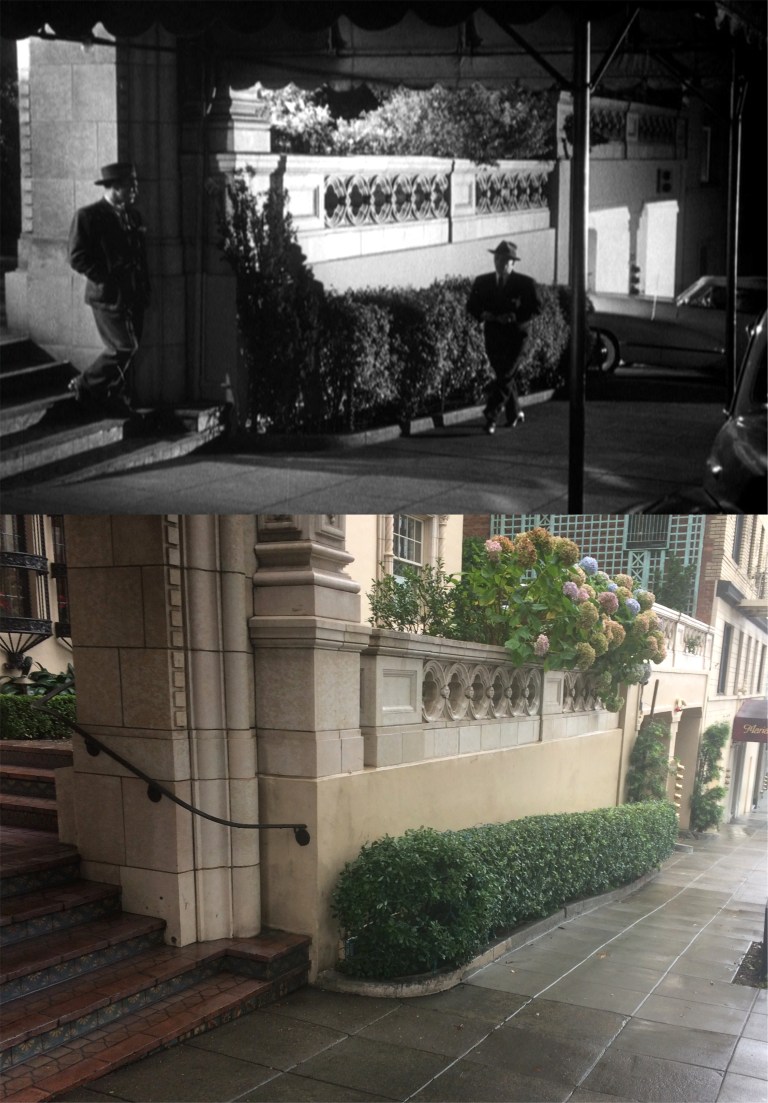
 I’ll close with a few of the scenes filmed at night. Refusing to be intimidated by the mob, Raft is intercepted by one of “the boys” going into his apartment. I’ll bet he has a gun in his pocket! I’m bright about things like that.
 Raft gets taken for the proverbial “ride”. It’s never a good sign when one of the hoods gets in the back seat with you and not in the empty front seat.
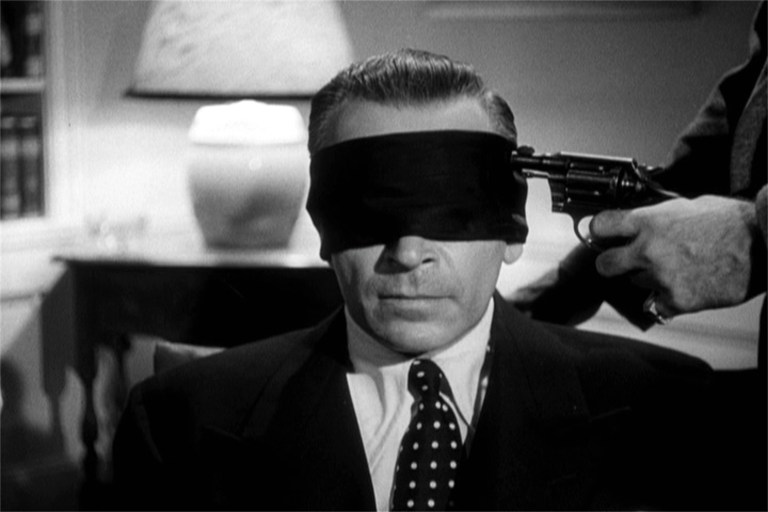 Mr. Big, played by Frank Faylen, tells Raft he had better get in line. This would certainly persuade me! Raft plays along with him to bide time, although they rough him up pretty good.
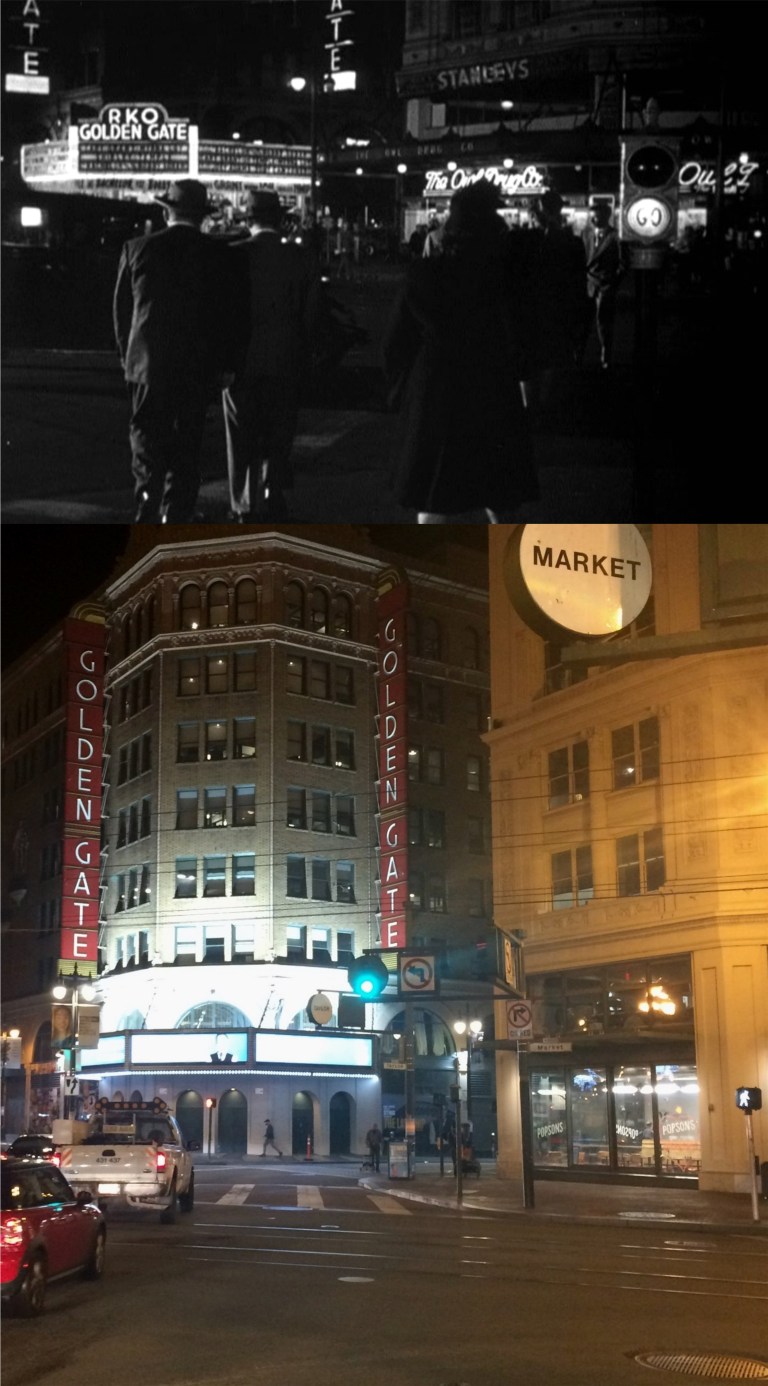 In one scene, Bendix tries to talk Raft out of taking the mob on without involving the police as they cross Market Street from 6th Street toward the Golden Gate Theater, at that time owned by Howard Hughes’ RKO Movie Studio.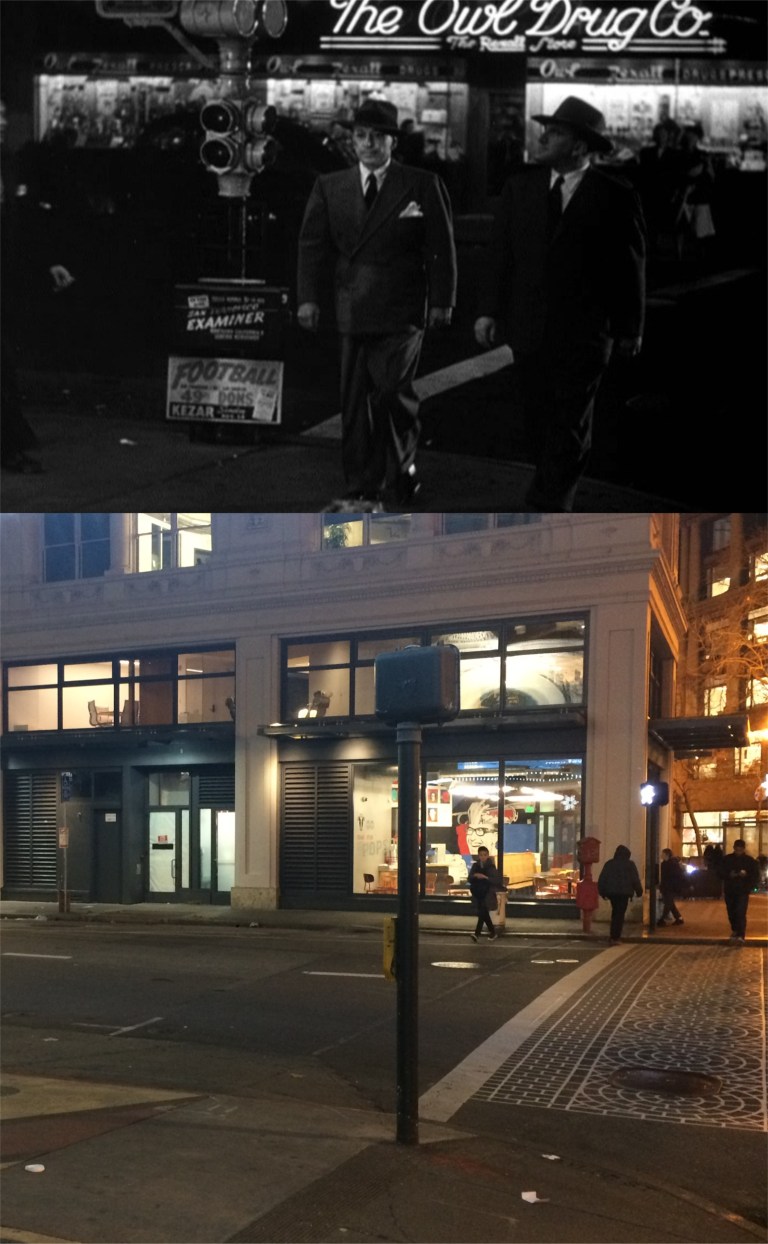
 The movie ends back where it began at the Top of the Mark for a nighttime view of the City, and closes out overlooking the Embarcadero and the Bay Bridge. The closing music even plays a little of ‘San Francisco’ from the 1936 movie.
