Some of my pictures here may be slightly outdated now and some would just be fun to redo, but these are on my list of comparison pictures I’d like to do again.
 Nick and Nora Charles getting pulled over on the Bay Bridge while they were heading east to the Golden Gate Fields in Albany in the 1941 film ‘The Shadow of the Thin Man’. A lot of new buildings have sprung up in SOMA since I took this picture about 7 years ago.
 I should redo this one I did in 2013 in honor of the closing at the end of this year after running for over 45 years of the San Francisco musical ‘Beach Blanket Babylon’.
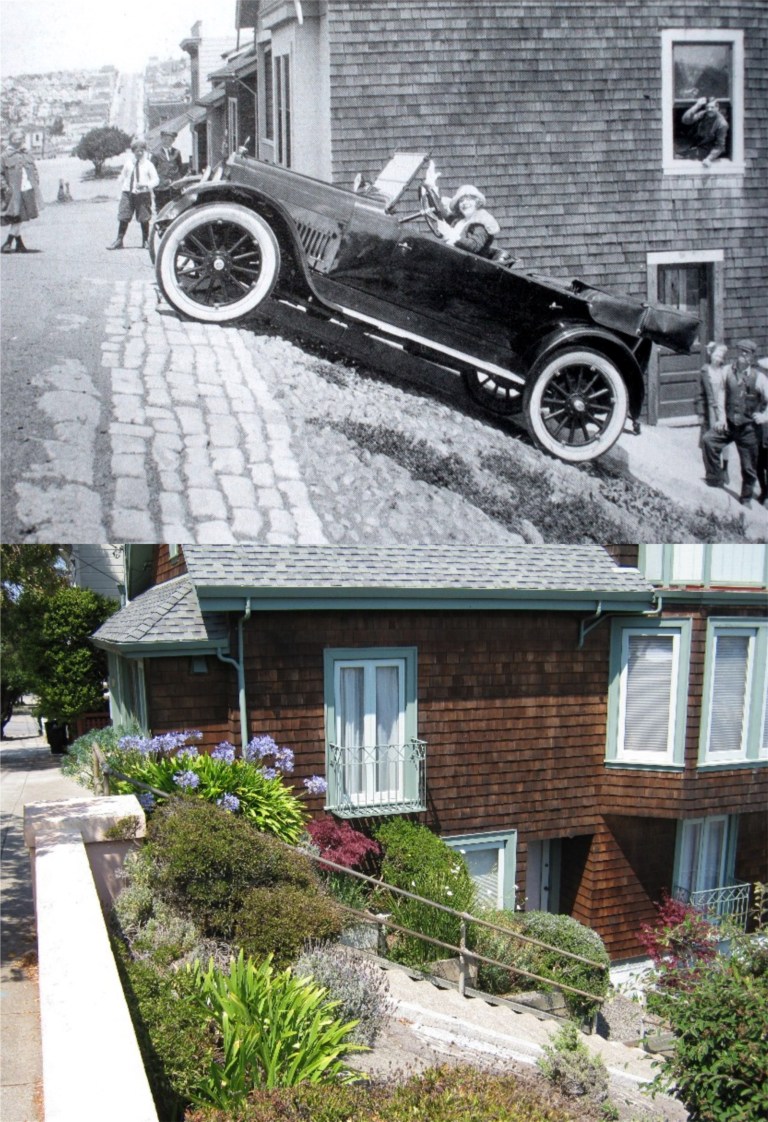 I’d like to redo this 1920’s photo from the Image of America Series taken at the top of Duncan Street in Noe Valley just to go there again.
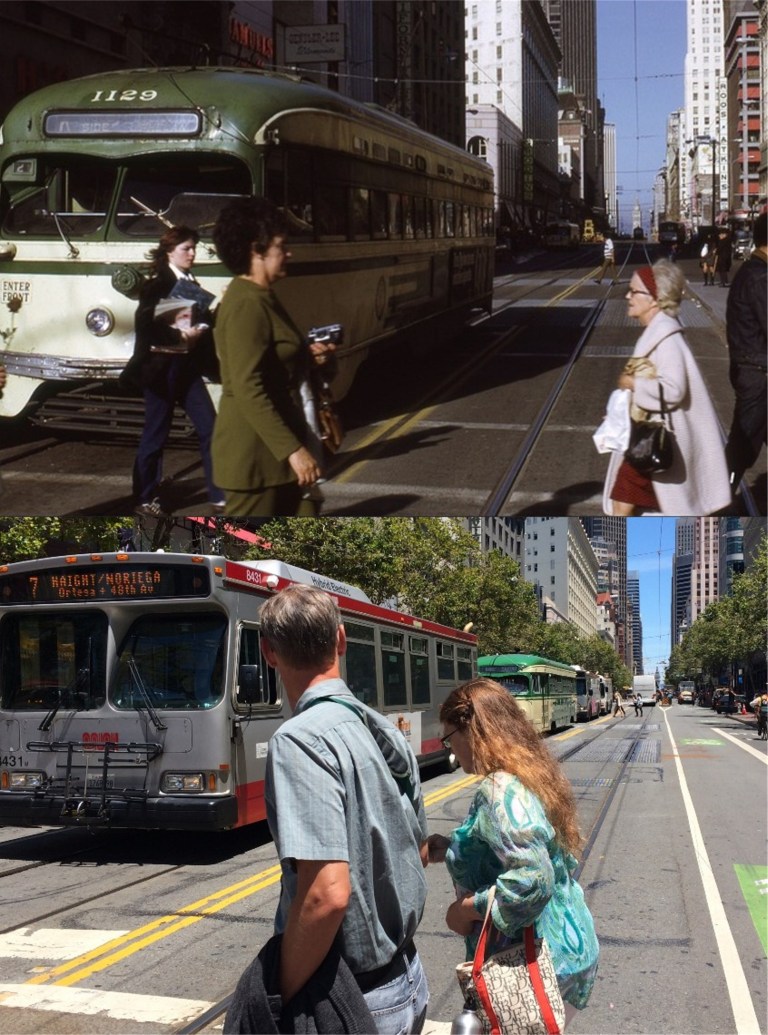 Market Street at Powell Street in the 70s: Ah, if only the vintage F Line streetcar behind the number 7 Muni bus would have been the one in the lead!
 I was leaving Treasure Island with friends in October of 2014 when this view of the eastern span of the Bay Bridge being dismantled reminded me of a fuzzy picture had in my computer of the bridge being built from this angle. I snapped a quick picture as we passed. I’d like to redo it, but never will.
 Looking south toward the old Southern Pacific Train Depot and the Lefty O’Doul Bridge from Brannan Street in the 1940’s: I’ll have to borrow someone’s crane if I’m going to get this one accurate in a redo.
 The opening of the Bay Bridge in November of 1936: As I mentioned in the opening picture to this post, a lot of new buildings have sprung up in the background since I took this picture in January of 2015.
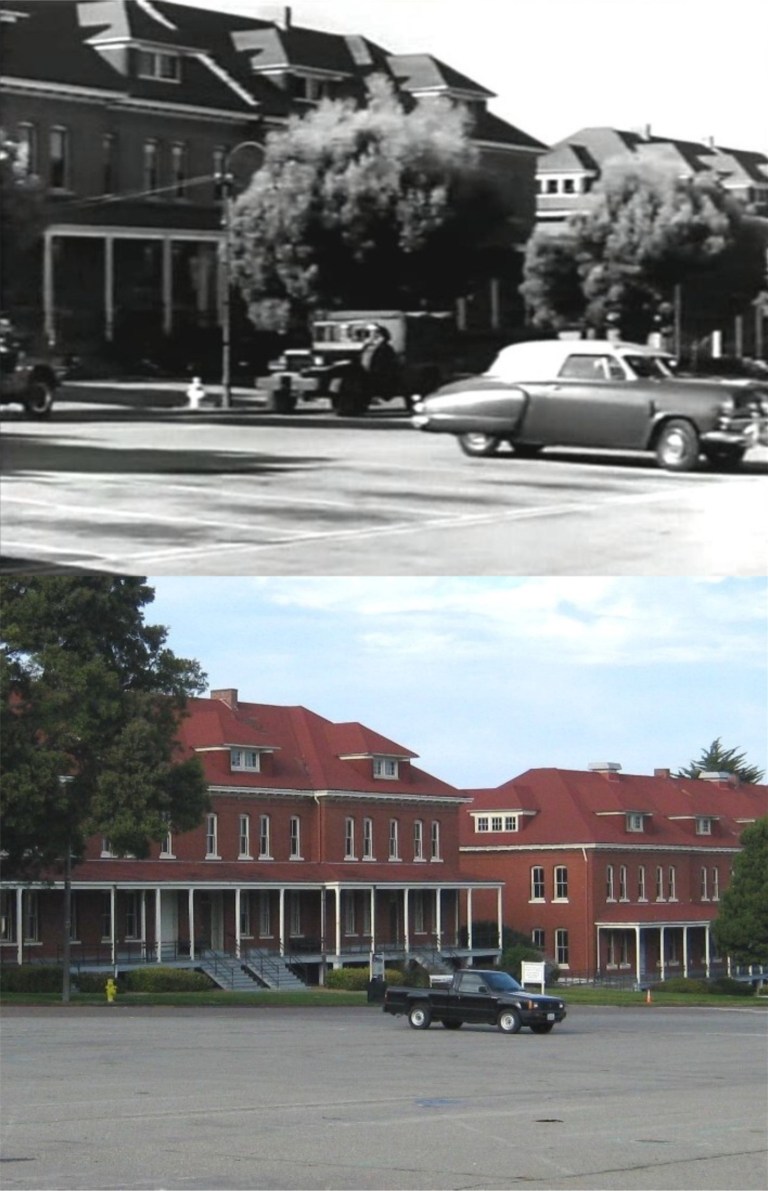 The old Montgomery Barracks in a scene from an odd 1950 film called ‘Experiment Alcatraz: Here, prisoners from Alcatraz Prison are being transported by the army to a location in the Presidio to participate in a medical experiment that may earn them their freedom. To me, the star of these pictures is my old truck that still runs. This area is all grass now, and more visitor friendly than when I took the original picture.
 I should probably redo this one on a regular basis to see if this building on the corner of Hayes and Laguna Street continues to survive. This was where the dental office of John McTeague was located in the 1924 film ‘Greed’, a movie that is considered one of the greatest films of all time.
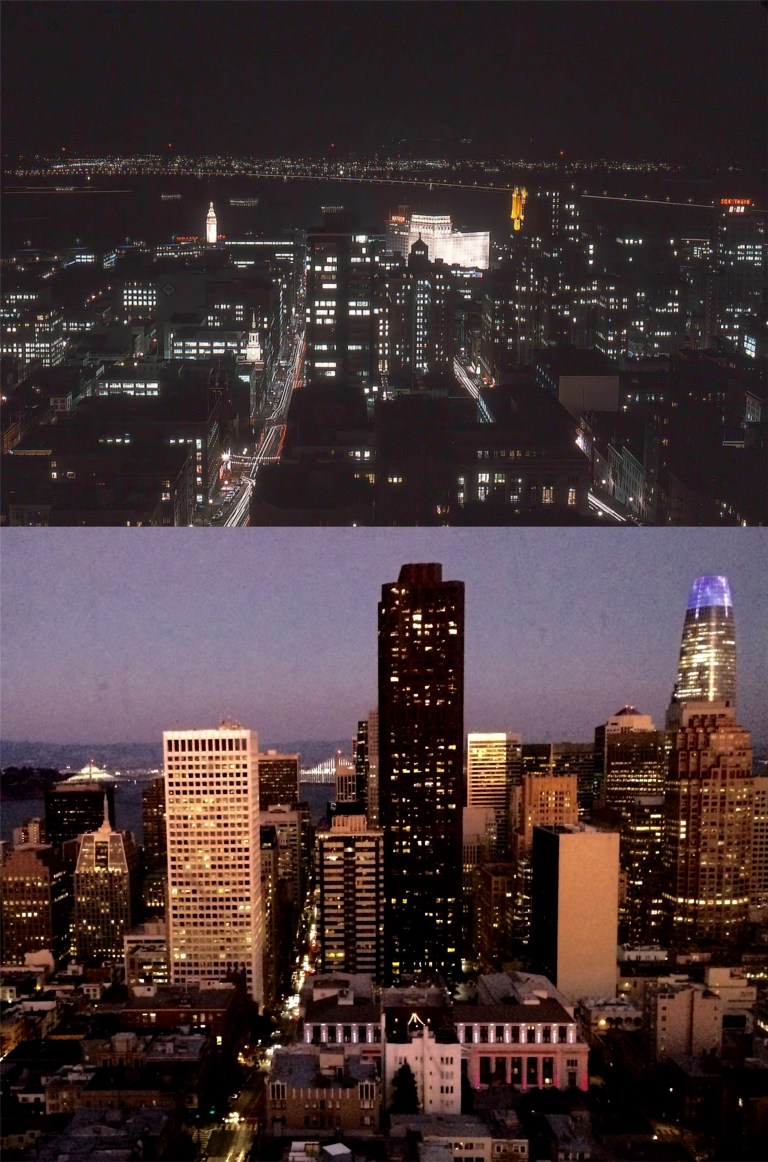
 Almost a perfect matchup, except that I’m 210 feet higher than from where the vintage postcard was taken: I’ll redo it from the Coit Tower parking lot instead of at the top of the tower after they cut back all of those trees blocking most of the view from the parking lot nowadays.
 Buffalo Bill at the Cliff House: I’d give anything to redo this one if my best friend could be in it again.
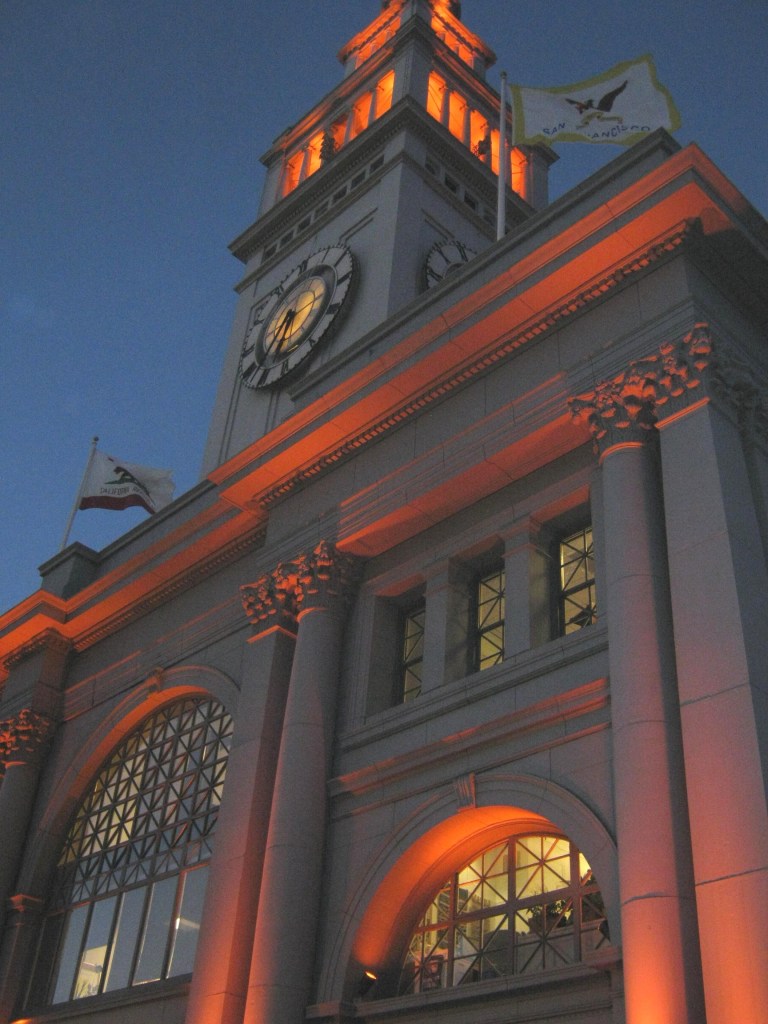 The Ferry Building on Halloween, 2010: No, that orange wasn’t for Halloween, the Giants were just about to win their first World Series in San Francisco. I’ll redo it again the next time they win the World Series.

 Last February I mentioned that someday I’d like to redo the top then and now picture I posted of the east entrance to the Union Square Garage taken during the 1940s. The source of the vintage picture was the Facebook page San Francisco Remembered. The Stockton Street construction on the Muni Metro extension to Chinatown made for a poor comparison picture back then. They’ve finished this portion of the new rail line and I was able to get a better then and now picture in between rain showers today. Back in the 40s Union Square had four entrances and exits; north, south, east and west. Today, there’s only the north and south drive-through on Post Street and Geary Street.
 With lower Stockton Street open again after so many years they’re not about to close it again, so they moved the street mall to Grant Avenue between Geary Blvd. and Post Street, and Maiden Lane. The vintage picture here on Grant Avenue is from 1960. (Source, opensfhistory.org)
 The pedestrian mall used to run along Stockton Street from Market Street to Geary Blvd for years. This picture of mine was taken in 2016 between O’Farrell Street and Geary looking toward the old Macy’s clock. The vintage picture is from the 1940’s.
 There were a lot of Maidens in Maiden Lane in this picture from 1949. (opensfhistory.org)
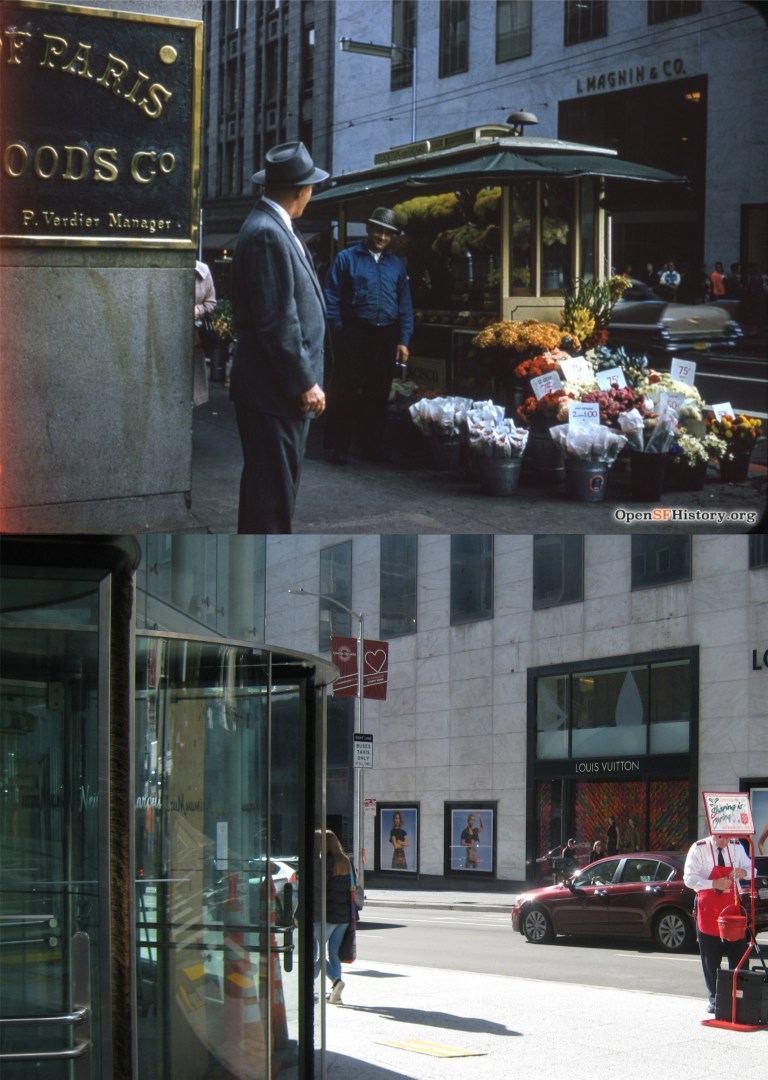 The southeast corner of Stockton Street and Geary St. in 1958, looking toward the old I Magnin Department Store: The vintage picture was taken near the entrance of the much loved City of Paris Department Store. (opensfhistory.org)
 The City of Paris seen from Union Square in the 1940s: Forsaking a rally to save the old landmark building, it was demolished in 1979. The Neiman Marcus Department Store is there today. (SF Chronicle)
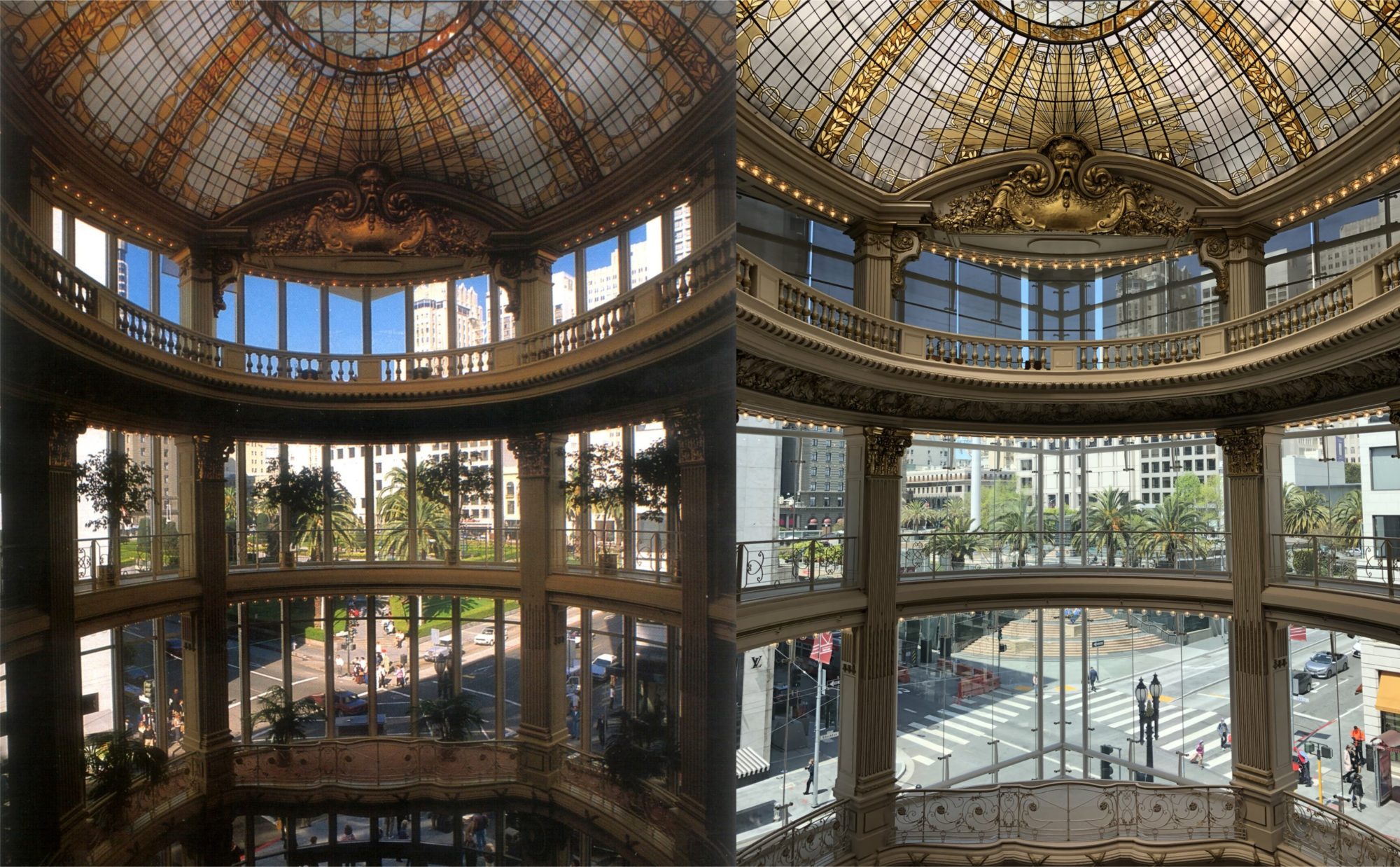
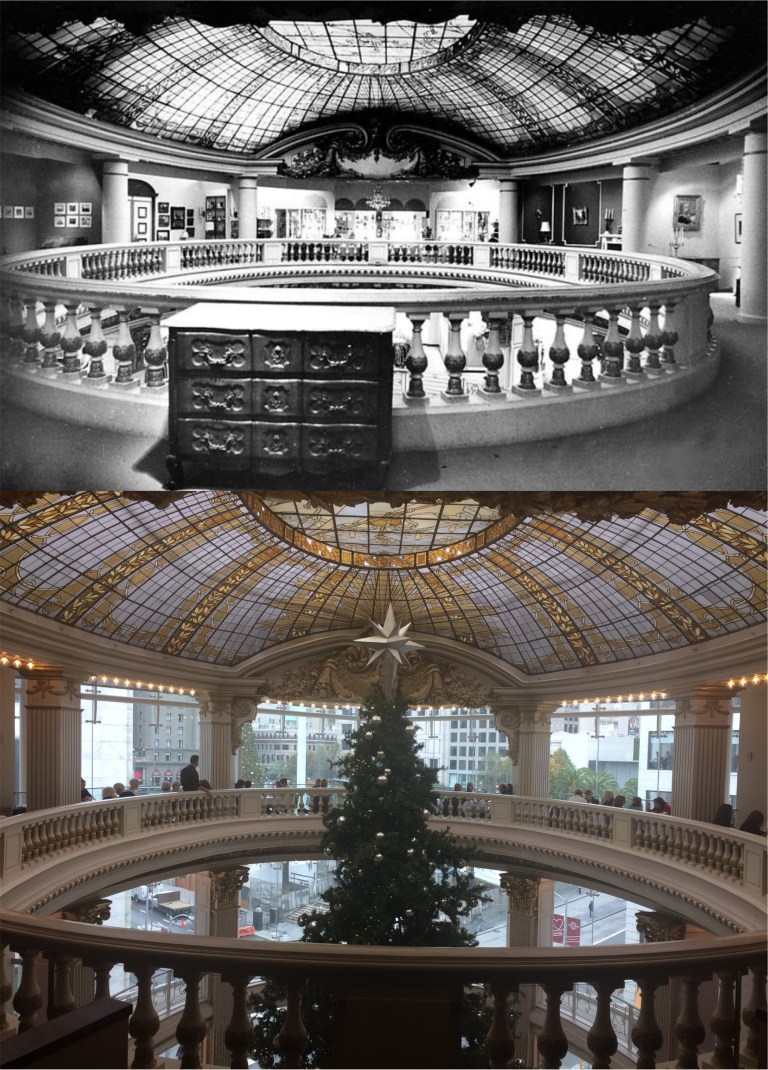 Neiman Marcus had the class to save the painted glass ceiling from the rotunda of the City of Paris, and you can step back in time for a minute when you go up to look at it. (SF Chronicle)
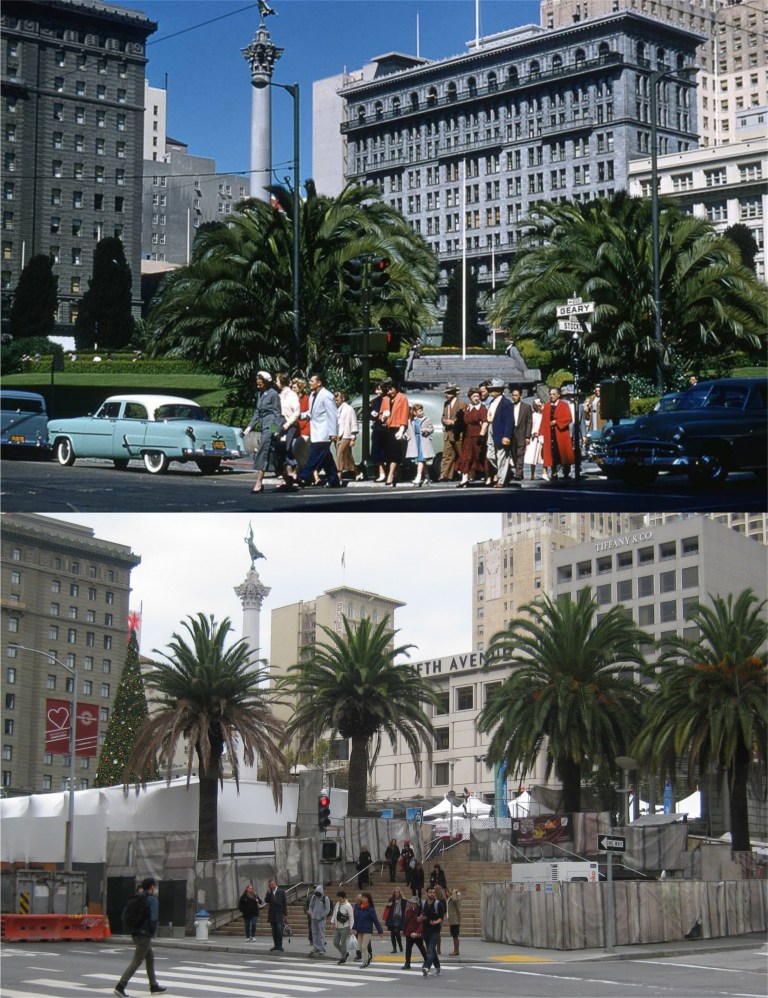 The northwest corner of Geary St. and Stockton Street looking toward Union Square during the 1950s: (San Francisco Pictures Blog)
 I’ve been waiting for awhile for them to clear the construction off Stockton Street from the MUNI expansion to Chinatown so I could get a comparison picture of this Charles Cushman Collection, looking past Maiden Lane toward Post Street in the 1950s.
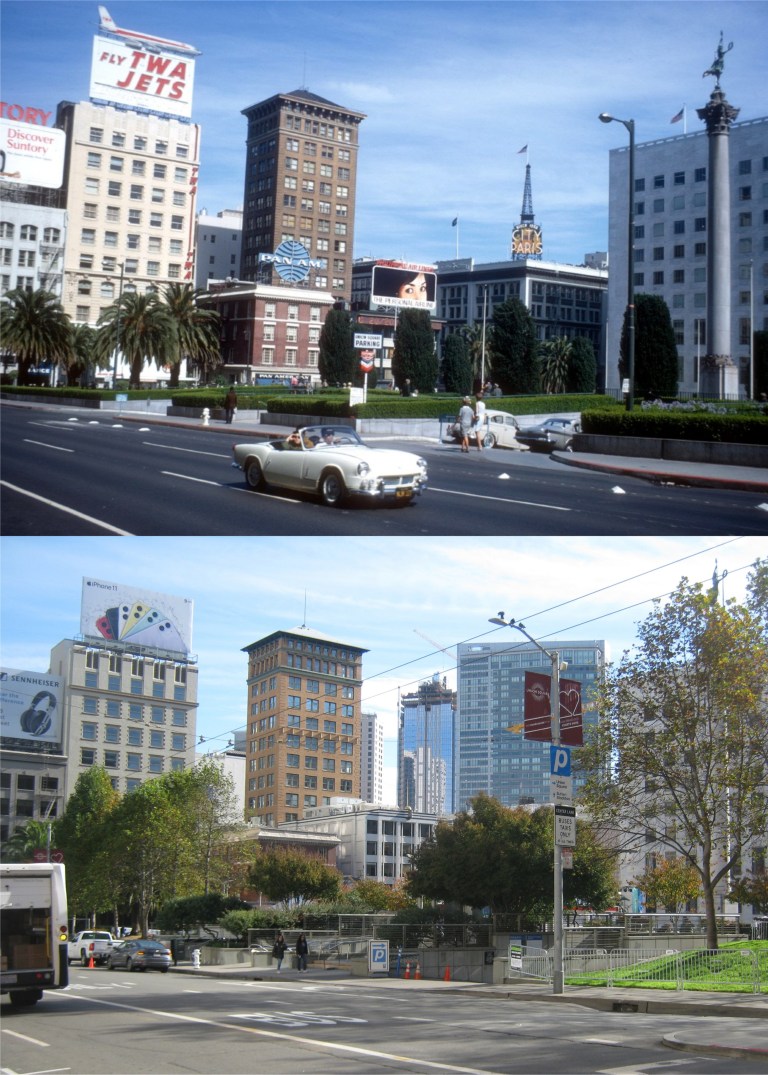 The north entrance to the Union Square Parking Garage on Post Street in 1967: The vintage picture is a nice time capsule. (San Francisco Pictures Blog)
 A gloomy 1987 picture along Post Street from Powell Street in 1987: San Francisco has had days like the older picture a lot recently, but yesterday was a little nicer. (San Francisco Pictures Blog, Rob Weststrate)
 The Ferry Building and the Ferry Building: The bottom picture is a gingerbread Ferry Building on display this season in the lobby of the Ferry Building
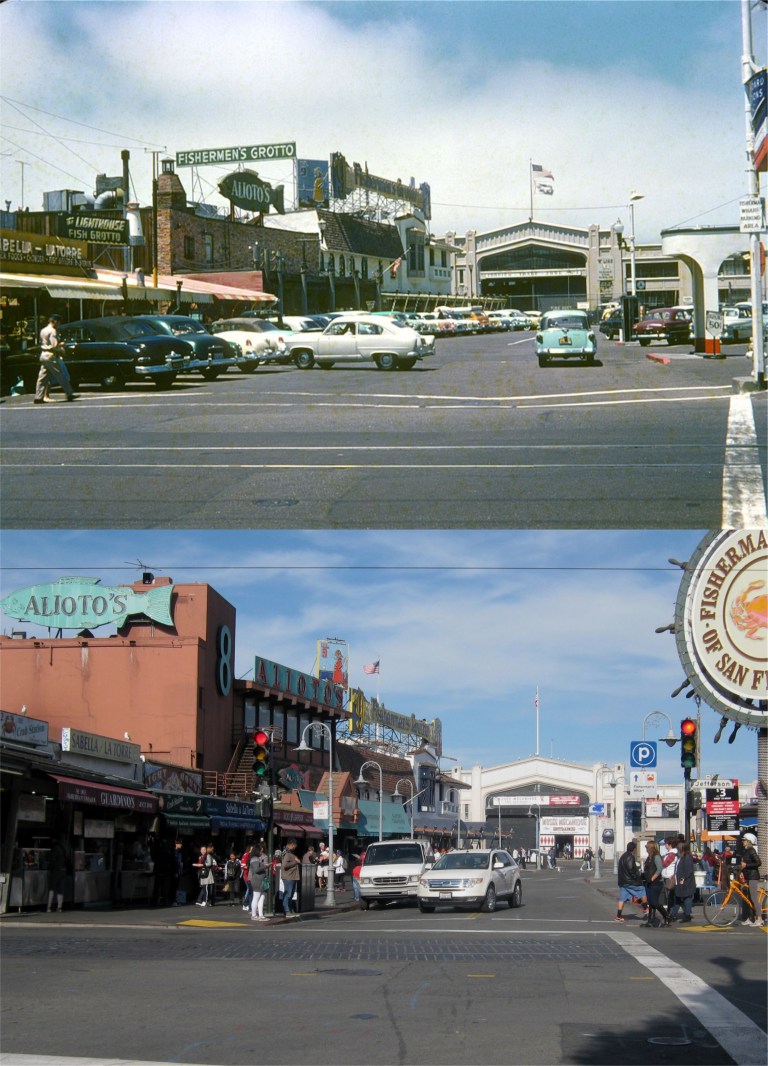 Jefferson and Taylor Streets looking north, probably the most recognizable view of Fisherman’s Wharf and one of the most photographed intersections in the city: The vintage picture is from 1953. (San Francisco Pictures blog)
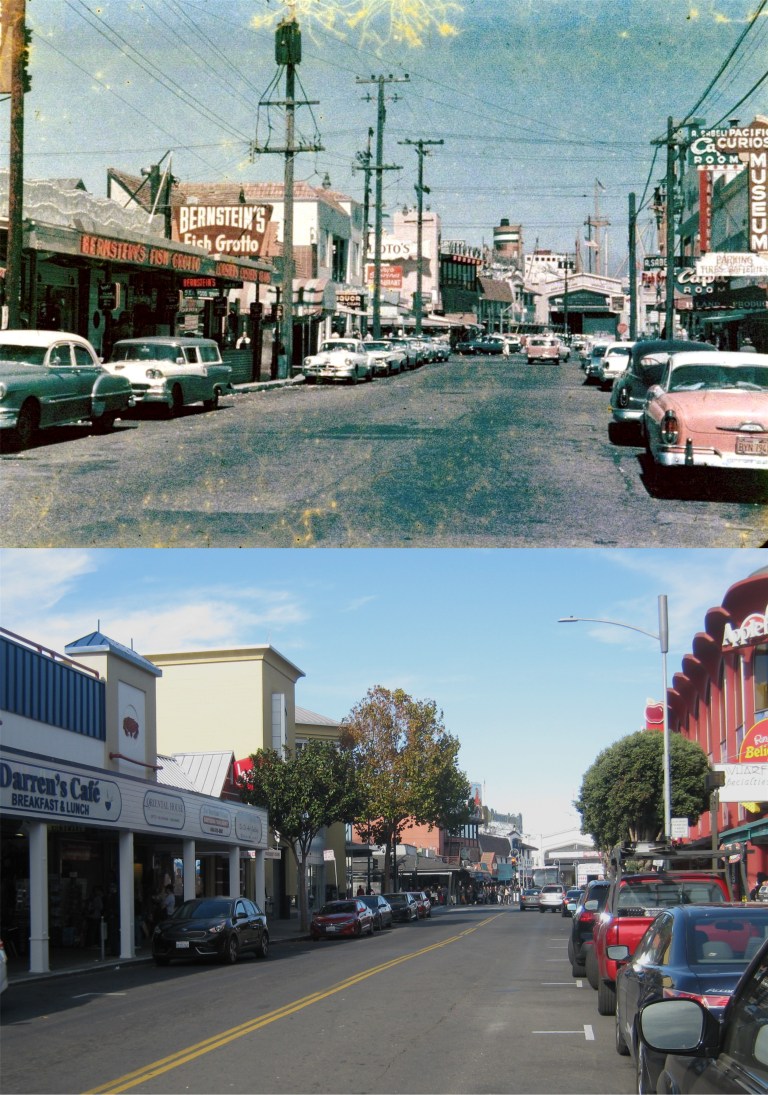 One block south of the previous picture on Taylor Street in 1956: Somebody didn’t take very good care of this old picture.
 Looking southwest along Taylor Street from Jefferson in 1963: The Z backwards K Gallery is where the old Sea Captain’s Gift Shop used to be. Personally, I think Fisherman’s Wharf lost a little of its atmosphere when that gift shop went out of business. (San Francisco Pictures blog)
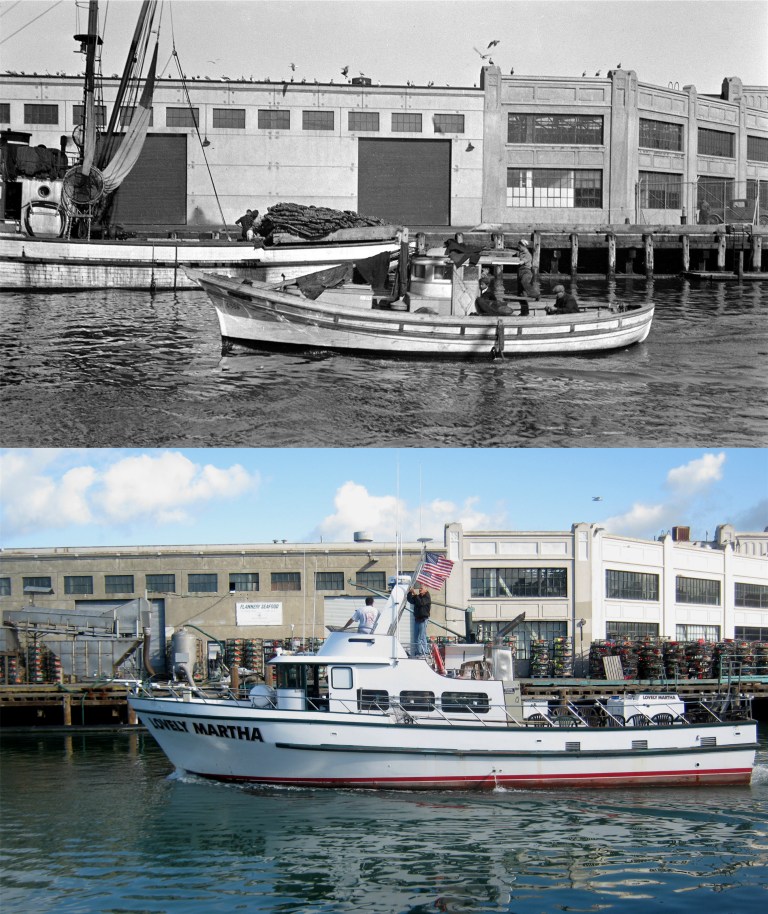 Pier 45, Shed B at Fisherman’s Wharf in 1932: Those baskets on the pier in my picture are crab nets being stored on Pier 45 until crab season opens.
 The Fisherman’s Wharf Boat Lagoon in 1955: Now, you see, here’s the way my mind works; the vintage picture doesn’t say anything about who the three gentlemen on the left were, but I see three plain clothes cops investigating a crime scene. It could have been. Somewhere underneath all those crab nets in my picture are a fleet of fishing boats. (Opensfhistory.org)
 The end of Taylor Street north of Jefferson in the 1930s: I had a better line up with the old picture here on Taylor Street, but then a line of vintage cars past by and I took this picture. I like the two sea gulls on either side of the procession watching the vintage autos pass; a couple of car buffs. (Opensfhistory.org)
 The best views from land in San Francisco of Alcatraz Island are from Fisherman’s Wharf, seen in both these pictures from the very end of Pier 45. The vintage picture was taken in 1935. Al Capone and “Machine Gun” Kelly were on the island when the old picture was taken. The ferryboat was leaving from the Hyde Street Pier for Berkeley. . (Opensfhistory.org)
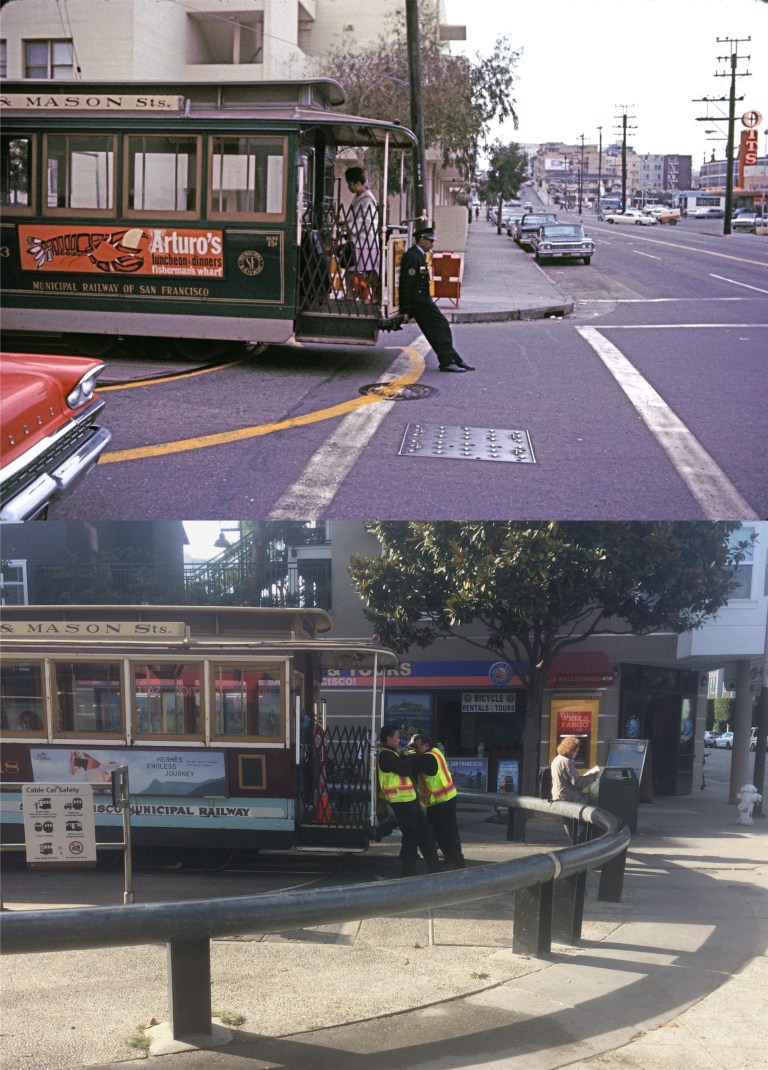 Three blocks south of Fisherman’s Wharf is the cable car turnaround at Bay and Taylor Streets, seen in 1964. It used to take only one person to push the car off the turntable back then. (San Francisco Pictures blog)
 Although there’s no geographical boundary I know of, the general rule is that the western side of Fisherman’s Wharf ends at the Hyde Street Pier. I wasn’t really going any further in this direction anyway. Still, I figured that I’d just shoot through the fence and tell people who worry about me that I ignored the sign.
 {The building at 706 Montgomery Street in San Francisco was a perfect setting for a murder. I had, in fact, thought so for a long time before anybody got killed in it.}
 Most of the story takes place at the 706 Montgomery Street building mentioned that houses artists and writers as tenants. The inside cover of the paperback has a drawing of the building and the floor where the tenants live and work. This Flickr image of the drawing is in better shape than the one in the old paperback I bought. Janet Keith, a socialite who lives in Pacific Heights and rents a room in the Montgomery Building to become a writer, narrates the book and identifies the year the story takes place on page 180.
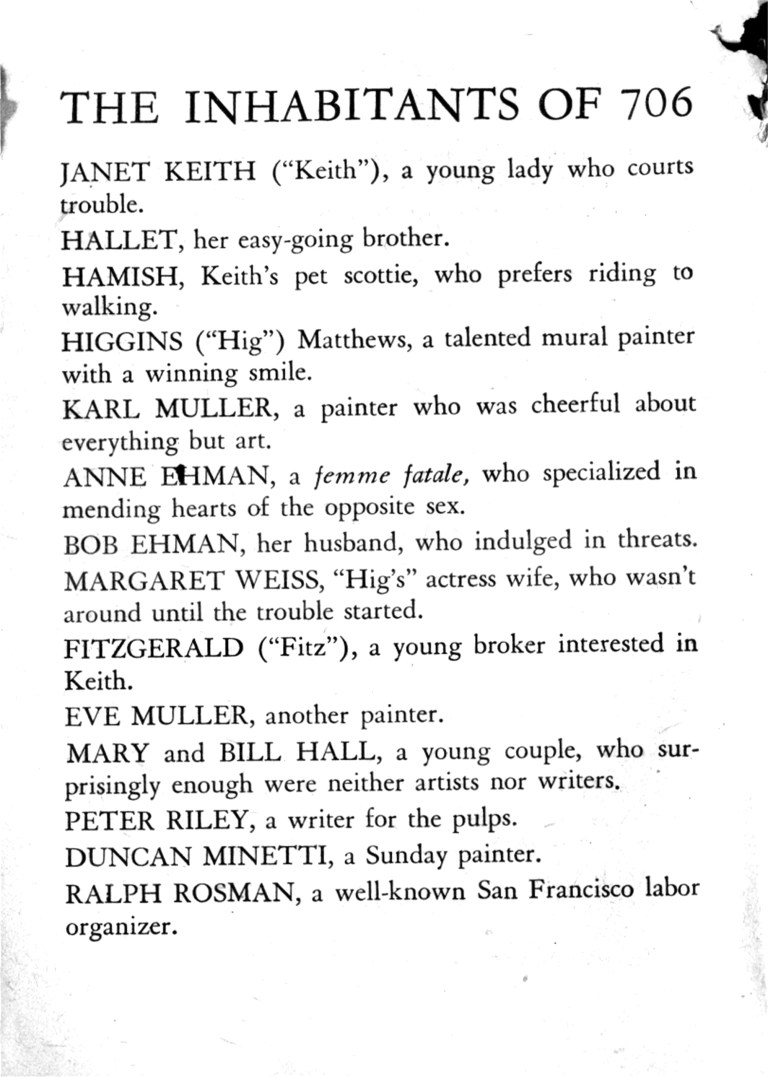 A prelude to the story is a list of the people staying at 706 Montgomery Street when the first brutal murder is committed. One of them is guilty.
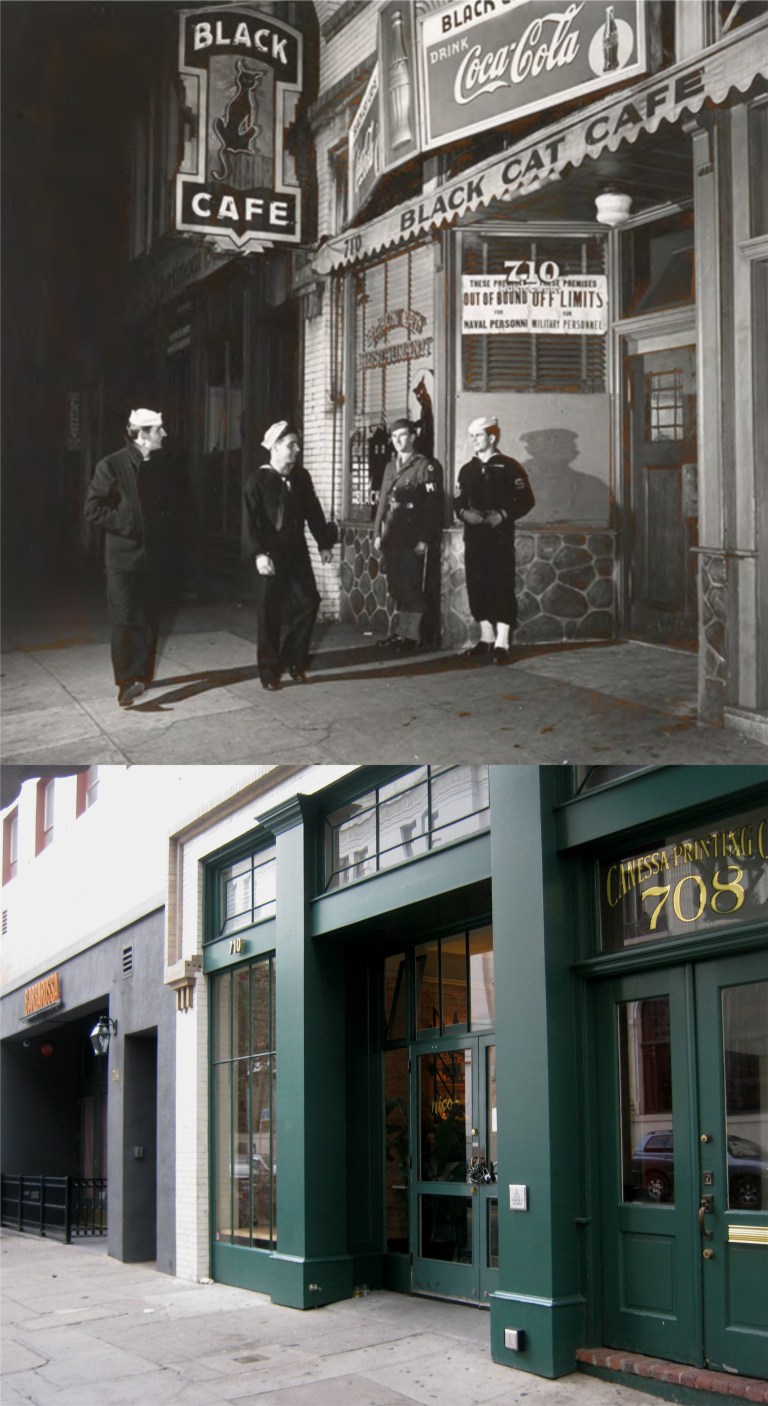 706 Montgomery is a fictitious address that sounds like another historic building you’ll see in the next photo. Today 706 Montgomery Street would have been in the building on the northeast corner of Montgomery and Washington Streets next to where the old Black Cat Café used to be. (Vintage photo from the Thomas Reynolds Gallery)
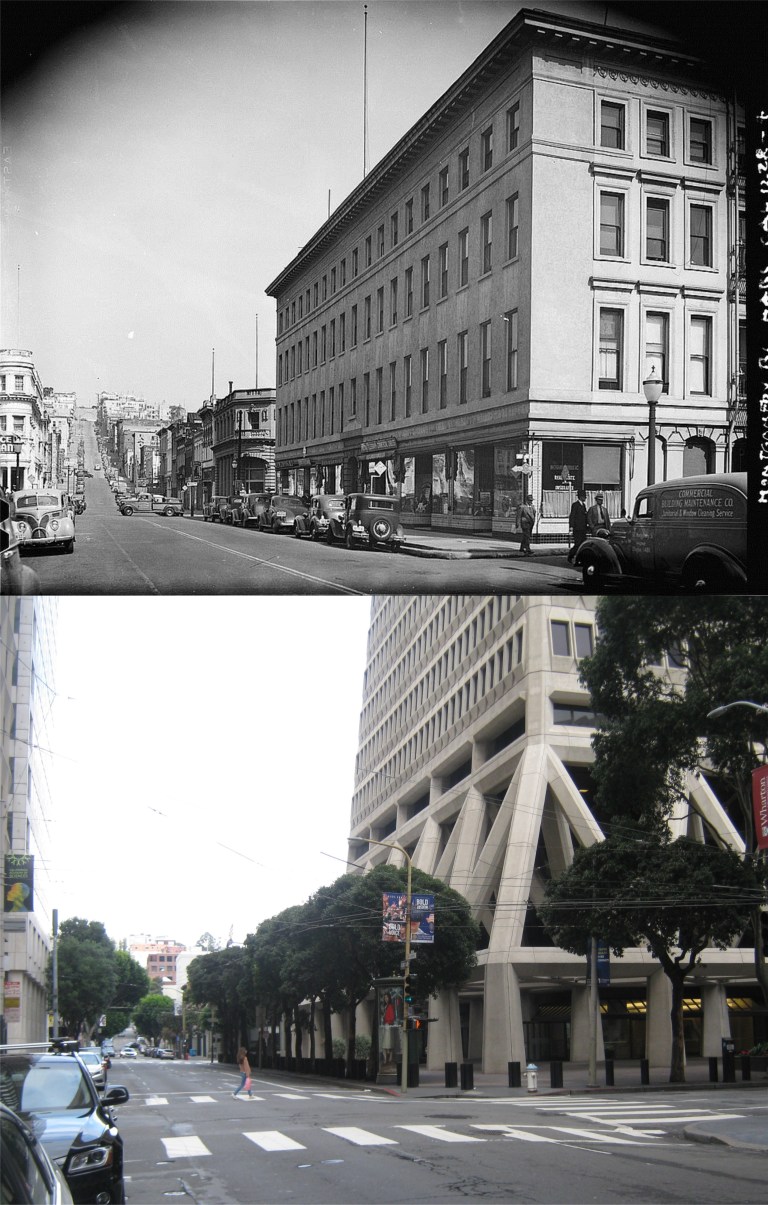 When you think of an old building on Montgomery Street that was a haven for artists and writers and you know your San Francisco history, you’ll think of the Montgomery Block, the “Monkey Block”. This is probably where Mary Collins got the idea for her 706 Montgomery Street setting. Janet Keith makes a reference to the old building.
 After inadvertently leading the police to a second murder, Janet is arrested by the police as a suspect and taken down to the old Hall of Justice Building on Kearny Street across from Portsmouth Square. She’s kept there throughout the night and released in the morning.
 Fearing for Janet’s life with the murderer at large, Janet’s father hires a bodyguard named Spike to follow and protect her. They become friends and Janet is always able to talk Spike into going along with her schemes, like breaking and entry, as she tries to solve the murders without the help of the police. One evening Janet and her bodyguard park at the top of Telegraph Hill and go down to Montgomery Street in an attempt to break into the house where the related murder victims lived to look for clues.
 Janet and Spike decide to go back to the house and break in through the back way avoiding the policeman in the front. Janet can be as clumsy as she is cunning and she drops a drawer making a racket and alerting the cop guarding the house. Janet bolts out the back door hoping to lead the policeman away from Spike and they become separated. Tired and scared she looks for a place on Telegraph Hill to meet up with Spike.
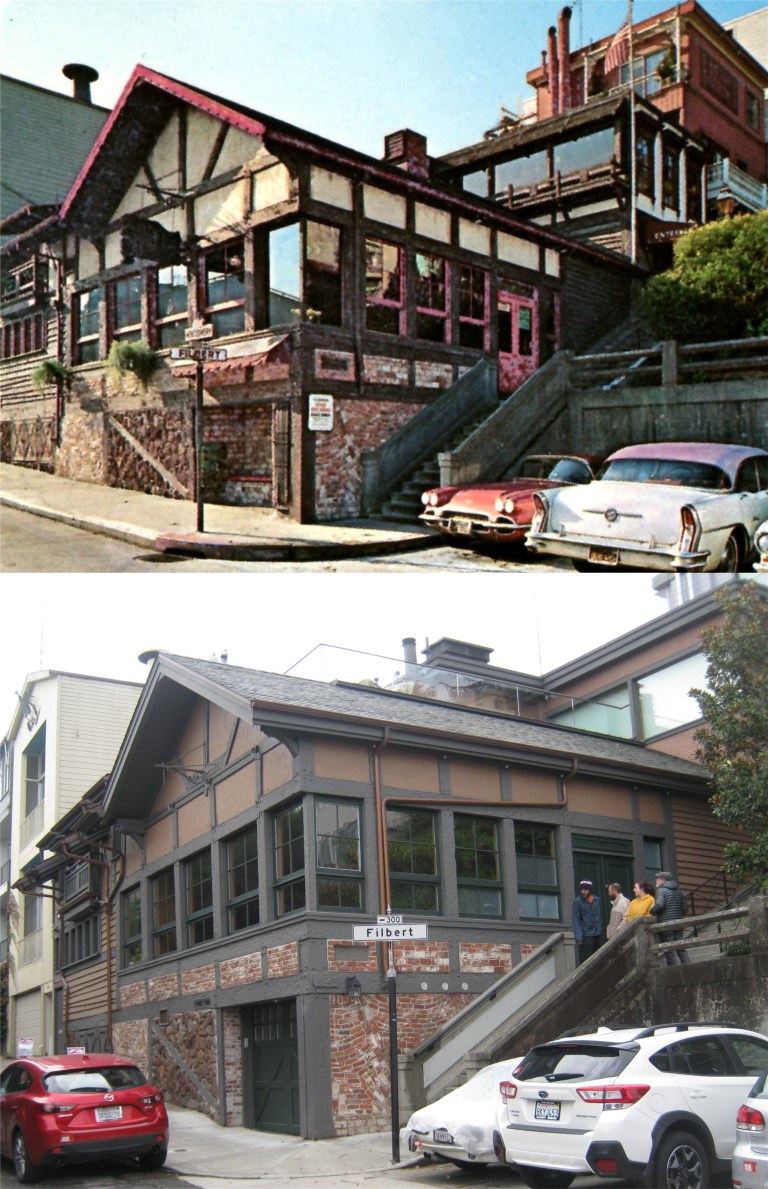 Here’s a picture during the 1950s of the old Shadows Restaurant, now closed and empty. (Flickr)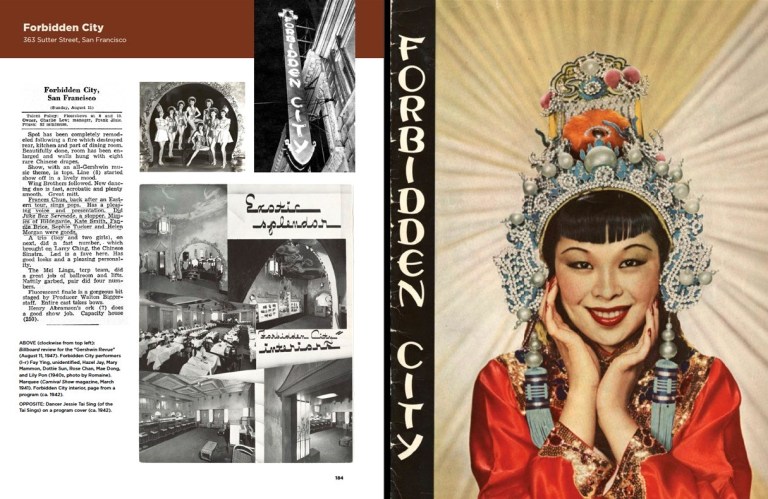
 The Forbidden City was up in the second floor of this building on Sutter Street.
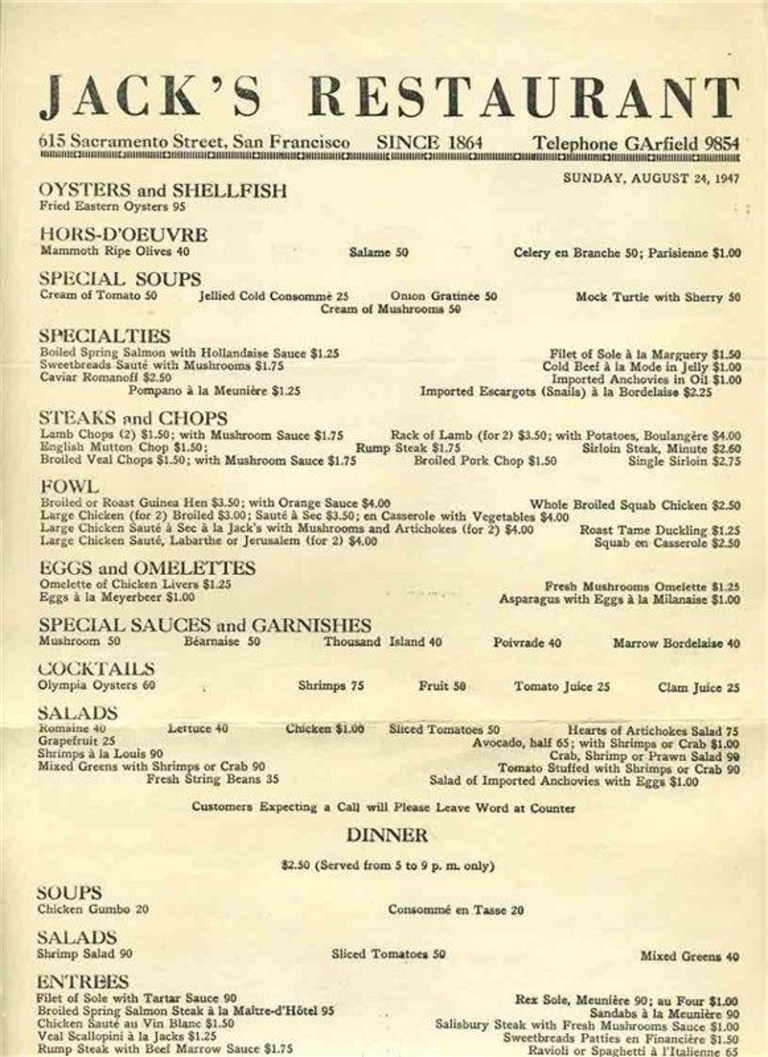 Janet, Fitzgerald, and Spike have lunch at Jack’s Restaurant on Sacramento Street near Montgomery.
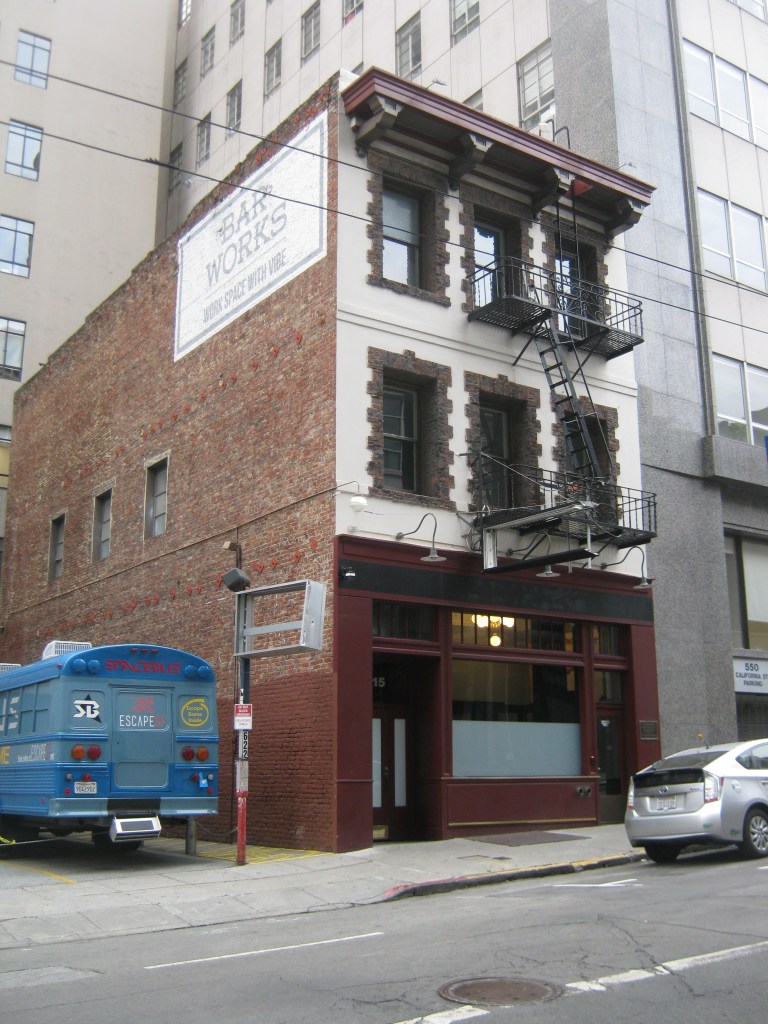 For many years, Jack’s Restaurant, the second oldest and one of the finest restaurants in San Francisco was in this building. The restaurant closed in 2009.
 I never paid much attention to the crime drama television show ‘Ironside’ that premiered in 1967 until I started watching them again on DVD. As I mentioned from a few posts I’ve done in the past, they’re actually for the most part entertaining little mystery shows with occasional views of interesting San Francisco locations, although most of each of the episodes were filmed in a studio. Raymond Burr plays Robert T. Ironside, a police lieutenant crippled by a sniper’s bullet in the pilot episode. He’s assisted by Barbara Anderson as Officer Eve Whitfield. Eve often gets double takes as a female police officer, which apparently was novel back then. Eve was a good cop and she could be tough when she had to, even though she often dressed like a tour guide from Disneyland. Don Mitchell plays Mark Sanger, an ex-con that Ironside sees promise in and employs him. Mark is basically Ironside’s man servant in early seasons pushing Ironside around in his wheelchair or driving him around in his armored truck. This may be racially offensive to some today, but Mark eventually joins the force as a police officer in later seasons. Don Galloway is Sergeant Ed Brown, the handsome detective who you sometimes hope was fooling around with Eve behind Ironside’s back. He even misquotes Herb Caen in one episode referring to San Francisco as “Baghdad on the Bay” rather than ‘Baghdad by the Bay’. Most of the San Francisco locations were filmed as Ironside’s truck is heading toward a crime site or an investigation. (IMDb)
 Ironside’s truck is often seen entering onto or exiting from the Washington Street side of the old Hall of Justice Building on Kearny Street across from Portsmouth Square.
 Although the old Hall of Justice Building was closed and demolition had begun on it when the show premiered, it was used as Ironside’s base of operations. Washington Street is on the left side of the building, Kearny at the bottom, and Merchant Street on the right. A Hilton Hotel occupies the spot today.
 In an episode from 1968 two criminals break out from one of the jails cells in the Hall of Justice and have taken Ironside and Eve hostage. This is a picture from the actual jail cell block in the Hall of Justice from a link about the Hall of Justice Building sent to me in a comment from a viewer to my blog, Irunnningynn. I’ll include the link to the interesting article she sent me at the end of this post.
 The bad guys who have taken Ironside and Eve hostage allow Ironside to take a telephone call from Mark to avoid suspicion. Realizing that Mark is returning to the office, Ironside sends Mark on a lengthy research project at the San Francisco Main Library on Larkin Street to protect him, much to Mark’s confusion.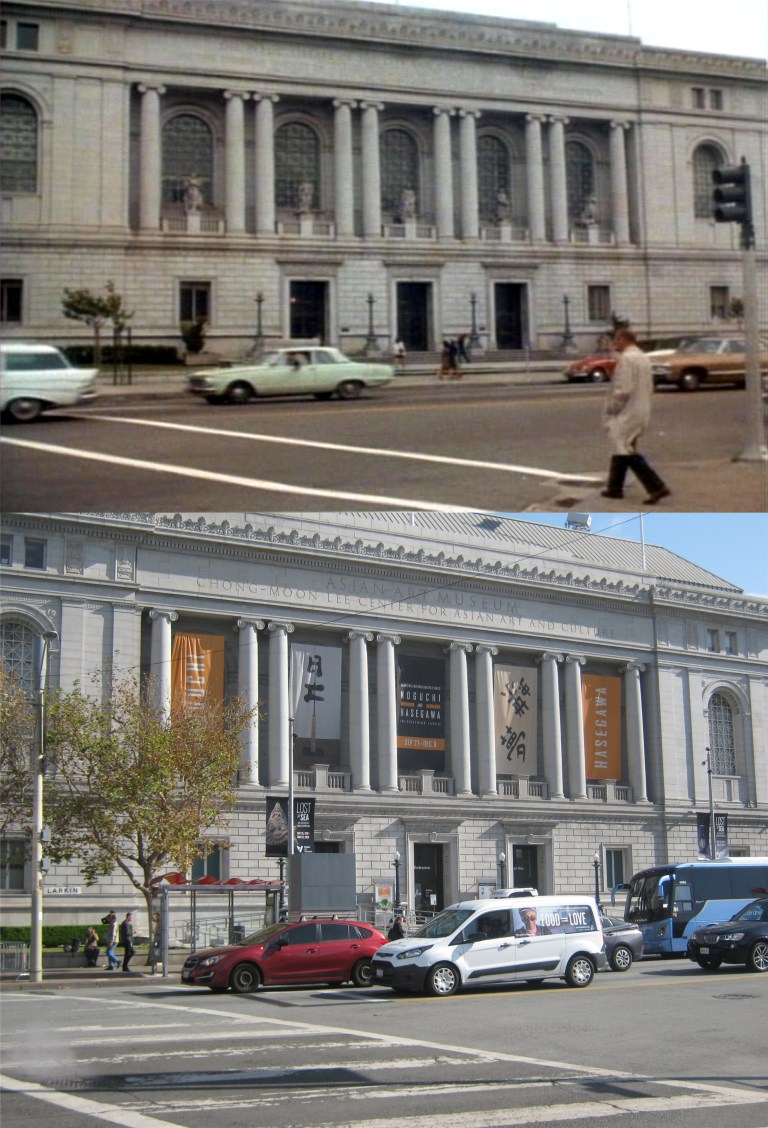
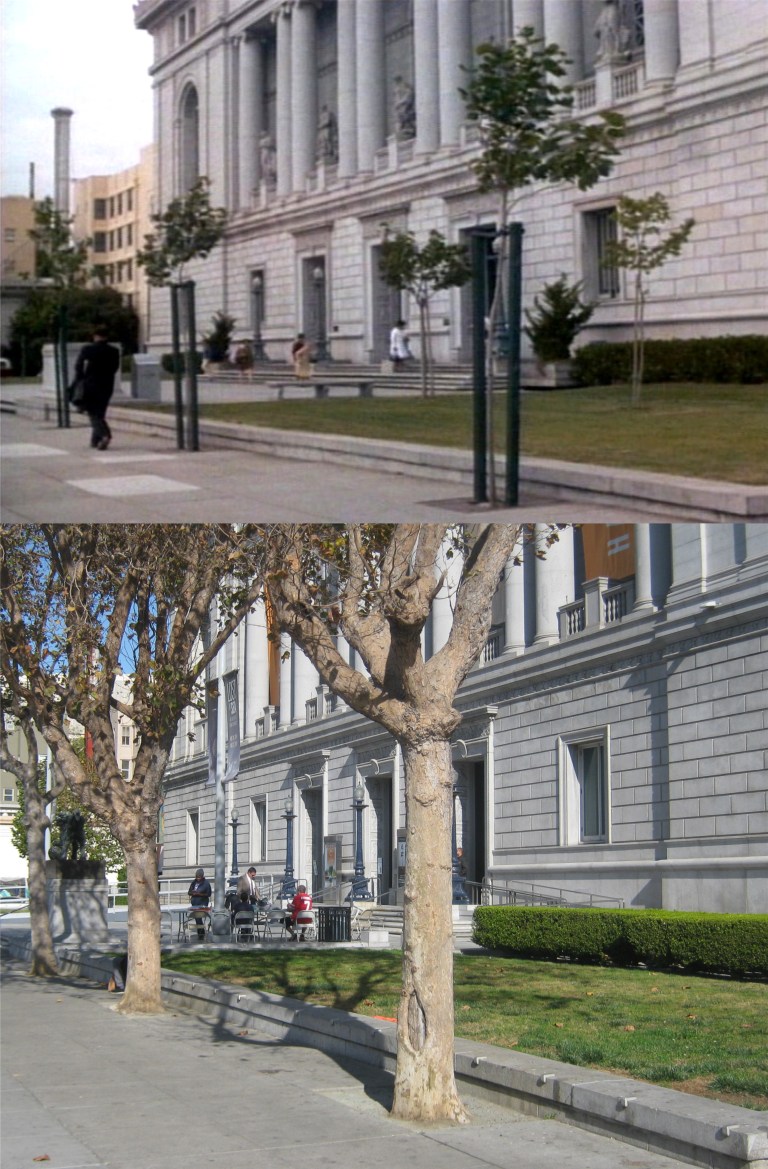 These are two views from the scene of the old location of the San Francisco Main Library back then. The building is now the Asian Art Museum.
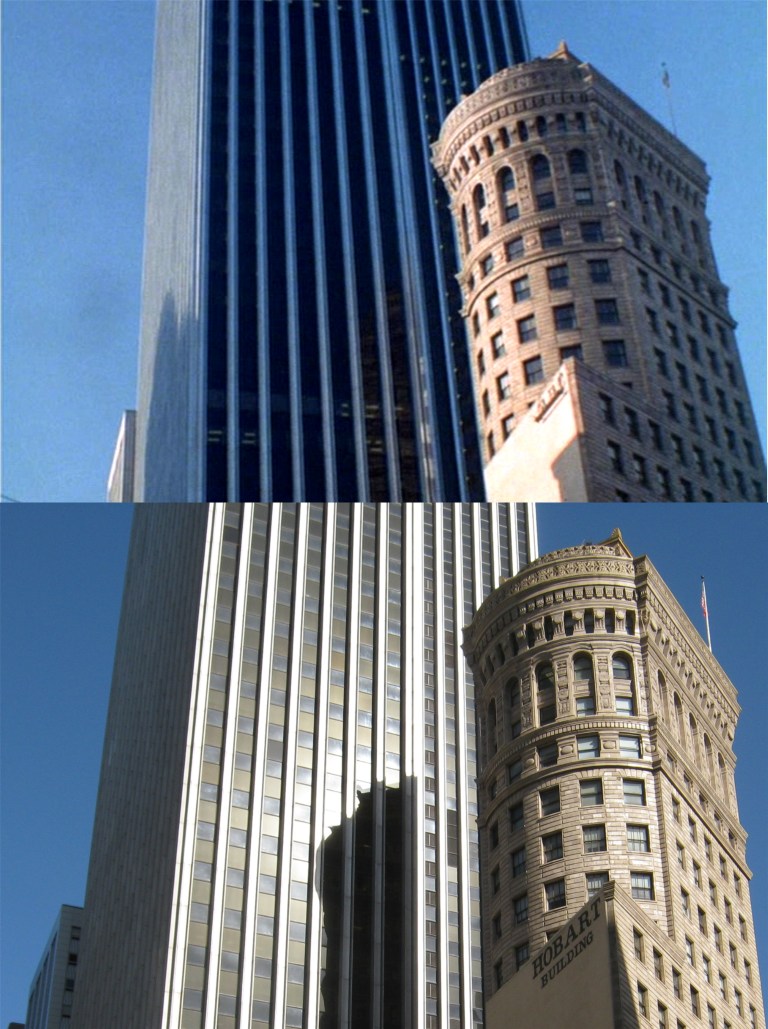 In a camera scene starting at the top and working its way down, the old Hobart Building on Market Street, with the new back then Wells Fargo Building behind it, is shown in one of the episodes from the first season.
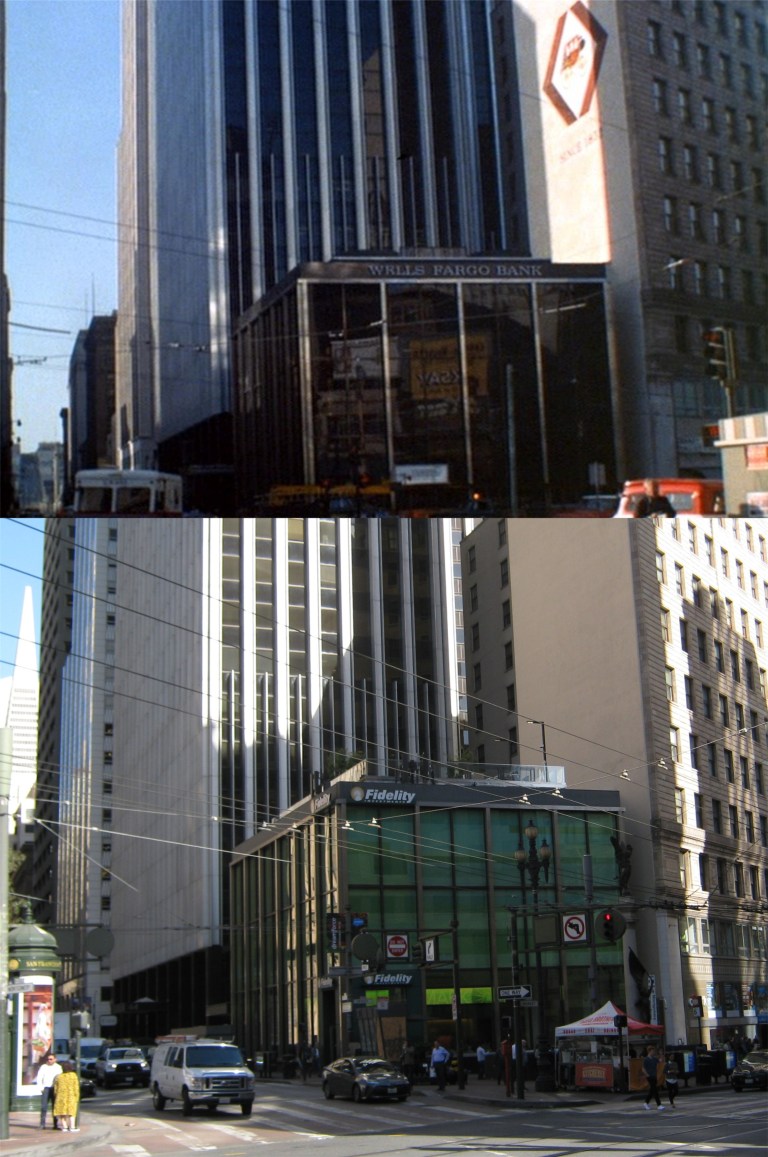 The Hobart Building operators let Wells Fargo paint their stagecoach on the side of the building back then.
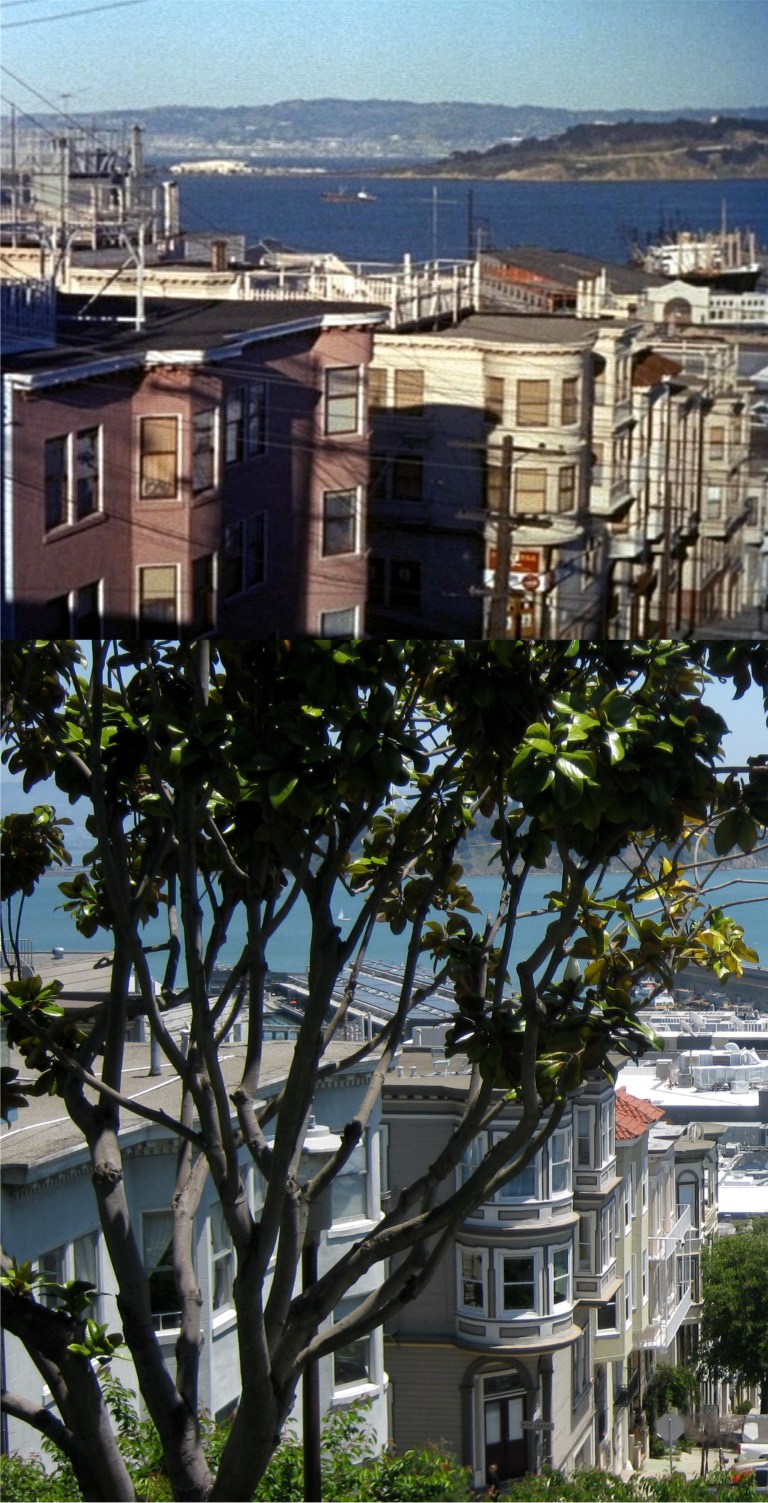 An episode that aired December 7th 1967 shows the view down Vallejo Street on Telegraph Hill. I was up on Telegraph Hill at this spot last June and got a reasonable comparison to the TV shot when I was working on another post, although a tree blocks a lot of the old view now. That looks like a Coca Cola sign on the doorway of the building on the corner of Vallejo and Montgomery Streets in the TV shot. There may have been a grocery store there back then.
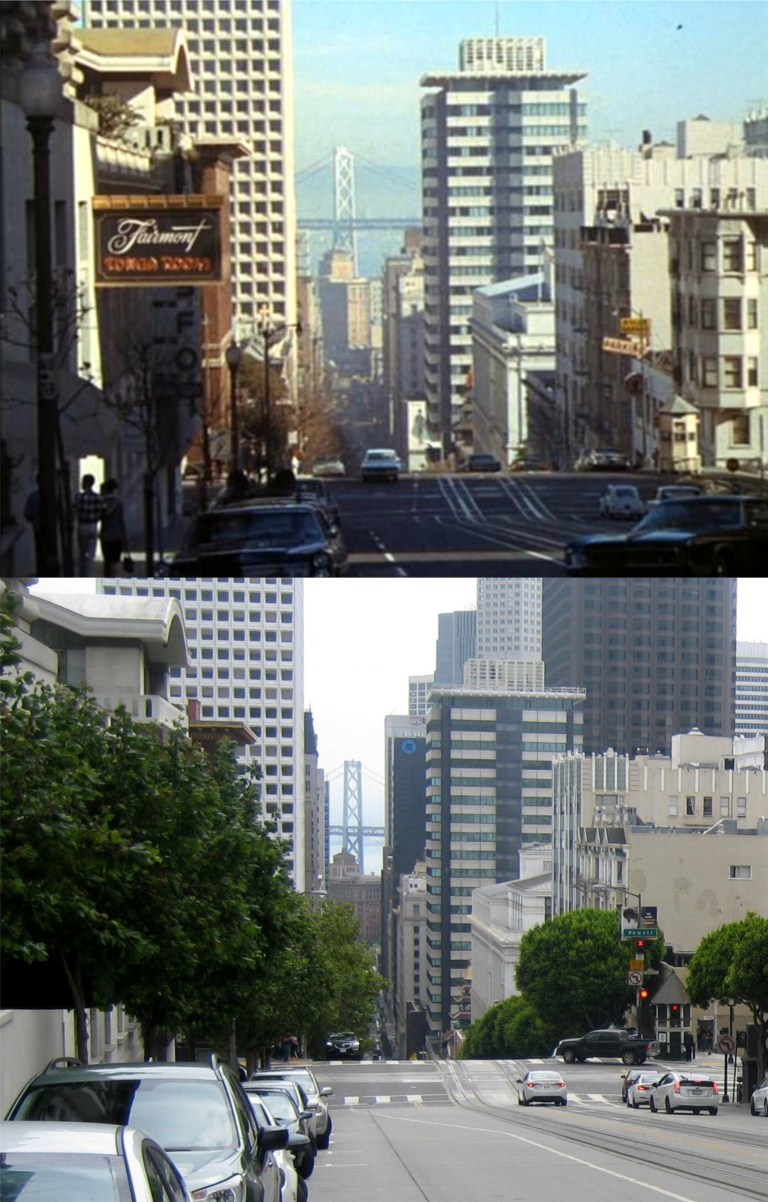 A view from an early episode looking down Nob Hill along California Street in 1967: There’s no Bank of America Building yet, and you can see the Fairmont Hotel’s Tonga Room on the left and the old Crest Garage building on the corner of Powell and California Streets on the right. The Crest Garage building was still around when I took this picture in 2017.
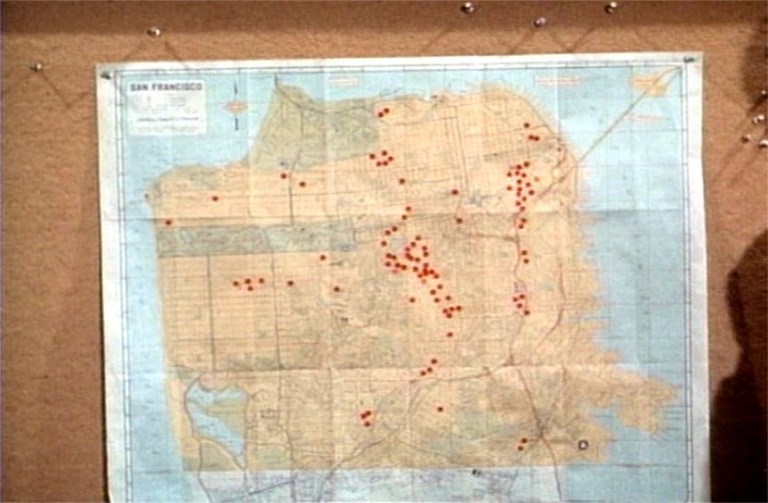 In an episode that aired November 30th 1967, Ironside’s team is trying to break up a stolen car ring operating out of San Francisco. Here, he reviews a map of San Francisco with Eve and refers to the red dots on the map as to where cars were stolen in San Francisco in the past six months. That may be less than the amount of cars stolen in San Francisco in one week nowadays.
 Whenever there’s a crime scene or a crime in commission, Mark always seems to drive Ironside north on Hyde Street coming down from Russian Hill to get there. In this scene they’re heading to an auto wrecking yard to break up a stolen car ring. They’re two blocks away from the Bay, and I doubt if there was an auto wrecking yard within fifty miles from here!
 Another often used San Francisco location in the show was the old Spreckels Mansion on Washington Street. Whenever the crime involved a well-to-do family, they always seem to live here. Ironside’s truck is turning into the courtyard entrance from Washington Street, seen in the early morning shadows from Lafayette Park across the street in my picture.
 The last I heard, the current resident of the Spreckels Mansion is authoress Danielle Steel.
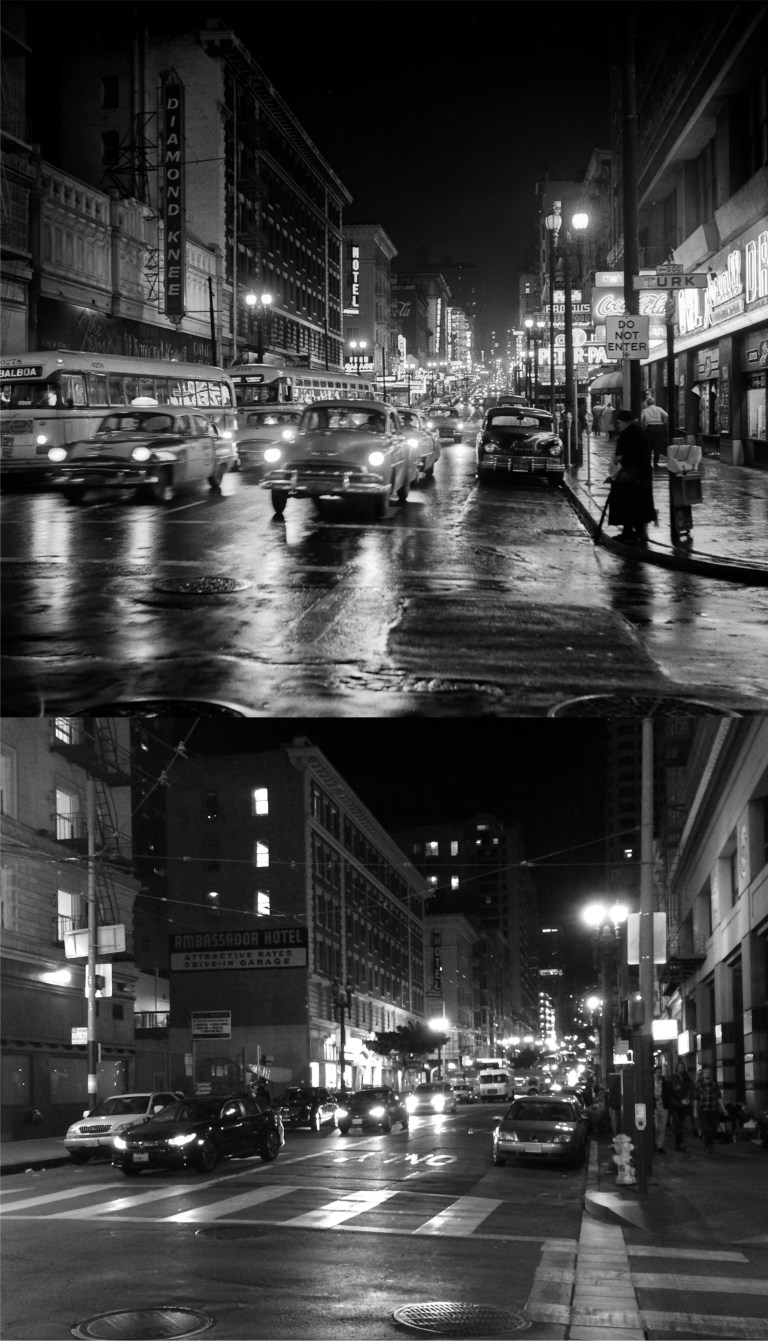
 We’ll start at the corner of Turk and Mason Streets; and where else could you hope for a tour to start? The vintage picture is from 1955. All vintage pictures in this post are from the San Francisco Pictures blog and the SFMTA Photo Archives. In the far back is Nob Hill with the Mark Hopkins Hotel, looking like another world from where we’re at. We’ll pass the vagrants on the Turk Street sidewalks as quietly as possible and head over to Turk and Leavenworth Streets.
 Turk and Leavenworth Streets in the heart of the Tenderloin, seen in the vintage photo in 1962: I got you into this and I’ll get you out. We’ll walk two blocks west on Turk to Larkin Streets and catch Muni #19 to Sutter Street. Unfortunately, it will be two of the most uncomfortable blocks you’ll ever experience in San Francisco.
 Sutter Street at Polk Street looking east in 1931: From here on in you’re going to find that a remarkable number of buildings in the vintage pictures are still around.
 One block east of the previous picture at Sutter and Larkin Streets, seen in 1931: They were doing a lot of work on Sutter Street that year.
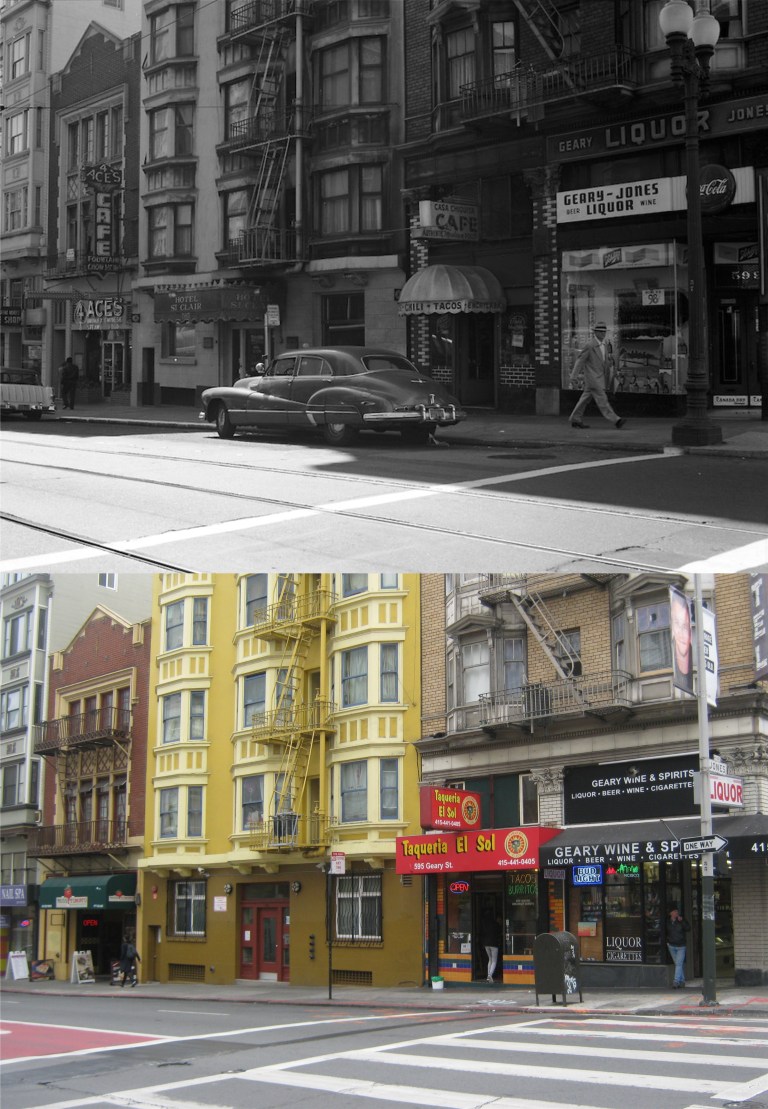 We’ll move over to Geary St. at Jones Street, seen in 1957. Geary St. used to be considered the northern border of the Tenderloin, but I don’t know if that’s accurate anymore. They’re still selling Mexican food and booze in the same two places they were in 1957.
 One block east and one block north and we’re at Taylor and Post Streets looking south down Taylor. The vintage picture is from 1937
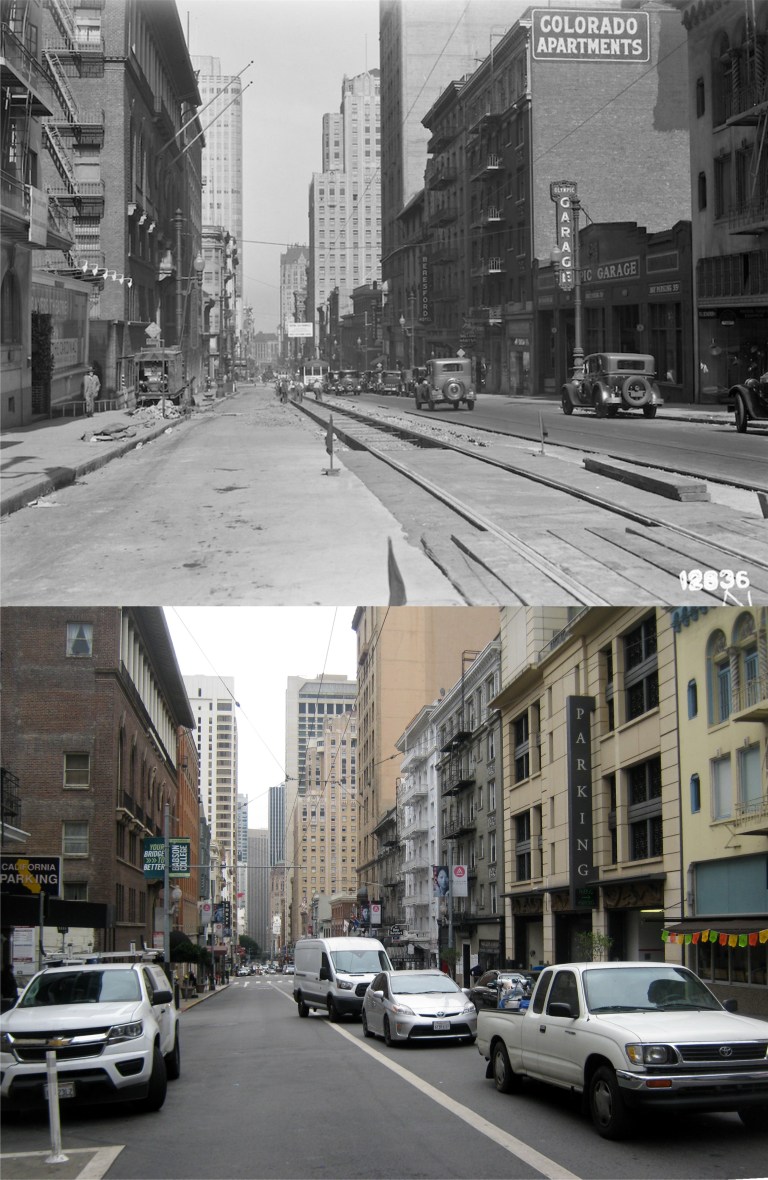 We’ll continue north up Taylor Street to Sutter Street looking east in 1931.
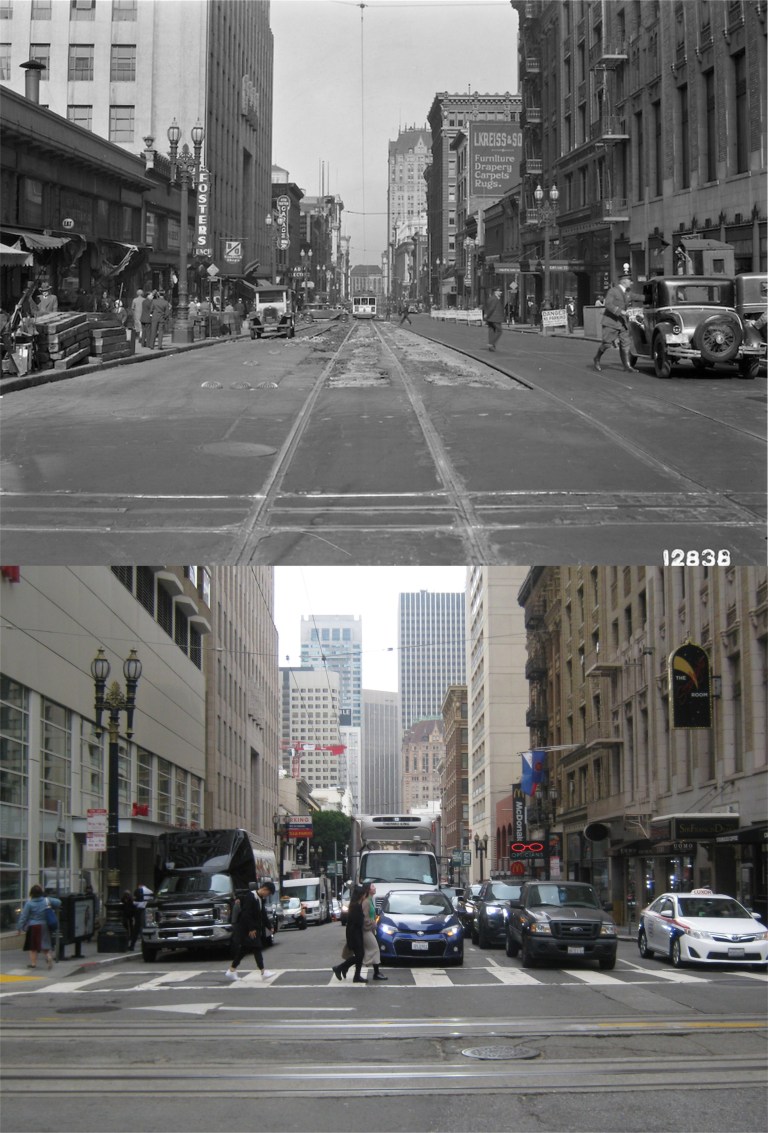 From the Taylor and Sutter Street intersection we’ll head two blocks east to Sutter and Powell Streets, looking east down Sutter in 1931: When you get to here you’re out of the Tenderloin, but you’ll often think back about that area with a definite…… viewpoint. On the right in both photos is the Sir Francis Drake Hotel, and at left center is the 450 Sutter Building.
 We’ll be closing the tour at Union Square. This is the northeast corner of the Square at Post and Stockton Streets in 1940. That’s some pretty antiquated construction equipment those guys are using.
 This is at the southeast corner of Union Square looking down Geary Street toward Market Street in 1951. Ah, the City of Paris Department Store; what a wonderful place that was until it was demolished in 1979. The Neiman Marcus Department Store is there now. This area is going to be ground central for “Black Friday” in less than two weeks. I’ve covered that hectic day for the past few years in posts on my blog, but I think this year I’ll just stay home and watch ‘Miracle on 34th Street’. If you enjoyed the tour, please be sure not to tell your friends; I don’t want to go through that again!
 I started out at Kearny and Market Streets looking west along Market Street to update a photo taken in 1971.
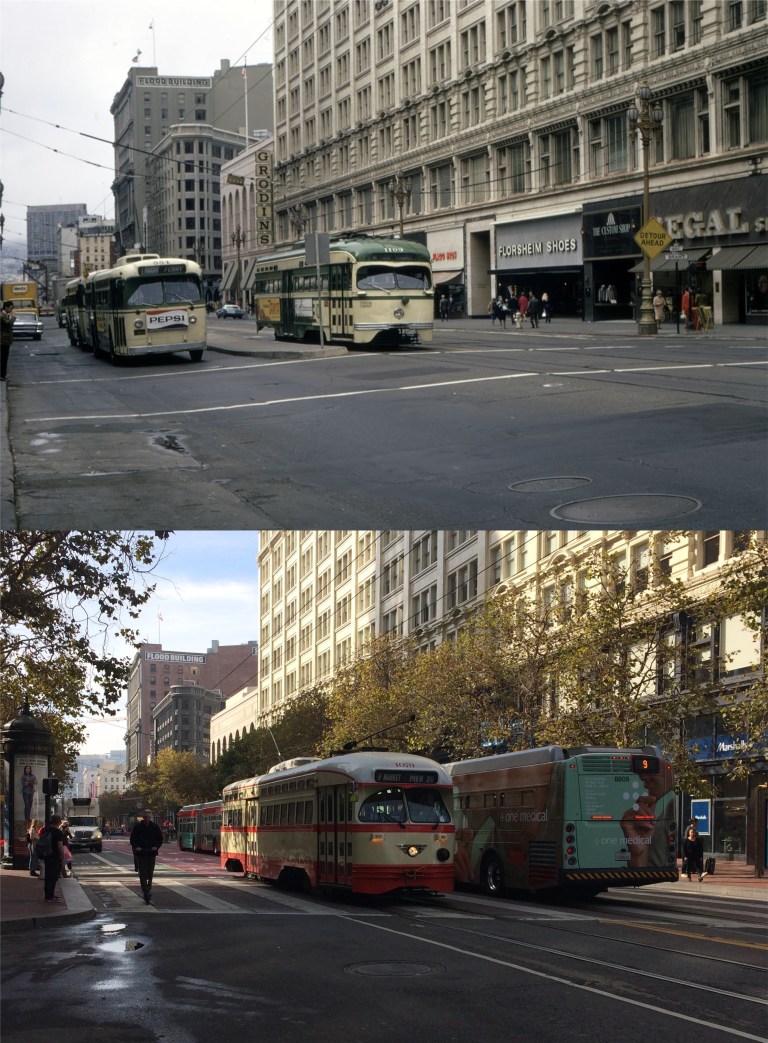 I headed west on Market Street on block to Grant Ave to get this comparison from 1970 looking up Market Street towards Stockton. “The woods are lovely, dark and deep. But I have promises to keep, and miles to go before I sleep.”
 I doubled back to Kearny Street and walked two blocks to the corner of Kearny and Sutter Streets looking west along Sutter. The vintage picture is from 1958.
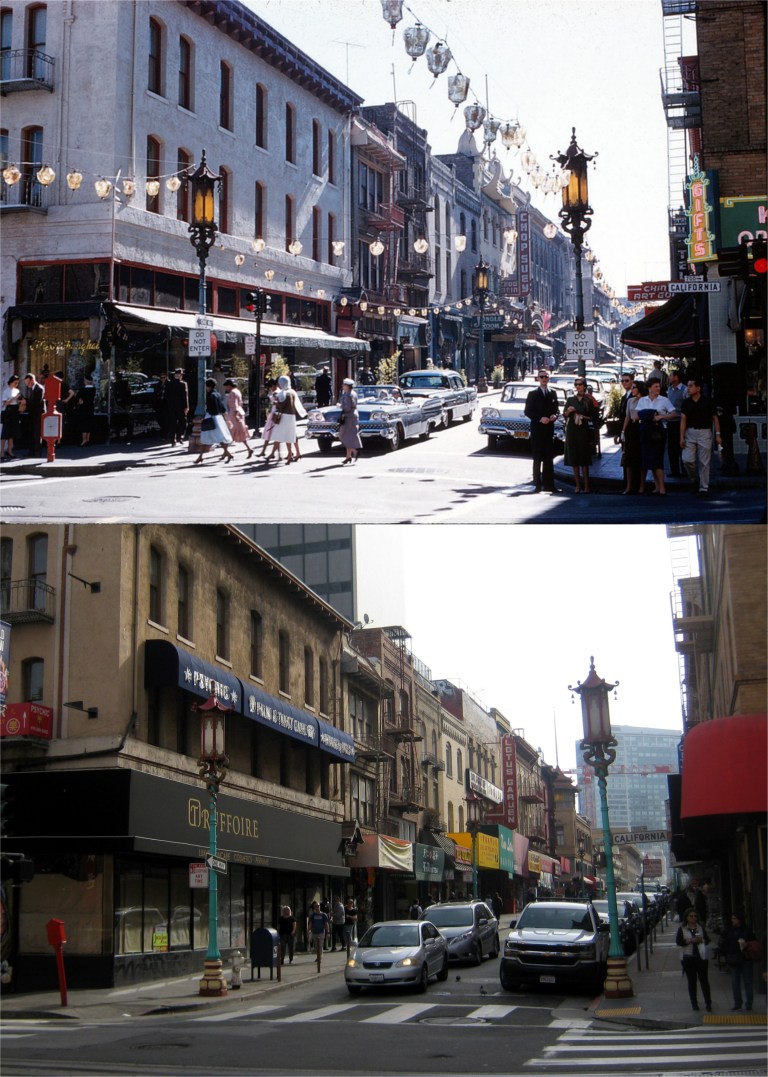 From Kearny I headed over to Powell and Bush Streets by way of the Stockton Tunnel steps. I passed Burritt Alley, where Miles Archer was “done in” by Brigid O’Shaughnessy, for another breakfast at Roxanne’s Café, and headed back down Bush Street to get my obligatory Chinatown picture. The vintage picture is at California Street and Grant Avenue in 1959.
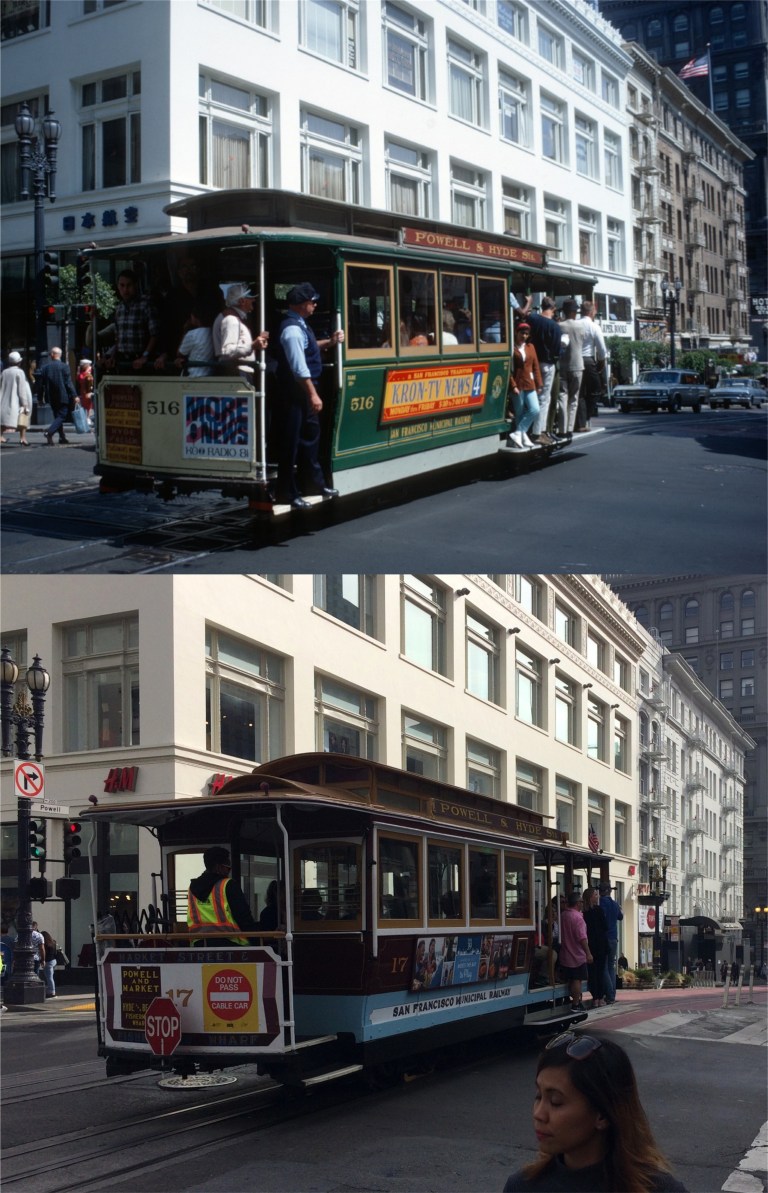 The shadows were still following me, so I snapped one more picture at O’Farrell and Powell Streets before heading back to the office. The vintage picture was taken in 1967. On the building just to the right of the front of the cable car in the 1967 photo, although difficult to read, is the entrance sign to Tad’s Steak House, another place on Powell Street I like to stop regularly for breakfast or burgers. After some 67 years at this location, Tad’s closed in October of this year and will be relocating around the corner on Ellis Street, although I’m not sure where or when. That left a cloud over me too.
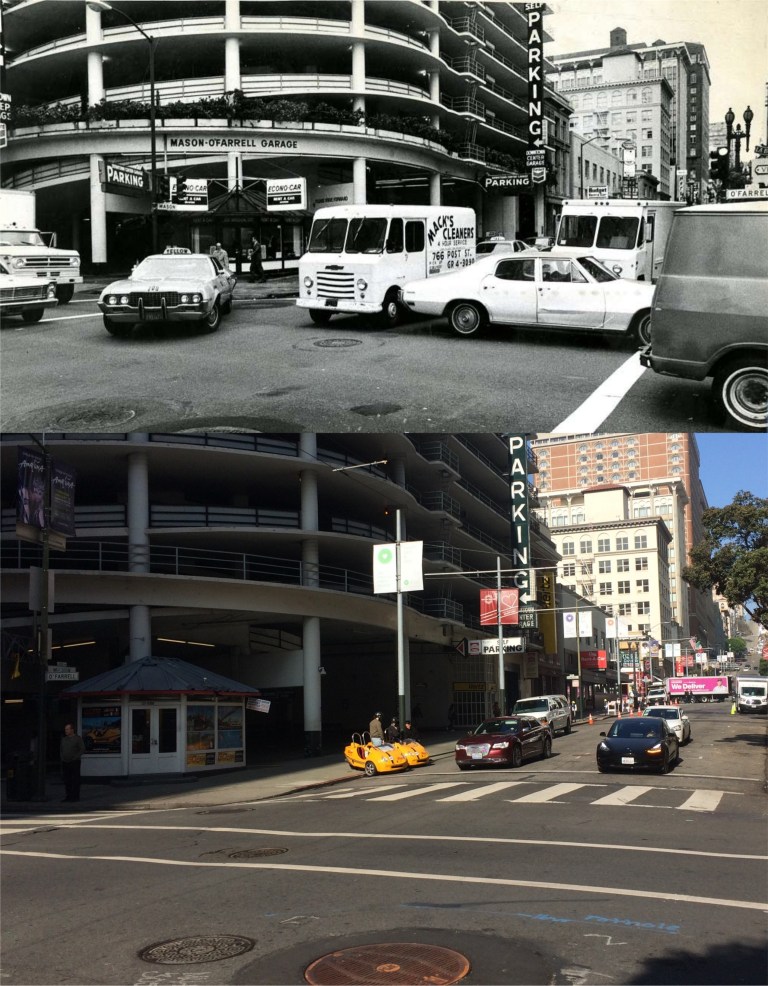 There are all kinds of driving infractions taking place at the Mason and O’Farrell Streets Garage in 1973; gird locking, signal jumping, near collisions, and probably a lot of honking. (San Francisco Pictures)
 Parking anywhere along Powell Street south of Nob Hill, seen in the vintage picture from 1958, is only a memory today. (Pinterest)
 Mason and Pine Streets, down from the Mark Hopkins Hotel, in 1964: There were still a few parking spots available here on Mason Street back then. KYA Radio brings back memories of when I was a kid in the 1960s. I’ll bet I heard my first Beatles song on KYA. (San Francisco Pictures)
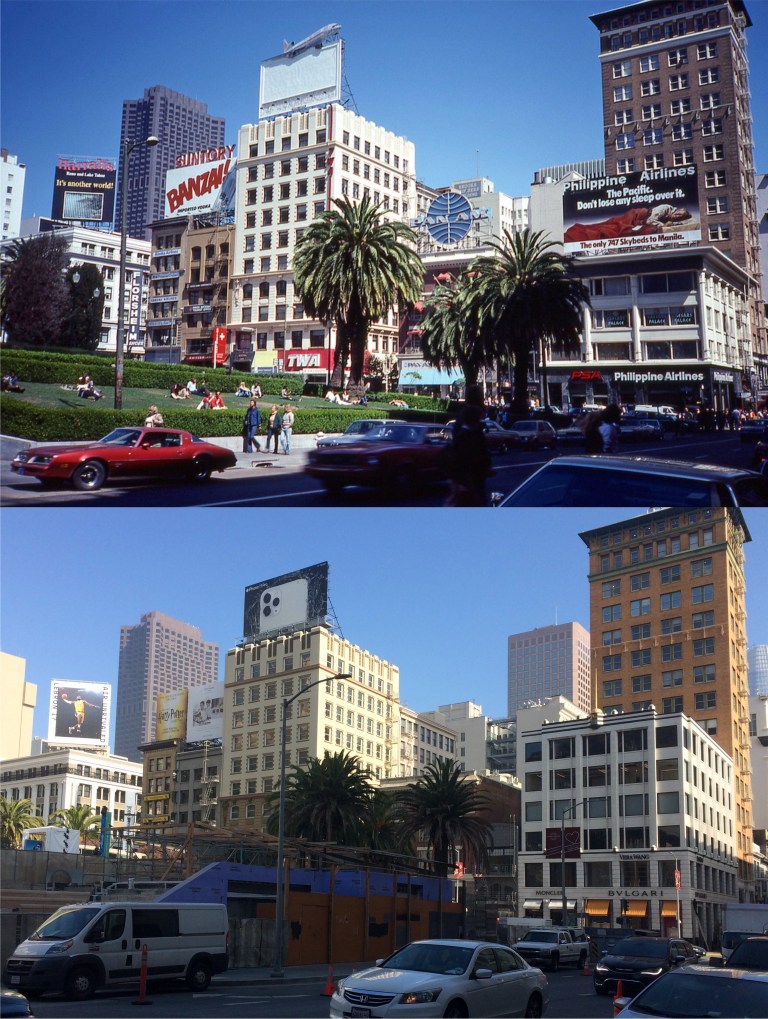 Union Square with its parking garage under the Square seen in 1980 from Geary Blvd.: I’ve never parked in the Union Square Garage. Herb Caen used to say that people who try parking there during a busy day in Downtown San Francisco are a “Sorry / full lot”. (flickr)
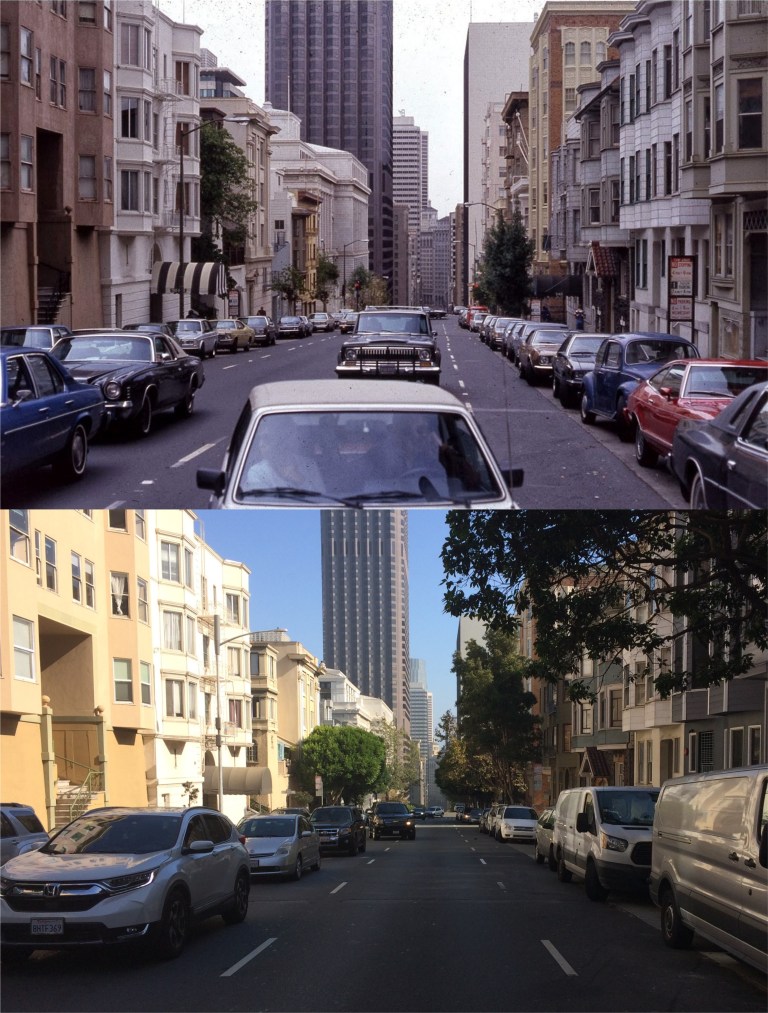 Pine Street east of Powell Street in 1982: This is probably not where you want to go to practice your parallel parking skills. (San Francisco Pictures)
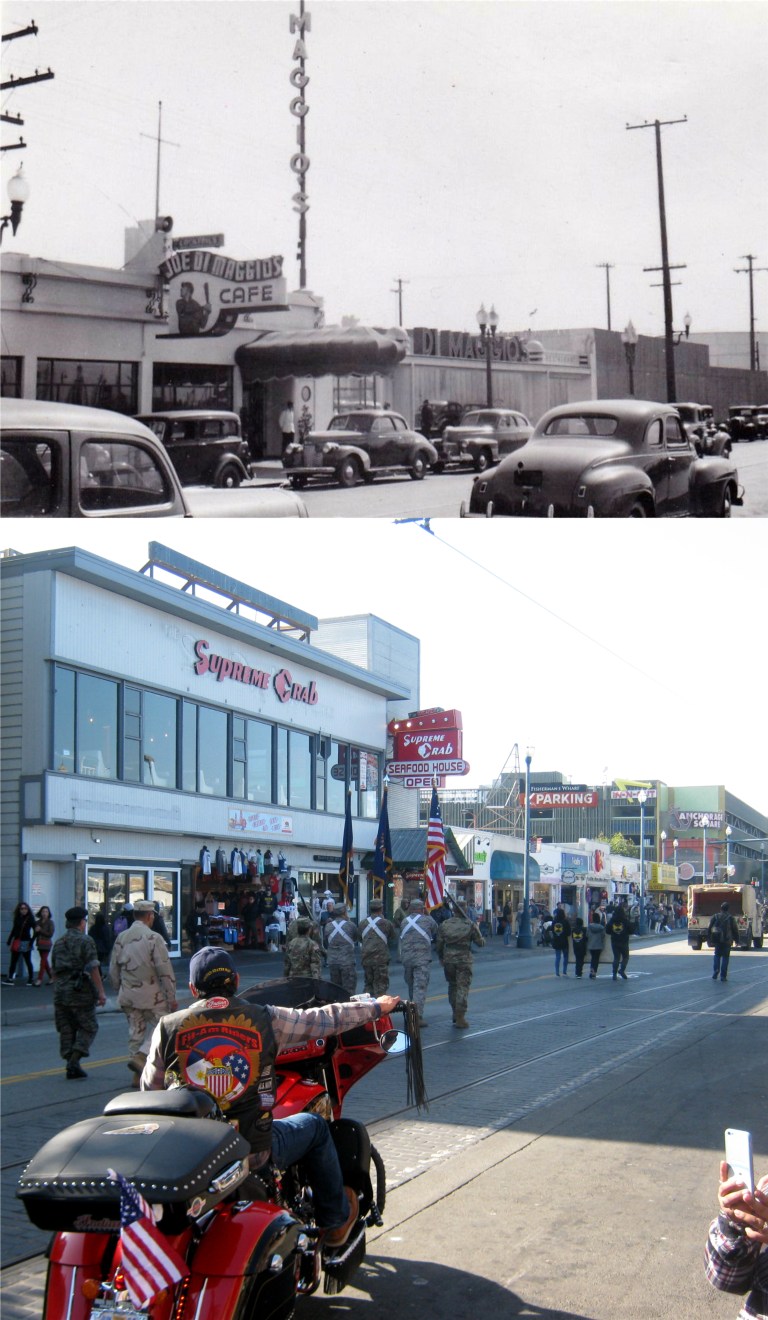 “Excuse me. Can you tell me where DiMaggio’s Restaurant is?”
 Twenty years later, in 1957, the letters above the DiMaggio Restaurant parking lot were still there, and can be seen in a 1957 episode of the television show ‘Harbor Command’. Here, a thug “on the spot” is trying to hide from the bad guys in the DiMaggio parking lot. The scene is looking across Jefferson Street toward the Fisherman’s Wharf Boat Lagoon. DiMaggio’s parking lot, seen in the bottom picture, is still there but blocked from Jefferson Street by buildings now.
 Parking in Fisherman’s Wharf can often be an expensive nightmare unless you have connections. I don’t have the clout of San Francisco’s Mayor London Breed, but I have a brother who works on the World War Two Liberty Ship, the Jeremiah O’Brien, and when I go to the Wharf I can usually get a pass to park in Pier 45 where the ship is berthed. That came in handy today to view the 2019 Veterans Day Parade. The vintage picture is Pier 45 in 1960. (opensfhistory.org)
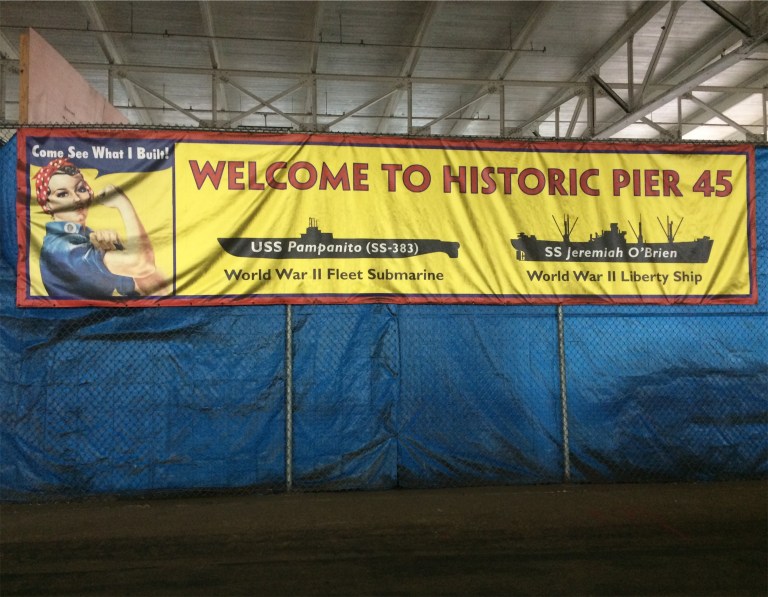 Built in 1926, Pier 45 with its two sheds was the largest pier in the world when it was built. Commandeered by the army during World War Two for moving troops to the Pacific Theater of fighting, Pier 45 is indeed historic. Two survivors of World War Two, the Liberty Ship the SS Jeremiah O’Brien and the submarine the USS Pampanito are berthed here.
 A wonderful picture looking down California Street from above Powell Street during the 1940s: Ah, look at the old cable car signal box and the Crest Garage on the right in the old photo. The Crest Garage Building was demolished at the beginning of 2018. (Ebay)
 I probably should have left this one out, mine wasn’t a very good picture, but what the heck; the vintage one is a picture of the old Crest Garage during the 1960s when it was called Rolls Garage. All that’s left of the Crest Garage right now is scaffolding around a building going up and portable bathrooms. (Vintage Everyday)
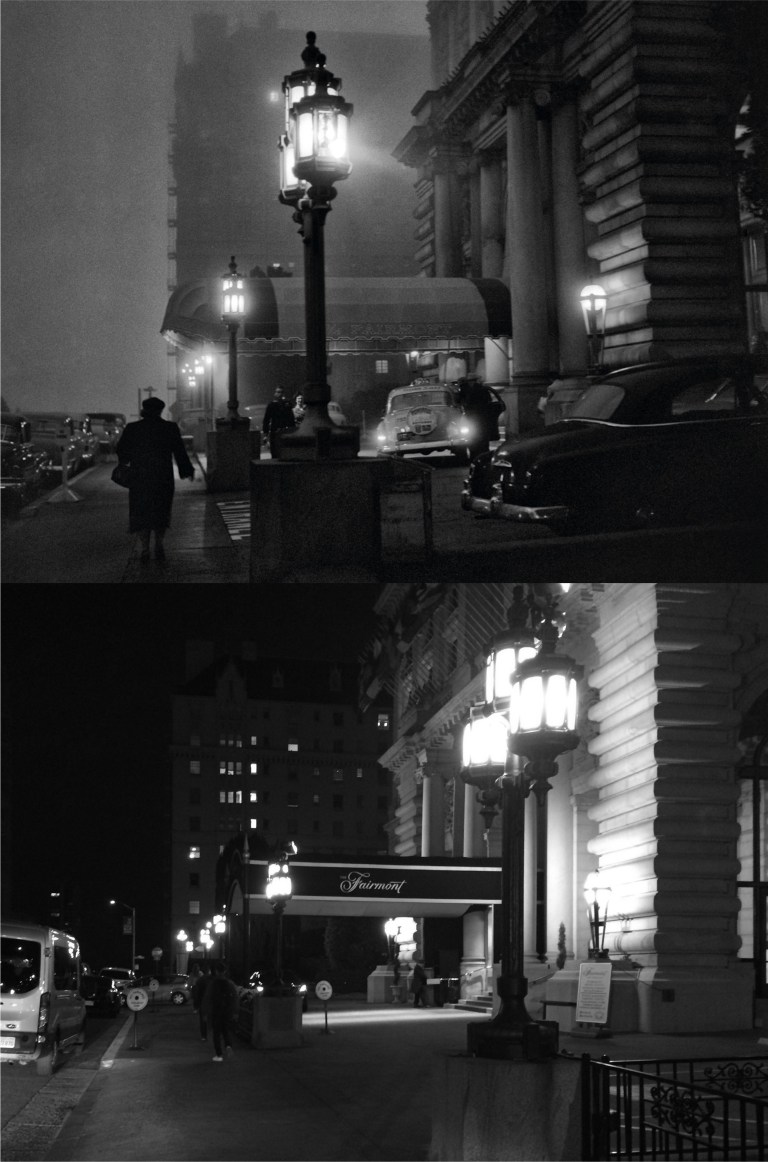
 A foggy Fred Lyon gem looking toward Grant Avenue from Pine Street during the 1950s:
 In my last post I showed a picture of two ladies from the late 1950s making a telephone call from a phone booth next to Old St. Mary’s Church that was designed to look like a telephone booth in Chinatown should look. This picture taken in the early 1960s is the only other picture I’ve seen yet of that old telephone booth with the red roof on the far right. The telephone booth was just behind where the cement potted tree is in my picture.
 Looking north on Grant Avenue from Sacramento Street in 1958: I’ve seen pictures of that Bakery sign in the center of both pictures that go back to World War Two, and it still lights up in neon at night. (KathieKemp.com)
 I’ve written in the past that this blog isn’t about my pictures, but the vintage photos. I don’t pretend that any of my pictures have any lasting quality, but a picture like this one from by Fred Lyon taken during the 1940s certainly does. What I do take a small pride in is often being able to locate where vintage pictures were taken when the location isn’t described. However, probably anyone with any knowledge of San Francisco history might be able to track this spot down too. Bail Bond businesses were located all around the old Hall of Justice Building on Kearney Street like this one on Clay Street, just east of Kearny. The old Hall of Justice Building was demolished in 1967 for some stupid reason and a Hilton Hotel now occupies the spot. Films like ‘The Lady from Shanghai from 1947, ‘Impact’ from 1949, and ‘The Man Who Cheated Himself’ from 1950 filmed scenes at the old Hall, as well as television shows like ‘The Lineup’ and ‘Ironside’.