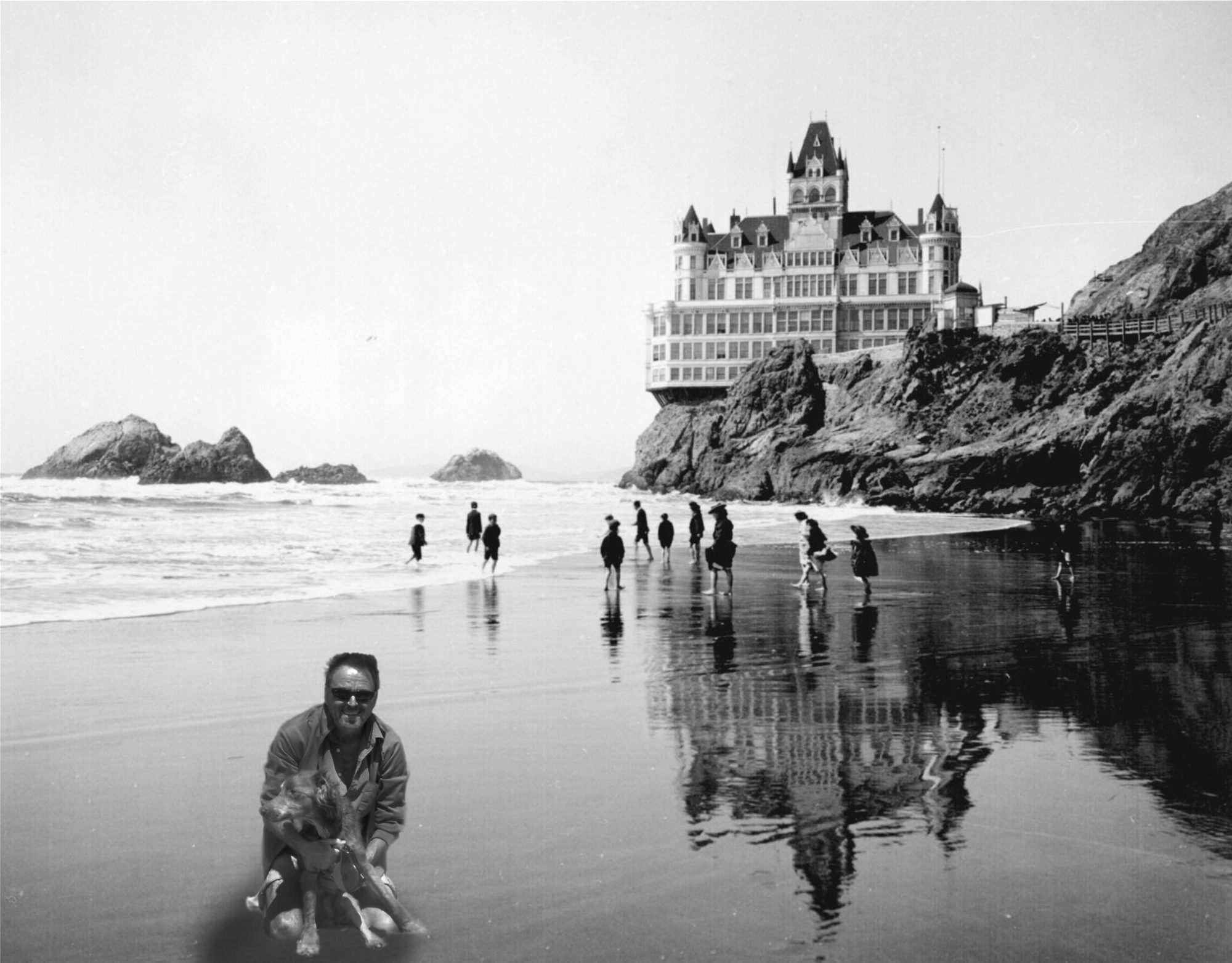
 Opening day at Sleeping Beauty’s Castle:
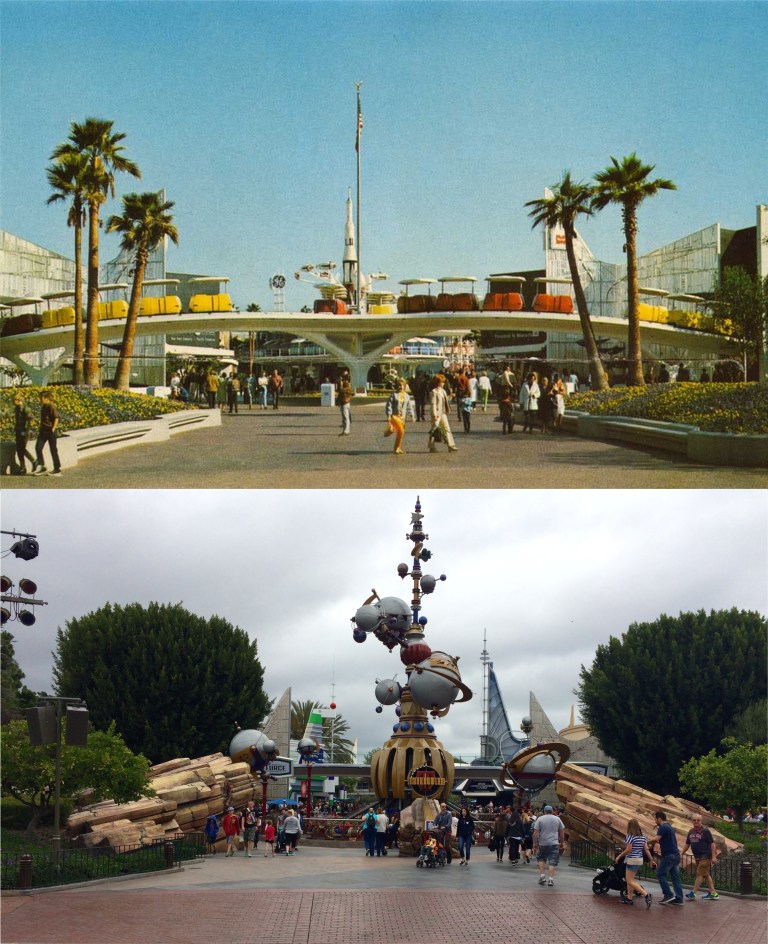 The old Tomorrowland entrance:
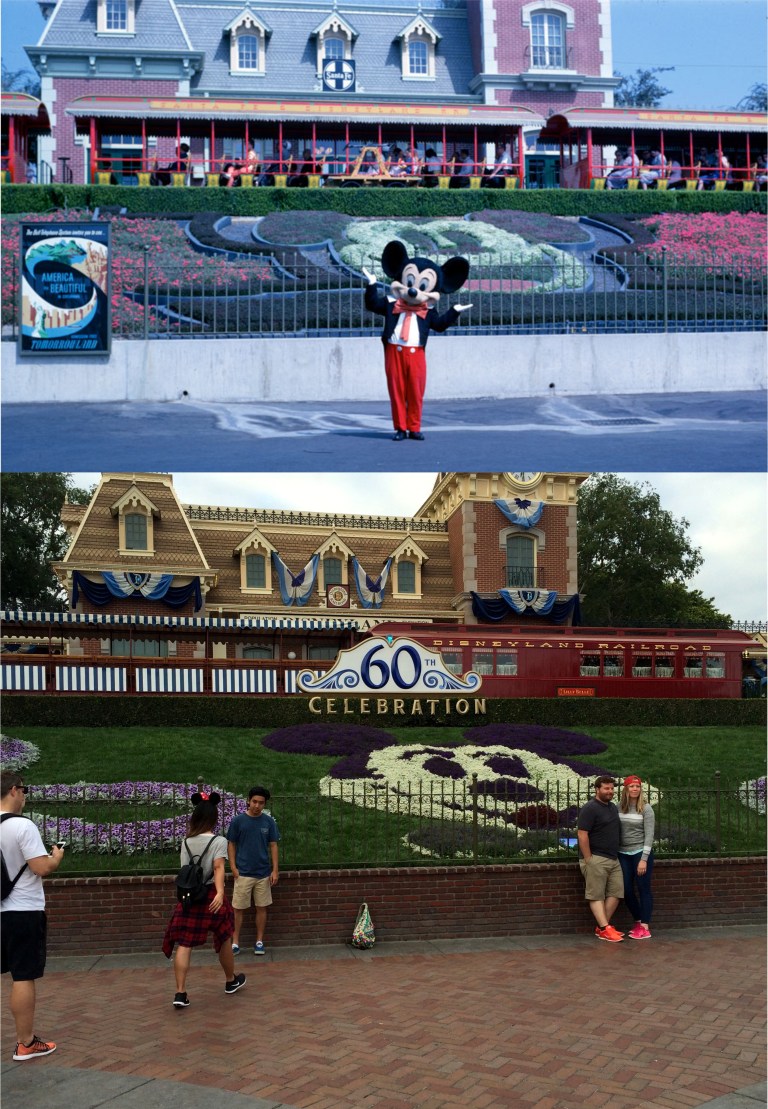 The Disneyland entrance in 1962:
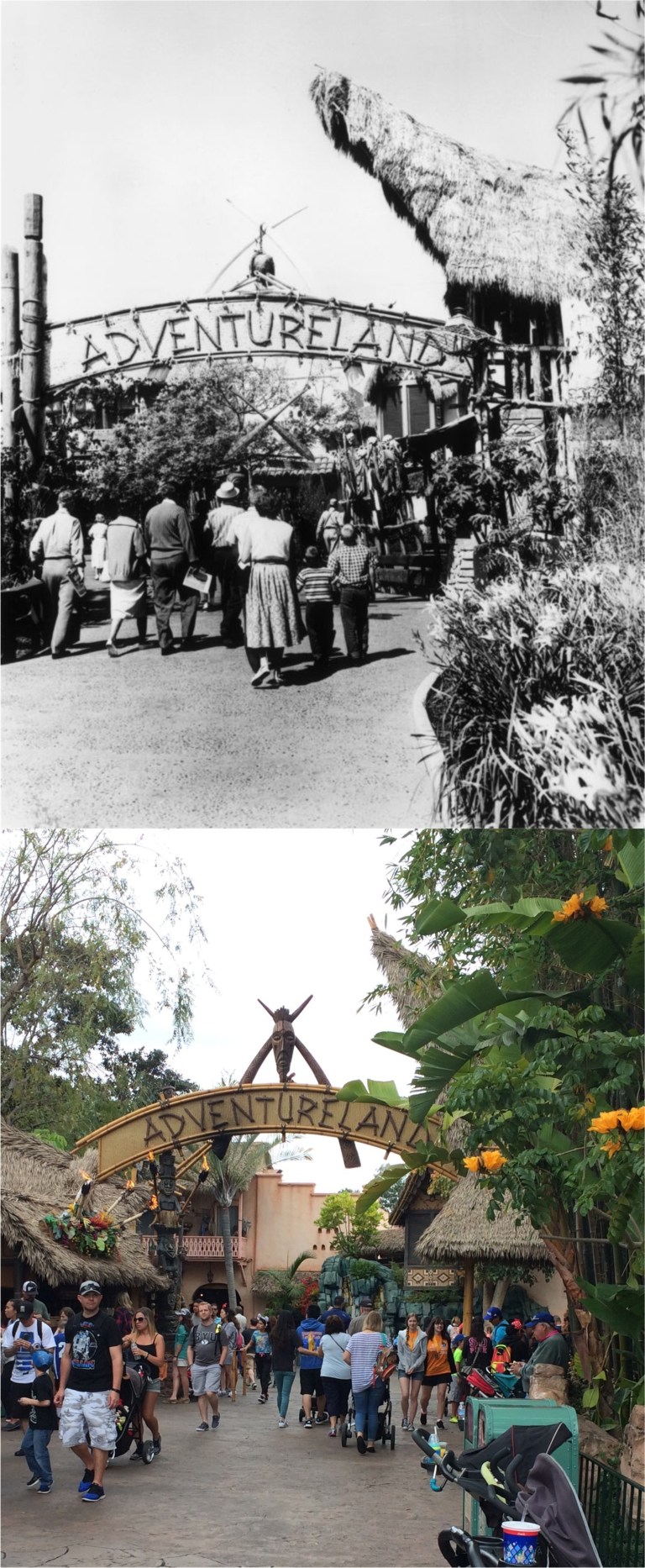 The Adventureland entrance:
 Walt Disney dedicating Sleeping Beauty’s Castle: He would have been sitting on these rocks. I don’t like the looks of those two culprits behind him!
 Walt Disney engineering, with the help of Mickey Mouse, the inaugural run of the Disneyland Railroad (DLRR) in 1955:
 I wish the crowd was like this quiet day on Main Street in 1963 when I was there this time.
 Disneyland closed and in mourning the day after Kennedy was assassinated: By a coincidence, the flags in Disneyland were at half staff for Police Officers Memorial Day when I took this picture last Sunday.
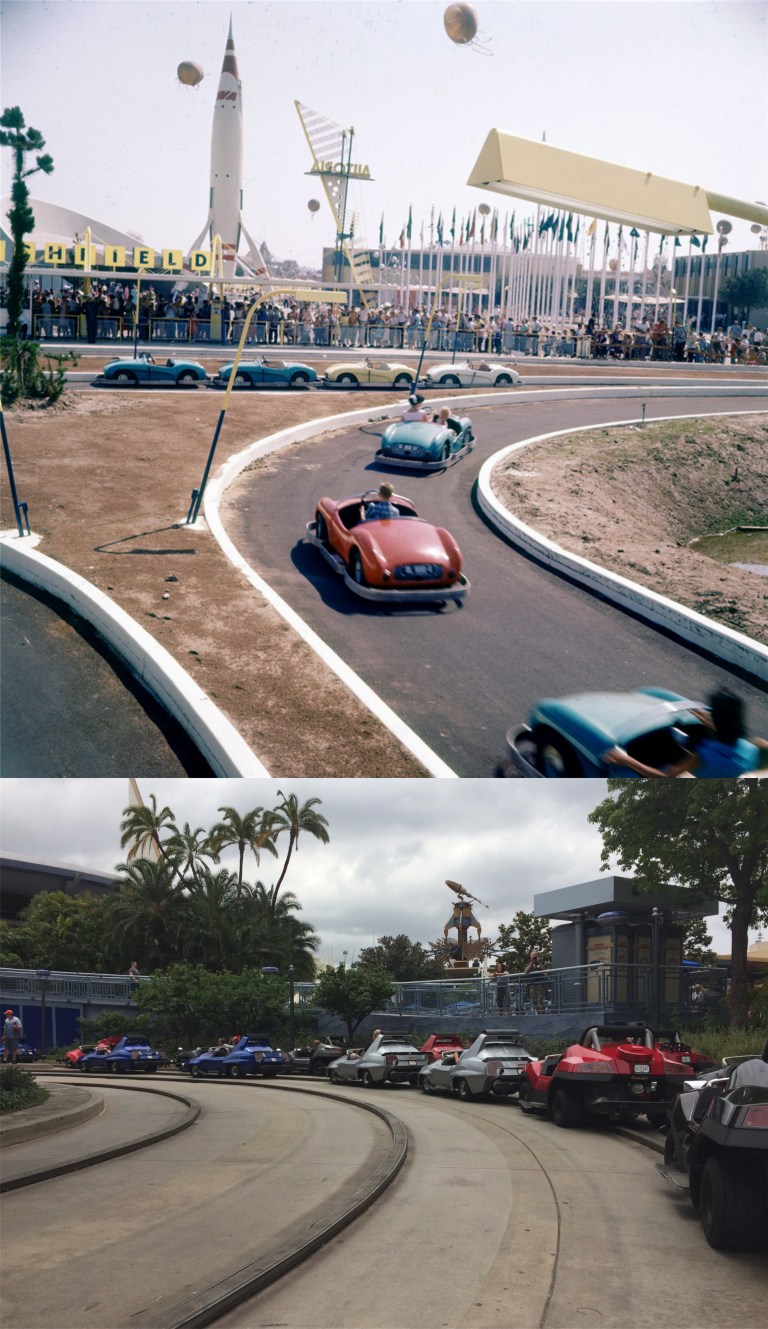 The Autopia in Tomorrowland: I like the way they all pulled over for me.
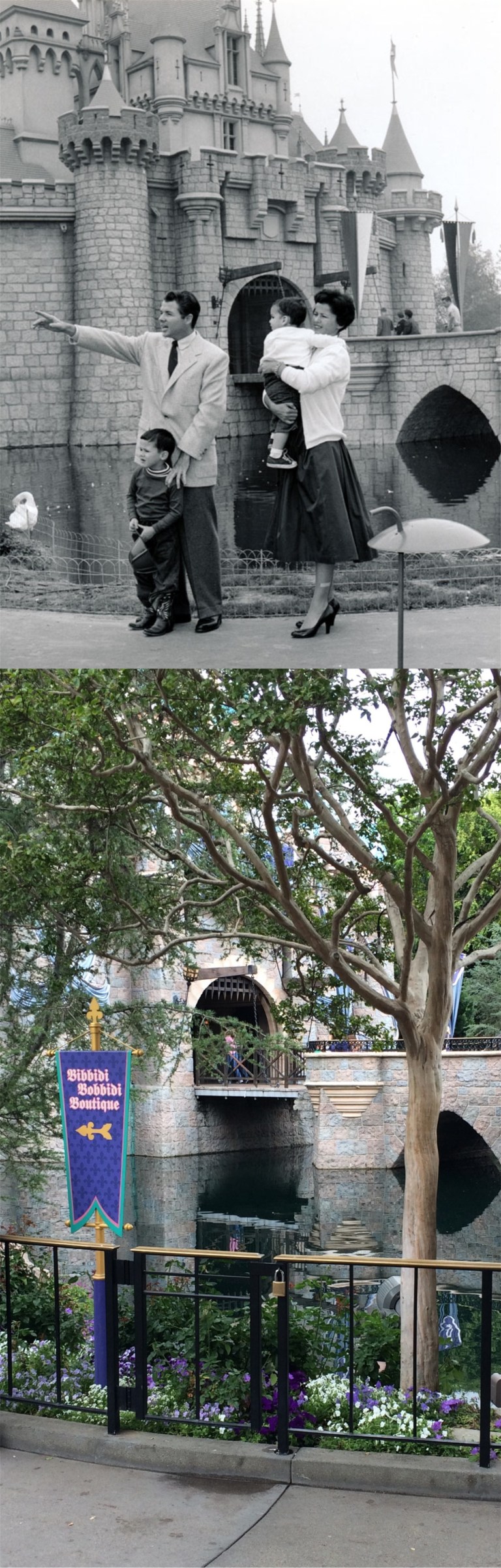 The most decorated soldier of World War Two; Audie Murphy and his family, next to Sleeping Beauty’s Castle in 1956. (davelandweb.com)
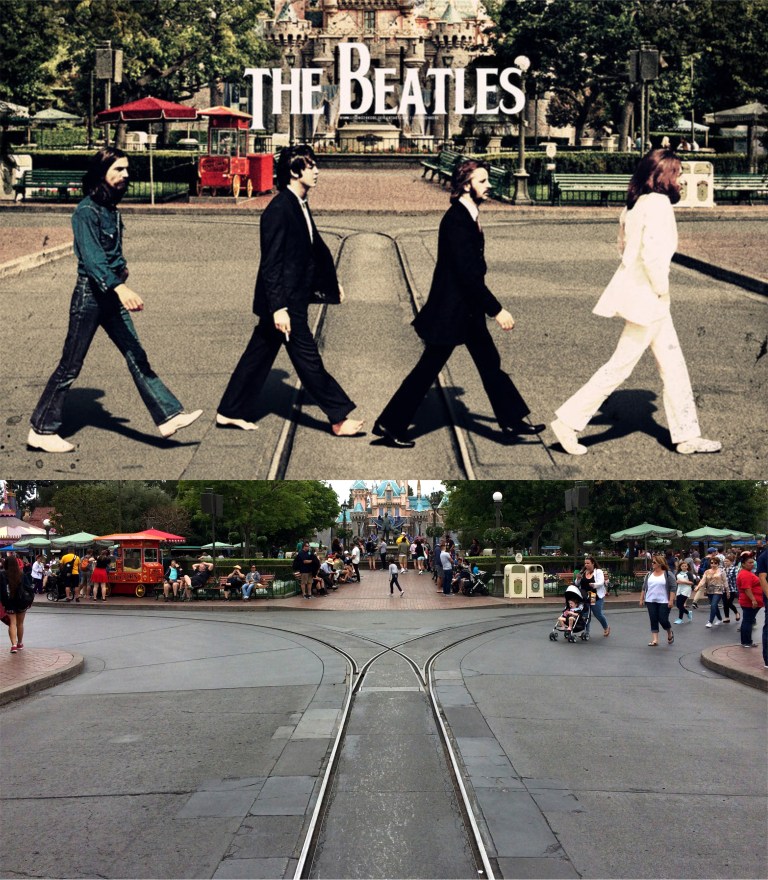 The spot where this famous picture was taken, NOT!
 The Bride of Frankenstein, (Elsa Lanchester) and the Hunchback of Notre Dame, (Charles Laughton) at the Main Street Cinema in the 1950’s: (Disneyland the First Quarter Century)
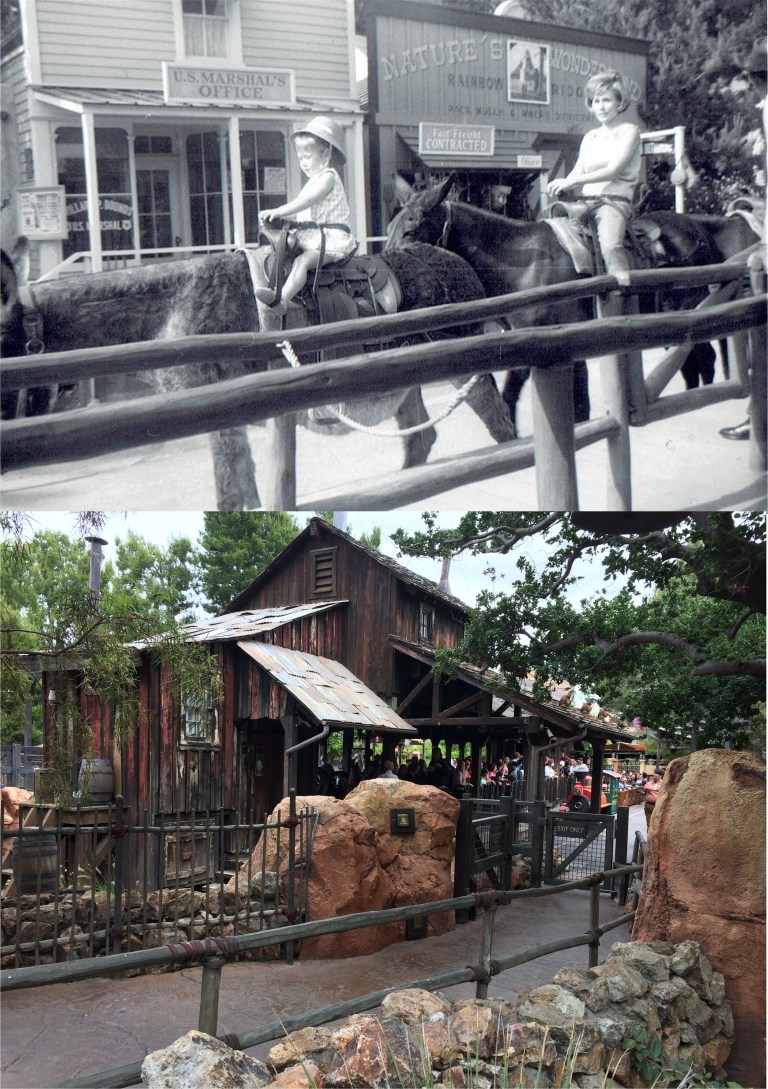 In 2014, Disneyland hosted a Facebook contest to select the best pictures from each decade Disneyland has been open. My friend Cindy made runner up from the 1960’s with this picture of her and her mom on the Disneyland Pack Mule Ride, (An E Ticket ride, by the way). Alas, she didn’t get the big ticket! The Pack Mule Ride left from the old Nature’s Wonderland Town. The Thunder Mountain Railroad ride now occupies the location of the mule rides.
Where birds sing to flowers, and large mice still walk.
Where pirates still plunder and “dead men” don’t talk.
Where hinges still “creak” and doorknobs still rattle,
I throw my vote in for the kid in the saddle.
Where kids ride on freeways in small open cars.
Where some things are gone now, like rockets to Mars.
Where witches still poison, and fairies still rule,
I throw my vote in for the kid on the mule.
Where “Indy” still whips it, and hippos still charge,
you can ride to an island on Tom Sawyer’s barge.
Where horses don’t trample, or poop in the street,
I throw my vote in for the kid in the seat.
You can eat mouse head pancakes, or buy a straw hat.
You could spit off the Sky Tram, (and what’s wrong with that?)
Where beckoning ghosts still frighten this honky,
I throw my vote in for the kid on the donkey
Although, so many things that I like have been hurled,
when you run into friends there, it’s still a “small world”
Hold tight little toddler, now there’s a fine lass!
I throw my vote in for the kid on the ass.
 19th and Broadway in Oakland and the emerald green I Magnin Building. The Disney cartoon, ‘Melody Time’ on the Paramount Theater marquee in the vintage photo dates the picture from 1948. Notice the flat front of the marquee in the vintage picture.
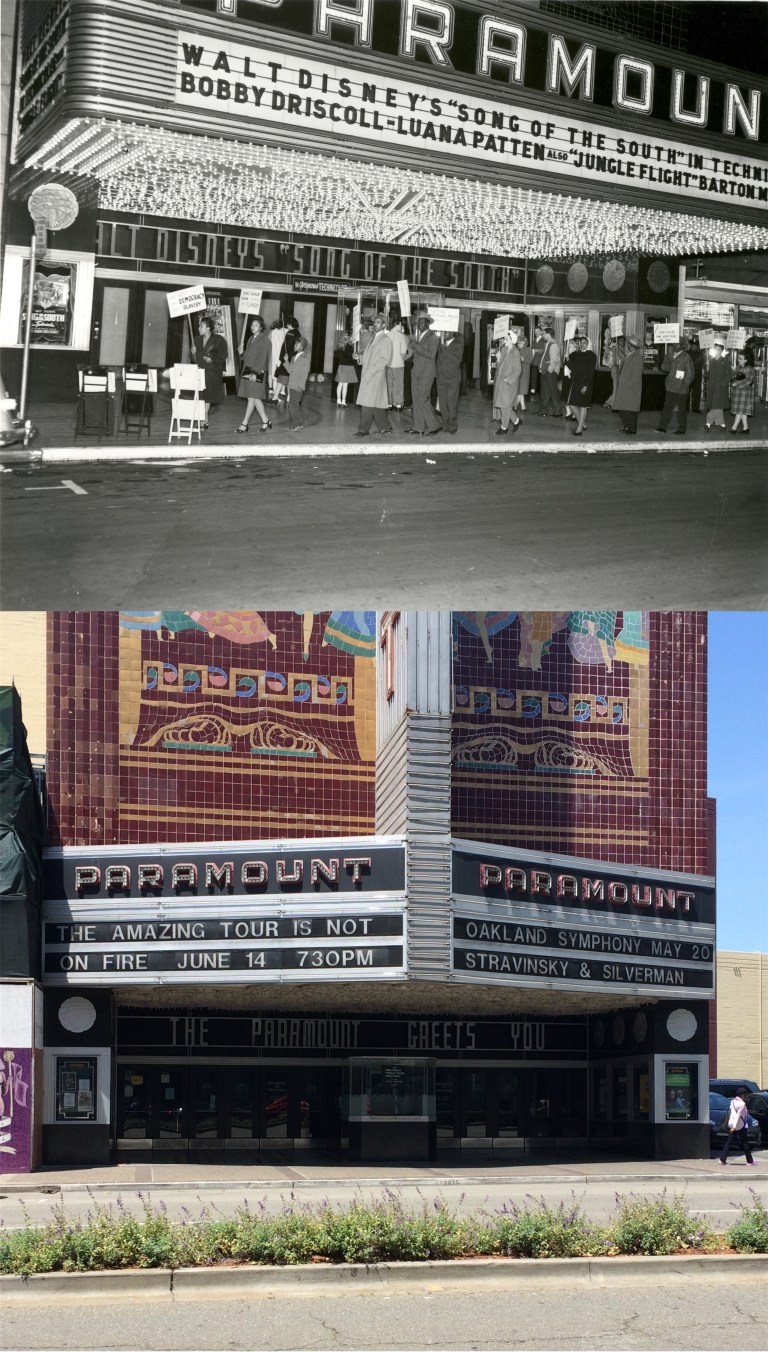 Disney wasn’t so popular here two years earlier in 1946 at the Paramount Theater in Oakland as this protest over the movie ‘Song of the South’ indicates.
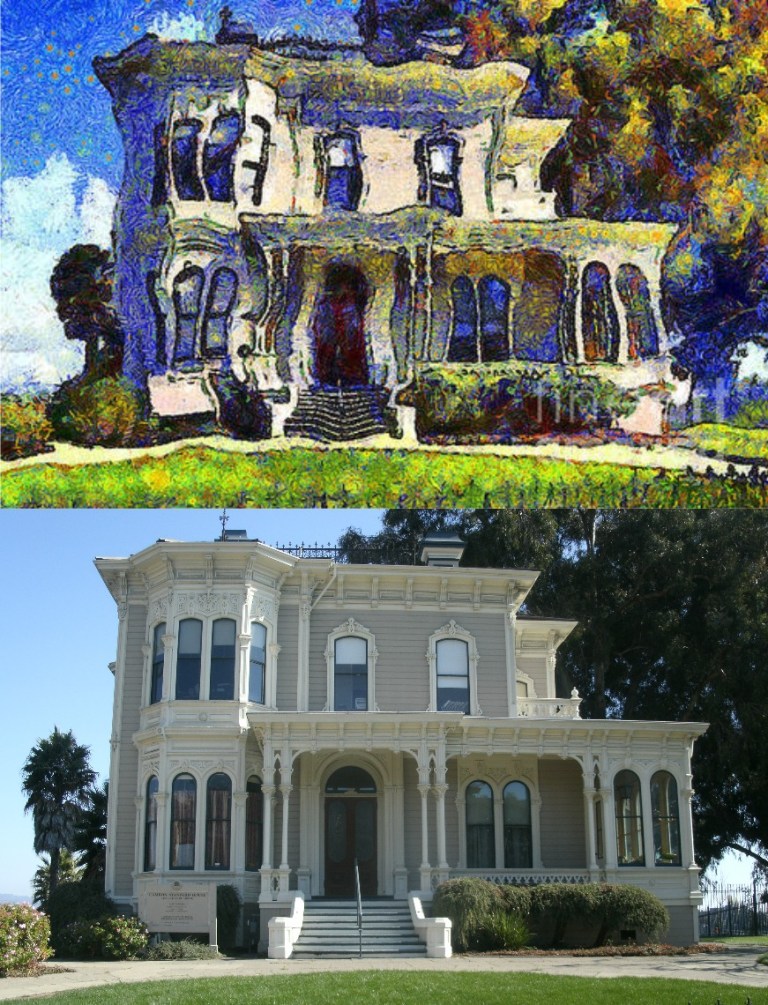 Vincent Van Gogh visits the Camron-Stanford House on Lake Merritt in Oakland: Built in 1871, this was once where the Oakland Museum was housed, and it’s said to have been visited by President Rutherford B. Hayes in 1880, although, some reports say only the First Lady, Mrs. Hayes was there. And, no, Van Gogh never visited the Camron-Stanford house. (Wingsdomain Art and Photography)
 I go back a ways, and I’ve seen Hayward change quite a bit through the years, and not always for the best. Take, for instance, the “Hayward Loop” downtown traffic plan that’s about as practical as an Elvira Day Care Center. Still, buildings like the modern City Hall show that Hayward can sometimes be, “The city that knows how,” too.
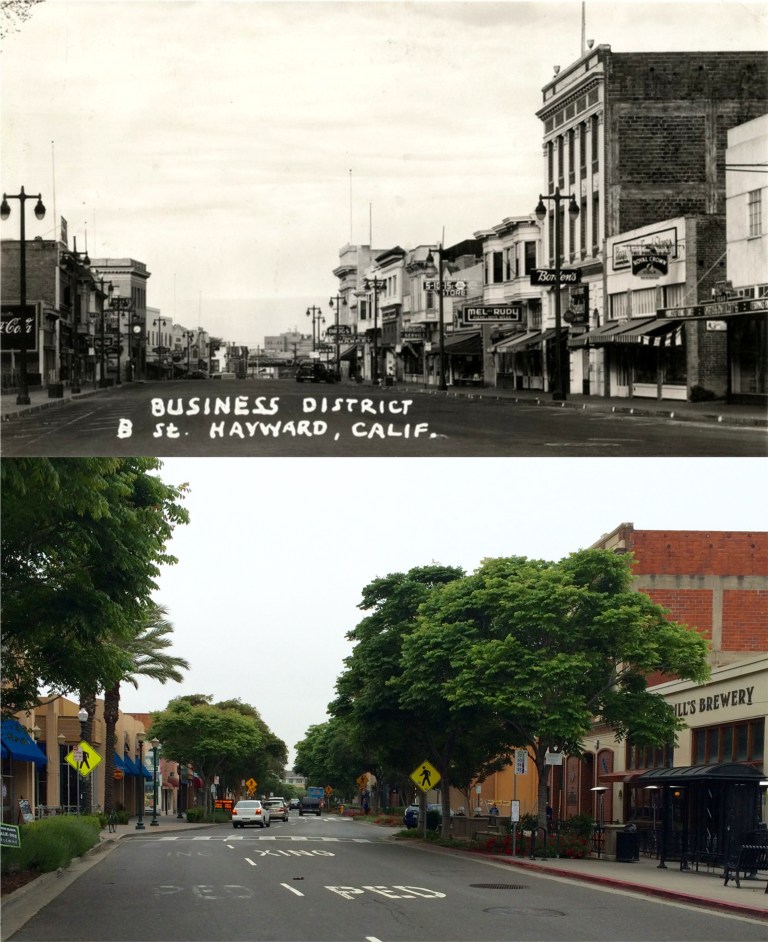 B Street from Foothill Blvd in Hayward: The brick Building on the right in both photos is the Masonic Lodge today.
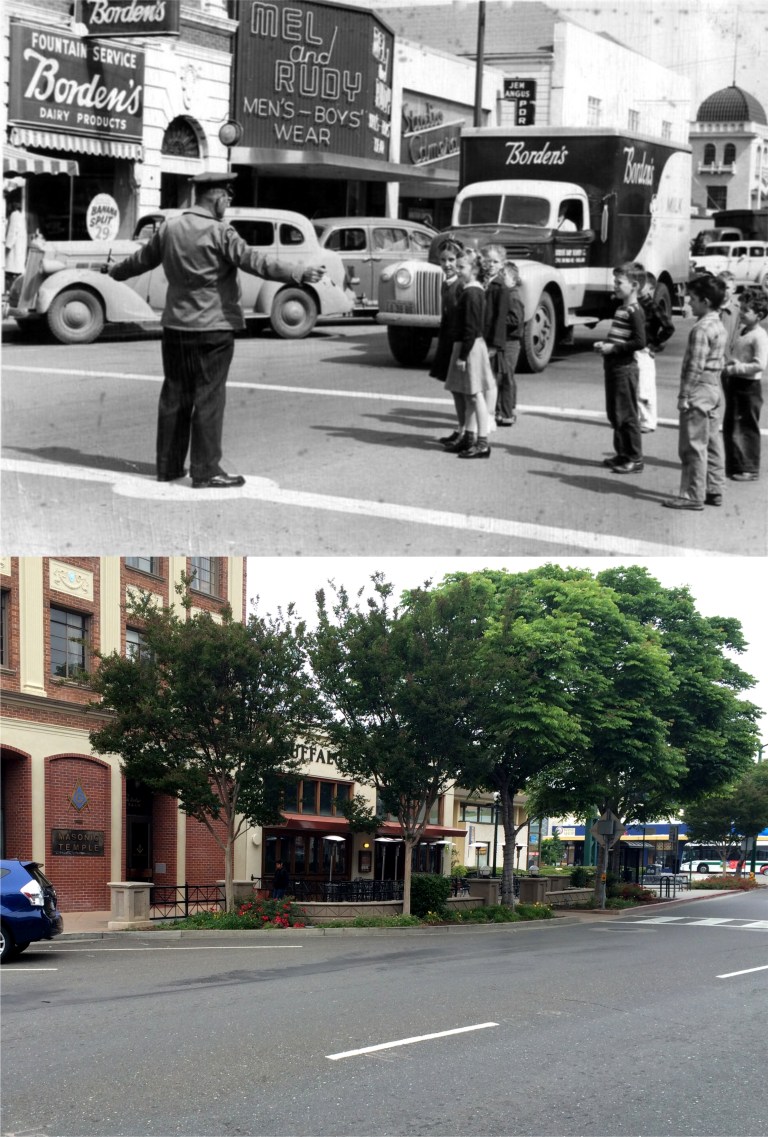 B Street in Hayward: This is approximately where the crossing guard was in 1940. The children are coming from the old Markham Elementary School that was on First (Now Foothill Blvd.) and B St. The Borden’s Dairy Products is now the remodeled Masonic Temple. The Mel and Rudy and Studio Camera were where Buffalo Bill’s is located now. The Tower at the far right was the old Carnegie Library at First and B Streets.
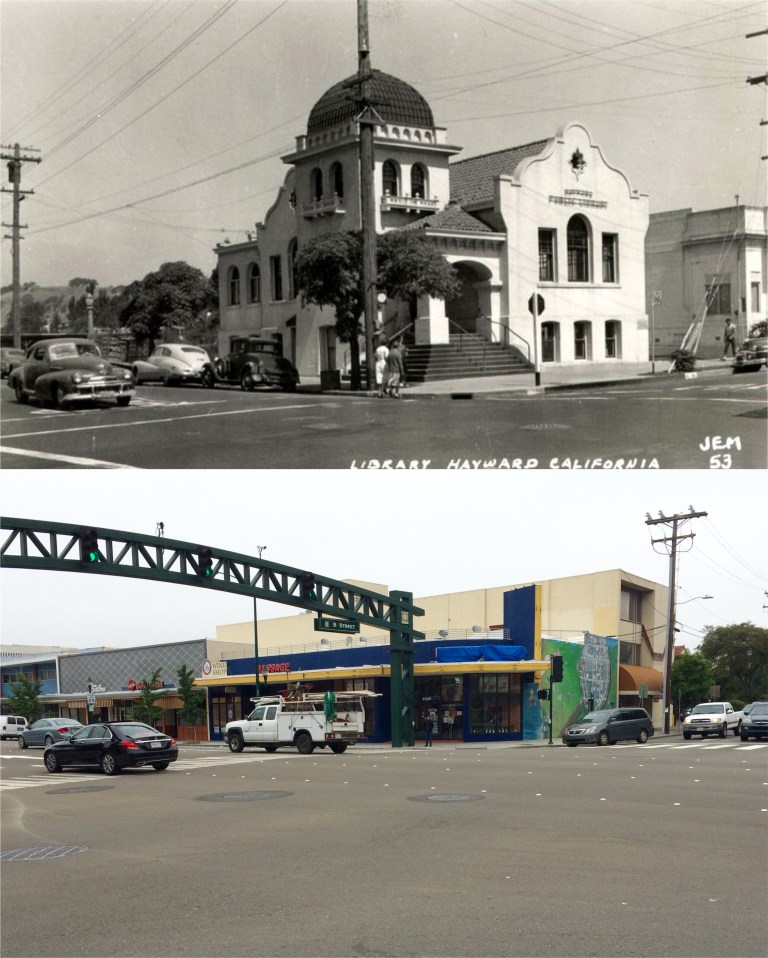 Foothill Blvd. at B Street and the notorious Hayward Loop; five lanes in search of a city: The Carnegie Library at the northeast corner of First and B Streets was demolished in 1948 to make way for the Foothill Strip. First Street to the left of the library was widened and renamed Foothill Boulevard. Notice the mural on the building at this location, and look at the close up in the next photo.
 A postcard of Downtown Hayward from the air in the 1960’s, and a painting of Downtown Hayward under a magnifying glass on the corner of B Street and Foothill Blvd. today. You can follow Foothill Blvd. as it sweeps past D, C, B, and A Streets in both images. The Library Park is above the door in the mural, and on the left in the old postcard. The library is currently scheduled to be demolished for a new one being build across C Street next to the post office. Don’t ask me “Why?”.
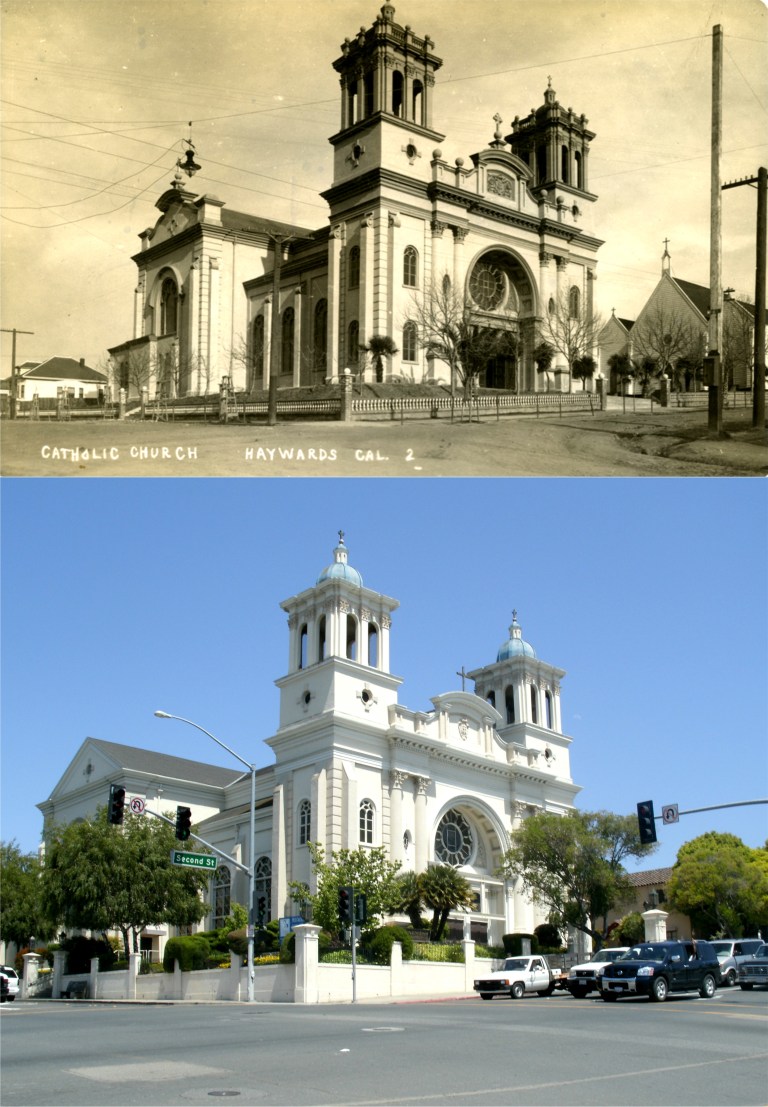 The All Saints Church on the corner of D Street and Second: It is considered by many to be one of the most beautiful churches in the East Bay. That’s not a typo, Hayward was originally called “Haywards”. Don’t ask me, “Why?” about that, either!
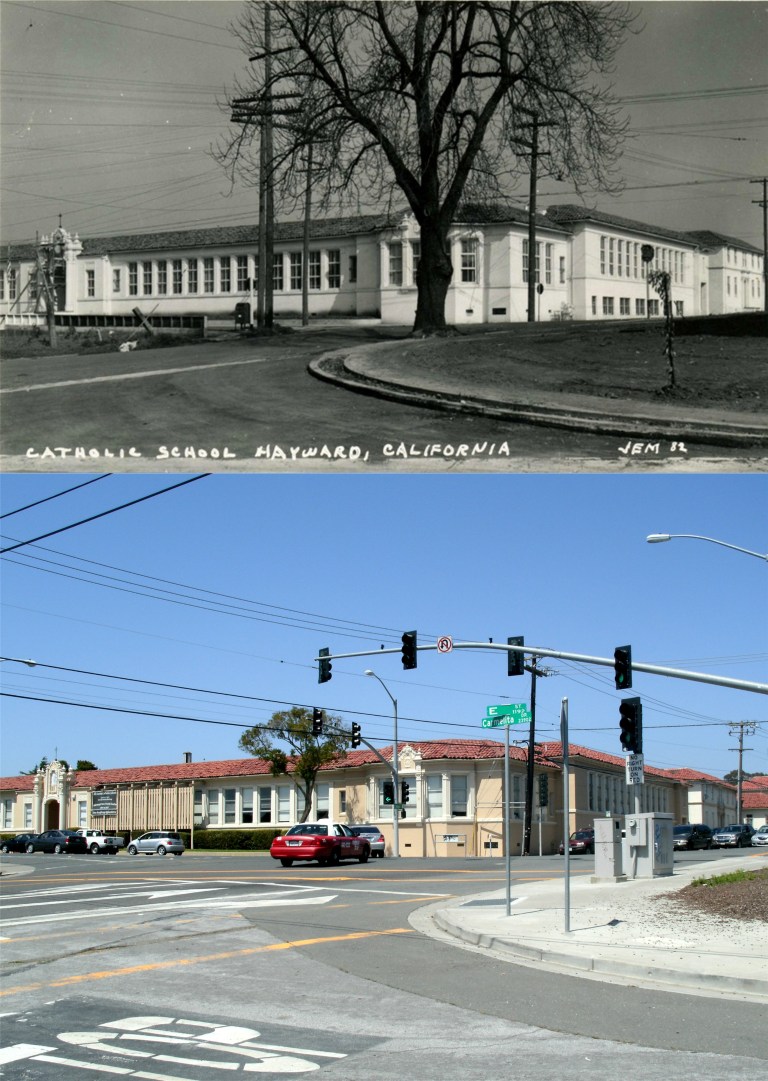 The All Saints Catholic School on Second Street in Hayward: Having once considered a career as an alter boy until I discovered that the job didn’t pay much, I have a soft spot for the parochial lifestyle.
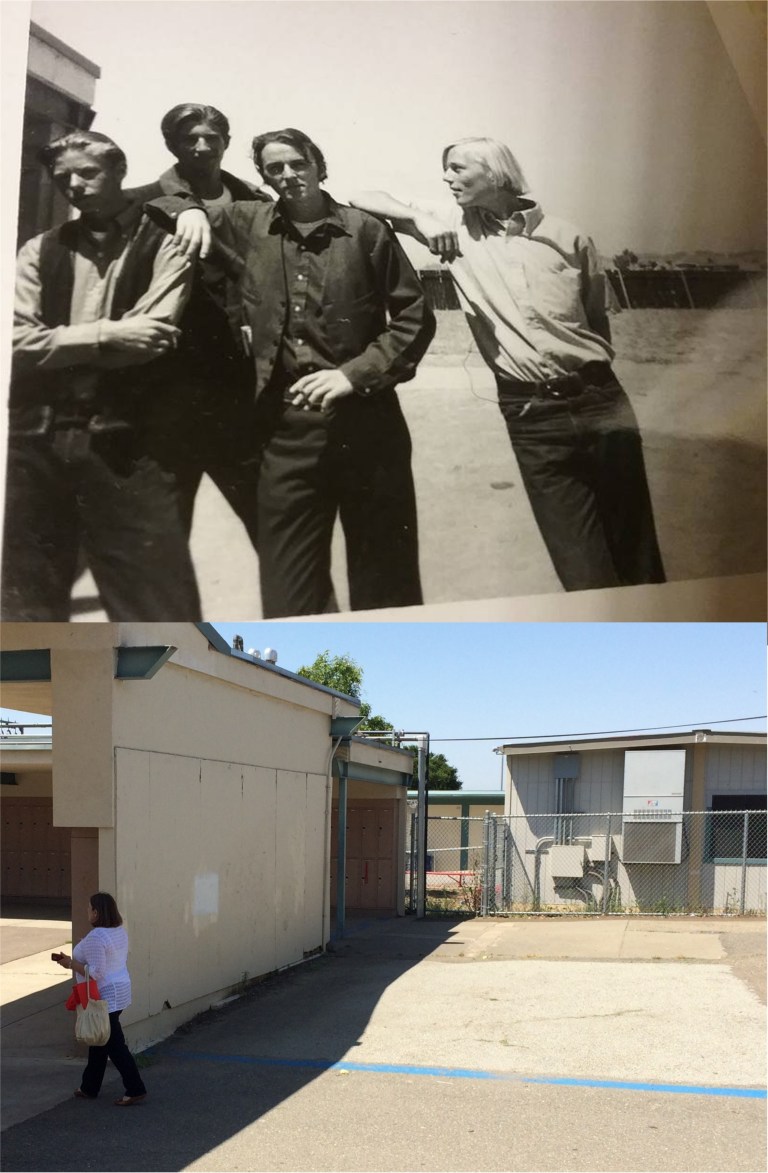 A friend of mine named Cyndy took this picture of some students sneaking a smoke break at Canyon High School in Castro Valley. At first I thought, “I wouldn’t let my kids anywhere near those rowdies!”, but on closer look, I discovered that the rowdy in the middle is me! I still wouldn’t let my kids near me back then! That’s Chris W. with my arm on his shoulder, Dennis G. with his arm on mine, and Jeff B. behind us. We were smoking behind this wall at the A Wing of the campus, a favorite hangout for students who should have been in class.
 Fishing at Fort Point in the 1950’s: The Bay was a lot calmer for this fellow. (Phil Palmer)
 Fishing with a bestie behind the St. Francis Yacht Harbor: (Barnaby Conrad)
 “Don’t lollygag, Dear, I’m right behind you. I’ll catch you if you slip.”
 Lollygagging at Spreckels Lake in Golden Gate Park: I’m beginning to hate that word! (Phil Palmer)
 The Conservatory in Golden Gate Park:
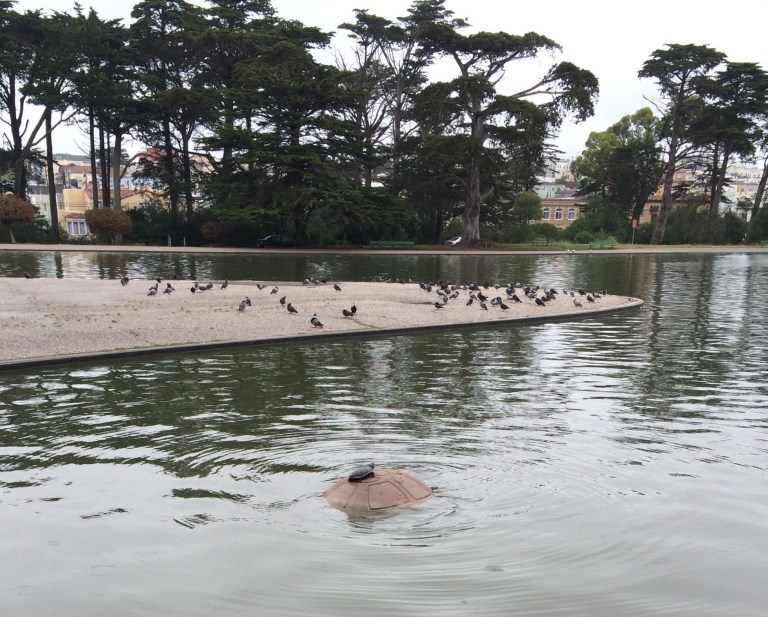 Hmmm, I’m not the only one lollygagging around! You and me, Mr. Turtle!
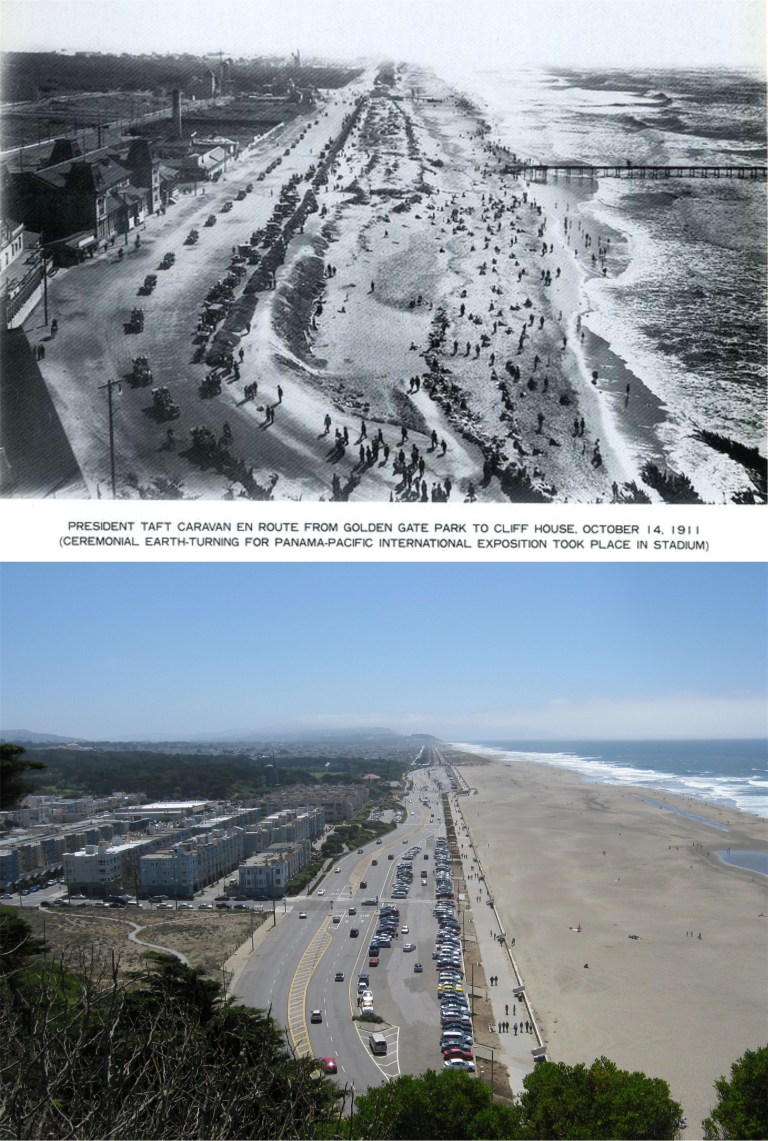 President Taft’s motorcade moves along Ocean Beach to the Cliff House in 1911.
 Ocean Beach in the early 1920’s: No Playland-at-the-Beach, no sea wall, but the observatory of Adolph Sutro’s mansion can still be seen on Sutro Heights, although, Sutro had died in 1898. (Vintage photo from Shorpy.com)
 The old streetcar turnaround at Playland-at-the-Beach, and the same spot today.
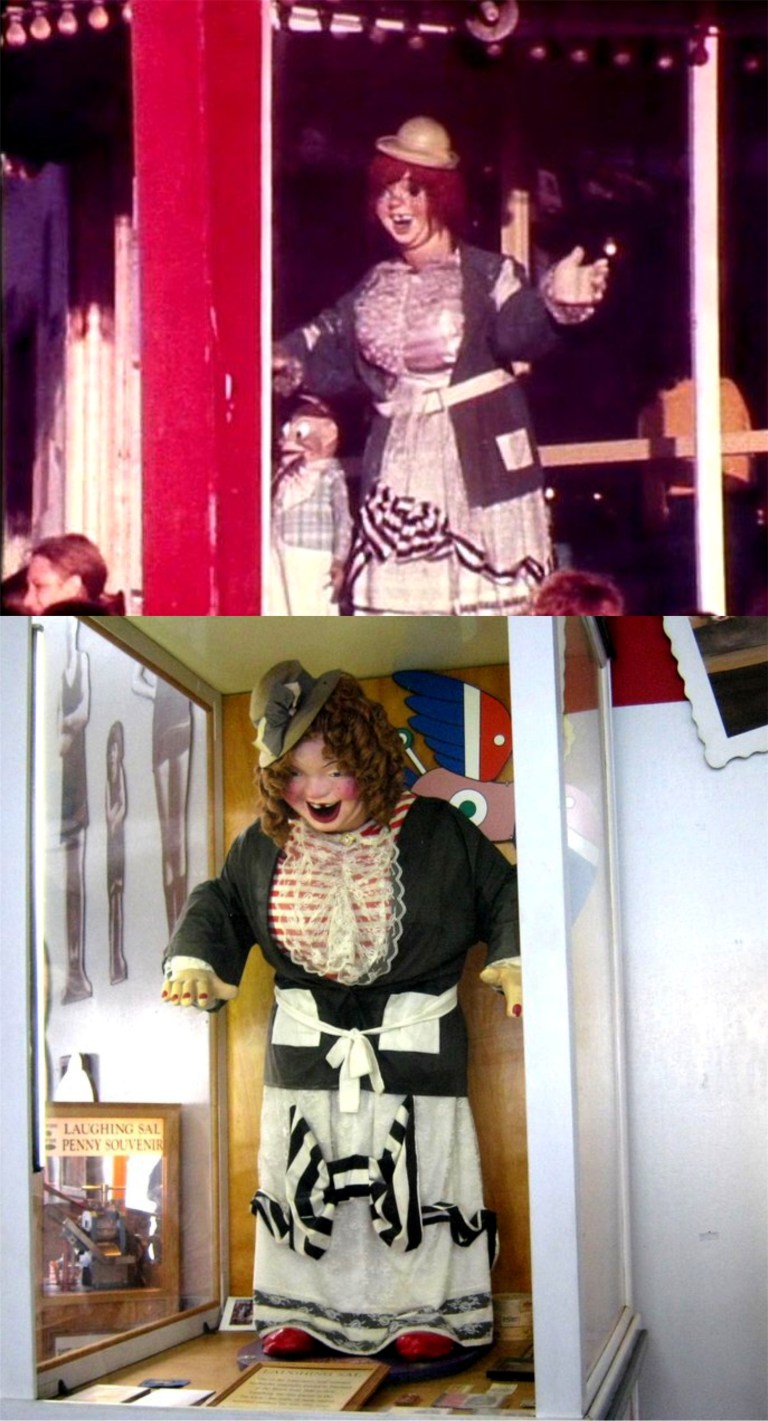 Laffin’ Sal at the Playland Funhouse and today: She hasn’t got any prettier over the years.
 One of the oldest pictures of the Cliff House I’ve seen. That’s the one that was built in 1858
 A neglected Historical Marker is about all that’s left of Playland-at-the-Beach.
 North Beach runs roughly along the western side of Telegraph Hill, and is centered around Columbus Avenue. It was more of a beach area once, as seen in this terrific 1880’s map before much of the Bay to the right of Telegraph Hill, seen at the bottom of the map, was filled in.
 A long ago father with children head up Kearny from Broadway early in the Twentieth Century. The intersection at the bottom of the hill, Broadway and Kearny, was once one of the main hangouts in North Beach frequented by the likes of Woody Allen and Bill Cosby, and many movies have filmed scenes in this intersection, such as ‘Bullitt’, ‘The Laughing Policeman’, ‘Kiss Them for Me’, ‘Play It Again, Sam’, ‘Butterflies Are Free’, and ‘The Enforcer’.
 One of the movies that used extensive North Beach locations was ‘The Sniper’ made in 1952.The film startled audiences with its frank subject matter, and dialogue when released. Using taboo expressions like “pervert” “registered sex offender”, and “voyeur,” this disturbing movie follows a maniac through San Francisco as he murders women victims with a telescopic rifle. The film tries to suggest a psychological understanding of what motivates the serial killer. This accounts for the film’s surprising ending.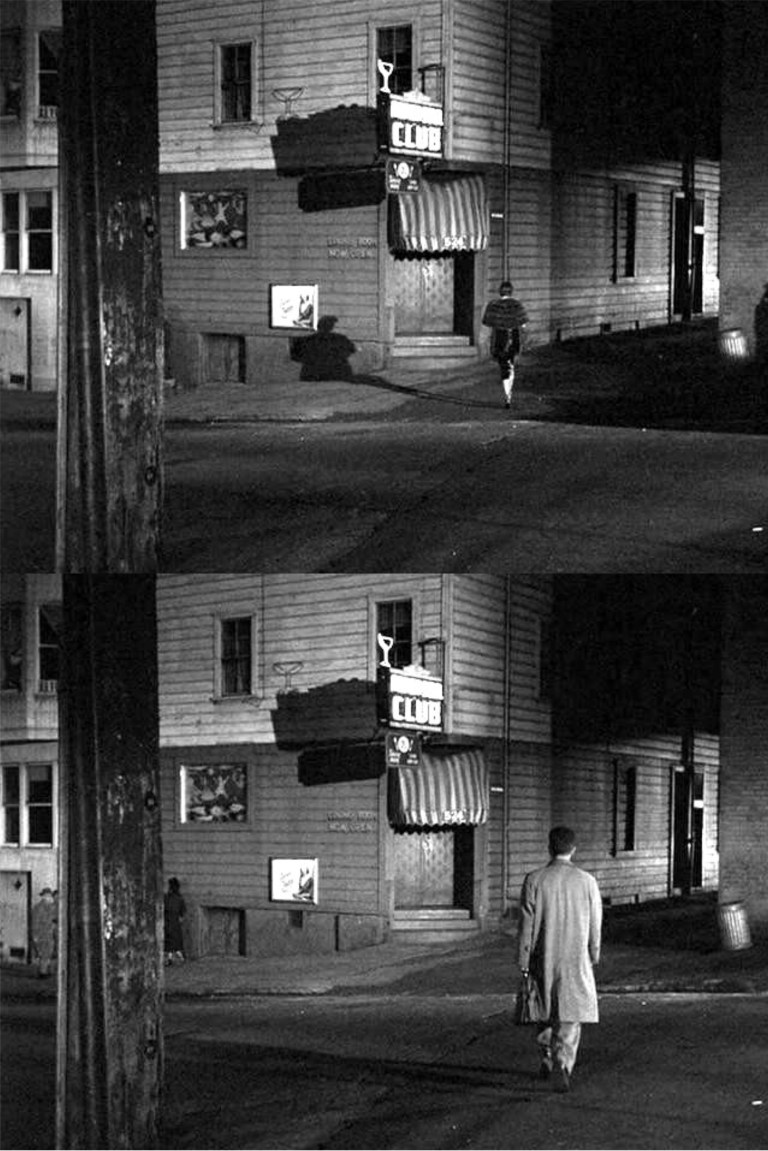
 What a stalker looks like: The “Sniper”, Arthur Franz, follows Marie Windsor to the Paper Doll Club on Union Street where she sings, shoots her with his rifle when she leaves after her performance causing her to crash back into her own marquee. The Paper Doll Club, popular in the 1940’s and 1950’s was known as the Silhouettes in the 1980’s, and I used to hang out there a lot myself. The building was closed and up for lease when I took the picture.
 After a long day of shooting another innocent girl to death, the sniper legs it up Varennes Alley to his home, little realizing that the police are closing in on him.
 Police Officers Adolphe Menjou and Gerald Mohr rush up Filbert Street to the killer’s house. My Budget Rent a Car makes a nice fill in for the police car in the alley in the 1952 movie.
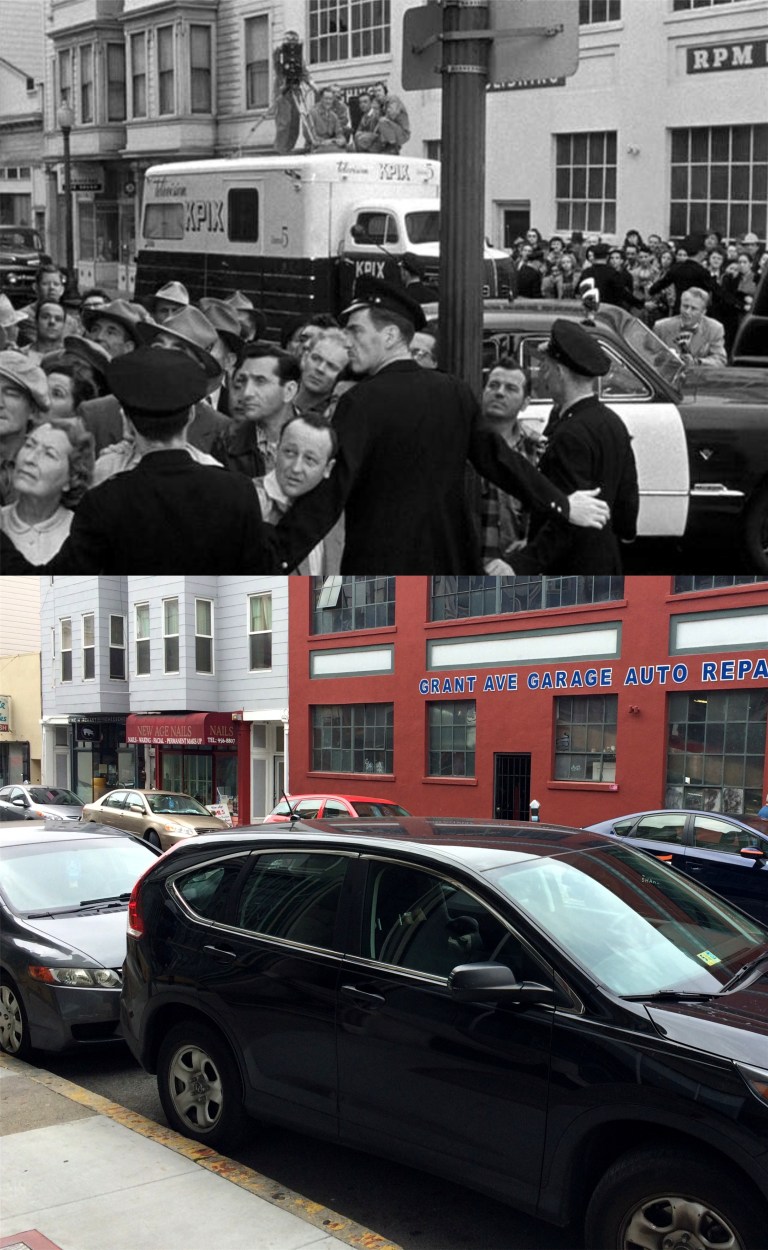 A crowd gathers at the corner of Grant Avenue and Filbert Street, including a KPIX news truck, as police move in on the sniper.
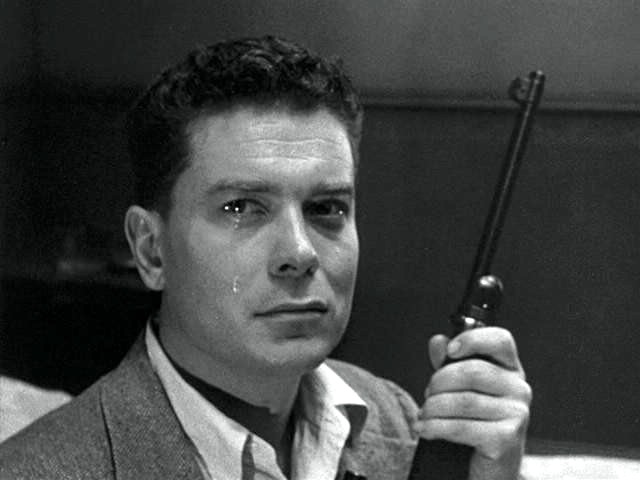 The police, realizing that he’s mentally ill when they break into his house, show compassion and don’t kill him. The film closes on an image of the tearful psycho. To be honest, I’d have been happier if they would have shot the creep, but that’s the romantic in me.
 A perfect day to splash on some Old Spice and set sail to explore the Embarcadero. The Java House is about where Fritz and Fred’s Restaurant was. Pier 40 still exists, although the front part was removed in the 1970’s and the pier sits farther back now behind where the Java House is. Also, an Acme Beer would hit the spot right about now, but I doubt if it still exists anymore. (Vintage picture from Michael Corbett’s book ‘Port City)
 The Lefty O’Doul Drawbridge next to AT&T Park seen in the 1934 movie ‘Fog Over Frisco’ with Bette Davis. The bridge is referred to as Butcher Town Bridge in the film, which was what it was known as then.The scene never looked convincing to me, so I don’t know if that was a special effects model of the bridge or another bridge standing in for The Lefty O’Doul Bridge, but the film’s climax appears to have been shot around the actual bridge.
 Pier 23 next to Pier 21 in the early 1920’s seen from Telegraph Hill: There is no Pier 21 anymore, but a remodeled Pier 23 next to the Pier 23 Café is still there.
 “Who picked this room?”
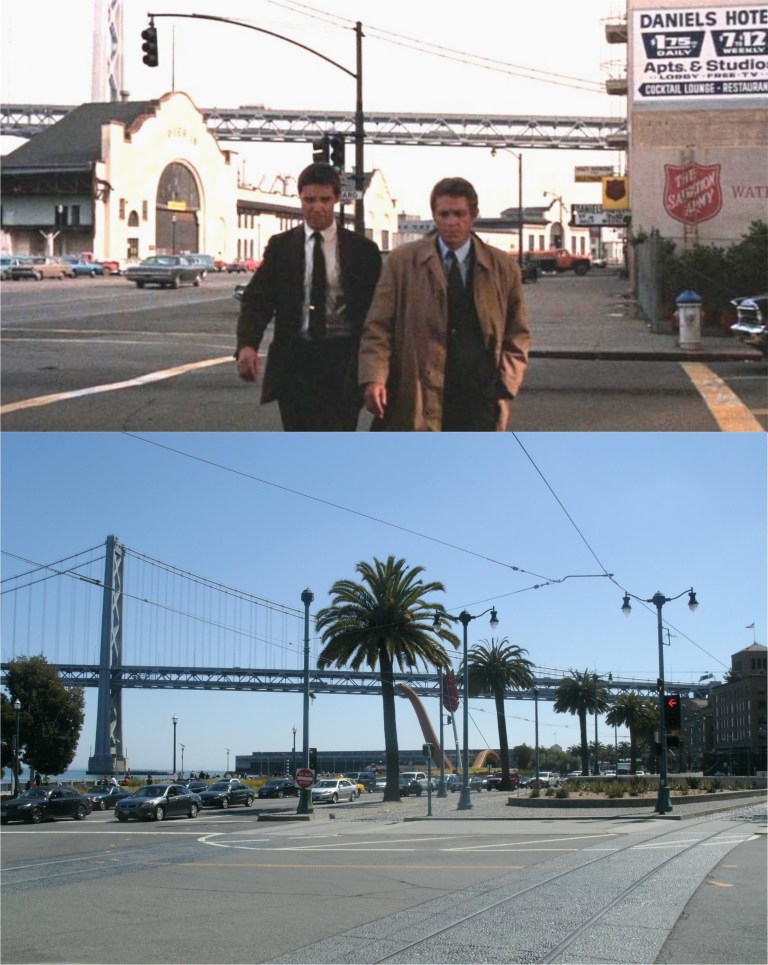 The Daniels Hotel was at Howard Street and the Embarcadero. The Embarcadero Freeway, most of the piers, and the Daniels Hotel are gone at this location now.
 Eli Wallach crosses the Embarcadero to the Seaman’s Club, (Actually, the old YMCA Building) to make his first kill in ‘The Lineup’. Wallach crossed the Embarcadero here. The YMCA Building is still here behind all that scaffolding.
 A few blocks from the Embarcadero and a fitting spot for this fellow to have been born.
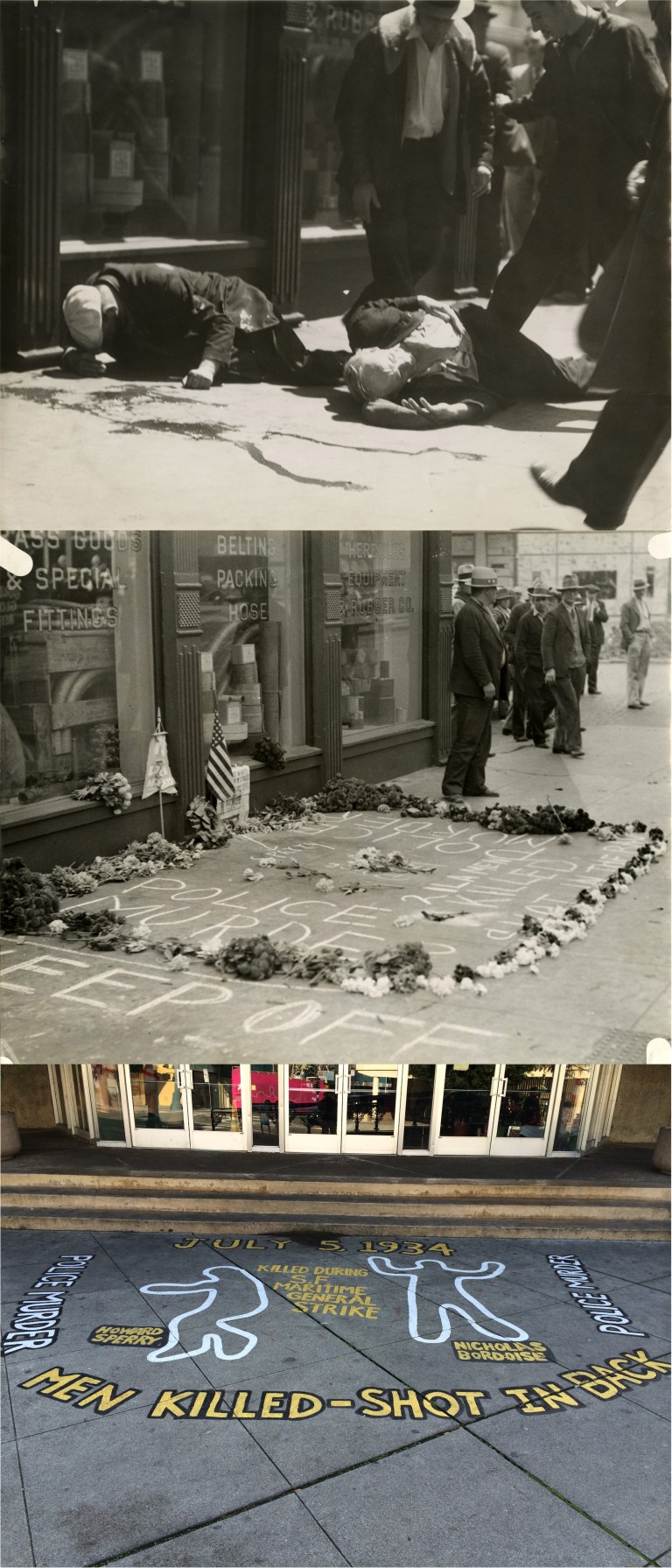 “Bloody Thursday”: On July 5th 1934, police fired on striking dock workers on Steuart Street, between Mission and Howard, killing two men, and causing the strikers to shut down the port for the entire month. A memorial was created at the spot where the men died, and the incident is remembered on the sidewalk in front of the Longshoreman’s Hall on North Point Street today. (The Picture This website)
 When the Three Stooges do valet parking!
 Ah, the old Hills Brothers Coffee Factory; a great place too stop and rest with a cup of coffee, except, they don’t make coffee here anymore. I didn’t get the coffee or the Acme Beer!
 “Nipping the fender.” Charles’s Smallwood’s book ‘The White Front Cars of San Francisco’ is a wonderful source of vintage pictures of San Francisco, but this image here had me doing my homework! When I first saw it years ago, I thought it was a terrific period picture of San Francisco from the 1940’s, and I always wanted to see if the location had changed or still existed since 1943. The trouble was, Smallwood, who was usually an excellent locator, and often identified where the photos in his book were taken, was off here; 26th and Army, (Now Cesar Chavez Street) do not intersect, nor did they in 1943. From an old map located in his book, I was able to determine that the Number 30 Line ran down portions of both Army and 26th in 1943. I perused portions of Cesar Chavez on Google Maps, but much of this area is industrialized now, and the site may have been demolished when Highway 101, cut across Army when it was created.. I went back to 26th on Google Maps to follow the route #30 took and only had to go one block to South Van Ness and 26th, which is where the picture was taken. The intersection looks remarkably the same today including a small grocery store on the same corner.
 “Have an accident?”
 The Butcher Town Bridge opens in 1933: Renamed the Lefty O’Doul Bridge, it now sits next to AT&T Park, and has been seen in a number of movies including ‘Fog Over Frisco’ with Bette Davis (1934), ‘The Enforcer’ with Clint Eastwood’ (1976) and ‘A View to a Kill’ Roger Moore’s last role as James Bond. (1985)
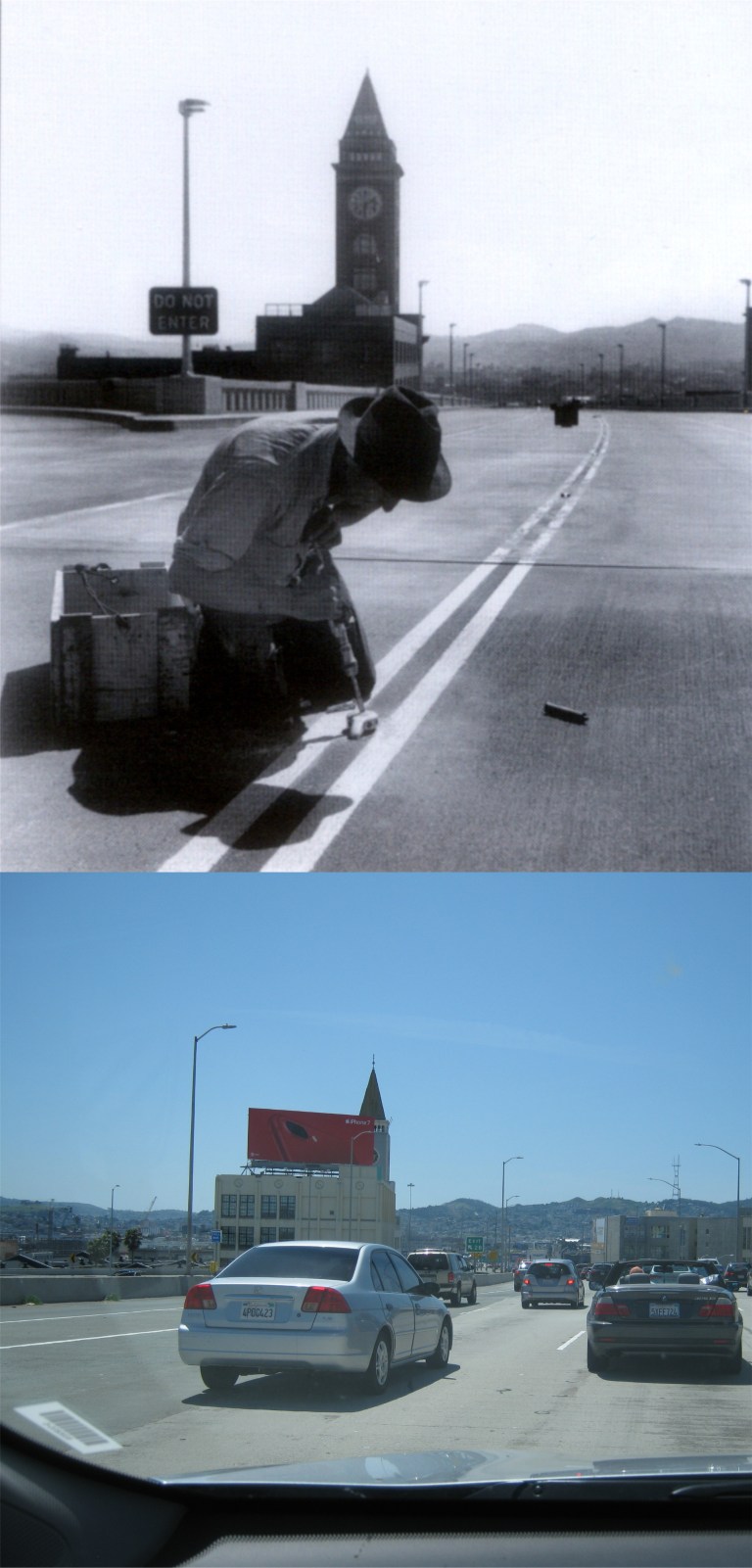 Eighty years later I would have ran over him! A worker puts on some finishing touches to the Bay Bridge before it opened in 1936 near where I was driving. A billboard and concrete addition to the Clock Tower Building in the background since the vintage picture was taken has blocked out most of the view of the tower, which can be seen below the street signs, from this spot today. Twin Peaks can be seen to the right of the Tower Building in both pictures. A long gone entrance to the bridge can be seen on the left.
 Soldiers watch a ship pass through the Golden Gate as work on the Golden Gate Bridge begins in 1933.
 “Come on, who’s next? I’ll fight anybody who says anything bad about my hat!”
 “There are eight million stories in the half naked city; this has been one of them.”
 Wow, a “Pushmi-pullyu”!
 “Far East meets West.”
 “Sneaking Sister Sally through the Alley.”
 Ah, the end of another tax season, and I’m glad that’s over! Now I can get back to the more important things! I’d like to thank all of the people who helped make it happen by name, but there’s too many of them, and some of them haven’t paid me yet! A special thanks to Will, whose computer skills got me through, Amber, who took over my desk when she was in, and also ate up every tasty thing in the office that I didn’t keep behind barbed wire, and Jaime, who left me all too soon for Steph Curry.
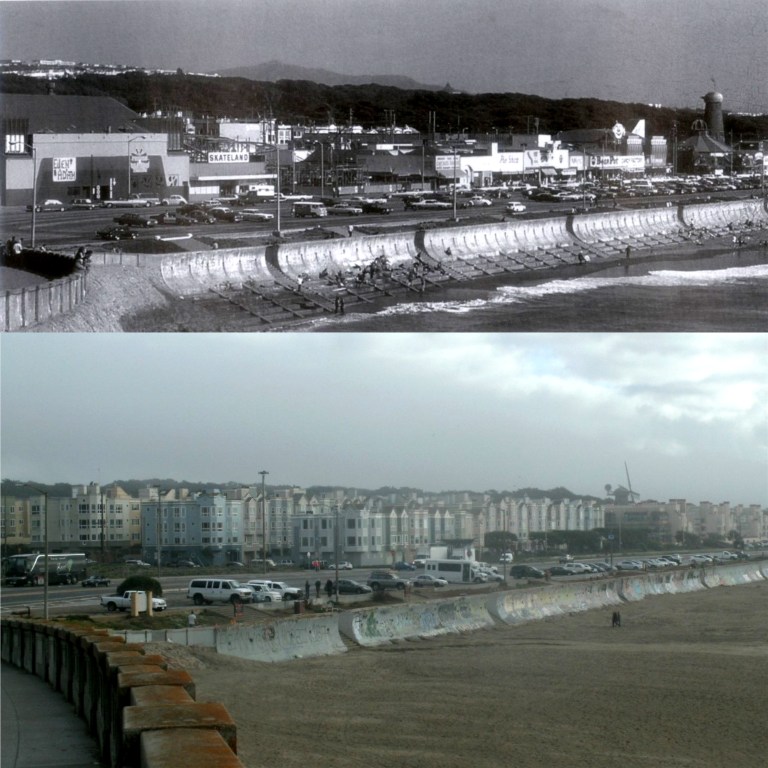 Playland-at-the Beach from Point Lobos Avenue:
 Just up the road where Point Lobos turns east was the strip of shops that ran between the Cliff House and the Sutro Bath House.
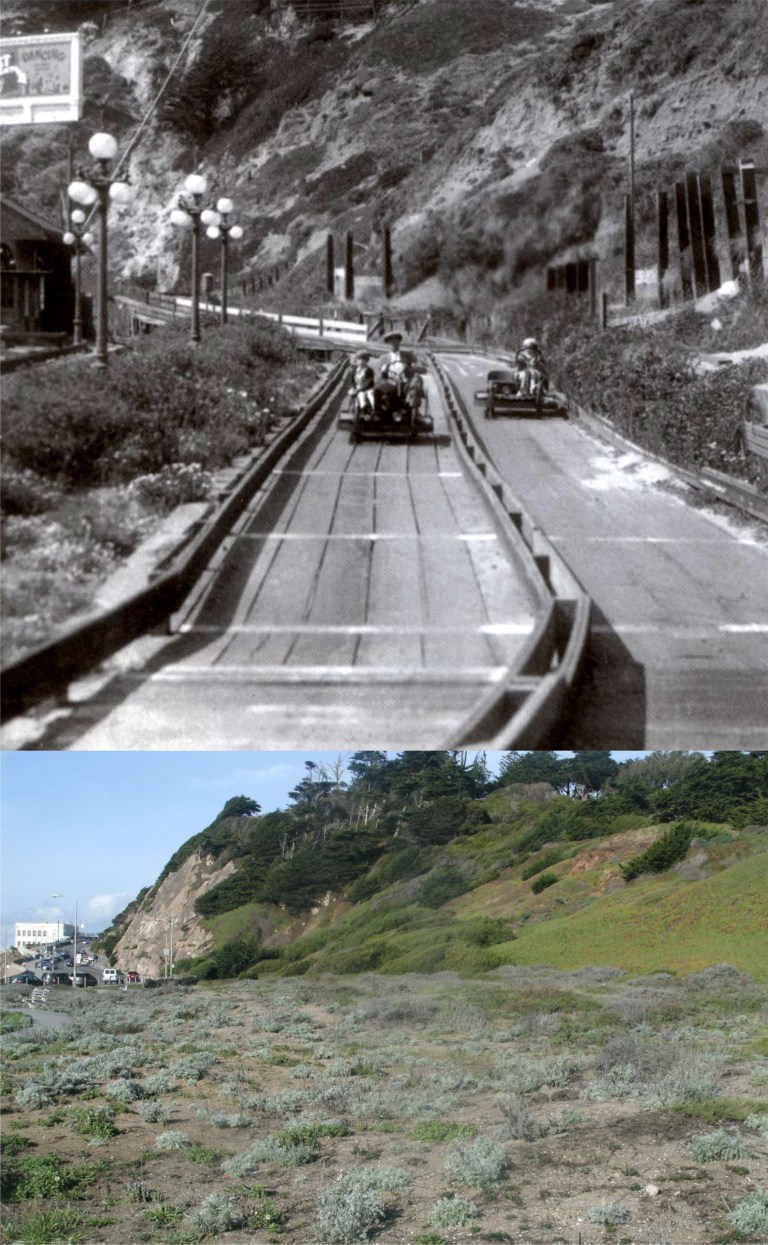 Long before the Autopia at Disneyland was the Red Bug Raceway that ran on a wooden track behind Topsys’s Roost. Below, is where the course once was. (James R. Smith’s San Francisco’s Playland at the Beach – The Early Years)
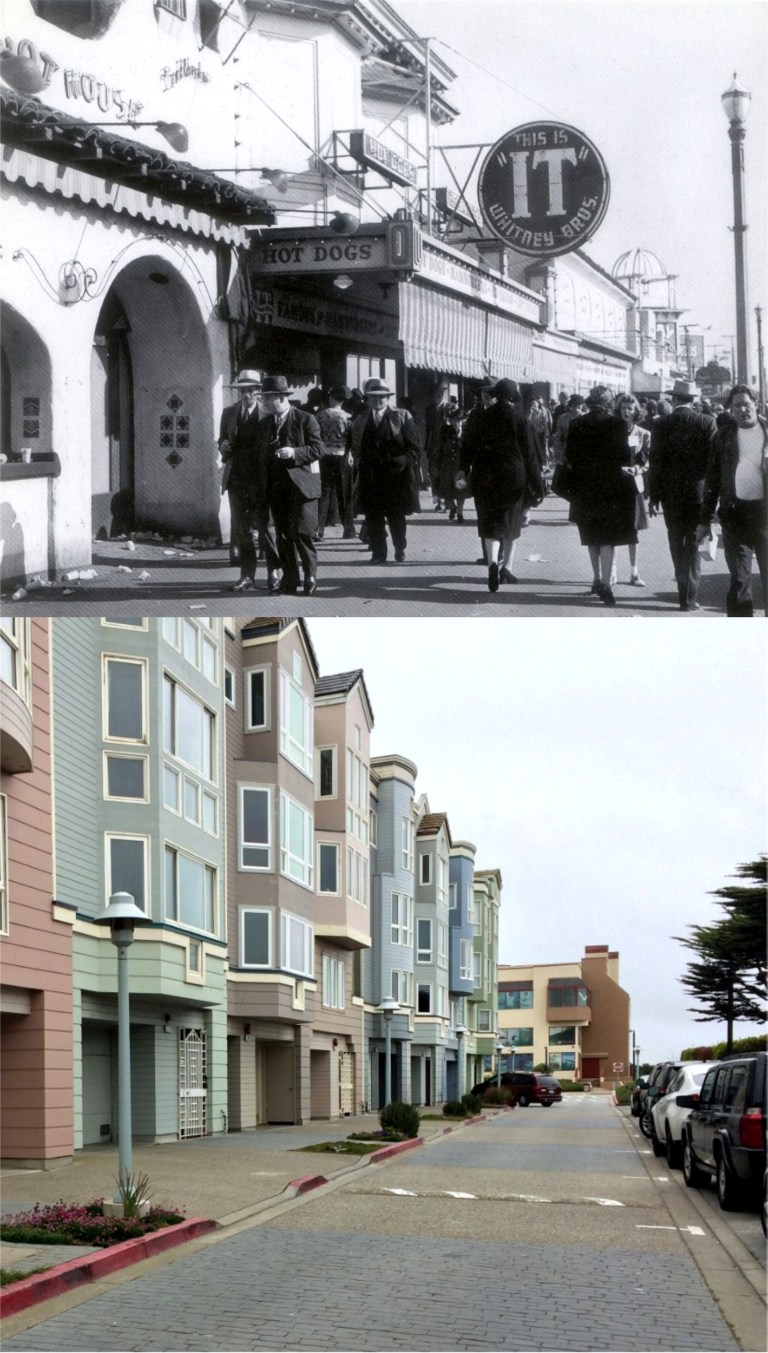 Where the It’s It Ice Cream Sandwiches at Playland, (Still just as good today) were invented:
 Back downtown for a photo from the Cushman Collection of Montgomery Street in the 1960’s:
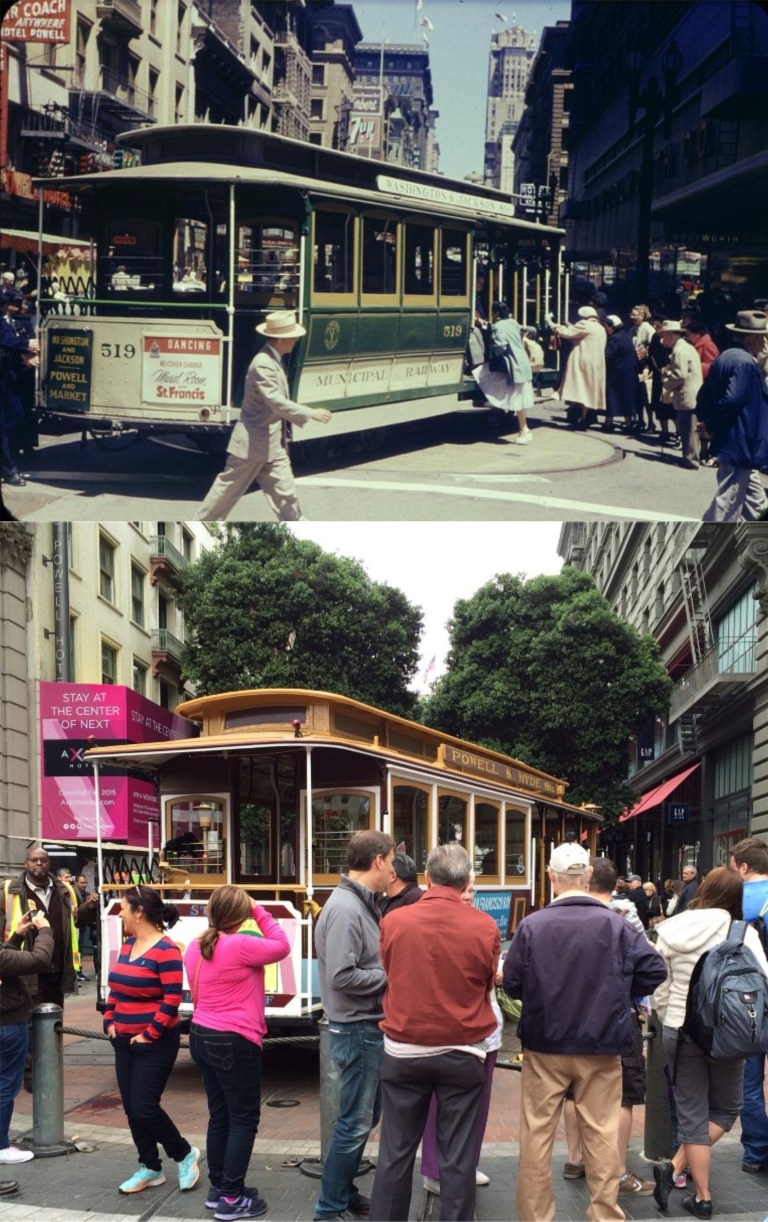 The cable car turntable at Powell and Market Streets:
 Looking down Powell Street from Nob Hill
 Another from the Cushman Collection of colorful Chinatown in the 1950’s:
