 Earlier this week, I found a 1932-1933 Yearbook from Miss Burke’s School for girls at the bookstore in the San Francisco Main Library. I had never heard of the school, but the book was interesting as it has autographs from most of the high school senior girls graduating to a girl named Constance, who the yearbook belonged to. There was no Constance among the senior girls or the faculty, and none of the names of the students from the lower classes are in the yearbook. I became curious about who Constance, who must be long dead by now, was, and also about Miss Burke’s School.
 Nearly all of the thirty three graduating seniors had written loving and thoughtful sentiments to “Connie” and I learned from the autograph written by Frances Crosby Beedy at the lower left of the above picture that Constance was a freshman! Wow, when I was a freshman, asking a senior to sign your yearbook was a good way to get punched out! (I get a kick out of what Janice Sanborn in the upper right wrote. I’m going to have to borrow that sometime if I’m ever asked to autograph a yearbook.)
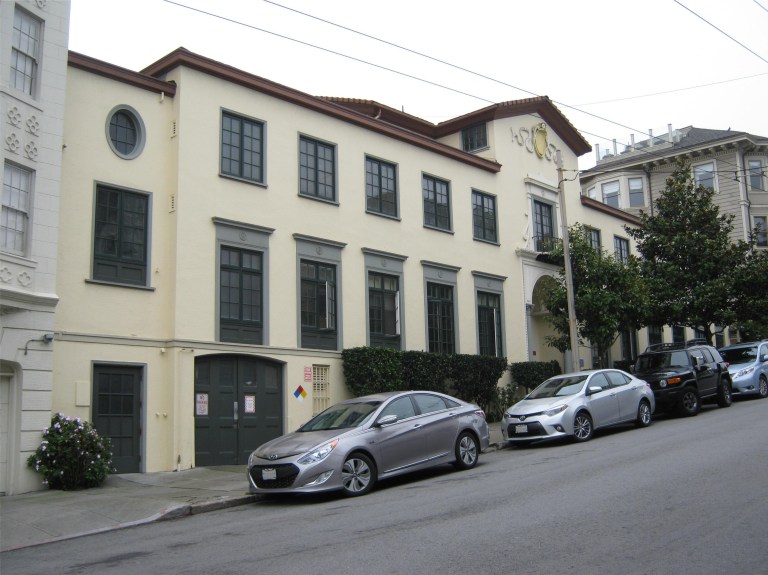 This was the building on Jackson Street in the Pacific Heights District where Miss Burke’s School was in 1933. This is now the San Francisco University High School.
 The top picture was one of the pages of photographs from Connie’s yearbook. Four of the pictures were taken in the courtyard behind the main entrance. Holly Johnson, the Director of Alumni Relations at San Francisco University High School, was kind enough to send me a photograph of the courtyard today. The yearbook picture at the lower right is the closest to the current picture of the courtyard. The archways seen on the left of the main building, which were also on the other side of the courtyard, have been filled in with additional wings since then.
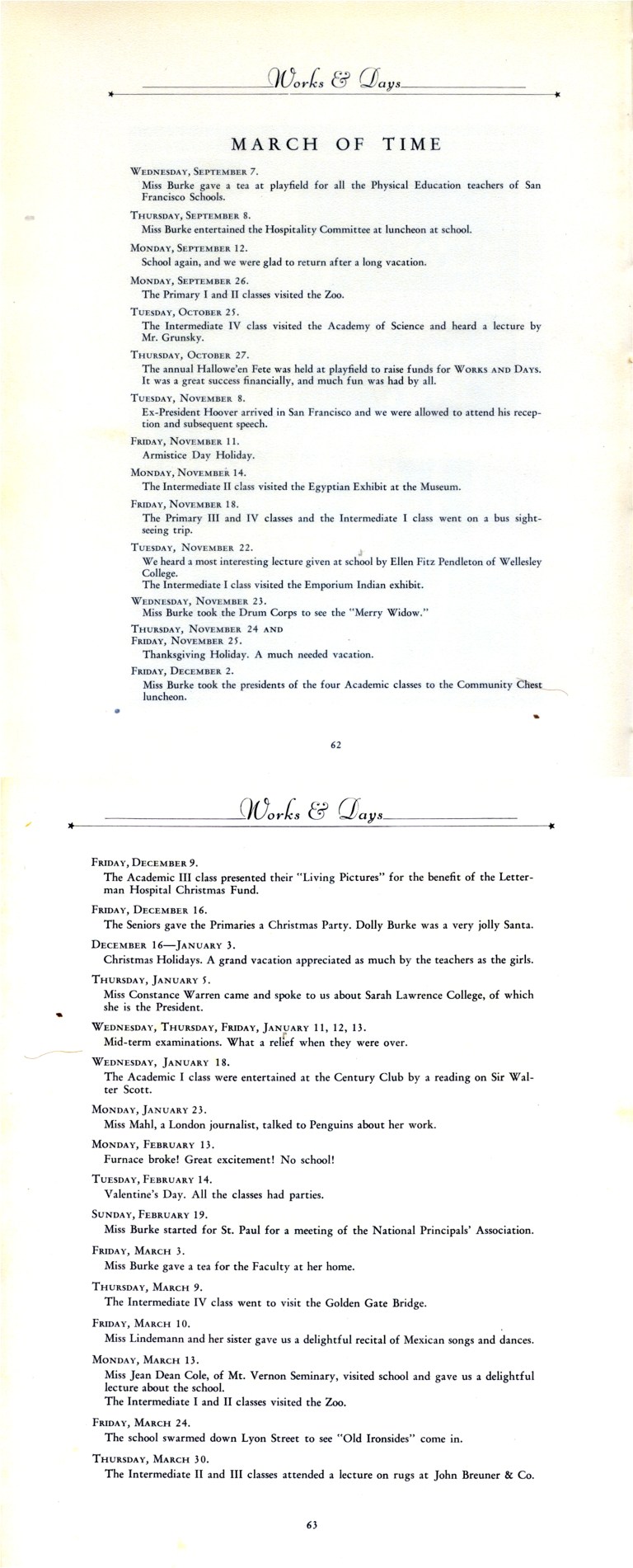 The March of Time events of the school year are a great time capsule. For instance, on March 9th the Intermediate IV class went to visit the Golden Gate Bridge. Construction on the bridge had only began two months earlier in January of 1933, so this would almost make them pioneers; one of the first groups of people to visit the Golden Gate Bridge! On March 24th, the school “swarmed down Lyon Street” to watch “Old Ironsides” come into the Bay. The USS Constitution did, indeed, sail into the Bay in March of 1933 ; something else I’m just learning from Constance’s yearbook. Check out the link below.
http://cdnc.ucr.edu/cgi-bin/cdnc?a=d&d=HT19330309.2.5
 This would have been where the school “swarmed down Lyon Street” to get a glimpse of “Old Ironsides”. The building with the white dome is the Palace of Fine Arts. Behind it is the Bay.
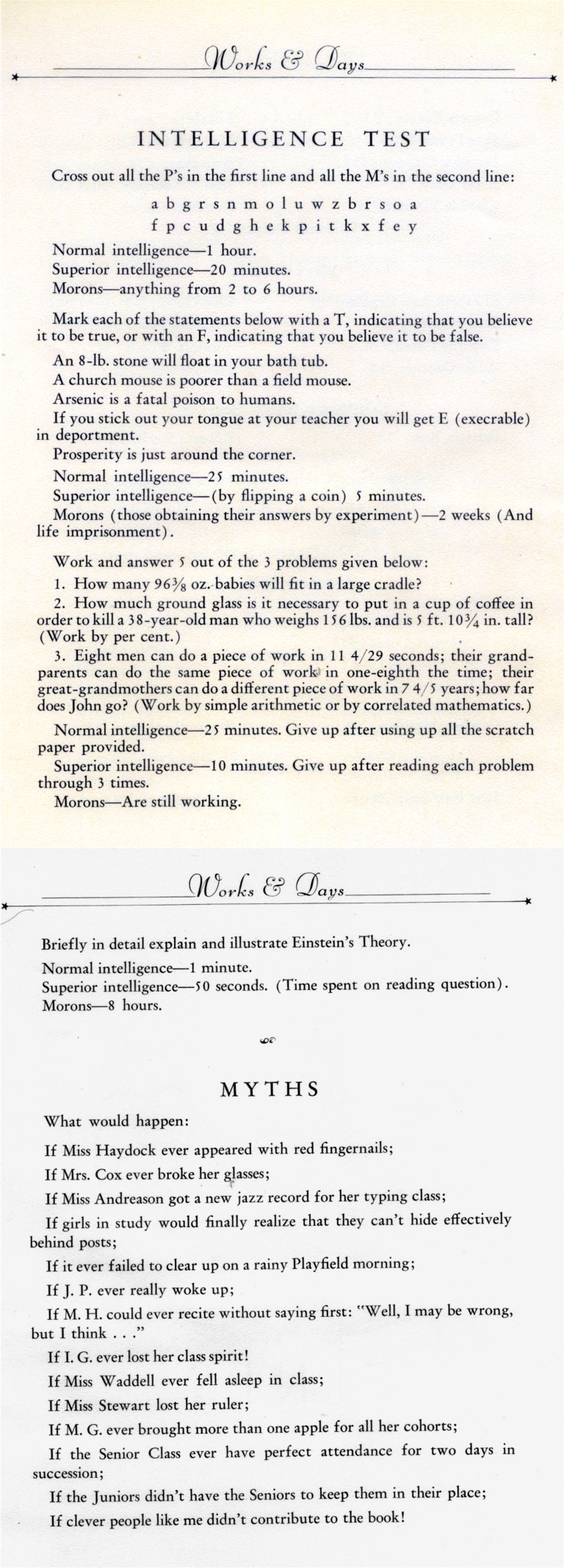 The Intelligence Test and Myths pages show that the girls had a wonderful sense of humor! I love “Work and answer 5 out of the 3 problems given below:”
 The girls in Constance’s freshman class all signed on one separate page, and they tell us a lot about the young lady, such as that she had a crush on her Dramatics teacher, Ronald Telfer, her “silent love” and she slapped “Jimmy” in the face! I missed it when I first went through the yearbook, but she signed this page. Her name was Constance Crowley!

I found a text on the internet co given in 1994 by a Constance Crowley Bowles entitled ‘A California Heritage: The Bowles Collection of 18th Century Porcelain’ and plowed through it until I found what I was looking for; Constance Bowles was born in 1919 and started high school at Miss Burke’s School in 1932. There was my girl, and she had still been alive in 1994, bless her heart!
 Constance had, indeed, gone far in life, and she only died a little over six months ago in February of 2016. She was 97. The link below has her obituary from SF Gate where this picture of her is from. Rest in peace, Connie.
http://www.sfgate.com/bayarea/article/Constance-Crowley-Bowles-Hart-Peabody-SF-6852305.php#photo-9446251
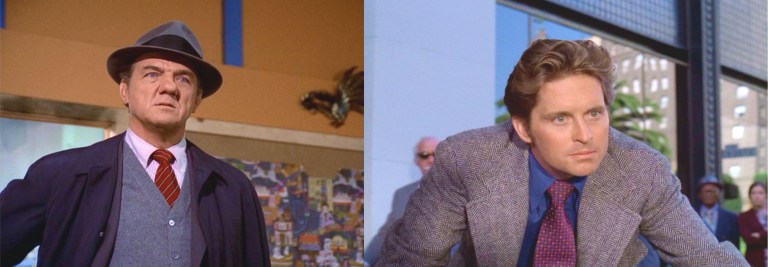 Karl Malden, “Papa Cop” and Michael Douglas, “Buddy Boy”, stars of the Streets of San Francisco”:
 “Buddy Boy” and “Papa Cop” finish up another day of violating somebody’s civil rights at the old Pier 18. Actually, they were pretty fair in the show. Pier 18 is gone now, but some of the old wooden supports can still be seen.
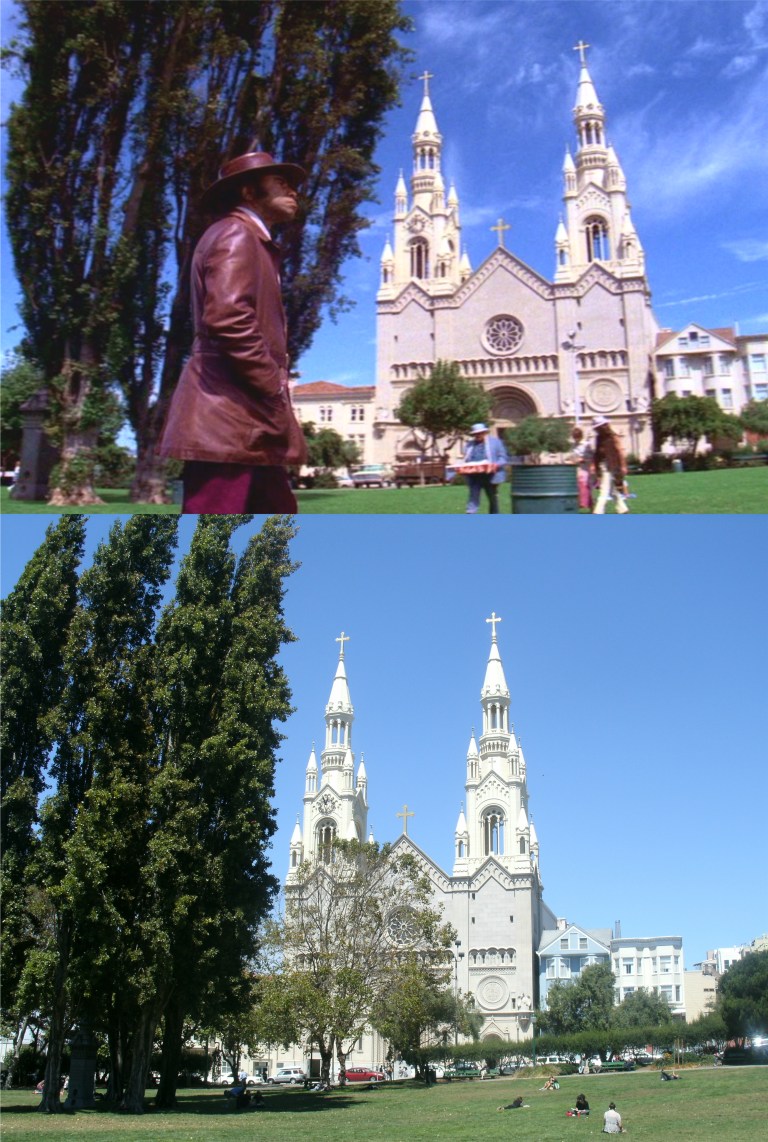 A bad guy in a obviously 1970’s outfit that was probably made into a couch eventually, walks past the Saints Peter and Paul Church at Washington Square in a Streets of San Francisco episode.
 In what was, probably, the most scenic parking lot in San Francisco before they blocked the view with a building, Paul Michael Glaser of television’s ‘Husky and Starch’, I mean, ‘Starsky and Hutch’ gets into fisticuffs with two parking attendants in a ‘Streets of San Francisco’ episode. What you get now in the parking lot is a lovely view of the back of an ugly building.
 School children heading up Nob Hill from Chinatown on Jackson Street: I had to be on the other side of the street to get the Bay Bridge in now.
 Goldie Hawn and her blind boy friend, played by Edward Albert, pass the City Lights Bookstore in North Beach in the 1972 film ‘Butterflies Are Free’.
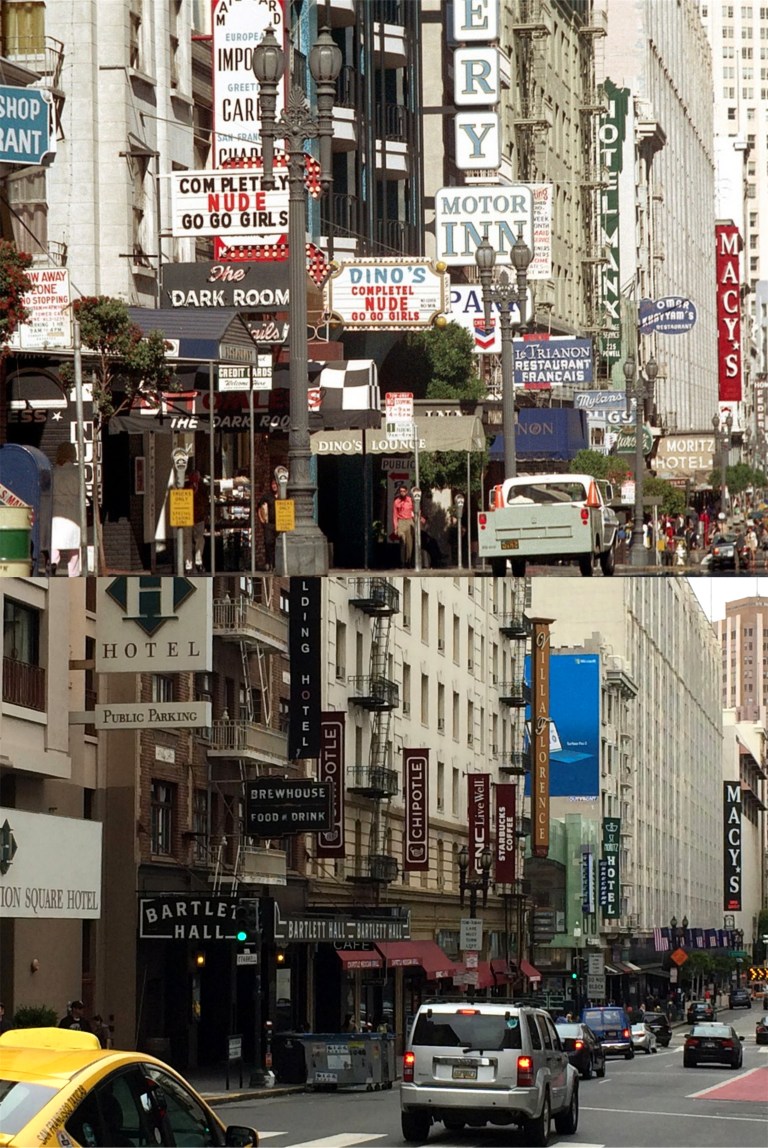 O’Farrell Street, west of Powell:

 Click on the link below for Muni’s moveable map to the old streetcars running on the F and E Lines.

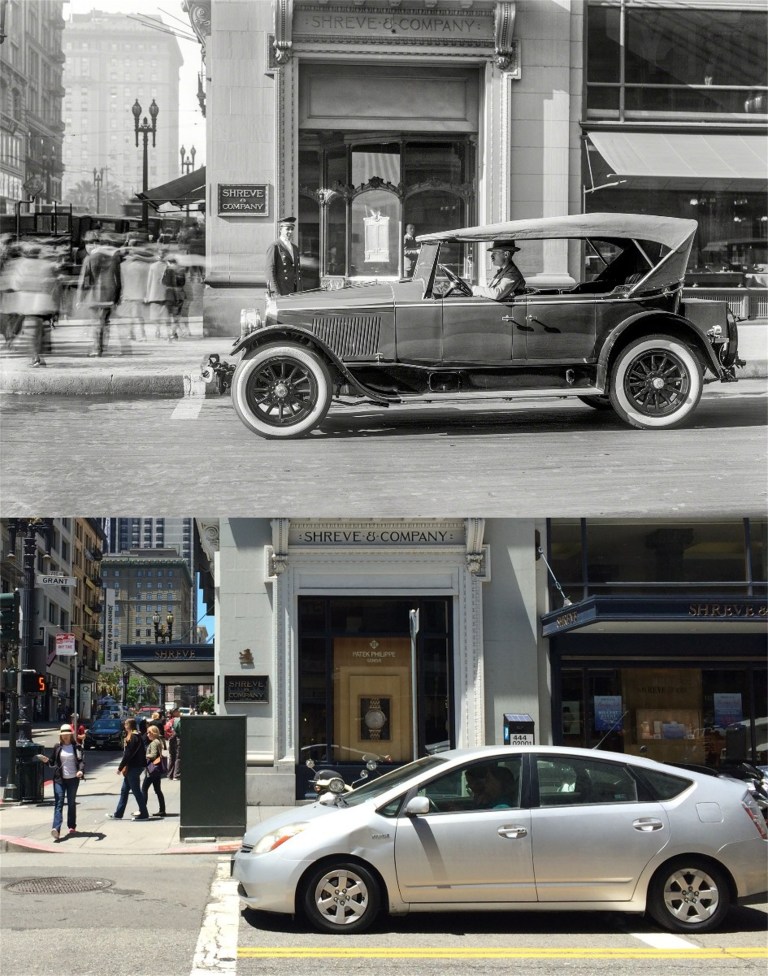 It’s the last week of summer in what Herb Caen called “the city with no seasons’, and that holds true for this week. The weather has been cloudy and overcast on some days, and warm and sunny on others. I got mostly sunny weather for my visits this week.
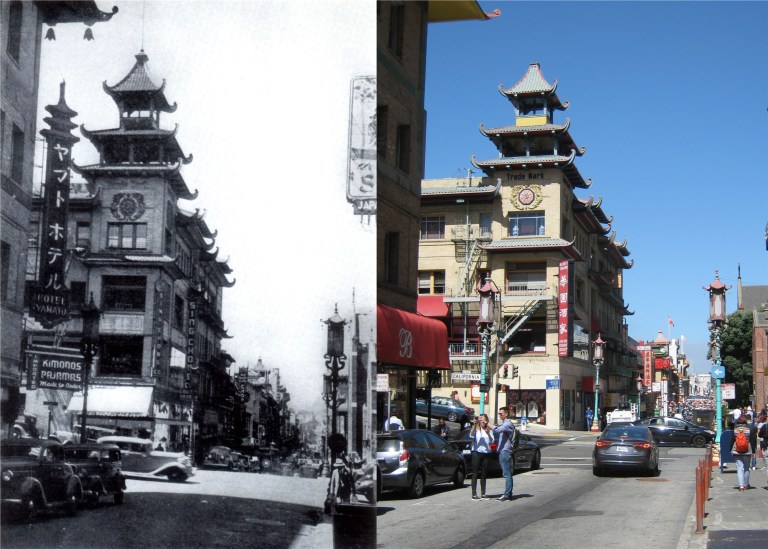 East meets East on Grant Avenue and California Street in 1939:
 Where O’Farrell Street, Market Street, and Grant Avenue come together in 1910: This is another of the comparisons I enjoy doing where the locations appear to have changed very little. Way down O’Farrell Street where the cameras are facing, St. Mary’s Cathedral can be seen in the modern picture. Pope John Paul II said Mass here on his visit to San Francisco in 1987.
 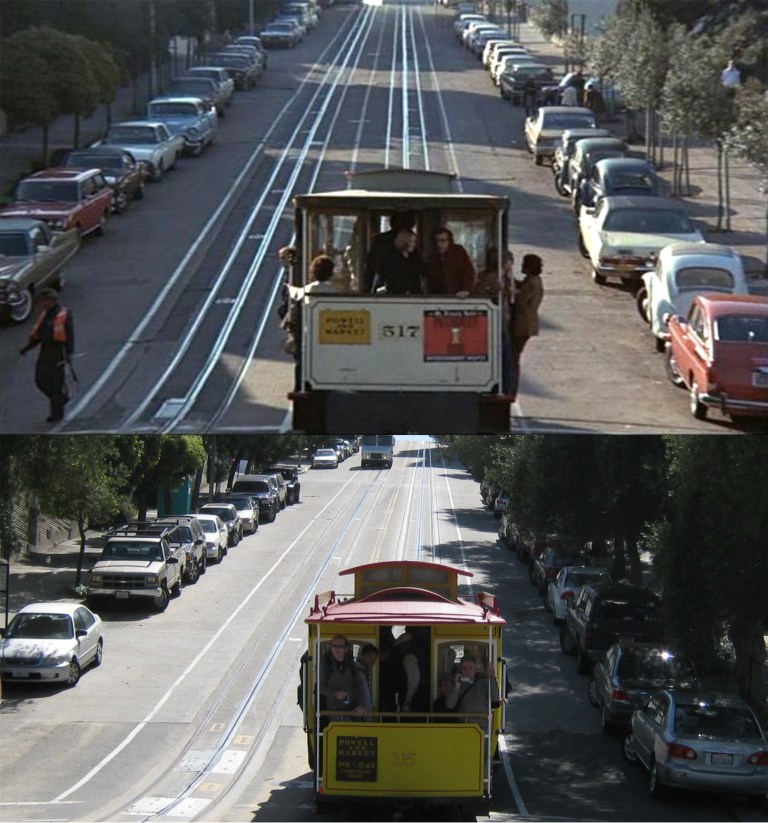 Most pictures of the Hyde Street cable car line to Aquatic Park are taken looking down from Russian Hill with its dramatic view. This is a rare look back up from the bottom of the hill as two cable cars begin their climb up Hyde. That’s Woody Allen and Diane Keaton in the top photo in a scene from the 1972 film ‘Play It Again, Sam’
 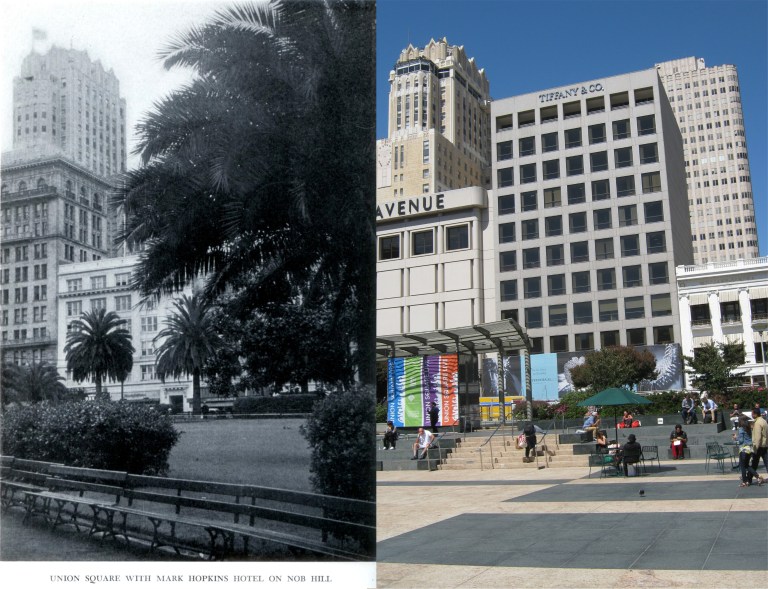 Everybody makes mistakes. That’s why there are editors; except, they goofed here. In this picture of Union Square from Elizabeth Gray Potters’ 1939 book, ‘The San Francisco Skyline’, that’s not the Mark Hopkins Hotel on the left; it’s the Sir Francis Drake Hotel. Ssshhhh!
 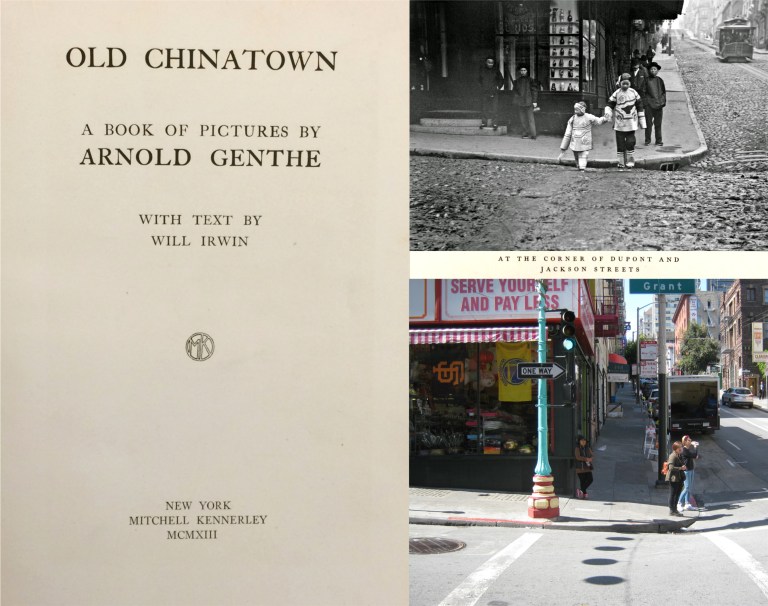 Speaking of mistakes, I spotted one here that really surprised me. Arnold Genthe has been referred to as the father of modern photography. Before the 1906 Earthquake and Fire, Chinatown was a mysterious and forbidden place full of opium dens, brothels, and frequent shanghaiing. When Genthe went in and took his famous pictures he opened the door to the tourist trade that’s there today. The famous picture at the top right, circa 1900, from his book of Chinatown identifies the picture as being at Jackson and Dupont Street, which is now Grant Ave. I’ve even seen images of this photo with Genthe’s writing stating it was taken at Dupont and Jackson. When I took my first then and now photo earlier at Grant and Jackson something didn’t seem right. When you wander around San Francisco for as long as I have been doing you feel things. The cable car coming down Jackson Street made me curious, as well. I checked on every thing I could find about every cable car line that ran in San Francisco and the Jackson Line stopped at Powell and never came down to Dupont. It had to be Sacramento or Clay Street. I contacted a fellow at the Market Street Railway System and he said he’d look into it, and get back to me, which he did the next day. He said it couldn’t have been Jackson Street and must have been Sacramento, which I agree. Arney must have been tired when he labeled his picture that day from walking around Chinatown, and I can appreciate that. Here’s a last week of summer picture of the correct corner at Sacramento and Grant that I took today. The summer crowds have dropped off quite a bit, and in reference to the gift shop, the Warriors will be starting another season soon, and the Giants are still in the hunt for the playoffs next month.
 That makes about as much sense as Hitchcock’s ‘North by Northwest’ but he got away with it! These are pictures of San Francisco from different points on the compass.
 Northeast: A cable car chugs up Hyde Street in the 1920’s and today. The old reservoir on the left is no longer in use. There’s normally a low amount of traffic on this stretch of Hyde, and I could stay for hours watching the cable cars go up and down the hill. Usually, more seem to head down the hill than up which might make one wonder if some are going into the Bay, but they just stack them up at the bottom of the hill.
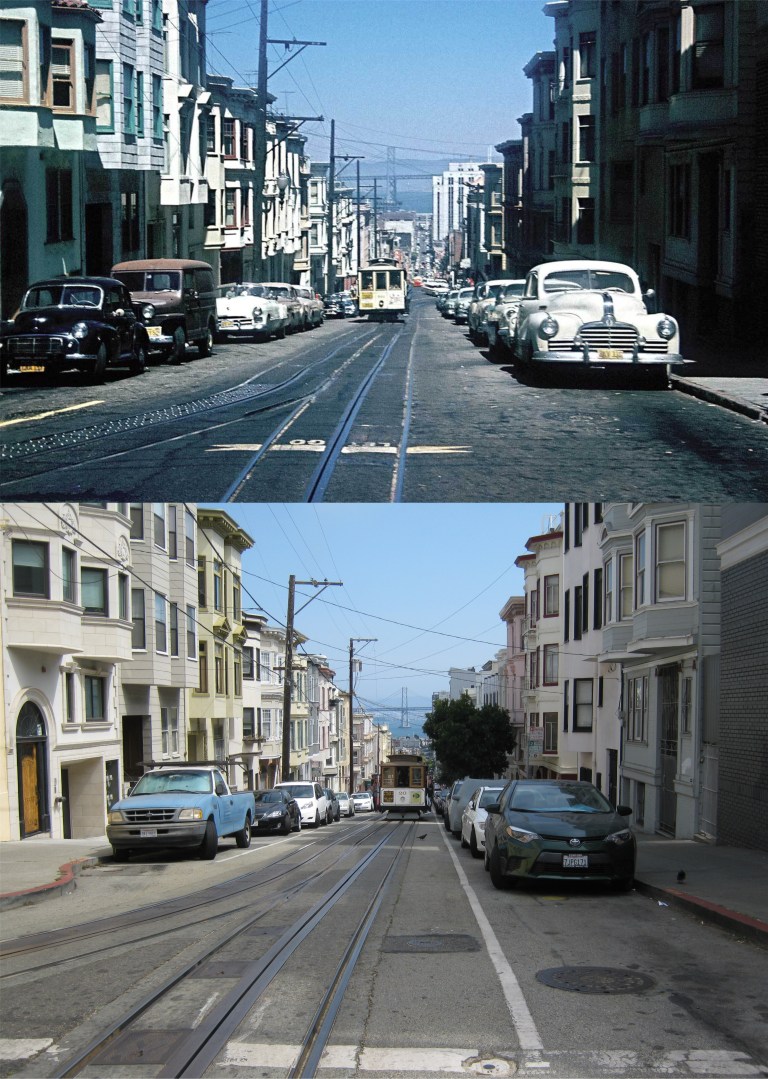 East: The view down Jackson Street from Mason looking east toward the Bay Bridge.
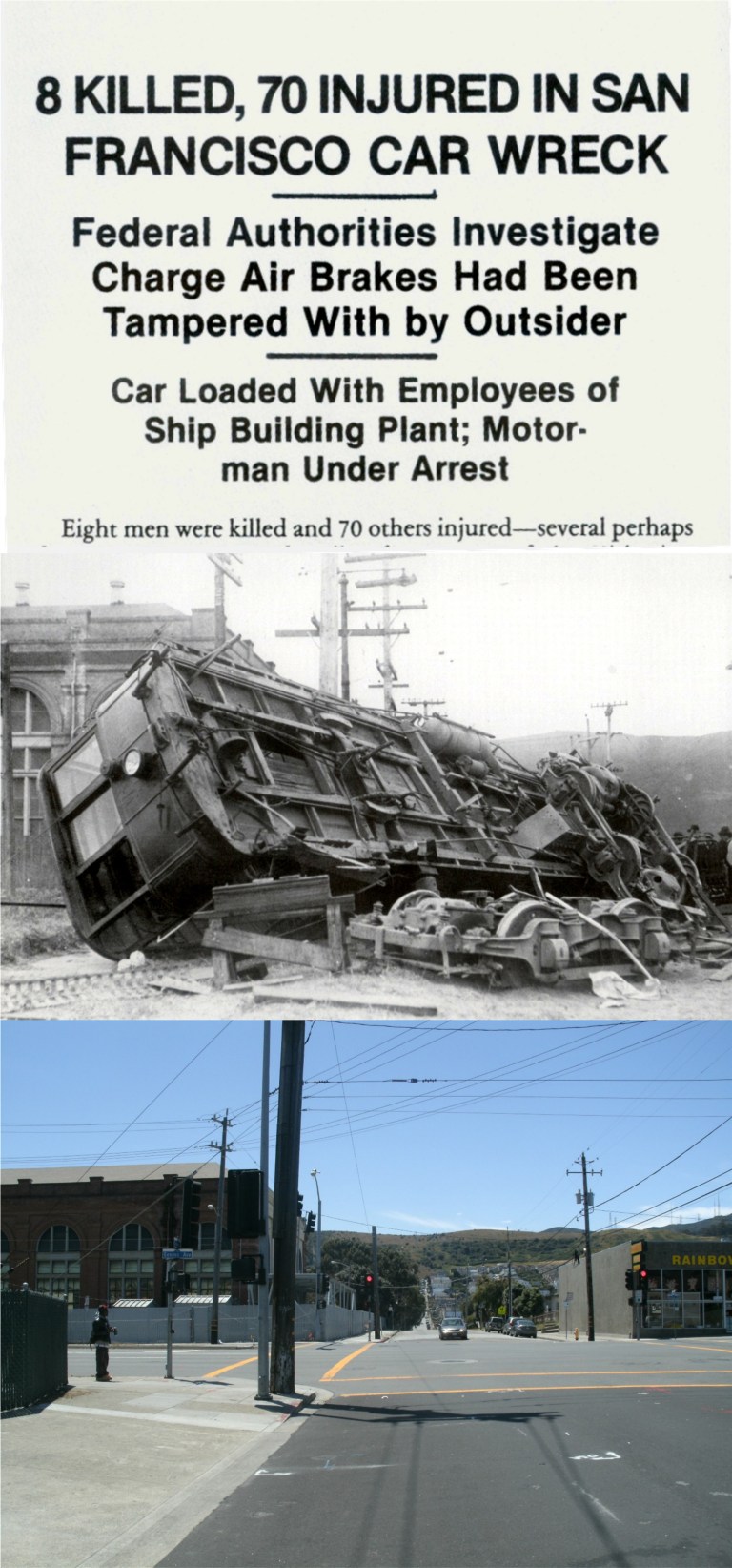 Southeast: The worst accident in Muni’s history occurred at this intersection in 1918, just east from the Cow Palace. A streetcar lost it on, what is now, Geneva Avenue, and jumped the track as it made the turn here onto Schwerin. The utility power plant building, now owned by PG&E, is still in the corner.
 South: This was the house on Morse Street in the Crocker Amazon District where Patty Hearst was captured by the F.B.I. in September of 1975. Hey, where did the Daily News get off by calling it “Frisco”?
 Southwest: I wasn’t even a naughty wink by my mom yet when this picture was taken. Here she is on the left with her cousin Frances at the old Sloat Blvd. entrance to the San Francisco Zoo, then called Fleishhacker’s Zoo, in 1939 when she was 17. This old Works Progress Administration project from the 1930’s is fenced off now to visitors and the San Francisco Zoo doesn’t respond to requests concerning why; maybe, to protect it.
 West: Balboa Street and the Great Highway at Playland-at-the-Beach. Balboa is the street going uphill on the left. Kiddieland was a portion of Playland with rides and attractions for children. This is about as west as you can go in San Francisco without getting wet, and even that isn’t guaranteed! (Western Neighborhood Project)
 Northwest: I couldn’t get their names, but these ancestors of the lady news anchors of today’s CNBC are reporting at the Palace of the Legion of Honor in the early 1930’s. (Voices out of the Fog)
 In my August 1st 2016 post ‘Out in the Field’ I wrote about a book I had recently read called ‘Laughter on the Hill’ by Margaret Parton. In the book Margaret writes about a year she spent in San Francisco looking for a job just before Pearl Harbor. Although outdated, and the events of her social life and zany parties may seem dull at times compared to now or even the 1960’s life of Holly Golightly from ‘Breakfast at Tiffany’s’, her descriptions of, historical recaps about, and obvious affection for San Francisco makes the book an interesting story of the City in 1941. At times Margaret identifies her locations by name, but other times you have to use your knowledge of San Francisco to determine where she’s writing about. These are a few passages from her book pertaining to some of her adventures on Telegraph Hill.
 Margaret’s search for a place to live in the second chapter ‘Gingerbread Versailles’ leads her to a run down house on Telegraph Hill. On the way, she passes what is obviously Washington Square in North Beach; I think the only fat old man with a red face in the park the day I took this picture was me!
  She crosses Union Street at Montgomery on the approach to Calhoun Terrace. Her description of the view from the cliff at Calhoun Terrace is still accurate today.
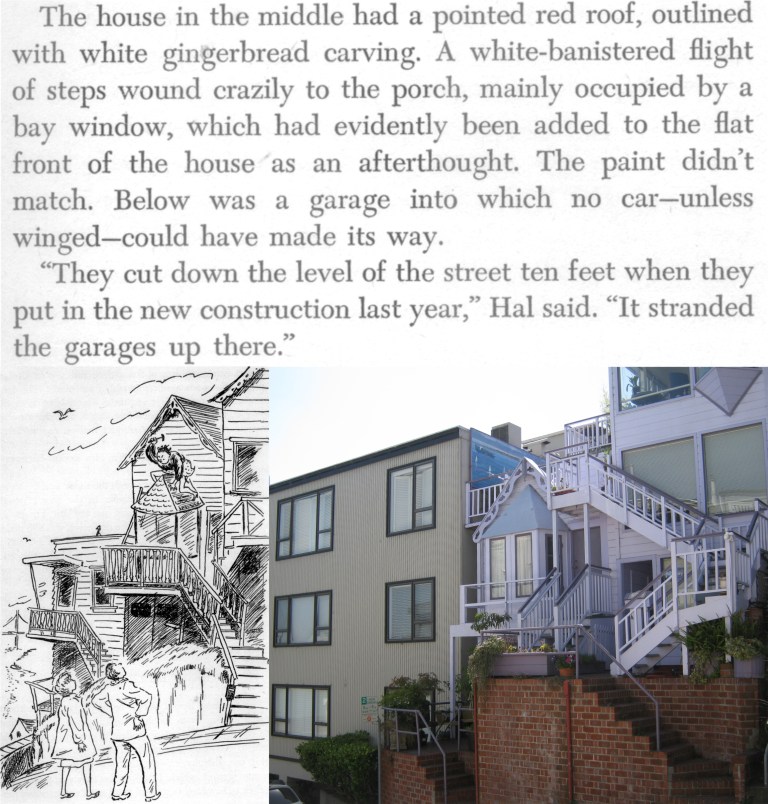 Margaret moves into what she describes as a shack with a “pointed red roof outlined with white gingerbread carving” at this location. The building has a leaking roof, bad plumbing and is in overall poor shape. On the left is a cartoon from the book of where Margaret will spend her year in San Francisco, and in the middle of the picture on the right is the house today. The part about cutting down the level of the street and stranding the garages of the houses is amazing! Incidentally, the Michael Douglas character, Steve Keller from the television show ‘The Streets of San Francisco’ also lived in this house, and Lee Remick’s Kirsten Arnesen from ‘The Days of Wine and Roses’ lived just across the street.
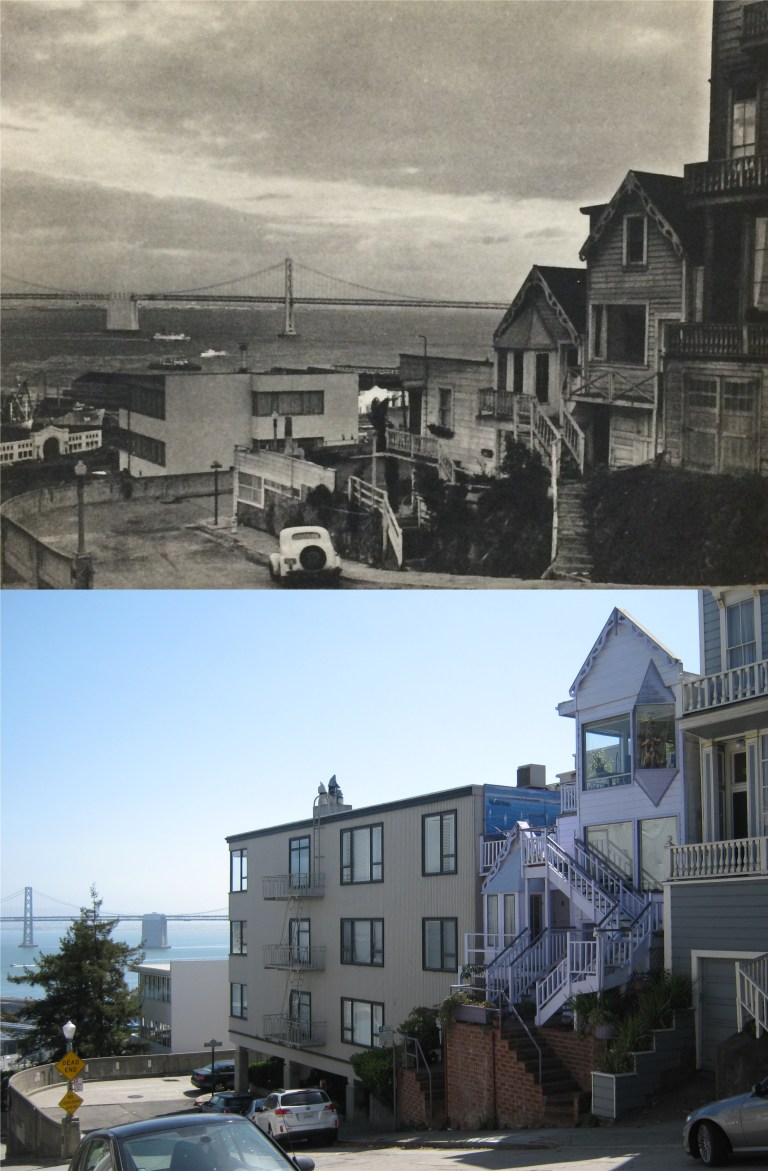 A photograph from the 1940’s of this location shows how accurate Margaret’s description was; the paint on the bay window of her “shack” didn’t match, and the garages here really were stranded from street work.
 18th and Dolores Streets, across the street from Dolores Park, in the 1950’s: They’re painting a mural on that building now! Well, no matter how artistic it will be, it won’t look as nice as, “SANDWICHES, MILK SHAKES, HOT DOGS, HAMBURGERS, ICE CREAM, and Coca Cola”. (SF Images)
 Powell Street, looks like the mid 1960’s: The tall building in the center of both pictures is the Sir Francis Drake Hotel. For decades its Starlight Room at the top rivaled the Top of the Mark. Many people, including Herb Caen, preferred it. Then for some stupid reason, they allowed two enormous and ugly buildings to go up blocking its north and east view leaving it with, basically, just a view of Union Square. What a shame! (vintage everyday)
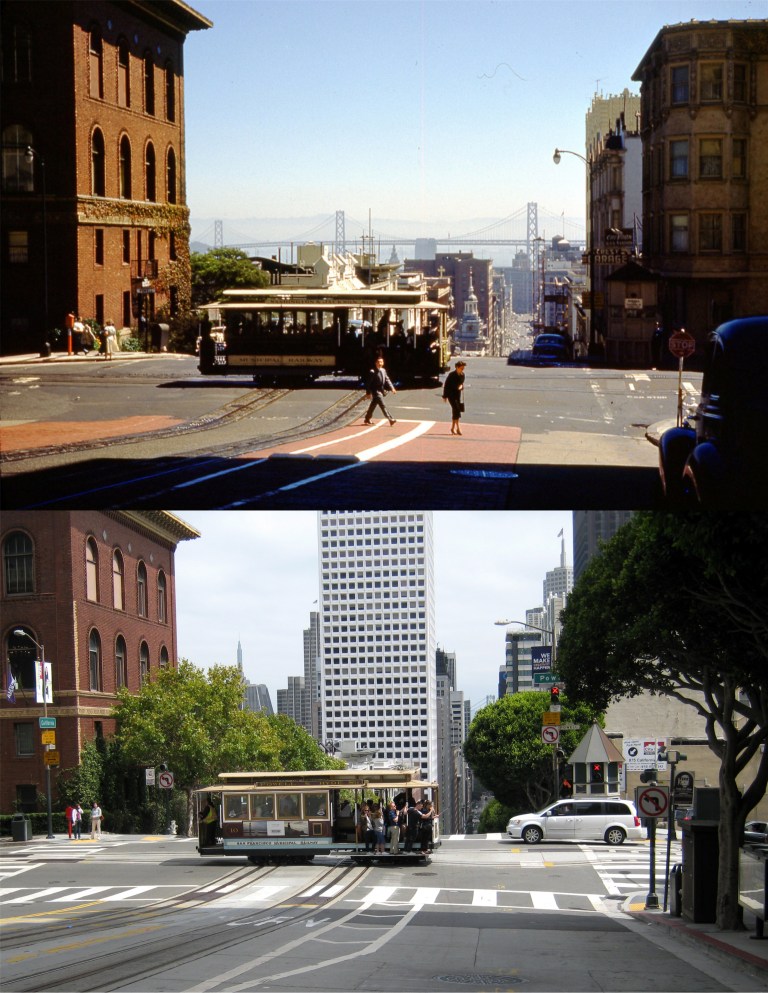 California Street at Powell on Nob Hill: Sometimes it works out just right! (vintage everyday)
 I never get tired of the magic of Chinatown. I’ll bet I’ve posted more pictures on my blog from here than any other spot in San Francisco. I don’t have much patience for crowds anymore, but the crowds in Chinatown never seem to bother me! I’m not sure why that is. (vintage everyday)
 “They’re creepy and they’re kooky, mysterious and spooky.”
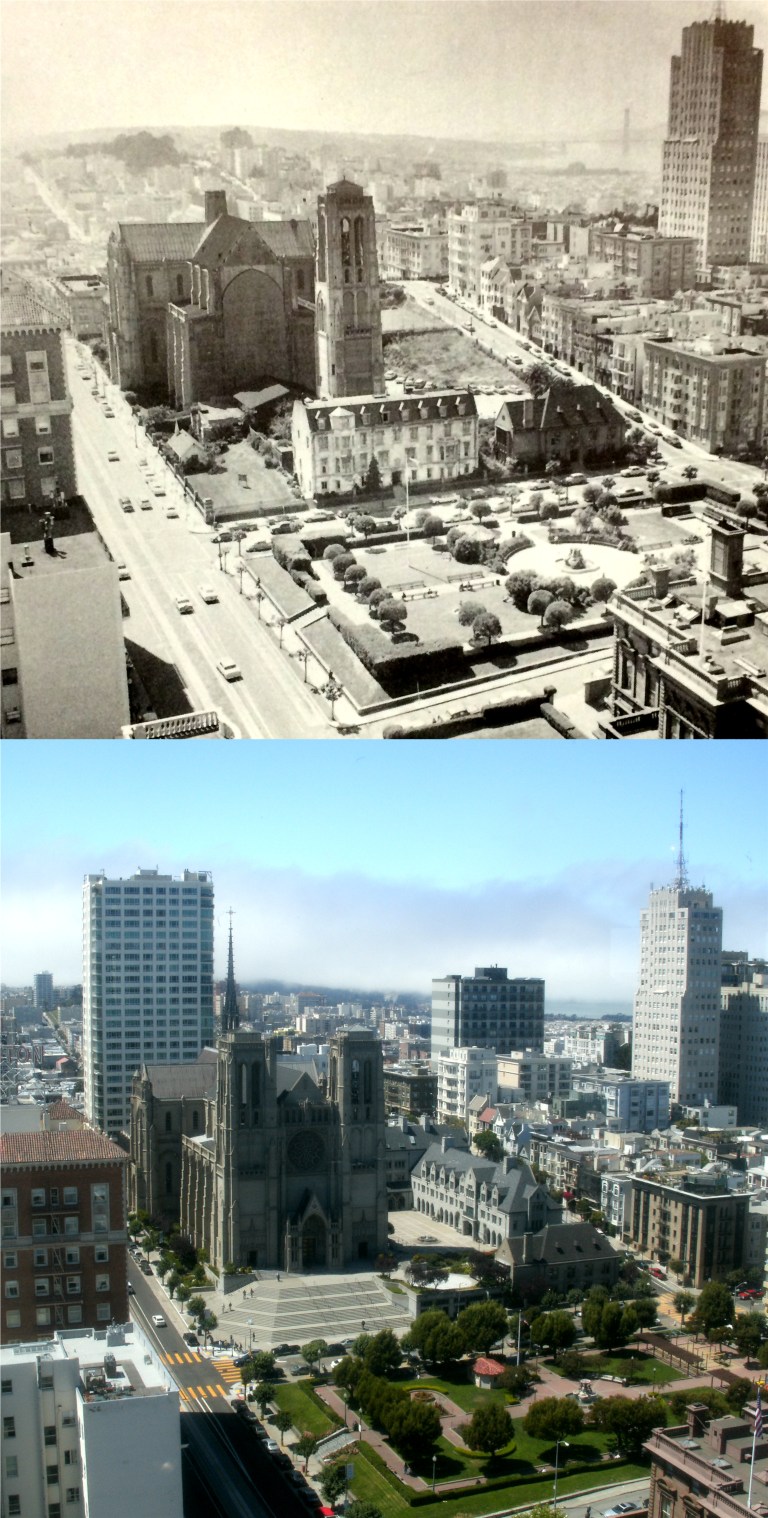 “Rome wasn’t built in a day” but it might not have taken as long as Grace Cathedral on Nob Hill did to build. Started in 1928, the church wasn’t completed until 1964. Still, the wait was worth it, it’s one of the most beautiful churches in San Francisco. In the vintage picture taken from the Top of the Mark circa 1960 it still wasn’t finished. Click on the link below if you want to explore Nob Hill further.
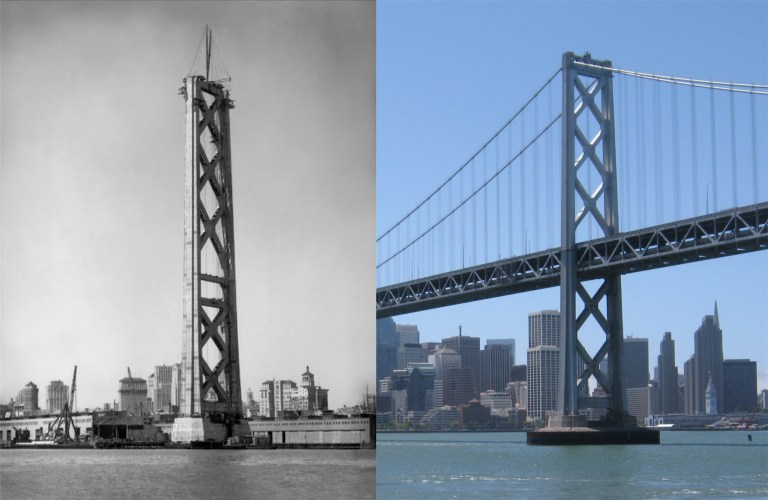 The Road Not Taken, I mean, taken before the road. (SF Images)
 A Pyramid scheme; The Transamerica Pyramid on the way up in 1971: (SF Images)
 A poet on Telegraph Hill; Allen Ginsberg’s partner, Peter Orlovsky on Vallejo Street: (Howard Greenberg Gallery)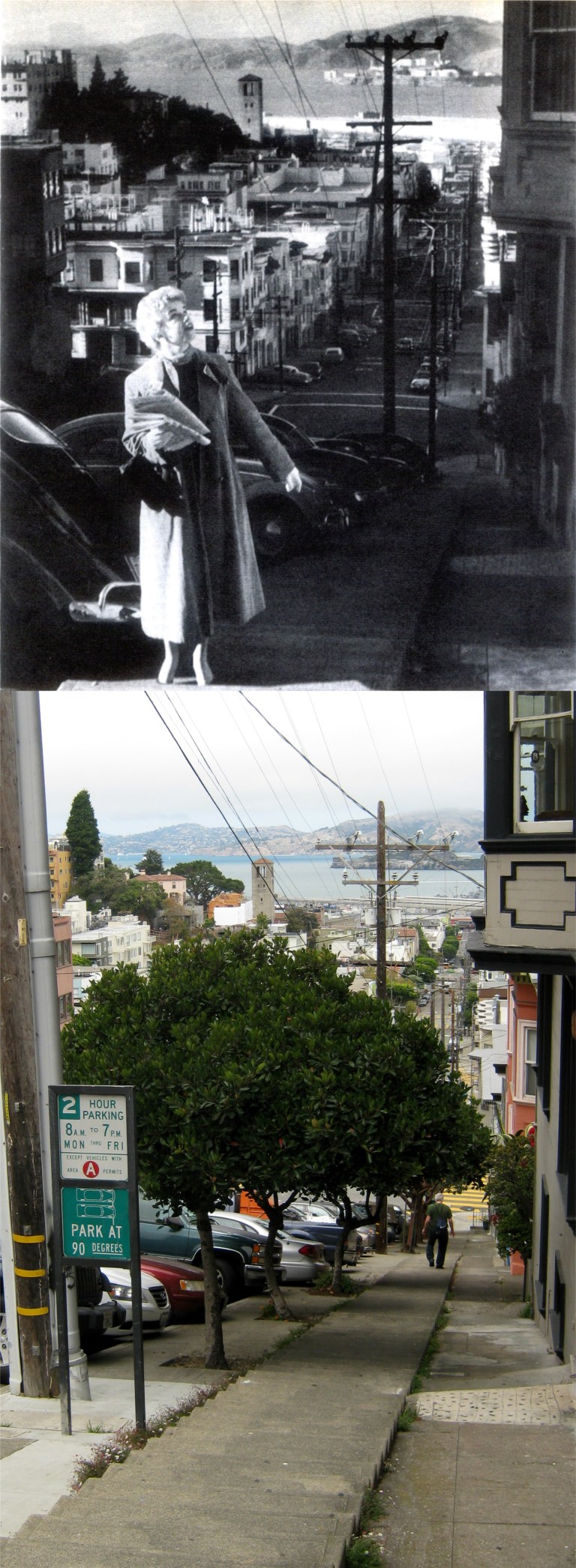
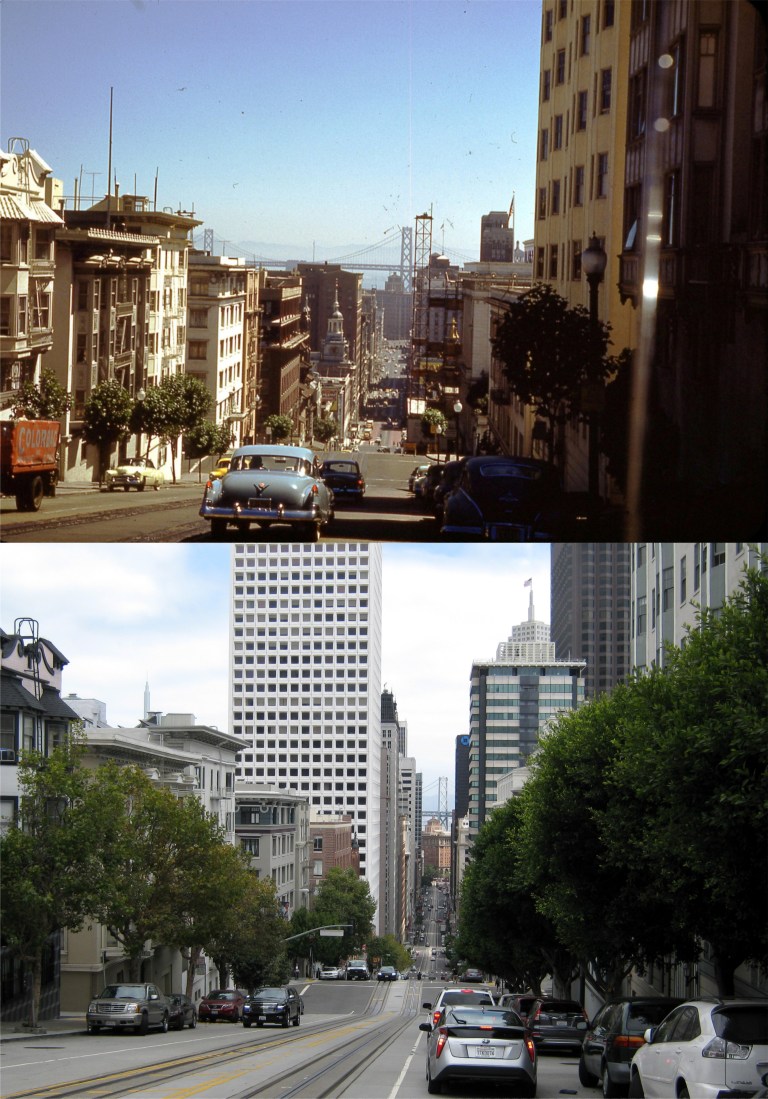 California Street up from Stockton Street in the 1950’s: This is a redo that I went back for; it’s too nice of an old picture to not try to get as close as possible. (vintage everyday)
 Police activity at the Cliff House in 1958, and police activity at the Cliff House yesterday: Click on the link below for some more police action in a series of pictures I did called ‘Cops” in May of 2015.
 Speaking of the Cliff House, this was how it looked in the early 1970’s. How cool was that; although, I would have got seasick looking at it! The totem pole farther down the street is still there.
 The Tenderloin is certainly the most depressing neighborhood of San Francisco. Bounded by Mason on the east, Van Ness on the west, Geary, on the north, and Market Street on the South, it has one of the highest crime rates in San Francisco, and the sidewalks are filled with homeless people, many of who are far beyond any help. Still, there are some great vintage pictures from the area to do comparisons on. We’ll start here at 645 Larkin Street in 1961. (Vintage San Francisco Library photo from the Huffingtonpost.com)
  Manuel’s Steakhouse at Turk and Leavenworth looked good. Looks like the early 60’s. The Market and Deli sign on the corner is the old 288 Club neon sign. (Vintage San Francisco Library photo from the Huffington.com)
 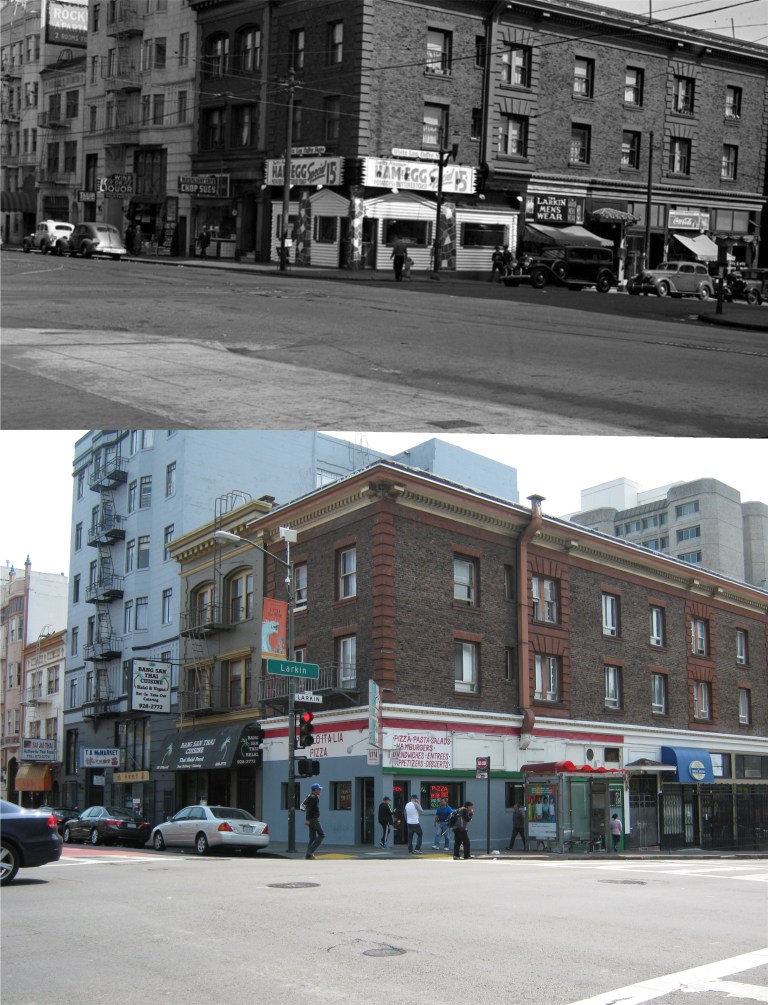 Larkin and O’Farrell Streets in 1939:
 A fender bender at the Shawmut Hotel on O’Farrell near Jones in 1941: The Shawmut is now the Crosby Hotel. (Vintage San Francisco Library photo from the Huffingtonpost.com)
  The Golden Gate Theater on the corner of Golden Gate Avenue and Taylor Street showing the 1956 movie ‘The Conqueror’: This movie has a notorious legacy; it was filmed in the Utah desert near an above ground nuclear test site, and ninety one people involved with the filming contracted cancer afterward, many who died of the disease, including John Wayne, Susan Hayward, Agnes Moorehead, and Director Dick Powell.
  Eddy and Taylor Streets, 1963: Aw, another lovely eyesore gone forever! Well, at least the fire hydrant survived. (Vintage San Francisco Library photo from the Huffingtonpost.com)
  Jones and Eddy Streets in 1962: The corner restaurant serving Chinese food is now the Tenderloin Police Station. (Vintage San Francisco Library photo from the Huffingtonpost.com)
 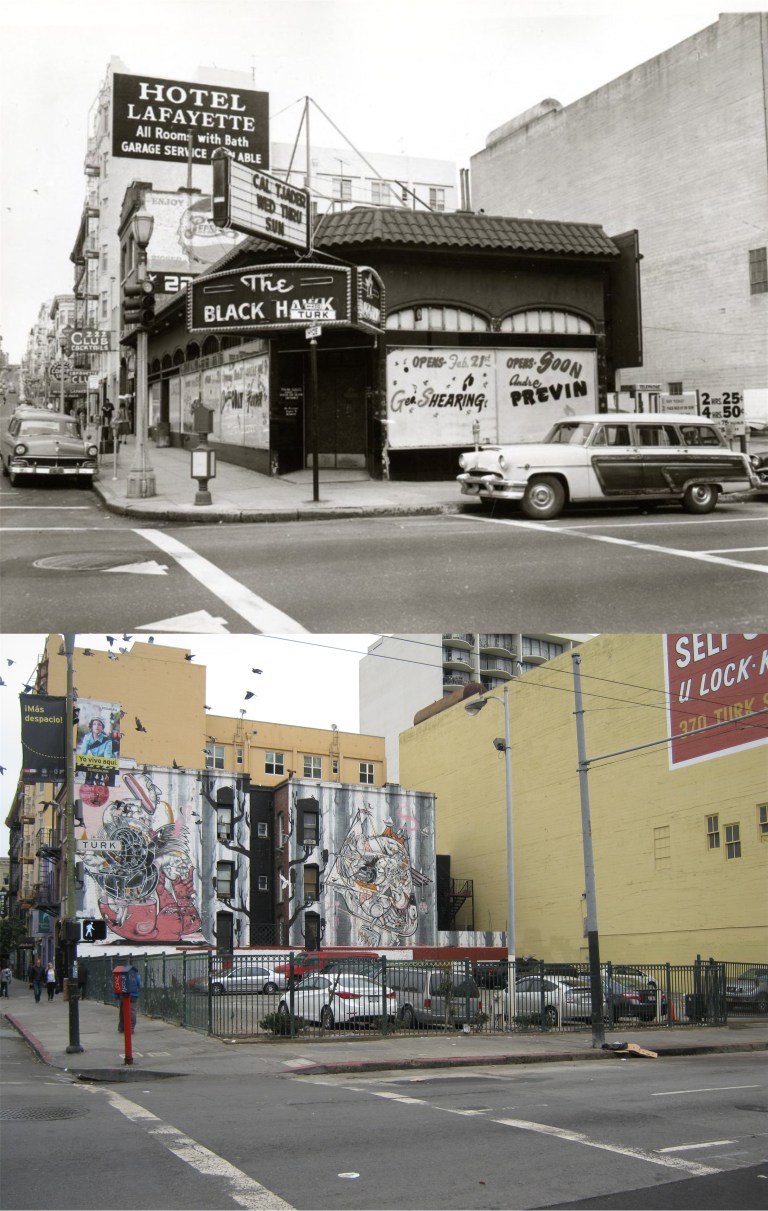 Hyde and Turk Streets, 1961: It would have been a great comparison if the Black Hawk Club was still there, but “Alas, alack, and Alaska” it isn’t. Andre Previn performed here!!! (Vintage San Francisco Library photo from the Huffingtonpost.com)
  The opposite view from the previous photo of the Black Hawk Club looking down Hyde Street in 1961: The tall building in the background is the old Empire Hotel building. (Vintage San Francisco Library photo from the Huffingtonpost.com)
 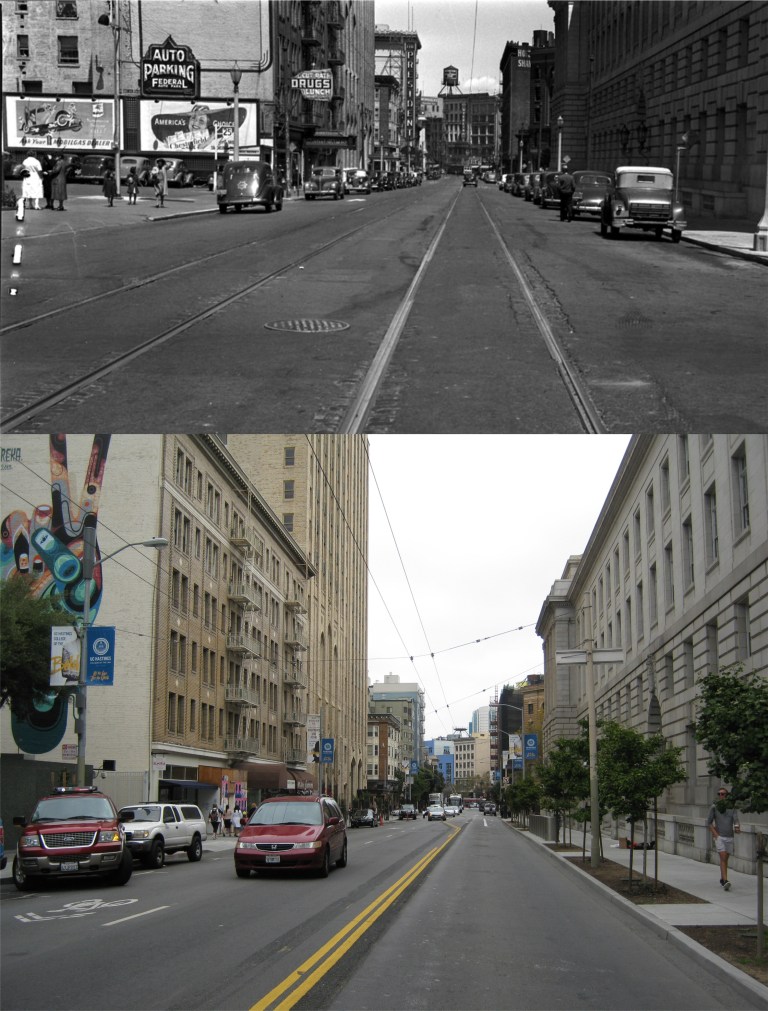 Looking down McAllister toward Market from Hyde in the 1939: The building on the right is the Federal Building. (Vintage San Francisco Library photo from the Huffingtonpost.com)
  86 Golden Gate Avenue in 1964: Unfortunately, this is part of life in the Tenderloin. Maybe someday long after I’m gone someone will do a then and now of my photo and write, “Can you imagine when it was like that?” (Vintage San Francisco Library photo from the Huffingtonpost.com)
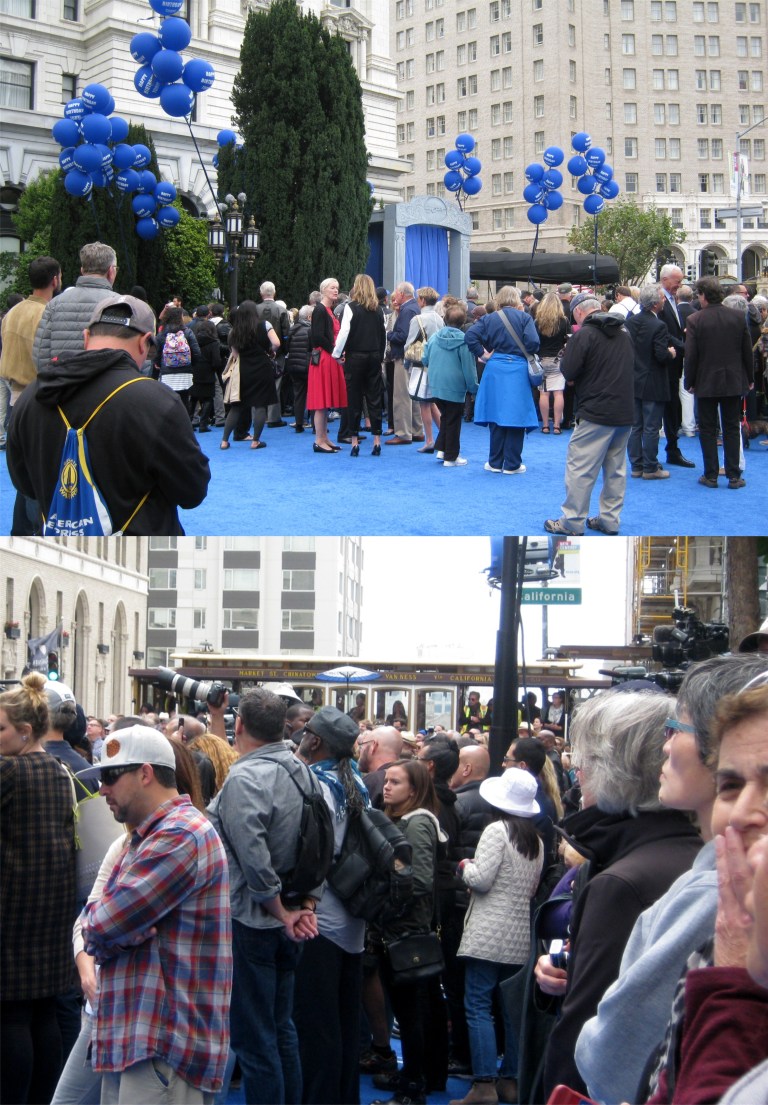 Fifty Five years ago this December, Tony Bennett first sang ‘I Left My Heart in San Francisco’ in the Fairmont Hotel’s Venetian Room. The Fairmont honored the occasion today with the unveiling of a statue of the singer who recently celebrated his 90th birthday. On hand were former San Francisco mayors Dianne Feinstein and Willie Brown, Nancy Pelosi, and Tony Bennett himself. A passing California Street cable car stopped for the ceremony and the conductor played ‘I Left My heart in San Francisco’ on the cable car bell.
  After a mist of imitation San Francisco fog for effect, the statue was unveiled. Click on the You Tube link below to see Tony Bennett singing a version of his signature song in July of 1963 to somebody else pretty special.
 San Francisco Film Locations Then & Now