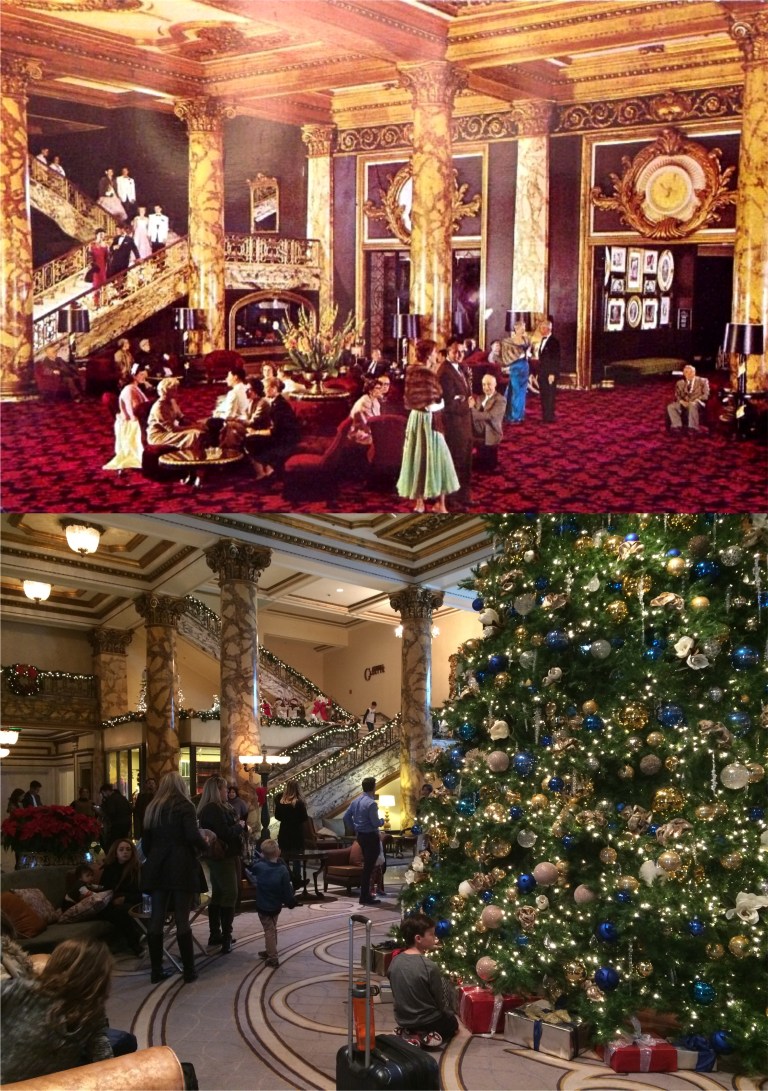
 The lobby of the Fairmont Hotel: If you get a chance to check it out over Christmas it’s worth it; it will put you in the mood. I like the kid on the floor wishing that this was his Christmas tree.
Author: SF Film Locations
Hello friends! My name is Tim Welsh. I’m the owner and operator of Welsh Income Tax Service in Hayward, California. When I was fifteen, I fell in love with San Francisco. It wasn’t a first in the family; my mother at seventeen had traveled by train from North Dakota, where I was later born, to see the Treasure Island World’s Fair, and fell in love with “The City” long before I did. You can see pictures from her trip in the November 19th, 2014 ‘Summer of 1939’ postings. It’s been a love affair that’s never broken my heart. Here, with pictures from books, movies, the internet, and personal collections, I’ve had a chance to share my affection for San Francisco with comparison and location pictures that I’ve taken. I’ve had help from family and friends, and even my dog ‘Danny’ who sniffed out the trail of Buffalo Bill at Ocean Beach on a November 15, 2014 post. My blog is for non commercial and non profit purposes only, and it’s always a lot of fun to work on. Many of the pictures from November, 2014 to November 2015 are thumbnail images. Pictures from posts after that can be enlarged by viewing the image. I hope you enjoy the posts, and please feel free to follow my blog, or make suggestions, comments or corrections if you like.
Four wheels and the City
I ran my car into God today,
I thought I had the right of way.
He says He’s suing after all
Can you believe the Almighty gall!
(Roshni D’Souza)
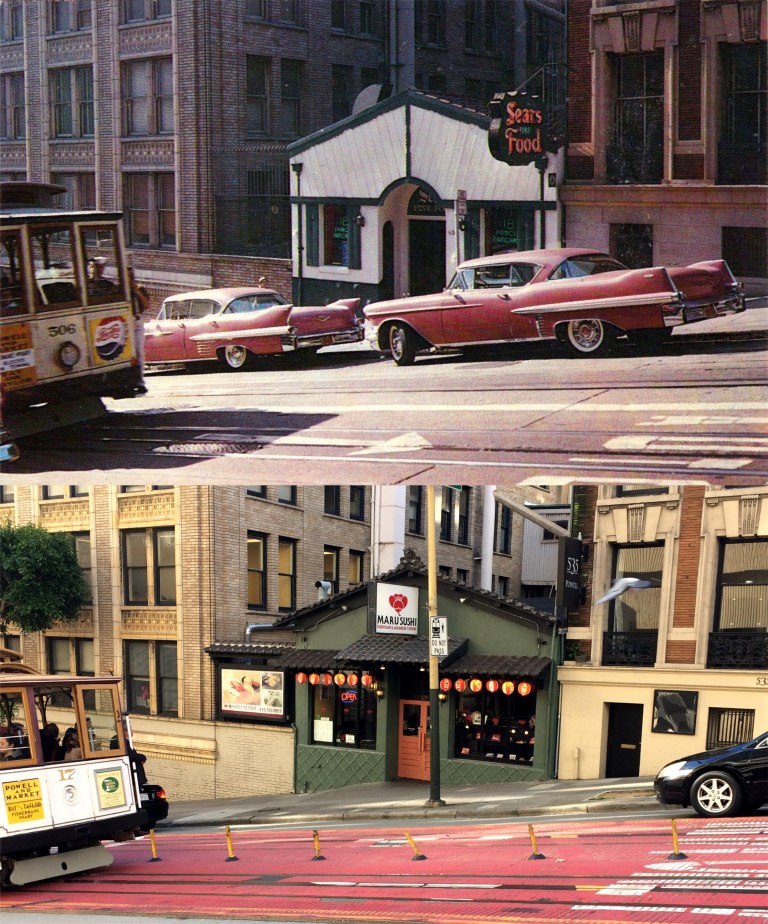 Two vintage beauties, three if you count the cable car and I will, on Powell Street between Bush and Pine Streets: Sears Restaurant is still around, but it’s one block down Nob Hill from here between Bush and Sutter Streets now.
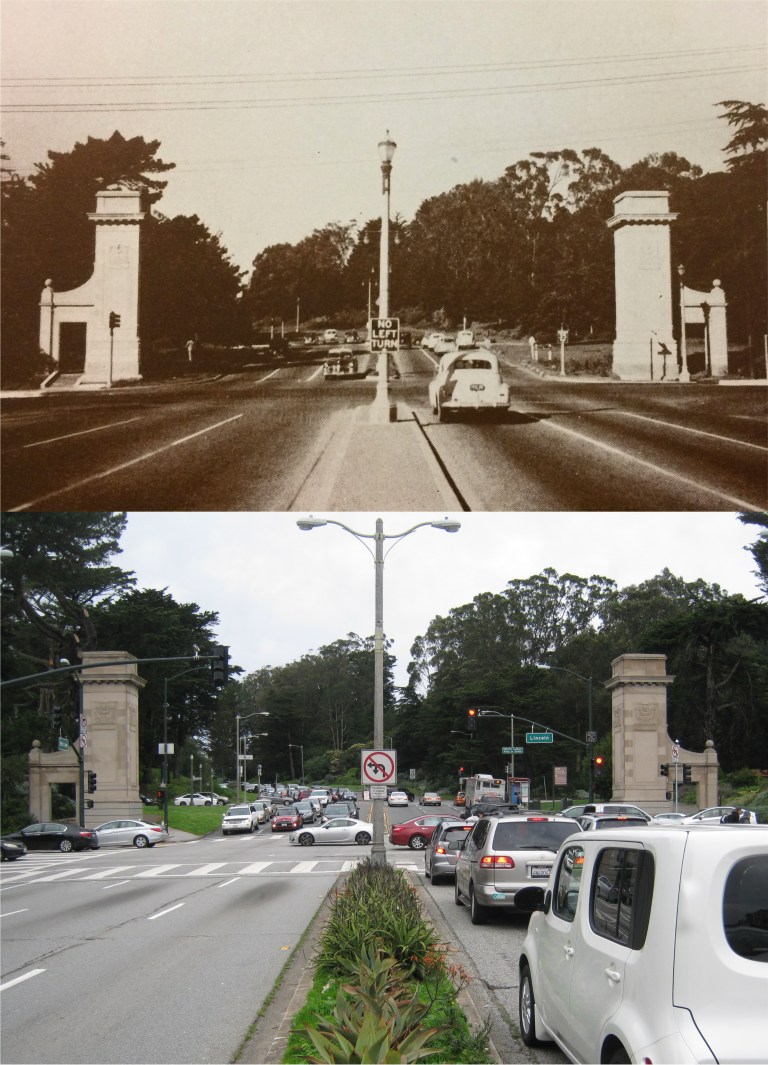 The 19th Avenue entrance to Golden Gate Park, looks like the late 1940’s or early 1950’s: They’re still kind of snotty about that left turn. I guess they thought I was a panhandler when I went out on the medium to get my picture because people in passing cars kept handing me money. I made a fortune! (San Francisco History Center)
 The old Travel Lodge at the Lombard Street entrance to the Presidio: Next to it is the now closed due to a fire Liverpool Lil’s Restaurant. I used to go to Liverpool Lil’s when I had a date and was in the area, but I’ve never been to the Travel Lodge next door. Hmmm, there’s probably something subliminally suggestive in that last line so I’d better take a closer look at it.
 The Cliff House from Sutro Heights in the 1920’s, the 1950’s and last week: You can’t see cars, the road, or even much of the Cliff House from here anymore.
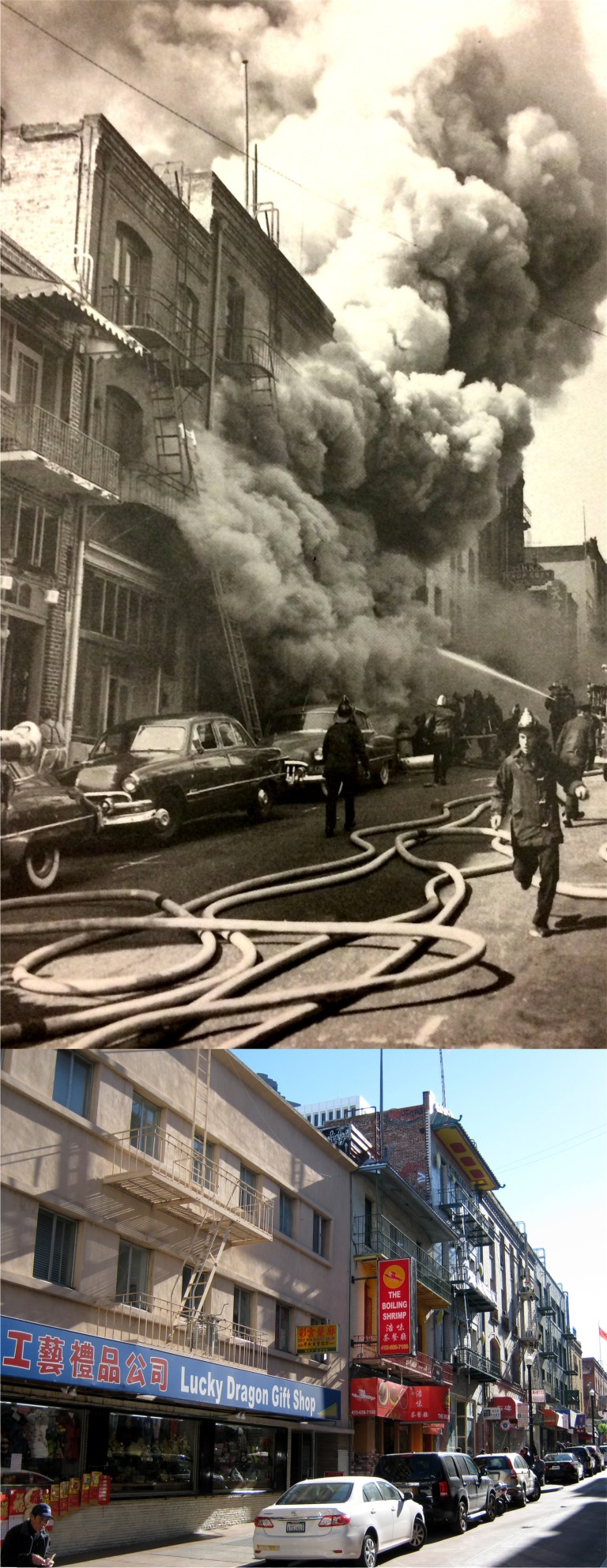 On April 1st 1953, illegally stored butane gas in the basement of a building on Waverly Place in Chinatown exploded injuring ten people and destroying the building. The San Francisco Chronicle reported that the building was on the southeast corner of Waverly Place and Washington Street which would be where the Lucky Dragon Gift Shop is today. The car with the dent in the back to the left of the fireman in the middle appears to be a circa 1950 Ford. This was the kind of car driven by the police inspectors in the old 1950’s television series ‘The Linup’ also know as ‘San Francisco Beat’. I think that this was the best on location television show ever made, and I wish that episodes of these could be found and restored. There is a grainy collection of about seventeen episodes available on DVD and they are wonderful to watch, including episodes where a woman threatens suicide by jumping into the ocean from behind the Cliff House, a serial killer is taken down by the police in front of #9 Fishermen’s Grotto, and a lunatic threatens to blow up Seals Stadium with a bomb.
 A few vintage chassis on Stockton Street south of Post: No, I’m talking about the old cars! Because of the Stockton Street Metro Project my picture is a little closer to Post Street than where the ladies and the precursor to Shirley Temple were. The vintage photo is interesting because it’s difficult to tell if that’s the Stockton Tunnel in the far back of the photo. If not, then the picture predates 1914 when the tunnel opened. The Galen Building can still be seen peeking out in the center of my picture. (San Francisco History Center)
December people watching
 Same crosswalk, different people: This Stockton Street crosswalk on the south side of Geary St. must have been the Designated Older People crosswalk in the 1950’s and the Designated Younger People crosswalk today! The landmark City of Paris Department Store where Neiman Marcus is today is behind the crossers in the vintage picture.
 Well, as long as nobody notices that the cable car was going up California Street at Grant Avenue in the vintage picture and down California Street at Grant Avenue in my picture, this will make a nice comparison.
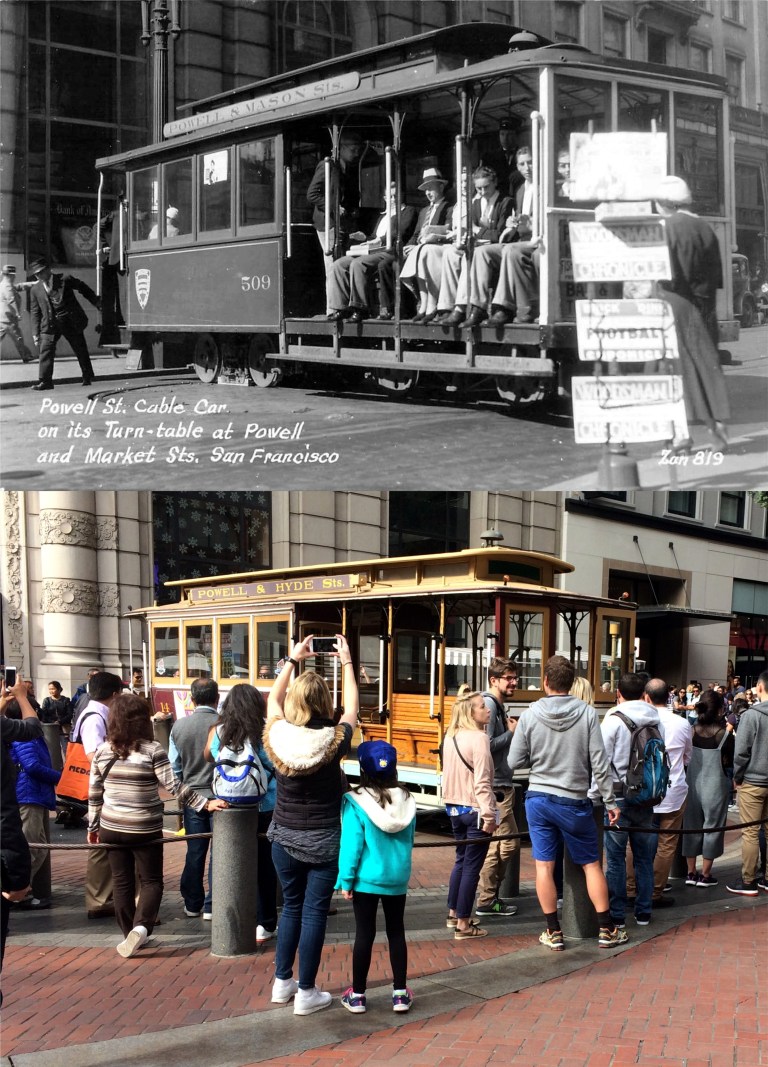 Sticking with cable cars here, you can’t ride on the cable car as it revolves on the turntable at Powell and Market Streets like those bored looking people in the 1930’s are doing. I wonder what football games were playing.
 No people watching here anymore: The old and now closed entrance to the Japanese Tea Garden in Golden Gate Park, looks like the 1960’s, when it was free to get in.
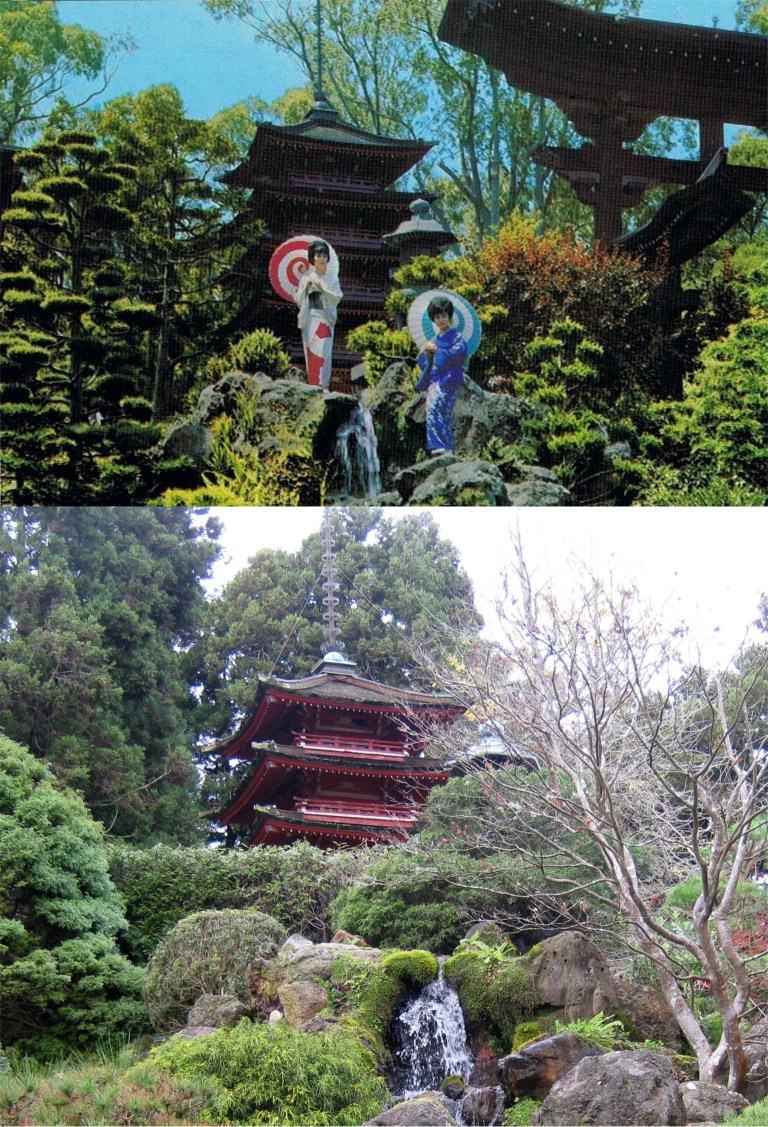 Two pretty geisha girls below one of the temples in the tea garden:
 The Tea Garden Pavilion, obviously, during the 1940’s or early 1950’s: The Japanese Tea Garden name was changed after Pearl Harbor to the Oriental Tea Garden, and was not changed back to the Japanese Tea Garden until 1952. The proprietor and caretaker of the garden, Takano Hagiwara, was interned in a Japanese relocation camp.
 Little people watching on the Great Highway from the top of Sutro Heights: It’s not an easy spot to get a comparison picture here today; you have to climb over a rather nasty fence and get close to the edge of the cliff to get this shot. I’m getting too old for this kind of stuff!
 I wonder if Nicole said yes.
A colorful city
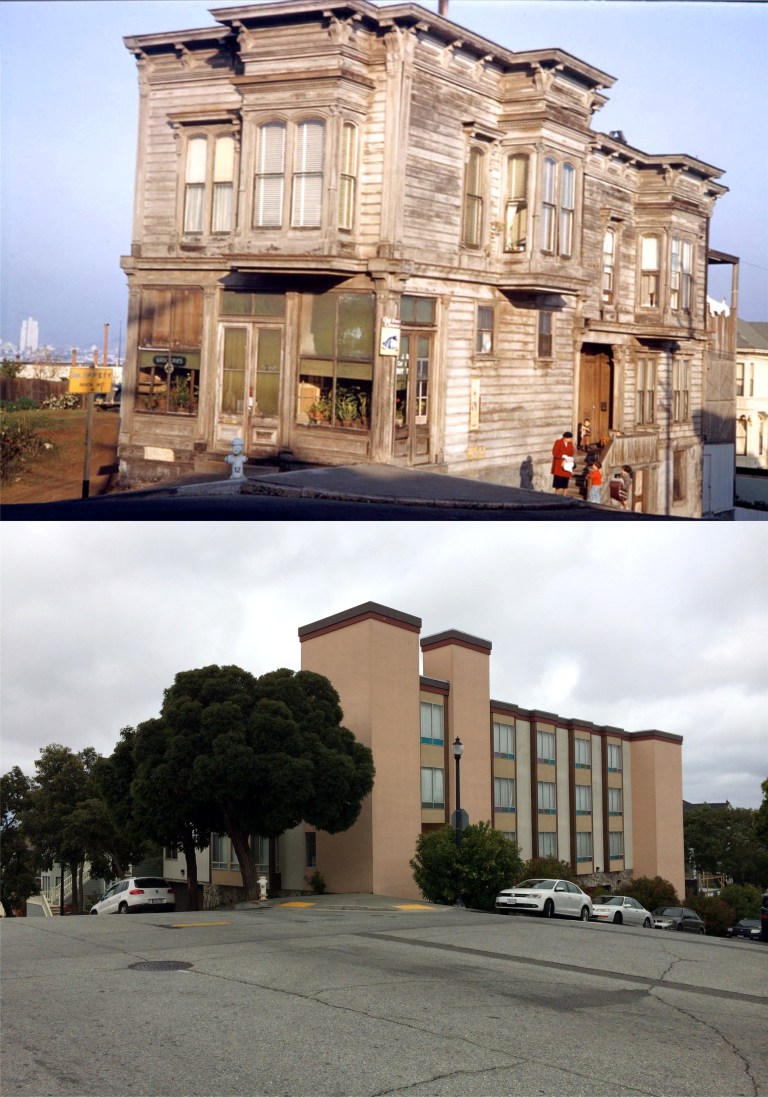 The northeast corner of 21st and Church Streets in 1952:
“Aw, Mom, we don’t want to go in that store, it’s creepy! There’s triffids in there!”
Actually, it looks like they lived in that place! I’m always, sort of, a proponent for preserving old San Francisco buildings, but this one, probably, had to go. (Cushman Collection)
 Well, now you know what people looked like in the Market Street crosswalk at Stockton Street in the 1960’s as compared to today. So, that’s one less thing to wonder about!
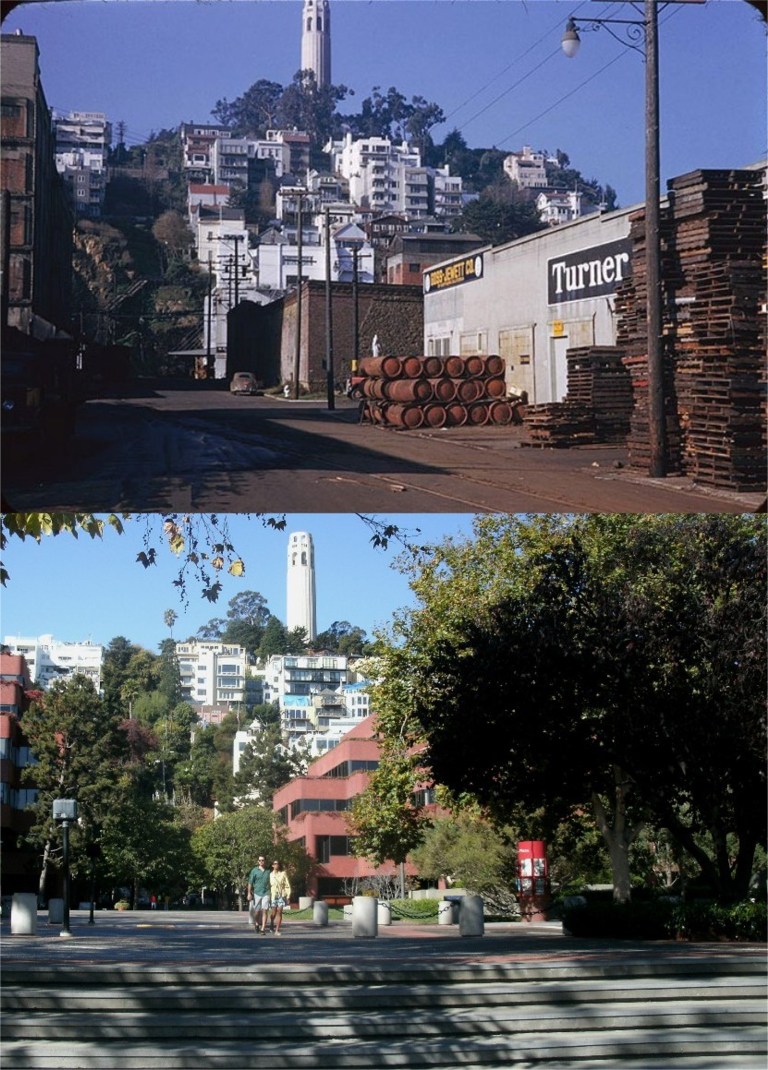 This once seedy looking area of Filbert Street beneath Telegraph Hill is now Levi Straus Plaza, one of the best spots for an outdoor lunch in Downtown San Francisco. (Cushman Collection)
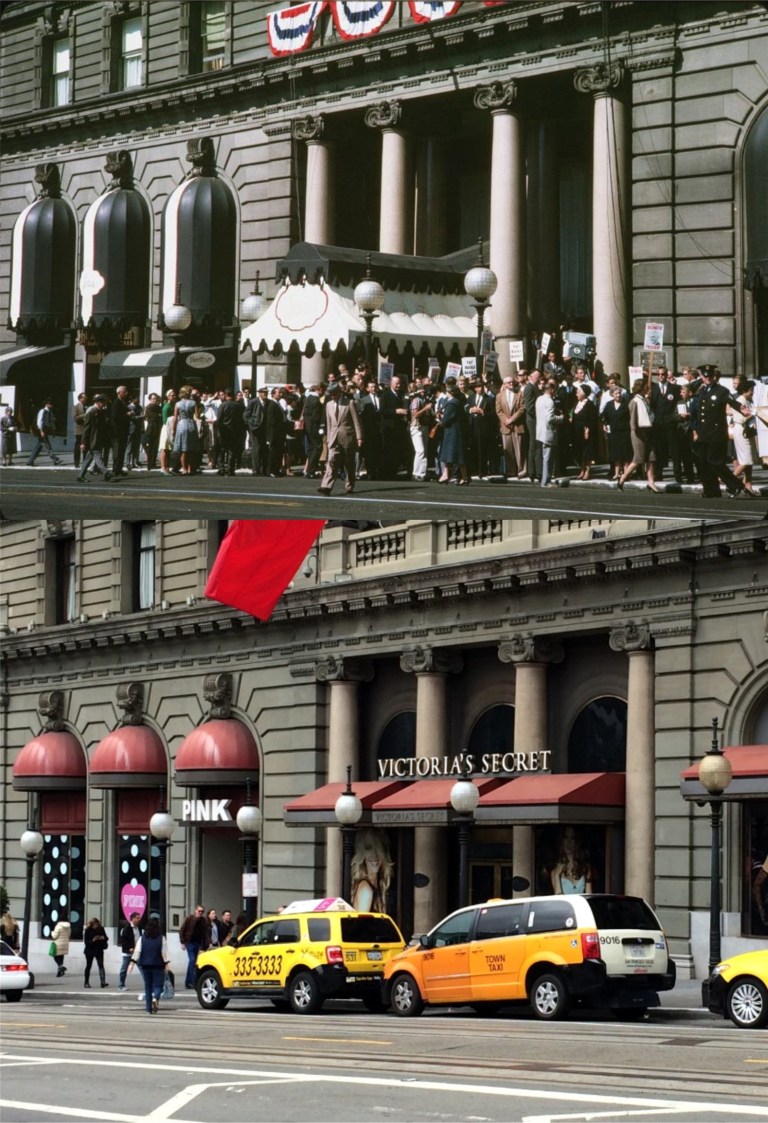 The Republican Convention at the St. Francis Hotel in 1964: Sorry guys, Johnson won. Cushman Collection)
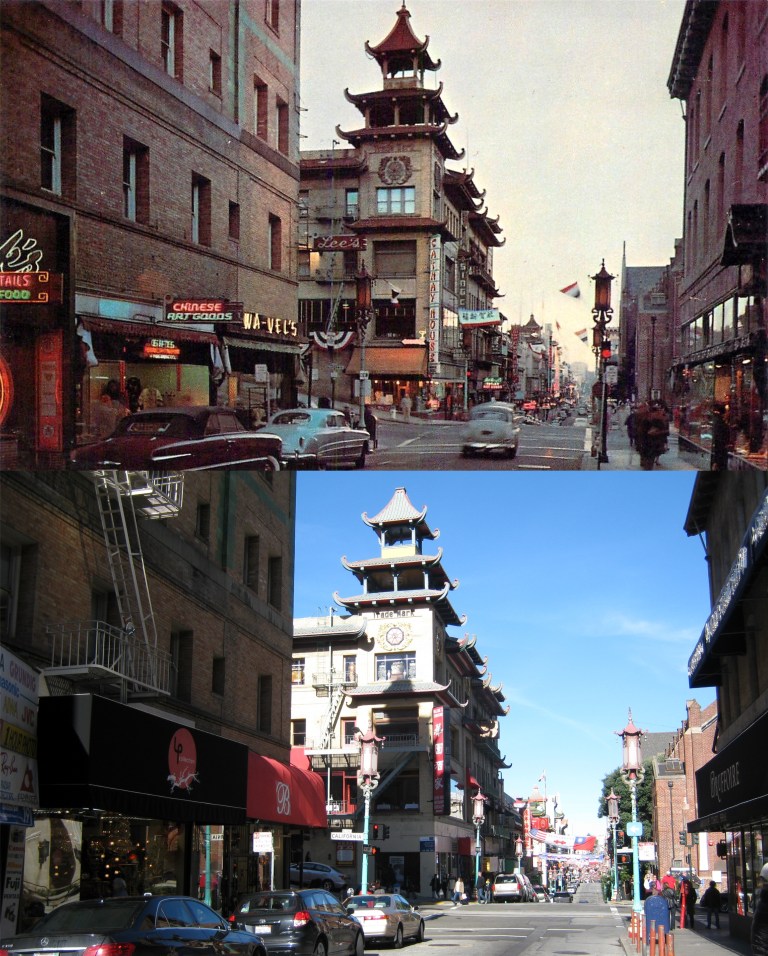 I know, “Doesn’t he have anything better to do than to go around Chinatown taking pictures?” Well, the answer is….. “No, not really!”
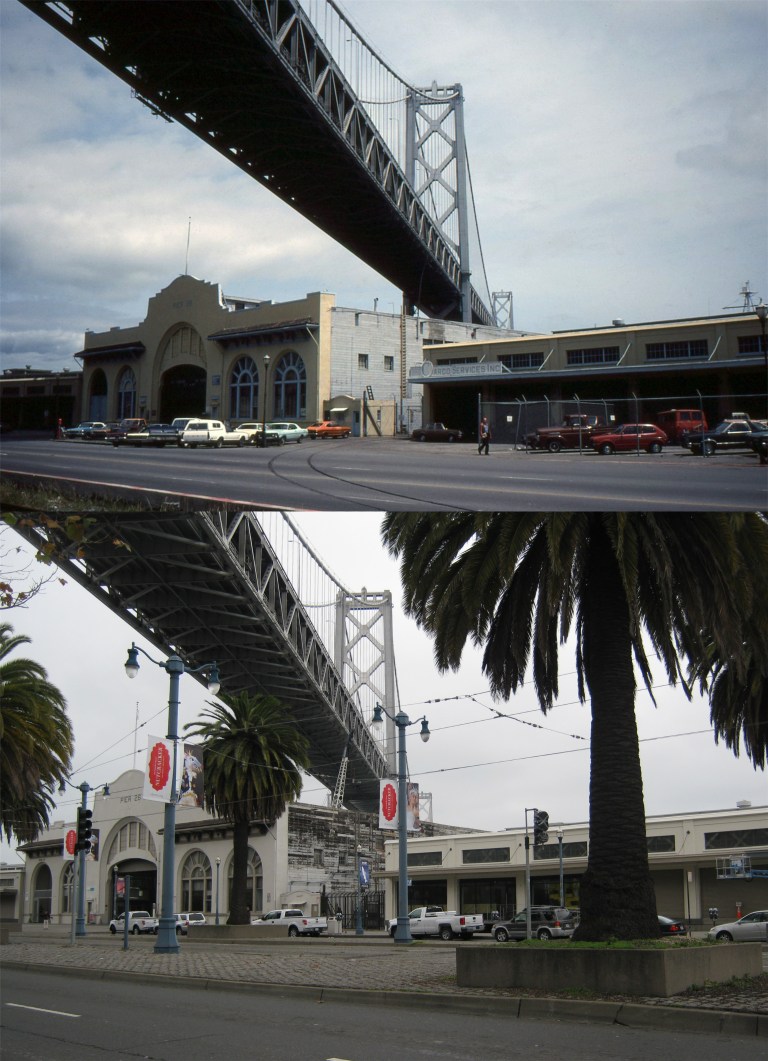 Pier 26, directly under the Bay Bridge from a slide picture I took in 1983: Sometimes, being a colorful city doesn’t always mean San Francisco gets it right. Around that year somebody got the bright idea of painting all of the piers on the Embarcadero mellow yellow and baby blue. I remember saying to myself back then, “What’s with that?” Of course, people didn’t say, “What’s with that?” in 1983, I probably said, “How grody!”
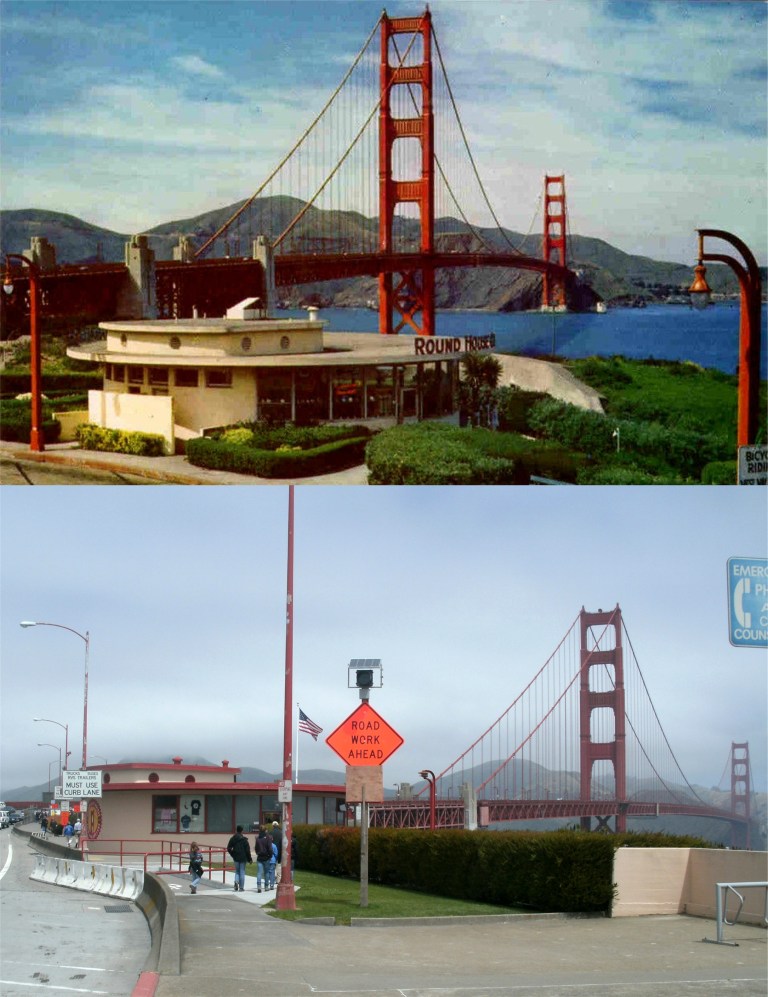 The old Roundhouse Restaurant at the Golden Gate Bridge, built in 1938 and seen in several film noir movies such as ‘Dark Passage’ and ‘The Man who Cheated Himself’ eventually became a gift shop for a number of years, but closed prior to 2012. It is now reopened as the Roundhouse Cafe. What goes round comes round!
 Red Maloooooooooney’s: Kearny at Sacramento Streets, 1952: If you’re wondering why all the bail bonds places, the building with the arched windows to the right of Coit Tower was the old Hall of Justice, seen in many old movies and television shows before it was demolished in the mid 60’s for a Hyatt Hotel. (Cushman Collection)
 A then, then and now! These are three images of where Leavenworth Street used to cut into Market Street. (It doesn’t anymore) The top picture is from the 1950’s; you can see Leavenworth coming in on the left. This area was right in the heart of where all the movie theaters, such as the uNITED Artists Theater were in operation for decades. The California Western State Life Insurance Company was occupying the David Hewes Building built in 1908. The Odd Fellows Fraternity Building, built in 1909, is on the corner of 7th and Market Streets. In the middle photo from 1967, Merrill’s Drugs, Fosters Restaurant, the Federal Hotel, and, of course, the inevitable buses are still around. Although, C.W.S.L Insurance, (easier to abbreviate) is gone, the David Hewes Building is still there, although extremely remodeled and green. next to the United Artists Theater was the Centre Theater. (I don’t know if that was pronounced Center or Centray!) In the modern picture at the bottom the Odd Fellows Building is still around, Foster’s and Merrill’s are gone, and the Federal Hotel is now the Aida Hotel. And, of course, the Market Street buses are still rolling.
Alioto’s and #9 Fishermen’s Grotto
 Had a birthday lunch at Alioto’s Restaurant in Fisherman’s Wharf this week. There isn’t a lot of tourists at this time of year so I got one of the best seats in the house overlooking the fishing boat lagoon. I don’t think I’ve ever enjoyed a more scenic lunch. The restaurant has been remodeled since the vintage photo from SF Gate was taken, so I was sitting about where the Alioto’s sign was.
 “A corsage, Madame, for your coat that so many little animals gave their all for!”
Stopped in at the Grotto first, but the waiting time was too long. The waiter at the door said, “We’ll call your name when there’s a table open.” When I asked how long it would be, he replied, “February.” Actually, the restaurant has changed ownership and it’s closed for remodeling at this time.
Pretty girls in the City
 Pretty in pink on Powell Street:
 A bonus, six pretty girls from the 1960’s and one pretty girl from today at the southeast entrance to Union Square:
 “Officer, I’m telling you I’m not on drugs! I saw ten pretty ballerina girls dancing under the Golden Gate Bridge!”
“Get him out of here!”
 Two pretty girls helping the old man up Mason Street on Nob Hill.
 Pretty girls still wave goodbye to Ferry boats at the Ferry Building.
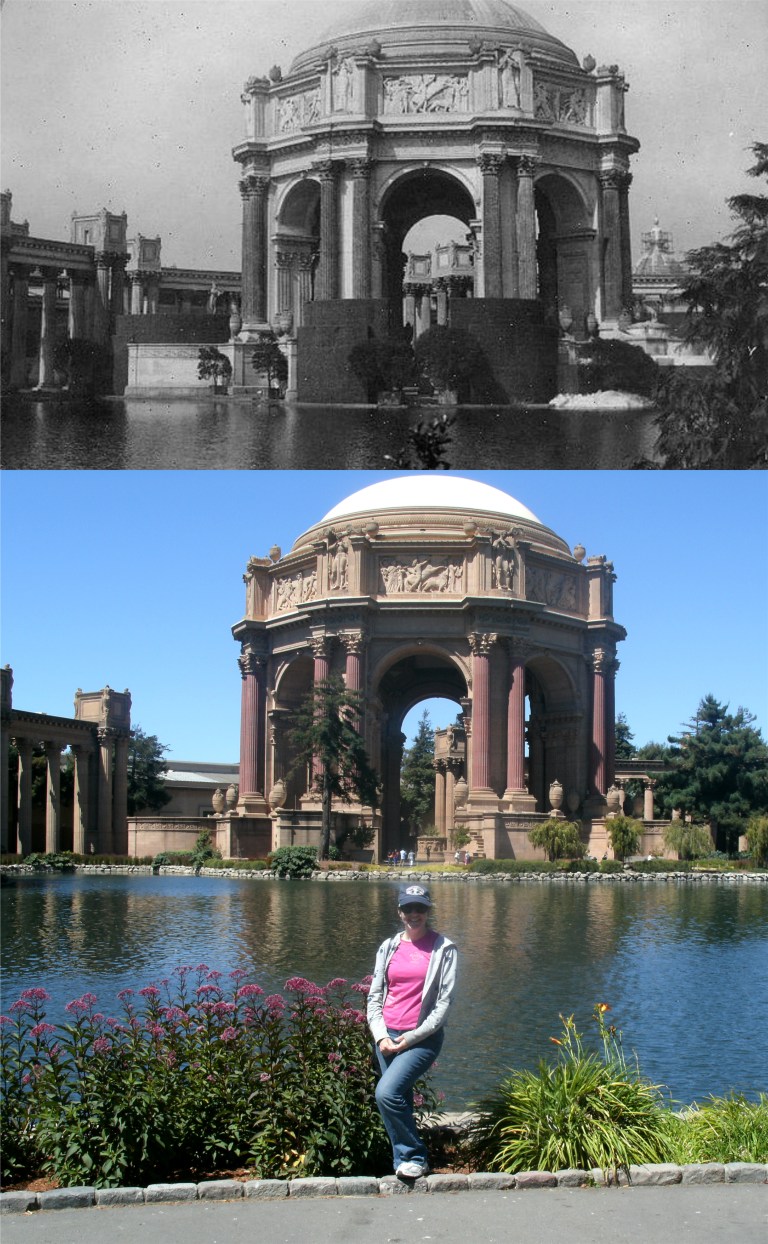 The Palace of Fine Arts during the 1915 Panama Pacific Exposition, and a perfect location for a pretty girl picture:
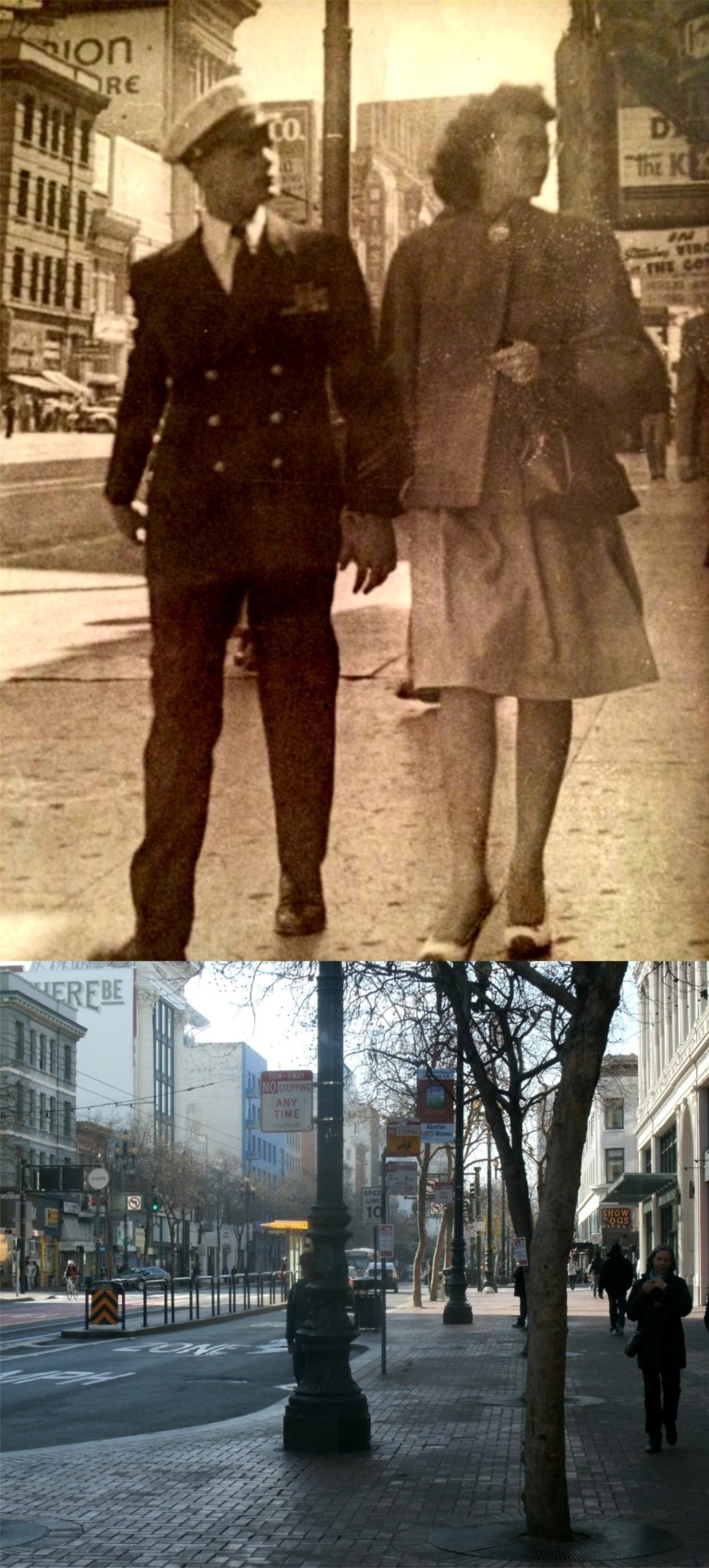 This one was, kind of, special. A friend of mine named Nora asked me if I could help her identify the location of a picture of her mom and dad in San Francisco at the end of World War Two. We worked together to find the spot here on Market Street, and it was fun to do.
“It’s beginning to look a lot like…..”
Christmastime in the City: Sometime it feels like I’m in an old movie when I go to Downtown San Francisco at Christmastime. I went over there last weekend to get into the spirit of the season. (Well, it’s possible!)
 http://opensfhistory.org/Display/wnp14.4522.jpg
The northwest corner of Union Square in 1929, and yesterday after the rain: The old photo was taken from a building that was later demolished for the I Magnin building that’s now part of Macy’s. My picture was from the Cheesecake Factory. (Opensfhistory)
 http://opensfhistory.org/Display/wnp14.3962.jpg
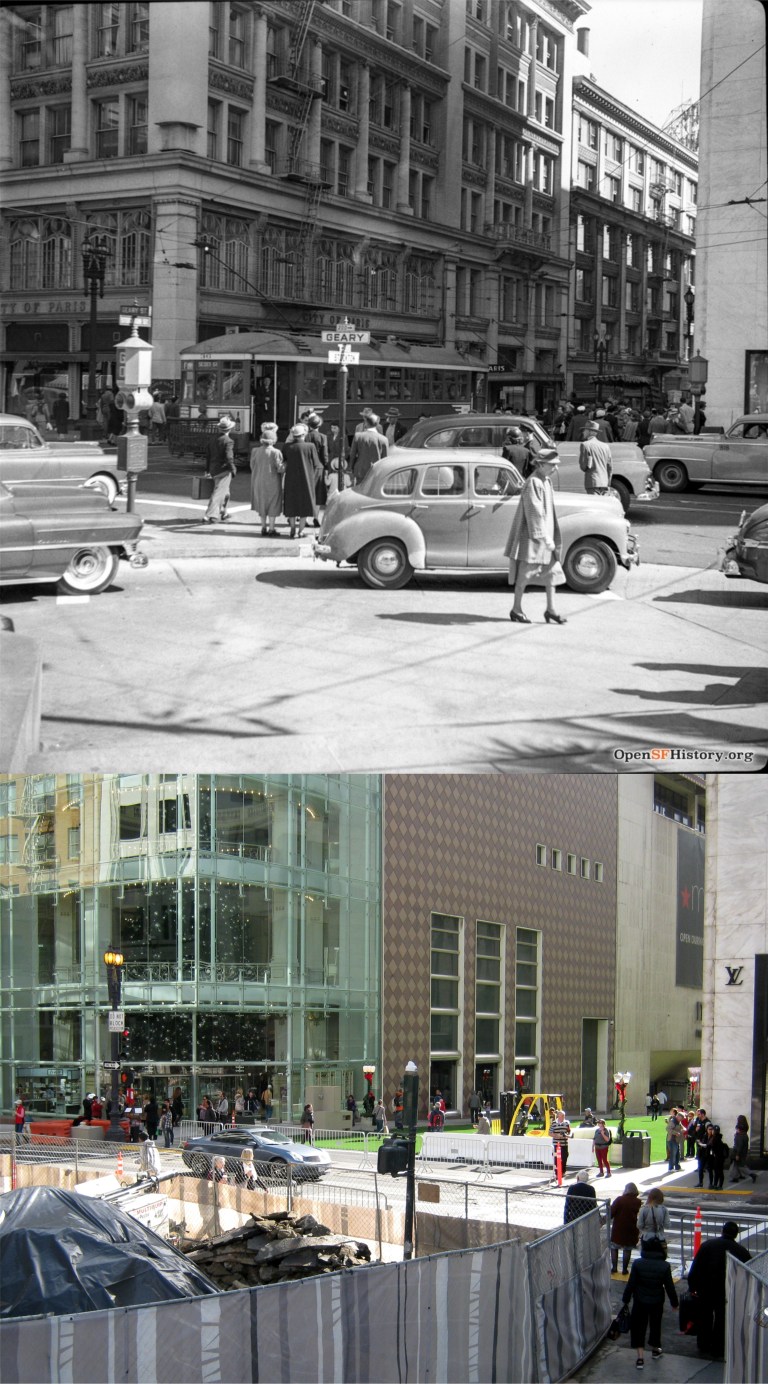
Here’s a great old picture; the hustle and bustle of Geary Blvd. and Stockton Street in the 1940’s, and the hustle and bustle and construction of Geary Blvd. and Stockton Street today. That’s the beloved City of Paris Department Store, demolished in 1981, in the background. Neiman Marcus is there today. You can see their Christmas tree in the entrance. There was a Salvation Army Band playing Christmas carols on the corner in front of Neiman Marcus that you can see in the modern picture, and they were great! Opensfhistory)
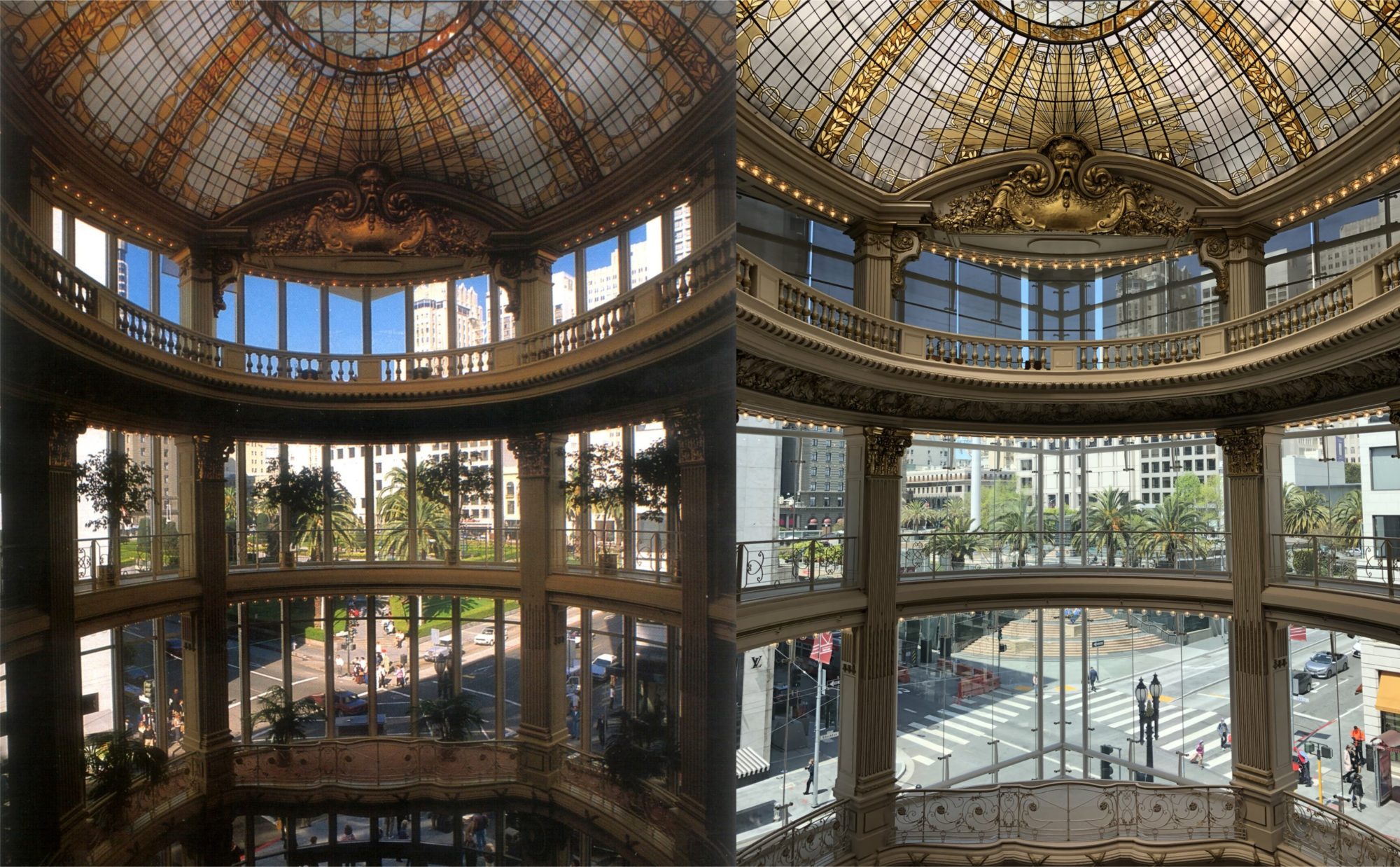
 The Neiman Marcus Christmas tree is under the same rotunda as the City of Paris tree, seen above. Neiman Marcus kept that roof from the old department store. That old photo looks like some creepy ‘Twilight Zone’ episode where the mannequins come to life and chase you out of the store, or something!
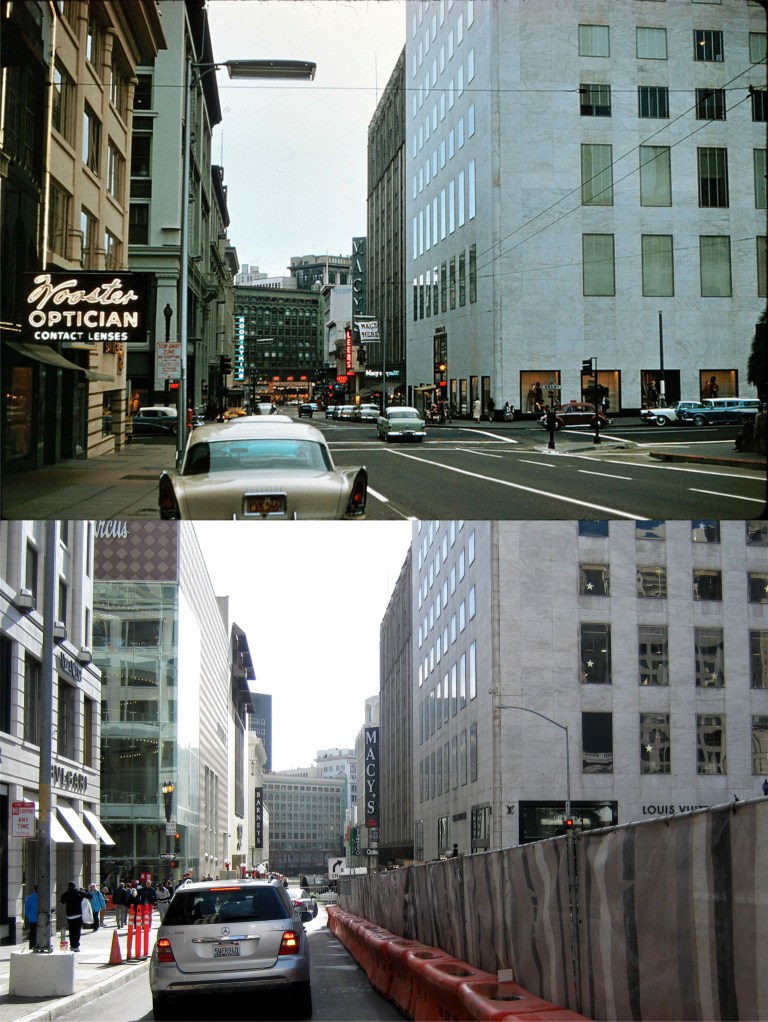 Here’s another cool old picture looking down Stockton Street from Maiden Lane. I’m not going to get a really good comparison until they finish the Stockton Metro project.
 This one is a little further down Stockton Street from the previous one. Where were the concerned citizens when those two nitwits were dragging that kid through all that dangerous traffic in the 1940’s? That’s the old Macy’s Store clock in both pictures.
 http://opensfhistory.org/Display/wnp25.1273.jpg
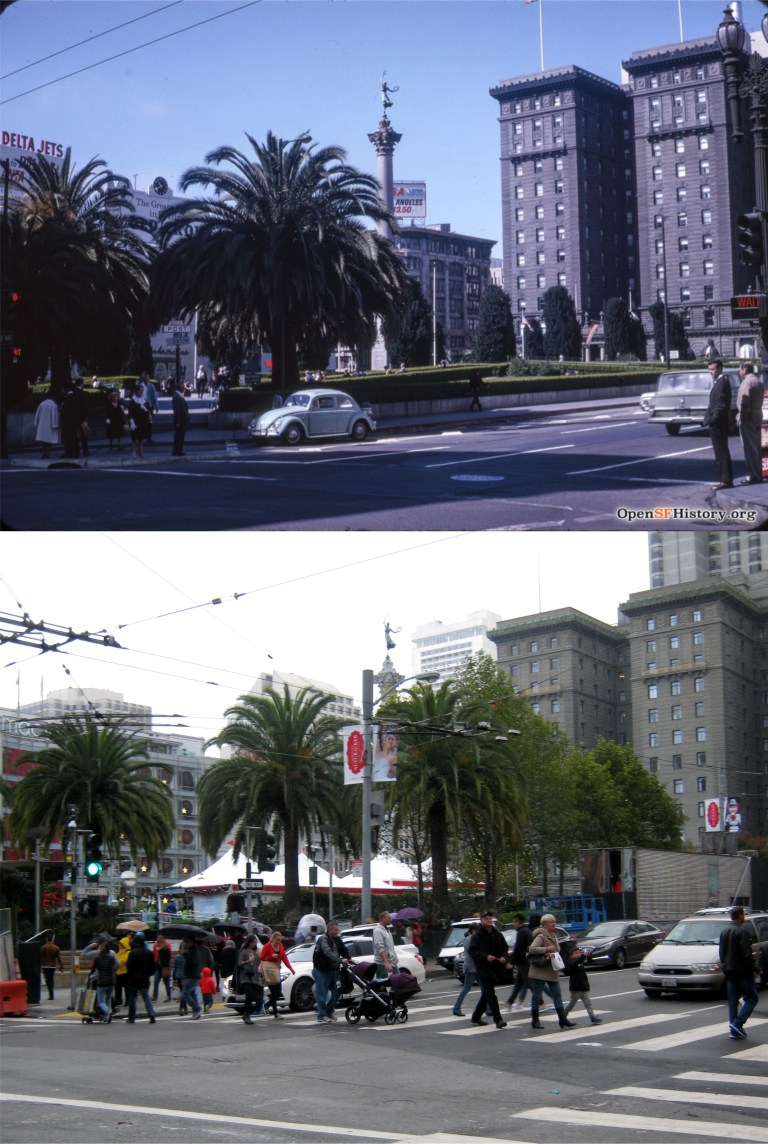
The northeast corner of Union Square in the 1960’s and last Sunday: “Hey everybody, here’s a crosswalk we haven’t checked out yet!” (Opensfhistory)
 Eh, why not? (Americards.com)
Two kinds of rain
To me, there are two kinds of rain in San Francisco; the romantic rain that you walk around in and wish that you were in love again, and the kind that just freezes your butt off. I took these over the past two weekends and got a little of both.
 It was a little friendlier setting when I took my picture on the northeast corner of Mason and California Streets on Nob Hill than that spooky looking long ago picture! That’s the Fairmont Hotel on the left in both pictures. (California State Library)
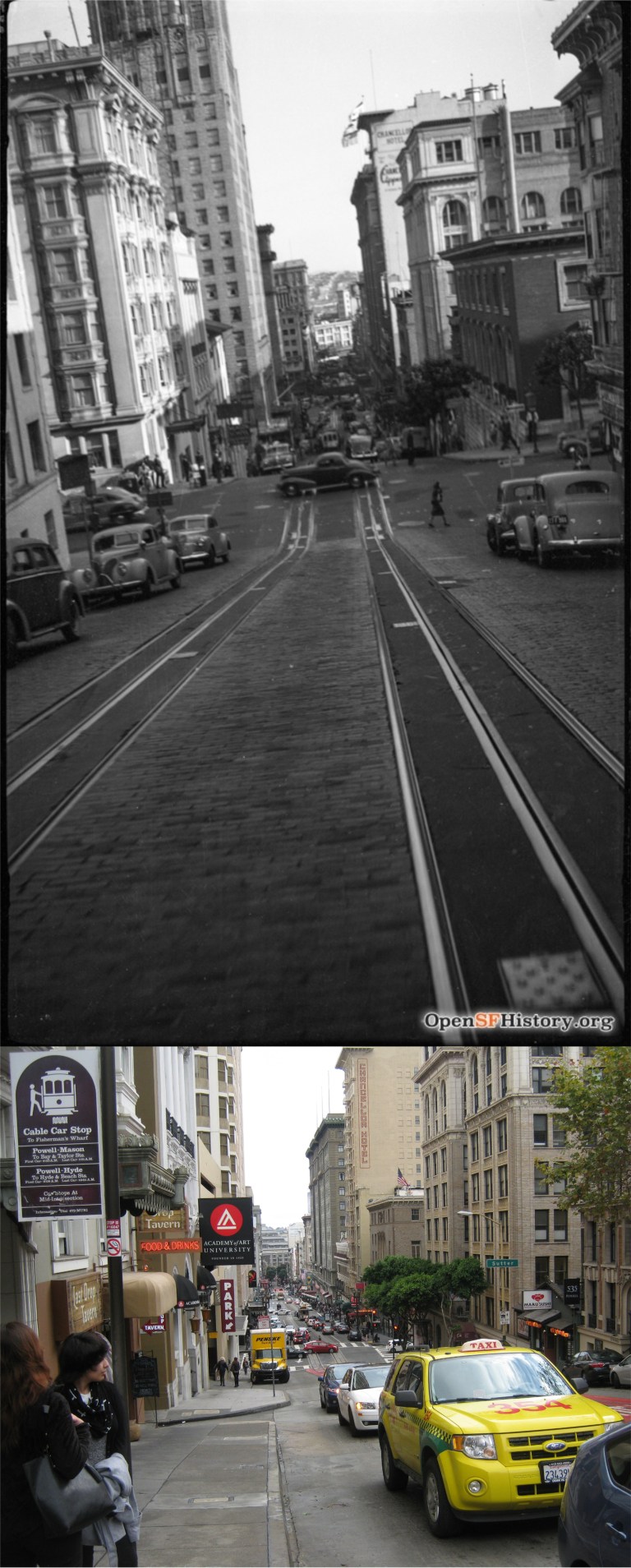
 Here’s another interesting picture at California and Powell Streets as a cable car begins its drop into Chinatown. The old Crest Garage is still there today, although, it is no longer that name.
 http://opensfhistory.org/Display/wnp14.3213.jpg
It’s slippery navigating your way down Nob Hill in the rain when you’re wearing four year old sneakers! My photo was actually taken where the bottom of the hill on the left is in the old picture at Bush and Powell Streets. I took my picture before I found the vintage one, and I liked it so a found this close comparison from the OpenSFHistory website.
 A cable car at Bush and Powell Streets on a sunnier day in what looks like the early 1950’s: Those people hanging on the front end of the cable car in my picture look miserable!
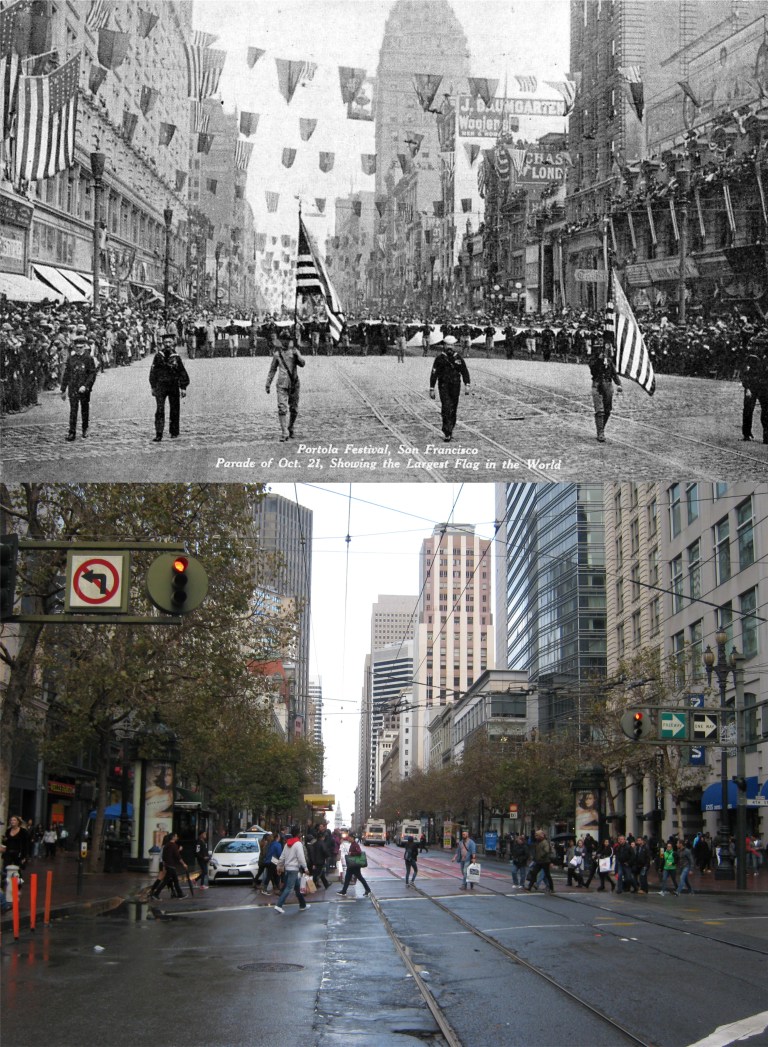 I can’t get a date on this wonderful old picture of a parade on Market Street between Stockton Street and Grant Avenue, but it looks like the 1920’s. The crowned building in the background of the vintage picture was the San Francisco Call Newspaper Building. Sam Spade went into this building in the novel ‘The Maltese Falcon’ to find out when the ship that would bring the falcon to him was to arrive. The building survived the 1906 Earthquake and Fire, but the crown was removed in the late 1930’s, and it was remodeled to look more like the Daily Planet Building from ‘Superman’ or something. Now called the Central Tower, it’s the white and brown building at the center right of my picture. The Humboldt Building, built just after the earthquake, can be seen on the right in both pictures.
 Powell Street at Ellis in the 1950’s from a San Francisco Call Bulletin photo in the San Francisco History Center: Look at the crowd heading toward Union Square in my picture for the first weekend of Christmas shopping!
The Lady from Shanghai
 Here’s another great film noir chase scene located in Chinatown from the 1947 film classic ‘The Lady from Shanghai’. I’ll set the situation up for you; Orson Welles plays a man being held in the old Hall of Justice on Kearny Street accused of murder. He fakes a suicide attempt by taking a number of pills, and escapes the building in the confusion. He flees into Chinatown trailed by his lover played by Rita Hayworth. Follow along as these two culprits race toward a movie theater encounter that would eventually lead to a denouement that’s one of the most famous scenes in film noir history.
 Welles bolts across Kearny Street toward Portsmouth Square. Notice the buildings in the background on Clay Street; they haven’t changed a bit in seventy years!
 Rita Hayworth follows him through Portsmouth Square. The short and taller buildings behind her can be seen in the center of my picture. The Medusa effect has turned a lot of San Francisco’s public squares to stone instead of grass, and Portsmouth Square is no exception. That block of stone on the right in the movie image is the Robert Louis Stevenson Monument which was in the center of the square at that time.
 Welles looks back on the corner of Grant Avenue and Pine Street to see if he’s being followed. The pills he took in his phony suicide attempt are beginning to take effect. You can still see the Chop Suey sign today in the center of the middle picture. I moved over to the storefront to try to get the mirror image of the Sing Fat Building like the movie scene. I don’t have Orson Welles skills, but it wasn’t a bad try.
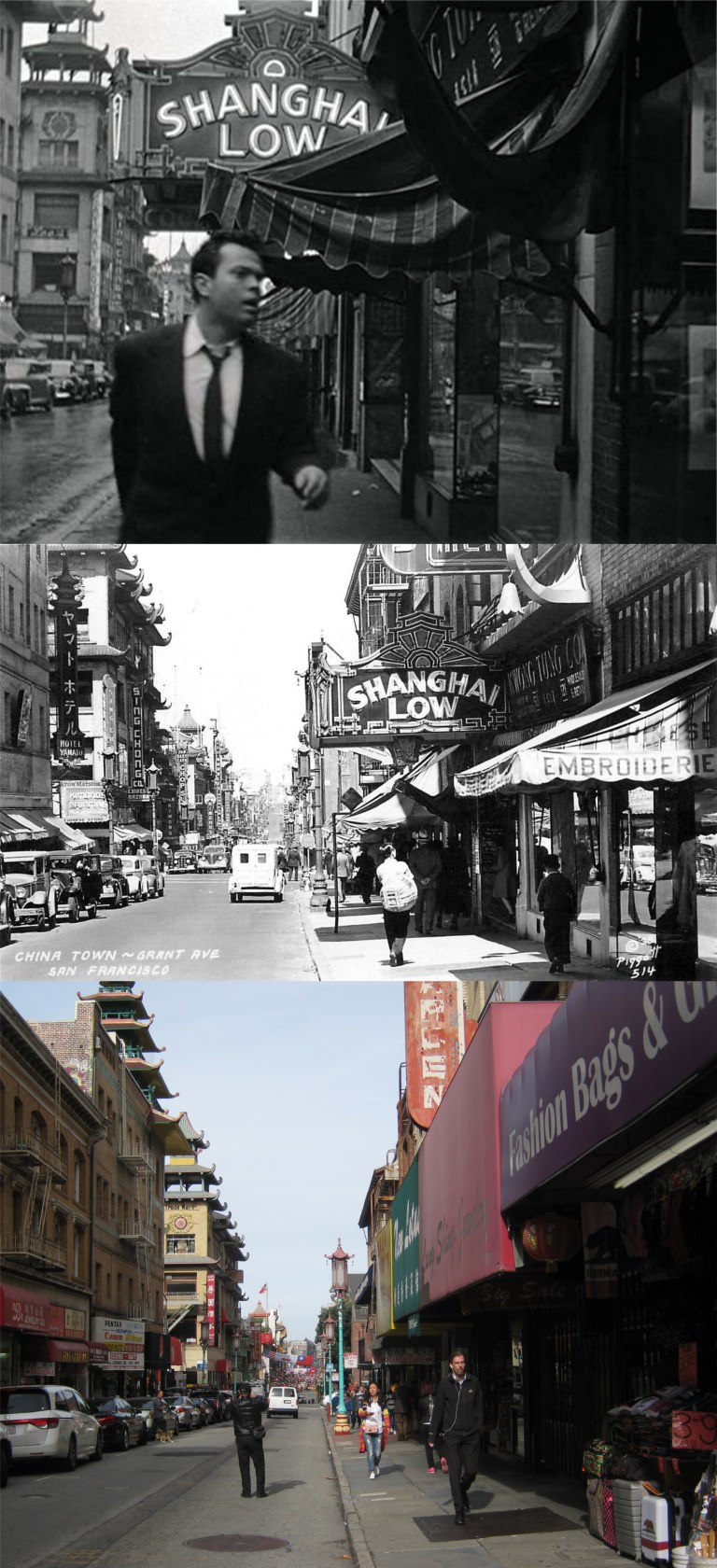 Orson passes the old Shanghai Low Club, seen in a vintage picture from the 1930’s in the middle. The long gone Shanghai Low Club became the Lotus Garden for a number of years, but the building is now empty. The lower portion of the red Lotus Garden sign at the top of my picture was once the Chop Suey sign seen in the previous picture.
 Beginning to lose consciousness, Welles ducks into the old Mandarin Theater on Grant Avenue. The Mandarin Theater is now the Sun Sing Center Gift Shop, but if you peek through the curtains in the back of the shop you can see where the stage used to be.
 This is where the Mandarin Theater once was.
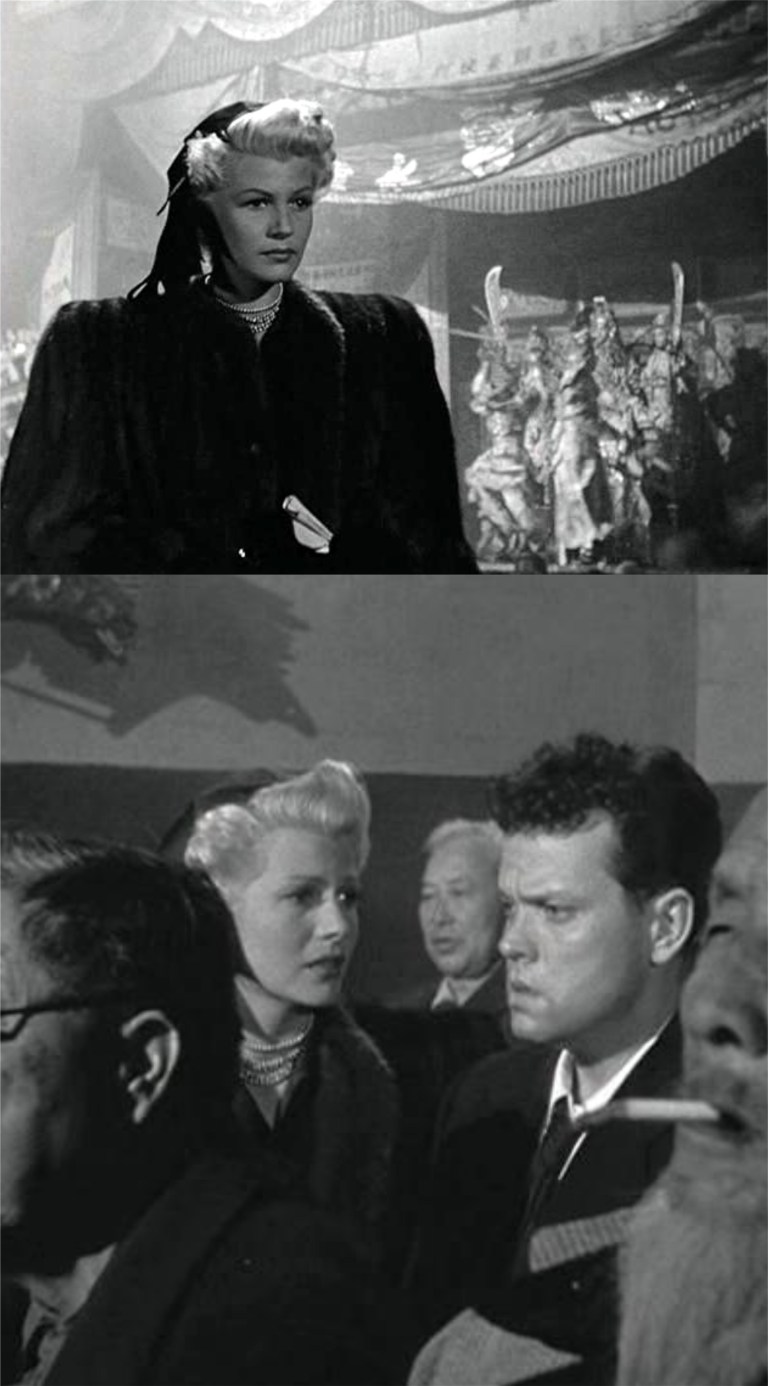 Lovely Rita, not the one from the Beatles, follows Welles into the theater in an effort to convince him that she’s trying to help him. Before Orson passes out here, he realizes who the real murderer is. The next and final scenes would be out at the Funhouse at Playland-at-the-Beach for the famous hall of mirrors scene.
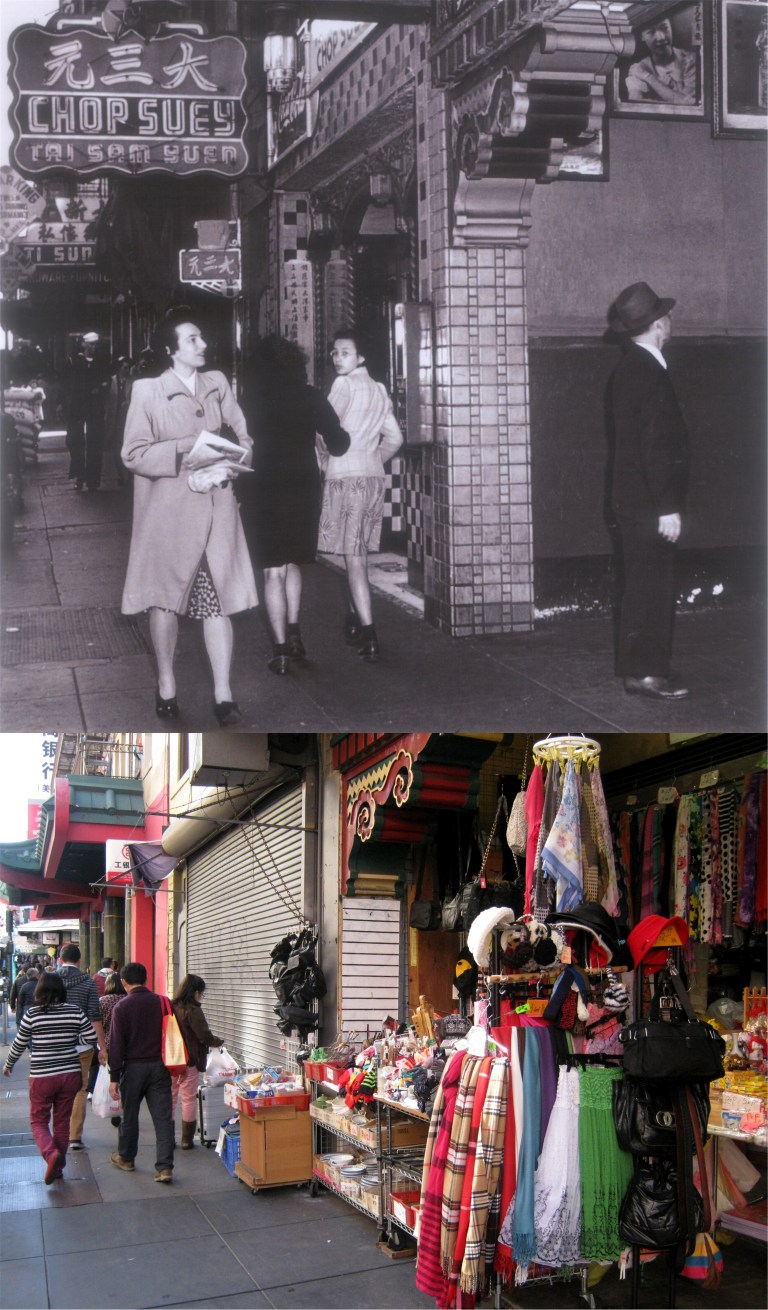 This vintage San Francisco Call newspaper photo from the San Francisco History Center was taken in front of the Mandarin Theater in 1944, three years before ‘The Lady from Shanghai’ was filmed. The fellow on the right is going into the theater. There was a lesser known but just as fun to watch chase scene that I covered in January of 2016 from a 1949 filmed called ‘Impact’ Click on the link below if you’re interested in seeing that one too.
https://sfinfilm.com/2016/01/13/the-chinatown-chase-scene-in-the-1949-movie-impact/
Another ‘Tim Tour’ (A thanks to Kevin for riding along and helping)
If you take the Hop On, Hop Off tour buses they’ll take you to places like the Golden Gate Bridge and Fisherman’s Wharf and those are fine places to visit, but if you take the Tim Tour here, I’ll take you up close to a cable car and the famous “Painted Ladies”. You’ll get a past look at the Portals of the Past and travel back to a World War Two change in Golden Gate Park. You’ll see San Francisco’s answer to the Swiss Alps, and I’ll show you where the lights are out and nobody’s home at a famous San Francisco landmark, at least for the time being! We’ll end up with a different view of the Cliff House than the one usually seen, complete with a celestial visitor!
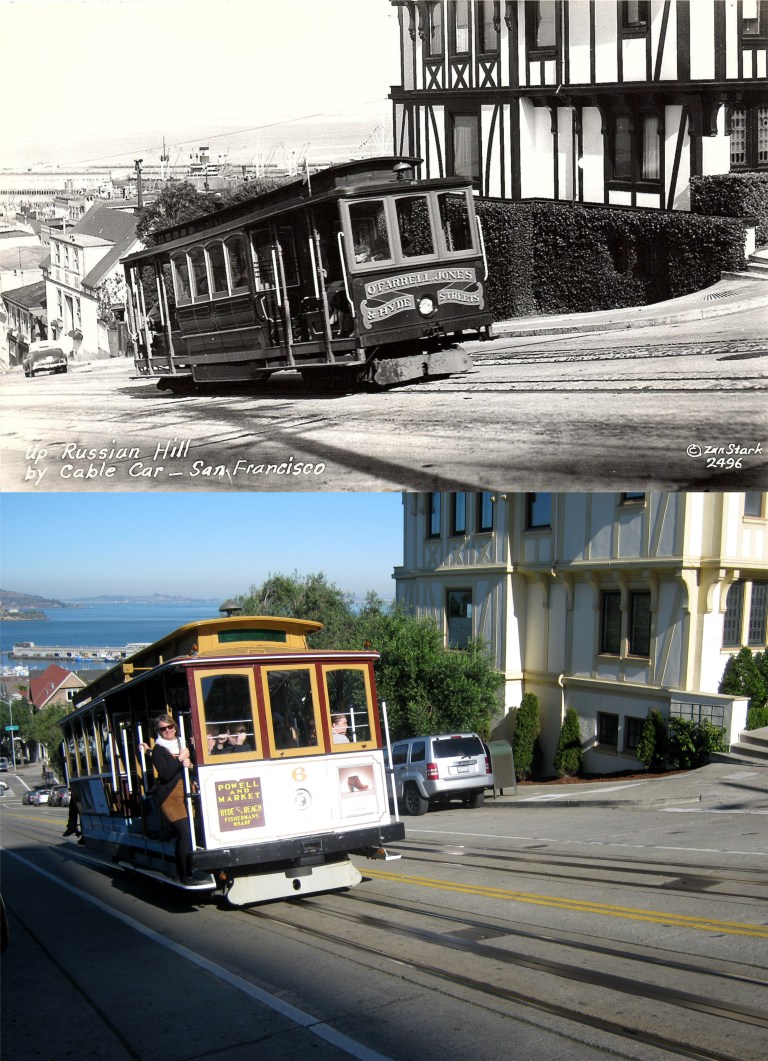 Cable cars still “climb half way to the stars” on the “Hyde Street Grip” here on Russian Hill, and I got a nice smile from a passenger!
 The famous “Painted Ladies” of Alamo Square from a different view than the one that’s now folklore: (Bob Hollingsworth)
 The doorway of A. N. Towne’s mansion was all that was left standing of his Nob Hill home after the 1906 Earthquake. It was moved out to Lloyd’s Lake in Golden Gate Park in 1909. Known as the ‘Portals of the Past’, here it is seen in an undated photo from whatever they call the decade before the 1920’s and yesterday.
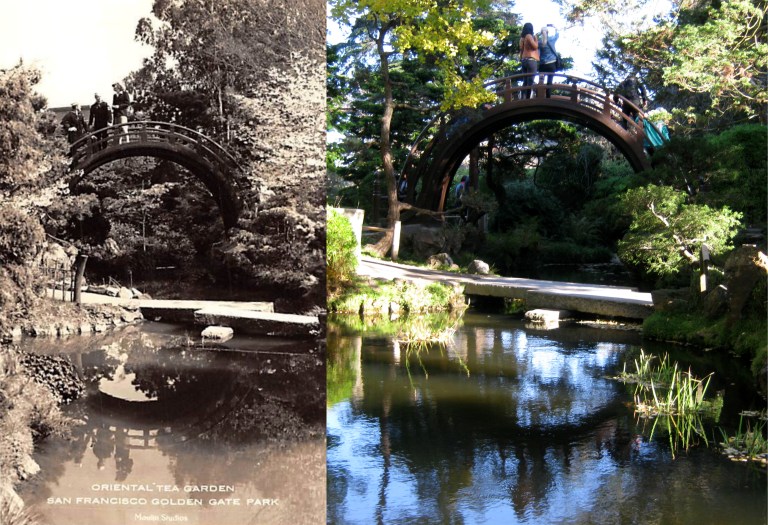 The Japanese Tea Garden in Golden Gate Park is one of the few attractions that remain from the 1894 Midwinter International Exposition. After Pearl Harbor when anti Japanese sentiment ran high, the name of the Garden was changed to the Oriental Tea Garden. The name was changed back to the Japanese Tea Garden after World War Two. The left photo was at the Moon Bridge during the war.
 The Sky-Tram ran behind the Cliff House from 1955 to 1961. It carried passengers across part of the Pacific Ocean behind the Sutro Bathhouse from the Cliff House to a waterfall at Point Lobos, seen here in these pictures, and back. It’s just a faded memory today and few people have heard of it.
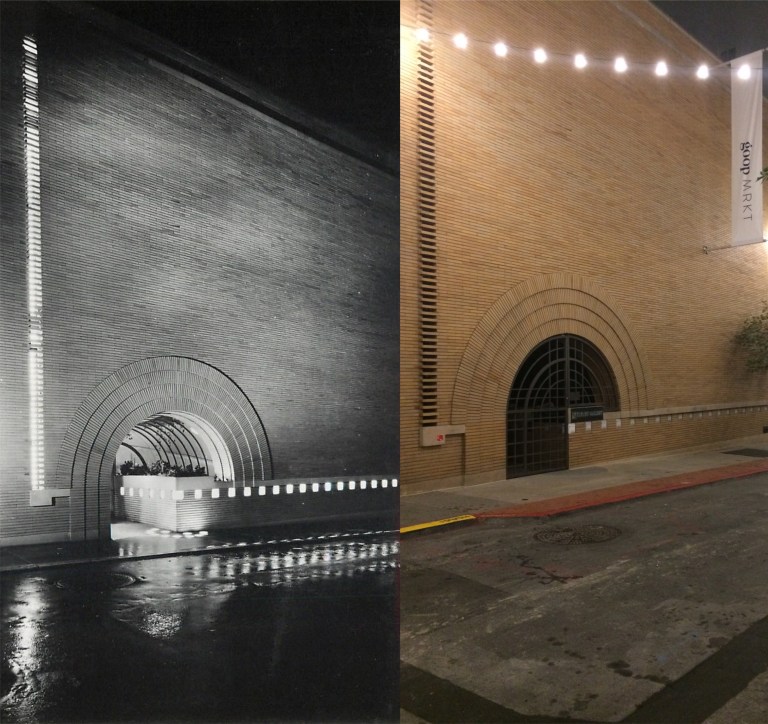 The only building in San Francisco designed by Frank Lloyd Wright is at 140 Maiden Lane. Built in 1949, a number of galleries and businesses have been housed there, the last being the Xanadu Gallery, but as of last Thursday evening it remains empty, and, kind of, spooky looking. The picture on the left is from the 1950’s.
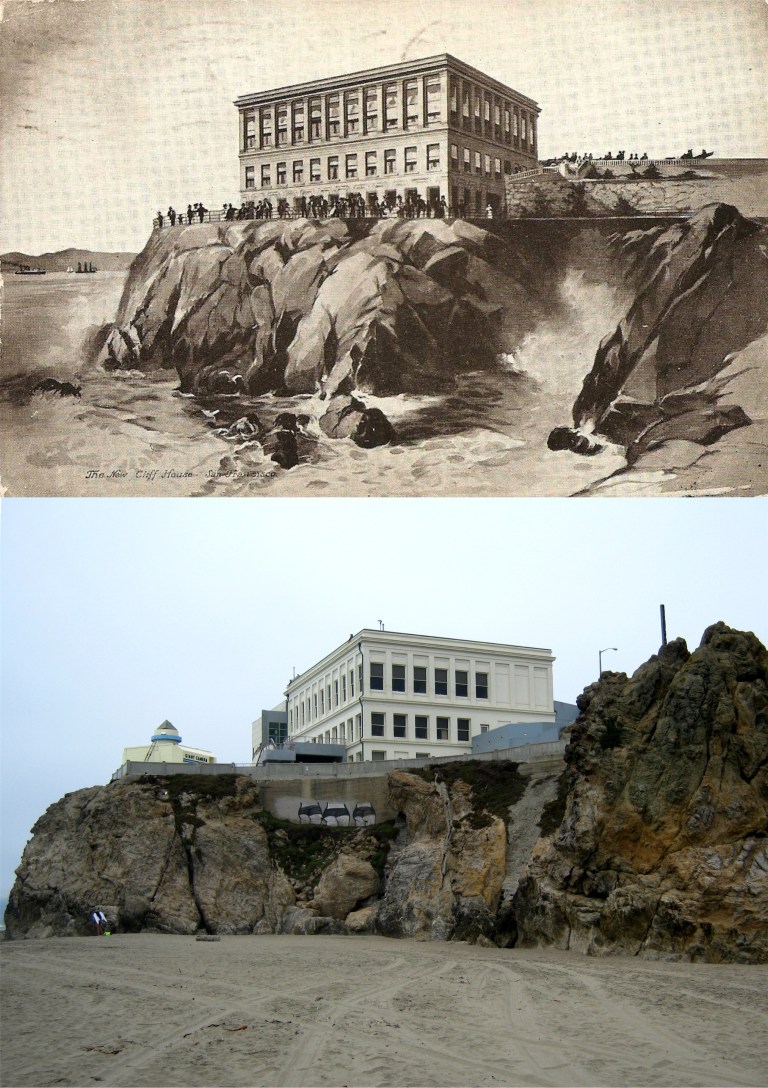 The old drawing from 1910 at the top appears to be the view from behind the Cliff House. They labeled it “New” then, and it’s, basically, the same building that’s there today. You can only get to this spot at low tide, (or if you’re an angel, and I had no idea what that was all about) I’ve never been this far behind the Cliff House before so I don’t know what those butts up on the wall are for, but there are some interesting caves down here that you would drown in when the tide comes in.
 I’ll just pretend I’m taking a picture of Seal Rocks!


