
 In 1957 Doubleday and Company published Herb Caen’s guide to San Francisco, aptly titled ‘Herb Caen’s San Francisco’. Very imaginative! It’s deliciously outdated and fun to read with entries like “STEINHART AQUARIUM, open 10 A.M. to 5 P.M. daily, no admission charge. Easily the most popular attraction in the park, the aquarium draws as many as ten thousand visitors a day, all walking around openmouthed in the semidarkness to stare at the openmouthed fish.” John Steinbeck once wrote, “It is very probable that Herb’s city is the one that will be remembered.” However, what interests me most about the book is the map on the inside of the front cover and first page. There is no explanation in the book as to why the route was laid out. In some areas it’s similar to the famous 49 Mile Scenic Drive, although shorter. Oddly, it bypasses some of San Francisco most visited tourist attractions, such as the Golden Gate Bridge, the Cliff House, Twin Peaks, Mission Dolores, and Union Square. The trail starts on Mason Street and ends on Mason Street. I followed the mysterious route over last weekend doing then and nows of photos along the way from OpenSFHistory.org. The OpenSFHistory.org site has one of the best, if not THE best, collection of vintage San Francisco pictures to be found. So let’s get our exercise and follow along on Herb Caen’s 1957 map from Mason Street to Mason Street.
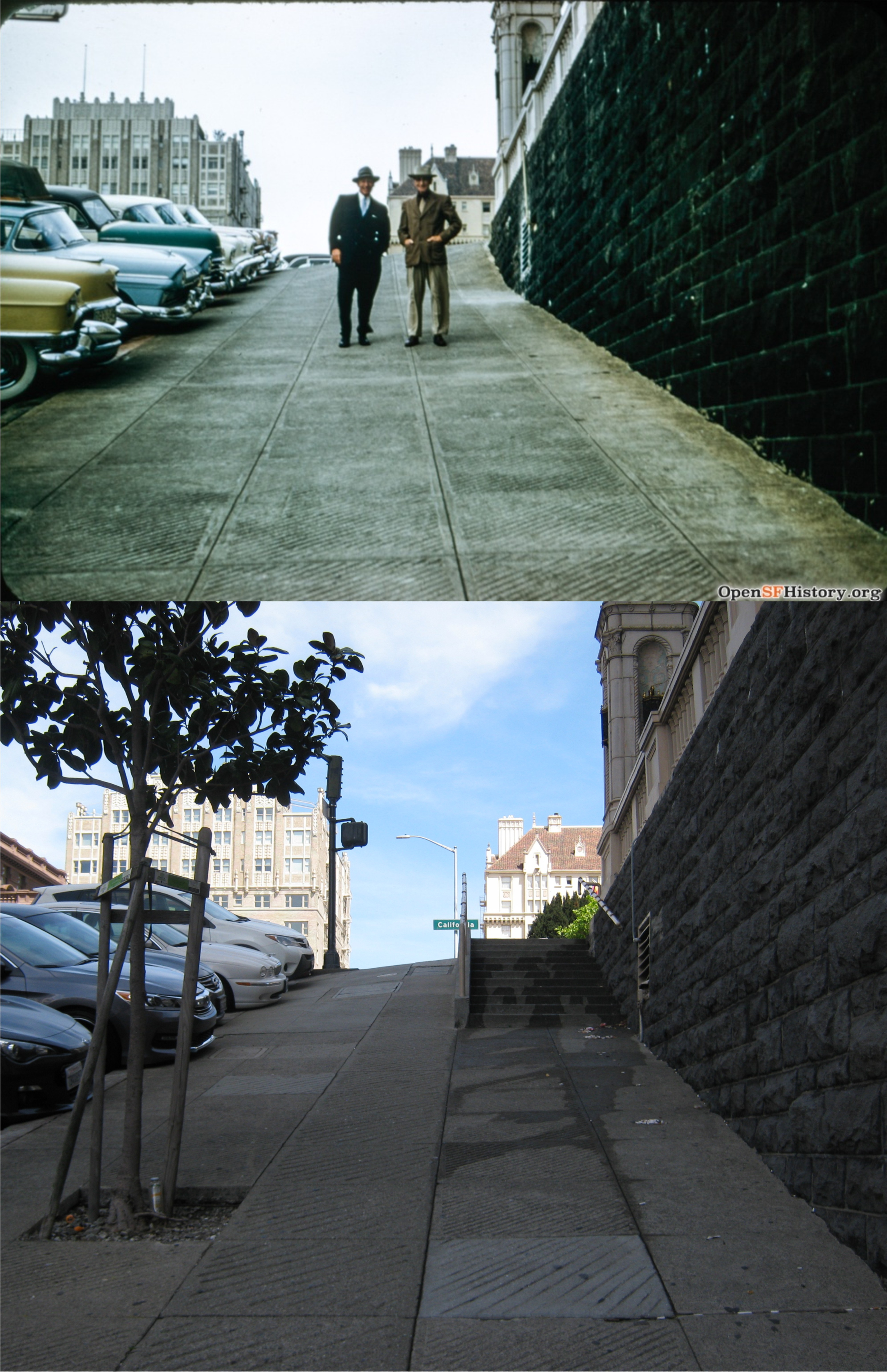 We’re off! We’ll start on the west side of the Mark Hopkins Hotel with these two dapper gentlemen from 1958.
 The trail heads down California Street turning north onto Grant Avenue. We’re in 1943 now with these ladies and next to Old St Mary’s Church.
 We move past Commercial Street in the 1930’s. Commercial is one of two streets that leads straight to the Ferry Building, the other being Market Street; although, Commercial Street is cut off from reaching the Ferry Building now by the Embarcadero Center.
 The route leaves Chinatown and heads northwest along Columbus Avenue. We’ve come forward a little in time to 1971 here at Columbus and Union Street. The 39 Bus is crossing Columbus Ave along Union and heading up to Coit Tower. The 39 line still passes by here and I wanted to get a picture of a coach going by in my photo, but the street is closed off now due to a massive fire that destroyed the building on the southwest corner of the intersection several weeks ago.
 This is what’s left of the building now.
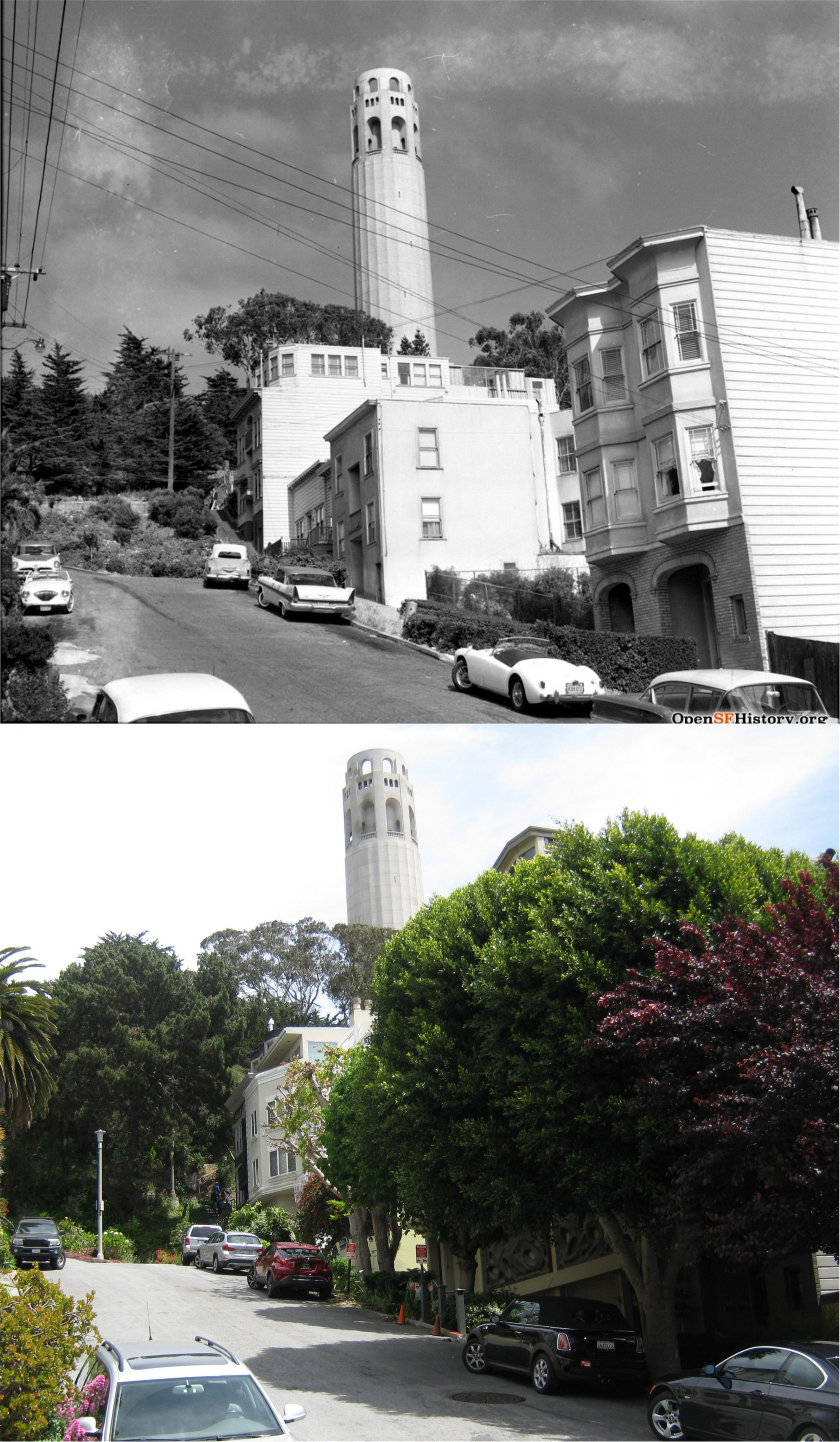 Like the 49 Mile Drive, the route heads up Lombard to Coit Tower, seen here in 1962 where Greenwich Street that runs next to Lombard ends. Hey, it’s going to be a long trip, so, I didn’t feel like going all the way to the top, okay?
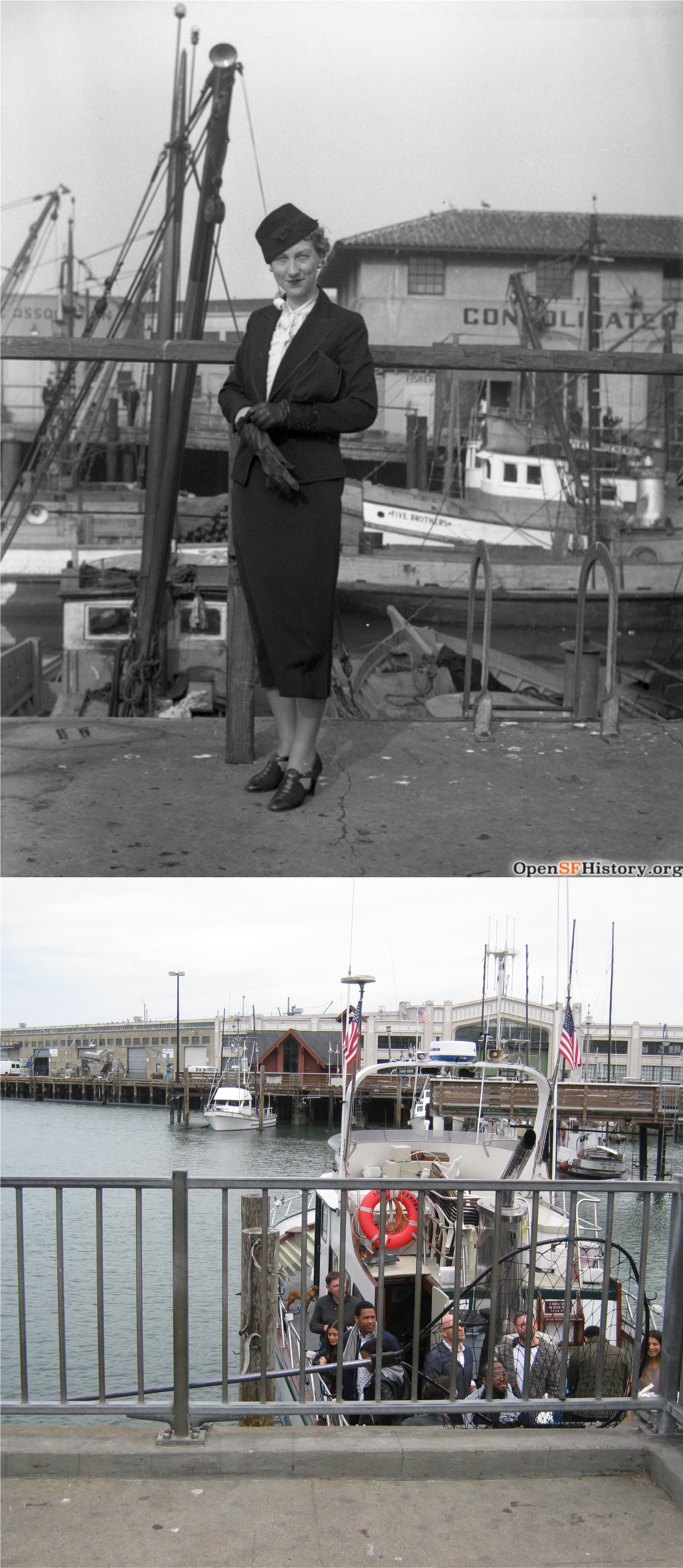 The trail passes by the Fisherman’s Wharf boat lagoon on Jefferson Street, seen here in 1936. Oh, swell, it’s Mrs. Danvers! (cf. ‘Rebecca’) “Now, sit right back and you’ll hear a tale, a tale of a fateful trip” Don’t worry, that’s the ‘Lovely Martha’ not the ‘Minnow’. I’ve been out in the Bay on that boat. The building with CONSOLIDATED on it was demolished and was to the right of the little brown chapel in the background.
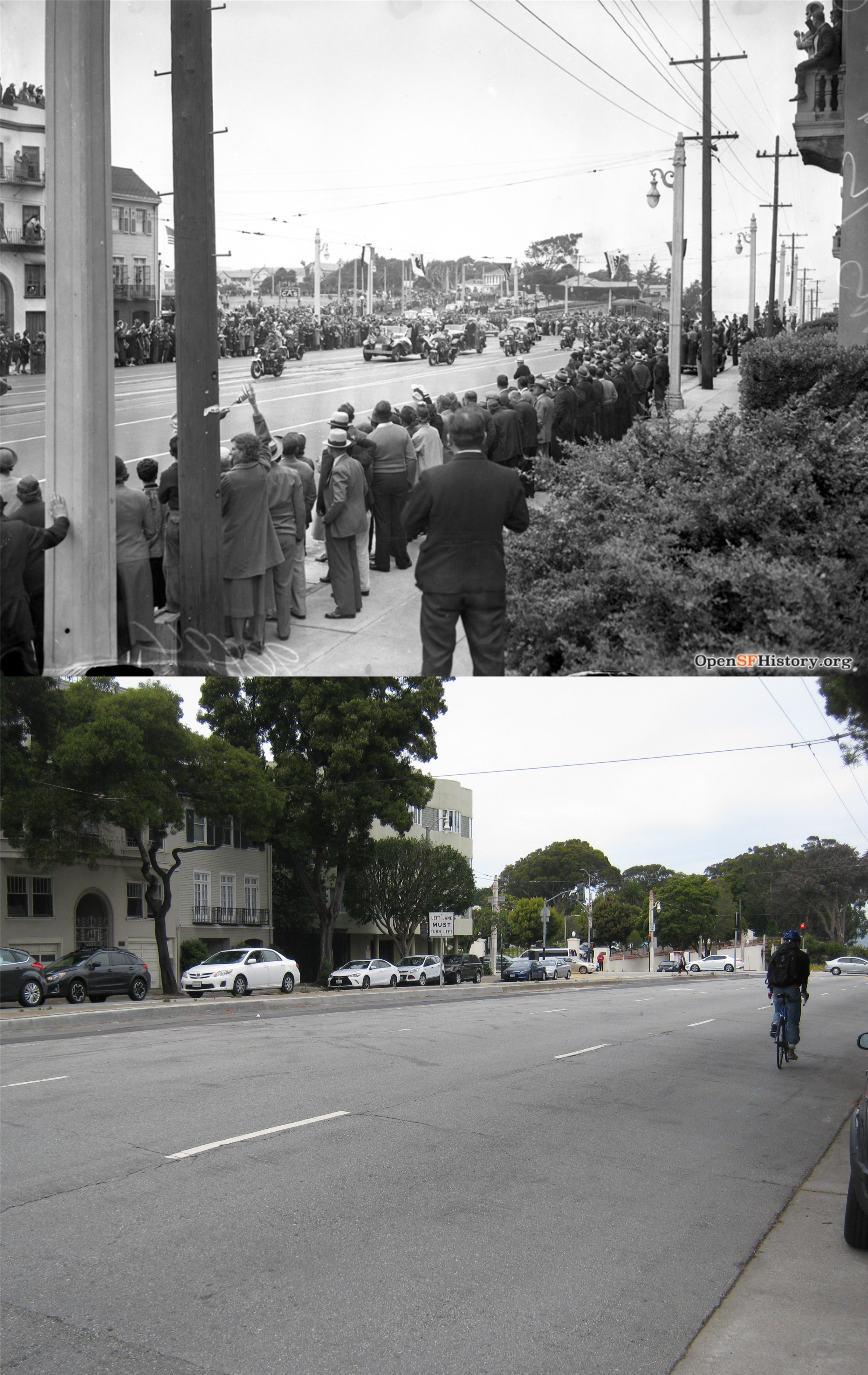 After leaving Fisherman’s Wharf the map moves over to Bay Street and takes a strange diversion from the 49 Mile Drive and runs south along almost the entire length of Van Ness Avenue to Fell Street. We’re watching President Franklin D. Roosevelt’s motorcade, here on Van Ness near Bay Street, pass by in 1938. Fort Mason is in the background.
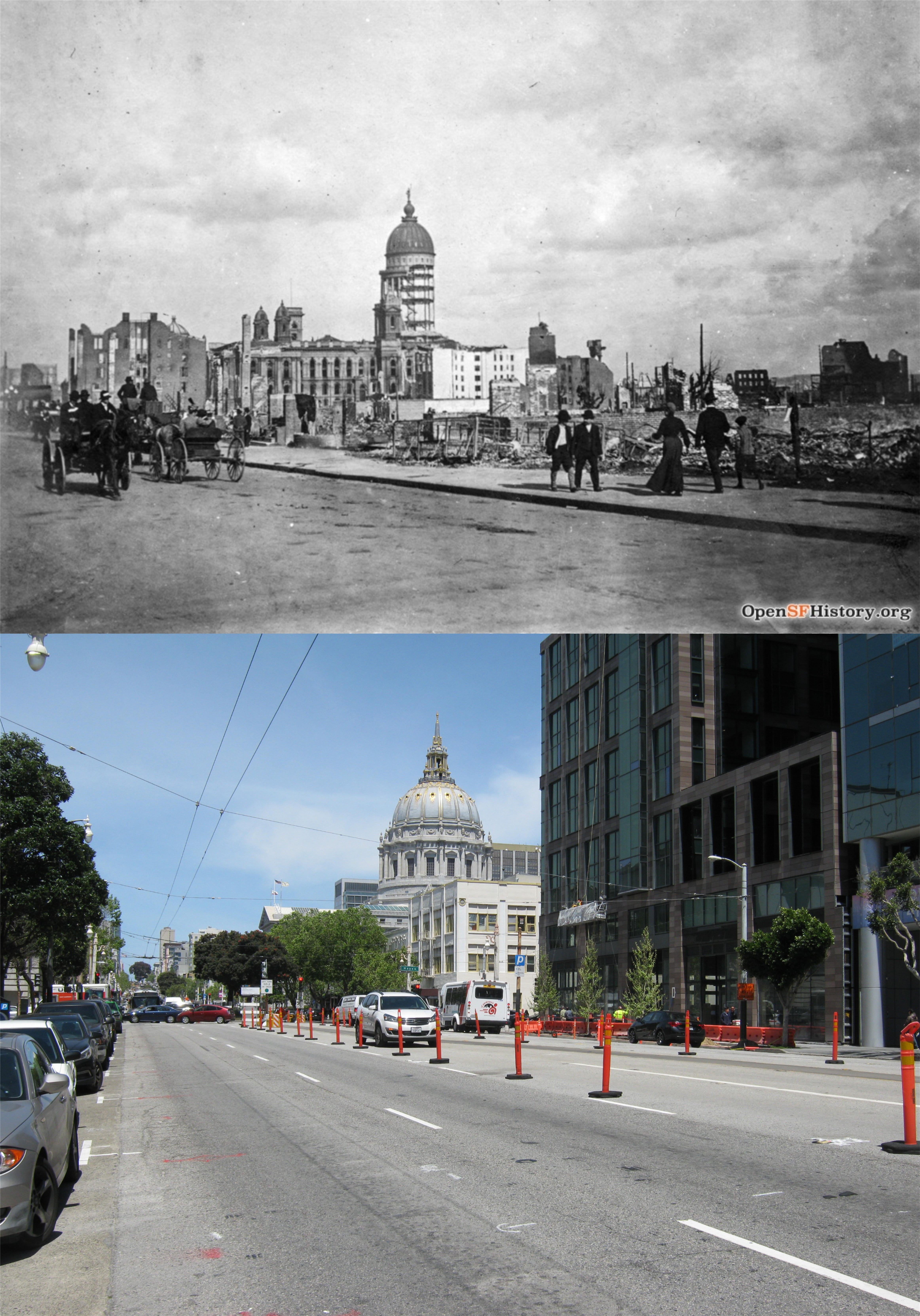 At the other end of Van Ness, we’ll turn onto Fell Street. This is Van Ness at Fell after the 1906 Earthquake and Fire. The crumpled City Hall Building is in the background.
 We’re heading west on Fell Street, the street that many people take to get to Golden Gate Park. The 49 Mile Drive does not move along any portion of Fell Street. This view is looking east down Fell from Fillmore Street in 1939.
 The trail enters Golden Gate Park where we’ll stop and rest at McLaren Lodge like they did here in 1905. Superintendent John McLaren, the mastermind behind Golden Gate Park, lived here for forty seven years.
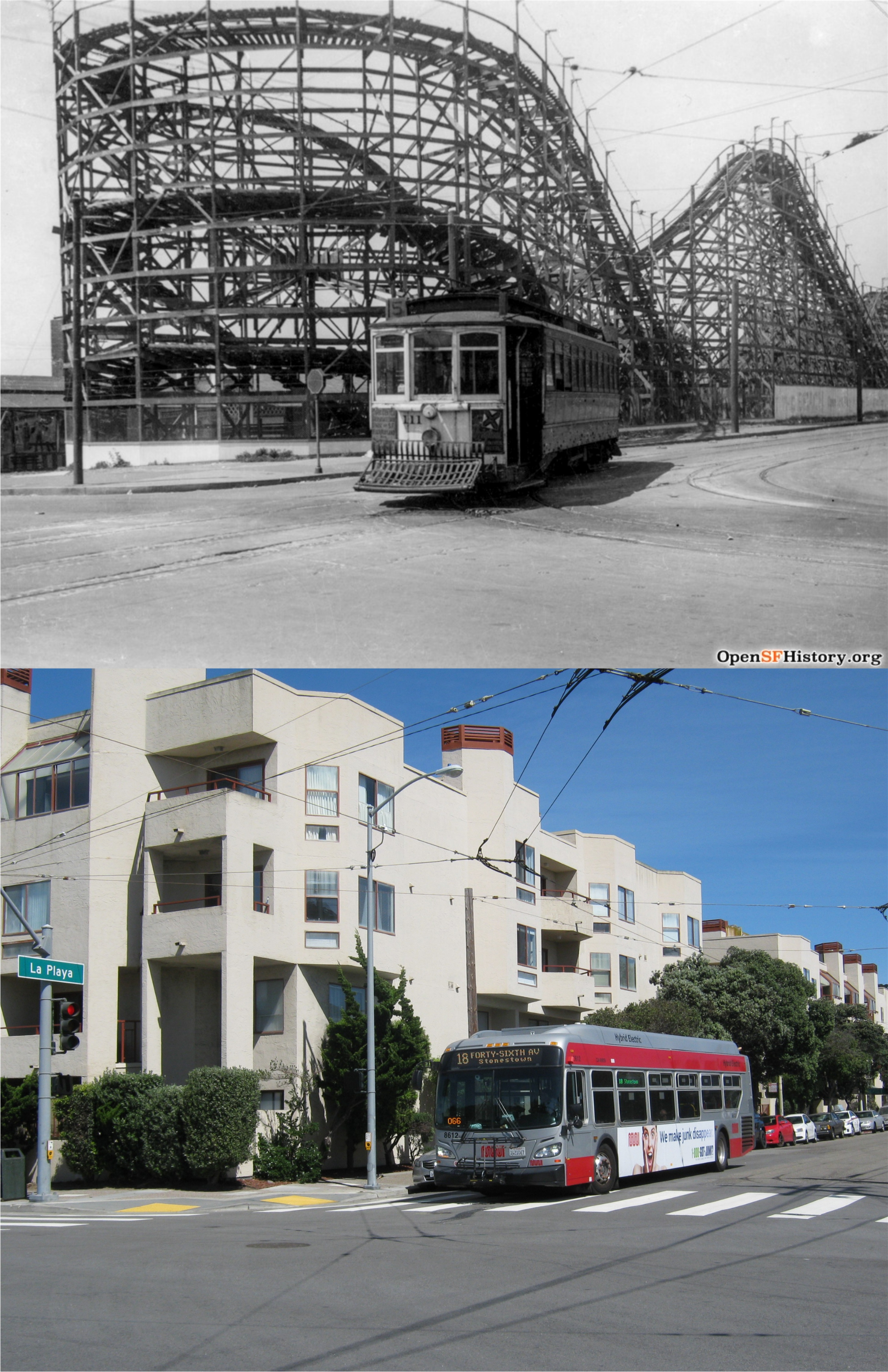 The route crosses through the park and exits near where Playland-at-the-Beach used to be, and was when the map was drawn. If we were in 1941 at Fulton Street and La Playa, like the vintage photo, we’d be looking at a terrific roller-coaster instead of these condominiums here today.
 Now we’re back neck to neck with the 49 Mile Drive in a race south down the Great Highway. We’ll stop here at Ocean Beach near Kirkham in 1916 to look at the sad wreck of the Aberdeen on the beach. High winds caused the ship to capsize and wash ashore here taking all eight of her crew down with her.
 Let’s move down the Great Highway to Taraval Street and look back up north three years later in 1919.
 We’ll turn east on Sloat Blvd. and stop for awhile as they move an old train into Fleishhacker Zoo, now the San Francisco Zoo, at the old stone Works Progress Administration entrance in 1957. Hmmm, I’m suddenly hungry for a Doggie Diner hamburger.
 Now, we’ll move on to Portola Drive and bypass Twin Peaks like Herb Caen’s map did. Hey, I love the view up there but there’s no parking! The old photo is Portola Drive at Twin Peaks Blvd. in 1929. You can see part of the old road that headed up to the top of Twin Peaks on the left.
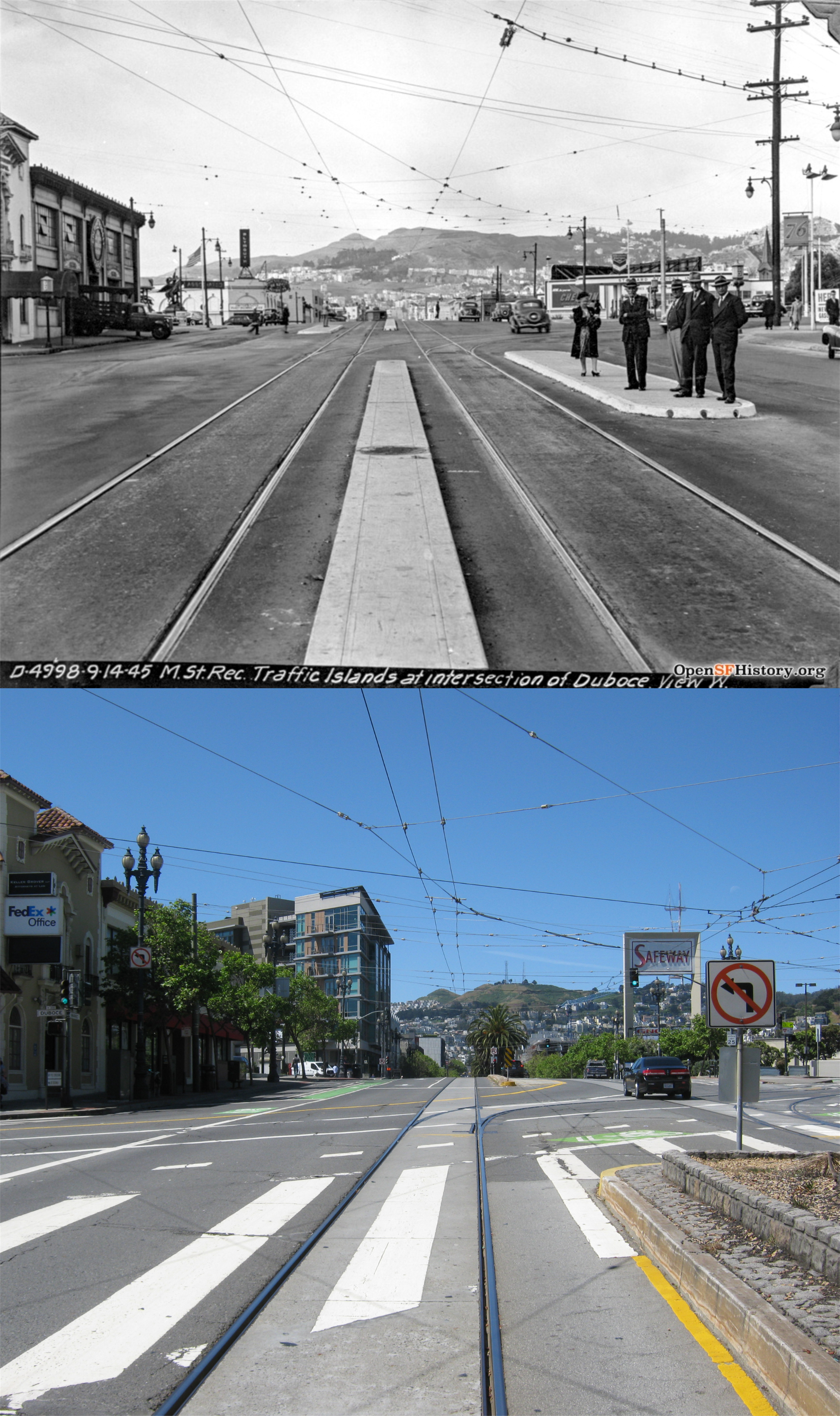 Sneaking past Twin Peaks and dropping down a few notches will put us on Market Street heading toward Downtown San Francisco. Here we are at Market Street and Duboce Avenue in 1945 near the new, old U.S. Mint. We’re looking back toward Twin Peaks.
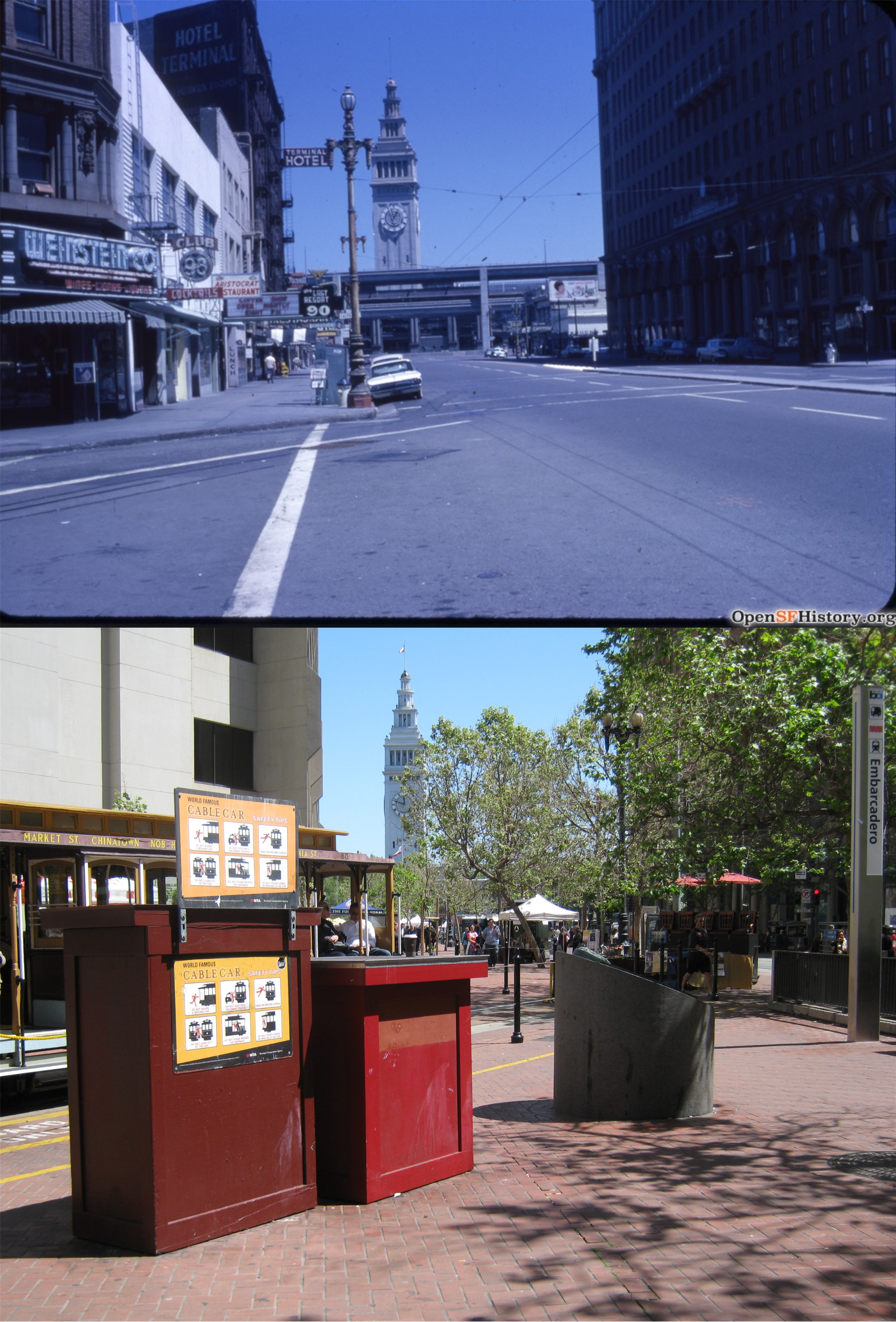 We’ve moved to the beginning of Market Street, or, if you were heading in our direction, the end of Market Street. It’s probably a sin for any respectable tour route to leave the Ferry Building out and this 1957 one doesn’t. We’re back in 1962 again, and this is where California Street meets Market. You can see the cable car tracks in the old picture, but not much activity.
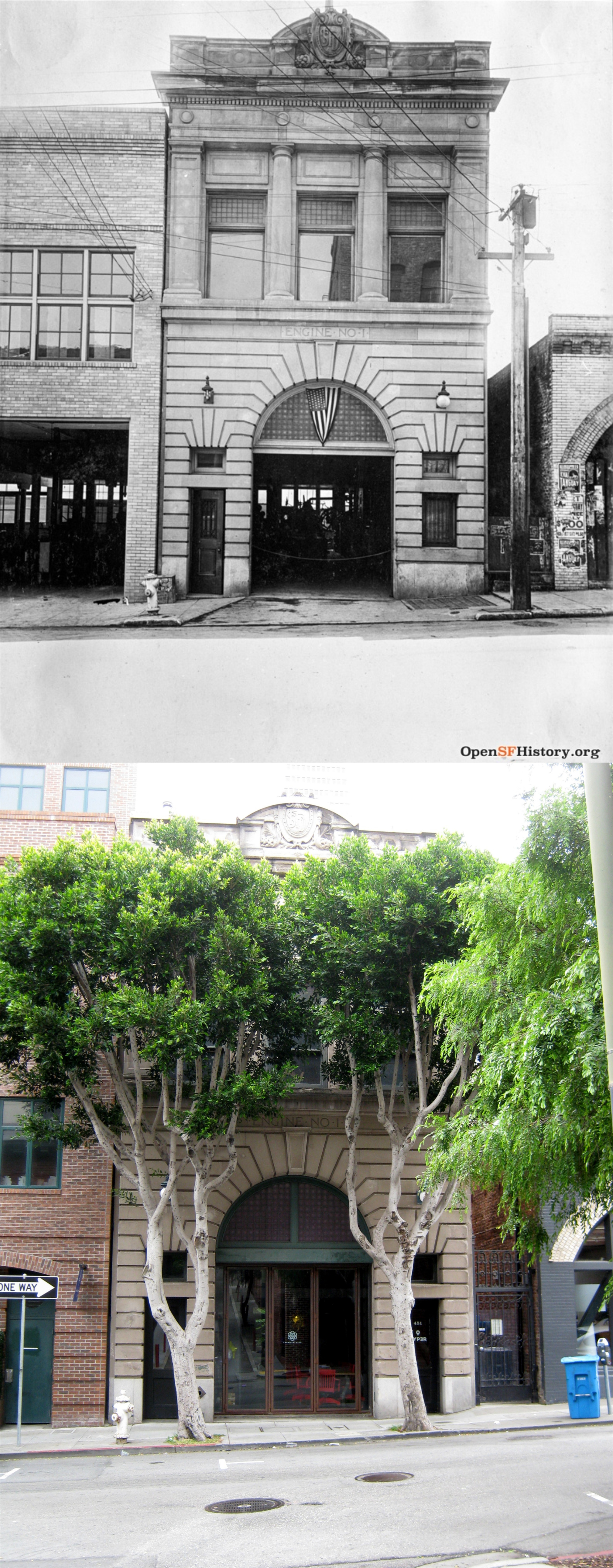 We’re in the home stretch now and heading along Pacific Avenue, the heart of the old Barbary Coast. This is the old Engine #1 Fire Station Building seen here in 1917 and still there today.
 Well, we’re back on Mason Street at Pacific Avenue in 1960 and looking up Nob Hill to where we started from. I don’t know about you, but I’m tired! I’m not walking up that hill! I’ll take the cable car.
 You have to enter San Francisco from the Bay Bridge pretty early nowadays to catch traffic as light as it was in this color photo from the 1940’s. (Vintage Everyday)
 “All aboard for the Dramamine Express!” Those old buses, like the one these ladies are boarding at the Ferry Building during the 1950’s, may not have been as uncomfortable as I’m making them out to be, but I’m sure they’re not as comfortable as today’s Muni buses. (Lucian Rosca)
 A cable car crosses Geary St. on Powell, heading toward Market Street in the 1940’s:
 Street and sidewalk motion in the 1970’s and today: That’s the old Samuels Clock, installed on Market Street in 1915. The clock, now a San Francisco Landmark, was moved a little from its original Market Street location in 1943. (24media.com)
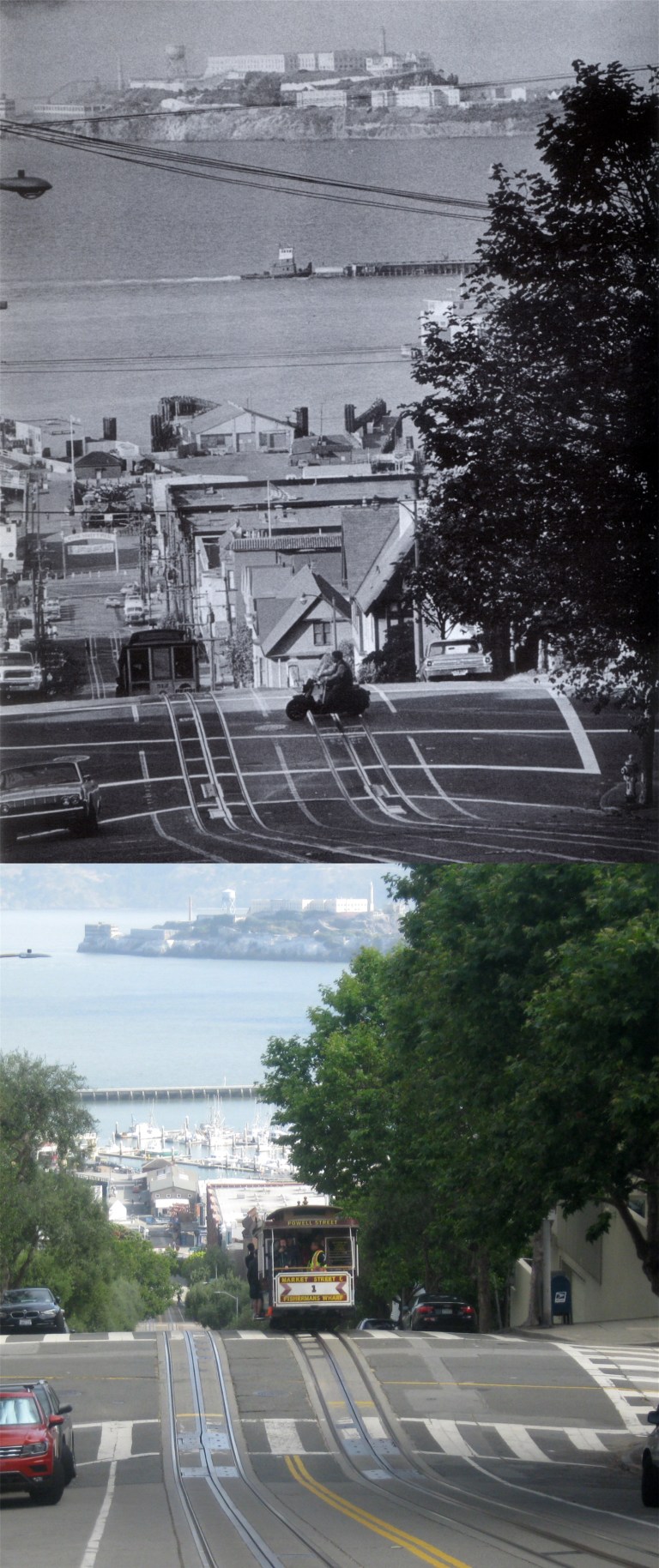 A scooter and cable car crossing paths on Hyde Street at Chestnut in the early 1960’s: The cable car in my photo was heading down Russian Hill unlike the vintage picture and I could have waited here for hours for a scooter, so I’ll just settle for the cable car. (Michael Bry)
 Sutter Street looking east at Stockton Street during the 1940’s: This is a wider angle of a clearer photo I posted on June 1st this month showing the location of the legendary Forbidden City nightclub on Sutter Street. (SFMTA)
 Sometime near the end of 1985 or early 1986, I drove over to Fort Mason to visit the Liberty Ship, Jeremiah O’Brien. She was tied up at there back then and having recently learned about the ship, I had already visited her on previous occasions. Fort Mason didn’t have as much activity back then as today, (although nothing compares to the activity there during World War Two) so I parked in the parking lot and headed toward the Liberty Ship. It was a chilly day and I remember that I was wearing a red jacket with the words ‘San Francisco’ on it that I bought earlier that year in Fisherman’s Wharf. As I approached the ship I saw a number of 1940’s cars parked around the pier the Jeremiah O’Brien was docked at and a group of people in clothing from that period standing around or boarding the ship. I’m sure that the Jeremiah O’Brien charged a fee back then but as I mixed in with the crowd and headed up the gangplank nobody said any thing to me. When I got on board, it was obvious that a scene from some movie being produced was about to be filmed. By talking to some of the crew I learned that it was going to be a miniseries called ‘Crossings’, set during World War Two and starring Cheryl Ladd of ‘Charlie’s Angels’ fame. Soon, there she was only a few feet from me walking toward the starboard aft side of the ship for the filming of the burial at sea episode of the miniseries. I moved up a ladder to watch the filming, and since Cheryl was facing my direction during the filming I’m sure that she saw me. A number of scenes were filmed around or aboard the Jeremiah O’Brien and here are some then and nows from the movie.
 The first scene I watched them shoot was a burial at sea. I’m standing about where I was watching that scene long ago; it was filmed just past the lifeboat where the garbage cans are. The Jeremiah O’Brien is now located in Fisherman’s Wharf.
 The bodies were laid to rest on the side she was docked at in the show so the crane cameras could capture this scene. That’s costars Cheryl Ladd and Lee Horsley in the center.
 This scene was right up where I was at during the burial scene so I had to move back out of the way. Cheryl and Lee move down the ladder from second to first deck.
 They headed to their romantic encounter through this passage.
 It’s been a trying day watching sailors buried at sea so even though Lee Horsley is married to Jane Seymour in the film, and Cheryl Ladd is married to Christopher Plummer, they go to Horsley’s cabin and….. “get involved”.
 Lee and Cheryl “get involved” a lot while aboard ship like here in a hammock on the starboard aft side. It didn’t seem to bother the crew much.
 Back over at Fort Mason, this was the scene that they had just finished filming when I showed up of the ship arriving at port.
 The Jeremiah O’Brien’s name was changed to Dorchester for the film. Here she is today at Pier 45.
 A time for, “Gosh, we shouldn’t have done that!” goodbyes. That’s the Van Ness Pier on the far right.
 The inevitable goodbye kiss and tearful parting:
 Cheryl drives away, but it’s only half way through the miniseries so they’ll be seeing each other again.
 Lee Horsley looks back tenderly at Cheryl Ladd, and Cheryl looks back thinking, “I wish that guy I had to kiss would get out of the way so I can see if that fellow in the red jacket is getting off the ship.”
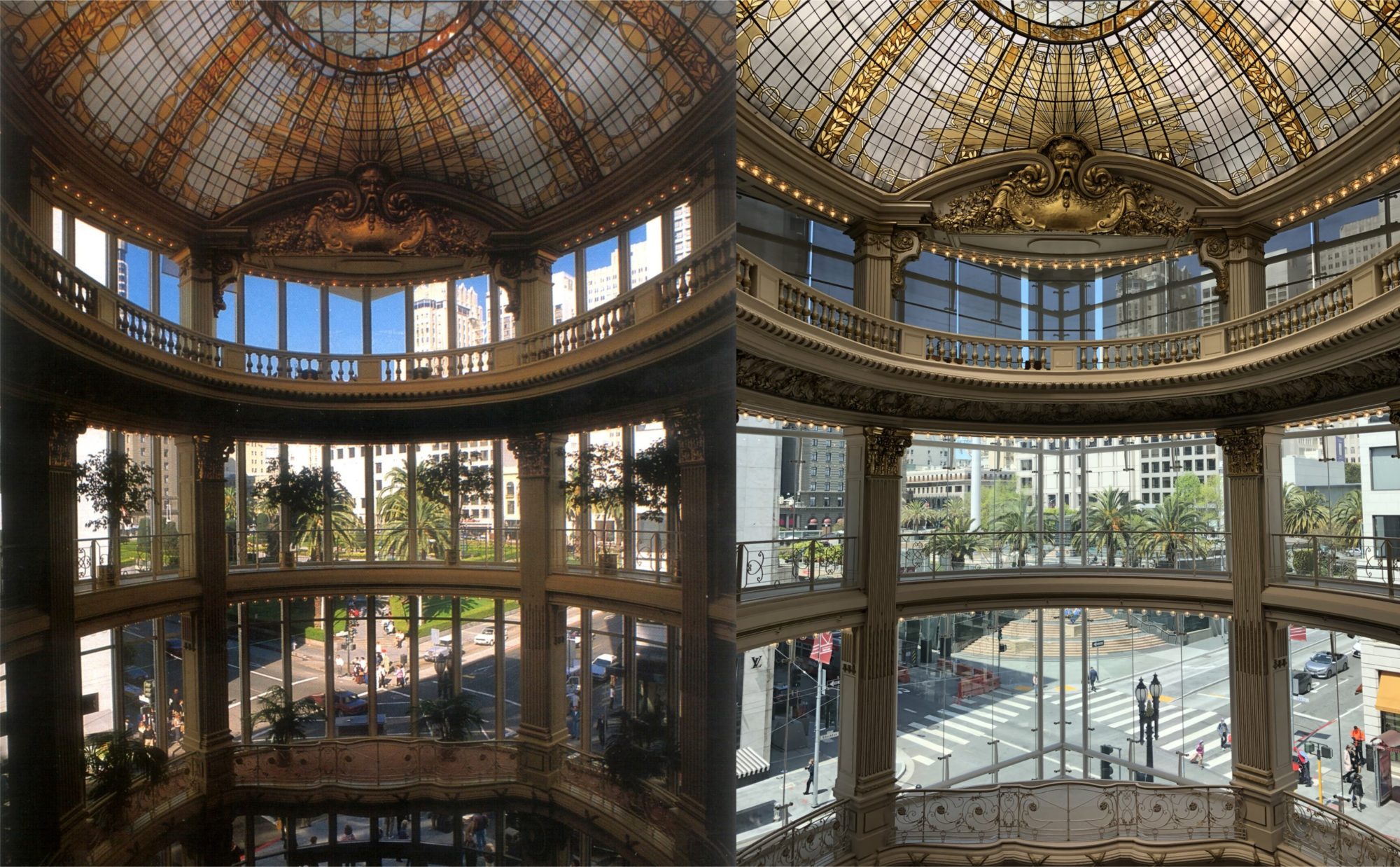
 By the 1950s, color photography was getting less and less expensive, although, the “natural color” had a little ways to go yet.
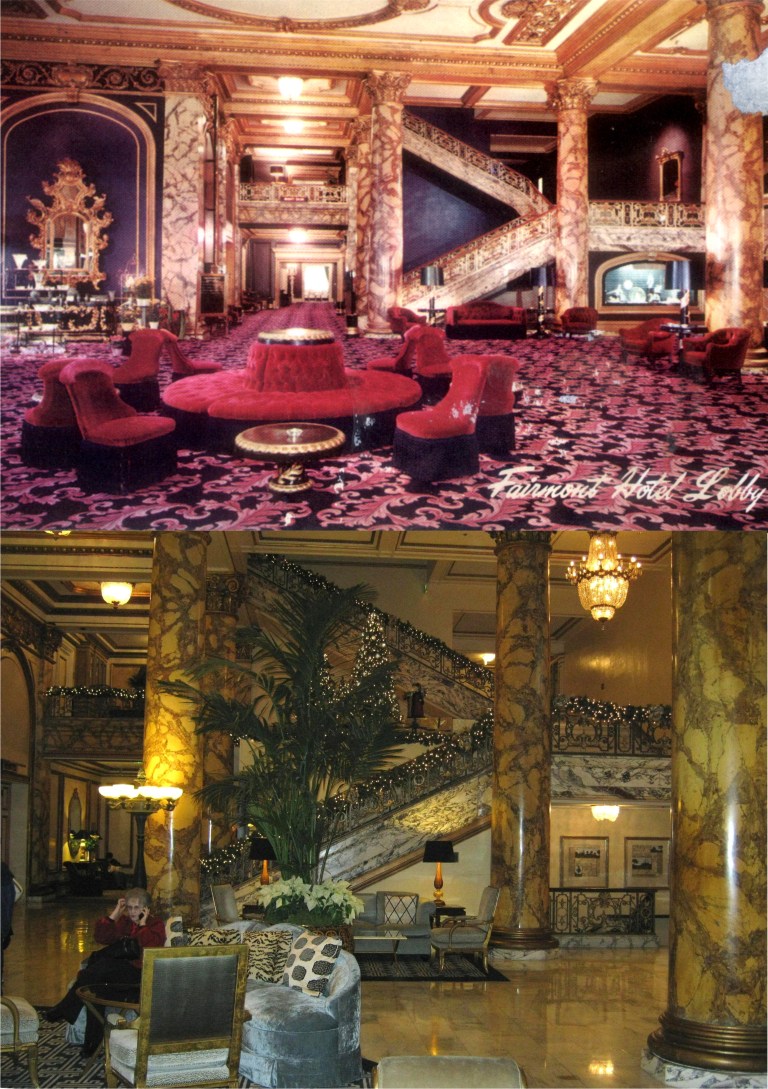 I’m not sure that I dislike the look of the Fairmont Hotel lobby back then, but it hurts my eyes!
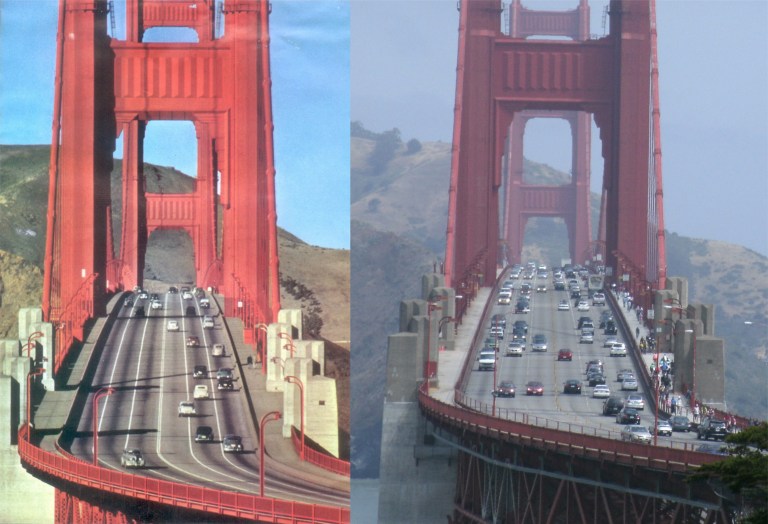
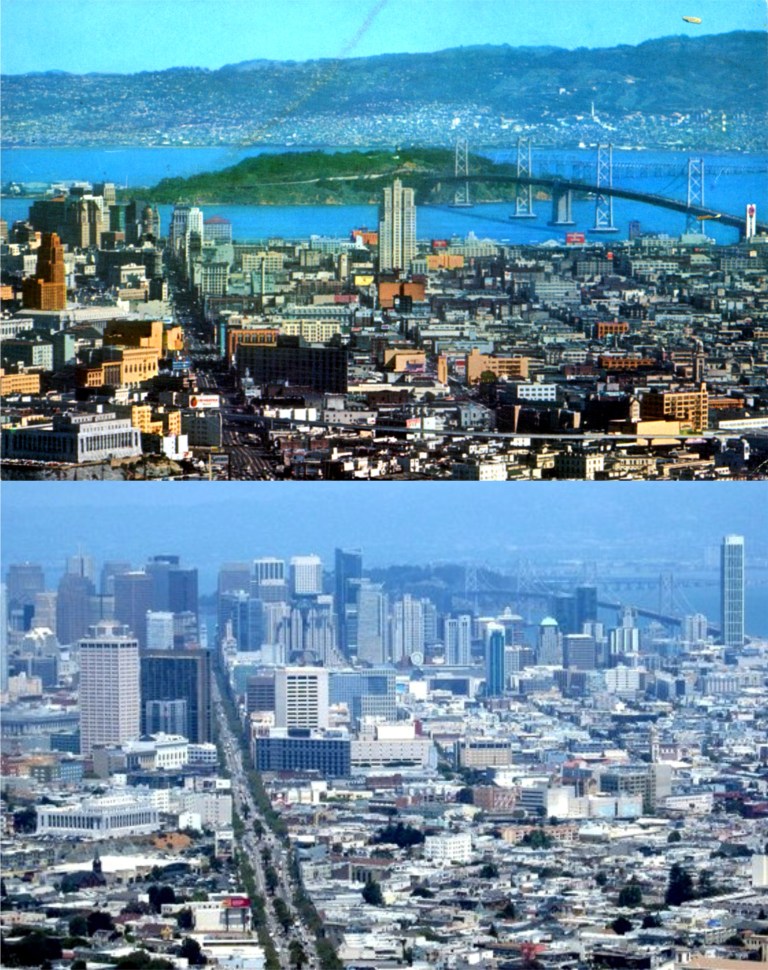 When you make it up to Twin Peaks and the colors are as good as the old photo, you picked the perfect day to be there.
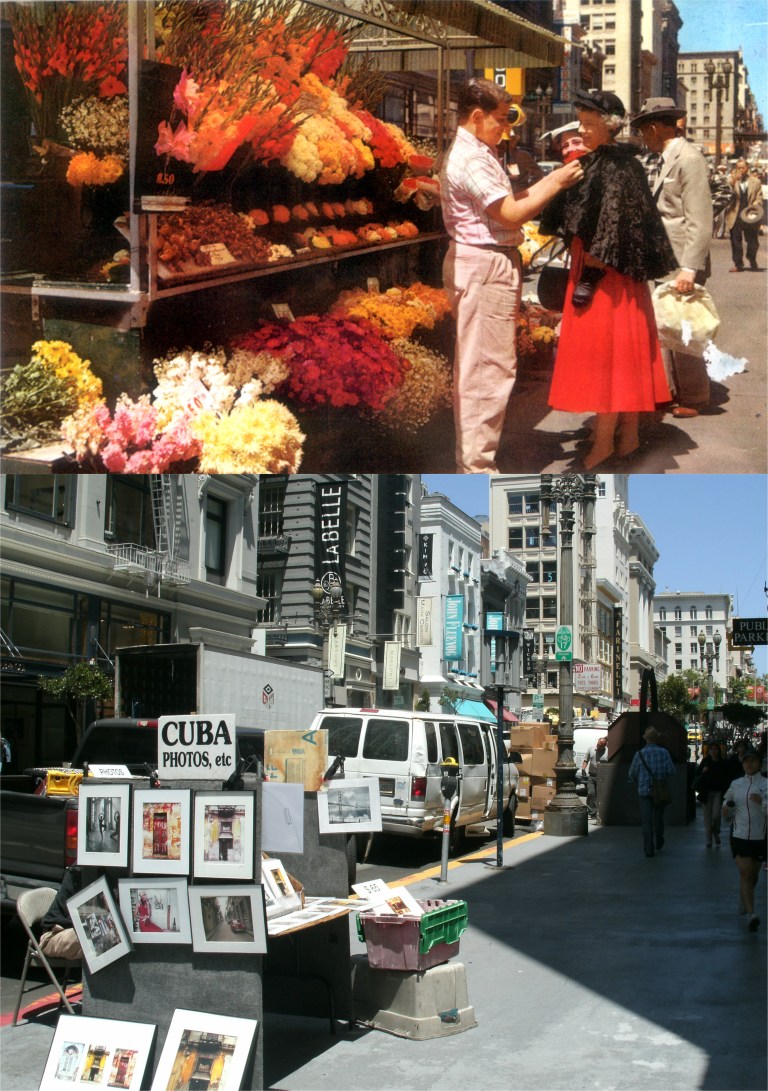 Grant Avenue, down from Chinatown: Aw, hope he got a nice tip.
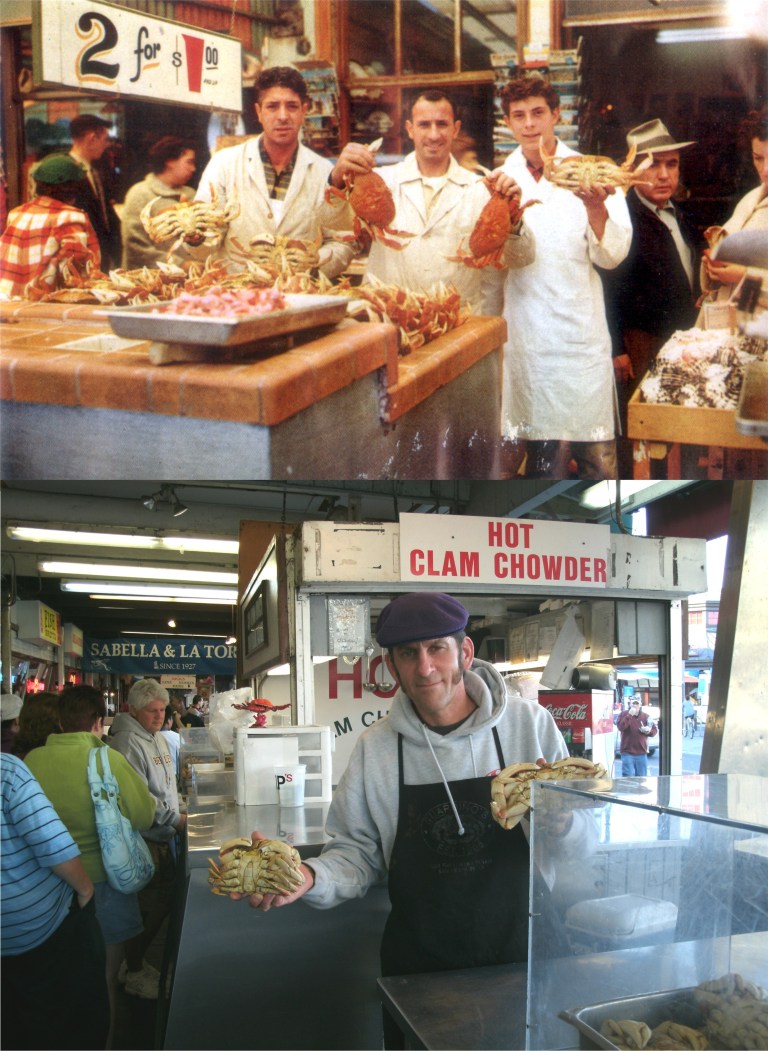 It was nice of that fellow to pose for me at Fisherman’s Wharf. He wasn’t crabby about it at all!
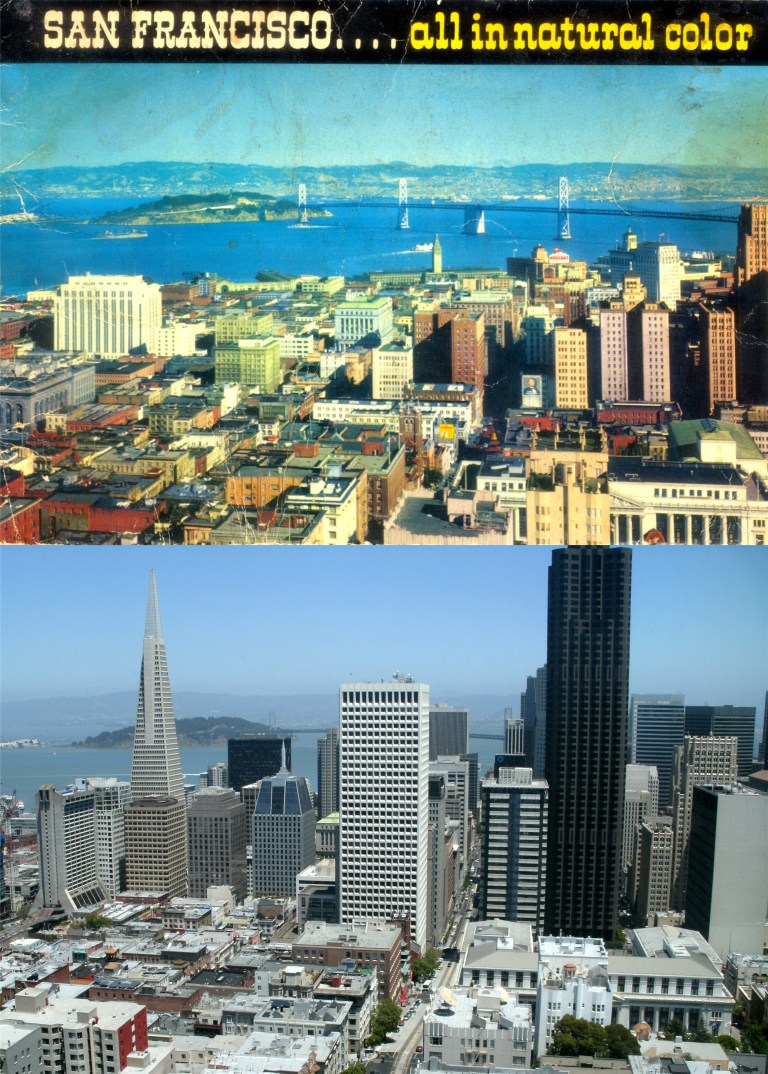 Looks like there’s more than just “natural color” on this old souvenir book, but I’m not going to guess what it is. Same view, different colors, both from the Top of the Mark.
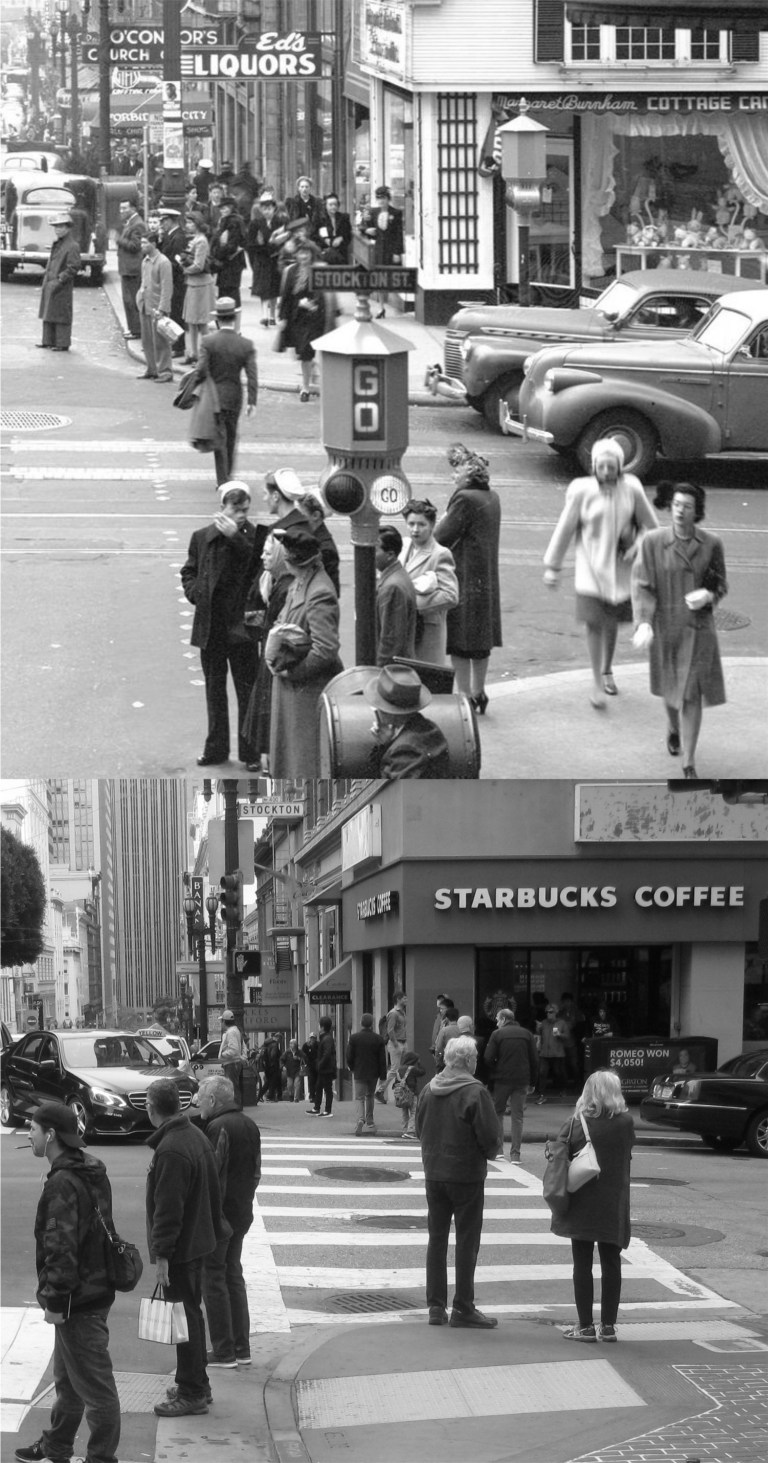 The southwest corner of Sutter and Stockton Streets in 1946: If you look down Sutter Street in the background of the vintage picture, you’ll see the Forbidden City night club, once San Francisco’s answer to New York’s Cotton Club. (Pinterest)
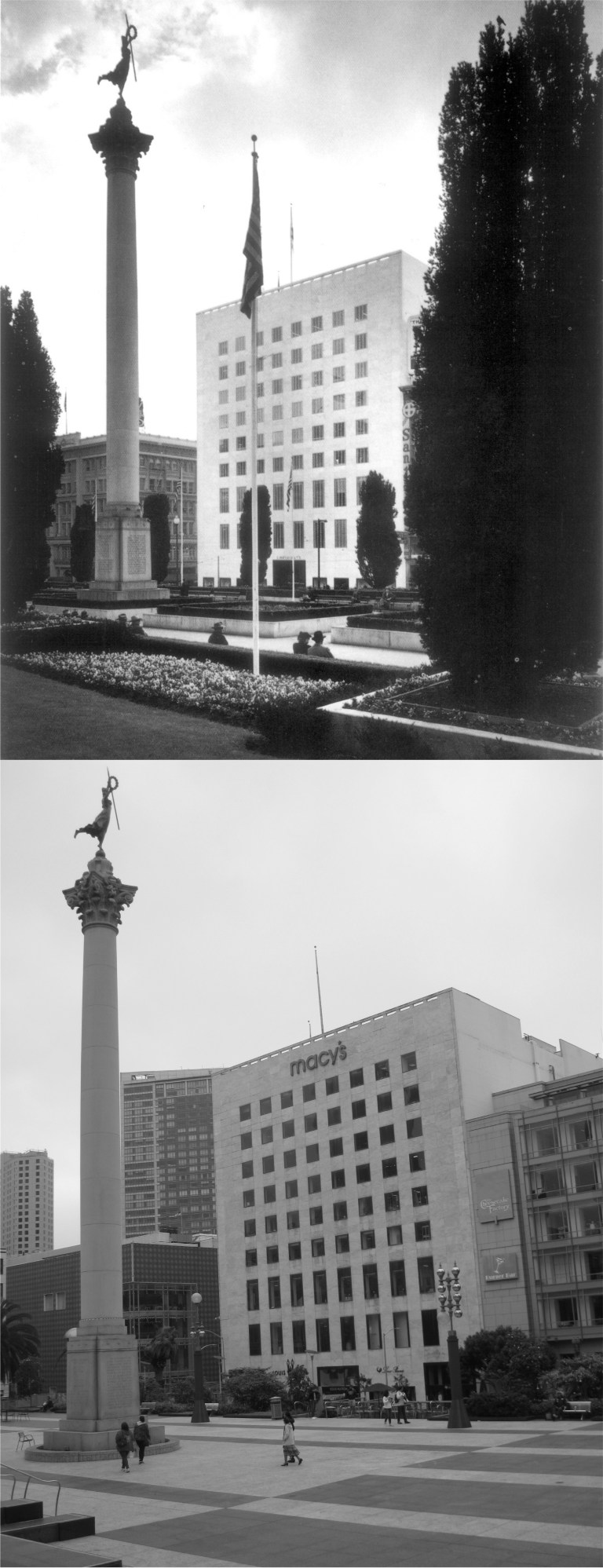 Union Square in 1948: The I. Magnin Department Store is now part of Macy’s, the City of Paris Department Store behind the Dewey Monument has been demolished, and there’s so little grass in Union Square today it’s hardly worth the name. (Roger Sturtevant)
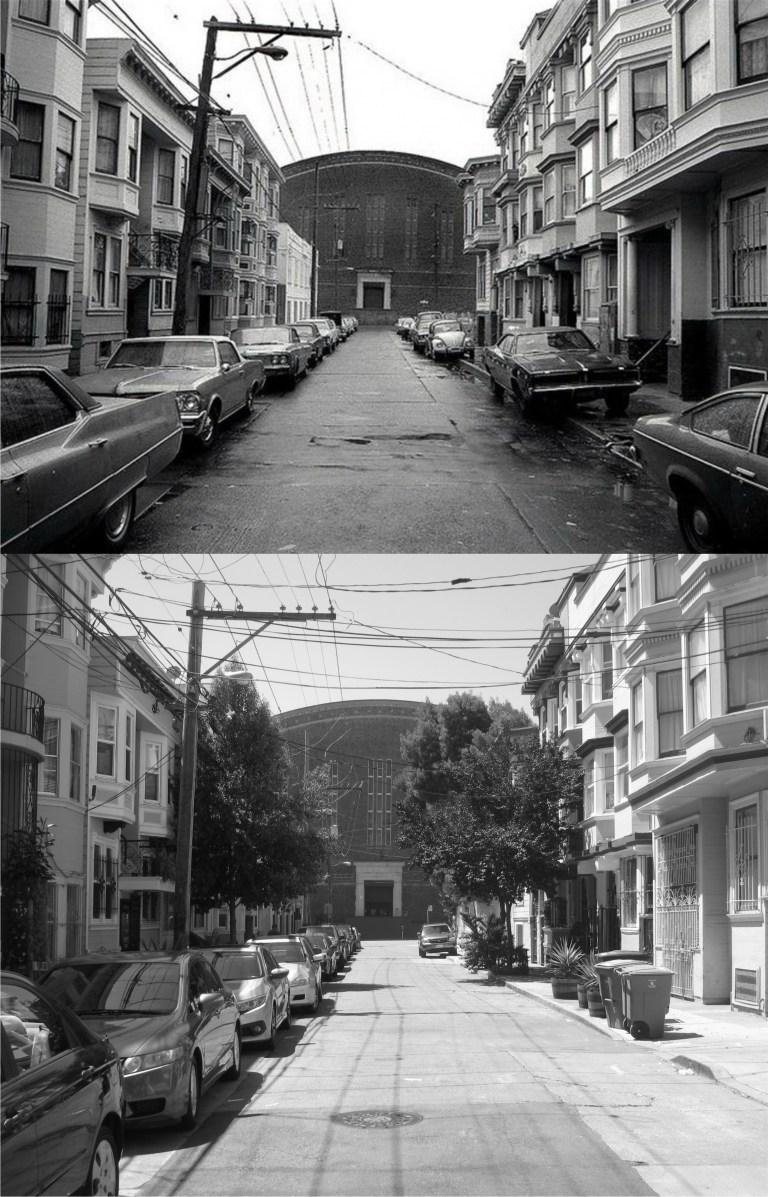 The old Armory Building in the Mussion District, seen from Woodward Street in the 1970’s:
 Washington Street, looking west from Grant Avenue in 1944: The building with the Chop Suey sign in the old photo has been remodeled and was where the Golden Dagon Restaurant, the site of one of the worst massacres in modern San Francisco history, was located.
 It was a lot nicer when I took my picture looking across Market Street to 4th Street than it was on this cold day in 1935 (SFMTA)
 Harbor Blvd across from the entrance to Disneyland in 1966: At least Denny’s is still there. (UCLA digital library collection)
 The Main Street Cinema in the 1960’s:
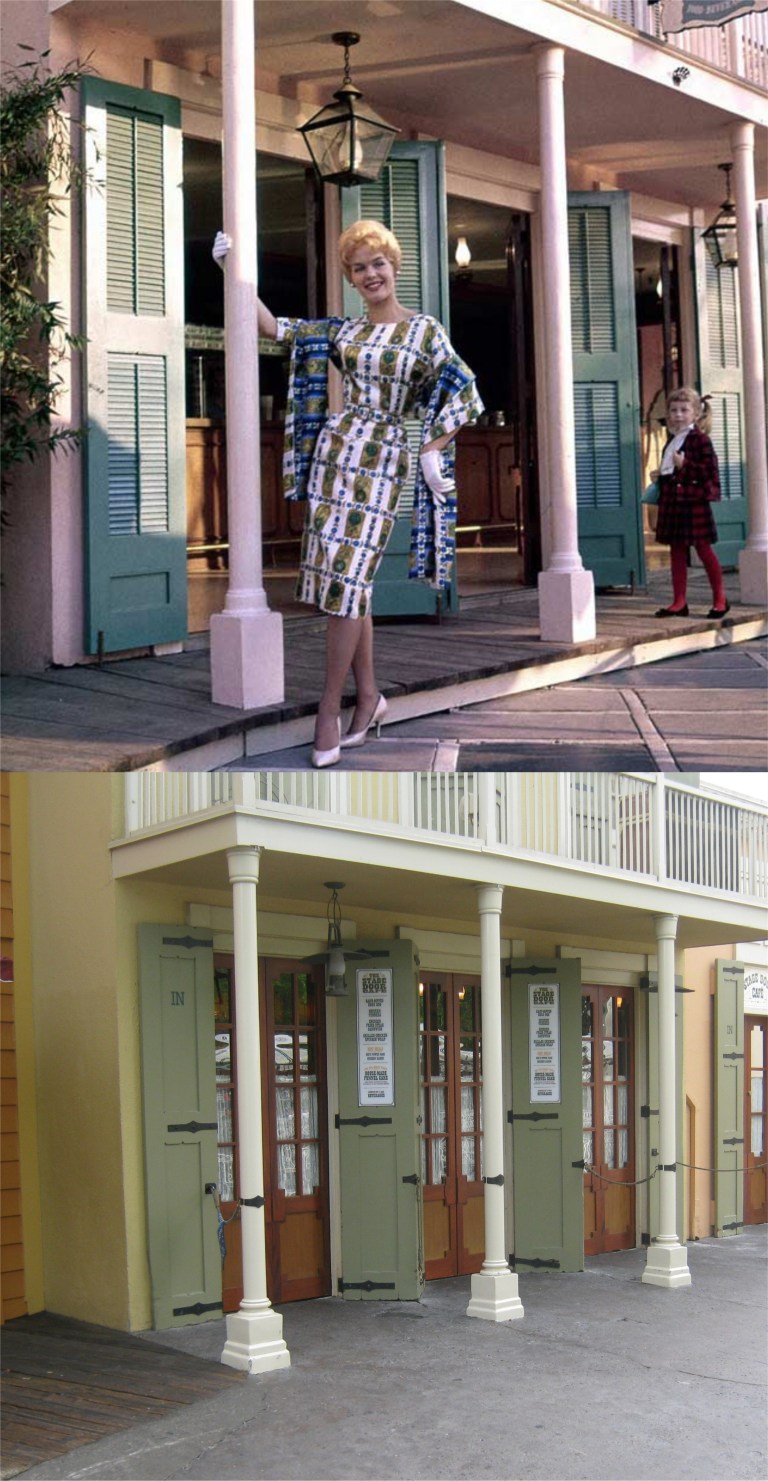 “What, this glamorous outfit that I wore to Disneyland so that I could show it off? Why, I’ve had it for years!”
 Main Street USA in a slide I took in 1983: Well, at least you can still see Sleeping Beauty Castle through the forest.
 The Wizard of Bras ladies underwear shop on Main Street: I guess some things had to go. Hmmm, someone is peeking in the window. (DisneyShawn)
 Some of my family in front of the Main Street Train Station in 1985:
 “Uncle” Walt deep in thought on Main Street near the City Hall:
 Disneyland remembered the real meaning of Memorial Day with a ceremony honoring fallen vets during the flag lowering at the end of the day at Main Street Plaza.
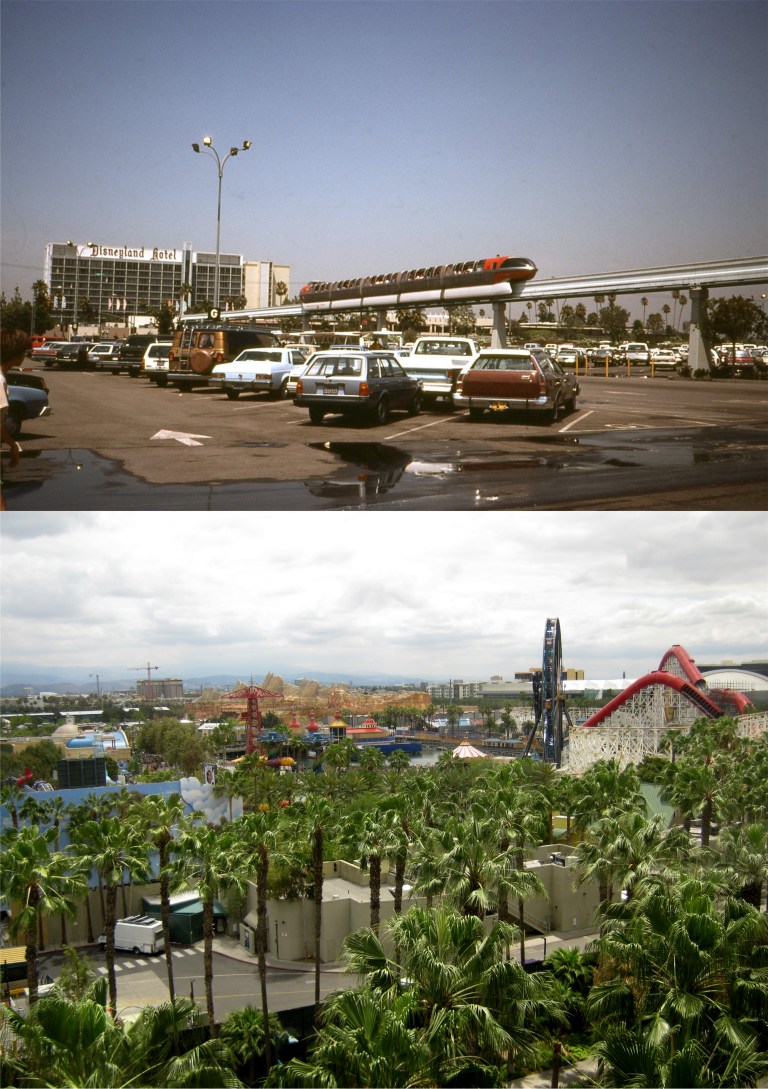 California Adventure – 1983 and now: The top photo is the Disneyland Parking Lot where California Adventure is today from a slide picture I took in 1983. That was in “Section G as in Goofy”.
 There were a surprising number of World War Two veterans on hand and some interesting uniforms.
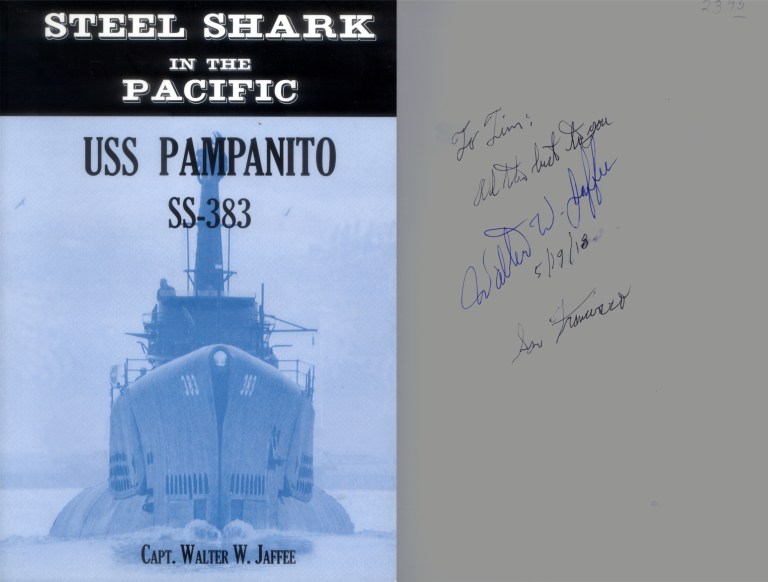 There were also a number of authors who have written books on military subjects autographing their books.
 We departed Pier 45 on a windy but beautiful day. This is Russian Hill in 1955. The street climbing the hill in the center of both pictures is Hyde Street.
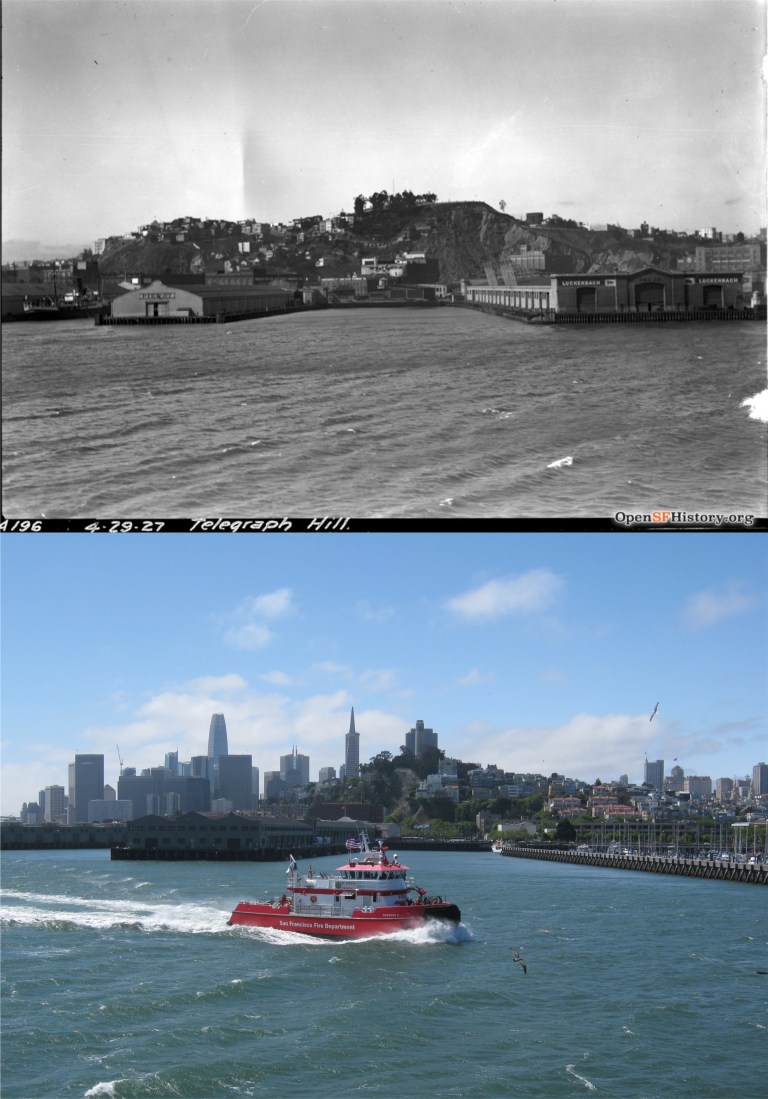 We sailed around Telegraph Hill, seen in 1927 without Coit Tower.
 We’re approaching the Ferry Building, seen in 1968. That’s the Bank of America Building going up in the old photo. There was no Hyatt Regency and no Embarcadero Center yet. The Bank of America Building, not the “king of the hill” anymore, can be seen on the right along with the Alcoa Building in my picture.
 We’re lined up with the Ferry Building at the foot of Market Street seen in 1906 with scaffolding around the tower to repair damage from the earthquake.
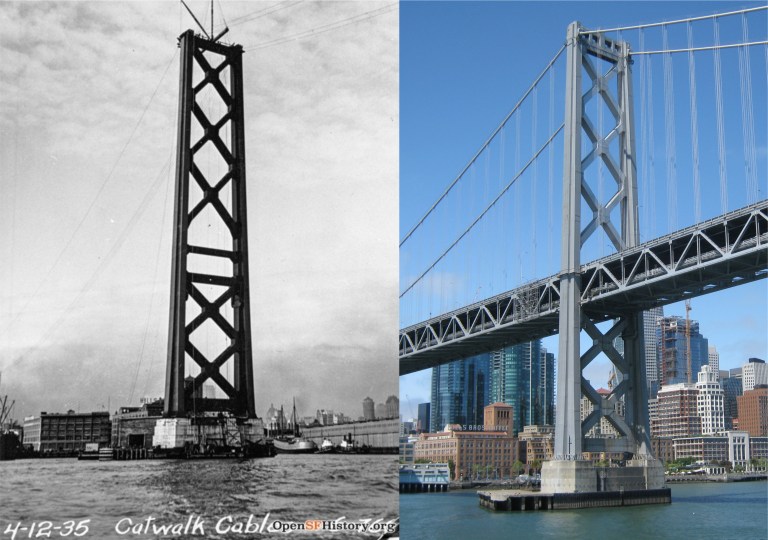 We’ve sailed under the Bay Bridge and you’re looking at the western most tower of the bridge being erected in the 1930’s. The old Hills Brothers Coffee Factory can be seen in both pictures.
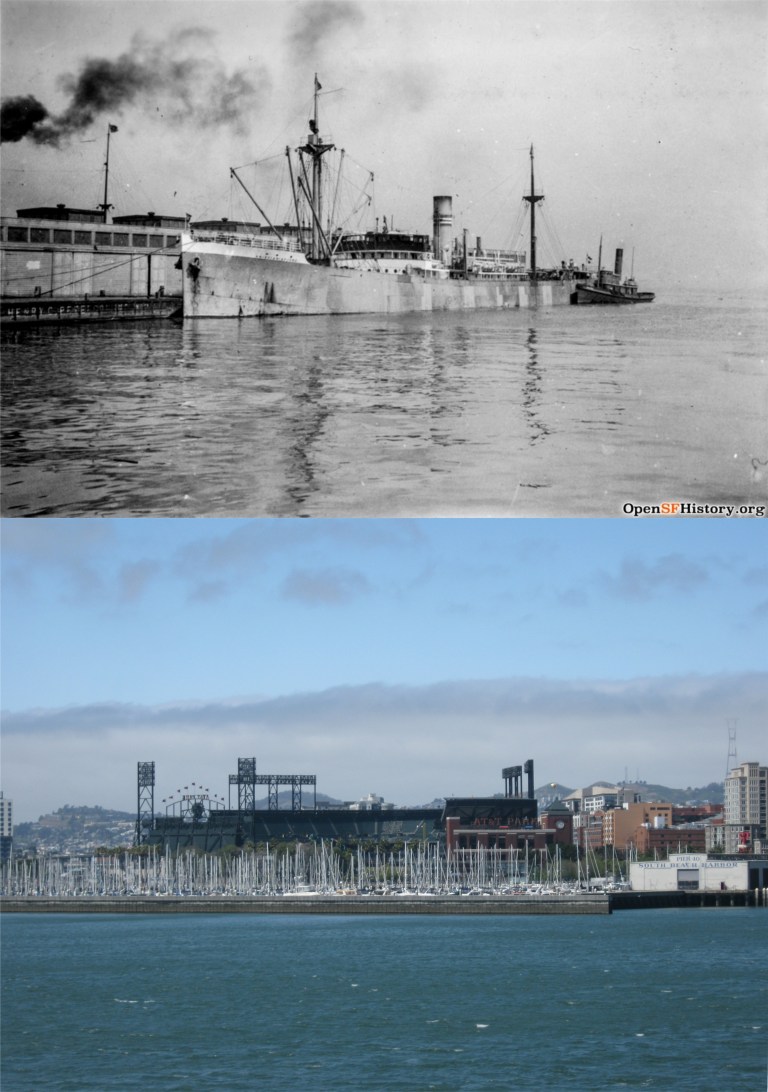 Now we’re at the China Basin, now called McCovey Cove after the San Francisco Giants slugger. The vintage picture is circa 1922. Just behind that ship is where AT&T Park is now. The baseball park was quiet and empty when we sailed past, but it was crowded and loud later in the evening when the Giants beat the Colorado Rockies 9 to 4.
 Now we’re cruising past Potrero Hill. The gas and water towers are gone now, but the smokestack from the old Potrero Generating Station is still there.
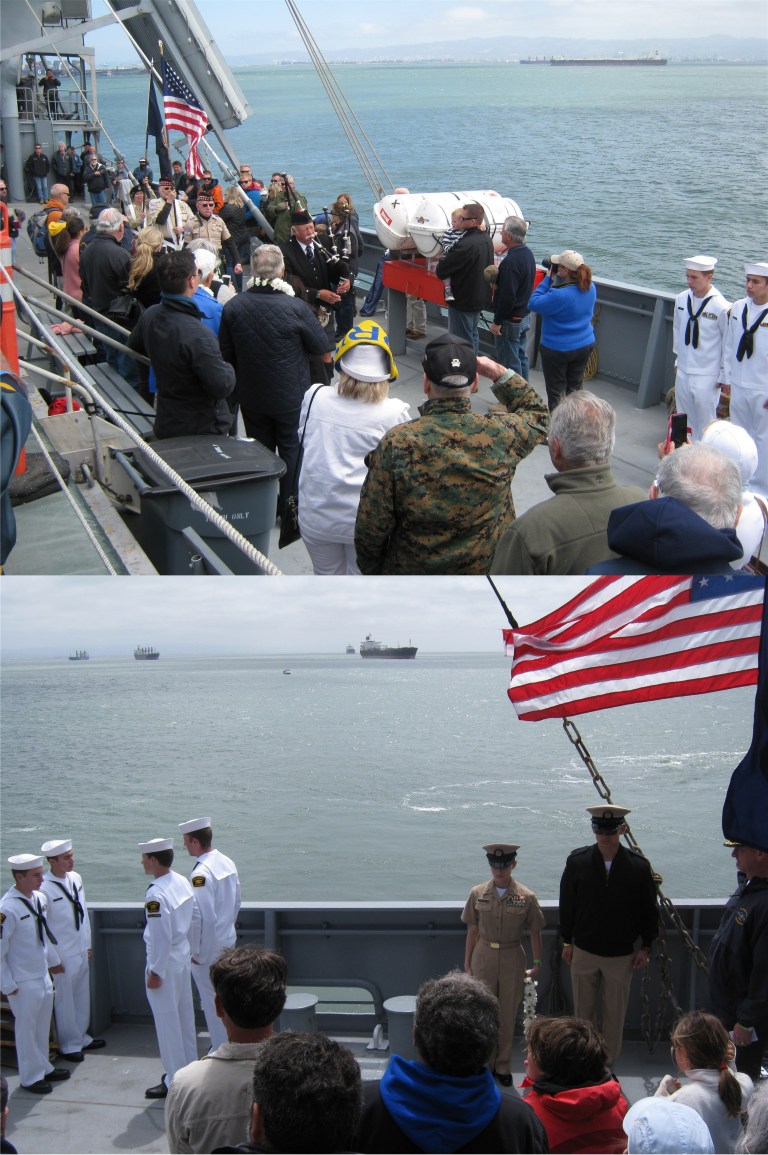 When we reached Hunters Point a moving wreath laying ceremony was held. I noticed that none of the ships or boats on our horizon were moving as well, so I wondered if they were respecting the ceremony also. However, an old salt on the Jeremiah O’Brien said that they were just waiting to be guided into port by a port harbor boat. I don’t know about that though, the little boat among them didn’t need guiding in!
 We headed back to town by a different and interesting route. It was time to relax, like these ladies on a ferry boat were doing in 1954, and enjoy some of the free coffee, donuts, hot dogs, and beer.
 Our return trip took us under the new Eastern Span of the Bay Bridge that replaced the old cantilever span, seen in 1960 in the vintage picture. The Eastern Span opened in 2013.
 And under the bridge we went! That’s the first time I, and probably most of the people on board the Jeremiah O’Brien, had ever done that.
 So, we headed back to Fisherman’s Wharf, guided in by tug boats. That’s the old sailing ship Balclutha that used to be docked at Pier 43 in the 1964 picture. There was no Bank of America Building, Transamerica Pyramid, or Salesforce Tower back then, and two of the more cherished buildings in the old photo, Coit Tower and Saints Peter and Paul Church, can still be seen.
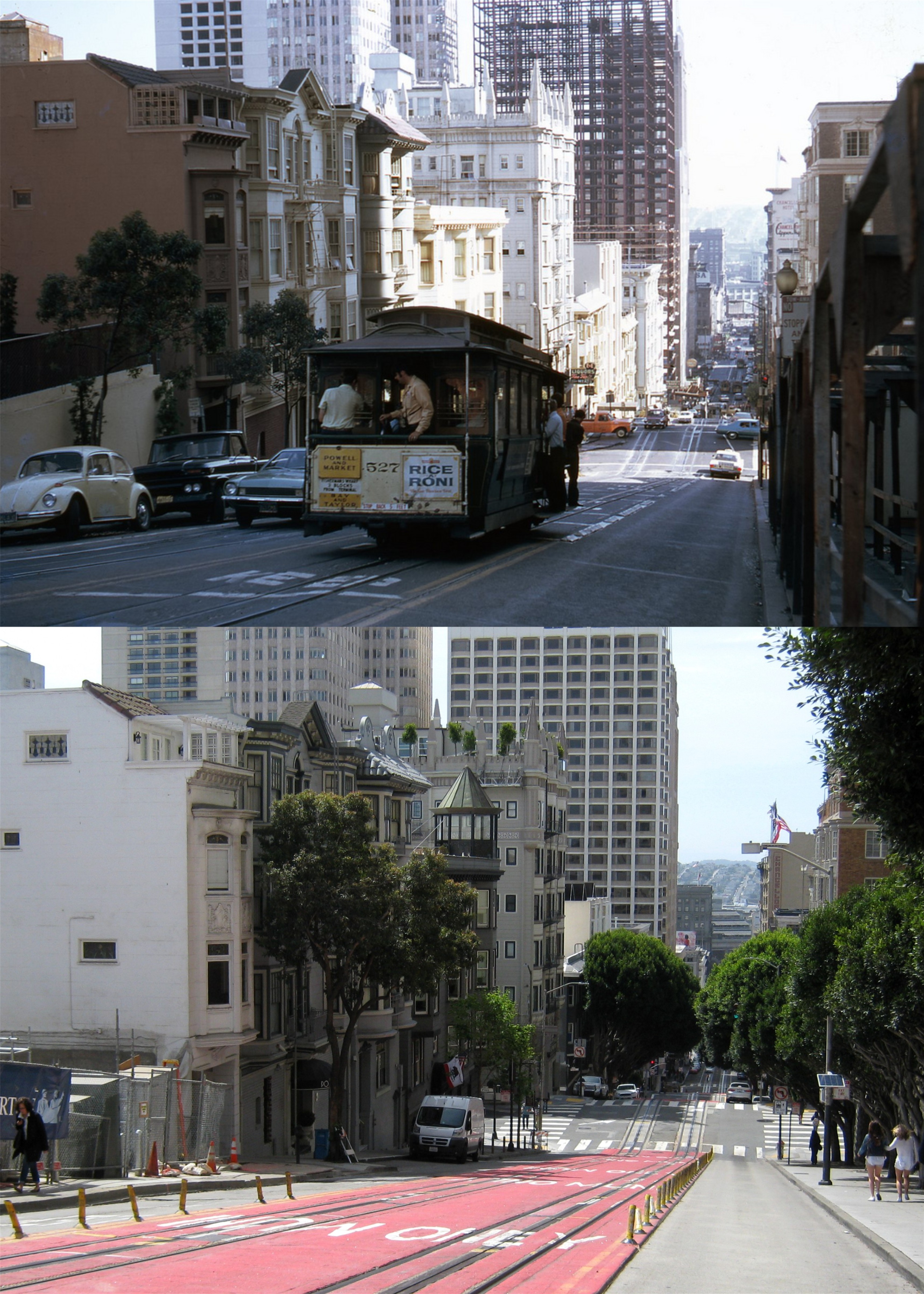
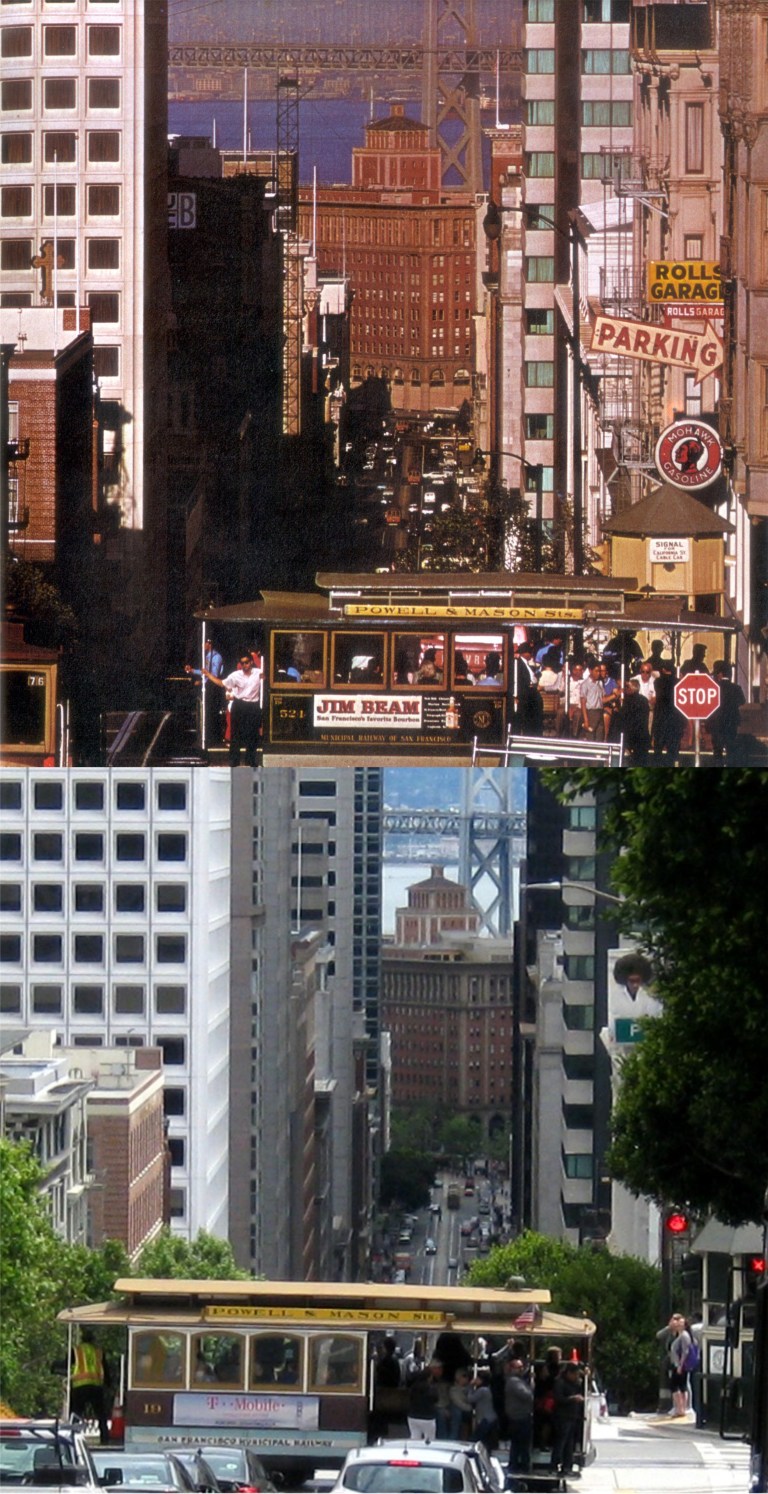 Looking down California Street between Powell and Mason Streets in the 1970s; no stoplights back then, and they don’t advertise Jim Beam Whiskey on cable cars anymore. The parking sign was where the old Crest Garage, then called the Rolls Garage, was located. It was demolished in February, 2018. (Vintage pictures from the photo researchers of Minerva S.A., 1977)
 Powell and California Streets: I had a nice line up on this one, I wish it had been a clearer day.
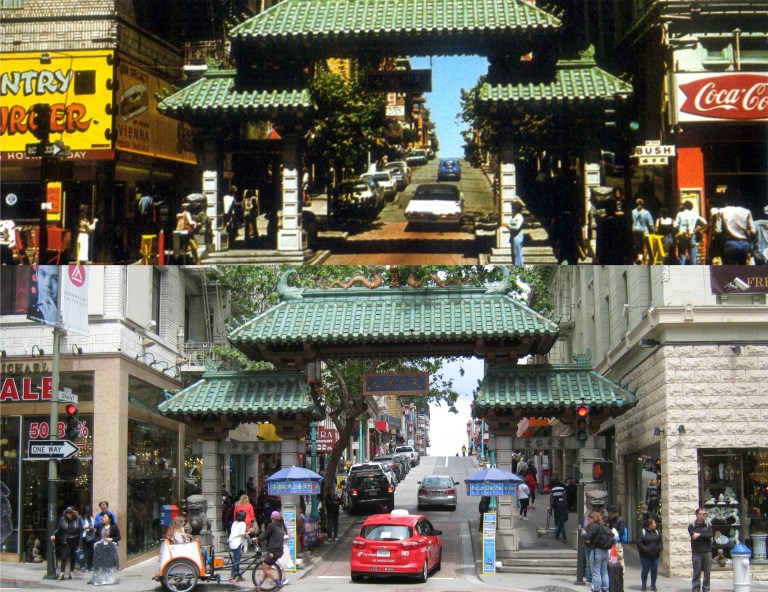 Ah, the entrance to the mystic world of Chinatown! You know that you’re in an exotic location when the signs read ‘Country Burger’ and ‘Coca Cola’ at the entrance.
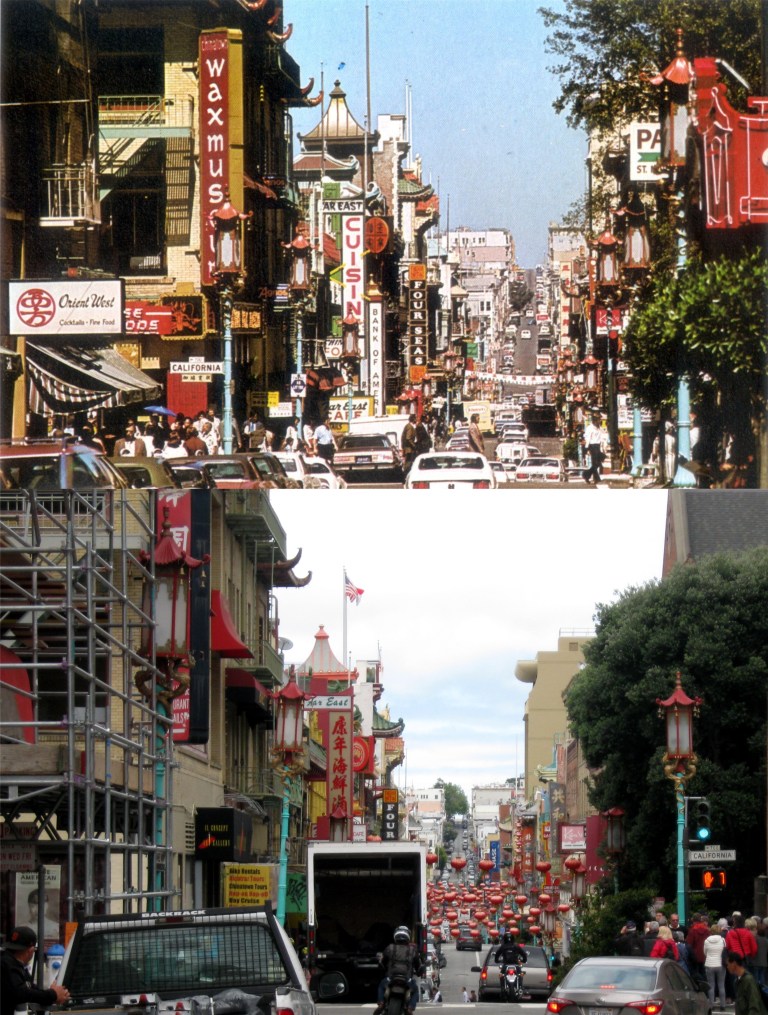 “Sign, sign, everywhere a sign”: There are still a lot of signs in Chinatown today, but they’re not “breakin’ my mind” like in that old 70’s song, and the red lanterns of nowadays are an added improvement.
 The old Crocker Bank on the corner of Montgomery and Post Streets: This was the bank where Lee Remick’s character Kelly Sherwood worked in the 1962 film, ‘Experiment in Terror’. Crocker Bank is defunct now and the top floors of the building were removed at the end of the 1970’s for a rooftop park.
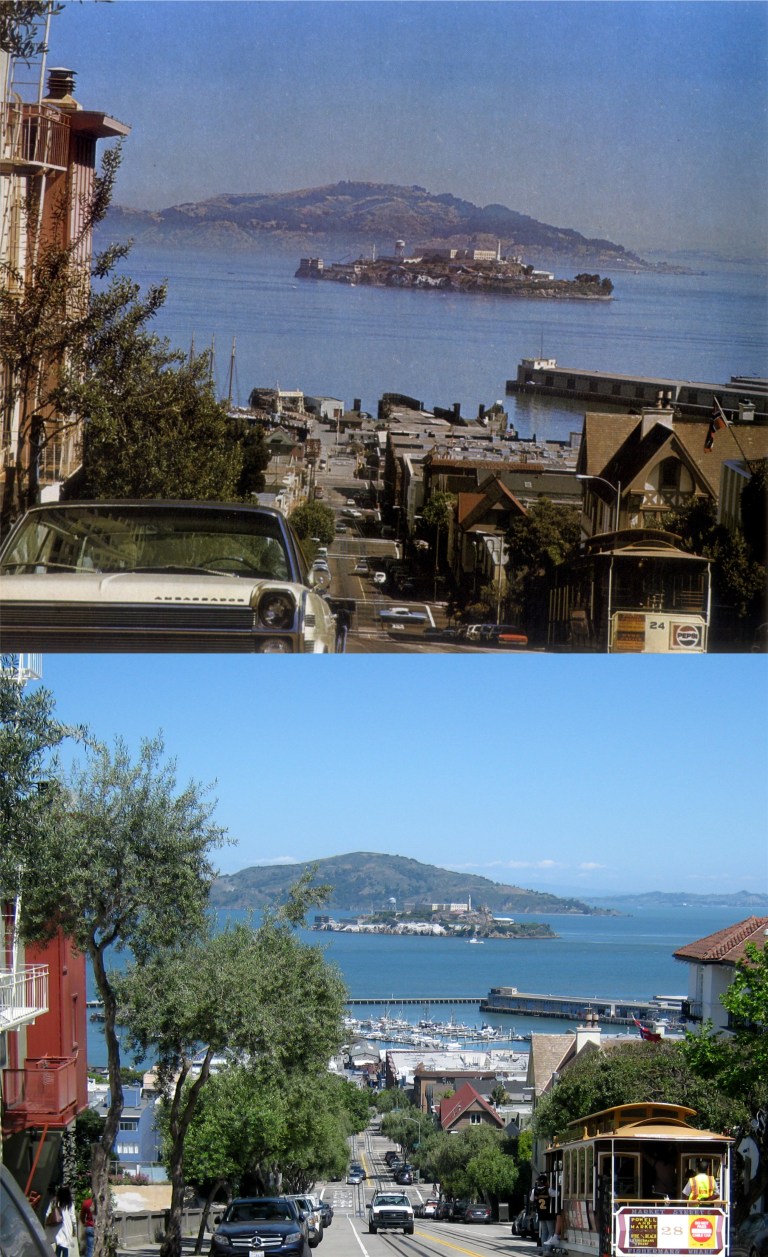 It was a lot prettier of a day in San Francisco today when I finished this set than it was a few days ago. In fact, it was about the nicest spring day I’ve had in town so far. I was trying to figure out why Alcatraz Island seems to tilt so much in the older picture looking down Hyde Street after you pass Chestnut Street. Of course, it’s partly due to the photographer, but it actually does seem to slant as you move further down from Chestnut. Probably because Hyde doesn’t run directly toward Alcatraz. Or maybe Alcatraz does tilt occasionally and no one has ever been able to figure out why.
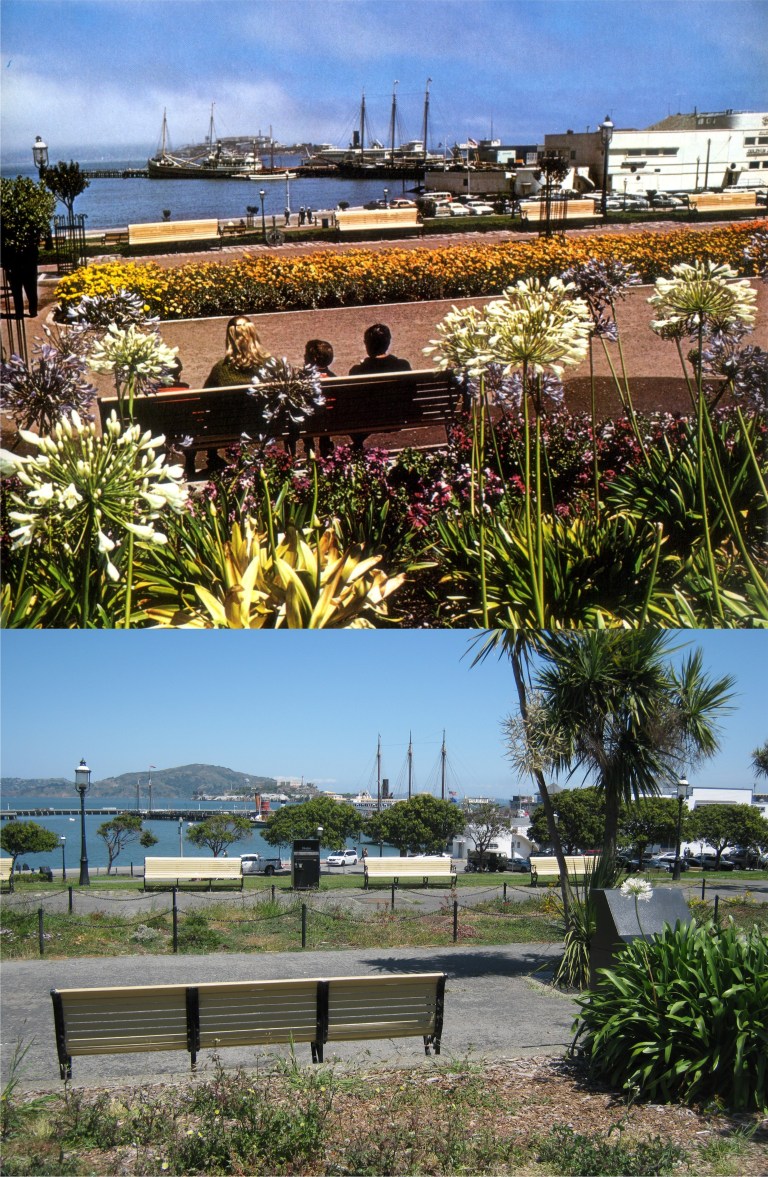 They used to call this peaceful portion of Aquatic Park on Beach Street Victorian Park, but I don’t know if anybody calls it that anymore.
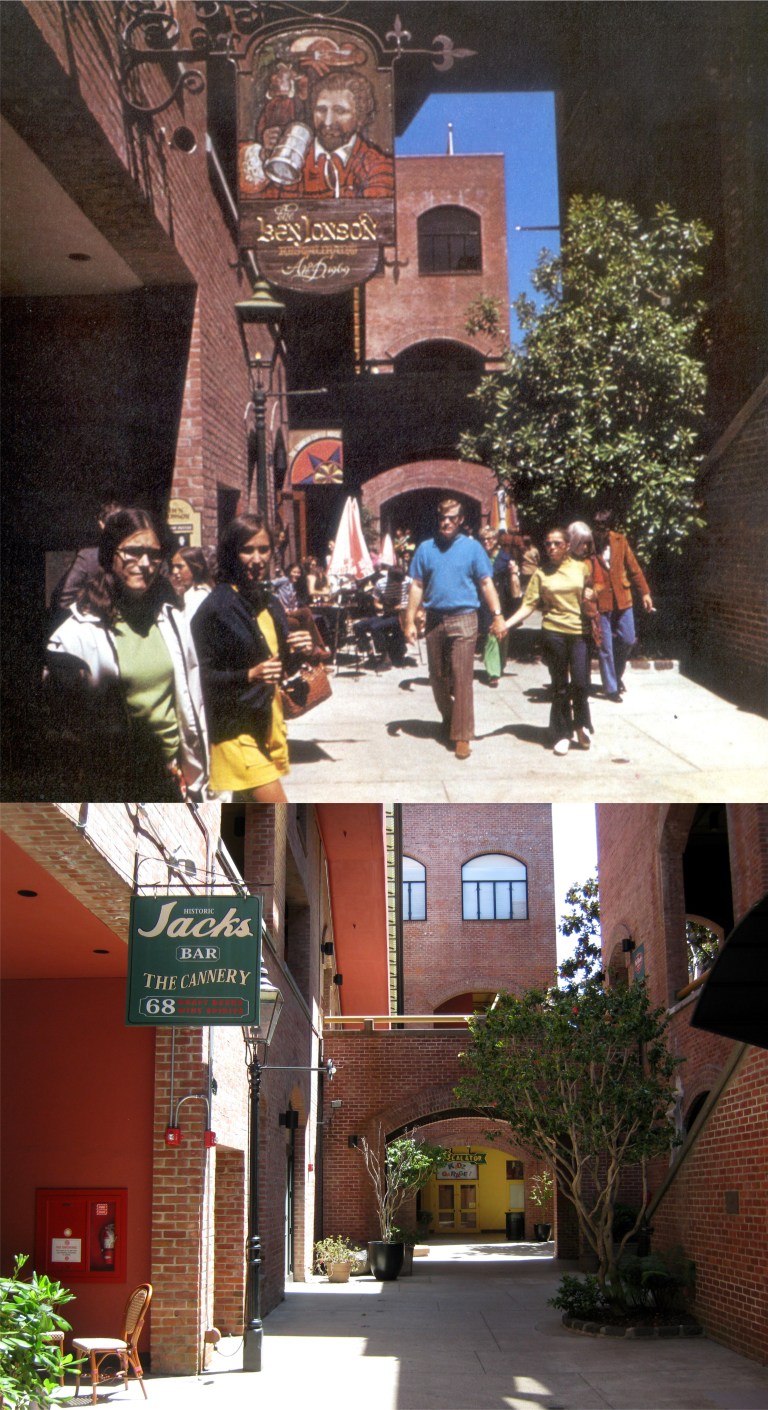 The Ben Jonson Restaurant in the old Del Monte Cannery Building near Fisherman’s Wharf was very popular in the 1970s. They served mostly recipes from England, but I’ll bet they didn’t serve Yorkshire pudding!
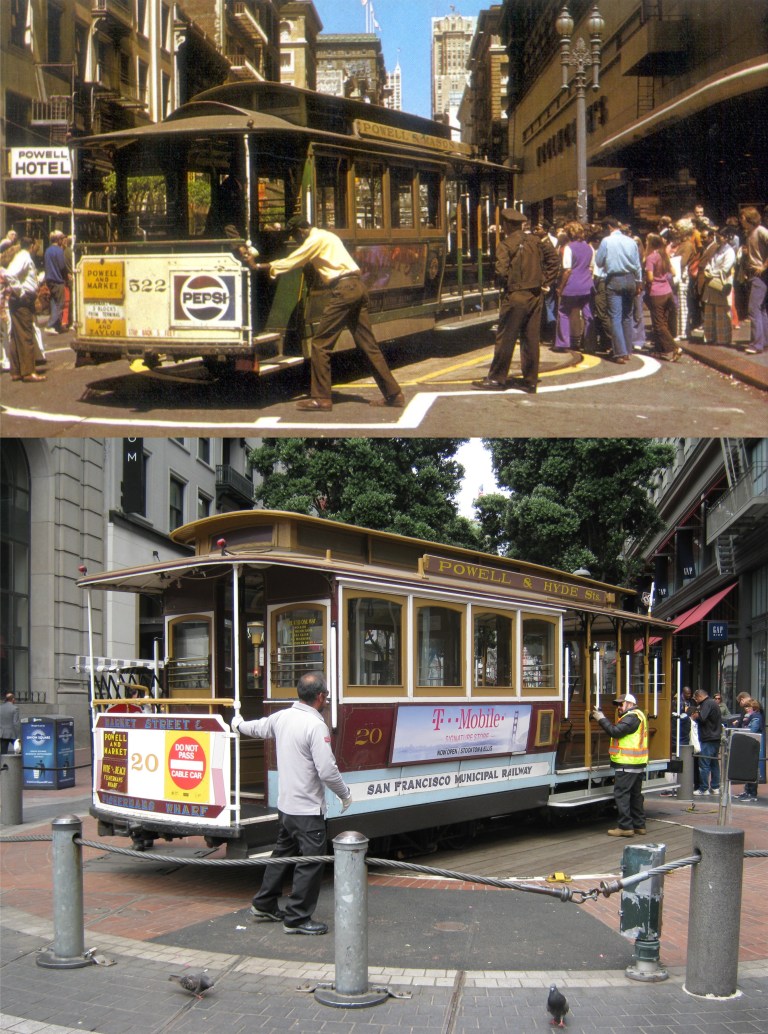 If I have critics, and nobody’s worth much if they don’t, “Woe unto you, when all men shall speak well of you”, they’ll probably say, “He’s always posting pictures of the same spots.” There’s truth in this, but I always feel that the website isn’t about my pictures; they’re, at best, pleasant snapshots. However, the vintage pictures are what it’s all about. I’ve probably posted dozens of pictures at the Powell and Market Streets cable car turnaround, but I keep discovering new pictures from the past of this location and these are what make a then and now comparison fun to look at. In short, sometimes when I post these pictures, “this I do for me.” The long cable car lines of today hadn’t really started forming yet back then and, surprisingly, the line a couple of days ago when I took the current picture was smaller than they were in the 1970’s!
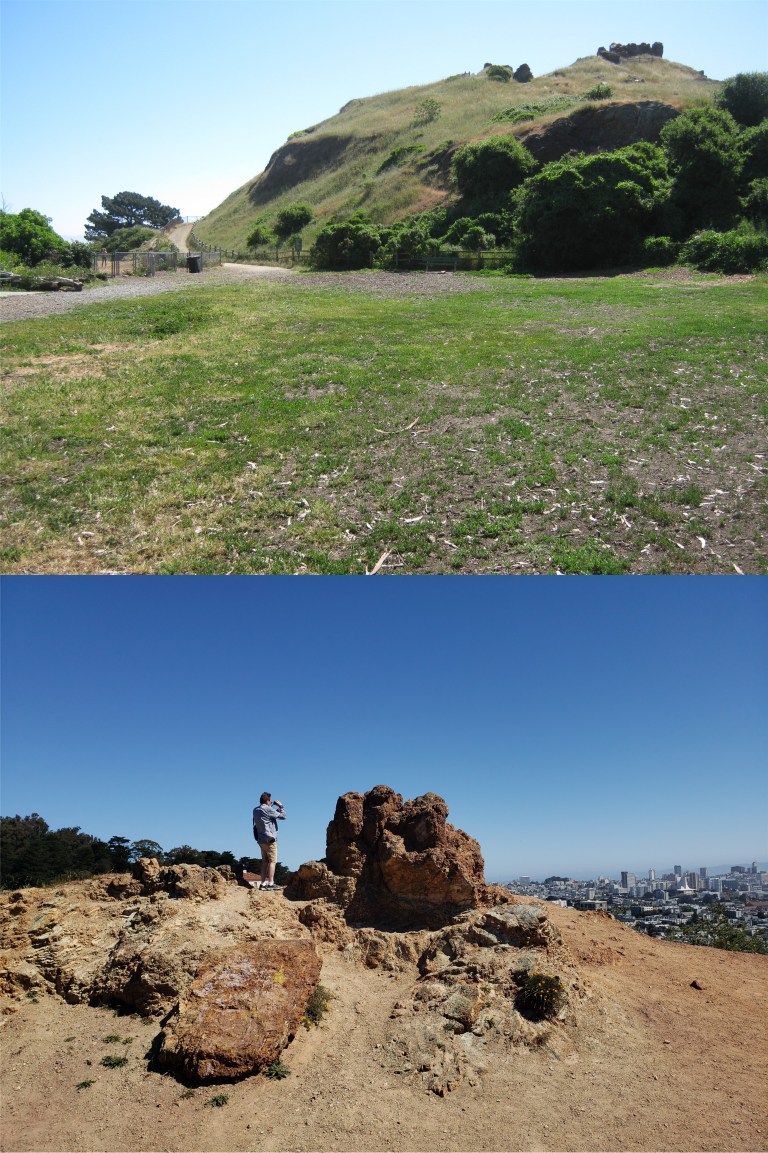 I visited Corona Heights for the first time ever: I can’t believe that all these years I’ve never been up there!
 The views of San Francisco from the top are as stunning today as they were in the 1960’s. (Michael Bry)
 Also on Corona Heights is the Randall Museum of Science, Nature and the Arts and its many wildlife exhibits. But seriously, this is a very interesting museum well worth visiting.
 Drove over to the Fillmore Street Hill at Vallejo: How did people drive their cars up here before automatic transmissions were invented? (Curbed San Francisco)
 Back to familiar ground: My mom got to San Francisco long before I did, and as a pre-World War Two teenager from Grand Forks, North Dakota, one of the first places she wanted to visit was the Cliff House. The vintage image is from the 1950’s. (virginiapicks)
 Before they closed it off, I had a chance to locate the spot where my mom, on the left with her cousin Frances, was sitting on the old stone W.P.A entrance to Fleishhacker Zoo.
 They’ve fenced the old entrance off now, either to keep people from sneaking into the zoo, or animals from sneaking out.
 Some, someday moms at the old Fleishhacker Pool: The girls in the picture from the Shorpy Archives are posing in 1927, two years after the pool opened. I’m standing on top of the pool in the current picture; the pool was filled in and is buried under the San Francisco Zoo parking lot. That’s the entrance to the old pool house on the left in the modern picture, the only thing remaining of Fleishhacker Pool.
 That’s my 17 year old mom on the left swimming in Fleishhacker Pool on her first visit to San Francisco. If she looks miserable it’s probably because the water in the pool was rumored to always be cold!
 Jackson Street is the northernmost extent of the Powell Street cable car line. From here the cars turn west to go to Mason or Hyde Streets. The vintage picture is the turn in 1914. (SFMTA archives)
 From Jackson Street it’s a gradual and relatively easy walk up hill to California Street. From here Powell St. drops down Nob Hill to Market Street. This picture from the early 1960s shows the north view that the tall Sir Francis Drake Hotel in the center used to have. (Vintage Everyday)
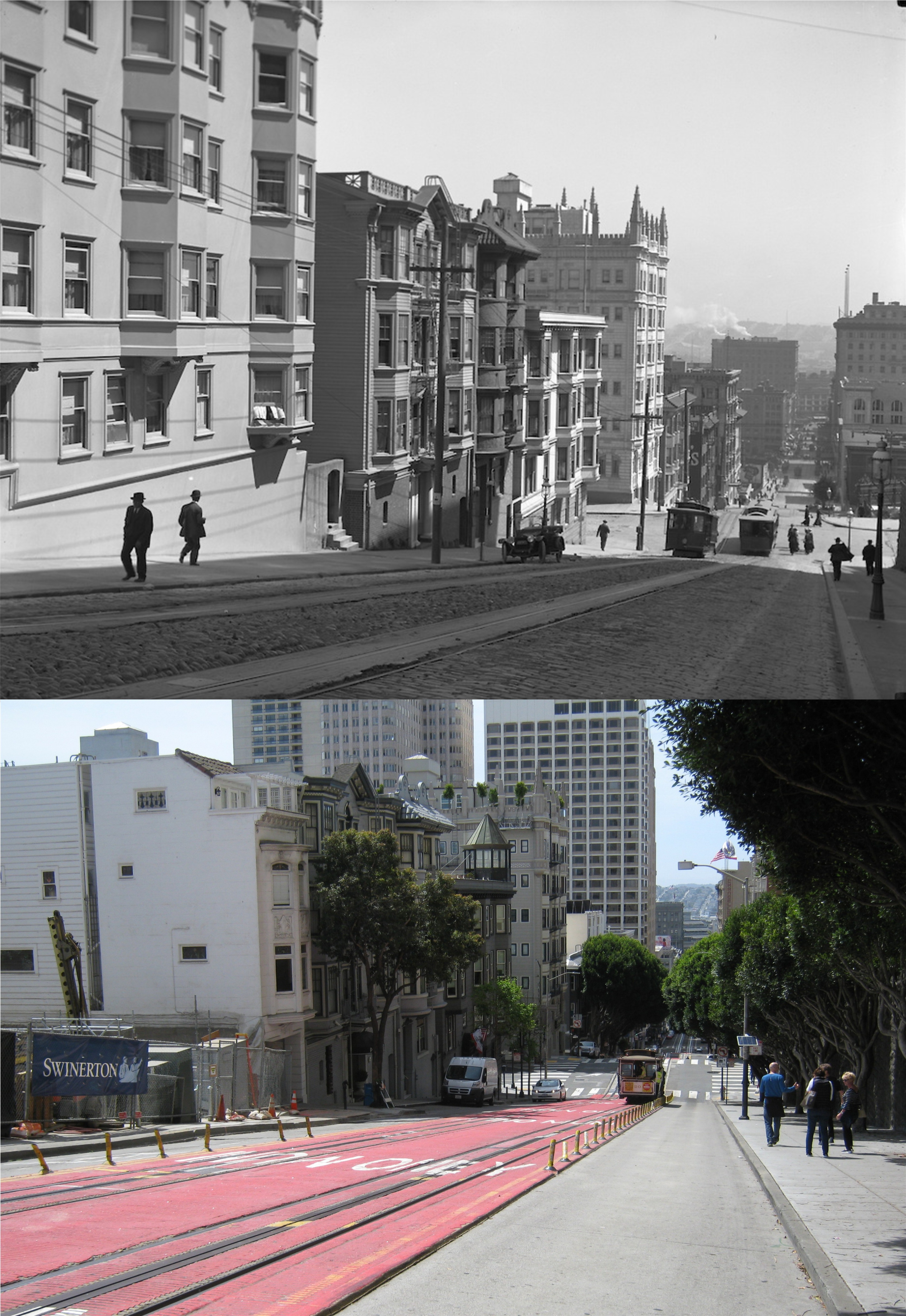 This great view from the 1920s shows Powell Street as it drops toward Pine Street before the Sir Francis Drake and the Hilton Hotel, in the center of the modern picture, were built. (SFMTA archives)
 As we move closer to Pine Street in the early 70s you can see the construction in progress of the building that would forever block the north view that the Sir Francis Drake Hotel with its legendary Starlight Room on top had. (Lindsaybridge)
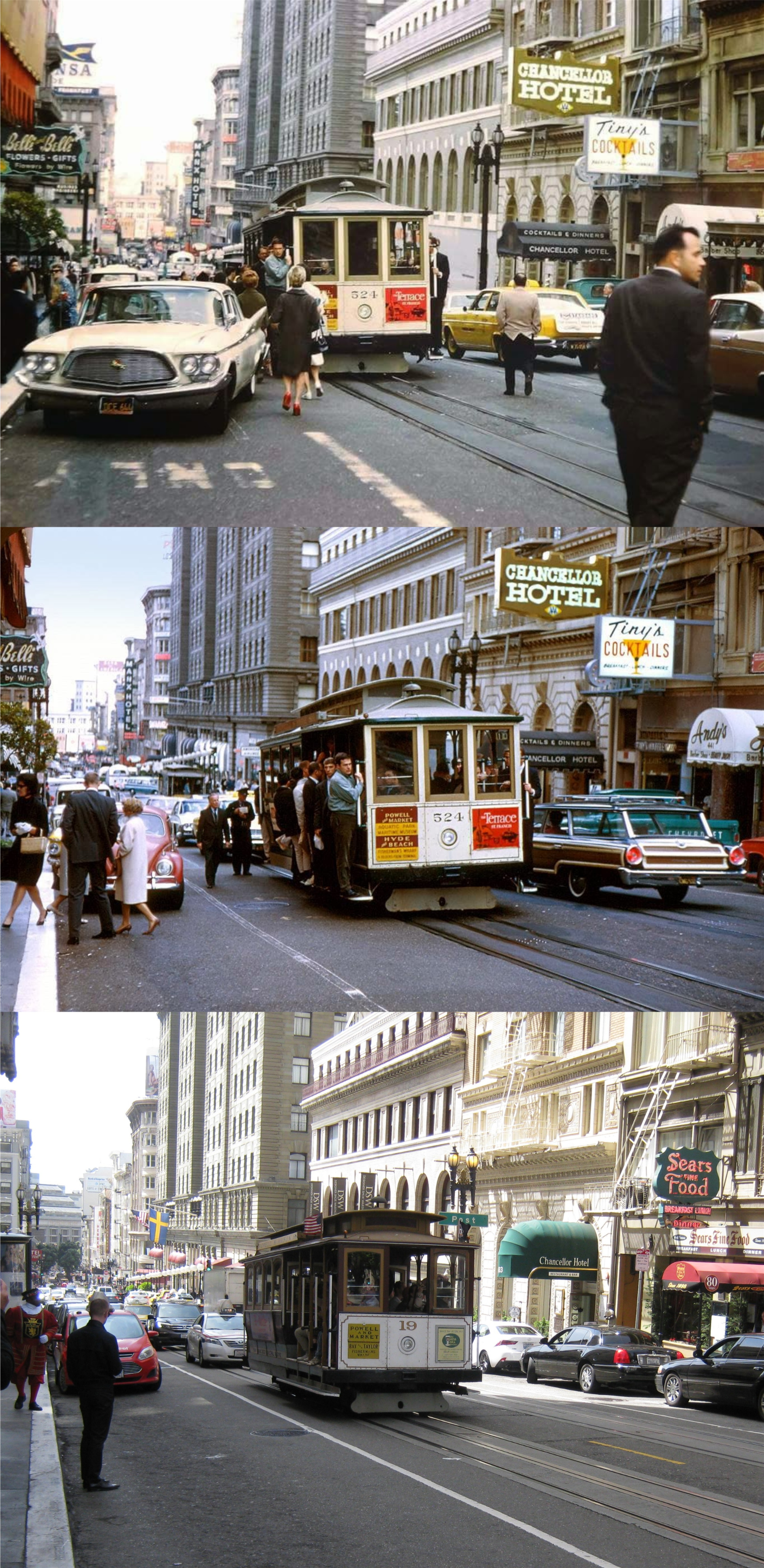 I’m past the Sir Francis Drake Hotel now and heading toward Post Street and the St. Francis Hotel. (Vintage Everyday)
 Cable cars were easier to catch in 1917 on Powell Street looking north toward Ellis than they are today. Now they rack them up all the way back from Market Street for the riders. (SFMTA archives)
 I finished my walk at the Powell Street turntable at Market Street; it looks like a World War Two era picture in the vintage photo. That was a nice spring walk! I felt like turning around and heading back, but Powell Street is a lot more of a climb from this direction. Spring makes me lazy and I wasn’t in the mood for that much exercise.
