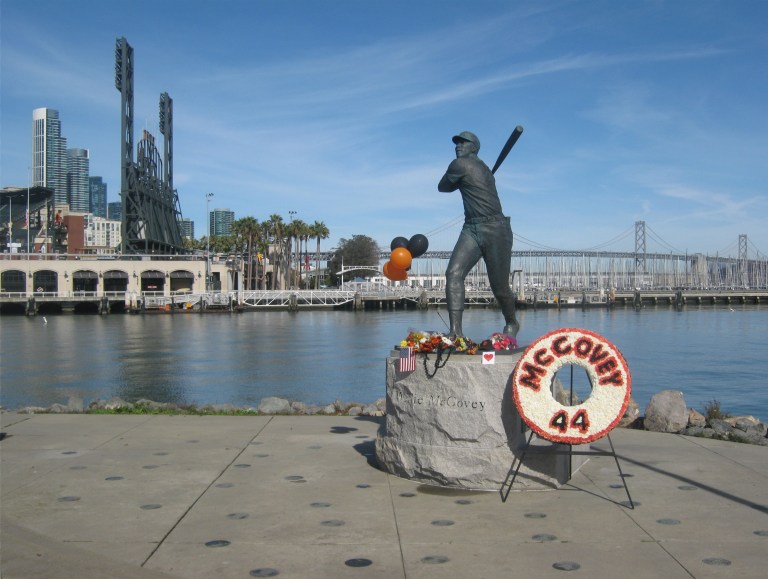

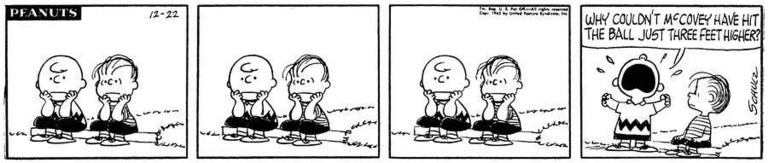
 Went out to McCovey Cove today to pay my respects to “Stretch”. I love this ‘Peanuts’ cartoon from 1962 about McCovey’s line drive that ended the 1962 World Series in a loss for the Giants. Charlie Brown is obviously a Giants fan!
Author: SF Film Locations
Hello friends! My name is Tim Welsh. I’m the owner and operator of Welsh Income Tax Service in Hayward, California. When I was fifteen, I fell in love with San Francisco. It wasn’t a first in the family; my mother at seventeen had traveled by train from North Dakota, where I was later born, to see the Treasure Island World’s Fair, and fell in love with “The City” long before I did. You can see pictures from her trip in the November 19th, 2014 ‘Summer of 1939’ postings. It’s been a love affair that’s never broken my heart. Here, with pictures from books, movies, the internet, and personal collections, I’ve had a chance to share my affection for San Francisco with comparison and location pictures that I’ve taken. I’ve had help from family and friends, and even my dog ‘Danny’ who sniffed out the trail of Buffalo Bill at Ocean Beach on a November 15, 2014 post. My blog is for non commercial and non profit purposes only, and it’s always a lot of fun to work on. Many of the pictures from November, 2014 to November 2015 are thumbnail images. Pictures from posts after that can be enlarged by viewing the image. I hope you enjoy the posts, and please feel free to follow my blog, or make suggestions, comments or corrections if you like.
These will keep me busy (Part one)
I do so enjoy stumbling onto a website filled with vintage San Francisco pictures I have never seen before. Skyscrapercity.com, where these vintage pictures are from, has too many terrific San Francisco pictures to be limited to just one post, which is fine with me.
 Looking down California Street near Powell on Nob Hill in 1960: I only got one cable car in my picture, and that’s as far out as I’m going onto California Street with oncoming traffic behind me. Down the hill where the PARKING and 76 sign are in the vintage picture was where the old Crest Garage, demolished just this year, was.
 Grant Avenue and California Street in 1955:
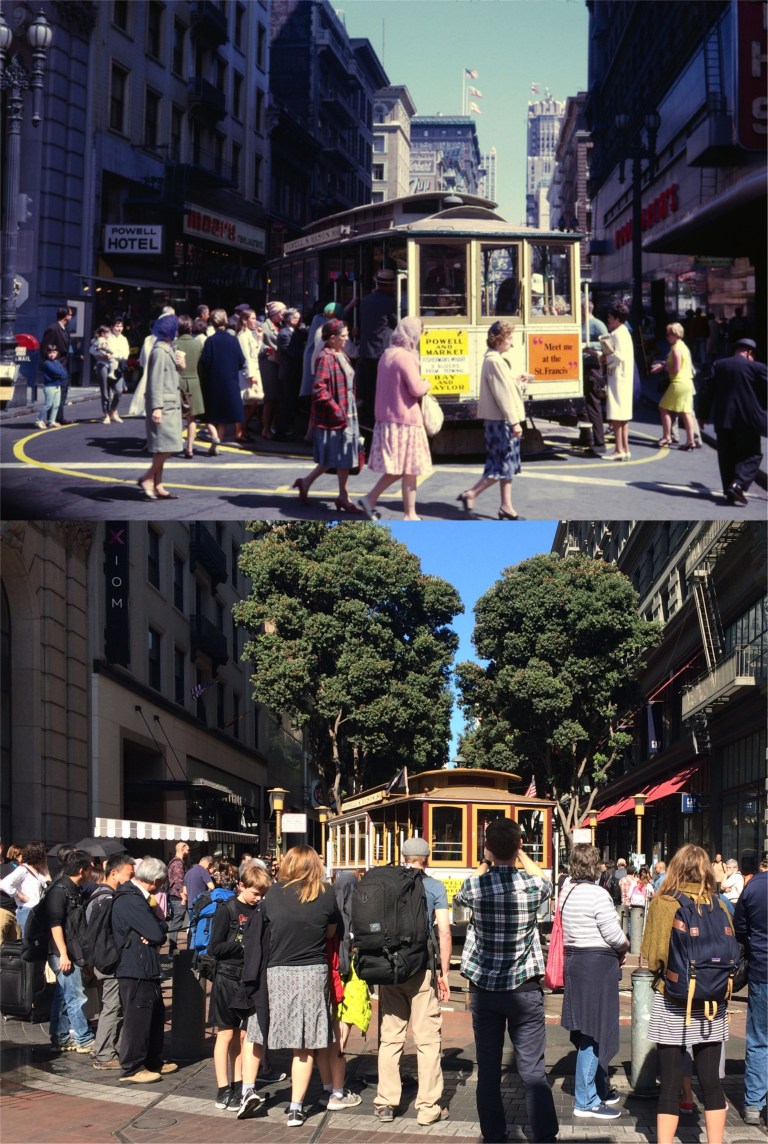 The Powell Street cable car turnaround in 1967:
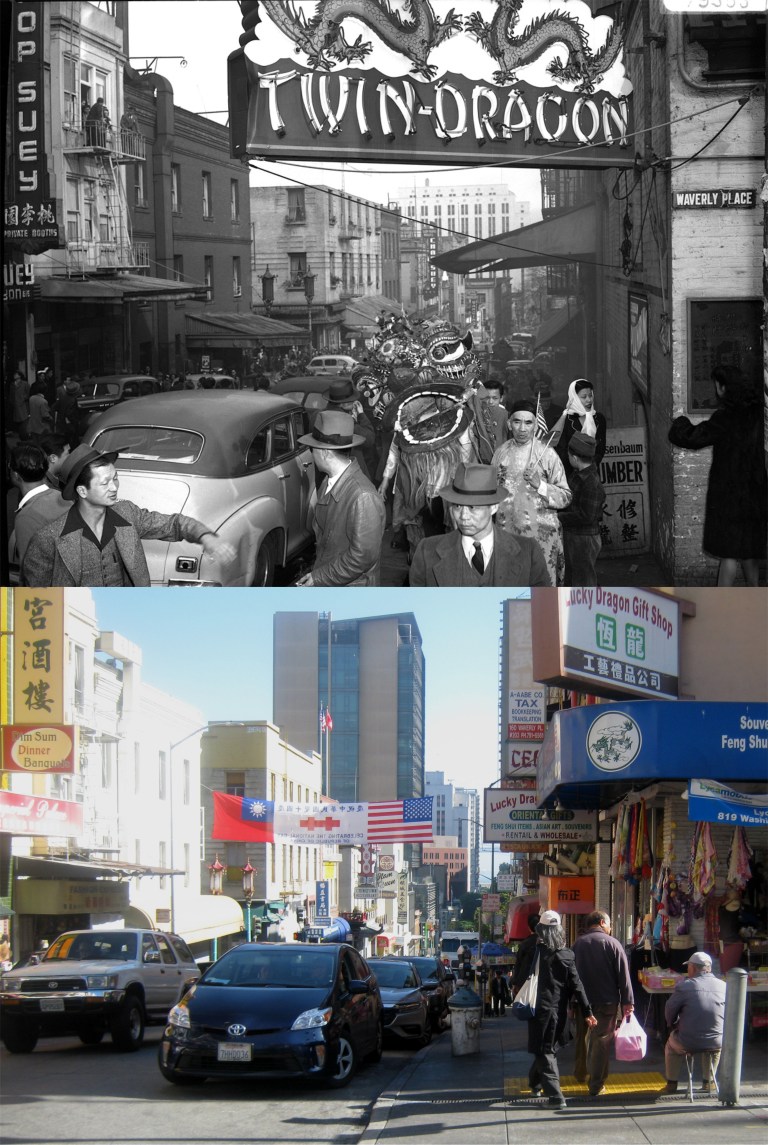 Waverly Place at Washington Street in the heart of Chinatown in 1946:
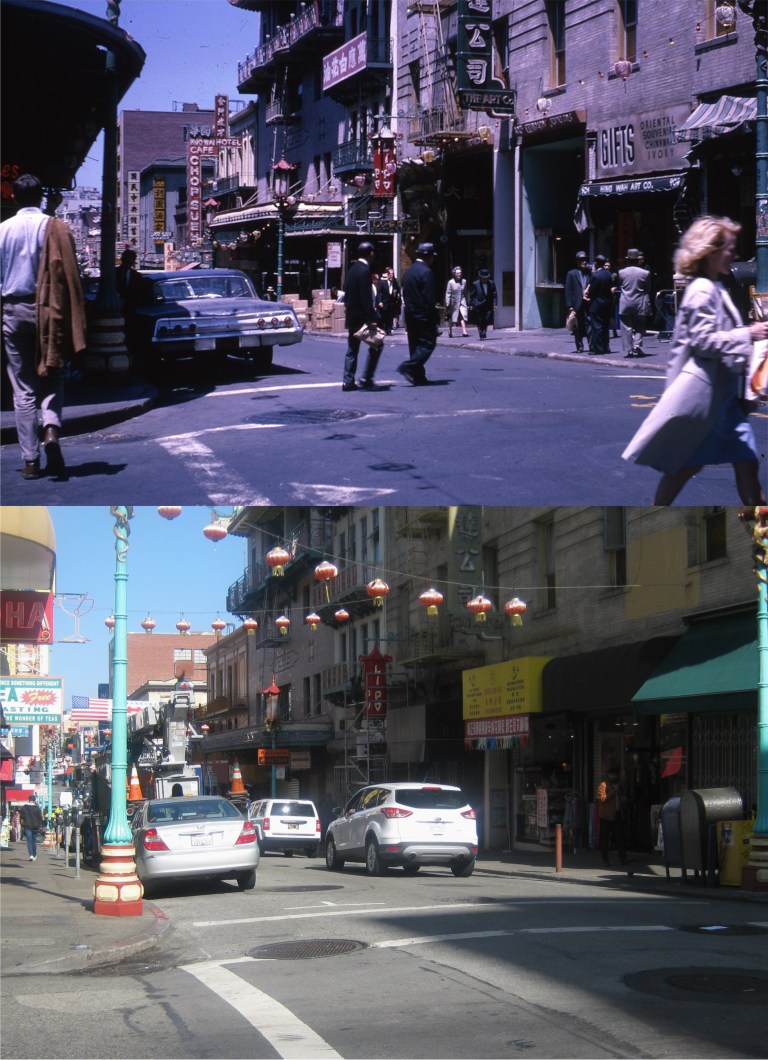 Grant Avenue at Washington Street in 1966:
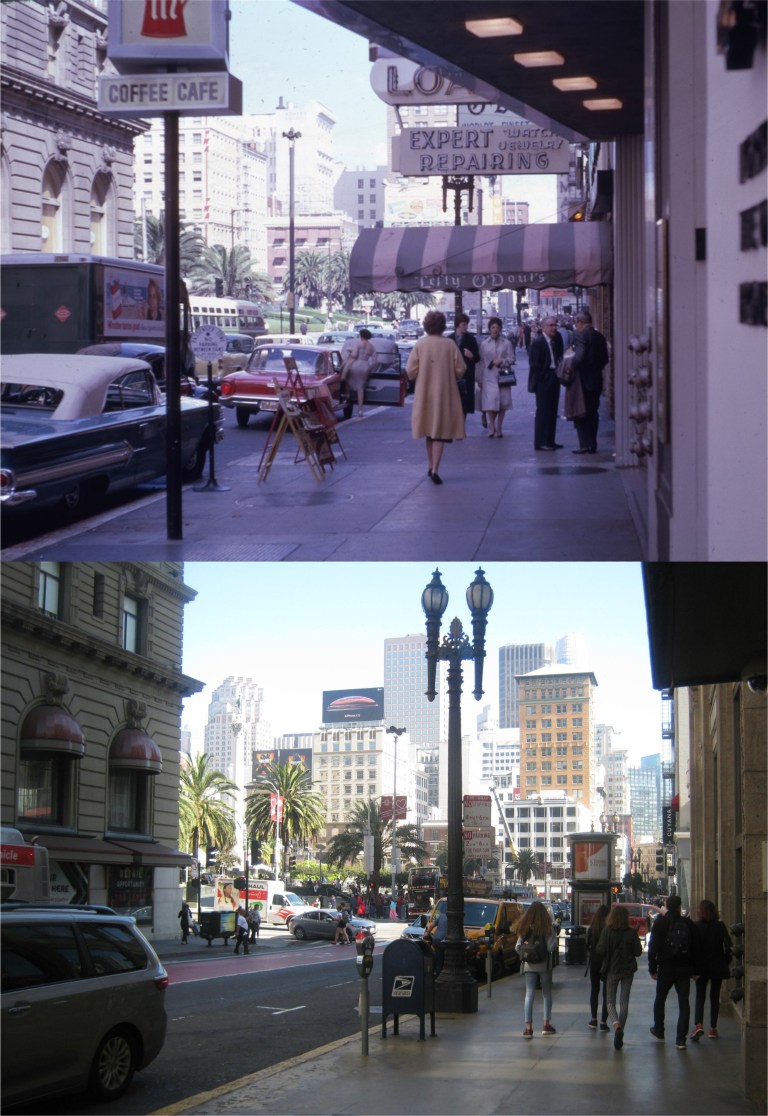 Geary Blvd. near Powell Street and Union Square in 1962: Lefty O’Doul’s closed in 2017.
 Grant Avenue at Jackson Street in the early 1960’s: Red’s Place is a great place to stop in for a pick-me-up (a drink not a date) after walking around the hills of Chinatown all day. Downstairs in the old building, you could look into rooms that were said to have once been opium cribs, but the area is closed off now.
 The San Francisco skyline near the Ferry Building from San Francisco Bay in 1960, before the skyscraper boom:
The mystery of the “Ghost Blimp” (For Veronica)
 With Halloween approaching, it seems appropriate to post a spooky mystery story. The fate of the World War Two blimp, L-8, is one of San Francisco’s greatest mysteries. I have read of the story before, but a recent article in the San Francisco Chronicle by Gary Kamiya raised my interest in the incident again. During World War Two blimps regularly patrolled the Pacific Ocean in search of Japanese submarines that may be lurking off the coast. (In fact, it was discovered after the war that a Japanese submarine did, indeed, fire a torpedo at the Golden Gate Bridge) On August 16th 1942, a navy blimp piloted by Lieutenant Ernest DeWitt Cody and Ensign Charles Adams left Treasure Island, flew over the Golden Gate Bridge, and headed toward the Farallon Islands. Shortly after that, a message, “Am investigating suspicious oil slick, stand by.” was sent to Treasure Island from the blimp. That was over 76 years ago, and that was the last thing ever heard from the two pilots! The blimp came down empty in Daly City, just south of the Crocker Amazon District, (not far from where Parry Hearst was captured) and to this day, no one knows what happened or what became of the two pilots on board. (Vintage photo from Welweb.org)
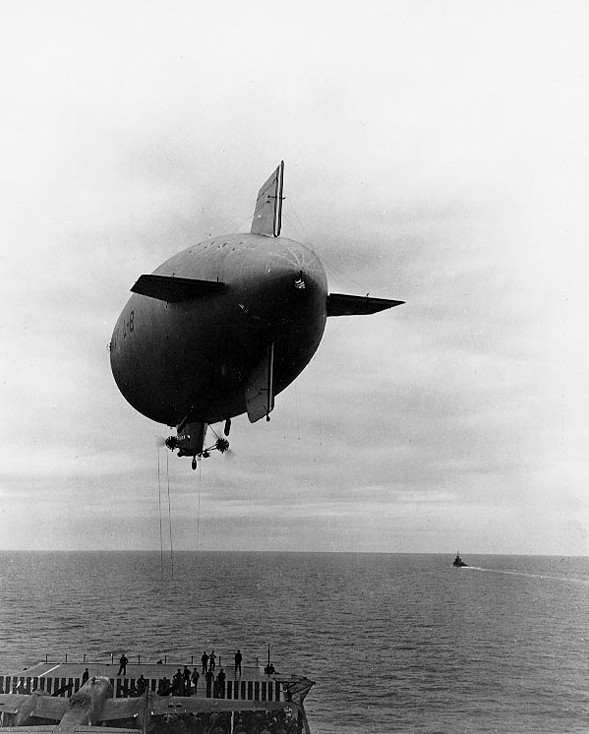 The L-8 blimp had a few previous moments in history. This photo from Wikipedia shows it delivering parts to the aircraft carrier USS Hornet just before she left for the famous “Doolittle Raid”.
 Around 11:15 AM, the blimp was photographed near the shoreline by Lake Merced deflating and descending. It struck a hill near the Lake Merced Golf Course which caused one of the depth charges on the ship to break off and roll down the hill. Fortunately, it didn’t explode. (Allthat’sinteresting.com)
 The blimp eventually crashed down on Bellevue Avenue in Daly City, seen here in this view looking southeast. (SF Chronicle)
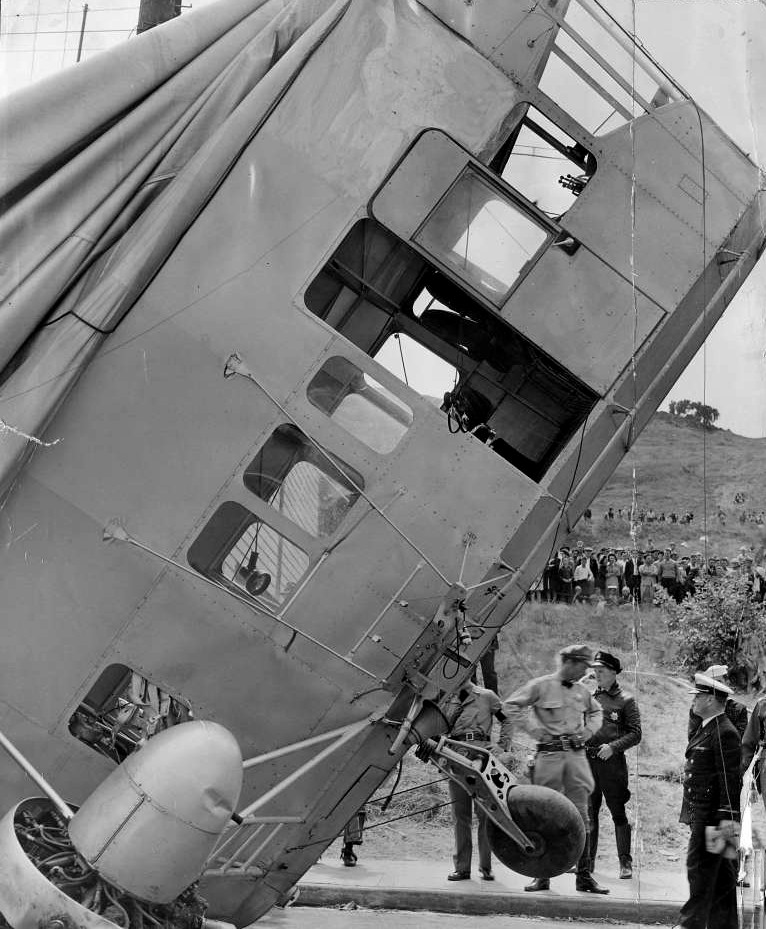 The blimp was intact, all the parachutes were still on board, but the door was latched open, which it should not have been. I think I may have solved a mystery within a mystery I was encountering from this San Francisco Chronicle photo of the gondola taken at the time. The L and 8 letter and number visible in the previous photo are missing in this picture. This may have been requested by the navy as not to identify which blimp it was.
 Two views of the downed airship from the San Francisco Chronicle, looking southwest:
 A view of the gondola looking northwest: That’s probably the same telephone pole.
 The San Francisco Examiner edition that covered the story: (Atlas Obscura)
 The two, lost forever, pilots, Ernest Cody and Charles Adams: It’s unlikely anyone will ever know what became of them.
 While I was researching the story, I met a nice lady from the area named Veronica who was interested in the incident, and the pictures. She helped me match up some of the angles. The top vintage photo was on the north side of Bellvue where the blimp came down. I was looking at the three houses in the center photo as the ones in the old photo; the stairs, doorways and small windows on the right side of the houses match up. Veronica thought it was where the houses in the bottom photo further to the east are, even though two of the houses didn’t match. There is a gap on the right that could be the same as the one in the vintage photo, so I took a picture of her guess, just in case.
 When I got back to the office I looked the area up again on Google Maps. Trust a woman’s intuition, Veronica was right!
 The L-8 gondola was eventually used for other Goodyear blimps after the war, and is now on display in the Naval Aviation Museum in Pensacola, Florida. (navalavationmuseum.org)
A then and now tour for visiting out-of-towners
The mild October weather is still holding up while I took visiting relatives from Texas on a San Francisco tour this Thursday and Friday.
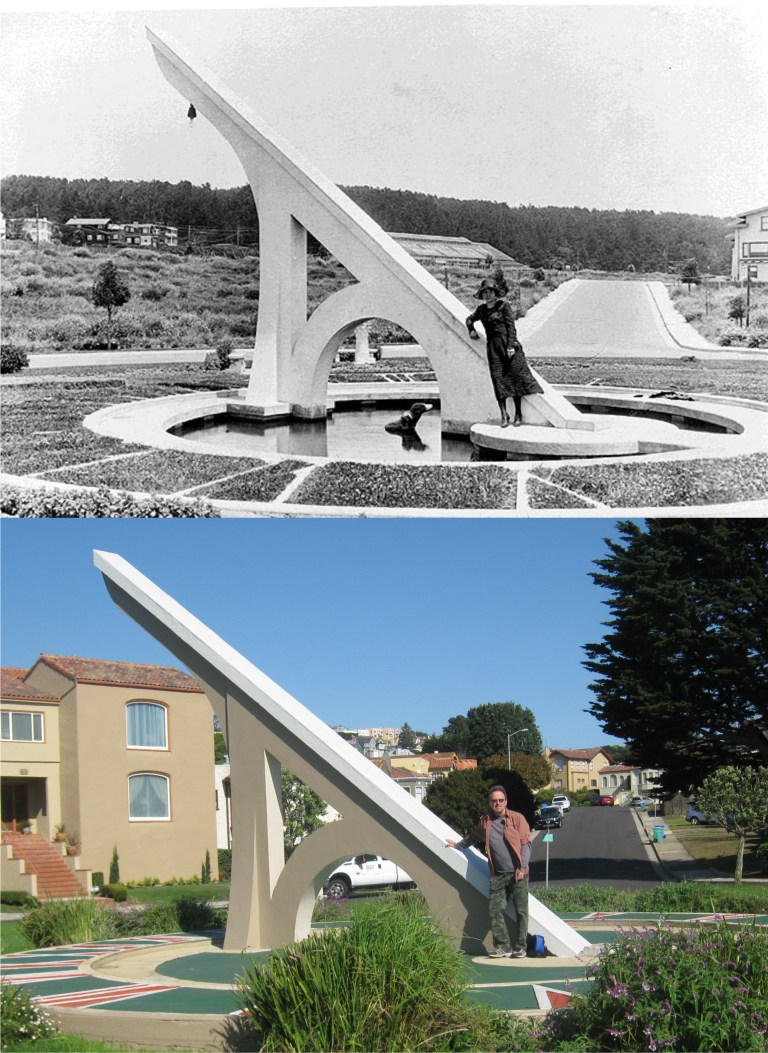 The largest sundial in the world, the mysterious Urbano Sundial in the south part of San Francisco: This thing has a cult following now. (Vintage photo from Found SF)
 Ocean Beach at the Cliff House:
“Come on, Stacy, you’re holding us up!”
“No, I’m holding up the Cliff House!”
 I believe the oldest merry-go-round in San Francisco is at the Children’s Playground in Golden Gate Park, seen here in the 1890s. (San Francisco History Center)
 Heading in on the Bay Bridge through number 5, like whoever this was in the 1970s, and getting a late start on day two of the tour: (Source unknown)
 And, of course, there’s ‘Laffin’ Sal’, seen at the Playland-at-the-Beach Funhouse in 1972 when they were tearing Playland down: The inscription here at the one in Fisherman’s Wharf reads that this was the one that used to be out and Playland, and she hasn’t got any prettier over the years.(opensfhistory.org)
 Sunset from the top of the Liberty Ship Jeremiah O’Brien as Pier 45 closes down for the day: It doesn’t get any prettier than this! That’s the World War Two submarine, the USS Pampanito, berthed in front of the Jeremiah O’Brien.
October weather
October is definitely here; the Fleet’s in, vampires are prowling around Nob Hill, the World Series and Halloween are just around the corner, and as of this second week of October, the weather in San Francisco is just perfect for picture taking.
 Witches at the Embarcadero Center in 1989: (SF Chronicle)
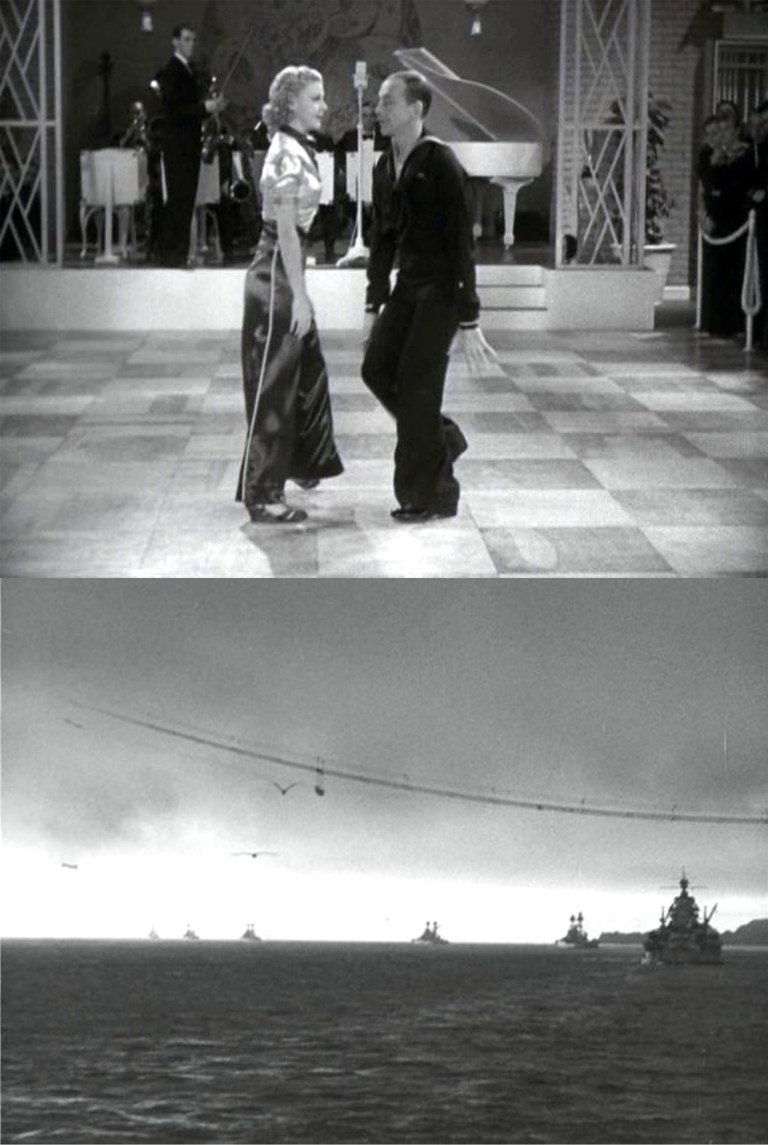
 The 1936 Fred Astaire and Ginger Rogers movie ‘Follow the Fleet’ (one of their best) shows a scene with what was probably a stock photo of the navy fleet sailing into San Francisco Bay under an unfinished Golden Gate Bridge. On October 5th, I got a chance to watch the fleet sail in again under the bridge for the beginning of Fleet Week, albeit, not as many ships. It sure is good to see those sailors standing at attention for the city of San Francisco!
 October is a great month to walk around exploring San Francisco. Here’s a neat 1970 picture taken on the southwest corner of Bush Street and Grant Avenue looking toward the Chinatown Gate. (Rob Ketcherside)
 In 1966, just four years earlier than the previous photo and across Grant Avenue on the southeastern corner of Grant and Bush, this great photo from the Shorpy Archives was taken before the Chinatown Gate was built.
 A couple of lols (No, not laugh out louds) on the corner of Geary and Powell Streets, across from Union Square, in 1975:
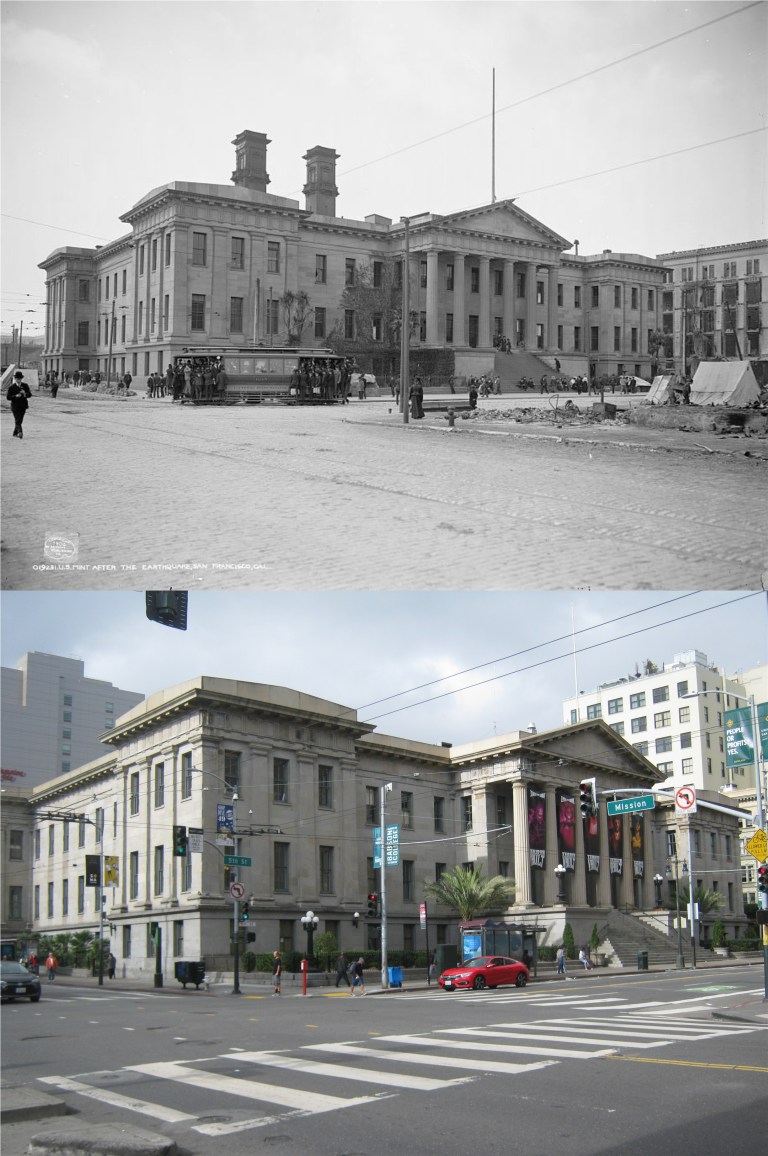
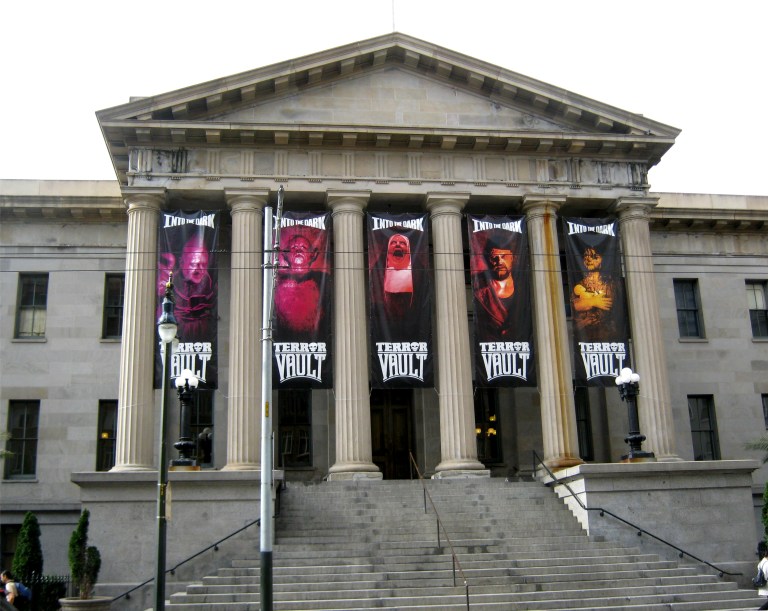 Mayhem at the Mint! The old San Francisco Mint Building on the northwest corner of Mission and 5th Streets is seen in the vintage picture taken just after the 1906 Earthquake and Fire. Built in 1874, it’s been closed for years, but not this month. Opening today in the Mint and running through Halloween is a frightening sounding attraction called ‘Terror Vault’. These things are usually pretty scary, but I may take a Xanax and check it out.
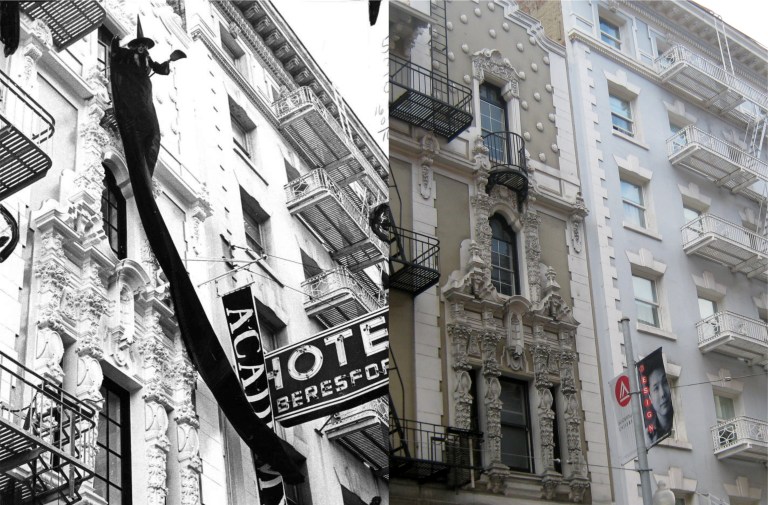 A witch above the San Francisco Academy of Art University on Sutter Street: I couldn’t get a date on the vintage picture, but it’s definitely not recent. (SF Chronicle)
Snapshots from the Eighties
Like a lot of people, I started out taking pictures with a camera that used 110 cartridge film. In 1982 I bought my first camera that used 35 millimeter film; a little Canon snap shooter that I took pictures with off and on during the 80’s from Hawaii to Europe until it was either lost or stolen in Disneyland in 1991. In 1985 I bought a Minolta X700 that I still have today but never use anymore. These are 35 mm prints that I took in San Francisco from 1982 through 1985. I took a lot of slide pictures back then that I’ve posted images from in the past, but these are scans of developed prints from back then.
 The view northeast from the Moscone Convention Center in April of 1982, before the Yerba Buena Gardens were built: This wasn’t too long after it opened. You could still see so many landmark buildings from here back then; the Hobart Building, the Call Building, the Hunter-Dulin Building where Sam Spade’s office was, the Transamerica Pyramid Building, to name a few. My current picture is as close as I can get to the same spot today. On the far right you can still see the west side of the old Pacific Telephone Building. The old building at 3rd and Mission on the left side is still there and having work done on it today. The One Montgomery Tower and the McKesson Corporation Building behind the building being remodeled are visible in both pictures. And, of course, the new bully in town, the Salesforce Tower is now on the far right.
 You can’t stand in the way of progress anymore than, as Daffy Duck would tell you, “you can’t bounce a meatball” but sometimes I wish they would have left Union Square, seen here in 1984, the way it was.
 ‘Olive Oil’s’ at Pier 50 south of AT&T Park, probably around 1985: I wonder if I noticed back then that they spelled Olive Oyl wrong.
 Girls on the southwest corner of Beach and Larkin Streets at Ghirardelli Square in 1985 and 2018: I remember I was testing out the zoom lens of the Minolta X700 camera I bought that year, and pretty girls are pretty girls!
 The Embarcadero at Broadway through my zoom lens in 1985: You can see part of the Embarcadero Freeway that ended at Broadway on the right. Those were the rusted and no longer used by 1985 Belt Line Railroad tracks. I’m a little bit closer to Pier 9 in the picture I took last week in order to get part of the Ferry Building in, and it was a lot sunnier on that long-ago day.
 Piers 24 and 26 on the Embarcadero looking south toward the Bay Bridge in 1985: Pier 24 has been demolished now:
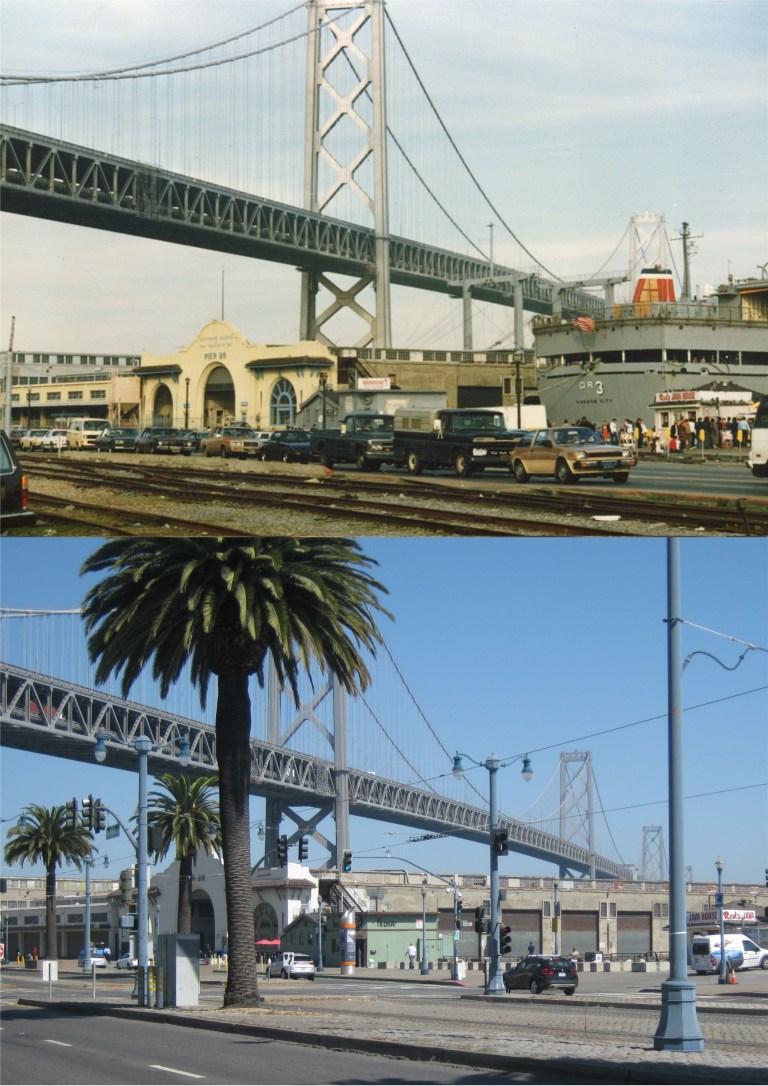 Pier 28, under the Bay Bridge, probably the same day in 1985 that I took the previous picture: You can see Red’s Java House on the right in both pictures.
 The USS Pampanito World War Two submarine at Pier 45 in 1982 or 1983: They sure have detailed her out really pretty today!
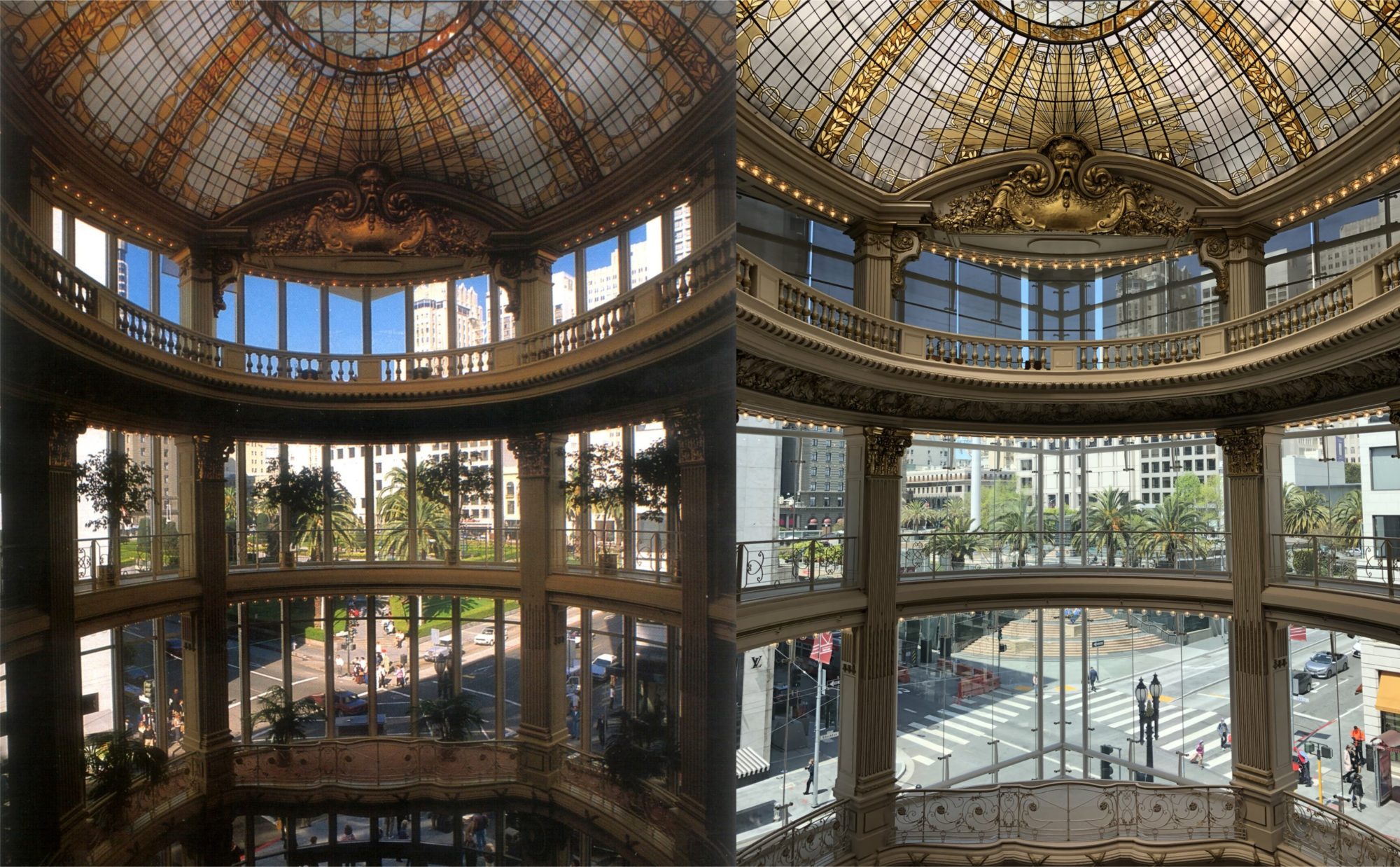
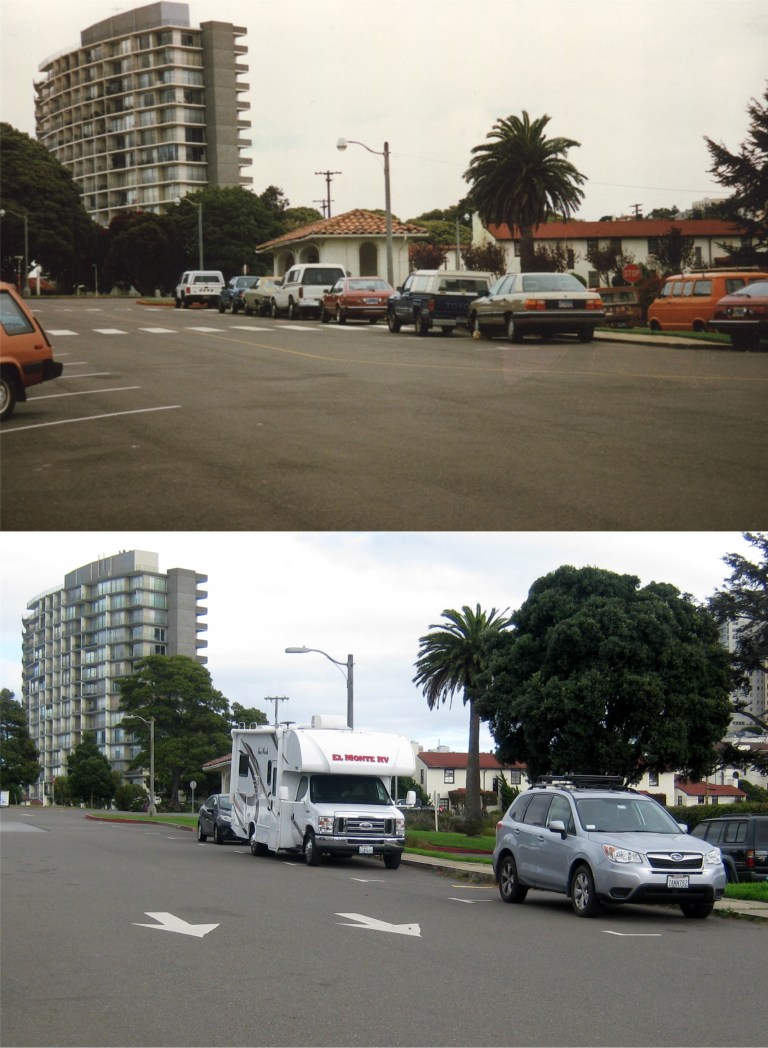 Fort Mason looking east in 1984 or 1985: That RV is almost blocking out the old adobe streetcar stop in my current picture.
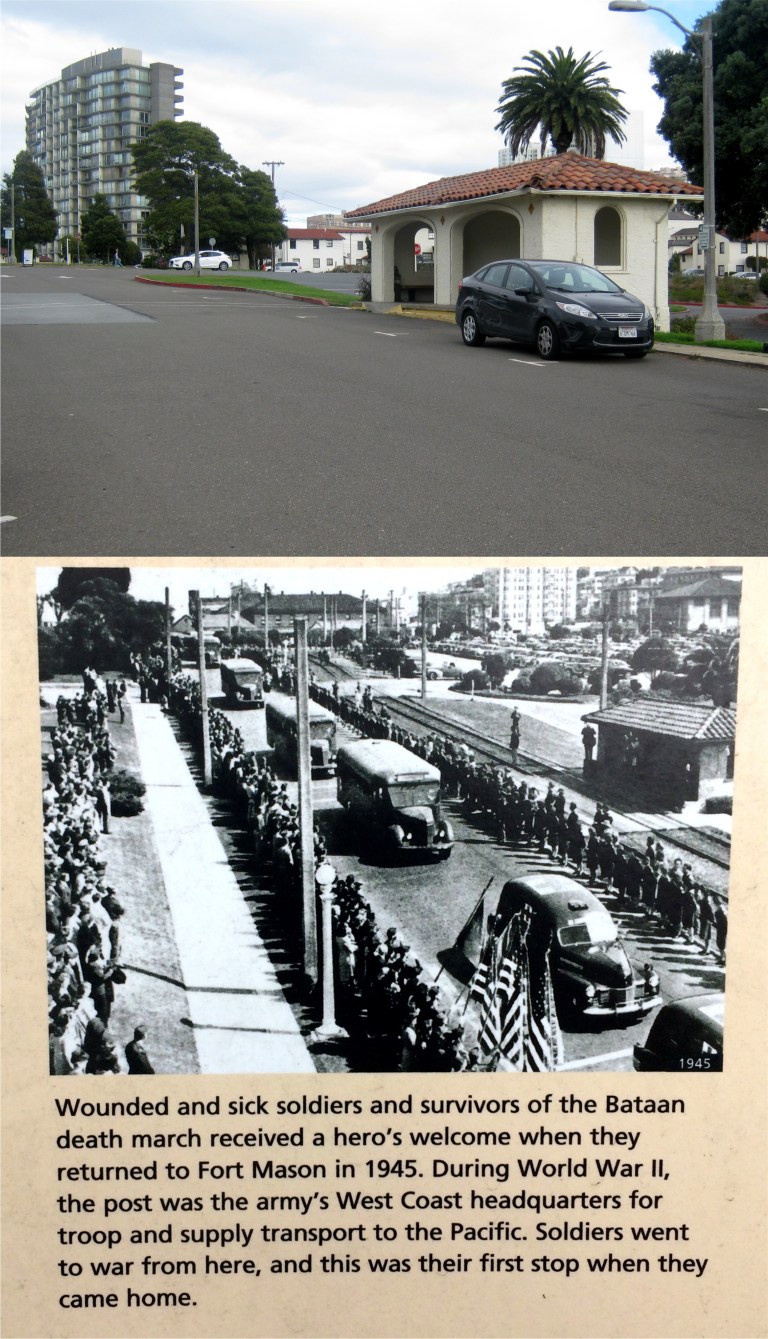 But the little streetcar stop is still there, although streetcars no longer run here. It must have been a lonely feeling for a lot of people who got off the cars here and were going overseas to help win World War Two. Although so many of them didn’t come back, there’s an historic picture at this spot in Fort Mason in the bottom photo of some of the people who did return.
A sad end to a losing season
When we were kids, my folks would always take us to “Fan Appreciation Day” at Candlestick Park for the last home game of the San Francisco Giants season. Those were in the days of Willie Mays, Willie McCovey and Juan Marichal. They used to give away as many as ten new cars during the game; I’m not making that up! When my mom and dad got older, I started taking them to Fan Appreciation Day, and did so until my dad died in 1993. Yesterday, I headed out to AT&T Park on yet another Fan Appreciation Day in San Francisco between the Giants and the Los Angeles Dodgers. The Giants as a team started folding in September ending their April dreams and yesterday wasn’t any better. Still, I’ve got my memories, not only of my mom and dad, but of the three World Series wins they never saw.
 The picture on the left is the main AT&T Park entrance when I got there; on the right was the back entrance after the game. Unfortunately for Giants fans, the Dodgers won 15 to 0! One of the Fan Appreciation Day games I took my folks to was in 1982 when Joe Morgan knocked the Dodgers out of the Playoffs with a game winning home run. The Dodgers didn’t appear to have forgotten that yesterday!
 Still, AT&T Park is one of the most beautiful baseball parks in the country, and I wasn’t too down about the game’s outcome. The Giants will be back! The top photo is looking north across China Basin, what is now called McCovey Cove, in the early 1900’s, and the same view yesterday. (http://opensfhistory.org/)
 The 3rd Street Bridge looking northeast in 1933: The bridge is now called the Lefty O’Doul Bridge named after the local baseball legend who started his career with the Minor League San Francisco Seals. Notice that the little white toll signal building on the right is still there. (http://opensfhistory.org/)

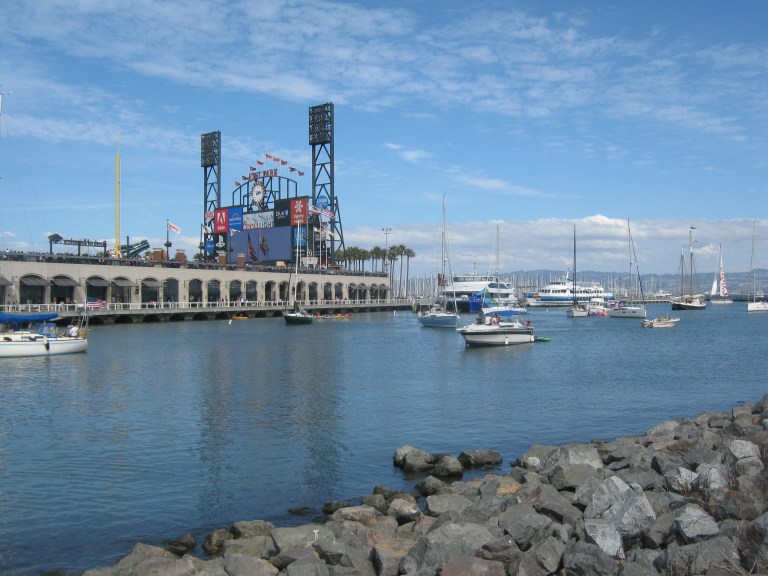 The top two pictures I took are looking across McCovey Cove during the last World Series game to date that was played at AT&T Park, the 5th game of the 2014 Series. With both teams tied at two apiece, the Giants won this game. They then lost game six in Kansas City, but wrapped it up with that great 7th game win on October 29th. Look at the ESPN guy doing a broadcast next to me. I was polite and didn’t jump behind him making a lot of noise; I thought about it, though. The bottom photo was the same spot yesterday; lonelier but just as pretty.
 Never let it be said of me that I don’t know how to line up a selfie!
More film clips and trailers from San Francisco movies
Click on the links below the film then and nows for a YouTube film link about each movie.
 ‘Sudden Fear’ (1952) Joan Crawford discreetly sneaks into the Tamalpais Apartments at Hyde Greenwich Streets on Russian Hill to try to learn how Jack Palance plans to kill her.
 ‘Patty Hearst’ (1988) Patty Hearst during the 1974 Hibernia Bank robbery she participated in located in the Sunset District, and Natasha Richardson who portrayed Hearst in the film during the robbery scene.
 ‘Born to Kill’ (1947) Elisha Cook Jr. arrives at the Ferry Building ready to commit murder. However, his plans don’t work out, as you’ll see in the YouTube clip.
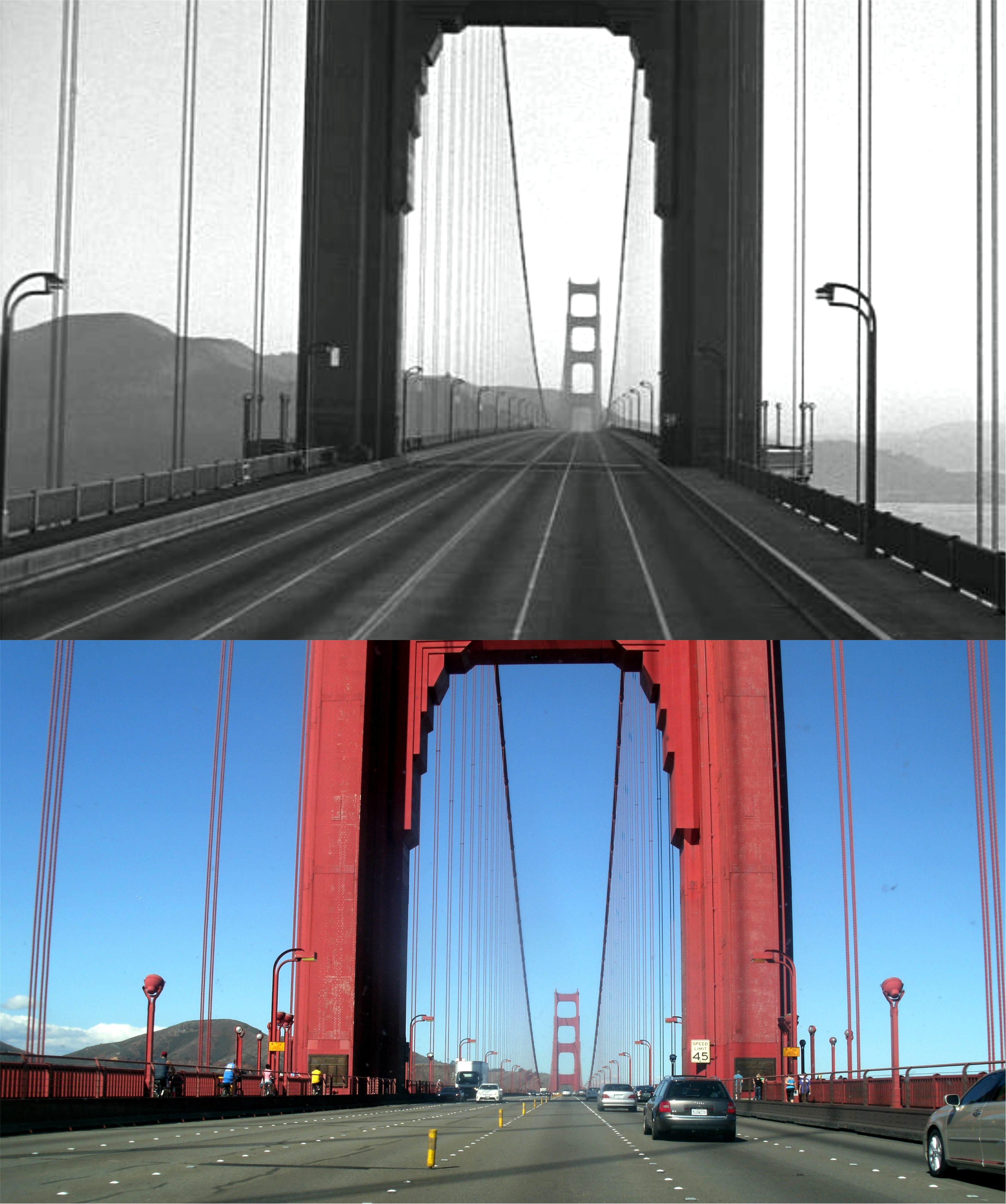 ‘On the Beach’ (1959) In a depressing scene Gregory Peck’s submarine crew arrive in San Francisco from Australia searching for life after a fallout from a nuclear war has killed off most of the world’s population. They find only an empty San Francisco, such as this scene of the Golden Gate Bridge.
 ‘The Falcon on San Francisco’ (1945) Tom Conway (the Falcon) is accused of kidnapping the little girl on the right in front of the Ferry Building early in the film.
 ‘I remember Mama’ (1948) Liberty Street, where the Hanson family lived in the movie. Because it was supposed to be on Russian Hill used special effect for the Bay and Alcatraz, but Liberty Street is actually in the Castro District.
 ‘My Favorite Brunette’ (1947) Bob Hope getting mixed up with spies, murder and lovely Lamour at his baby photographer office on California Street in Chinatown:
 ‘Point Blank’ (1967) After being shot in a conspiracy between his wife and friend and left for dead in a cell on “Broadway”, what the inmates used to call the center cell block isle at Alcatraz, Lee Marvin recovers and seeks revenge.
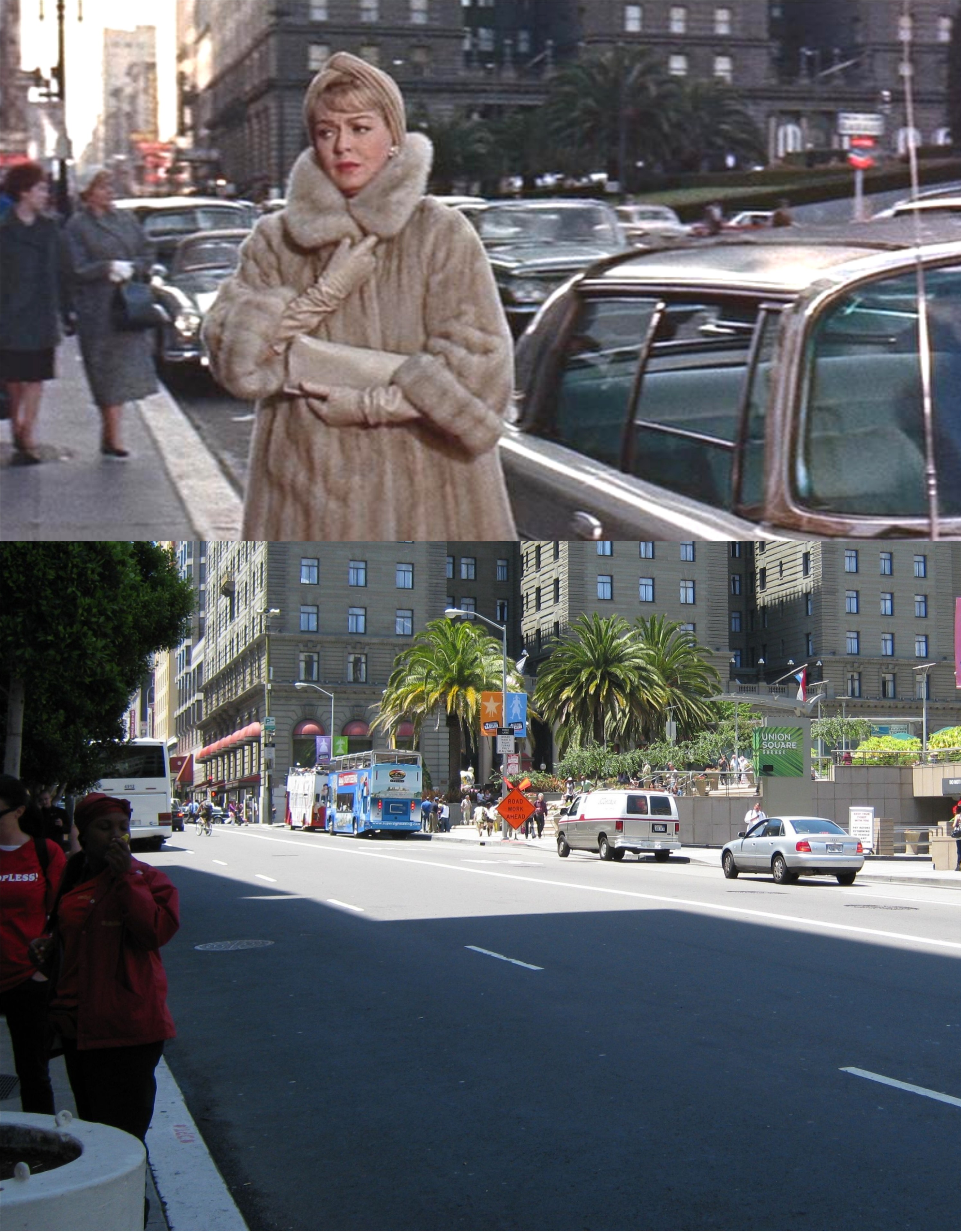 ‘Portrait in Black’ (1960) Plotting with Anthony Quinn to kill her husband, Lana Turner begins the first phase of their plan at the old I Magnin Department Store on Geary St. across from Union Square.
 ‘The Towering Inferno’ (1974) Fred Astaire looks up at the special effects building that will eventually catch fire in the film. The dark Bank of America Building on California Street, where some of the movie was filmed, makes a nice comparison when the sun catches it just right.
 ‘What’s Up, Doc?’ (1972) Clumsy Barbra Streisand creates all kinds of trouble for Ryan O’Neal, who she has fallen in love with, like this motorcycle accident she causes by crossing the intersection at Jones and Bush Streets against the light.
Fall has fell
Several posts back, I made a mention of the “weather in Peter Stratmoen’s 1975 pictures”. Peter Stratmoen took a series of photographs around San Francisco during 1975. I don’t know if his pictures were taken during the fall, winter, spring or a Mark Twain summer, but they’re all overcast and dark. I’ve covered some of them already on my blog. With fall here we’ll be moving closer to gloomy weather similar to “Stratmoen weather”, but not just yet! On this first complete day of fall it’s still sunny and warm in San Francisco. We’ll start downtown at Union Square and follow a route similar to the ‘Barbary Coast Trail’ to Aquatic Park as we track down Peter Statmoen’s 1975 locations. (Peter Stratmoen pictures from Vintage Everyday)
 Union Square looking northeast: The building on the far left has been demolished since 1975 and is now where Saks Fifth Avenue is, but other than that the view hasn’t changed a lot except for Union Square.
 We’ll head into Chinatown looking north toward Pine Street from Bush Street.
 Now we’re looking east down Sacramento Street.
 Grant Avenue at Clay Street: Except for the next picture, you won’t see any major differences in the Chinatown of today and 1975.
 The quaint gas station at Jackson Street and Columbus Avenue has been replaced by a bank now. It’s too bad that couldn’t have been saved. The gas station was on the south side of the old Sentinel Building on Columbus Avenue.
 We’ve moved into North Beach, looking southeast on Columbus Avenue from Chestnut Street. Notice the old Kentucky Fried Chicken on the left when it was still officially called ‘Colonel Sanders’. “Lately, I have been spotted with a Big Mac on my breath; stumbling in to a Colonel Sanders with a face as white as death.” (cf. ‘Junk Food Junkie’) Notice that the cable car tracks ran down the center of Columbus Avenue back then and along the side of the avenue today. This must have been done during the major renovation of the cable car system during 1982/1983 to ease traffic congestion on Columbus.
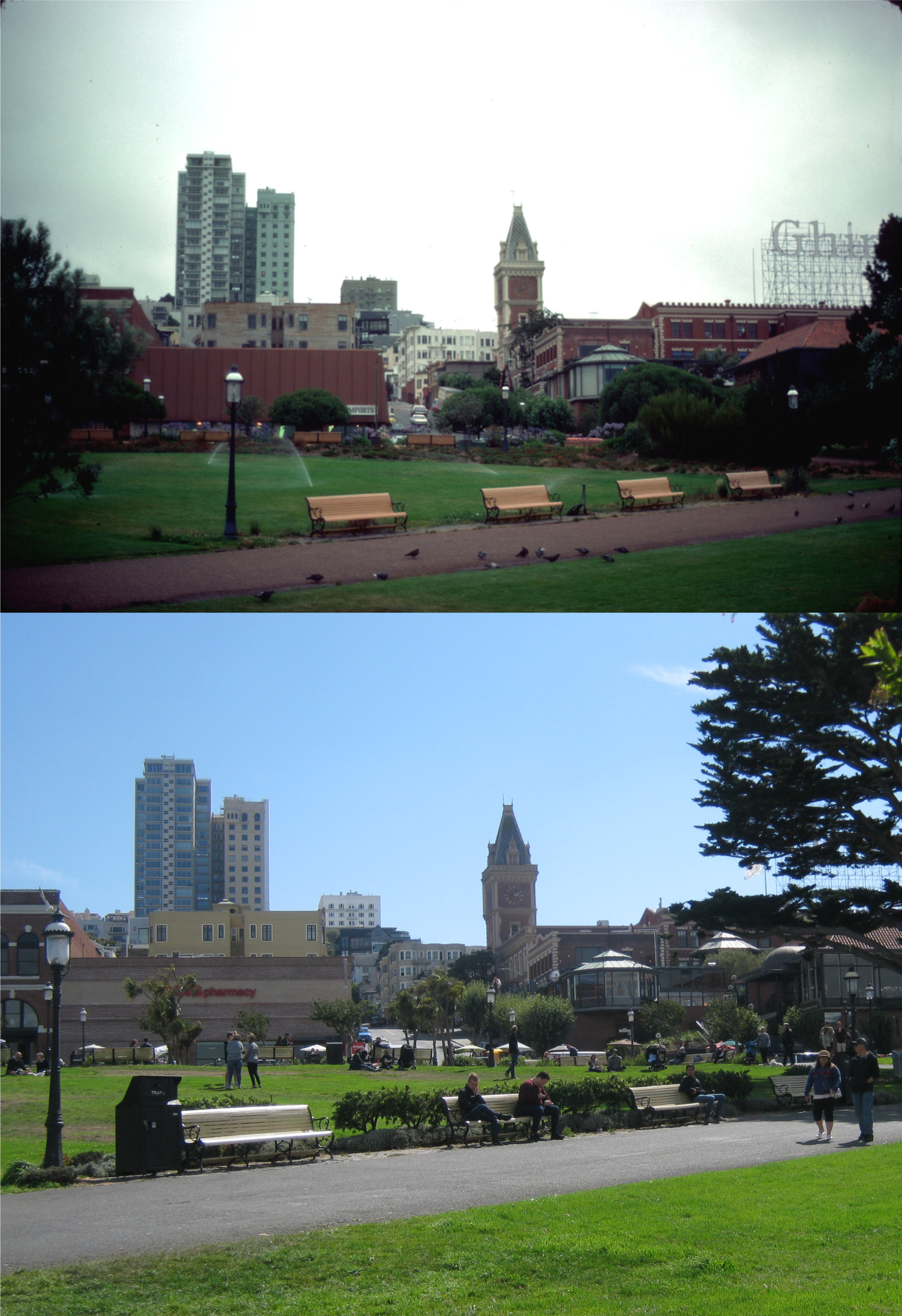 We’ve ended up in Aquatic Park. Why do I always feel like putting on a sweater when I look at Peter Stratmoen’s photos? Not much of a change here, except there was nobody in Aquatic Park; like a scene from ‘On the Beach’. Maybe it was too cold.
The Oakland Coliseum (For Jake)
For all of my Bay Area life I’ve been a San Francisco Giants baseball fan, but their season ended in August this year. The Oakland Athletics are still in the playoff running, and last night I had a chance to check out a game at the Oakland Coliseum. Unfortunately, the A’s lost, but it was still a fun night. The Coliseum is the fifth oldest baseball stadium in the Major Leagues and has a lot of history, some of which I was able to be there for.
 The top photo is heading into the ballpark across the bridge that carries passengers from BART to the Coliseum. When you’re at this point you’re heading straight toward the back of the infamous “Mount Davis”. Mount Davis was the monstrosity that Al Davis, the owner of the Oakland Raiders at the time, had built to accommodate the return of his football team back to Oakland in 1995 and forever changed the baseball field. It also replaced the bleachers that were there up until then and seen in the bottom photo from the 1980’s.
 In evening games long ago, the pretty view of the east side Oakland hills changed colors as the sun went down. Today, you get a golden view of Mt. Davis at sunset. Al Davis bailed out on his Oakland fans in 1981, and then bailed out on his Los Angeles fan base in 1995. Now his son, Mark Davis, will be bailing out on the loyal Oakland Raider fans who forgave his dad 23 years ago. After the Raiders leave for Las Vegas, I think they should blow Mt. Davis up and restore the baseball park to the way it was.
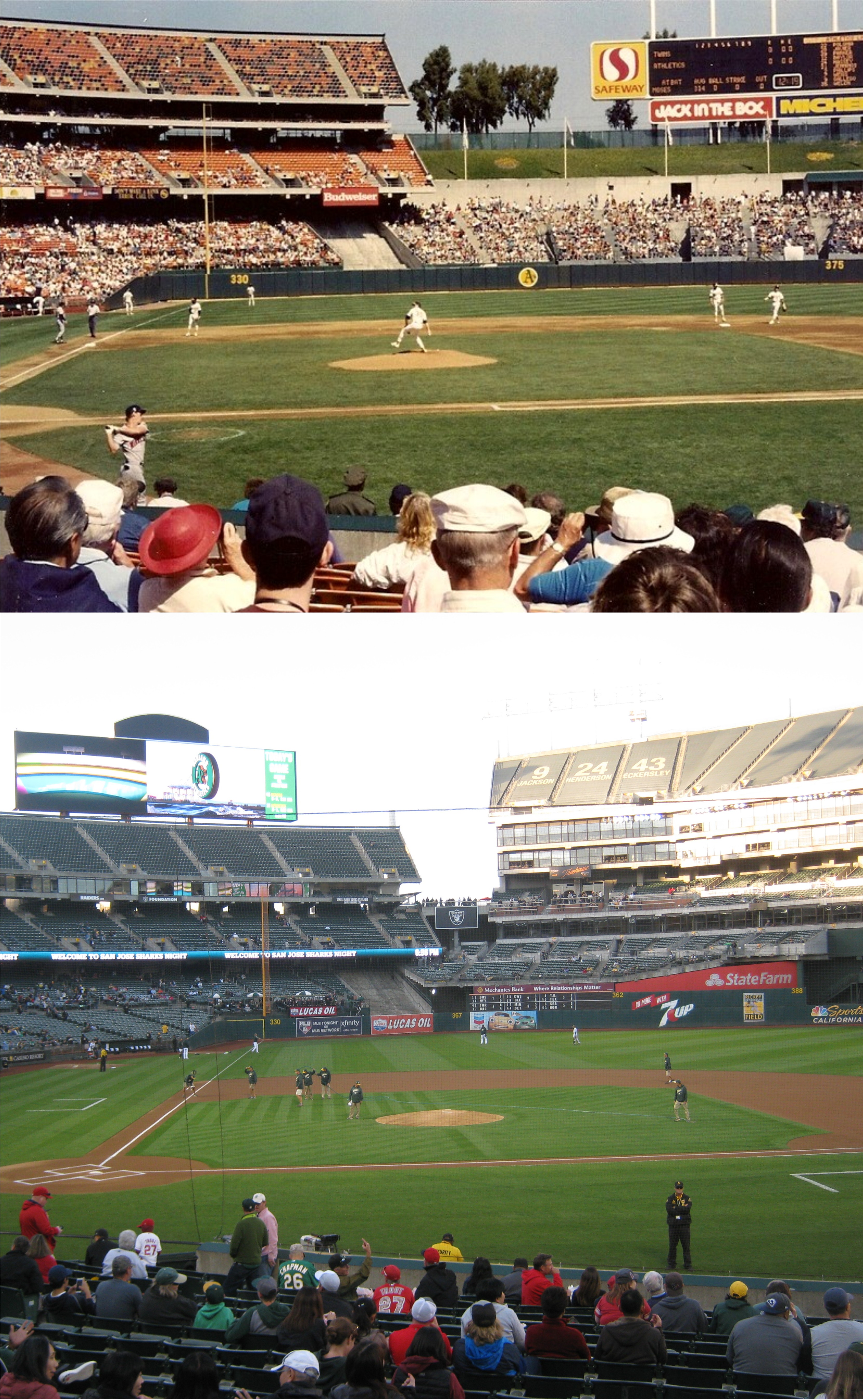 Our seats last night lined up pretty close to this early 1990’s game view. I love AT&T Park, but the Oakland Coliseum is a great place to watch a baseball game for half the price of the Giants ball yard.

 Charles O. Finley, who owned the Oakland Athletics from 1960 to 1980, came up with some of the craziest ideas to promote games, like painting the baseballs used in the game yellow. The top photo was from a 1971 “Hot Pants Day” where girls in “hot pants” got in free. The bottom photo was taken during a “Bald-head Day in the 1970’s when bald or balding men were let in free. That’s Charlie O’s mascot mule. (SF Chronicle)
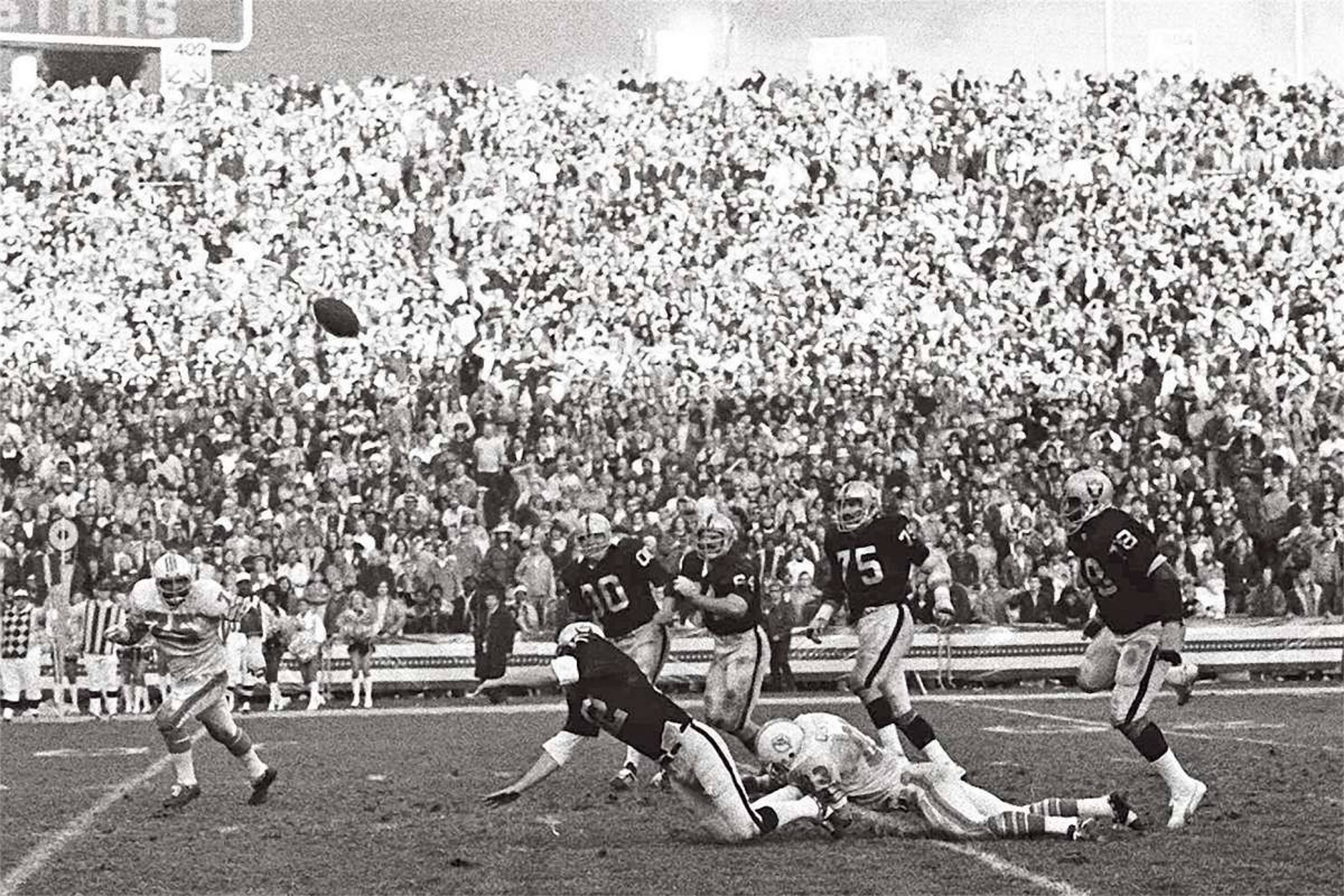 This is a great shot of Ken Stabler throwing a touchdown pass for the Raiders on his way down in a 1974 game against the Miami Dolphins. (SF Chronicle)
 In July of 1978, the Rolling Stones played to a crowd of over 64,000 people for “A Day on the Green” on Mick Jagger’s 34th birthday. (SF Chronicle)
 Balloons being released during the Rolling Stones 1978 concert over the bleachers where Mt. Davis is now: (SF Chronicle.)
 I think MVP Baseball is the best video baseball game. I used to play that for hours. If you get enough points you can play baseball games in classic baseball parks, such as Ebbets Field or the Polo Grounds. Now, I guess, they also have the old Oakland Coliseum before Mt. Davis. Imagine that!
 In 1997, interleague baseball play during the regular season was introduced. I was at the first interleague season game between the San Francisco Giants and the Oakland Athletics held at the Oakland Coliseum. They had played In July that year at Candlestick, but this was the first one in Oakland. On September 1st 1997, I was in Section 218, Row 2, Seat 19, when Barry Bonds hit a foul ball back behind home plate. I was looking around the stadium through mini binoculars and not paying attention to the game when the ball hit me in the stomach. It didn’t hurt much, but it left a bruise larger than the baseball. I remember a ton of people climbing all over me to get the ball that fell down by my feet, but my brother sitting next to me snagged it and gave it to me figuring that I had earned it. I’ve still got the ball and the fading ticket, as well.

