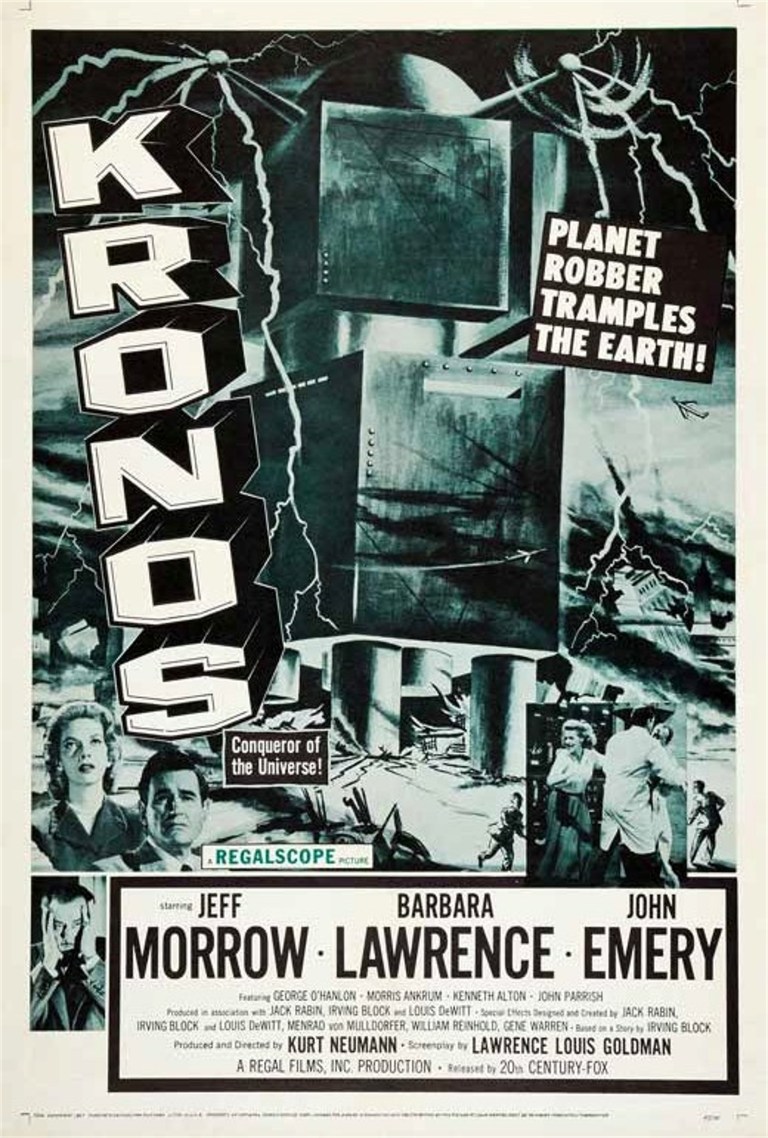
 As the story goes, and I believe it, when the 1960s skyscraper boom in San Francisco erupted and the pile drivers were heading north and destroying everything in their path, like ‘Kronos’ the Planet Robber did, the people living on Telegraph Hill got together and forced City Hall to approve an ordinance that stopped new buildings from being built north of Market Street that would block Telegraph Hill from its view of the Ferry Building. So, Kronos turned south and the result is today’s SOMA, South of Market Street, once known as “South of the slot” in reference to the cable car line that used to run down Market Street. I took a walk and bus ride around SOMA last Saturday to take some pictures, and I was also granted an audience with Emperor Joshua A. Norton. His Highness was at the new Salesforce Transit Center to rededicate a marker that was originally installed in his honor at the old Transbay Terminal Building in 1939.
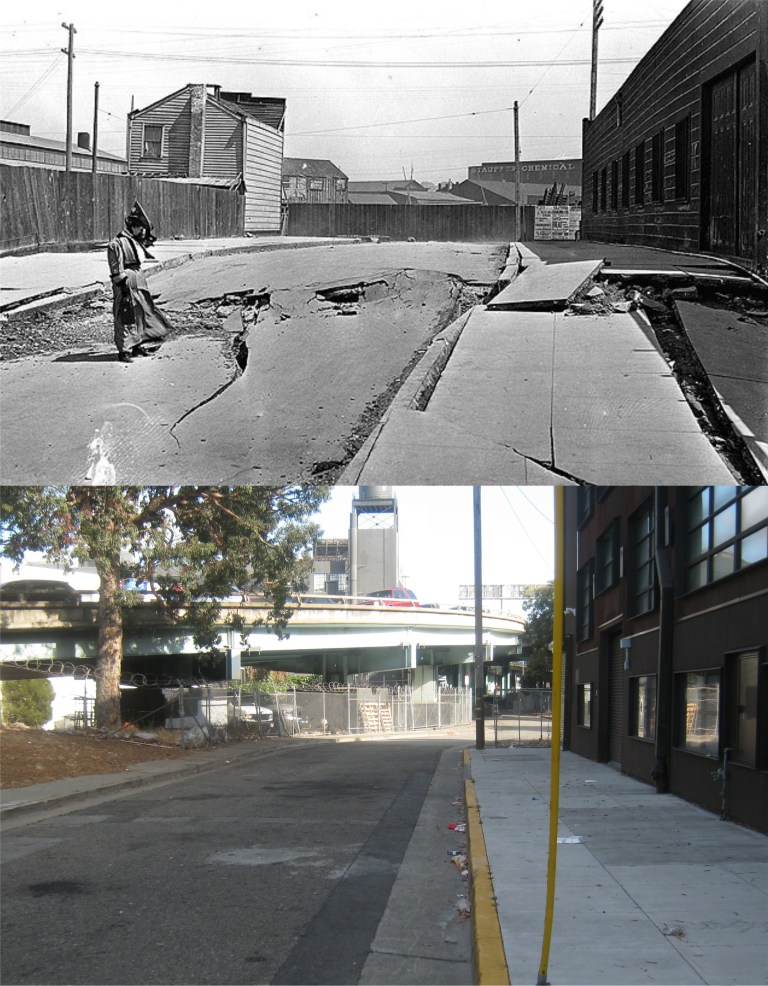 Hidden away south of Market Street is the southern end of lonely Dore Street, looking south from Bryant, just after the 1906 Earthquake. (On Shaky Ground)
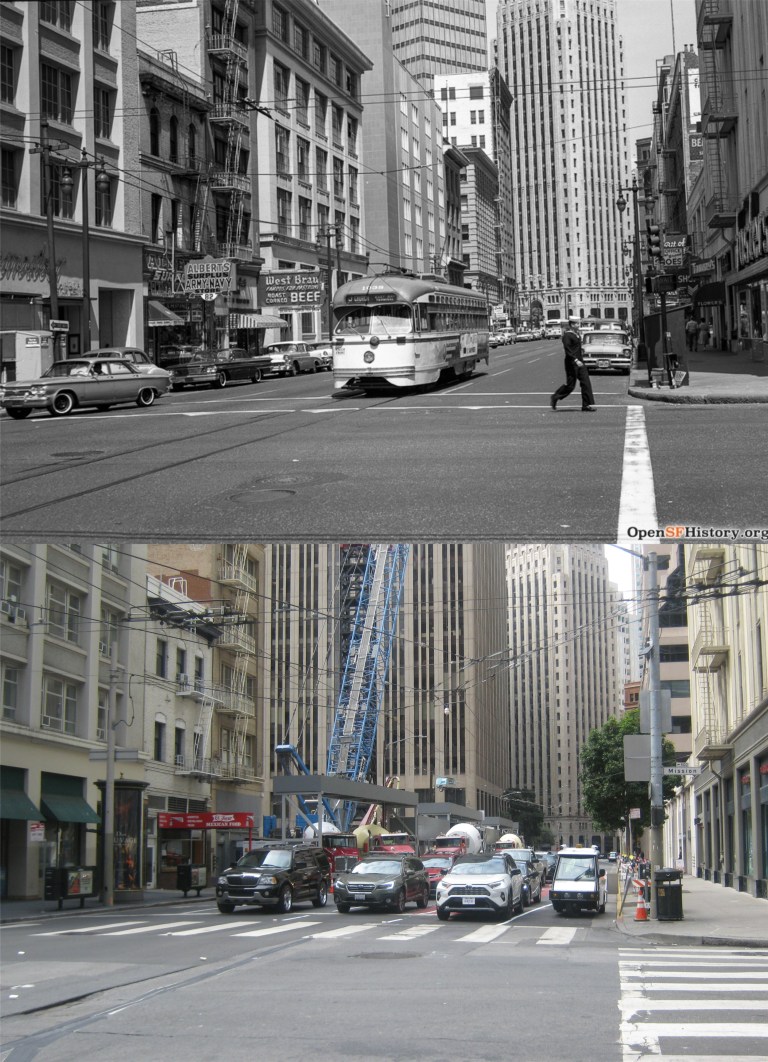 Looking north along 1st Street from Mission Street in 1962: These pictures were taken from where the Salesforce Tower is today. (opensfhistory.org)
 Looking down 1st Street from Harrison Street in 1973: This was a close of a comparison picture as I could get nowadays, trees block the view from further up 1st Street now. That Union 76 gas station in the old picture survived until just recently. The building on the far right in both pictures is the Sailors’ Union of the Pacific Hall. (opensfhistory.org)
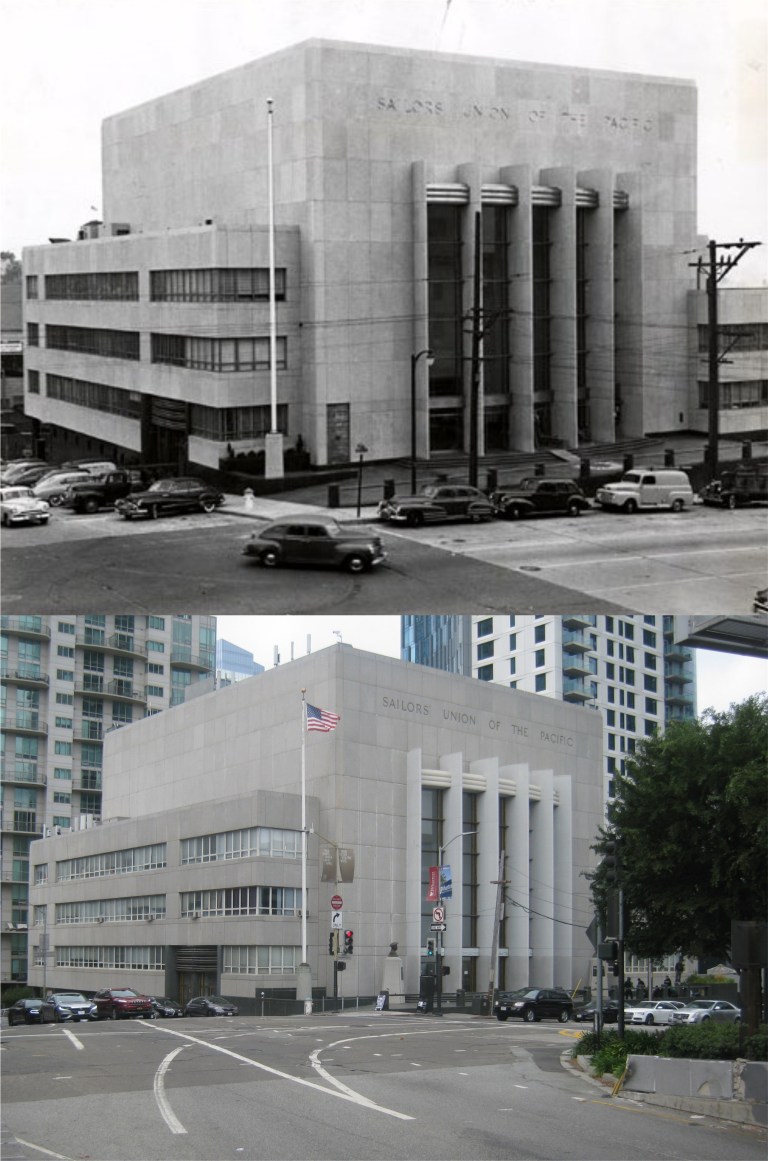 The Sailors’ Union of the Pacific Hall in the 1950s: The building was built in 1950. (FoundSF)
 The lobby of the Sailors’ Union of the Pacific Hall: This building is a gem compared to some of the buildings they’re slapping up around here today.
 Howard Street near 6th St. in 1980, before the SOMA boom started. (Janet Delaney)
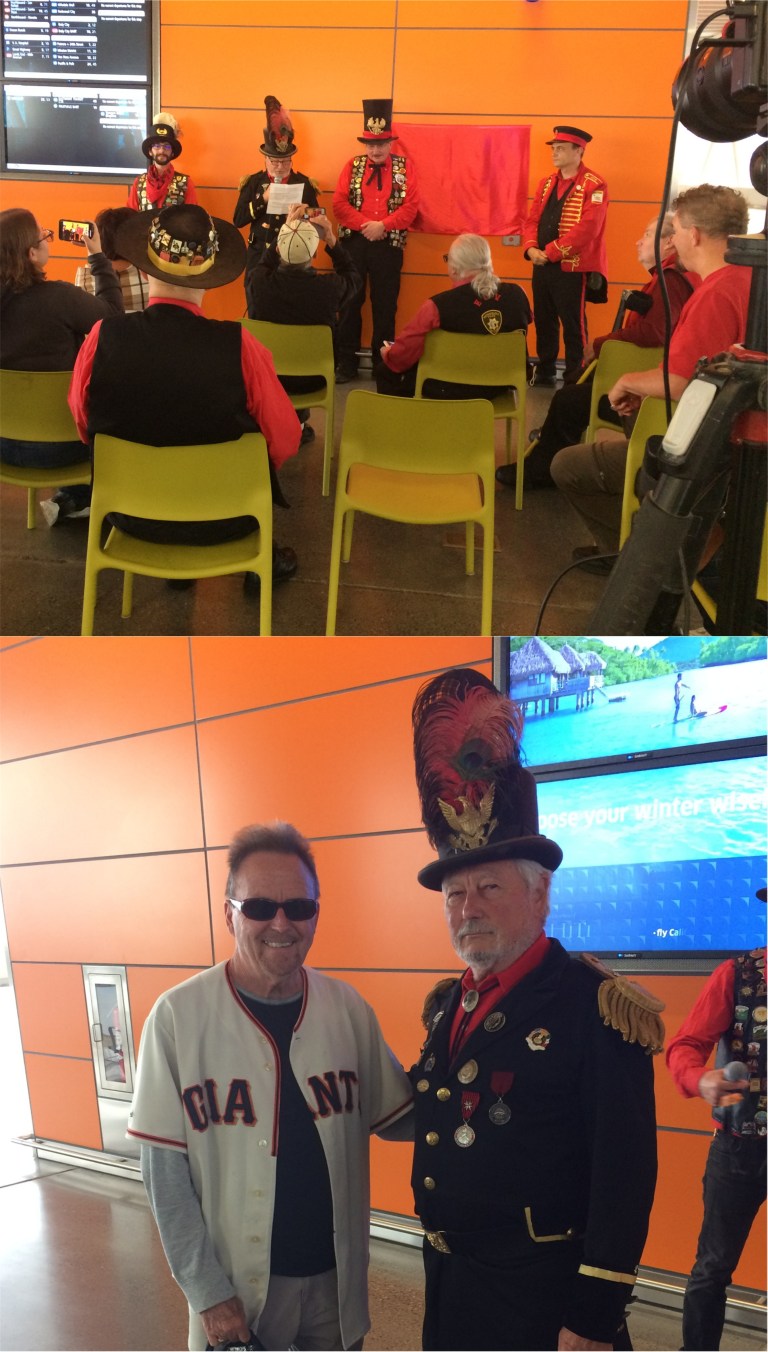 Emperor Joshua Norton at the ceremony in the new Salesforce Transit Terminal rededicating a marker that was placed in his honor in 1939 at the old Transbay Terminal, demolished in 2010: Emperor Norton was a whimsical lunatic, (maybe, or maybe he was just pretending) who came to San Francisco in 1859 proclaiming himself to be the Emperor of the United States, and San Francisco honored him as such until he died in 1880. He was one of the most colorful characters from San Francisco’s history. One of his proclamations decreed that two bridges were to be built someday, one from San Francisco to Oakland, and one from San Francisco to Marin County. San Franciscans must have really got a kick out of that, but guess what……
 The Emperor Norton marker placed in the Transit Center on Saturday. Those streaks are from an expensive bottle of champagne used for the Christening.
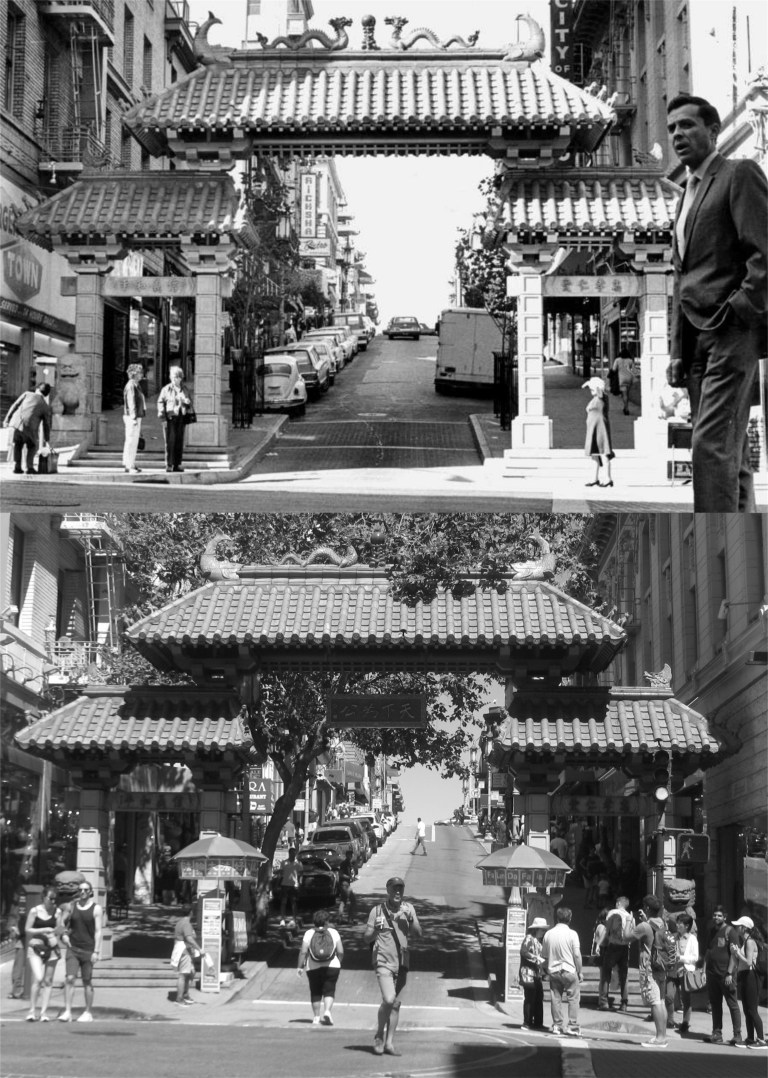 There are many streets to enter Chinatown by, but most visitors prefer the entrance gate at Grant Avenue and Bush Street, seen here around 1969 when it was built.
 I usually like to take the Number 1 Muni up Sacramento Street to Stockton Street, cross over to California Street and walked down to Grant Avenue; less uphill walking. In the vintage picture from the 1950s you can see the old Fireman’s Fund Insurance Company Building, built to look like Philadelphia’s Independence Hall. Now, why did they get rid of that? (ebay.com)
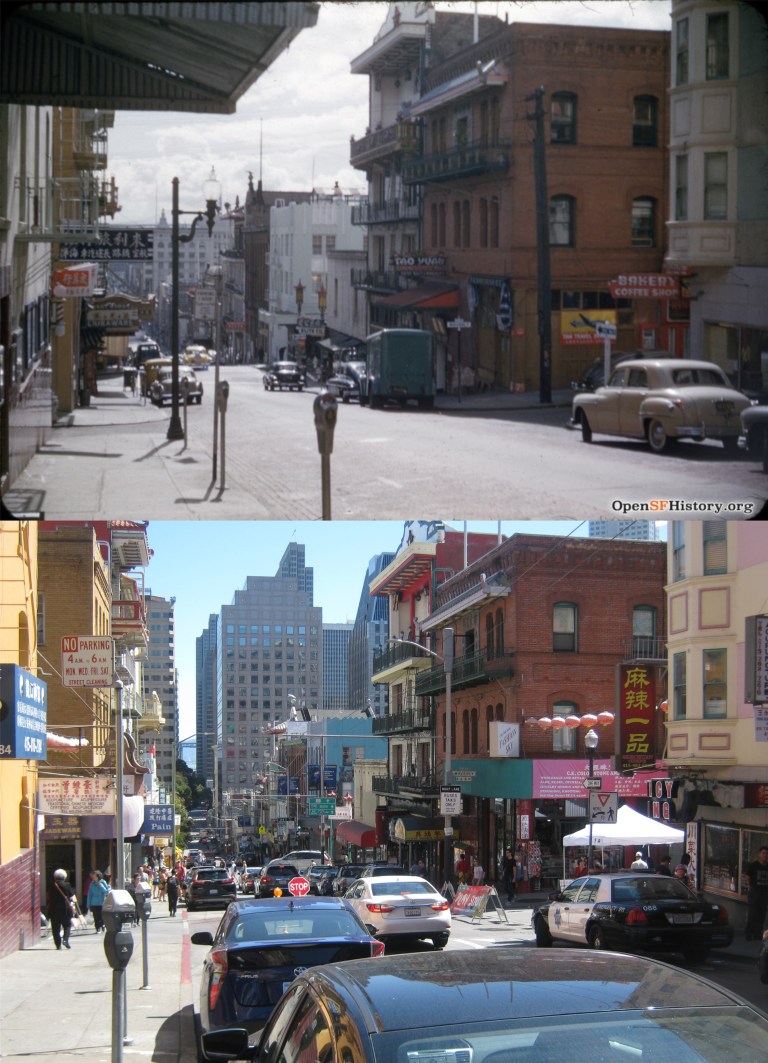 Looking down Clay Street toward Waverly Place in 1954: (opensfhistory.org)
 This was the street festival in Waverly Place being set up that I mentioned earlier. The top photo is looking north from Clay Street to Washington, the bottom one is looking south from Clay to Sacramento Street. I think that eventually was going to be a dragon in the bottom photo.
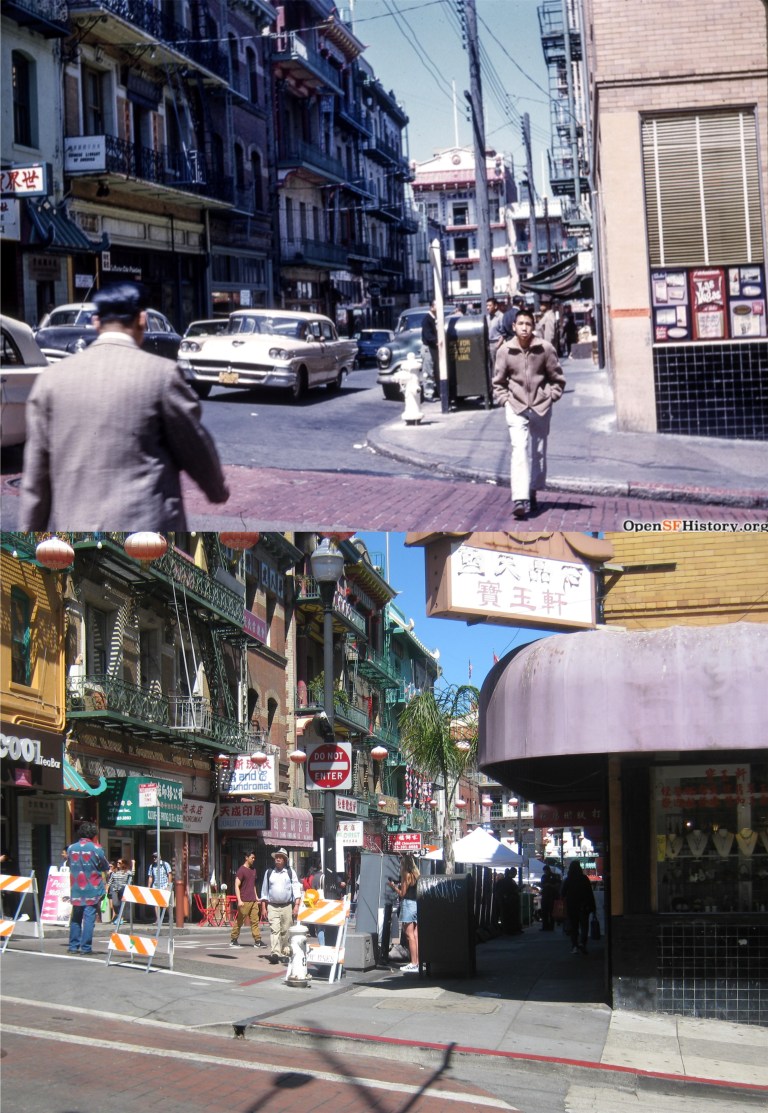 Waverly Place looking toward Washington Street in 1962, and last Sunday as the festival was getting started: (opensfhistory.org)
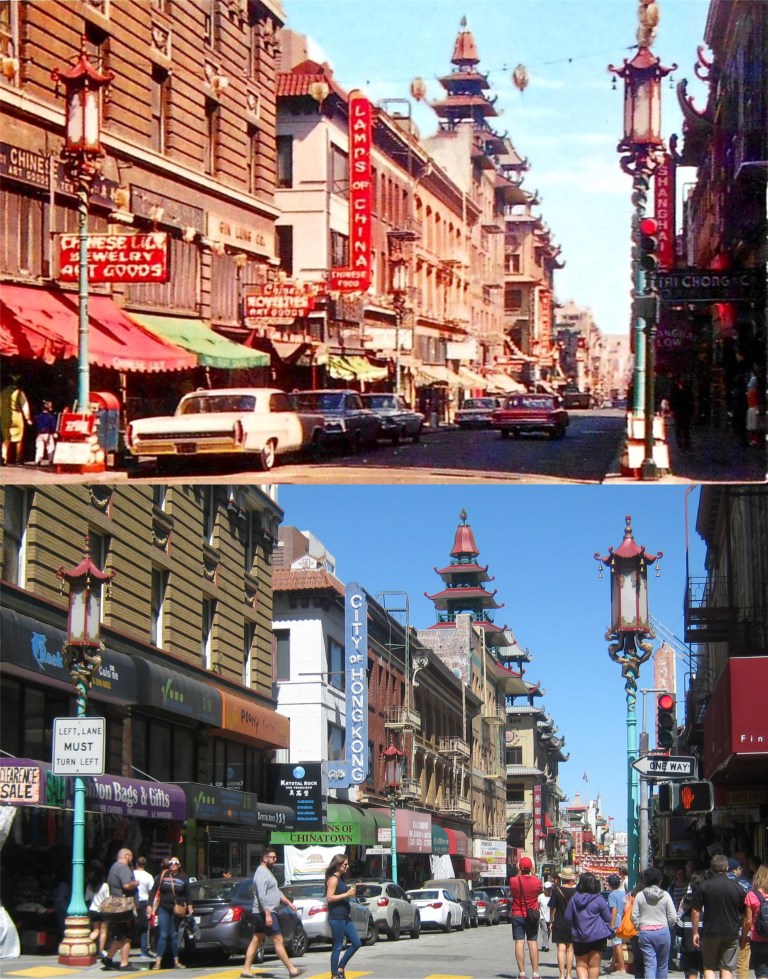 If you do head up Grant Avenue from Bush Street, you’ll come to Pine Street, seen here in an old postcard from the 1960s. The signs for the Lamps of China Restaurant, and Shanghai Low’s, both long gone Chinatown institutions, can still be seen. (Deviant Art)
 Another look at Grant Avenue and Pine Street from the 1940s: (Curbed SF)
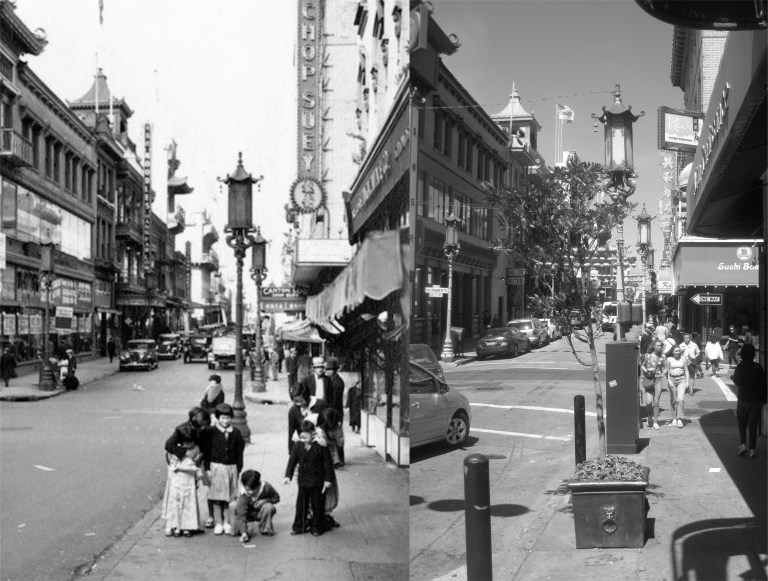 Children playing on the sidewalk on Grant Avenue near Sacramento Street in the 1930s, around the time that the quaint lampposts were installed: (Curbed SF)
 Grant Avenue looking north from Washington Street on a rainy 1930s day: The Rice Bowl Football Game was a benefit in the late 1930’s to raise funds for relief to the people in China suffering from a famine at the time, and also from the country’s invasion by Japan. (FoundSF)
 We’ll start with an old 1906 postcard showing a Labor Day parade on Market Street. Although it’s dated 1906, if Labor Day was observed in September back then, the parade must have been in 1905, as most of this area was destroyed by the 1906 Earthquake and Fire in April of that year. The Emporium Building on the right in the old photo was gutted by the fire and rebuilt. The Call Building in the background of the postcard survived the earthquake and was remodeled in the 1940’s. It’s behind the domed Humboldt Building that’s above the girl in the white hat. The Humboldt Building was built in 1908. (picryl.com)
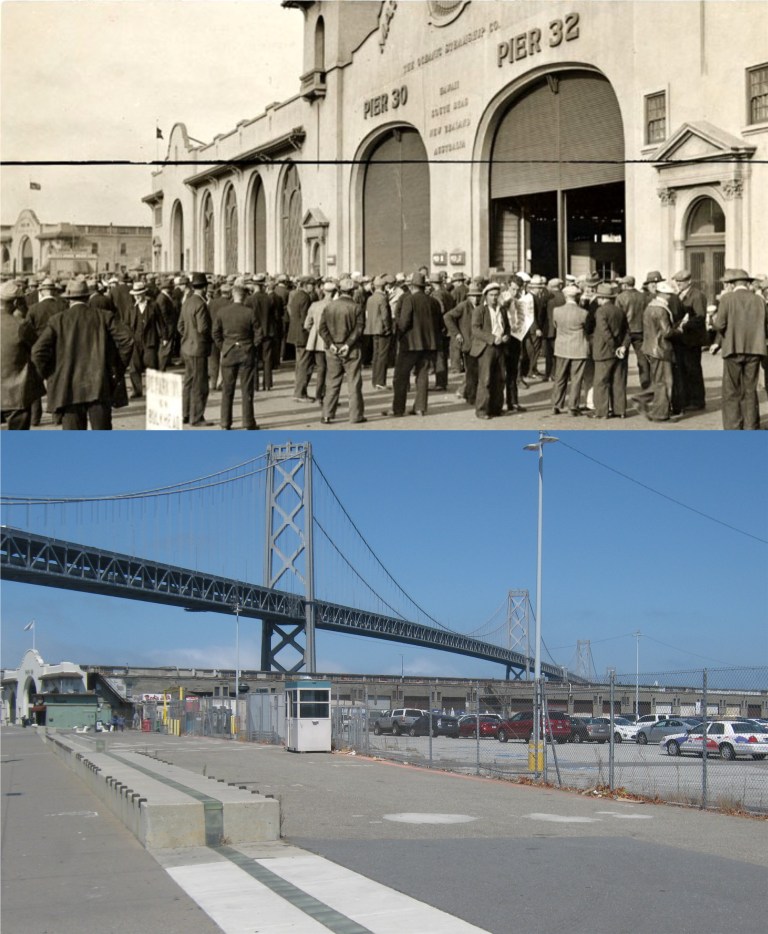 A stevedore strike in 1933 in front of Piers 30 and 32 on the Embarcadero south of the Bay Bridge: Piers 30 and 32 have been demolished now, but you can still see Pier 28 in the far background on the left in the vintage photo and in my picture. (FoundSF / San Francisco History Center)
 California Street at Van Ness, looking west in 1957: Wow, construction work on Van Ness! How novel is that today? Just kidding; I’m sure that their doing the best they can. This was another one where I could have got a better comparison with a long-focus lens, but that wouldn’t fit in my pocket as well as my digital day-tripper does. (SFMTA)
 A detour at Market and 5th Streets in 1968: The detour was caused by the construction of BART under Market Street. (SFMTA)
 Dock workers relaxing near Pier 24 in the 1940s in a comparison picture I did a few years ago: Pier 24, demolished now, used to run right out to the Bay Bridge tower.
 16th and Illinois Streets looking east in 1925: The vintage picture was taken from the top of the 3rd Street viaduct that carried streetcars past here back then. “Via duck? Vi not a chicken?” You’d have to be a Marx Brothers fan to remember that one. That’s the Chase Center on the left, the new home of the Golden State Warriors, that the workers are finishing up on. Chase Center, where the LOOP sign was in the vintage picture, is scheduled to open September 6th this month. (opensfhistory.org)
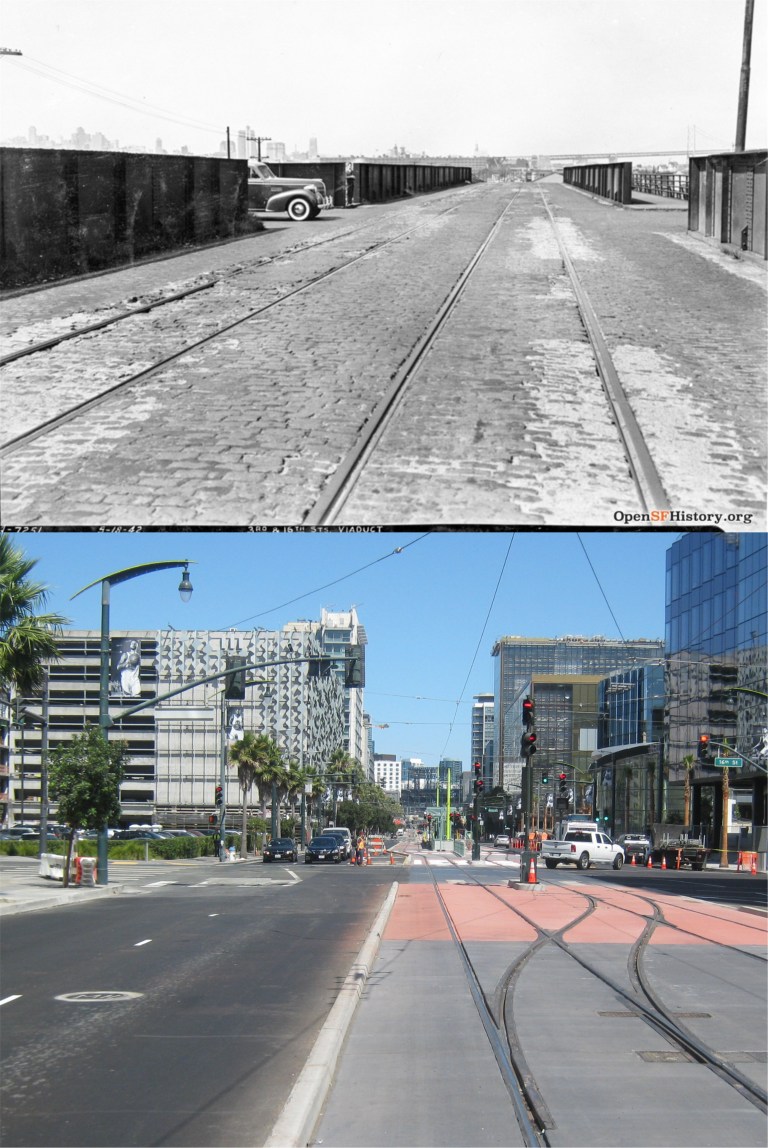 3rd at 16th Streets on the streetcar viaduct, just west of where Chase Center is now, looking north in 1942: What a change! (opensfhistory.org)
 A war bonds drive in front of Commodore Sloat Elementary School at Junipero Serra Blvd. and Ocean Ave. during World War Two: “We’re all in this together.” Sometimes, that applies to nowadays, as well; I hope! You can see some of the houses in the vintage picture across Junipero Serra Blvd. behind the eucalyptus trees in my picture. (commodoresloat.com)
 A closer look at some of the houses across Junipero Serra Blvd. seen in the previous vintage picture: These are what a lot of people go to work for. It would be nice to buy one for what they would have cost in the old photo.
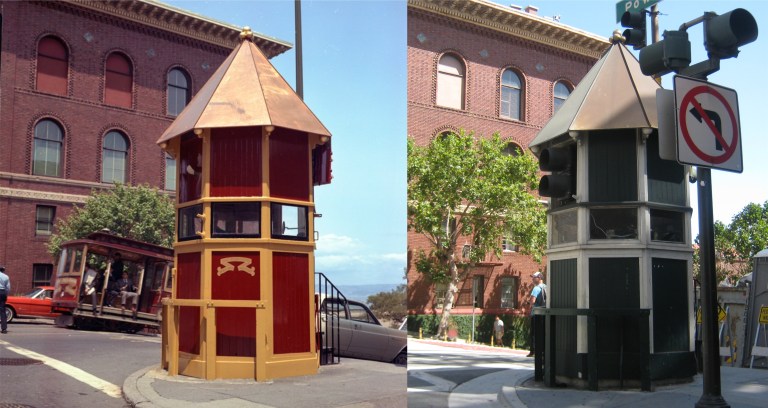 Saturday morning, 9:00 AM to 12:00 PM: Already hot by nine o’clock.
 Still plenty of sunshine at 11ish AM to get a nice comparison with this 1950s photo before the shadows creep into the intersection of California and Powell Streets. (Vintage Everyday)
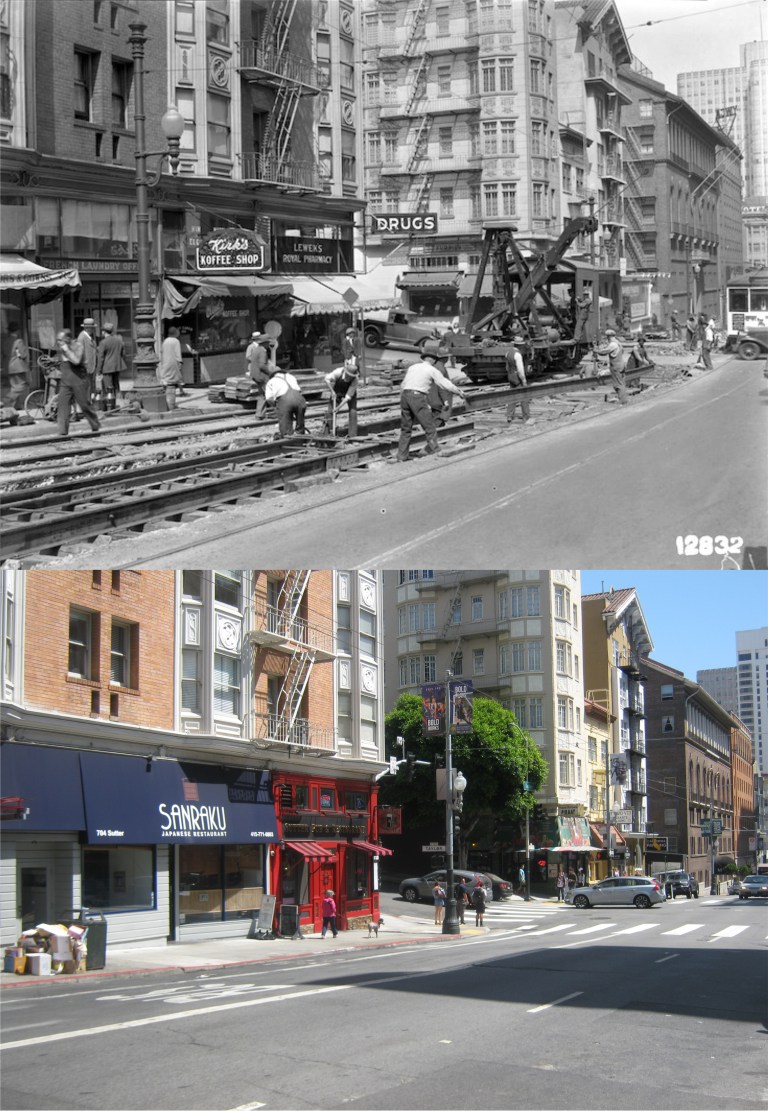 Long gone streetcar tracks being laid down on Sutter Street near Taylor in 1931: (SFMTA)
 After breakfast at Tad’s Steak House on Powell, I caught the end of the morning around noon for this 1949 update at Market Street near 5th. (SFMTA)
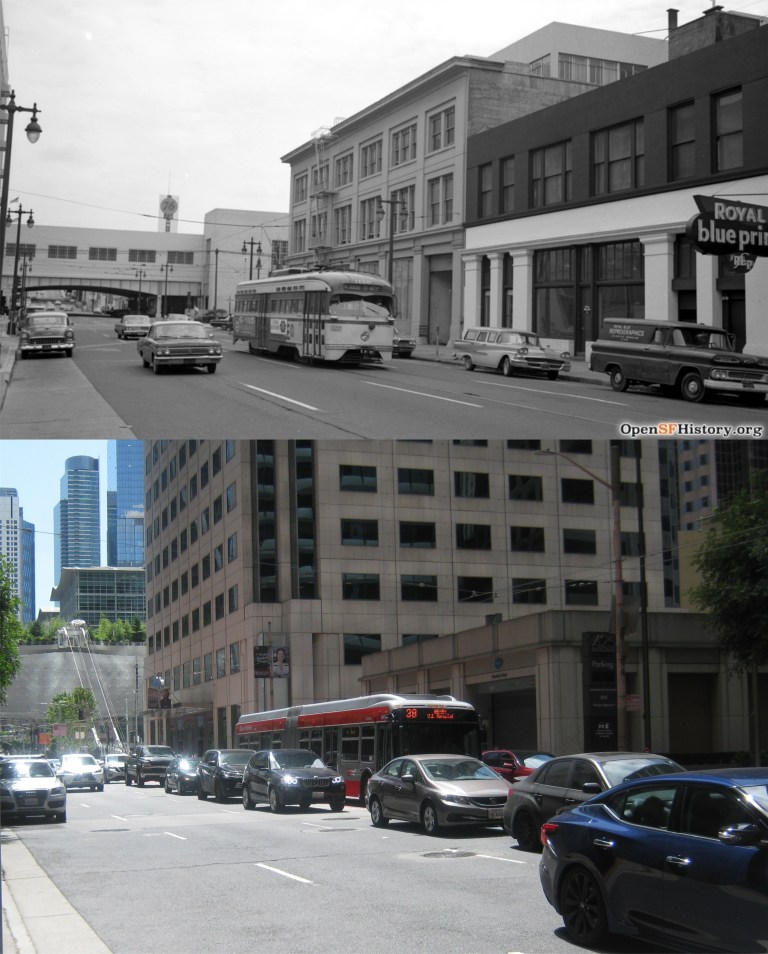 Sunday afternoon, 12:00 PM to 4:00 PM: Still warm to hot, but cooled down a little.
 Construction work nearing completion on the old Transbay Terminal in 1938: As I mentioned last August, I think the new one is a beautiful transportation terminal, and it’s great to hear the noise buses make indoors when they pass by. It reminds me so much of the old terminal building. (opensfhistory.org)
 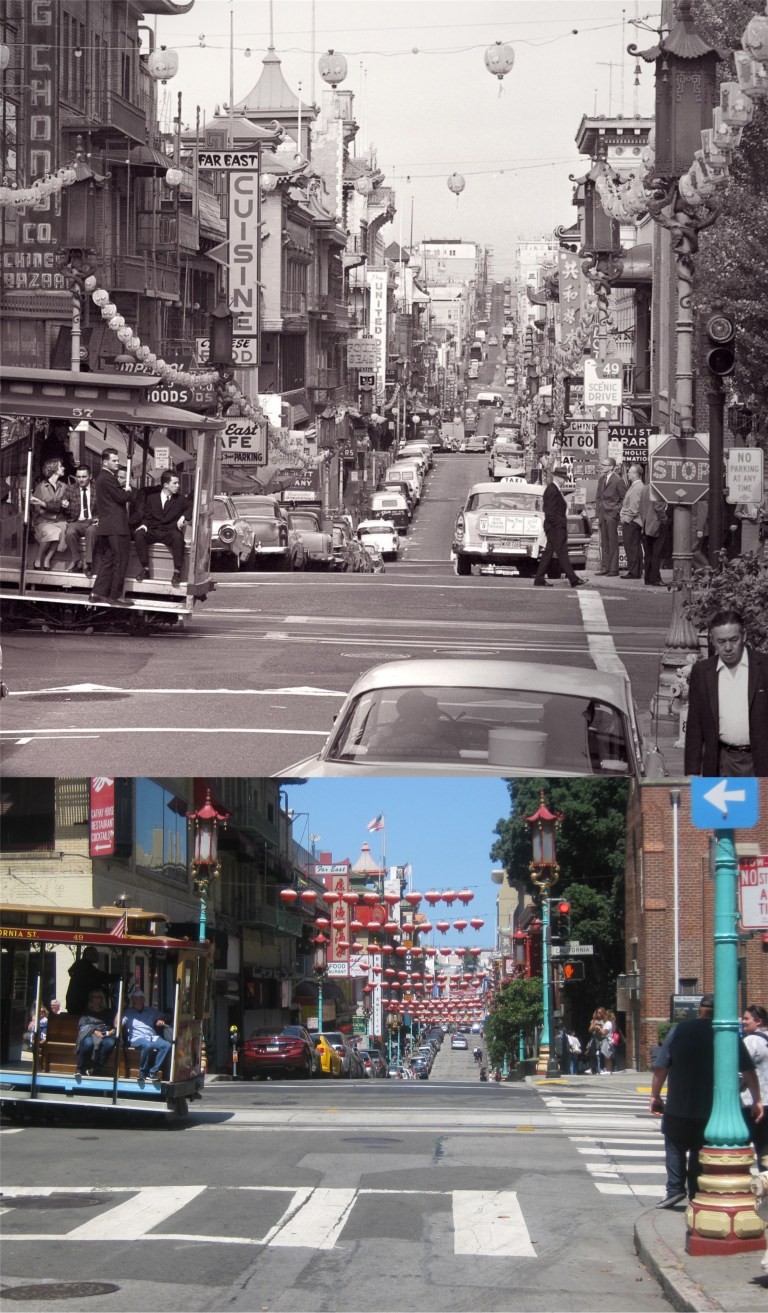 Grant Avenue and California Street in 1961: I got a decent lineup, but I needed a long-focus lens to make this one worthwhile.(SFMTA)
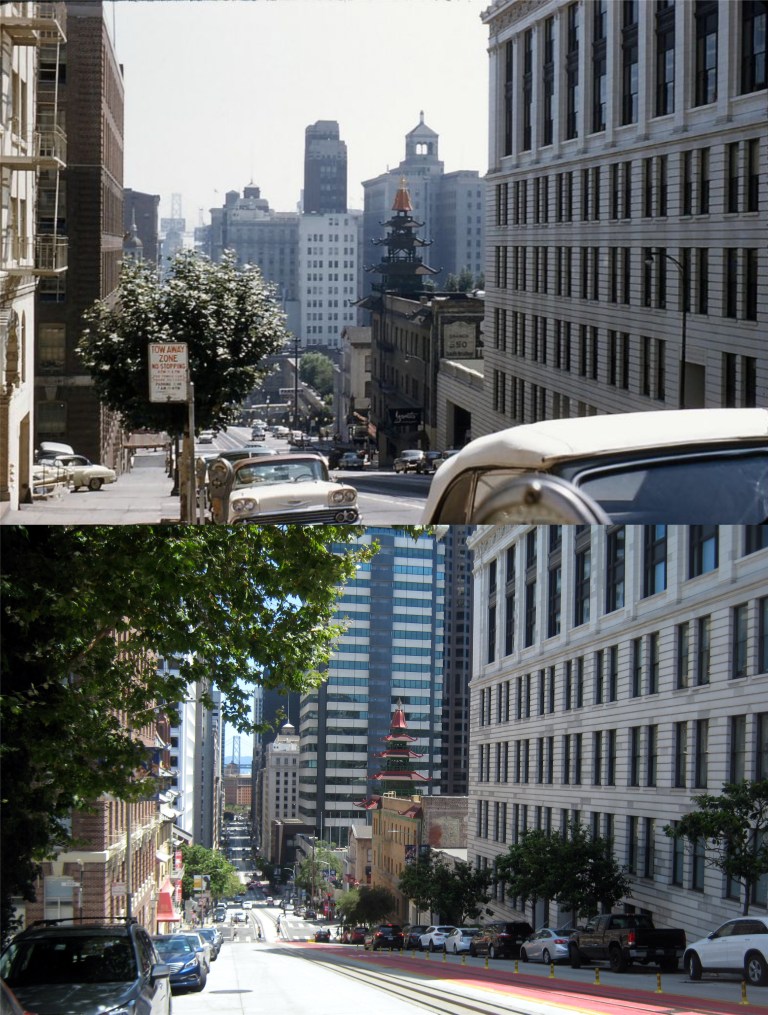 Looking down California Street from Stockton Street in the 1950s: (Vintage Everyday)
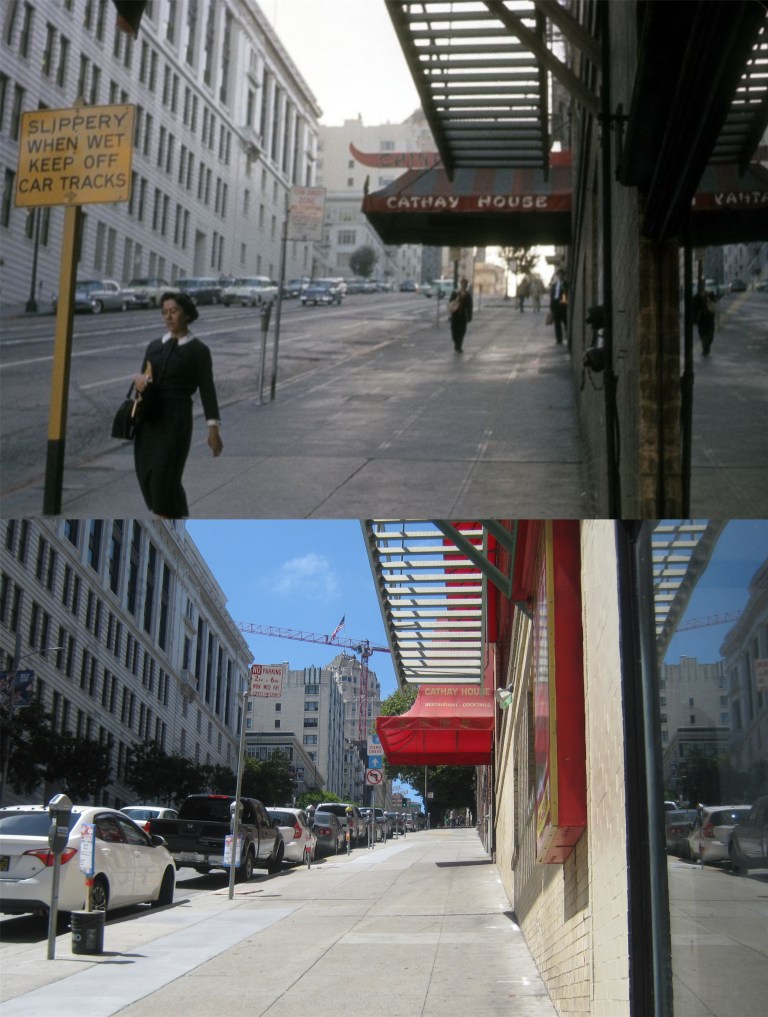 Looking back up California Street toward where the previous pictures were taken in the 1950s: There’s something about this vintage photo that makes it my favorite in the set. (Vintage Everyday)
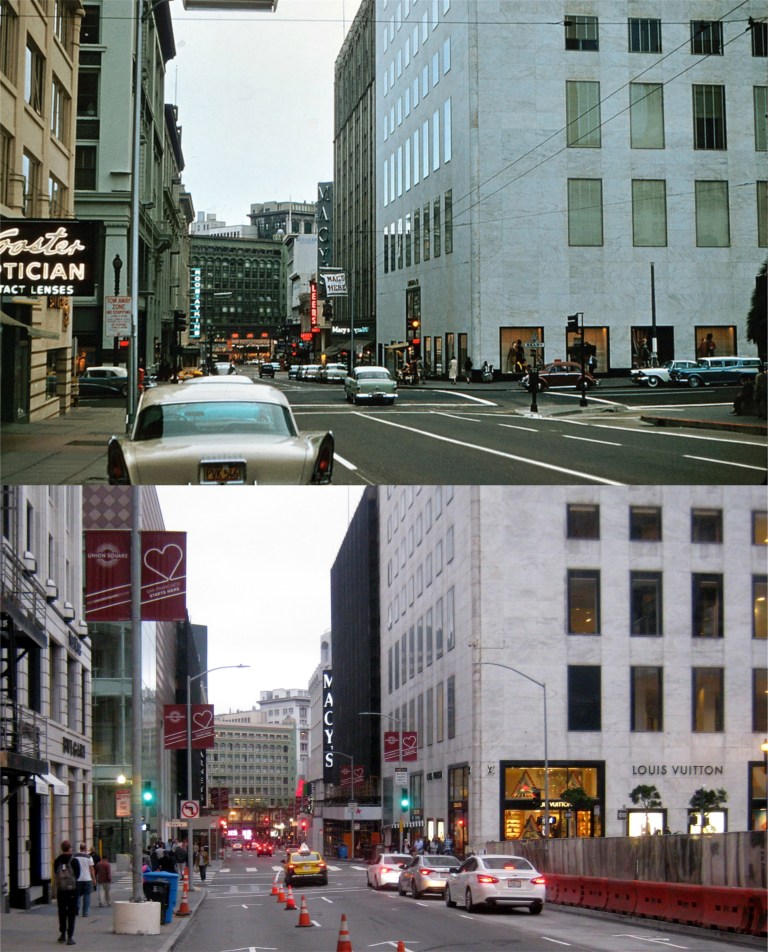 Monday evening, 5:00 PM to 9:00 PM: It cooled off into a pleasant summer evening.
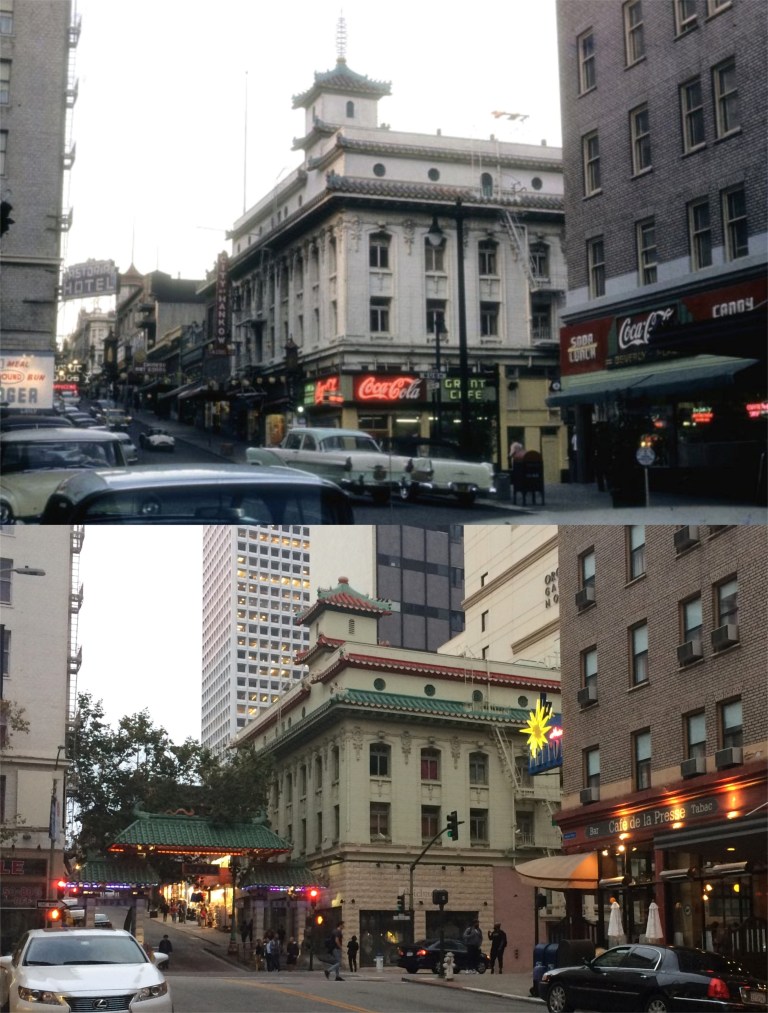 Approaching Chinatown at Grant Avenue and Bush Street in the 1950s: The lights are starting to come on in the City in both pictures. (Vintage Everyday)
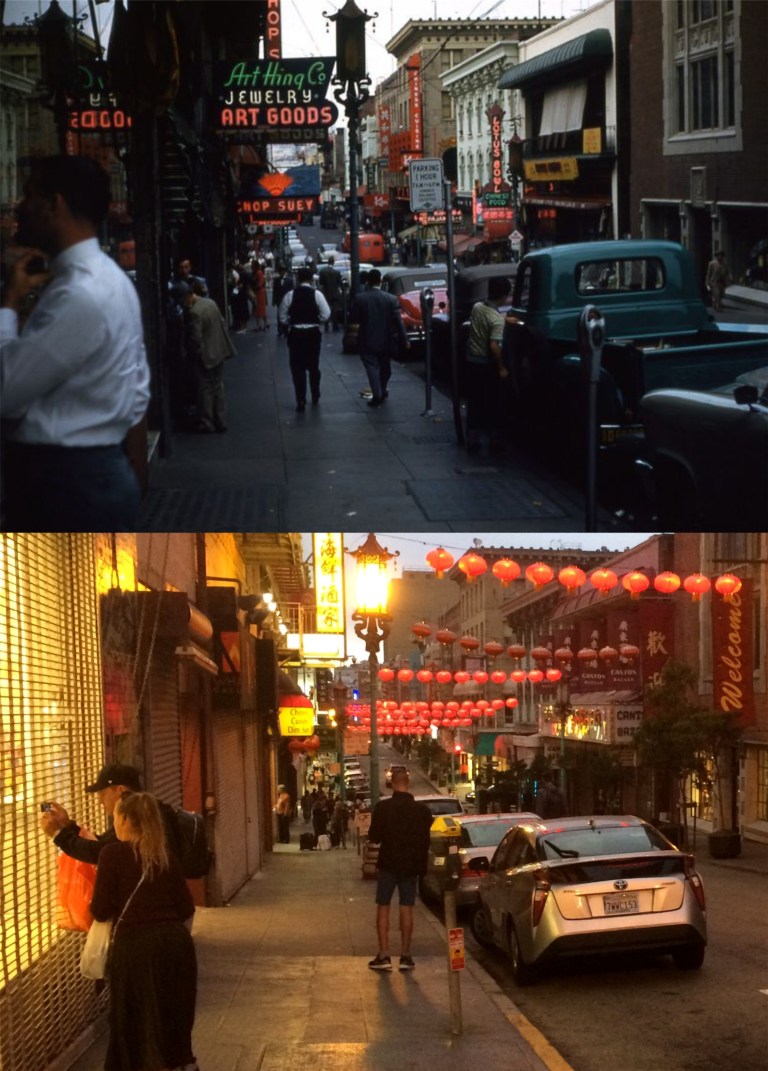 Grant Avenue between California and Sacramento Streets as evening approaches in the 1950s:
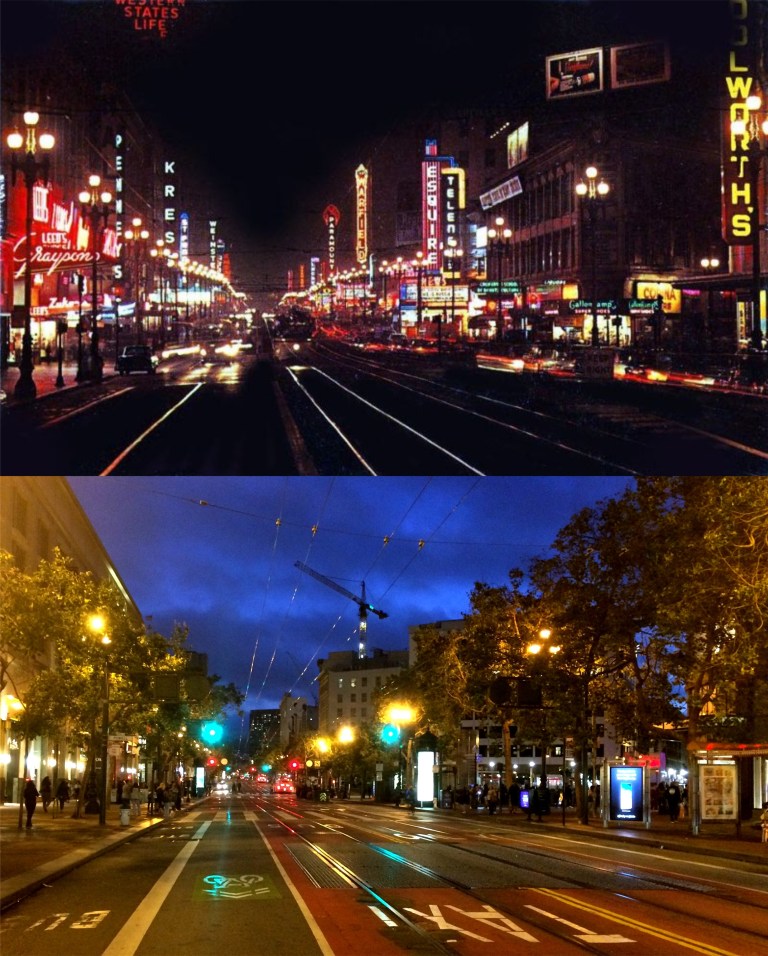 The end of a perfect day(s). Market Street at Powell in the 1950s; San Francisco’s “Great White Way”: Look at all the movie palaces that were gone by the 1980’s; the Telenews, the Esquire, the Paramount, the Fox Warfield. Over on the left near where the Powell street sign is in my picture was where the elegant Grayson’s was. The Nordstrom Department Store is here now. On the right was where the flagship Woolworth’s San Francisco store was located in the old Flood Building from the 1950’s to the 1980’s.
 A streetcar turns onto First Street from Market in the 1960’s heading toward the Transbay Terminal. Buses are returning into the new Transit Terminal this weekend, but no more streetcars. That’s the Crown Zellerbach Building with its novel turquoise blue shades in the background. (Market Street Railway)
 California Street at Grant Avenue in the 1950s: You can have the patience of Job but I don’t think you’ll ever get a shot of two cable cars lining up here going up and coming down from Nob Hill. I don’t think they do that anymore; at least not while I waited. (Vintage Everyday)
 Huntington Park on Nob Hill looking toward the Mark Hopkins Hotel in the 1958: (Vintage Everyday)
 Grant Avenue in Chinatown between Pine and California Streets in 1965: That’s Old St. Mary’s Church in the background. The sign from the old Shanghai Low nightclub and restaurant is still there. Orson Welles stumbled past Shanghai Low’s while hiding from the police in the 1947 film ‘The Lady from Shanghai’. (etsystatic.com)
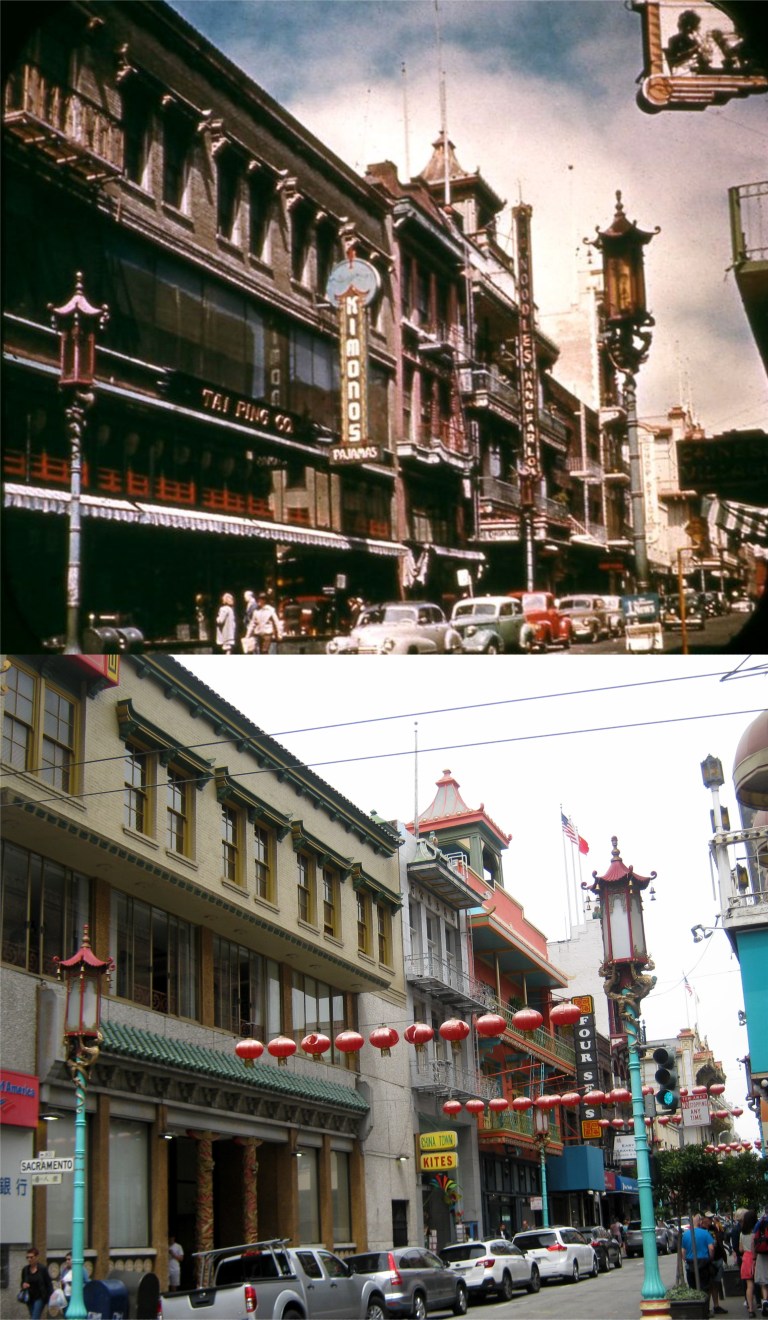 Also in Chinatown, Grant Avenue between Sacramento and Clay Streets in the late 1940s.
 Looking down Clay Street from Powell in the 1950s: (Vintage Everyday)
 Children at the cable car turnaround at Bay and Taylor Streets in the late 1950s: (Vintage Everyday)
 Lombard Street in 1959: (Vintage Everyday)
 Looking down Hyde Street between Francisco and Bay Streets in the late 1950s or early 1960s: Look at that spooky looking fog devouring Alcatraz in my picture. (theoldmotor.com)
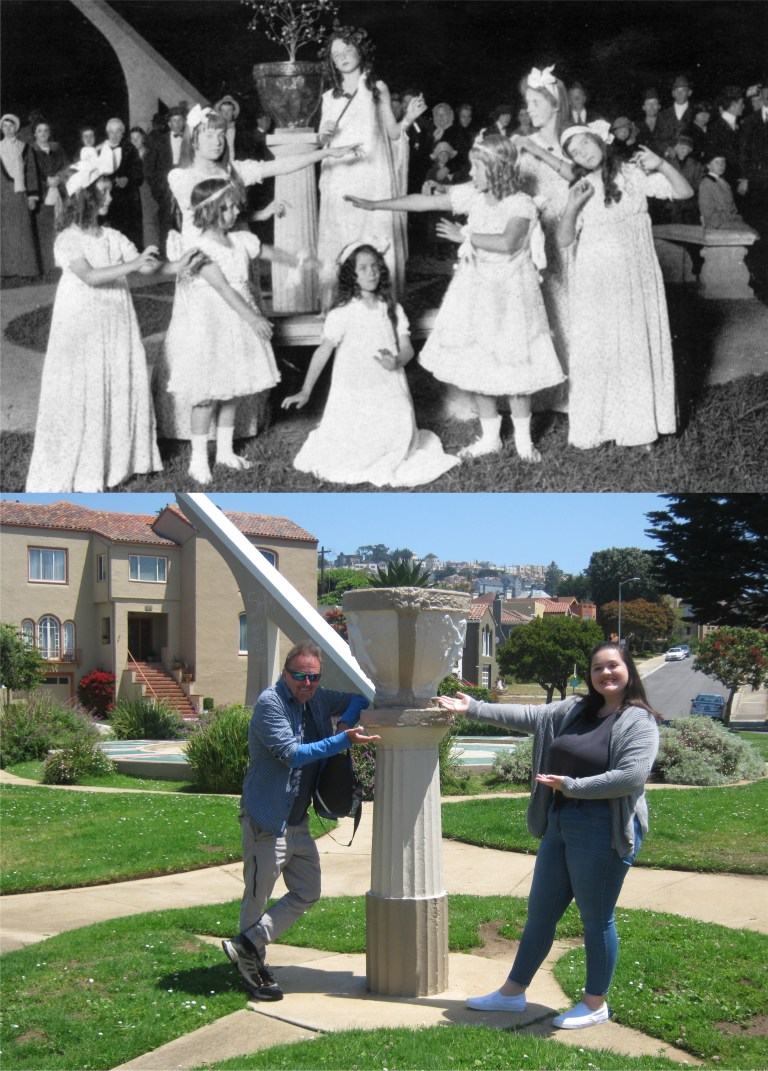 “So what do you guys want to see, the Golden Gate Bridge, Chinatown, Fisherman’s Wharf, Golden Gate Park, the largest sundial in the world?”
 “And you brought us to this boring spot, because?”
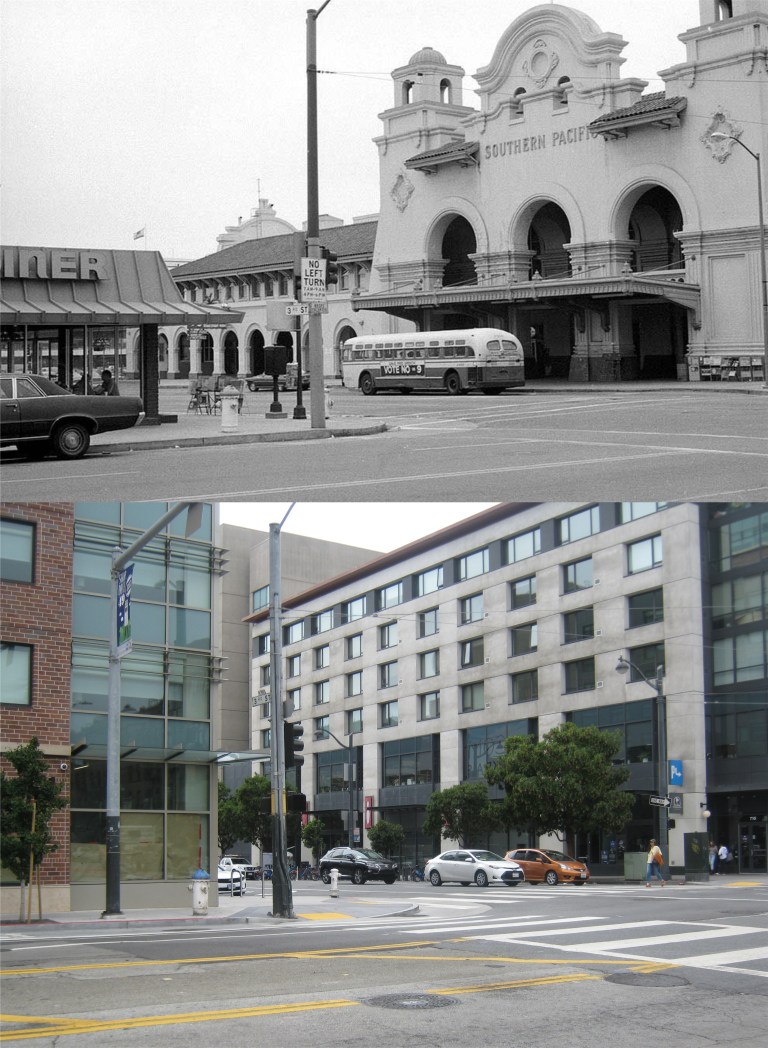 “Hey, you said you were taking us to a famous movie location in San Francisco!”
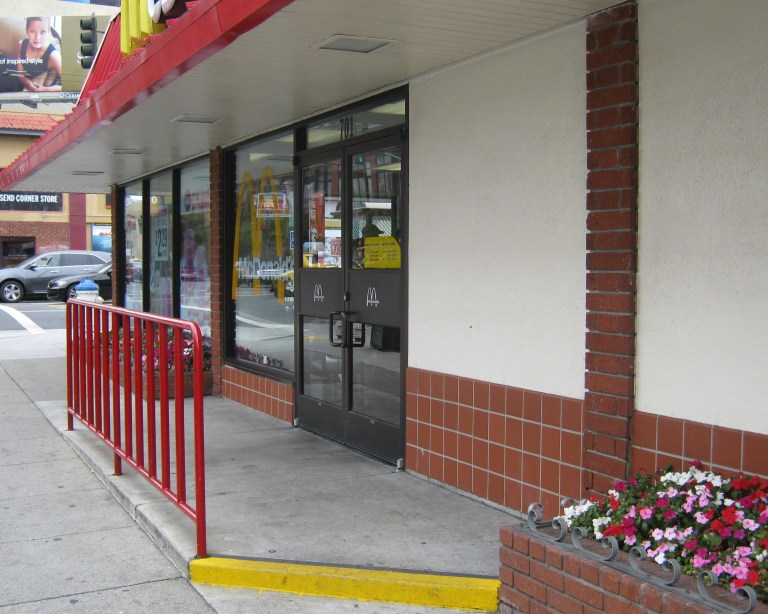 The ‘Sudden Impact’ restaurant was still around as a McDonald’s last time I visited the spot, but it’s been knocked down now and a new building has replaced it. That didn’t “make my day”.
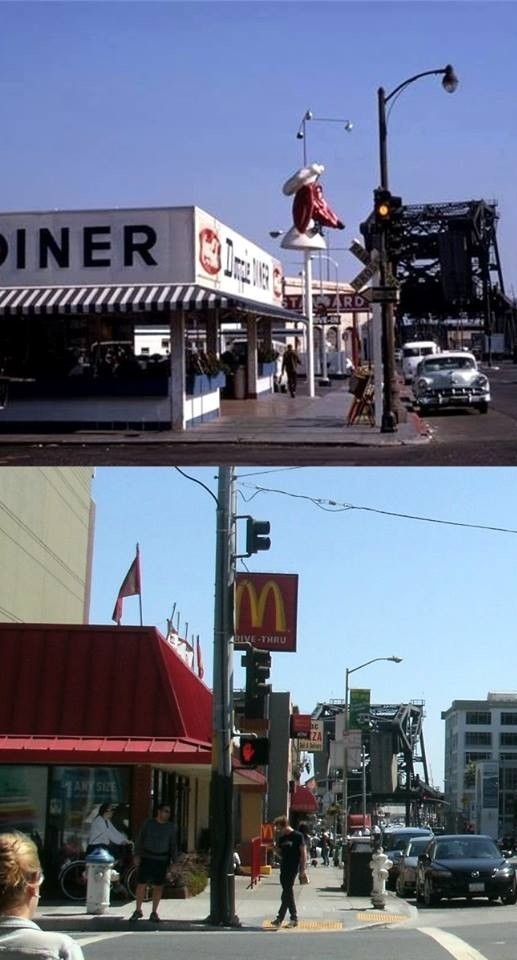 Here’s a picture I posted in February of 2016 showing the McDonald’s.
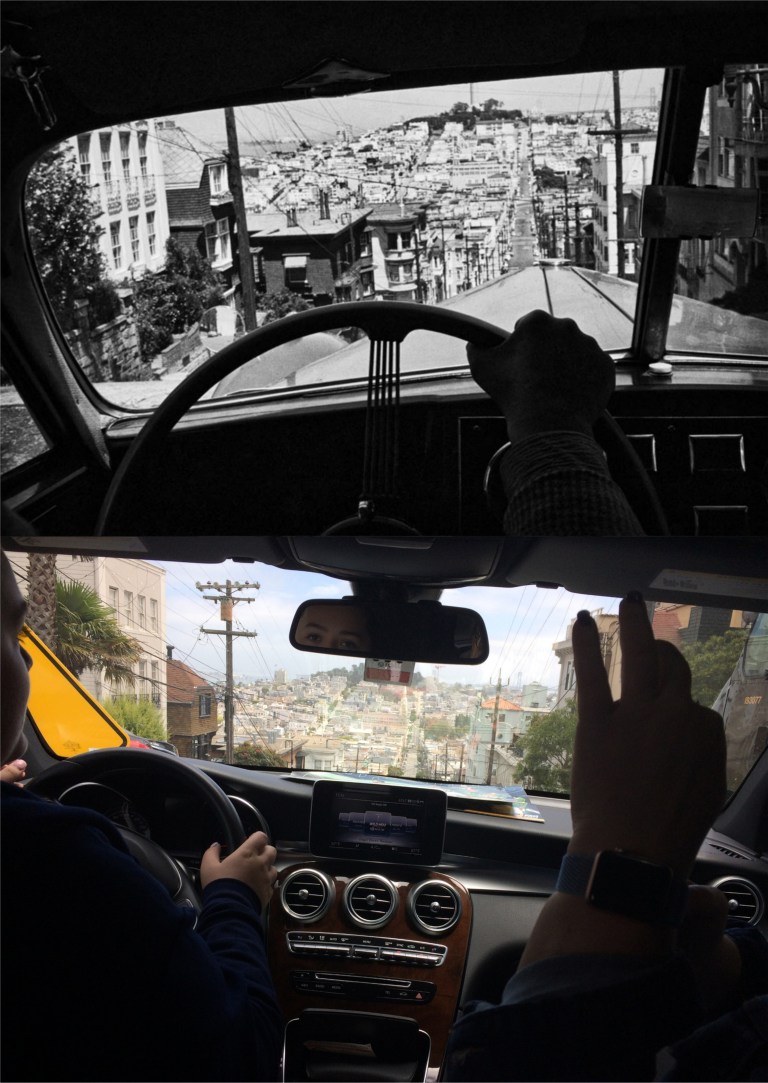 “Uncle Tim, this isn’t Lombard Street!”
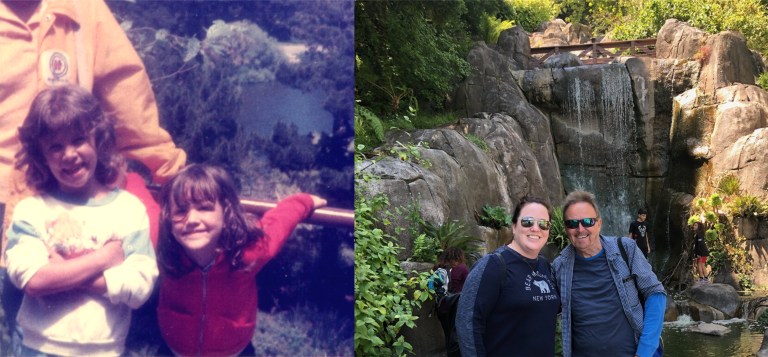 Some of these locations were personal. The little tyke in the red jacket I took a picture of at the top of the waterfall at Golden Gate Park’s Strawberry Hill in the 1980’s is the grown up tyke with me at the bottom of the waterfall.
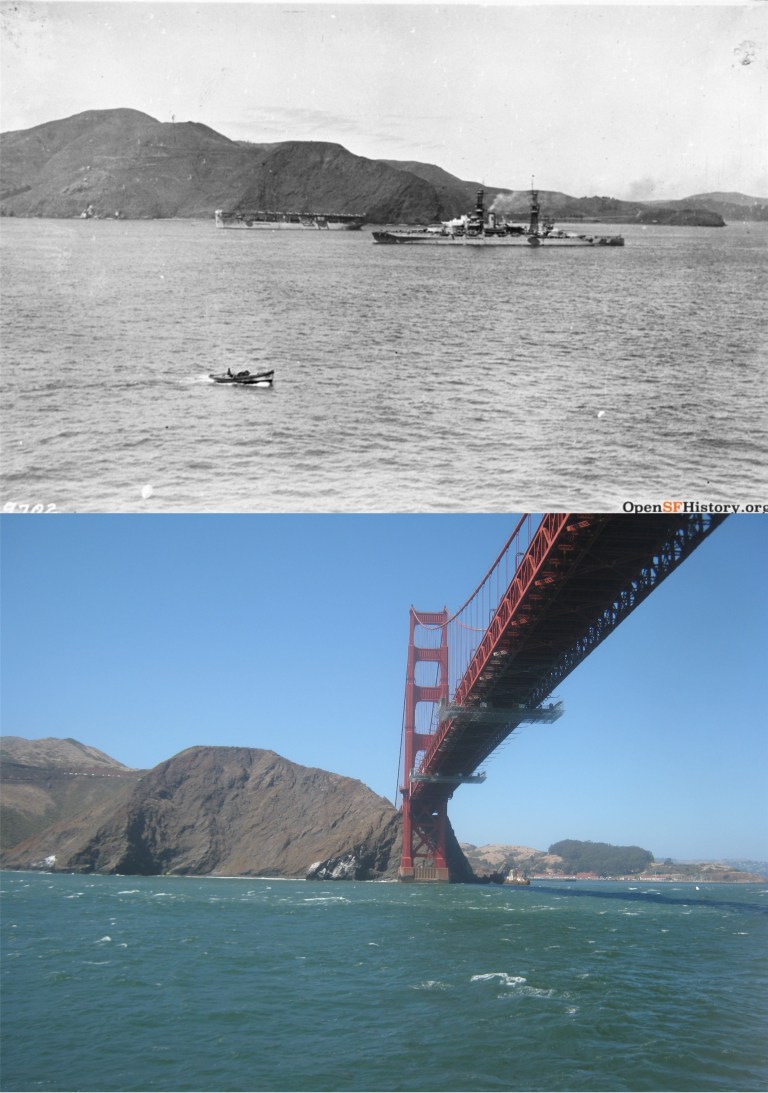 We took in some of the main attractions too. Sailing under the Golden Gate Bridge in the summer is a lot easier than walking on the Golden Gate Bridge, and a lot more scenic. Here we were on our Red and White Fleet tour at near the same spot in the Golden Gate as the 1925 pre Golden Gate Bridge picture. (opensfhistory.org)
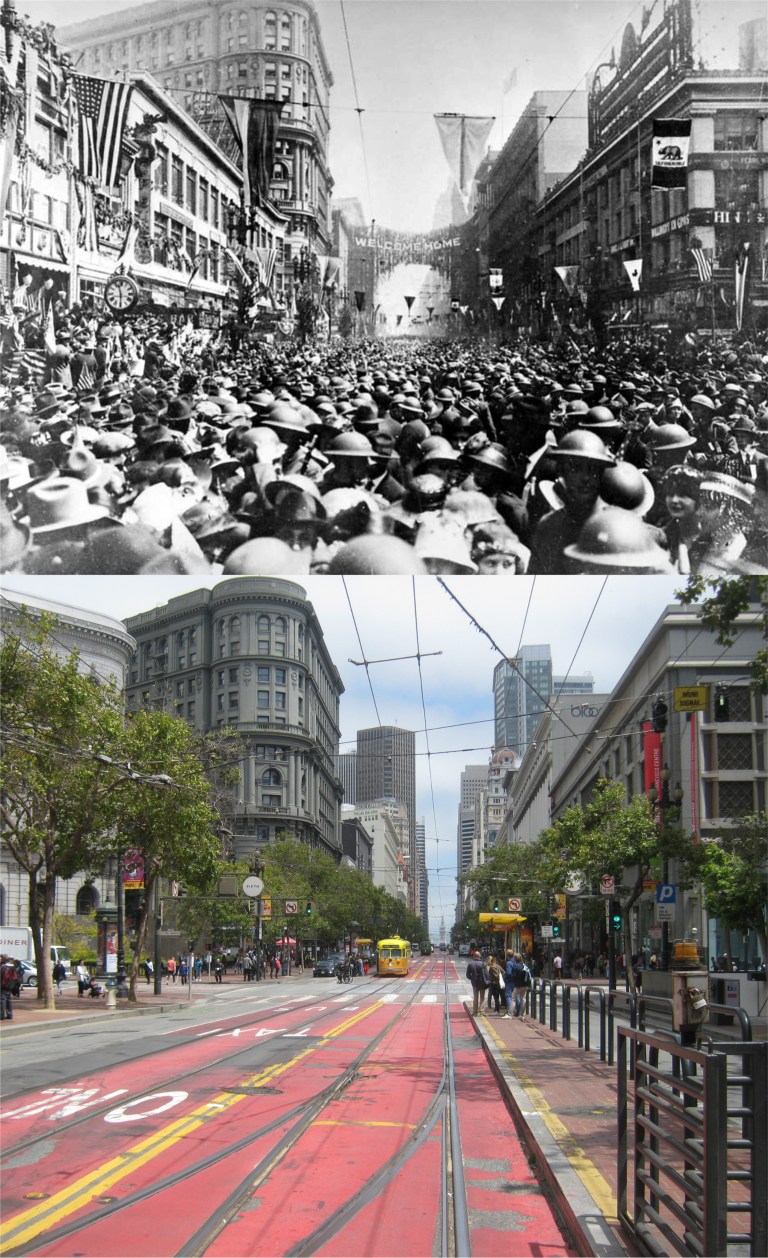 A celebration for soldiers returning home after World War One at Market Street and 5th in early 1919: (San Francisco History Center)
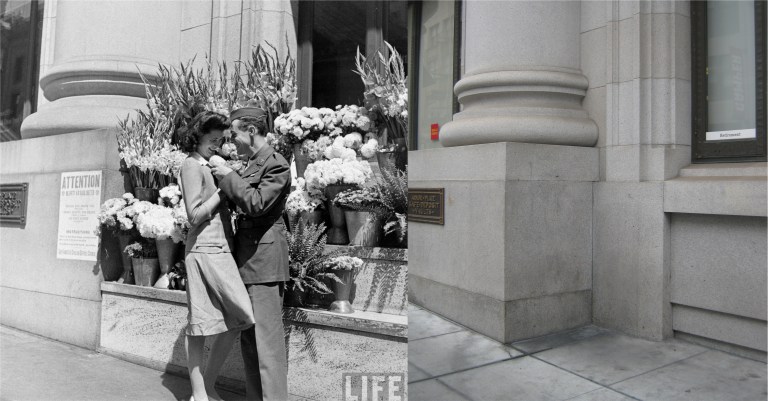 “Kiss me once, then kiss me twice, then kiss me once again. It’s been a long, long, time.”
 Greenwich at Mason Streets in 1958: The passengers don’t seem too rattled.
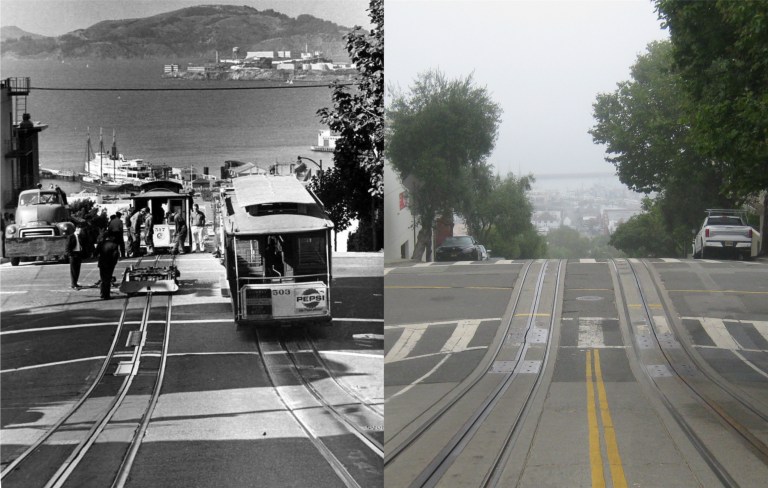 Looking down Hyde Street at Chestnut in 1965; cable cars on the left side are heading up the hill, so the car may have slipped back after something broke off of it. You’ll have to take my word for it that Alcatraz is still out there.
 Hyde Street at Chestnut looking in the opposite direction of the previous pictures in 1964: Don’t ask me what the chain reaction of this accident was, or how it came about. The truck in front may be about to tow the cable car away, or it may have caused the accident.
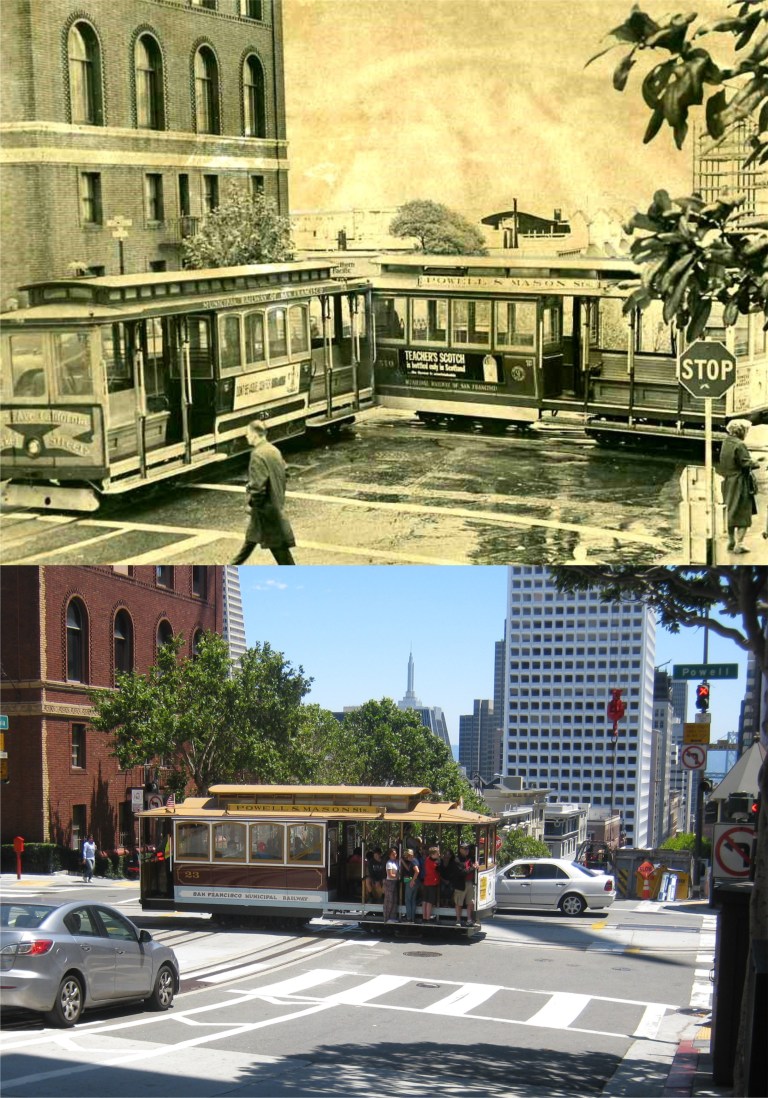 Powell Street at California in 1963: Cable car collisions are extremely rare here, if at all, since they put the signal control box on the far right in.
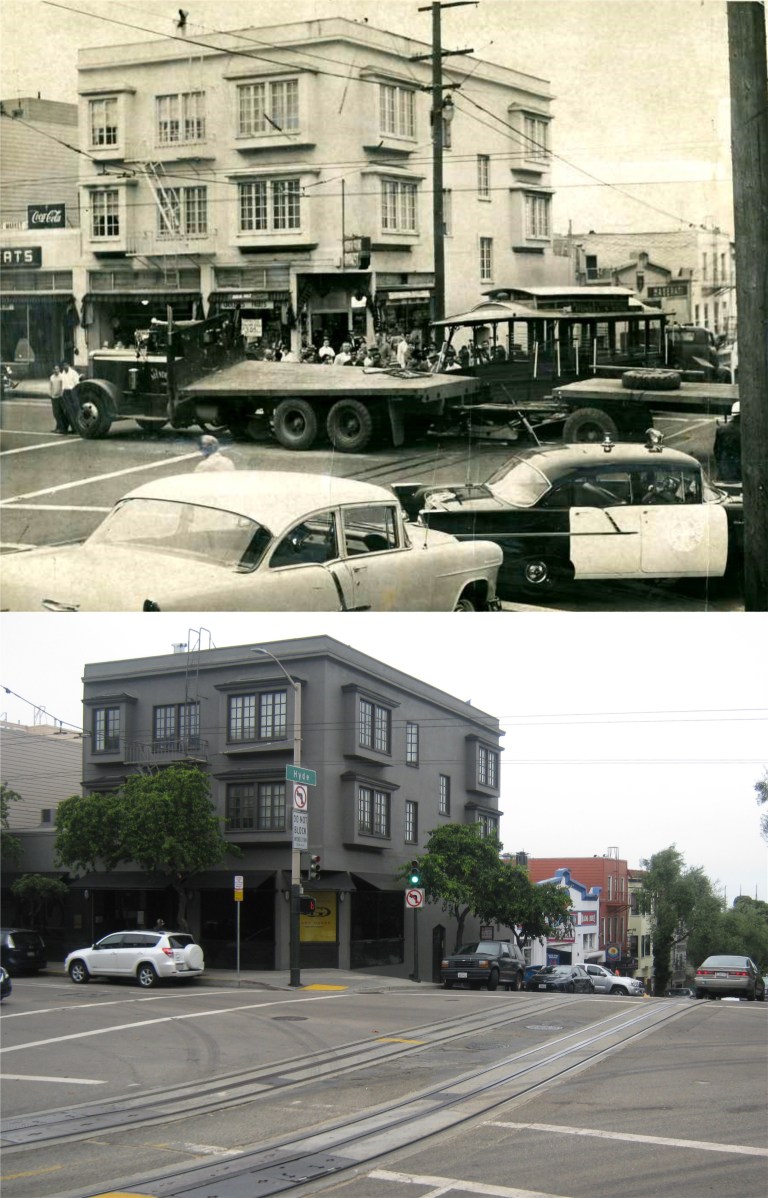 North Point Street at Hyde in 1958: I would guess that the truck driver was at fault; cable cars always have the right-of-way.
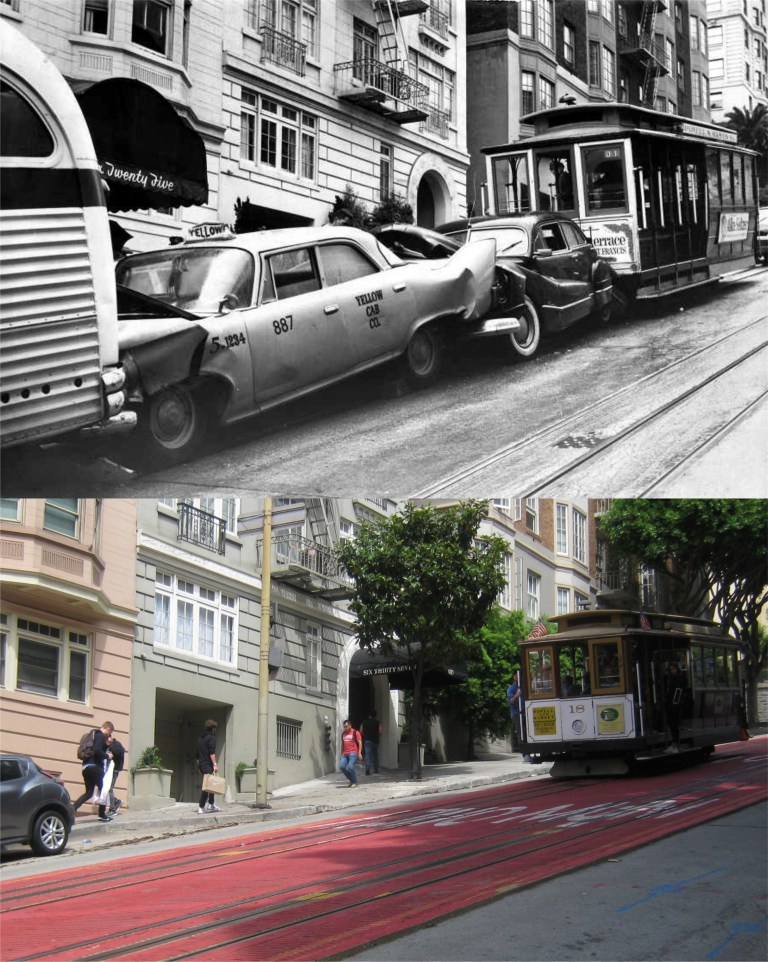 Powell Street north of Bush in 1960: Cable car brakes used to slip occasionally long ago, something that fortunately hasn’t happened in a long time, so I’m guessing that the cable car was at fault here. Interestingly, we have a bus, a taxi, a personally owned automobile, and a cable car involved in this one. The only thing missing, very fortunately, was a motorcycle.
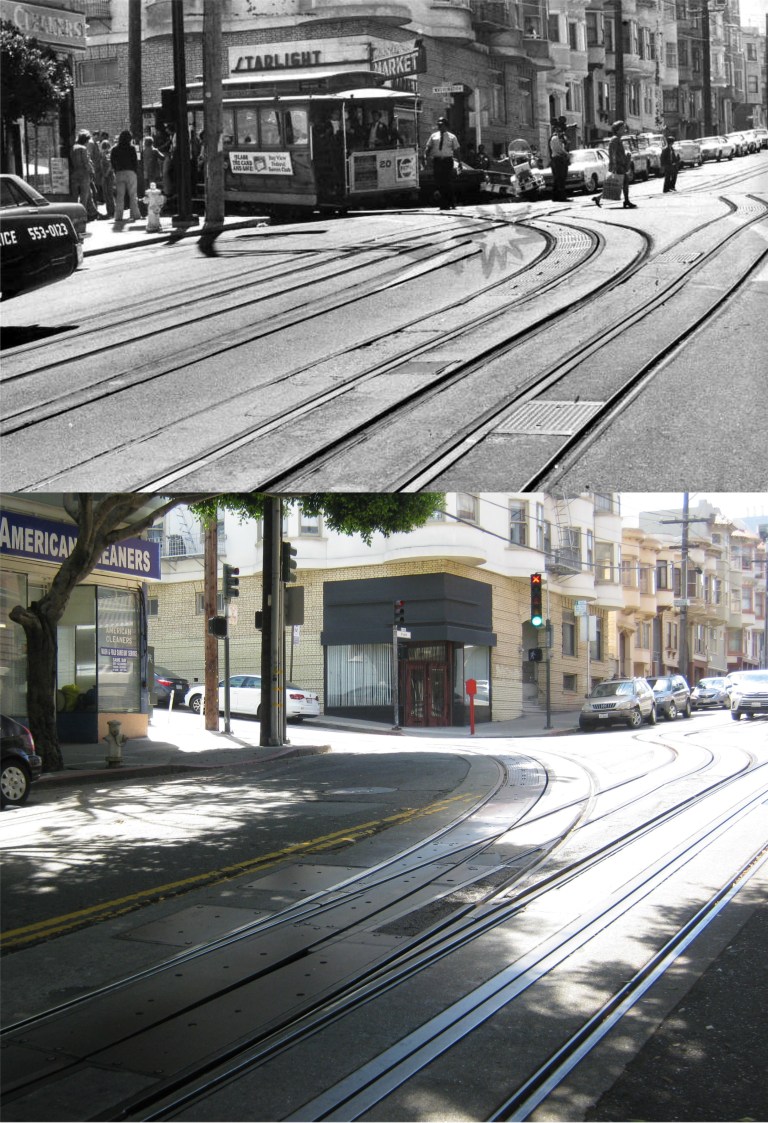 Hyde and Washington Streets in August of 1974: A cable car derails after colliding with a pickup truck.
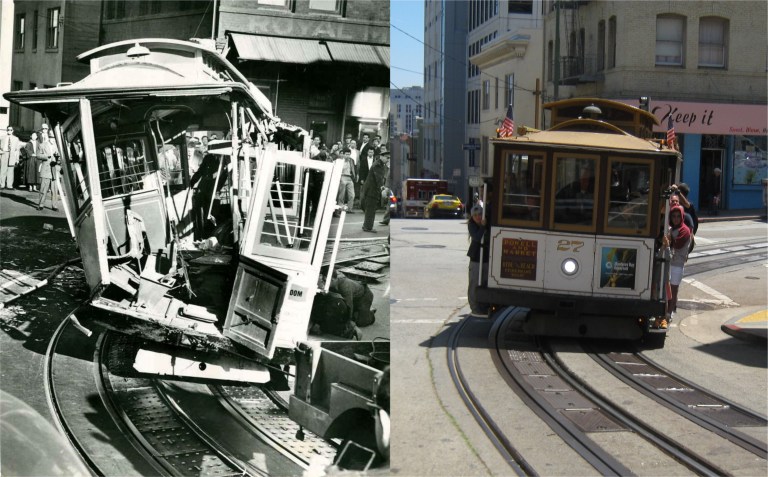 Powell and Jackson Streets in September of 1955:
 Washington Street just up from Taylor Street in January of 1958: A cable car heading down hill hit the cement truck here, derailed, and slid twenty feet down the hill.
 Washington Street west of Powell in 1953: A rare cable car rear ender.
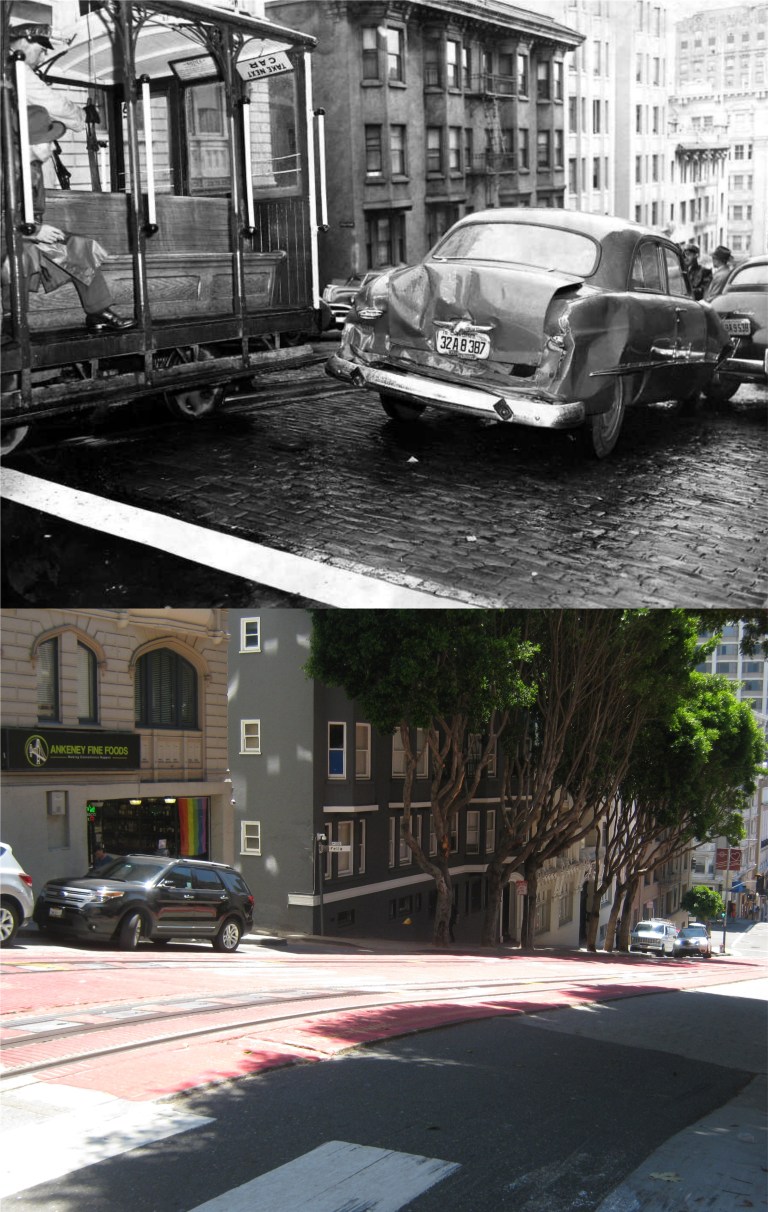 Powell and Pine Streets, March of 1950:
 Powell Street at Pine looking north in the 1950s
 Powell Street at Sutter, September of 1957: It must have been Ralph Kramden driving that bus!
 Powell Street north of Sutter in February of 1974: When cable cars try to sneak in the back door of the bus:
 Looking down California Street toward Dupont Street, now called Grant Avenue, from Stockton Street in 1863. San Francisco is proud of its tough and not always refined past and this location typifies much of the legend. Dupont Street, in the heart of Chinatown, was a dangerous place in 1863, complete with opium dens, slave prostitution, regular shanghaiing, and murders. In 1856, San Francisco dared to build a church in the middle of this godless area, Old St. Mary’s on the left, and it’s still there; you can see it peeking out on the left in my picture. In the far back are some of the three mast ships on East Street, now called the Embarcadero, that many drugged sailors woke up in when they were out to sea after being shanghaied. (lostnewengland.com)
 A streetcar turns around at the Ferry Building during the 1940s: The Ferry Building is probably the major building associated with San Francisco and ranks right next to the Golden Gate Bridge as one of the city’s top icons. To me, it’s just great to see that old streetcars still rattle past the Ferry Building. (Market Street Railway)
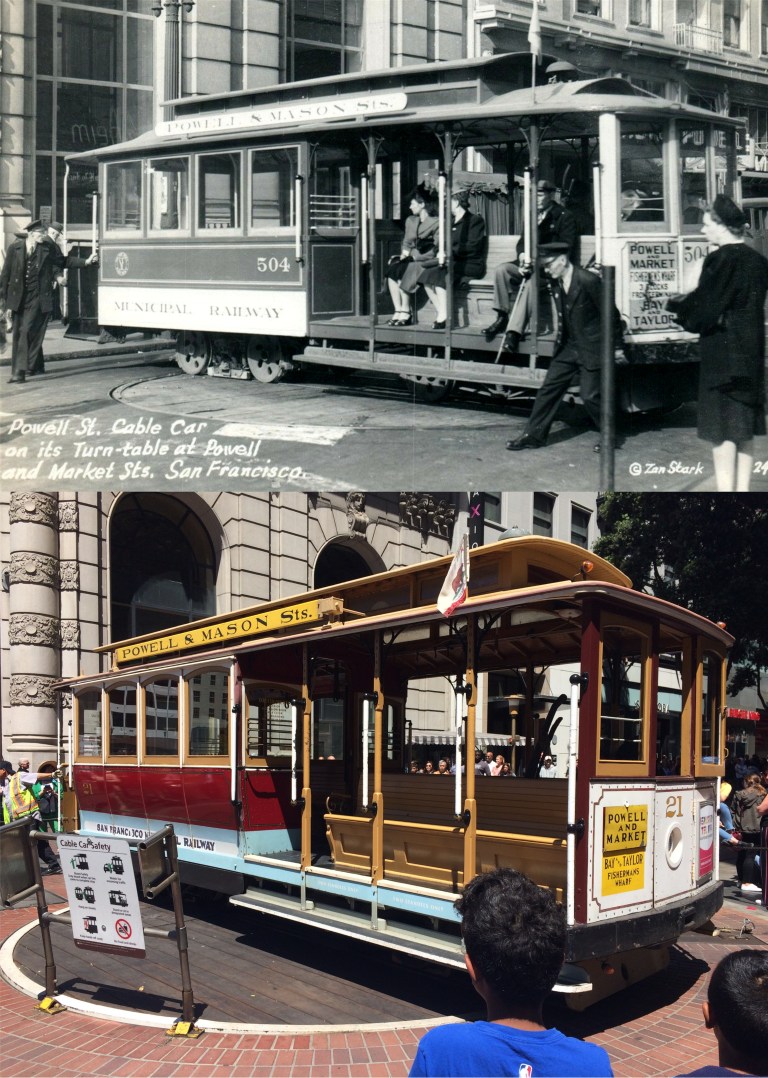 And what says San Francisco more than the clang of a cable car bell? Passengers are no longer allowed to climb on the cable cars while they’re being turned around like here at Market and Powell Streets in the 1950s. We used to do that too when I was a teenager. It’s not a bad regulation; there’s too many people getting on them nowadays, and someone would get hurt. (ebay.com)
 The ever changing, never changing Market Street, where a green and yellow streetcar rolls past the old Emporium Department Store in 1971, and nowadays: (hiveminer.com)
 Chinatown in the 1950s: The most densely populate area in San Francisco and one of the most flavorful, it remains a must see place that visitors simply do not miss when they come to San Francisco. (ebay.com)
 If San Francisco citizens are anything, they’re outspoken. Regular rallies for a cause date back to before the Civil War. Here, at Turk and Fillmore Streets, was a civil rights march for African Americans in 1963.
 A little bit of the Mediterranean at the Fisherman’s Wharf Boat Lagoon in the 1950s. There were a lot of boats out of the lagoon catching seafood today, but even when they’re all tucked in there isn’t nearly as many as in the vintage shot. Although Italian signs abound in Fisherman’s Wharf, The Italian and Sicilian presence is no longer prominent here. Those are the masts of the sailing ship Balclutha in the background. (ebay.com)
 Artists have a special way of looking at San Francisco. This is on top of the Stockton Tunnel looking north along Stockton Street in Chinatown in a Dong Kingman painting from 1967.
 Reminders of San Francisco’s connection with the sea can be found everywhere throughout the city. Here is the Maritime Museum Building, designed to look like an ocean liner, in 1939, the year that building opened. (SF Chronicle)
 Construction on the Embarcadero Freeway in 1957 that would imprison the Ferry Building for over thirty four years: I wonder why they ever built that thing. (SF Chronicle)
 Broadway, where the Embarcadero Freeway ended, looks like the early 60s: I wonder what San Francisco would have been like if they had completed the freeway. It was supposed to go all the way along the waterfront to the Golden Gate Bridge when it was designed. (SF Chronicle)
 California Street down from Stockton Street in 1948 and a picture I took in 2017: I wonder what the House of Lee was. The building to the right of the House of Lee in the vintage photo was called the Trafalgar Building. Bob Hope, Dorothy Lamour, Alan Ladd, and Peter Lorre, filmed a scene in that building in the 1947 film ‘My Favorite Brunette’.
 I wonder what Joan was looking at? Joan Crawford and Jack Palance in a behind the scenes photo on Hyde Street near Lombard during filming of the 1952 film noir movie ‘Sudden Fear’. It couldn’t have been the tourists on Lombard Street because they hadn’t started gathering back then. The camera view is looking south toward Greenwich Street. They still had the cobblestone on Hyde Street back then. (ebay.com)
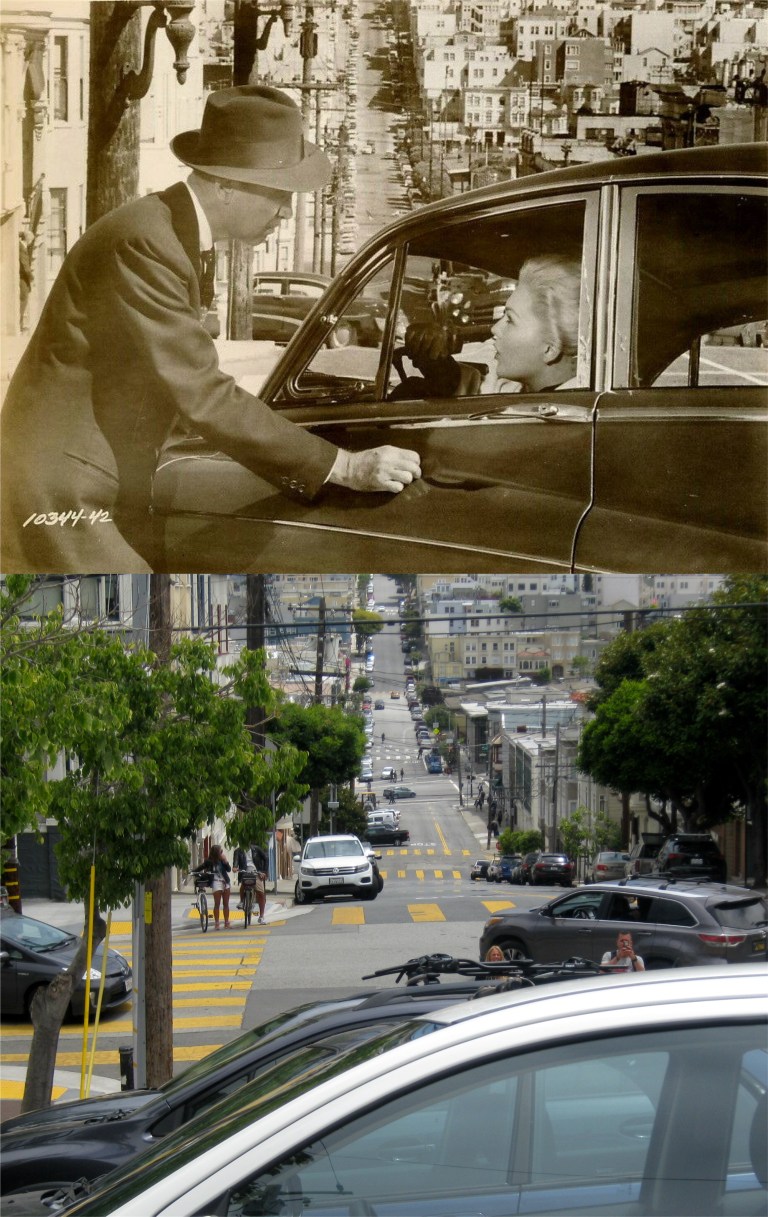 Mysterious Judy Barton (Kim Novak) thanks “Scottie Ferguson” (James Stewart) for pulling her out of San Francisco Bay in a poster scene from the 1958 movie ‘Vertigo’. The scene was in front of Scottie’s house on the northwest corner of Lombard and Jones Streets. I wonder if Alfred Hitchcock had any suspicion that he was filming what would arguably be his most studied movie, except for possibly ‘Psycho’, and the quintessential San Francisco film locations movie. (ebay.com)
 Walter Chalmers (Robert Vaughn) and Captain Sam Bennett (Simon Oakland) in front of Grace Cathedral on Nob Hill in a behind the scenes photo during the filming of ‘Bullitt’ from 1968: That’s the Bank of America Building on California and Kearny Streets going up in the background of the vintage picture. I wonder if the new building under construction on the southeast corner of Powell and California Streets will block the view from here of the B of A Building when completed. The steps leading up to Grace Cathedral have been remodeled since 1968. (ebay.com)
 Powell Street climbing Nob Hill in the 1940s: The building on the right in the old picture is the Sir Francis Drake Hotel. The Starlight Room at the top of the hotel once had some of the greatest views in San Francisco, rivaling the Top of the Mark. I wonder why the Union Square Marriott built that plain looking hotel and completely blocked most of the view from the Starlight Room. How rude was that?
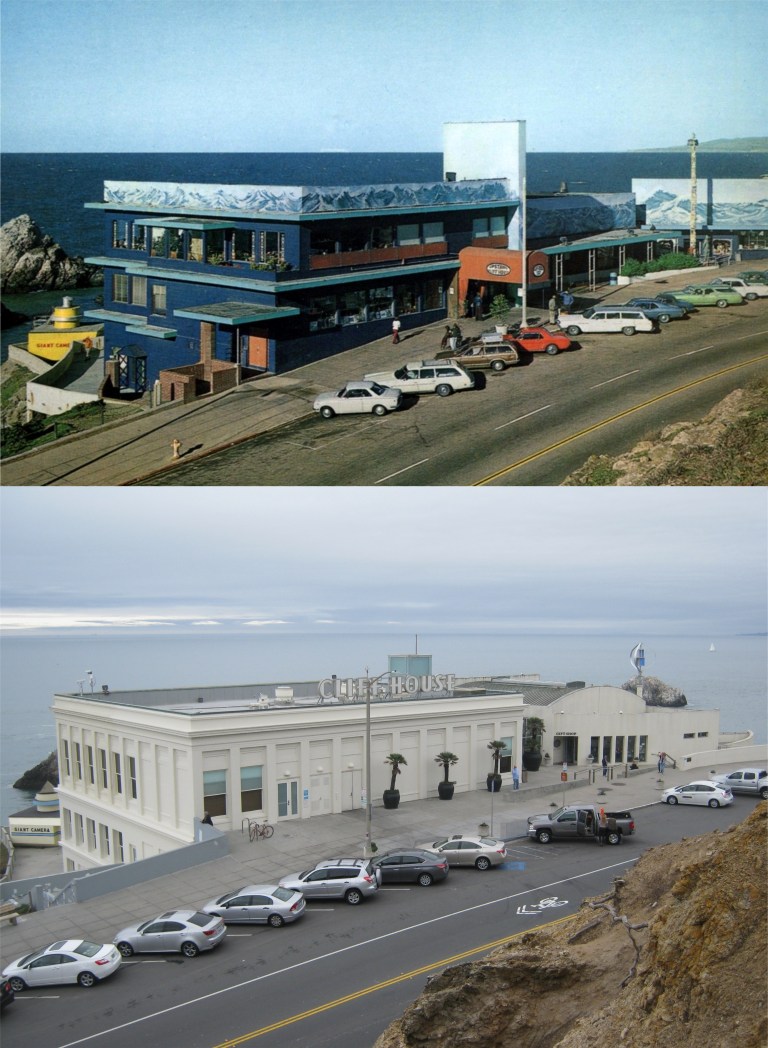 I wonder if they’ll ever paint the Cliff House blue with waves again like they did in 1972.
 San Francisco Film Locations Then & Now