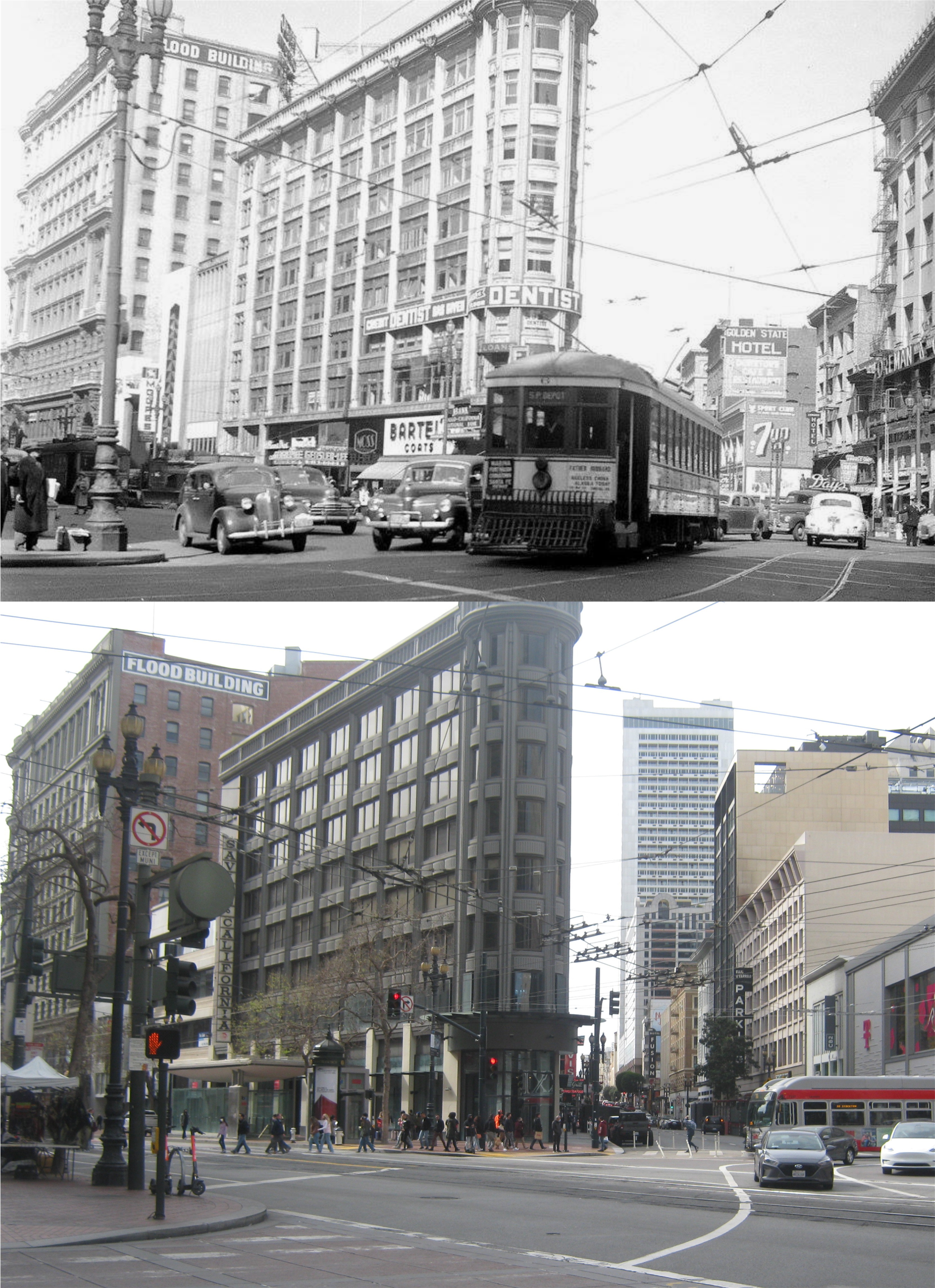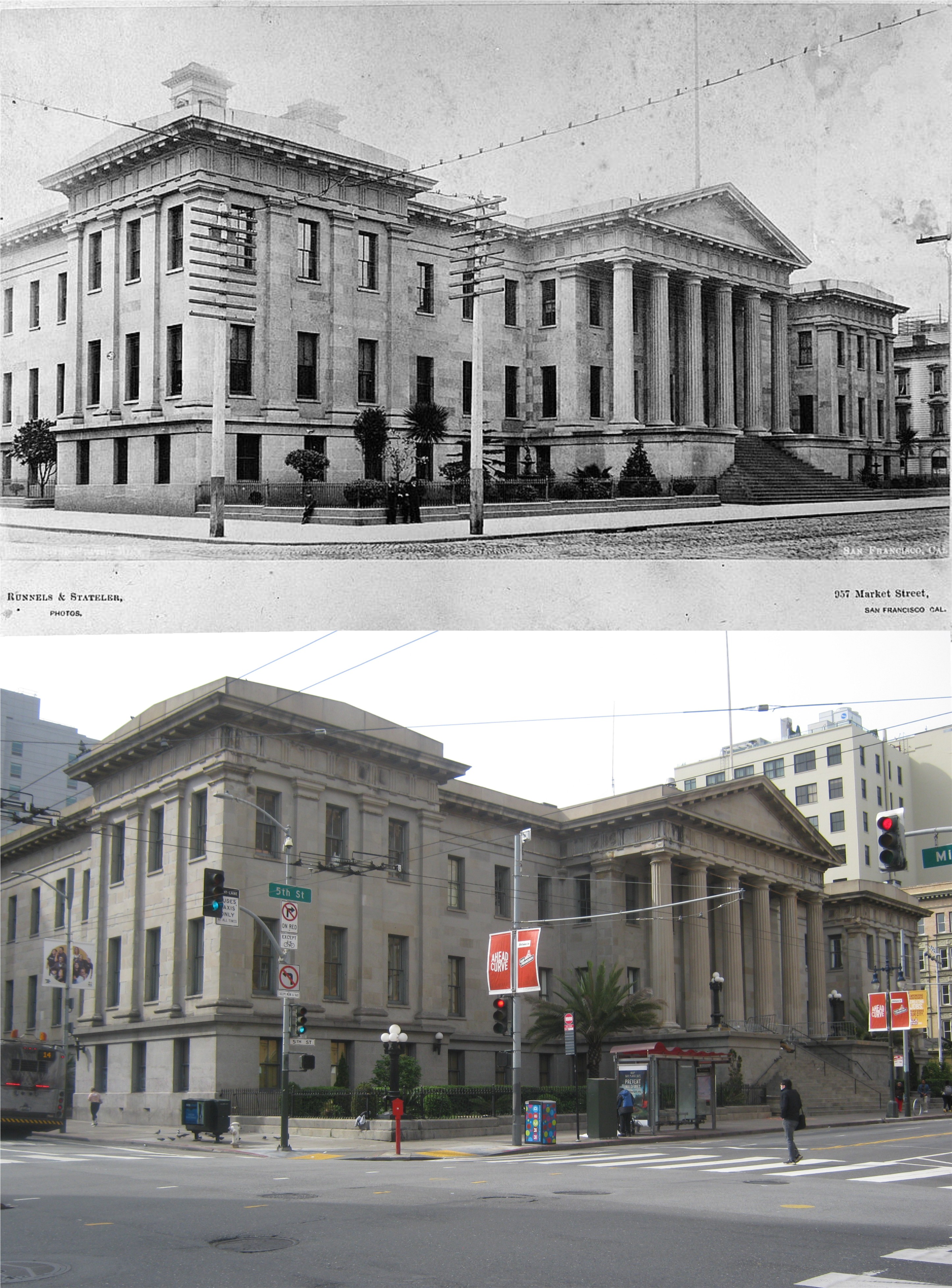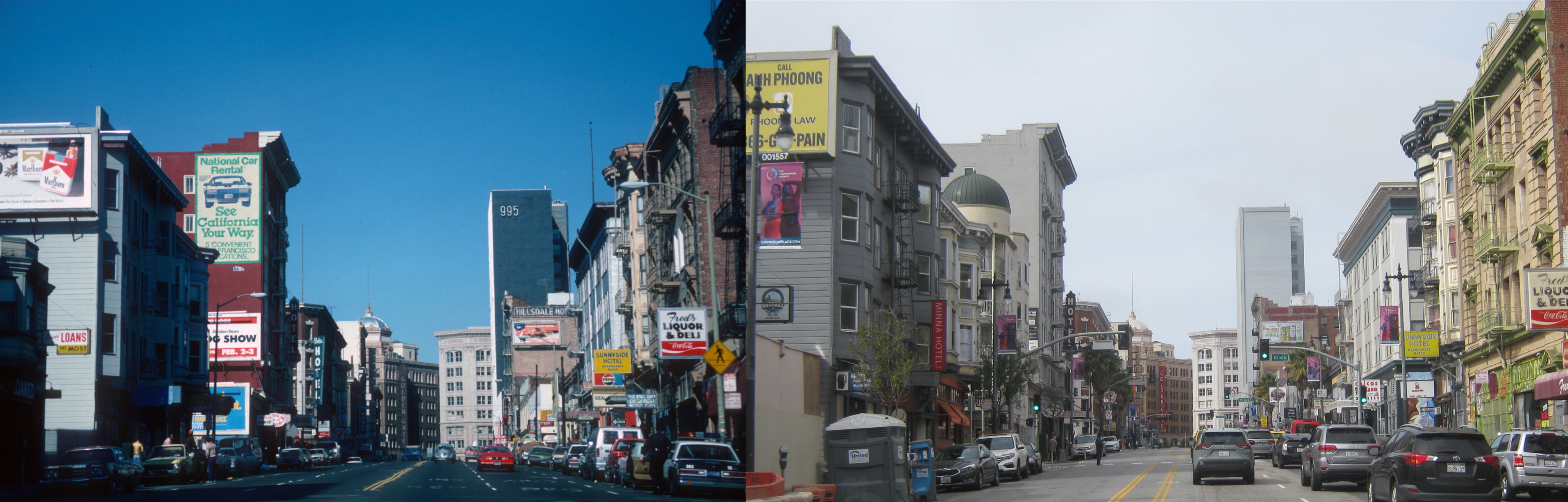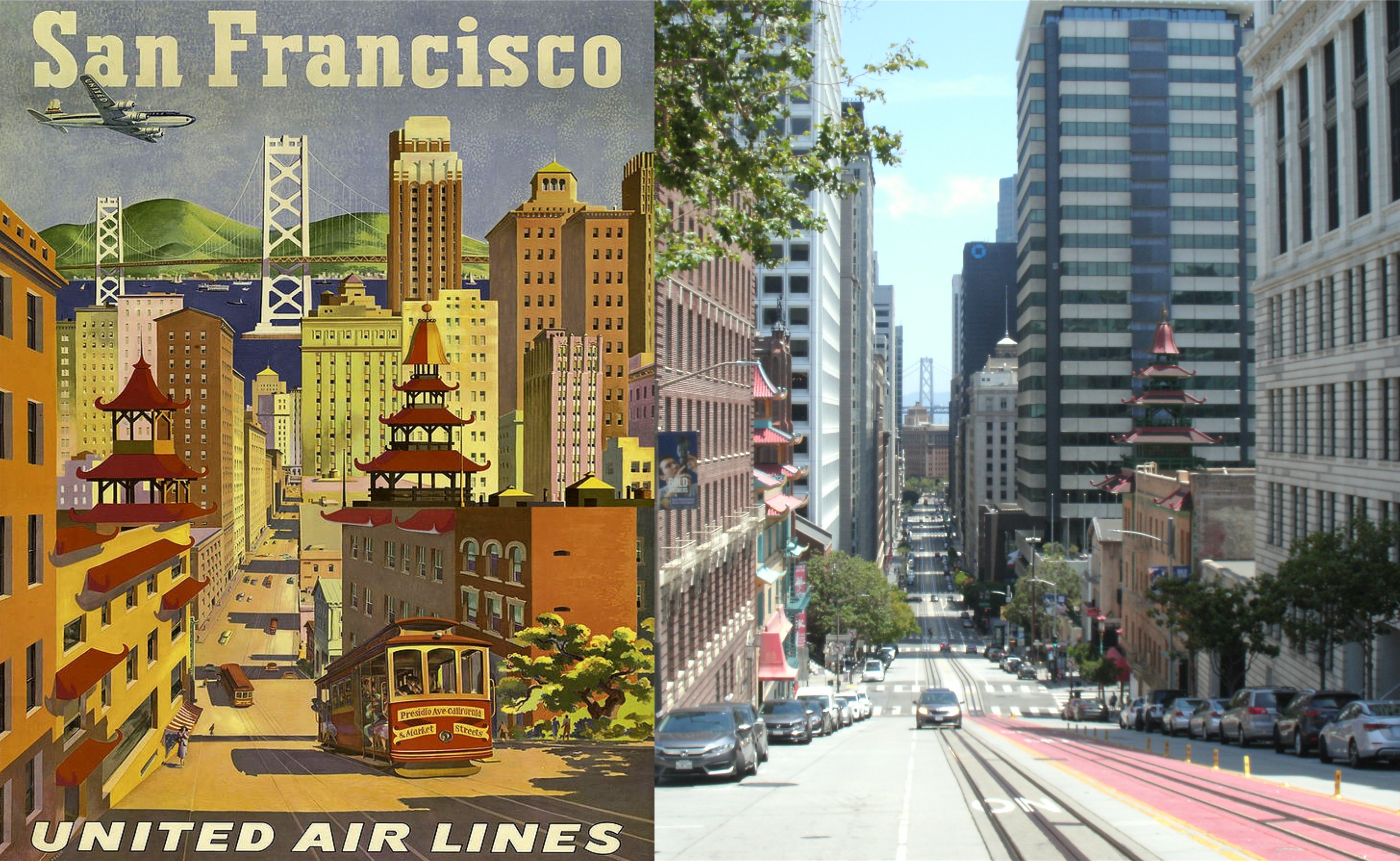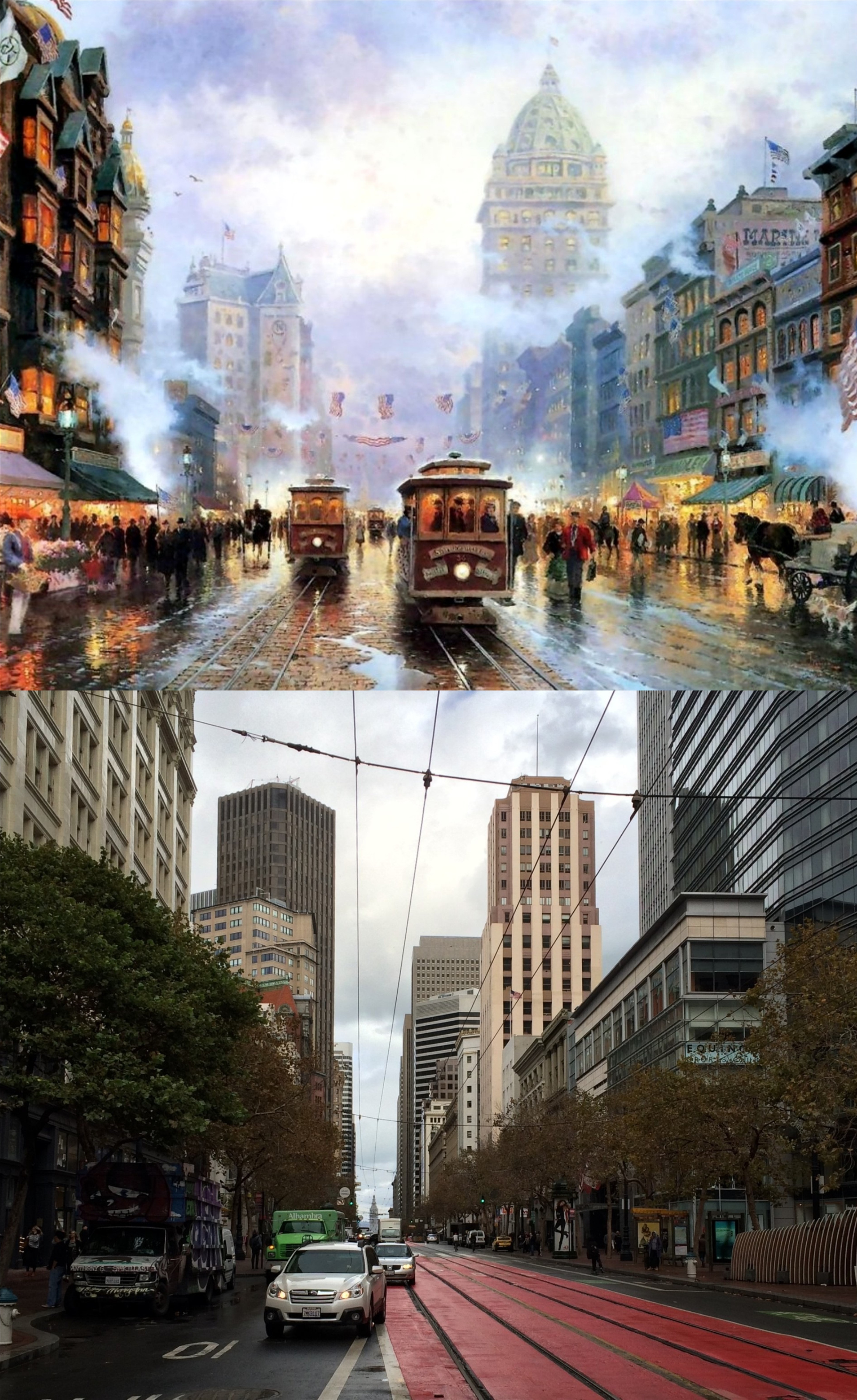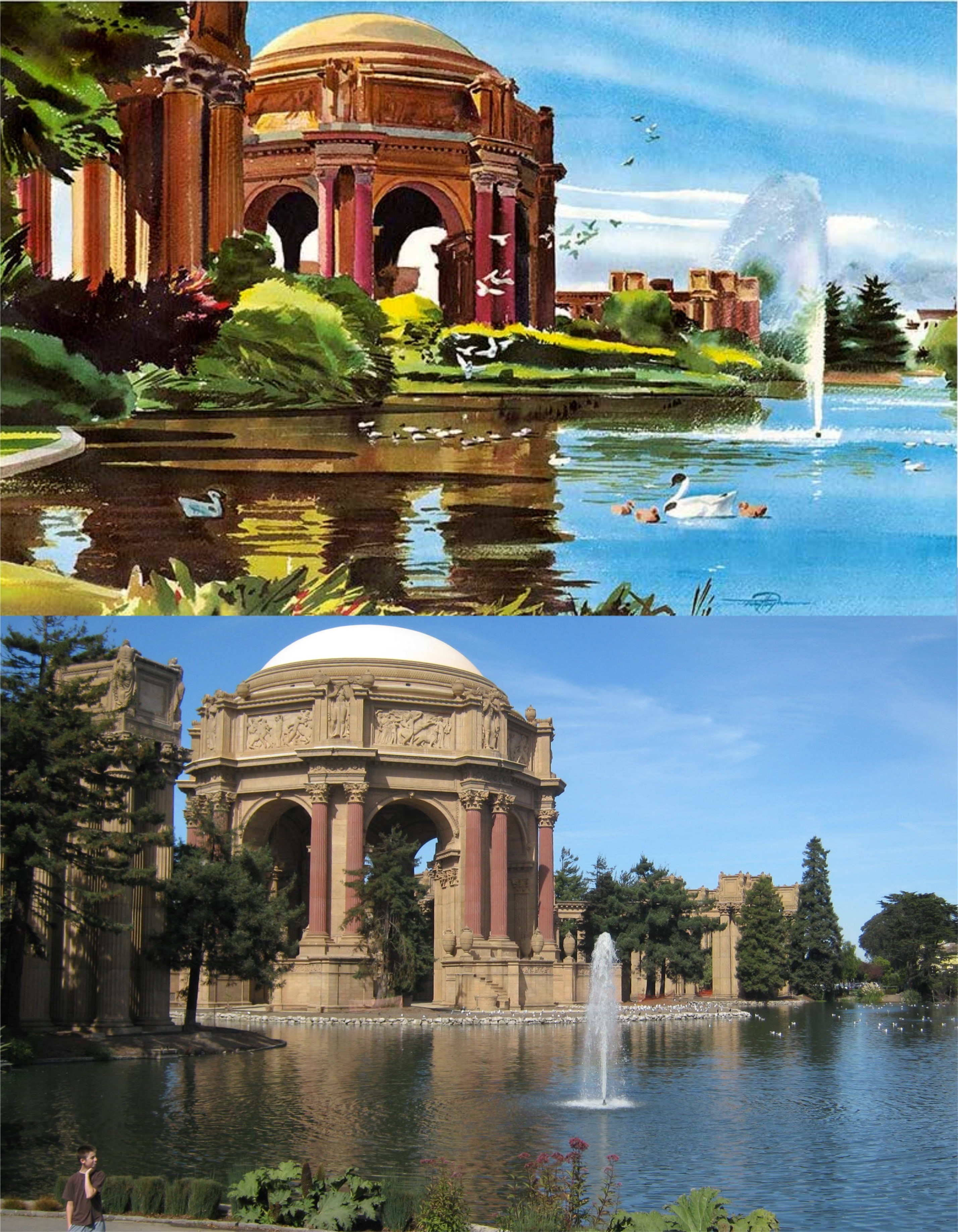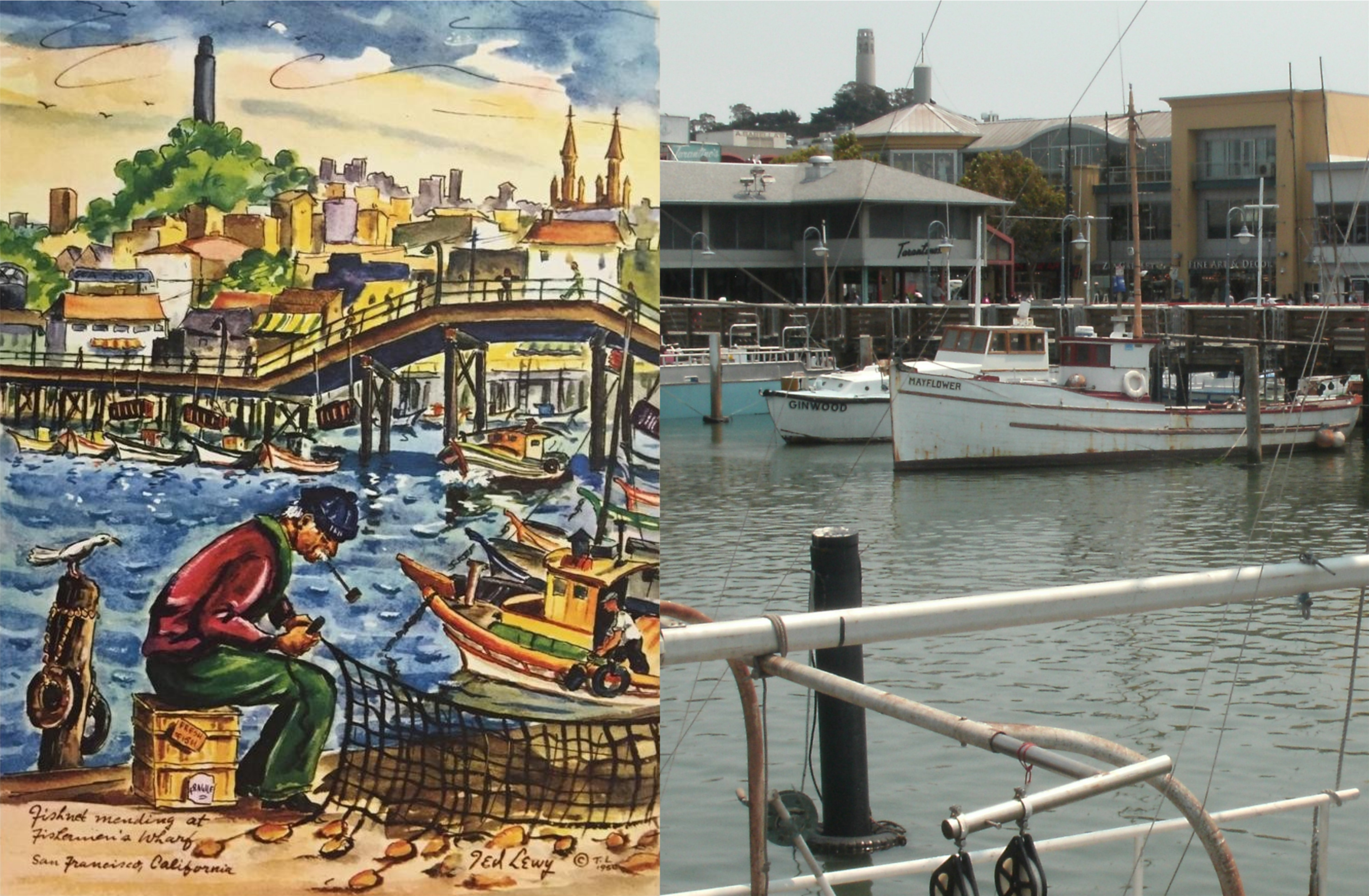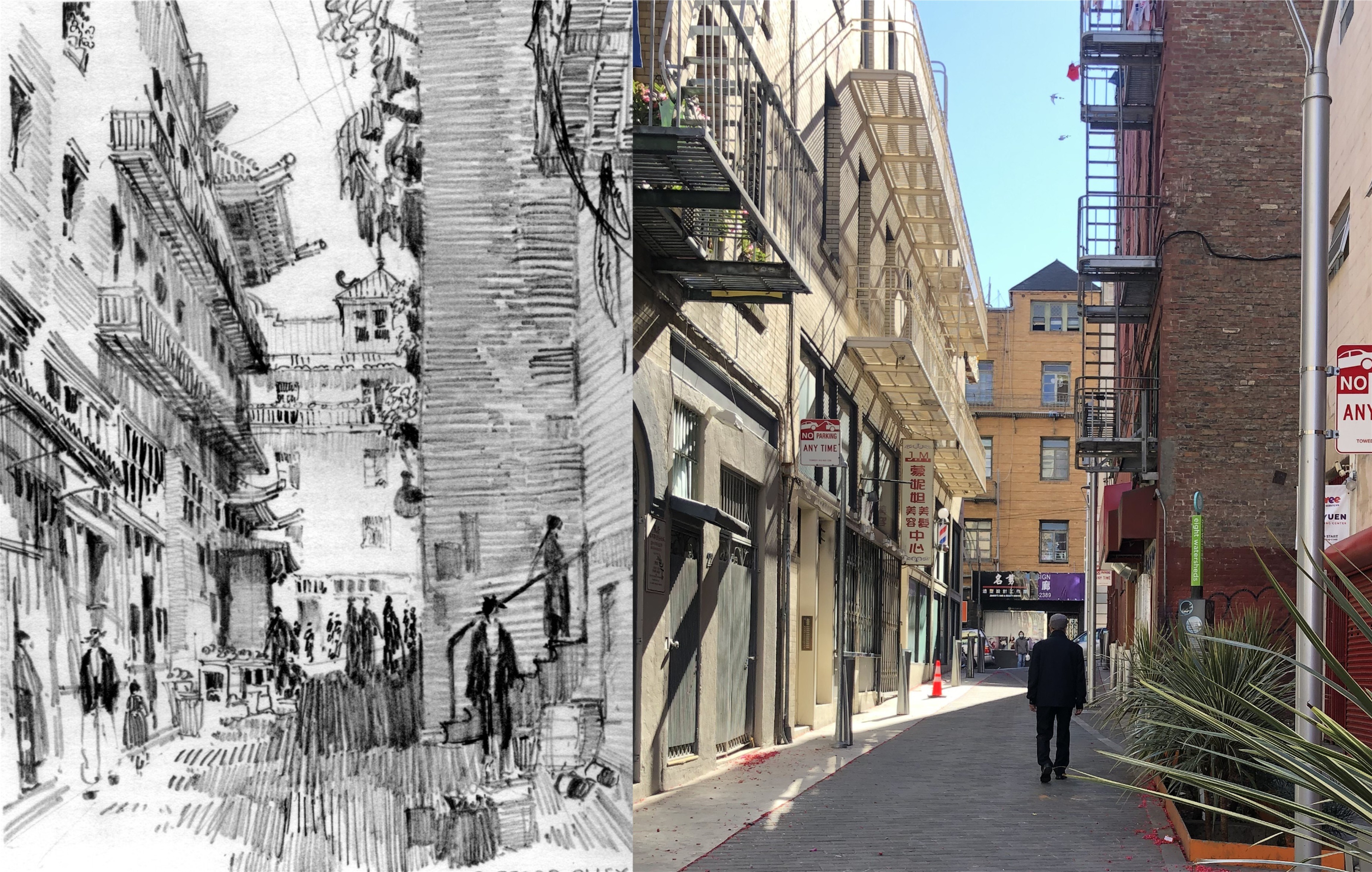
Corner cruising

“Down on the corner, out in the street,” Well, you won’t run into Willy and the Poor Boys in this post, but you might see some interesting people here in this collection of corner captures from around San Francisco. (Thumbnail images)

A Polk Street princess walking her pet raccoon on the southeast corner of California and Polk Streets during the 1970s: In any other city that might seem weird, but in San Francisco…… that seems weird! (Street Scenes of San Francisco)

I reckon I could have picked a sunnier day to be hanging out at the southwest corner of Market and Church Streets to update this early 1970s picture, and a six pack from Jug’s Liquor would have been nice if it was still there. (All liquor stores should be named Jug’s Liquor) However, that’s San Francisco summer weather for you occasionally. That’s the U.S. Mint Building in the background. (Pinterest, Flickr)

The northwest corner of Ellis and Taylor Streets during the 1970s: The rich get richer, “but we can’t get our picture on the cover of the Rolling Stone.” (Street Scenes of San Francisco)

The northeast corner of  what became probably the most famous intersection in San Francisco because of the 1967 “Summer of Love”: The vintage photo was taken in 1973. Hey, the kid in the stroller needs a haircut!  (SF Gate)

Rod McKuen on the northeast corner of Stanyan and Grattan Streets in the 1960s: McKuen was a poet, singer and songwriter who started out reading poetry in North Beach nightclubs with the likes of Jack Kerouac and Allen Ginsberg in the 1950s. His songs were recorded by many popular artists during his career, including Perry Como, Johnny Cash and Frank Sinatra, to name a few. However, he also co-wrote the song ‘Seasons in the Sun’. The 1974 version of that song is regarded by many as the worst pop song of all time! Oh, well, nobody has a batting average of 1000. (Ralph Crane, Fine Art of America)


Looking toward the northeast corner of Grant Avenue and Pine Street during the 1940s; easily, the best vintage picture of Chinatown that I’ve seen: The crowds are back here, many of the shops have reopened, and I even went into Old St. Mary’s and sat through a Mass! That was the first time I’ve been to church since…… well, we’ll go into that some other time.


The International Hotel (For Raquel)

Built in 1907, the International Hotel, on the southeast corner of Kearny and Jackson Streets, was a low income residential hotel in an area next to Chinatown. The area would become known as Manilatown because of the Filipino American neighborhood that was located there from the 1920s to the 1970s. In the mid 1960s the International Hotel was scheduled to be demolished, and eviction notices began going out to the residents of the hotel in 1968. After a long court battle and many protests at the site by activists wanting to save the building, the last residents were evicted in 1977 and the hotel was demolished in 1981. A new and smaller International Hotel occupies the corner today.(Thumbnail images)

The International Hotel viewed from the northwest corner of Kearny and Jackson Streets as the building was being demolished, and the new International Hotel that’s there today: (Vintage picture from Wikimedia Commons)


Another view of the hotel in 1976 in a picture from the FoundSF website: The buildings in the background are, from left to right, the Transamerica Pyramid, the Hilton Hotel that replaced the old Hall of Justice, and the Bank of America Building.


Looking north along Kearny toward Telegraph Hill and the back side of the Sentinel Building, aka as Columbus Tower, during the fight to save the Hotel. (freedomarchives.org)
SF Police on standby for protests at the International Hotel in August of 1977: (SF Chronicle)
Protesters in front of the hotel, looking down Kearny Street to the pedestrian walkway that crosses Kearny from the Hilton Hotel over to Portsmouth Square:

What’s left of the International Hotel near completion of its demolition in 1981, and the same spot today: (theculturetrip.com)


From 1952 until 1969 guests were entertained at Enrico Banducci’s hungry i nightclub, located in the basement of the Jackson Street side of the International Hotel. The hungry i was paramount in kick starting the careers of many entertainers, including Barbra Streisand, Woody Allen, Jonathan Winters, Joan Rivers, Bill Cosby and the Kingston Trio. In his 1967 book, ‘San Francisco, City on Golden Hills’, Herb Caen writes about a walk he took from his Russian Hill home, down Chestnut Street to Columbus Avenue, and along Kearny Street to Jackson Street, where he stops at the International Hotel to visit Enrico Banducci in his hungry i office.

{I don’t think you could raise a gang there today to topple a statue or set out for Galapagos, but around Jackson, it’s still pretty colorful. Peruvian and Chinese restaurants, Filipino pool Halls and barber shops, the barbers sitting in their chairs between customers and playing guitars and violins. The big hotel that was once a whorehouse—two doors down from the old Hall of Justice. I peered through a window into Enrico Banducci’s, office above the hungry i. Enrico may not have the most elegant office in town, but it’s the most ridiculous: two roll top desks, a pool table, a billiard table and three phones that never stop ringing.

“Hey, Bandooch,” I said, “I’ll play you for a buck.”You’re on,” he said, dumping his secretary off his lap and grabbing a cue, or even vice versa. A drunken seaman came in, waving a bottle and dancing around the room. “Hey, Enrico!” he shouted. “I got my papers again—I’m going back to work! I ship out tonight!” “That’s wonderful, Kelly,” said Enrico, “just wonderful!” The seaman pulled the secretary out of her chair and began dancing around with her. I sank the fifteen in the side pocket and expected Bill Saroyan to walk in any minute. His kind of scene.}


The album Barbra Streisand recorded at the hungry i in 1963: (themusicshopandmore.com)


The Kingston Trio, up Kearny Street from the hungry i between Columbus Avenue and Broadway, on the cover of their 1964 album, ‘Back in Town’: In the background of both images is the domed Sentinel Building. To the right of the Sentinel Building on the album cover image is the old Hall of Justice Building.

Fisherman’s Wharf reopens fully:

On April 7, 2020, three weeks after the shelter-in-place order was given across the Bay Area, I went over to Fisherman’s Wharf to take some photos that I posted here on the following day. Before the pandemic, Fisherman’s Wharf was said to be the second most visited tourist attraction in California after Disneyland. However, on April 7, 2020, it was empty, lonely, and depressing. This last Tuesday, the Wharf opened up fully again and I went over there the next day to update the pictures I took in April of 2020.


The end of Taylor Street, looking toward Pier 45 in the background: Even the Musee Mecanique Arcade has reopened.

People are back alright, in all shapes and sizes.

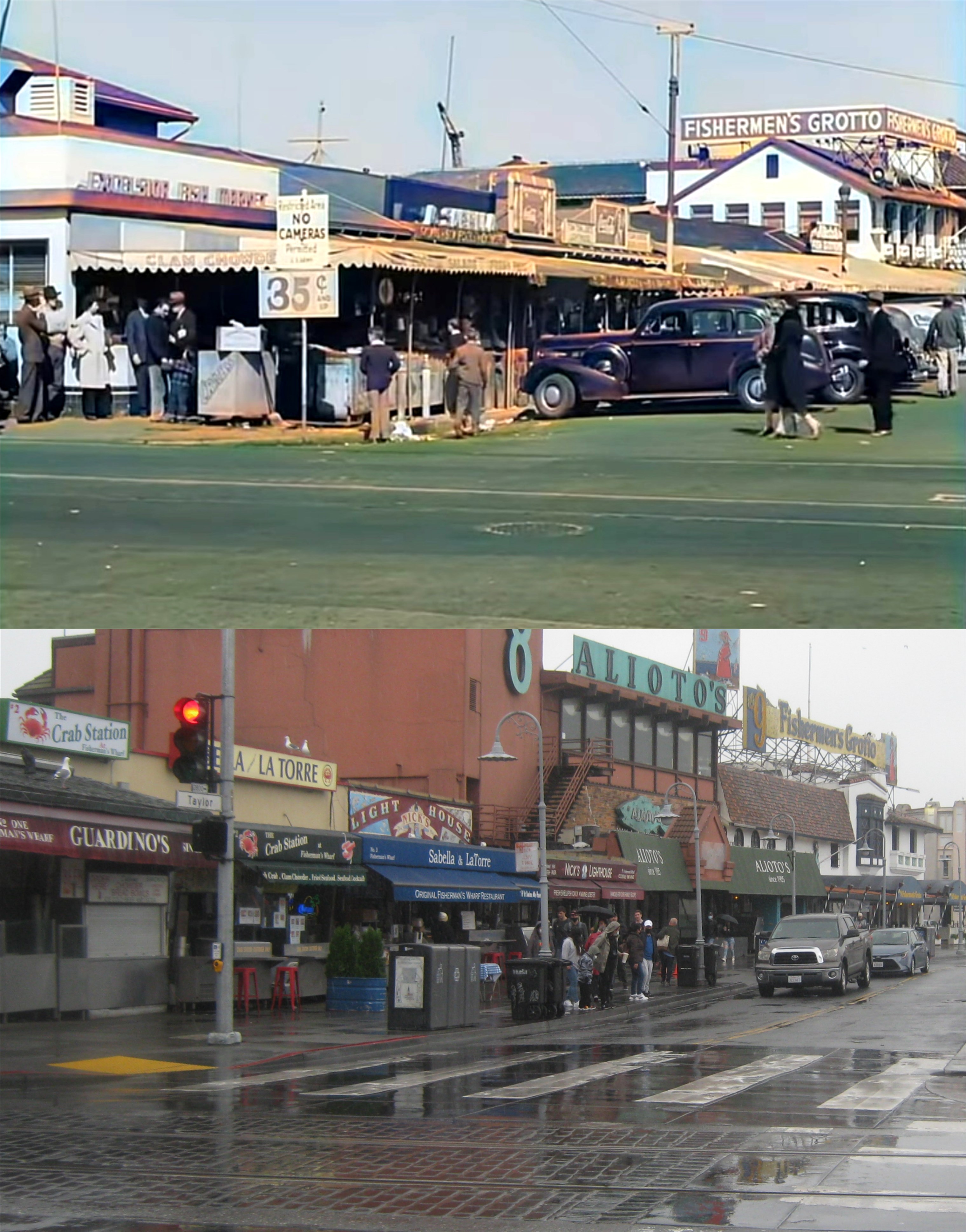
Looking toward the Fishermen’s Grotto Restaurant; they spell it different than Fisherman’s Wharf: Hey, they moved the seal! Sadly, the two most famous restaurants in Fisherman’s Wharf, Alioto’s and Fishermen’s Grotto, have closed permanently with no plans to reopen.


Looking toward the Boudin Bakery from the northwest corner of Taylor and Jefferson Streets.

They’re packing them in again on the Red and White tour boat cruises, as well.


Visitors are back, wandering down Pier 45 toward the World War Two submarine, the USS Pampanito, and the Jeremiah O’Brien Liberty Ship.


On April 7, 2020, the Jeremiah O’Brien was closed and locked down tight next to Shed C of Pier 45. The following May 23rd a fire destroyed Shed C and almost the Jeremiah O’Brien. The Liberty Ship is back again at Pier 45, but not Shed C.


“Under the bridge, downtown”

I know, I swiped the title for this post from the Red Hot Chili Peppers, but it just seems to fit these old pictures from under, or near under, the gone but not forgiven Embarcadero Freeway. (Thumbnail images)

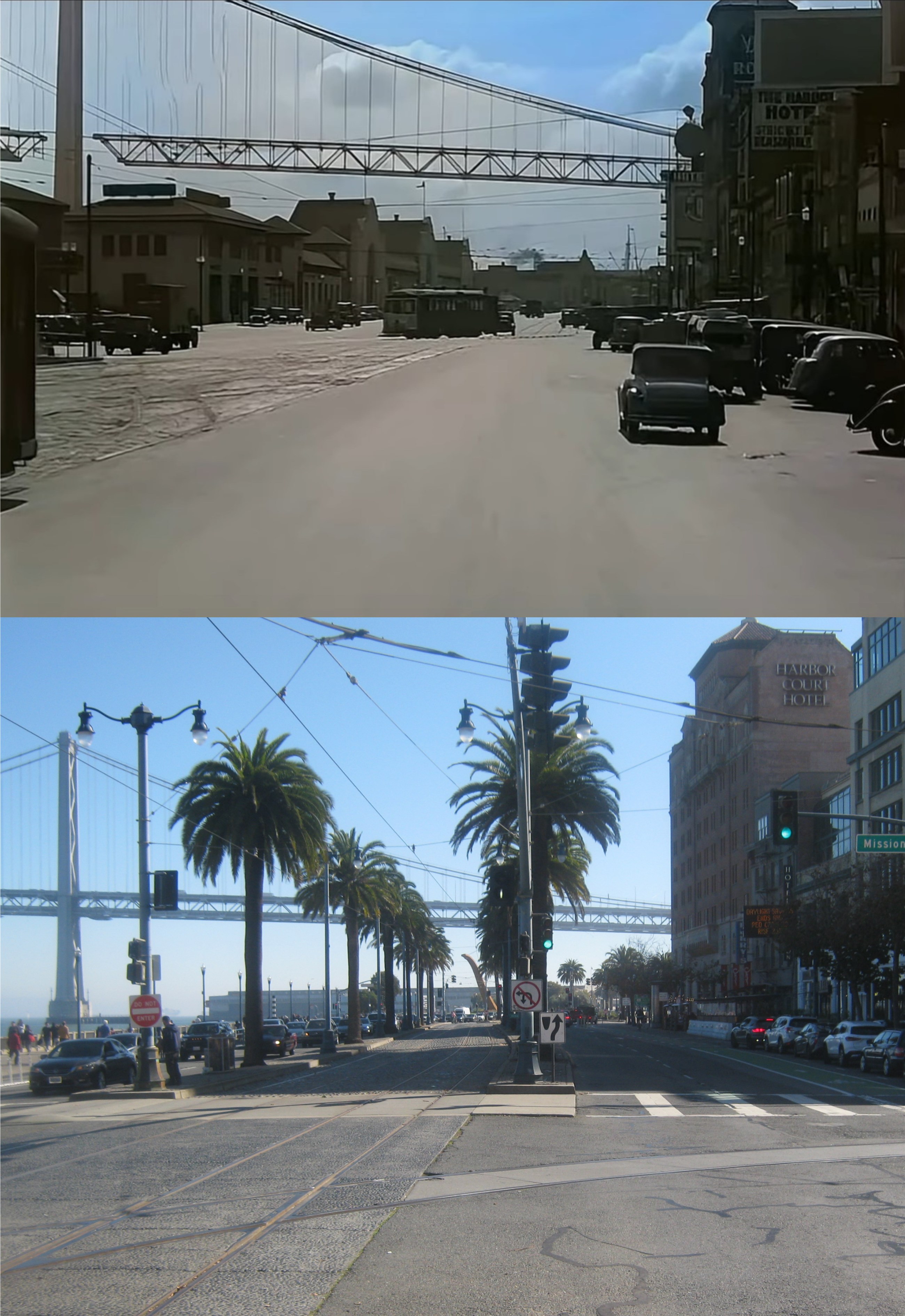
Mission Street and the Embarcadero, looking toward Market Street One and Two, the Southern Pacific Building, and the Embarcadero Center: (Dave Gardner Photography)


The Muni 32 rolling past the Ferry Building in a SFMTA picture: I don’t think the 32 still runs.


Just about here at Maritime Plaza was where Clay Street used to come into the Embarcadero. At this point the Embarcadero Freeway branched off, past over Clay Street and came down at Washington Street. (Reddit)


The Embarcadero Freeway ended here at Broadway. It was originally planned to reach all the way to the Golden Gate Bridge. Can you imagine how awful that would have been? (Flickr)


Hmm, a little contraption pulling a larger contraption; looking northeast toward where the walking and fishing Pier 7 is from the first of these next few Market Street Railway pictures posted on the internet.


Let’s follow along as they move south down the Embarcadero.


They’re at the Ferry Building now. Hey, it’s a Dinky, I thinky. Sorry! Dinkies were a sort of combination cable car and streetcar that ran for awhile along Market Street before and after the 1906 Earthquake.

Remembered well (Part Two)

Several years ago I posted about a Facebook page I had joined called San Francisco Remembered. It’s a large group of San Francisco enthusiasts who post memories and photos of their favorite city. Members are frequently contributing vintage pictures of San Francisco from public sources or from their own collections. These are a few updates I did last weekend of some of the vintage pictures posted by group members. The source of some of the photographs is not always identified, so I’ll just list the last names of the members who posted the pictures for the credits. (Thumbnail images)

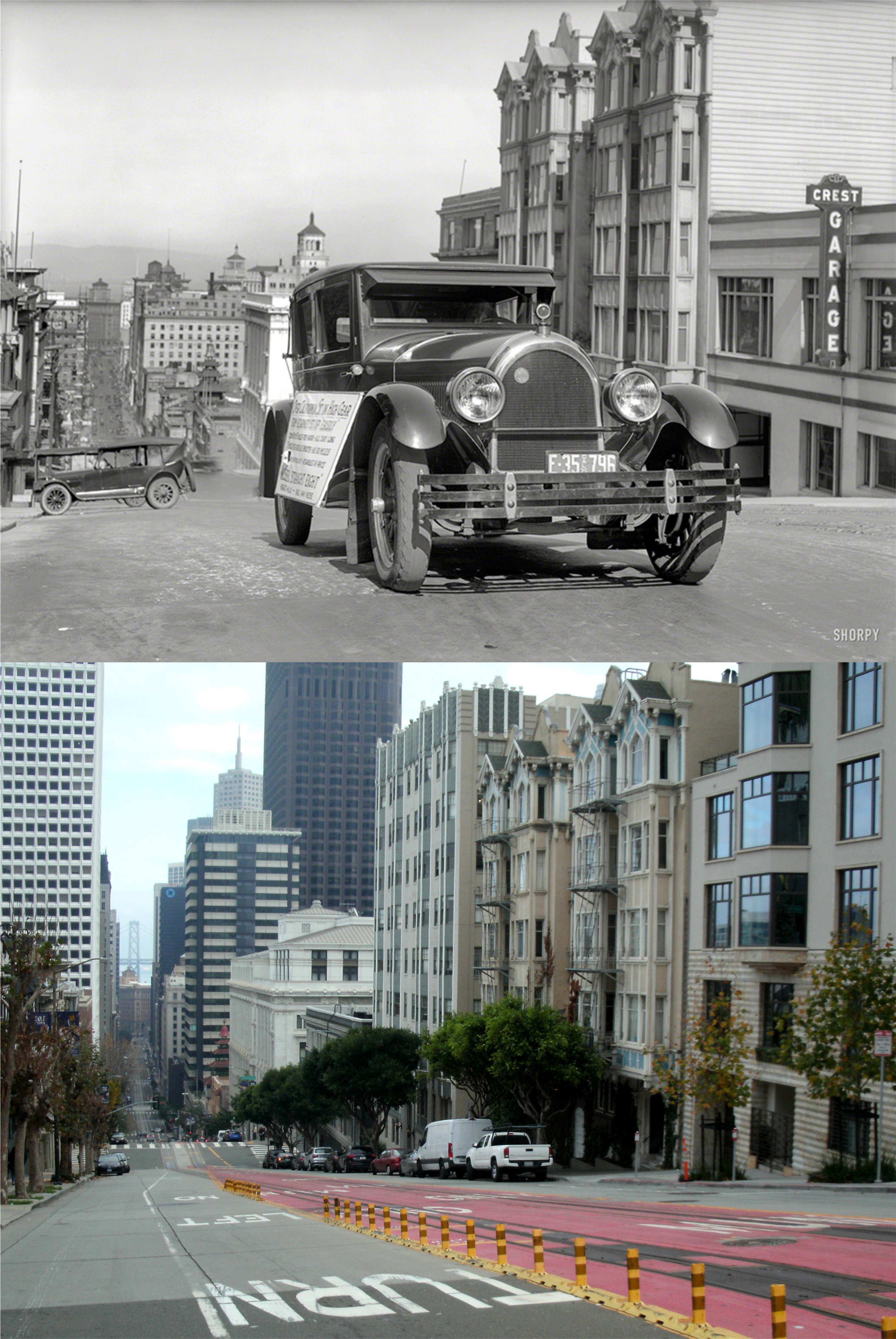
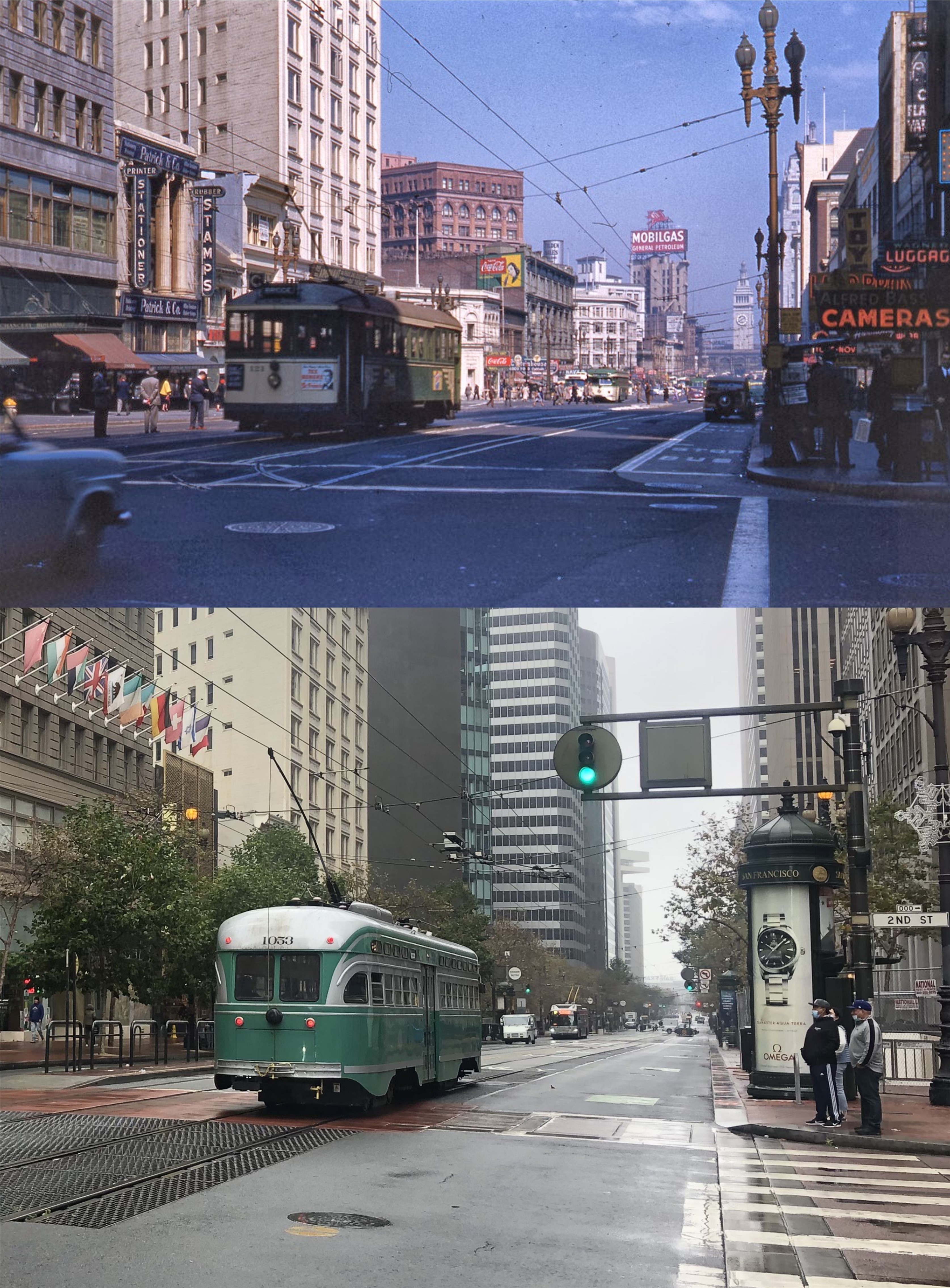
Market Street, looking east toward Mason Street: The movie ‘Dear John’ playing at the Crest Theater dates the vintage picture to circa 1964. (N. Wright)


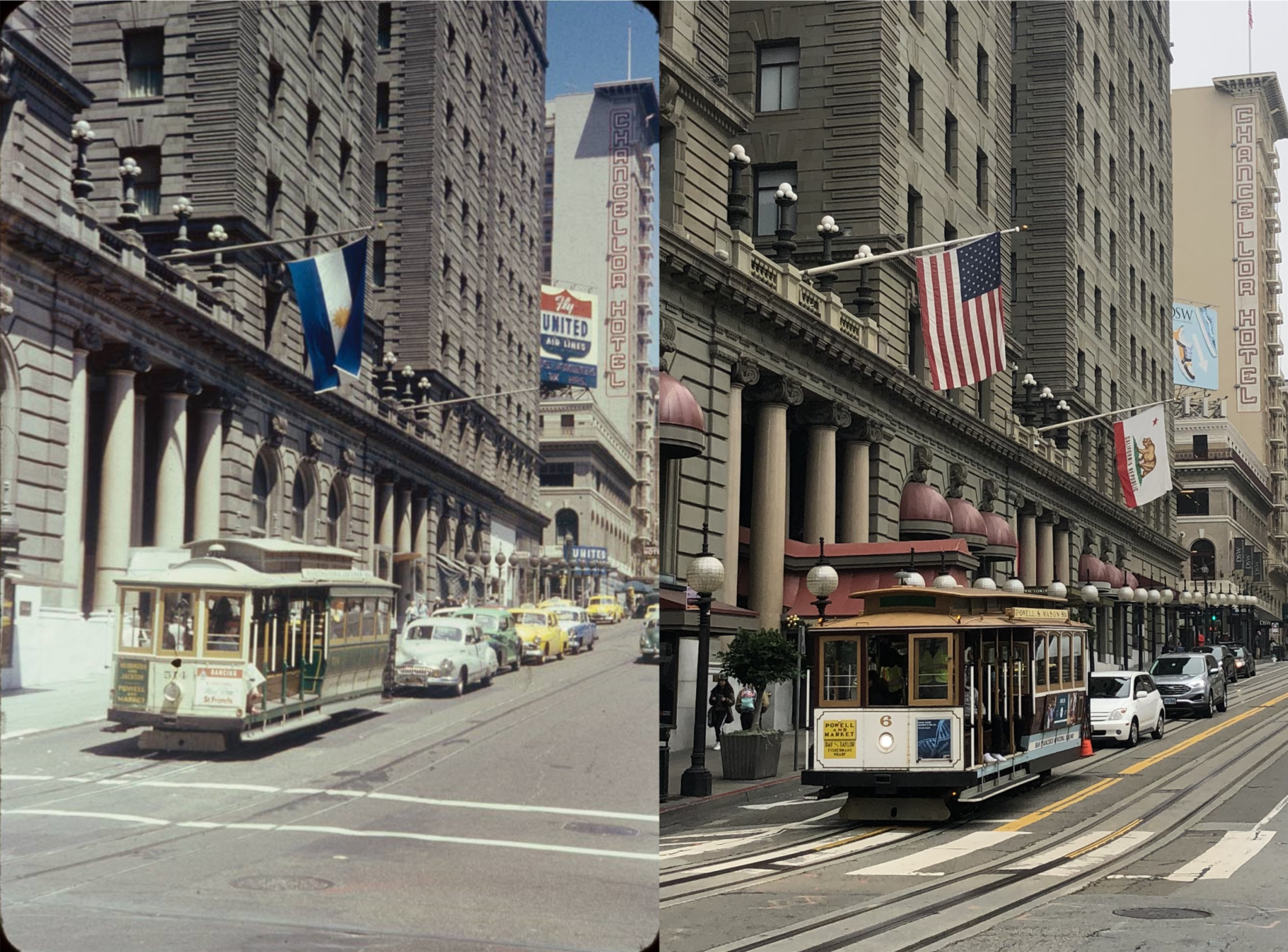
Looking down Nob Hill along Powell Street in 1968: The Sir Francis Drake, with its Starlite Room, is on the left. (M. Rodriguez)

Construction on Market and Stockton Streets, looking east in 1947: You can see Twin Peaks in the far back of both photos. (M. Rodriguez / SFMTA)


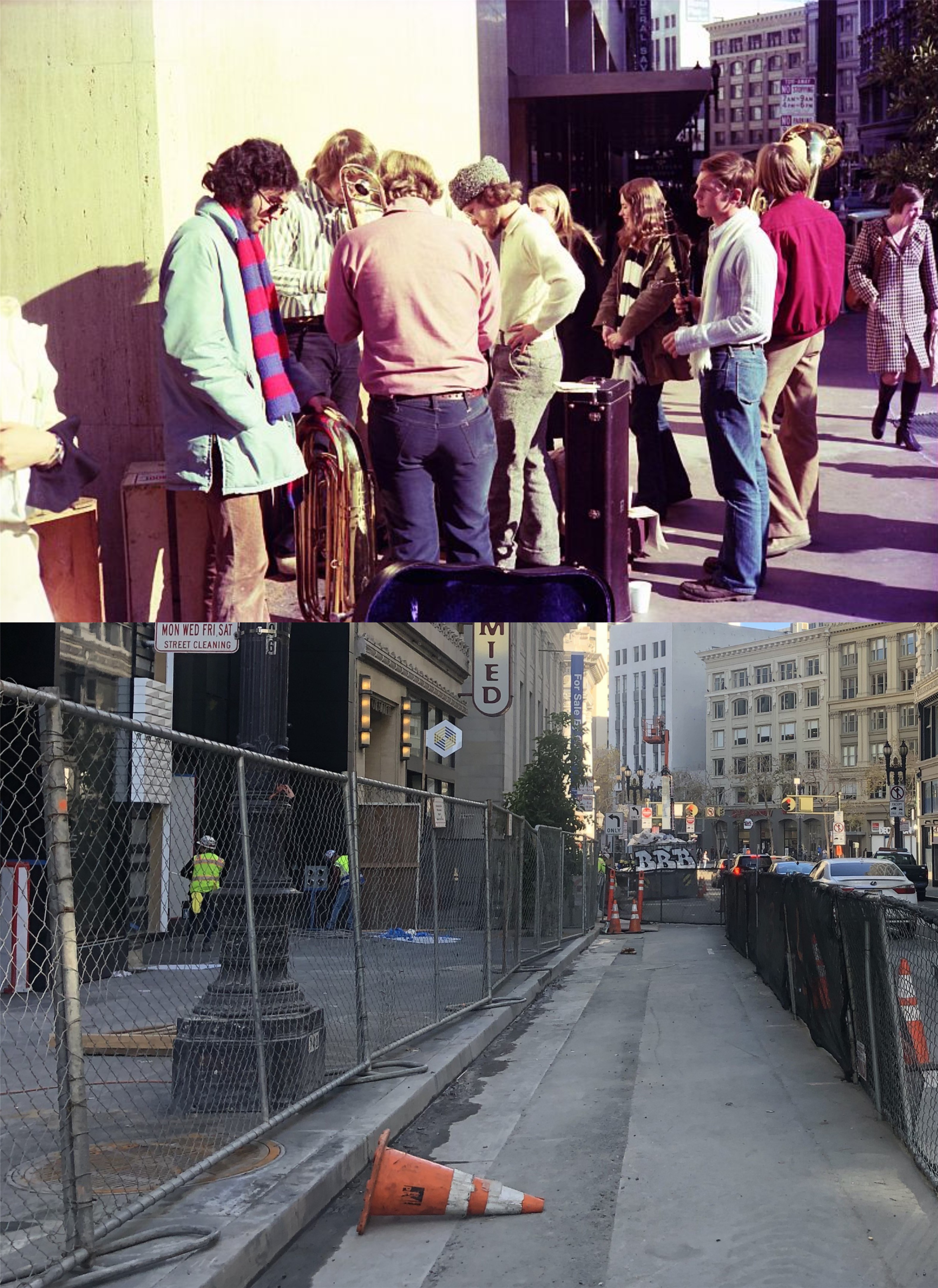
The southeast corner of Union Square, at Geary Blvd. and Stockton, during the 1960s: (M. Kava)

The most famous location of Gump’s, 250 Post Street, was THE home furnishing store of San Francisco. Founded during the Civil War, some of the icon’s most famous customers included Sarah Bernhardt and Franklin D. Roosevelt. You can’t see the 1914 Hobart Building from here anymore, but you can sure see the Salesforce Tower. (M. Rodriguez)

The cable car turnaround at Market and Powell Streets during the 1970s; I like those sunglasses. A little closer to twilight than in my picture, and, of course, there’s no cable car in my photo, but overall not a bad juxtaposition. (M. Kava)

Did you know?

This is a collection of interesting stories concerning San Francisco’s history that you may not be aware of. Some of them are quite historic. (Thumbnail images)

On January 25, 1915, the first transcontinental telephone call was made from New York to San Francisco by the same two people who are credited with making the first telephone call ever in 1876, Alexander Graham Bell and Thomas Watson. You know, “Mr. Watson, come here, I want you.” The call was made from Mr. Bell in New York to Mr. Watson, who was in the Telephone Exchange Building here on Grant Avenue. Alexander Bell even used the same expression, “Mr. Watson, come here, I want you.” he used in the 1876 call to which Watson replied, “It would take me a week to get to you this time.” This building was heavily sandbagged just after Pearl Harbor when it was still the Telephone Exchange Building, then a vital communication center, in fear of Japanese bombs dropping on San Francisco. (Source, This Date in San Francisco by John C. Ralston)


Did you know that the record for the largest crowd ever to assemble on Market Street stood for almost 100 years when opera soprano Luisa Tetrazzini sang at Lotta’s Fountain on Christmas Eve, 1910. No Super Bowl Parades for the 49ers or even the celebration of the end of World War Two drew a larger crowd to Market Street. That record was broken on November 3, 2010 when an estimated one million plus people turned out for the victory parade celebrating the San Francisco Giants first World Series championship in San Francisco. I wonder if Luisa sang, “Kill the wabbit! Kill the wabbit!” Come on, you guys remember that Bugs Bunny, Elmer Fudd opera cartoon.

Here’s the San Francisco Chronicle’s front page story of Luisa’s freebee show.


Today, Lotta’s Fountain stands at a spot that’s a few feet different from where it stood in 1910.

This old warehouse on the northwest corner of Sansome and Green Streets at the foot of Telegraph may not look like much today, but trust me, this building was and is of enormous importance to just about everybody in the world; from Howdy Doody to Lucille Ball, the Beatles to Michael Jackson, Muhammad Ali to Joe Montana, President Truman to President Biden, or even myself, who spends most of his evenings at home these days watching reruns of ‘Gunsmoke’. You guessed it, it’s where television was invented. The vintage picture was taken in 1952 by Charles Cushman.


There’s a tarnished historical marker there today.


Did you know that “sideshows” are not unique to our time period? Here’s one on Vallejo Street, west of Mason, during the 1920s. Of course, they weren’t referred to as sideshows back then, they were just called “showing off”. (Shorpy Archives)


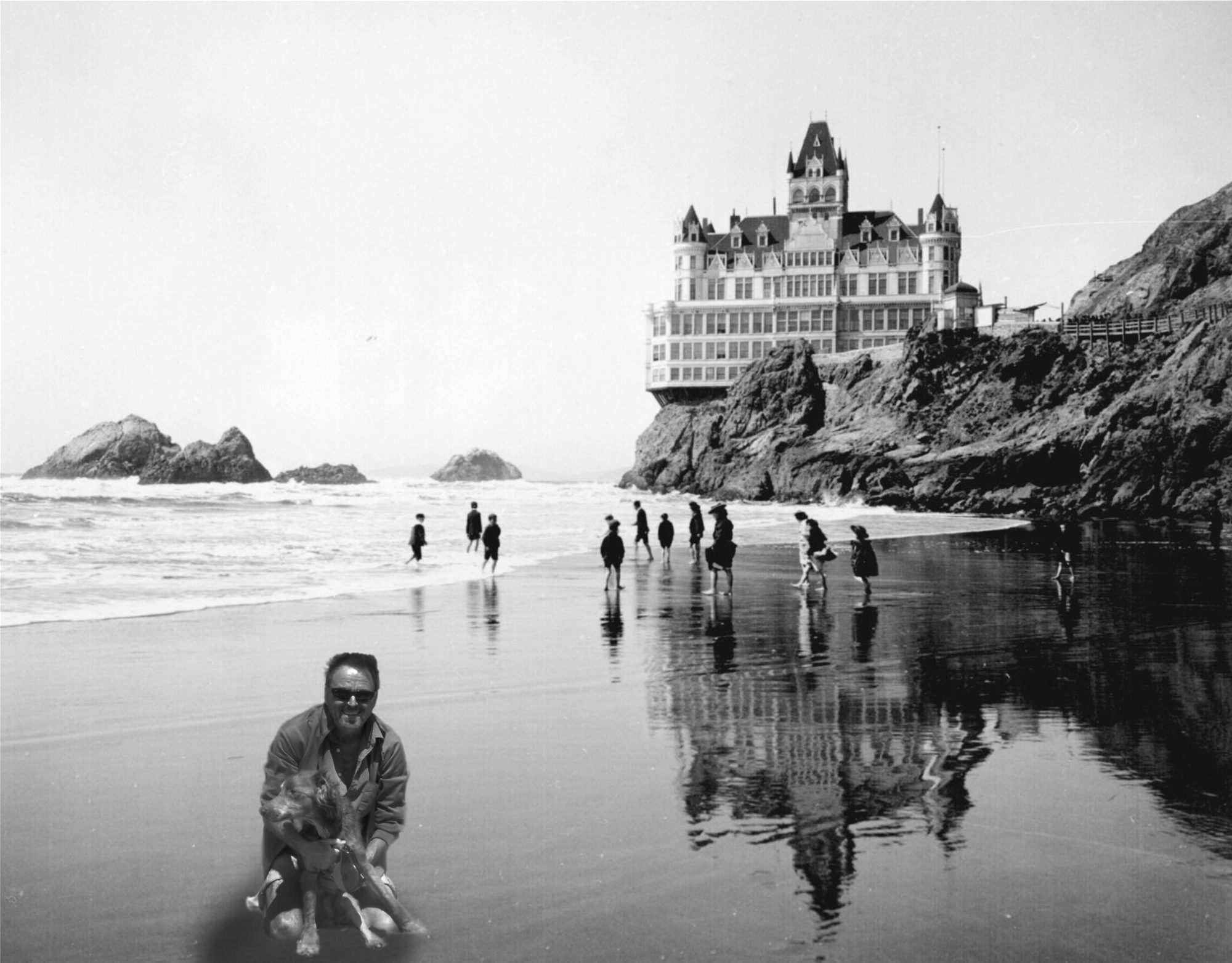
Did you know that the groundbreaking for what would become the 1915 Panama Pacific Exposition was staged at the Polo Field in Golden Gate Park by William Howard Taft? “We’re sorry Mr. President, but there’s been an awkward mistake.” Actually the location was intentional and symbolic because the site for the exposition had not been designated yet. The date of the ceremony was on October 14, 1911, three years and four months before the world’s fair opened February 20, 1915 in the Marina District. Taft can be seen in the center of the vintage picture from opensfhistory.org. Later, President Taft went out to the Cliff House to have what I’m sure was a hearty lunch. Well, look at the size of him!

What was possibly the first stolen car incident in San Francisco occurred here on Page Street, just up from Stanyan Street and Golden Gate Park, on January 29, 1909. A Mr. C. P. Lane parked his car here and went into a building. Four kids, juveniles, jumped in the car for a joy ride. One of the kids knew how to start the automobile, and they took off. They drove down to Stanyan, turned right and then left into Golden Gate Park at Fell Street. Two mounted police officers; J. Mangan and James Harrington, spotted them and chased them on horseback. The driver Jumped out of the car and ran into the bushes and got away. The cops, who didn’t know anything about driving a car, tried to drive the kids to the station themselves in the automobile. According to John Ralston in ‘This Date in San Francisco’ the auto went off the road, crossed over ditches and flower beds, and back on to the road, careening all over the place. The three remaining kids in the car were terrified, and the officers eventually hitched the car to their horses and towed it to the Park Police Station.  The three kids who were busted were sent to a Detention Home. The vintage picture at the spot where the car was stolen was taken just after the 1906 Earthquake, three years before the “boosting car” pioneer’s copper caper.(opensfhistory.org)


Two days later, on January 31, 1909, the San Francisco Examiner ran this cartoon showing the cops trying to drive the kids in the stolen car back to the station.


Welcome back the F Line

The vintage streetcars of the MUNI F Line that runs from the Castro District to Fisherman’s Wharf began running again this May, and it’s great to hear them rattling past again. (Thumbnail images)


Vintage streetcars are once again rolling past the Ferry Building, a couple of them almost as old as the ones in the 1900 picture.

Number 1079 rumbles past the Ferry Building where buses used to turn around during the 1950s:

Muni driver, Cheri, was kind enough to let me use her friendly smile for an update of a 1942 picture from the Muni History site.

Number 1814 turns onto Market Street from Steuart in a reverse angle shot of a 1942 picture from opensfhistory.org, taken at the same location:


Long ago, there used to be another F Line that ran along Stockton Street, seen here exiting the south end of the Stockton Tunnel during the 1940s in a photo from streetcar.org.


Market Street at Fifth during the early 1970s in a vintage photo from SF Gate:


A ginormous bus on display on Market Street at the cable car turnaround on Powell Street during the early 1970s photo from SF Gate. You can see a cable car on the turnaround in both photos.


Baseball is back in San Francisco, the Giants are in first place, and it’s great to see the cable cars appreciating it. They’ll be running again soon, as well.

Open City

No, I’m not referring to Rossellini’s 1945 film ‘Open City’, which is undoubtedly a masterpiece of a movie, but I’m ashamed to say that I’ve never seen it. This post is about the gradual reopening of San Francisco, all but shut down one year ago by the COVID-19 Pandemic. The few times I’ve been able to get over to the City since the 2021 tax season began, and is still in progress, San Francisco has opened up more and more. Also, it’s no longer a depressing town, as it was so often when I visited in 2020. This isn’t to forget the 534 people from San Francisco who, as of this writing, will never get to see San Francisco come back to life because they lost theirs to COVID-19. I’ll dedicate this post to them. Last Monday, I had a chance to leave the office for awhile for a walk around some of Downtown San Francisco to appreciate the difference in the last week of April, 2021 to the last week of April, 2020. Updating a few vintage pictures from the opensfhistory.org photograph collection seemed a fitting way to enjoy the reopening of a city. (Thumbnail images)

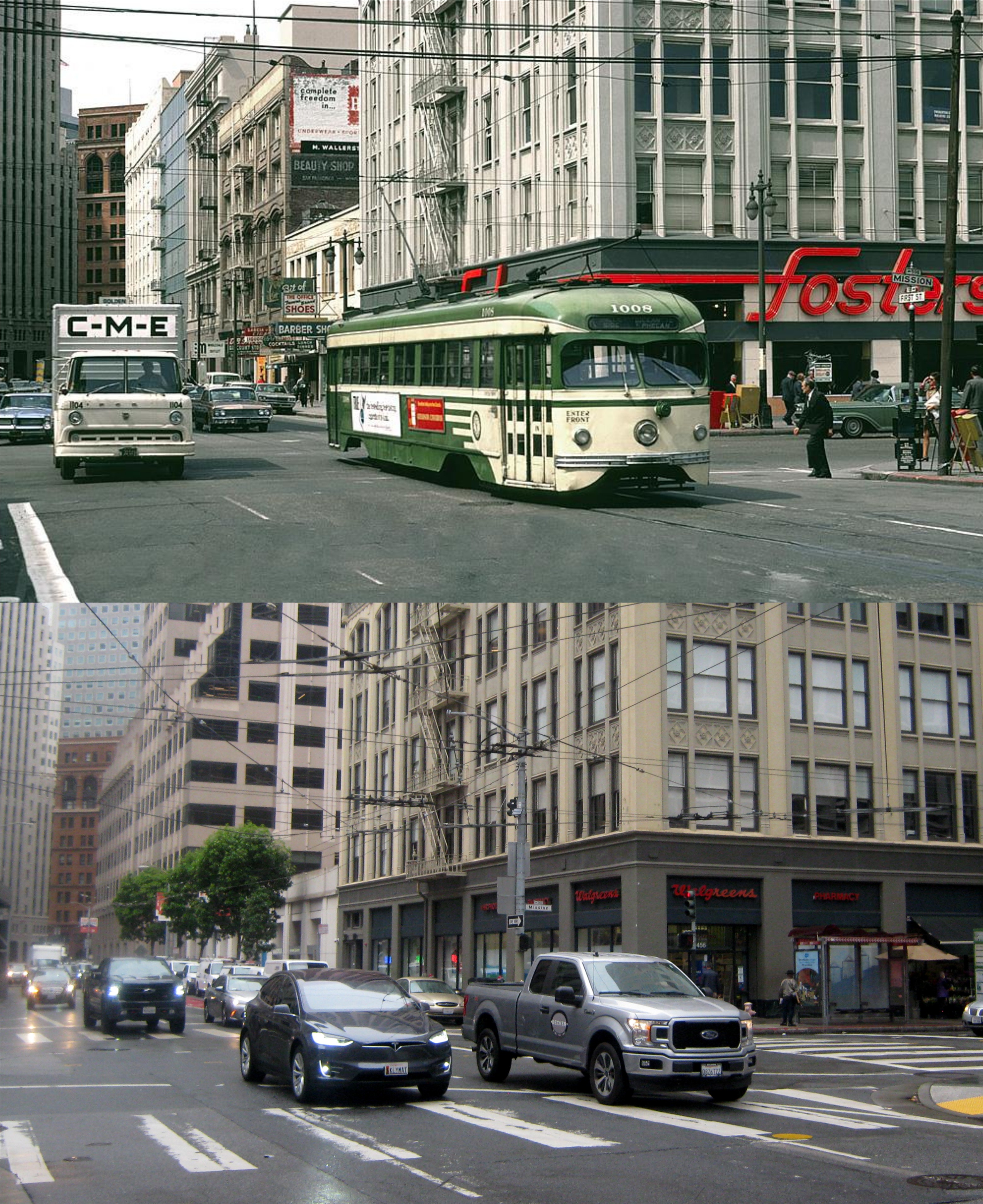
I started out at California and Market Streets, looking toward Spear and Market and the old Southern Pacific Building. I have no idea what that lookout tower on the corner of Market and Spear Streets in the 1924 picture was for, but it must have been an interesting job.

I walked down Drumm Street to Sacramento Street. Before the 1970s, Sacramento Street cut all the way through to the Embarcadero before the Embarcadero Center and the Justin Herman Plaza stopped the street at Drumm. The 1957 photo is looking toward the Embarcadero and the Ferry Building in 1957. Construction on the soon to be opened Embarcadero Freeway was nearing completion.


Hopping on on the Muni #1 bus on Sacramento, I rode up Nob Hill and got off at the Powell Street intersection, seen in 1935 in the vintage photo.


I crossed over California Street along Powell and headed down the south side of Nob Hill to breakfast at Roxanne’s Café on the corner of Bush Street and Powell. It was great to see the café almost pre pandemic full with smiling and hungry people. After breakfast, I did a quick update from Anson Place Alley next to Roxanne’s looking toward Powell. The vintage picture is circa 1948. It would have been nice to catch a cable car passing by, but there not back running just yet.


From Anson Place I headed back to Bush Street and wandered down to the Stockton Tunnel. This is classic Maltese Falcon territory. Sam Spade looked down from where I’m at here to Stockton Street from the roof of the tunnel near the spot where his partner, Miles Archer was shot.

{Spade crossed the sidewalk between iron-railed hatchways that opened above bare ugly stairs, and resting his hands on the damp coping, looked down into Stockton Street. An automobile popped out of the tunnel beneath him with a roaring swish, as if it had been blown out, and ran away.}


Just yards from Stockton Tunnel is Burritt Street Alley, where Miles Archer was shot, and this plaque near the entrance to the alley


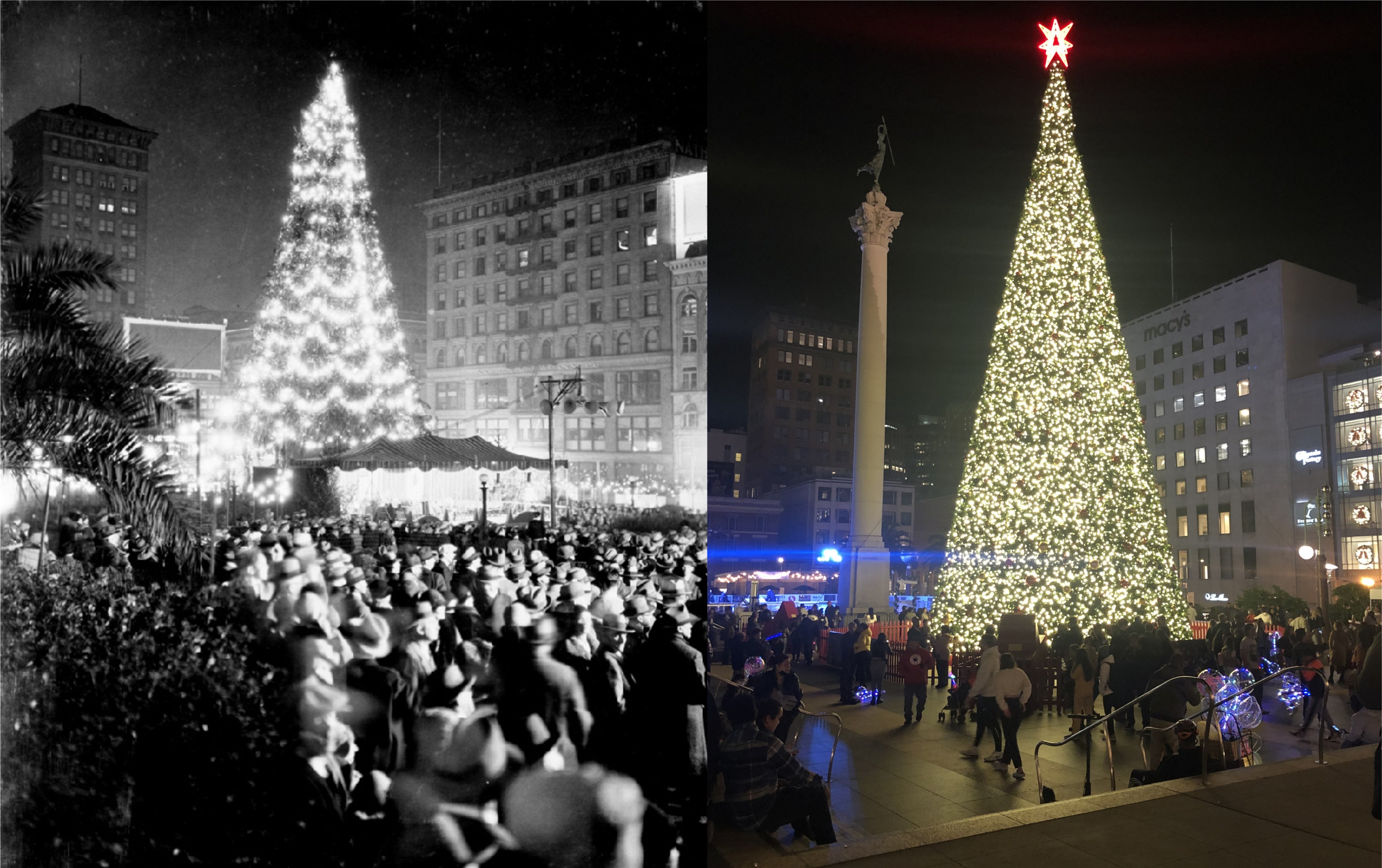
Two blocks south of the Stockton Tunnel will bring you to the friendly sight of Union Square, seen in the vintage picture in 1958. It was unsettling and almost haunting last May to walk through the empty Square and not hear the clanging of cable car bells, the tour bus barkers beckoning, cars honking, people talking, and music.


The little stretch between Kearny and Stockton Streets known as Maiden Lane will probably never be as popular as it once was with all of the quaint shops like Robinson’s House of Pets or the Union Square Lounge gone now, but it’s still a pretty alley, and fun to walk through during the Holidays. The vintage picture looking east is from 1953.


Stockton and Market Streets in 1938 and a rare picture of the Call Building’s dome being removed, and the building being remodeled into what is now the Central Tower: I headed back to the office on BART from here feeling all the better for the day from my visit.

Circa 1989: San Francisco around the time of the Loma Prieta Earthquake. (Thumbnail images)

Broadway at Columbus Ave. The Sexsational, Totally Nude Girls on Stage, and the Love Act are gone now. And they call that progress!!! (Vintage photos by Santi Visalli)

Columbus was still discovering Coit Tower.

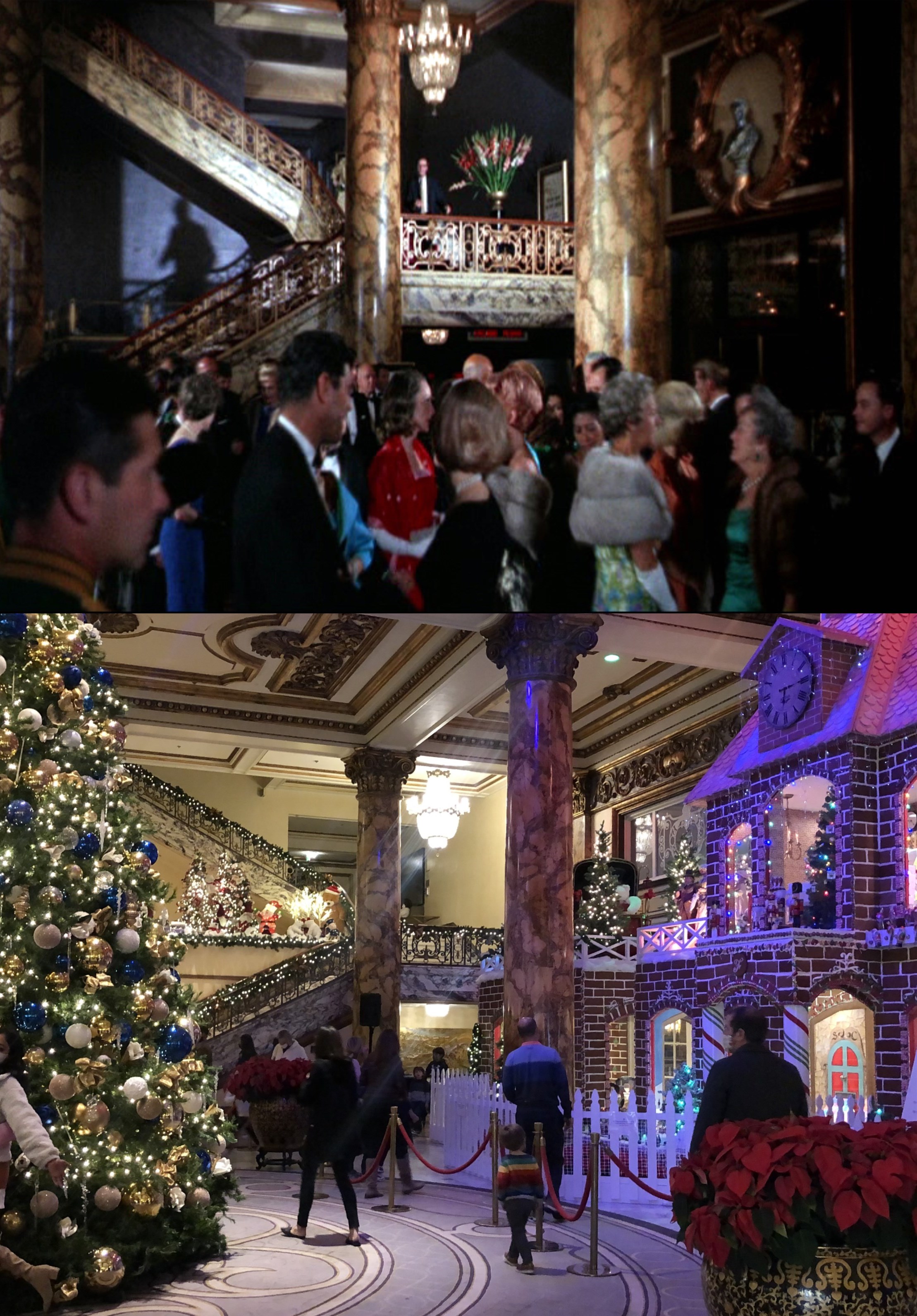
The Fairmont Hotel Lobby is a little easier on the eyes now than it was back then.

The Giants were still playing out at Candlestick Park; in fact, they were playing out there when the Loma Prieta Earthquake hit. I got a chance to explore Candlestick one last time in 2014 while the 49ers were playing their final season there. The ballpark was demolished in 2015.

‘Joe Turner’s Come and Gone’ was packing them in at the old Geary Theater. The Geary Theater was severely damaged during the Loma Prieta Earthquake.

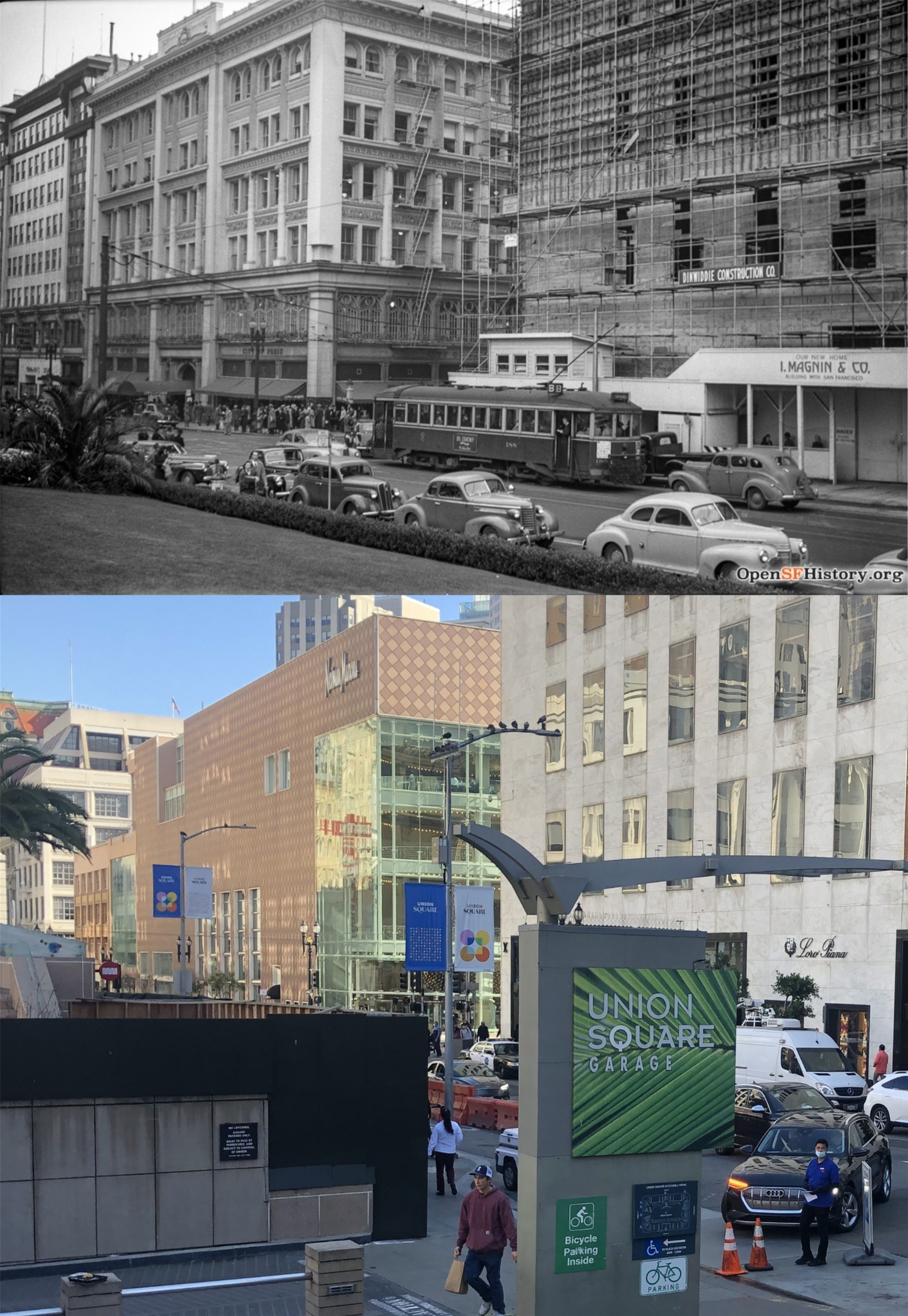
Looking through the Neiman Marcus Rotunda toward the old Union Square before the 2002 remodeling of the Square:

Another look back to the 1980s (Thumbnail images)

I’ve only been able to get over to San Francisco twice since this one-of-a-kind tax season began back in February, but both visits were a tonic.


Boat Tram 228 and Streetcar #1 on 17th Street near Hartford in 1983: This was around the time they began running historic streetcars again around San Francisco. (Wikipedia)


Alcatraz and the Hyde Street Pier from Larkin Street and North Point in the 1980s: That’s the old sailing ship, the Balclutha, docked at the Hyde Street Pier now. (SF Gate)

562 Green Street: The Columbus Café, along with other restaurants on this block, has reopened with lots of sidewalk seating after the COVID-19 Pandemic forced them to close in 2020. (Bold italic)

During the 1980s, Lotta’s Fountain still had the bronze column that was added to the monument in 1916 to match the height of the streetlights on Market Street. It was restored to its original height in 1999. (Opensfhistory.org and Wikipedia)


Tower Records at Columbus and Bay, was still THE place to buy the latest Billy Idol, Toto, or any other popular collection from the 1980s, or albums from the Beatles, Jimi Hendrix, or even Elvis from earlier periods. (SF Gate)

Elegant Ladies still, peek into the shop next to 2447 Mission Street just like they did in Janet Delaney’s 1984 picture; especially if they’re a friend of mine and I ask them to do it for effect.

The Boat Lagoon at Fisherman’s Wharf in June of 1987: That little tyke on my left holding on to my leather jacket is my niece, Stacy. She came out from Texas for a visit in March, and we got a chance to update the picture.