I’ve been staying in the East Bay Area for the past week or so, and haven’t been able to get over to San Francisco for awhile. Mostly, this is because the October 15th income tax deadline for those who filed an extension in July and who told me that they wouldn’t wait until October to file, are waiting until October to file! There’s nothing wrong with that; I haven’t filed my tax return yet, either. These are comparison photos taken in the two cities that I’ve worked in the most during my life, Oakland and Hayward, California. I’ll start in Oakland.
The following vintage pictures of Downtown Oakland are from the Downtown Oakland Property Collection: I spent most of my twenties in life working at this building on the corner of 12th Street and Broadway; the Bank of America Oakland Main Office, ‘OMO’ as it was referred to back then. Although Oakland had its issues then as it does today, I remember this area as being a fun place to be young in, and some of the happiest and romantic days of my life were spent in and around this building. It’s still a bank building today, Comerica Bank, which didn’t have any branches in the area back when I worked there. When I was employed there the building was owned by Robert Lurie, who was at that time the owner of the San Francisco Giants.
This is one block up at 13th and Broadway. The blue building in the center, which was on the corner of 14th and Broadway, was the Bank of California Building once. On the ground floor of the Bank of California Building was Smith’s Men’s Store. I remember buying a stylish suit at Smith’s about the third year after I started working for Bank of America that looked like something Rhett Butler would have worn if he would have around in the 1970s. Shortly after buying the suit, I was passing by Smith’s again while wearing it, and there was a panhandler on the corner who I ignored, as most people did back then. As I walked past him he yelled to me loudly, “Damn! Where’d you cop that bad-ass suit?” That was one the best compliments I’ve ever had in my life! I think I gave him five bucks!
This one is kind of special to me. I bought my very first suit the second year after I started working for the bank here at Bond Clothes. I was dating a teller named Melodie at the time who helped me pick the suit out. In fact, the little rascal insisted on going into the dressing room with me while I tried it on. Hey, I was young once too. After the renovation to the area, I wasn’t able to locate exactly where Bond Clothes used to be until I found this picture. Also, I still have that suit and can still get into it if I hold my breath deep enough. I’ll keep it for the rest of my life.
This is looking back toward 14th Street across Broadway from Bond Clothes at 15th Street. Downtown Oakland didn’t really look a lot different from these vintage pictures two decades later when I started working in the area.
This is looking back toward the Bank of America Building along 12th from Franklin Street. ‘OMO’ was really a fun building to work in. It had a rickety old elevator that ran four floors from the basement to the third floor. You could stop the elevator between floors by sliding open the crisscross metal door to catch a few kisses, if you were riding with the right company, before heading on to your floor.
About ten miles south of Oakland is Hayward. My father started his income tax practice in Downtown Hayward in 1960, and I continued running the business after his death in 1993. Hayward is where I do all of my income tax and bookkeeping work, edit the posts for my San Francisco photography website, and occasionally sleep with my feet up on the desk. The top vintage picture is Foothill Blvd near A Street looking north in the 1950s. This is about two blocks from where my dad’s income tax practice originally opened. This was once a bustling shopping area before the opening of the Southland Mall in the early 1960s, which eventually put all of the department stores in the vintage picture out of business.
This is Foothill Blvd., looking south from the previous picture around the same time. Joseph Magnin, Milens Jewelers, Lewis Carpets, Bond Clothes, Smith’s, and all the rest, were doomed when the Southland Mall opened. (Hayward Area Historical Society)
‘Bullitt’ showing at the old Ritz Theater on Mission Blvd: I’ll bet that that’s where I saw ‘Bullitt’ for the first time. The Ritz Theater would eventually become a porn theater before it was demolished. (Cinematreasures.org)
The southeast corner of B Street and Mission Blvd long ago: Scenes were filmed at this corner in 1972 for the 1973 film ‘Steelyard Blues’, starring Jane Fonda and Donald Sutherland. (Pinterest / T.J. Soares)
Donald Sutherland chases Jane Fonda along Mission Blvd. to the corner of B Street, seen in the previous picture, past what is now called the Eden Loan Company in 1973’s ‘Steelyard Blues’.
The old City Hall on Mission Blvd. empty for over 40 years: Too bad they can’t find a way to reuse this fine old building. It’s sitting right on the Hayward Fault and isn’t worth renovating, I guess. One of my older brothers got tossed into jail here overnight for too much partying. He told me that the cell they had in the basement wasn’t any bigger than the one Andy and Barney used to always toss Otis into in ‘Andy of Mayberry’. (Hayward Area Historical Society)
A Hayward landmark, “Big Mike” stood at this location on Mission Blvd. where a car wash used to operate for years. (Wikimedia Commons)


{I headed for Chinatown. I had friends there and was certain that I could lay low until the heat was off. As I headed up Grant Avenue to California Street, I approached a young lad holding a shoe shine box.
{My destination was the Lee Building at 109 Waverly Place. When I approached the temple I spotted the lookout on the second floor. He was called a “lookout” because if you didn’t look out when you were around him, you could vanish! It might be a good place to hide, but it also may be more trouble than it was worth. I decided to move on.}
{My next stop was the Six Families Building on Stockton Street. The families associated with this building had a history of assisting people in need. When I asked them if I could find temporary shelter in the building they asked me which of the six families who owned the building was I a member of. When I asked them who the names of the six families associated with the Six Companies Building were, they replied, “Kong Chow, Ning Yeung, Sam Yup, Yeong Wo, Hop Wo, and Yan Wo.” Being Irish, I wanted to be very careful about which family name I selected. While I was trying to decide which one to pick, they quietly closed the door.}
{The Free Mason Building in Spofford Place; just the place to hide! After all, they hid Sun Yat-sen from assassins at 36 Spofford Alley while he was in exile trying to raise money for his revolution; although the current tenants here probably aren’t aware of that. I knocked on the door and a man answered. I told him I was in danger, and asked him if I could hide out here for awhile.
{I stopped to rest at the corner of Columbus and Kearny. I wondered if I’d shaken the people who were after me, I wondered if I could find a place to sleep, I wondered how much money I had, and I wondered if those really were female impersonators at Finocchio’s up the hill.}
{Ah, the International Settlement on “Terrific Street”, a “terrific” place to hide out! Why, even “Baby Face” Nelson came here to hide out in July of 1934; except he died four months after that. That’s not encouraging.}
{Well, at least I can get a meal at Diana’s Café; the food stinks, but she doesn’t charge much. She said to me when I left, “Don’t complain about my coffee, you’ll be old and weak someday too.”} *
{Diana had told me that there was a place on the corner of Sansome and Jackson Streets where they would put me up for the night, no questions asked. However, shortly before I arrived there, the building was blown up in a terrific explosion! I knew that the bomb was meant for me. I was frightened thinking about the violent type of people who would go this far to get me. I was filled with rage over thoughts about innocent people who may have been hurt because of me. But most of all, I was absolutely delighted that I wasn’t in the building when it exploded.}
Recently, I learned of a new book published in 2020 about San Francisco’s Chinatown in the past. Titled ‘GOLD MOUNTAIN, BIG CITY’, it’s an oversize book by author Jim Schein displaying much of the work of a mapmaker and photographer named Ken Cathcart while he lived in San Francisco during the 1930s. At $39.00 from Amazon.com, it’s a little pricey, but if you’re as intrigued by Chinatown as I am, it’s well worth it. Besides, there isn’t much else to do these days other than staying at home and reading a good book. Besides wonderful vintage pictures of Chinatown and North Beach by Cathcart, mostly taken from 1937 to 1939, the book also includes a foldout map of Chinatown drawn by him in 1947. The book explores all of the areas drawn on Cathcart’s map. I had a great time during this past week, myself, exploring locations covered in the book, and taking pictures. I also know that there’s some concern and a little resentment by some people toward the residents living in Chinatown lately over COVID-19, and there shouldn’t be. Wikipedia states that Chinatown is “the most densely populated urban area west of Manhattan”, yet Chinatown has a remarkably low death rate from COVID-19. Chinatown is gradually and carefully coming back to life, and ‘GOLD MOUNTAIN, BIG CITY is a perfect way to visit there, either staying at home and reading or by going on location. My updates of a few of Ken Cathcart’s pictures are in black and white also; they turned out better that way.
Grant Avenue, between Jackson Street and Pacific Avenue, looking north in 1937: The old Mandarin Theater is in the background.
Looking south in the opposite direction as the previous picture from Pacific Ave in 1939: The Mandarin Theater is on the right.
Looking north on Grant Avenue past Sacramento Street in 1937: That’s a cable car from the old Sacramento Line passing by. You can see life starting to come back to Chinatown.
Waverly Place at Sacramento Street in 1938: Although considerable remodeled now, that’s the same building on the corner.
The old Children’s Playground on Sacramento Street between Stockton Street and Grant Ave in 1937: an effort is underway to restore and preserve the old playground.
The northwest corner of Washington Street and Grant Avenue in 1938: I like the old awning better.
The same corner of Washington Street and Grant Avenue as in the previous picture, looking north in 1938:
The Great China Theater, now the Great Star Theater, in 1938: They’re still putting on operatic shows at the Great Star Theater, although they have been closed since March because of the pandemic shutdown.
These ladies in 1937 are coming out of the restaurant called Jackson Chow Mein seen in the previous picture next to the Great China Theater. There’s still a restaurant there today called Bund Shanghai Restaurant, but it’s take-out only due to the pandemic.
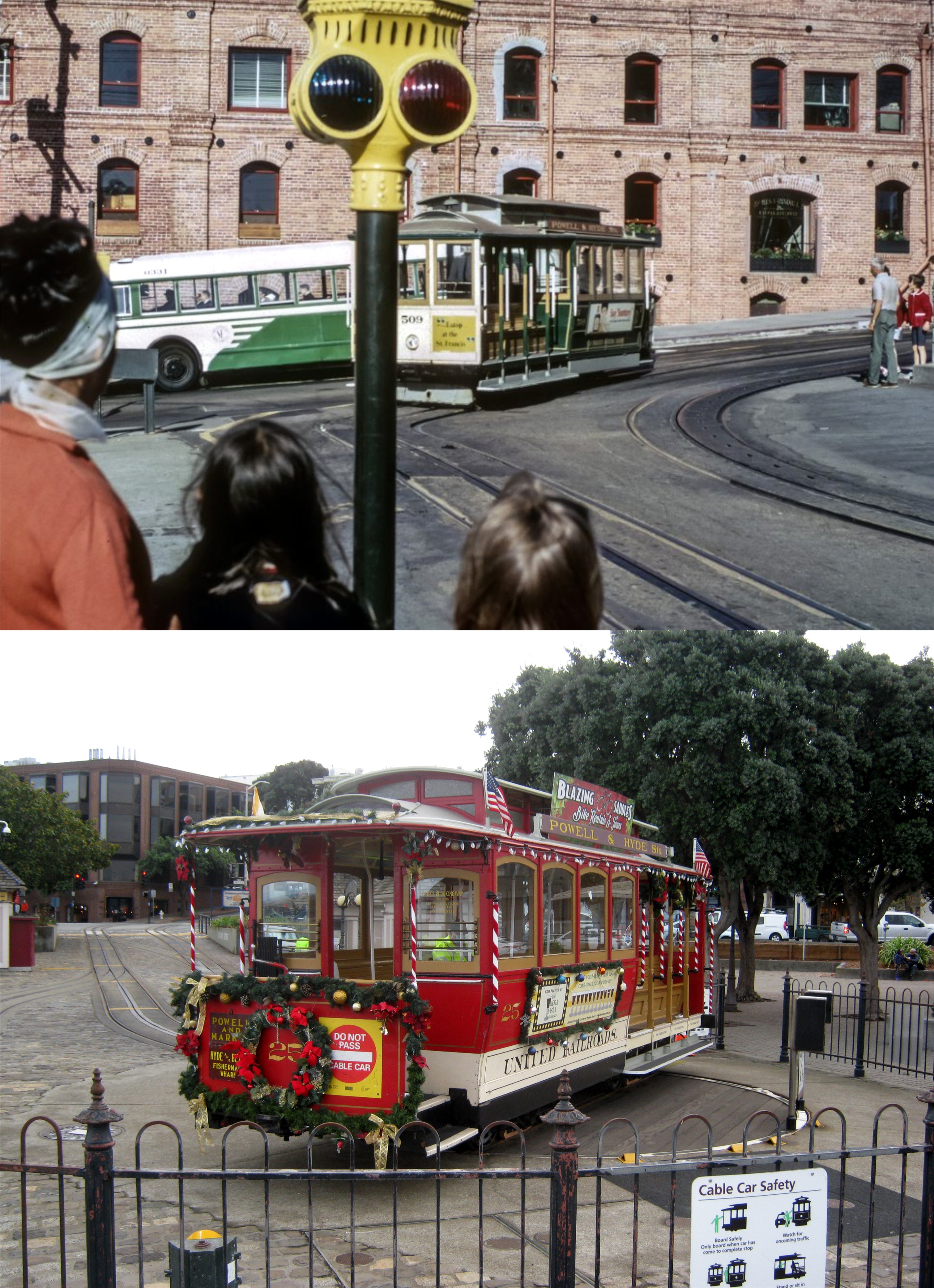
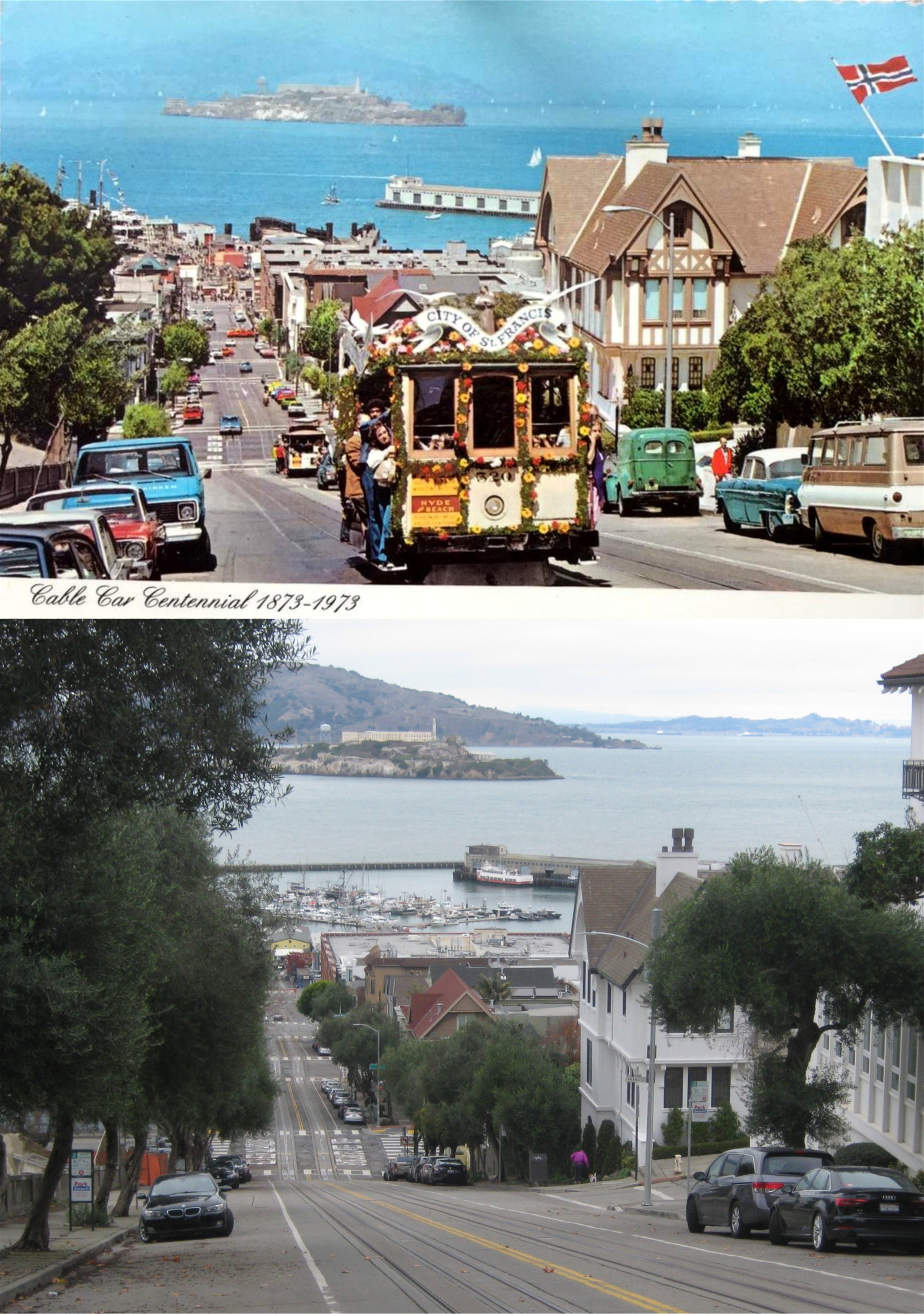
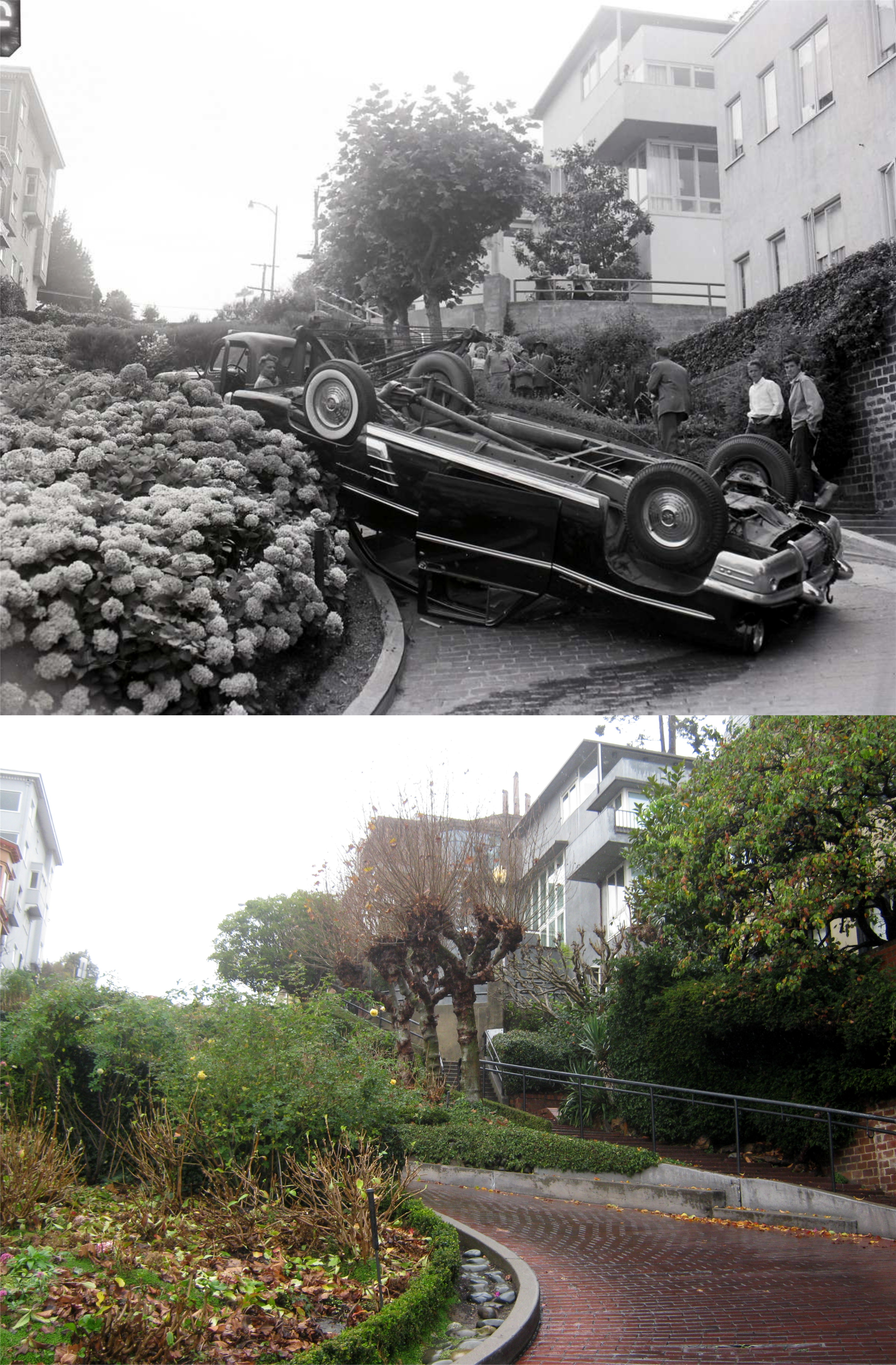
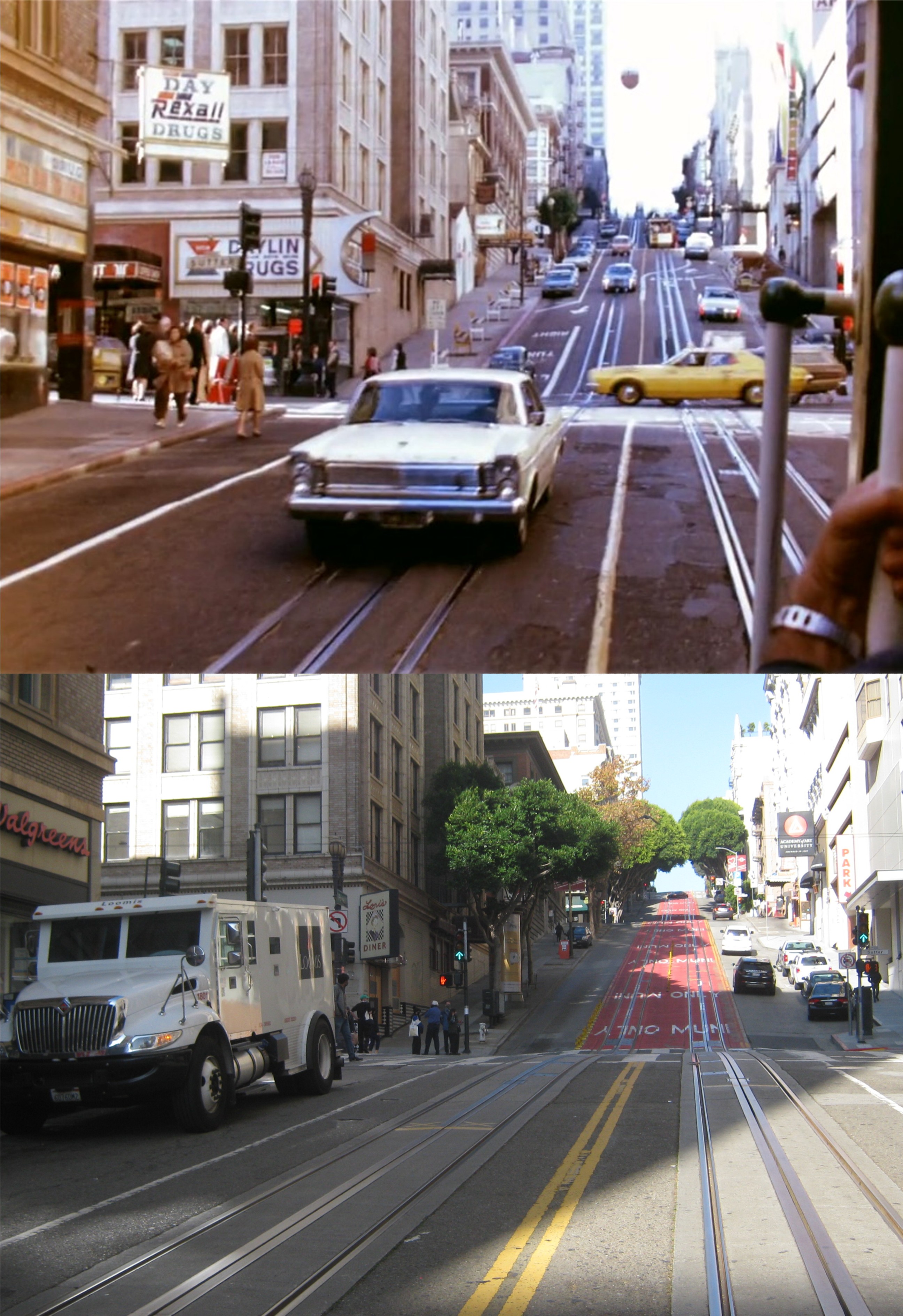
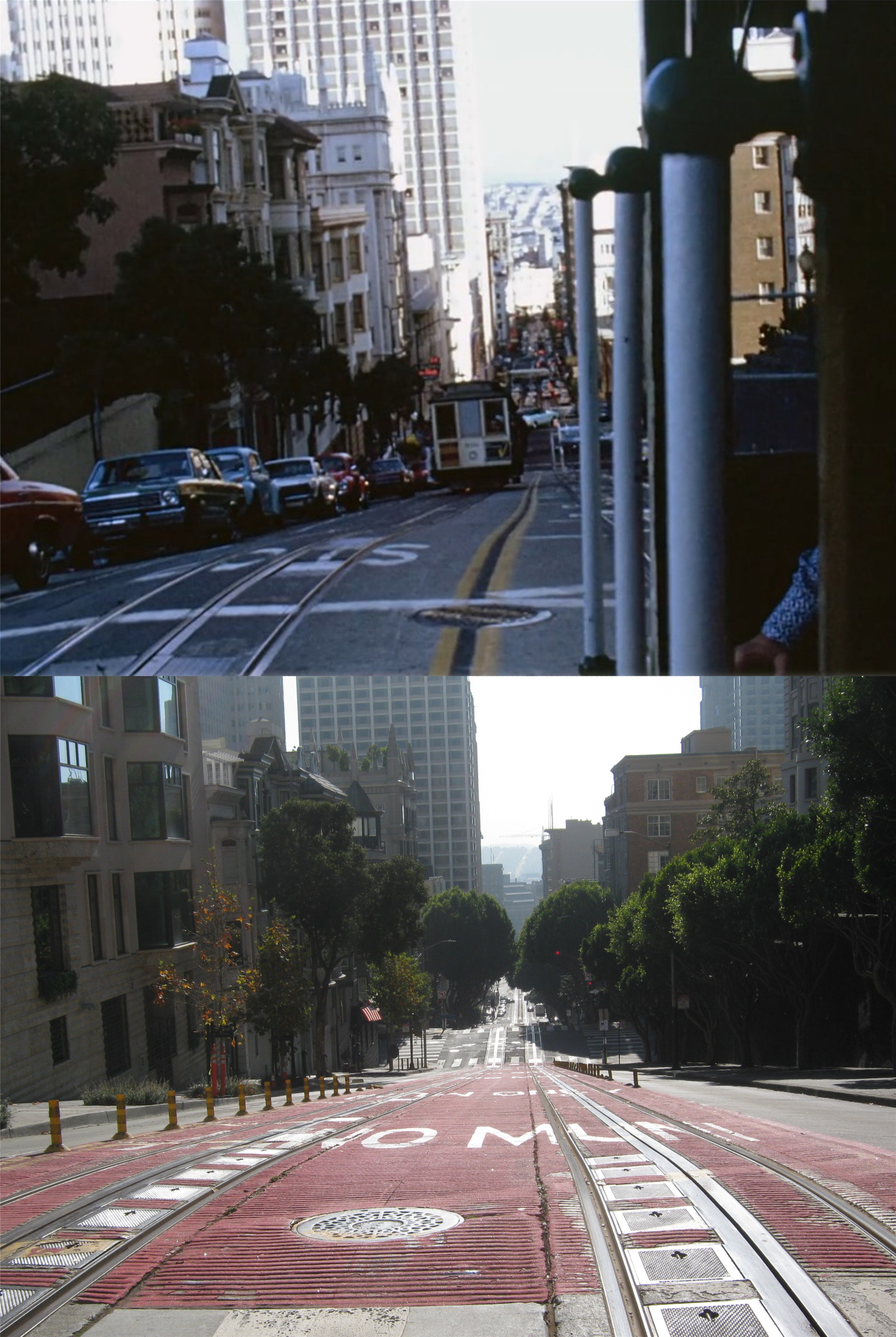
The last time I rode on the Hyde Street Cable Car Line up over Russian Hill to Downtown San Francisco I was able to get a spot to hang on to the outside of the cable car as we passed over the top of Russian Hill. This picture is looking down Lombard Street as we pass. The next block we approached is Greenwich and Hyde Streets; ‘Dark Passage’ territory. ‘Dark Passage’, of course, is the 1947 film noir set in San Francisco starring Humphrey Bogart and Lauren Bacall.

As we rattled toward Greenwich Street, we’re approaching the spot in the film where Humphrey Bogart boarded a cable car in his escape after causing Agnes Moorehead’s accidental death.
On the west side of Hyde Street at Greenwich is the Tamalpais Apartment Building. In her top floor apartment here, Agnes Moorhead panics as Bogart tries to make her confess to killing his wife, which he went to prison for. She crashes through the window of her apartment and falls to her death. Well, there goes his alibi!
Bogart goes the roof of the building and climbs down the fire escape.
In this cutaway shot of Bogie descending the stairs, you can see a reservoir that used to be where the Alice Marble Tennis Courts are today.
Bogie jumps to the ground from a ladder below the stairs that no longer exists. You can see the fastening markers where the ladder used to be in my picture.
As sirens approach, Bogart crosses Hyde Street to catch a convenient passing cable car to make his escape. Well, they did run more often back then, and as of right now they’re not running at all. This is looking down Greenwich Street toward Telegraph Hill.
We’re getting ready to hook up with Bogie as we approach Greenwich.
And right about here is where he jumped on a cable car, but he wouldn’t have found much room on ours. Bogie climbed on just about where the first parked car we’re approaching is.
Once on board, Bogie looks back at the Tamalpais Apartment Building. He can’t worry too much about Agnes Moorehead now; he’s got a date with the Dame de la crème, Lauren Bacall. I’ll close with a link to a film clip of the Tamalpais Apartments escape scene below.
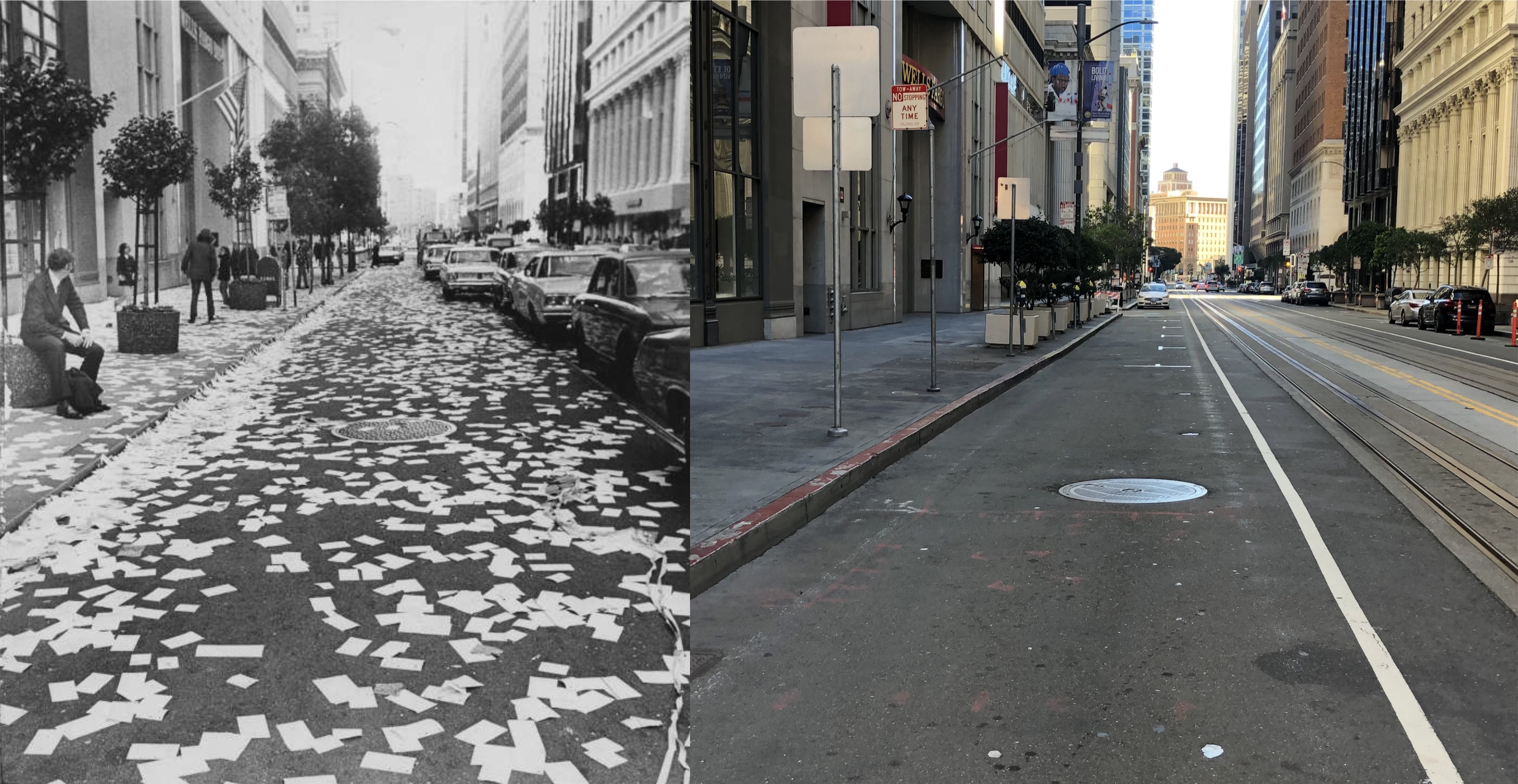
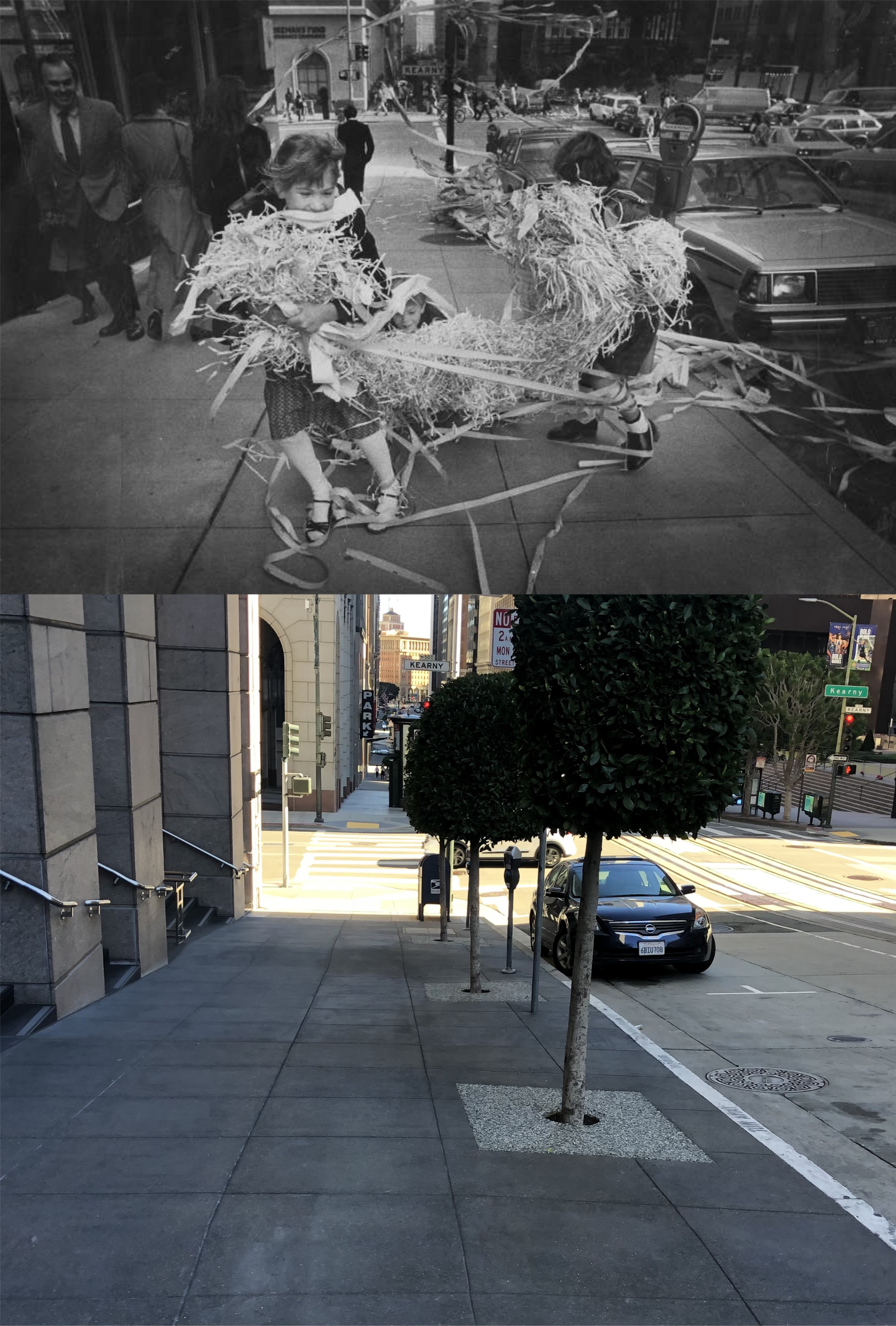
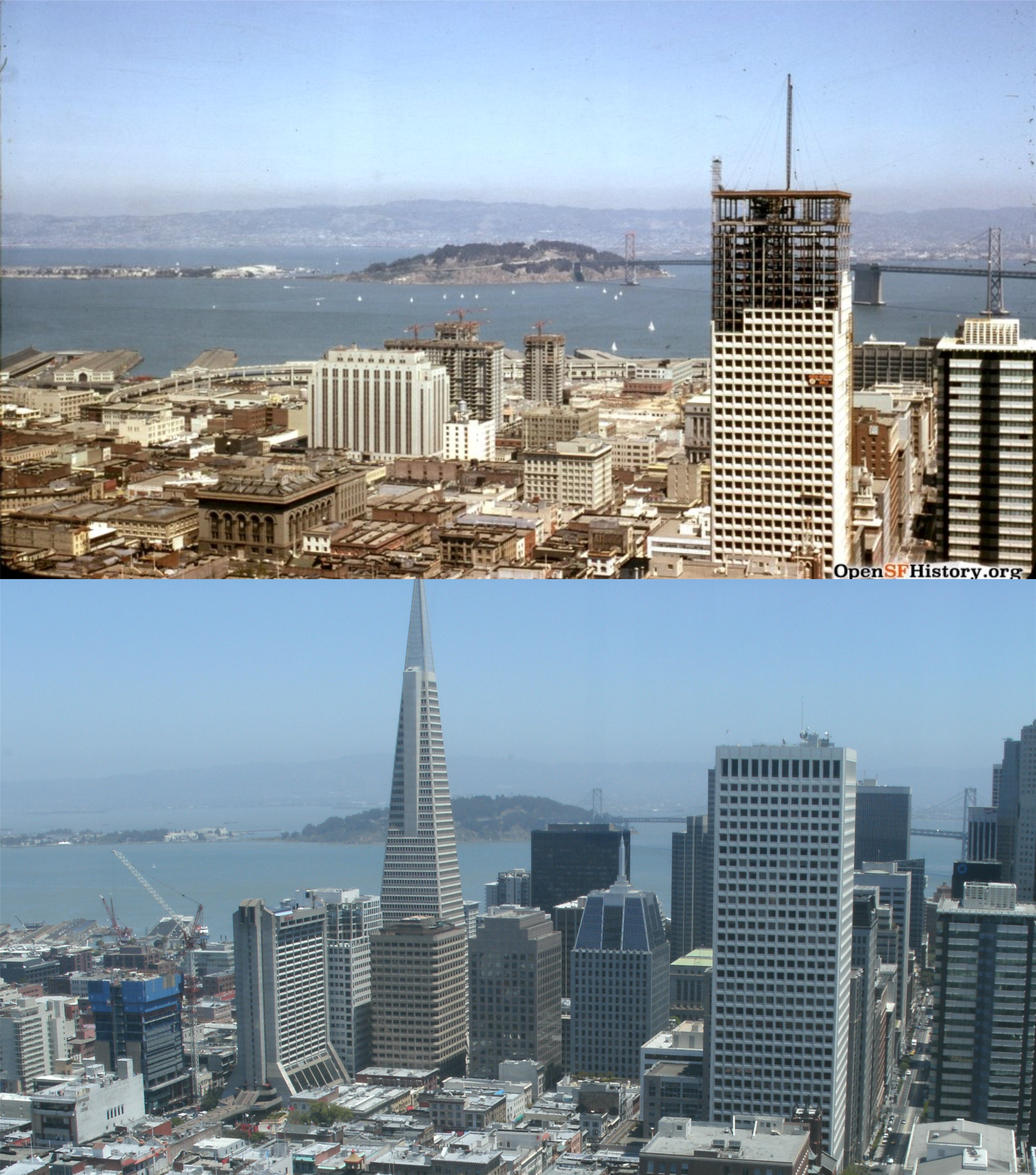
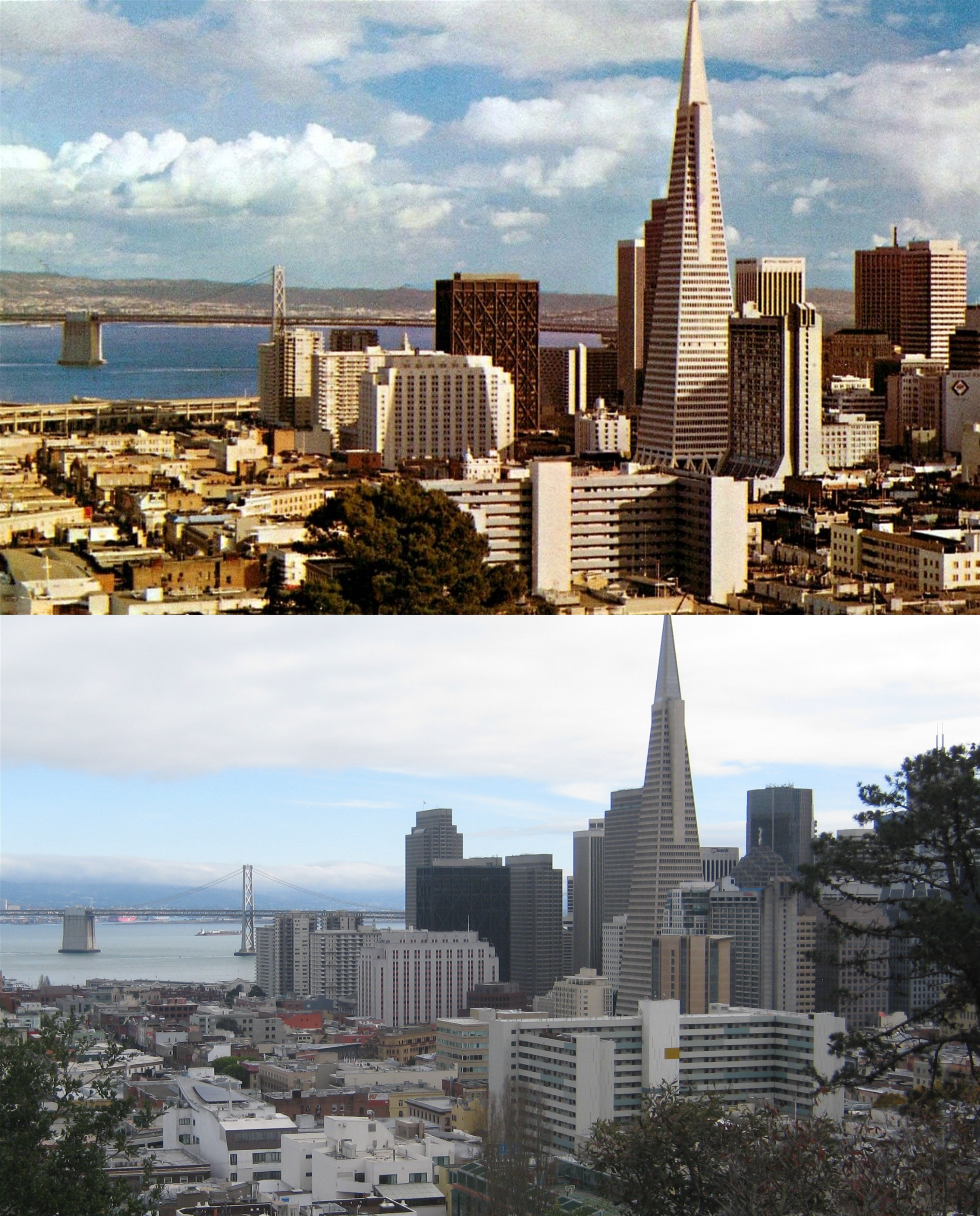
Clay Street looking east from Jones in 1978: Not a big change here, a few more buildings and they finished the Embarcadero Center. (Gosta Knochenhauer)
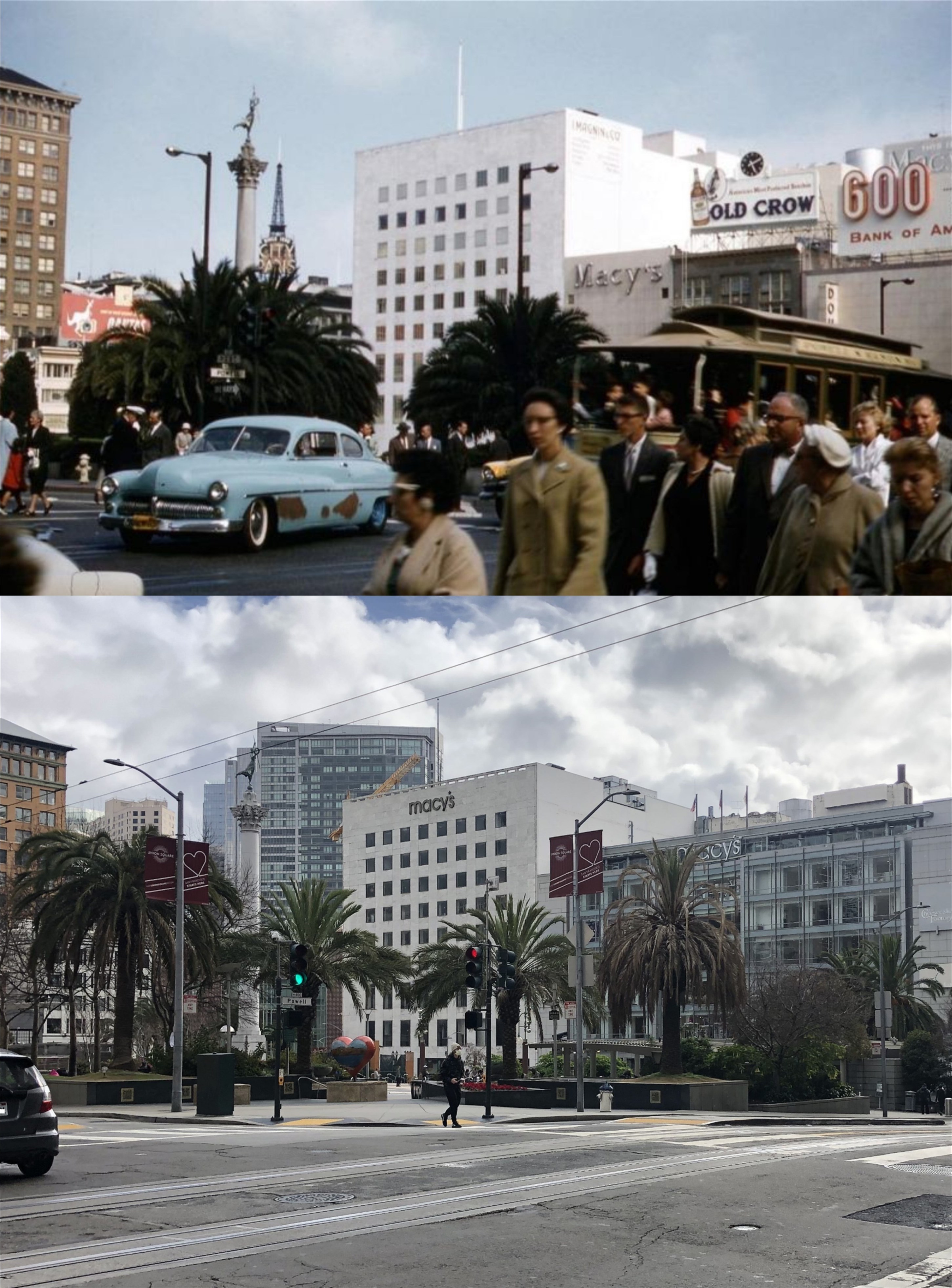
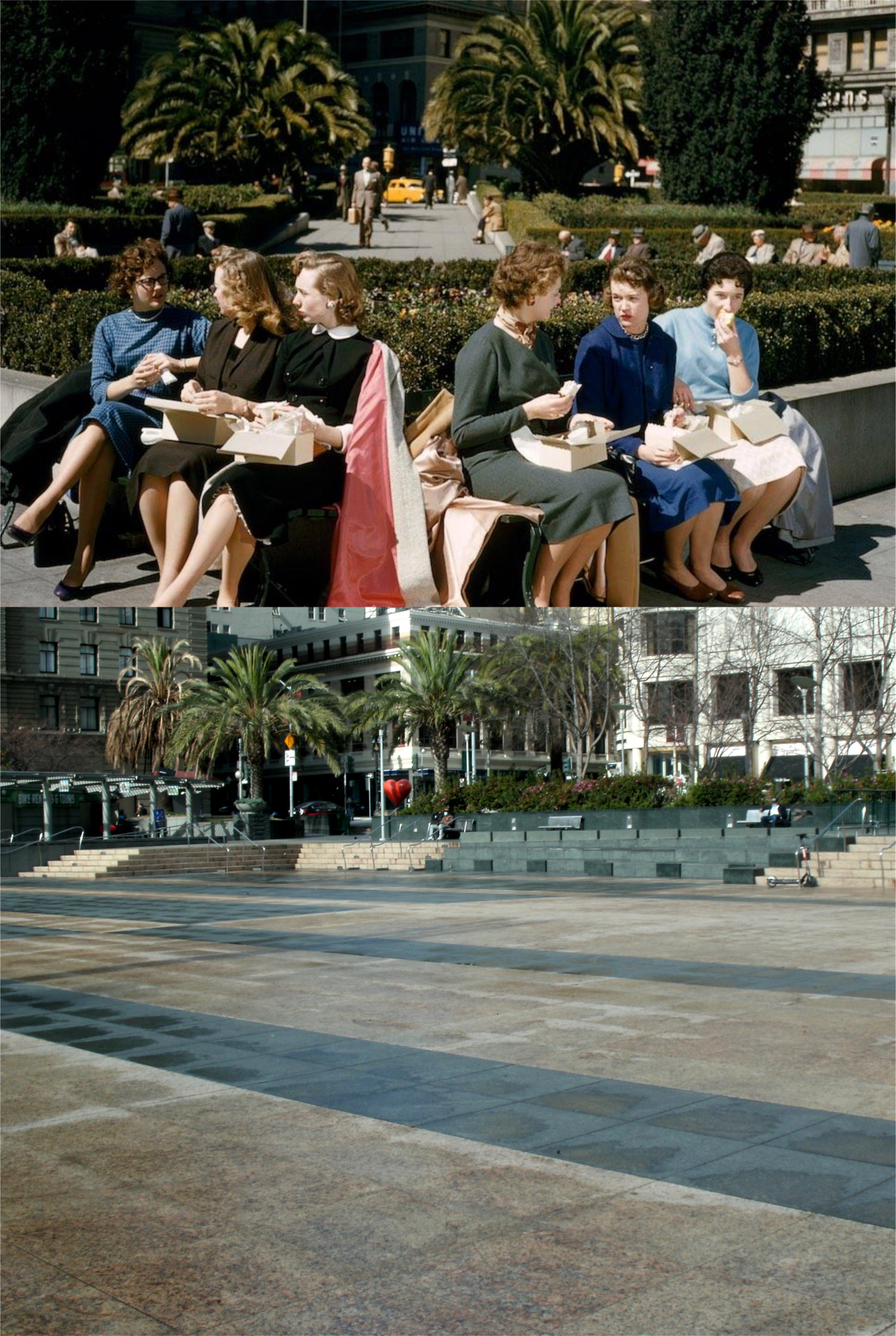
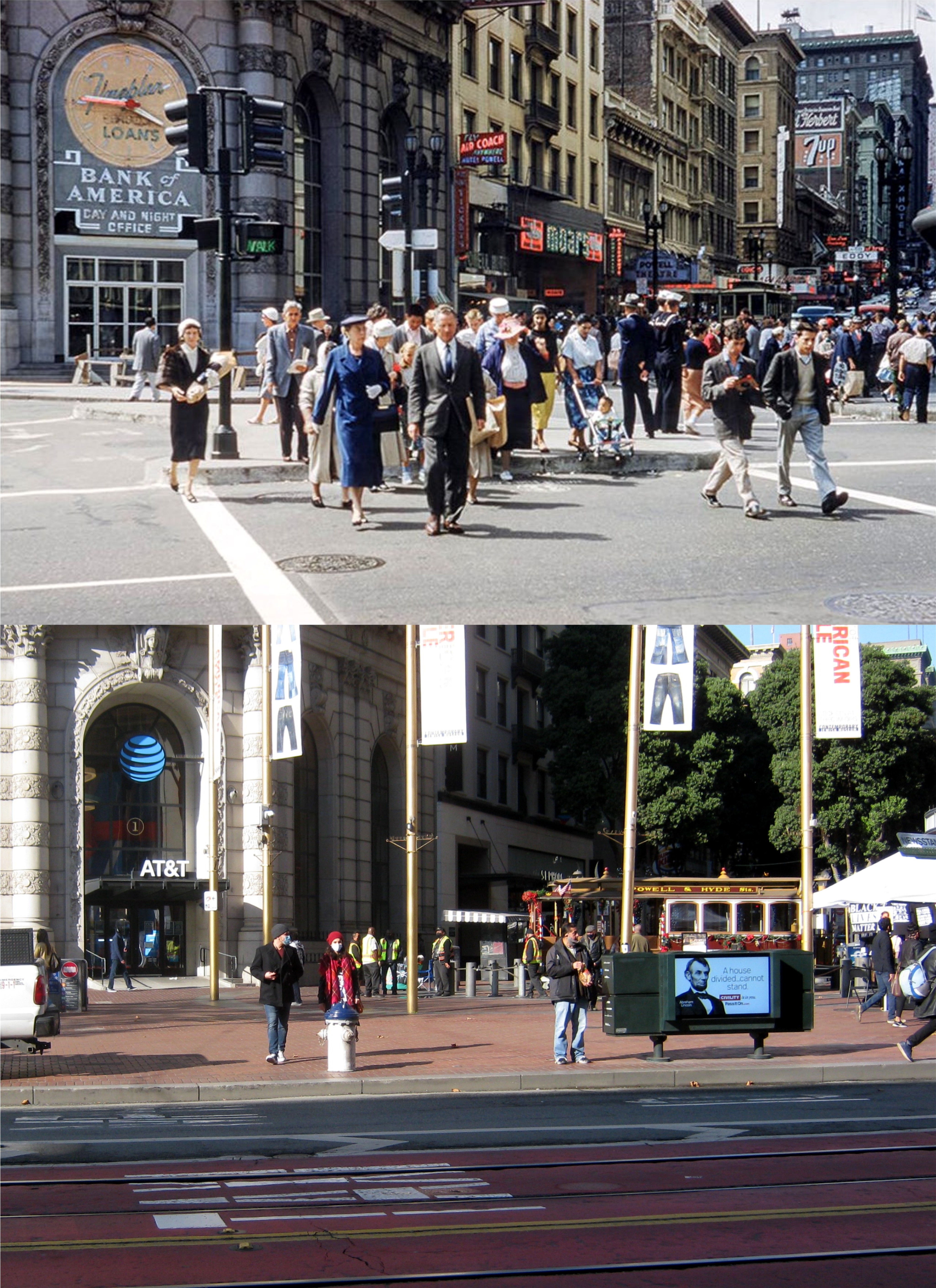
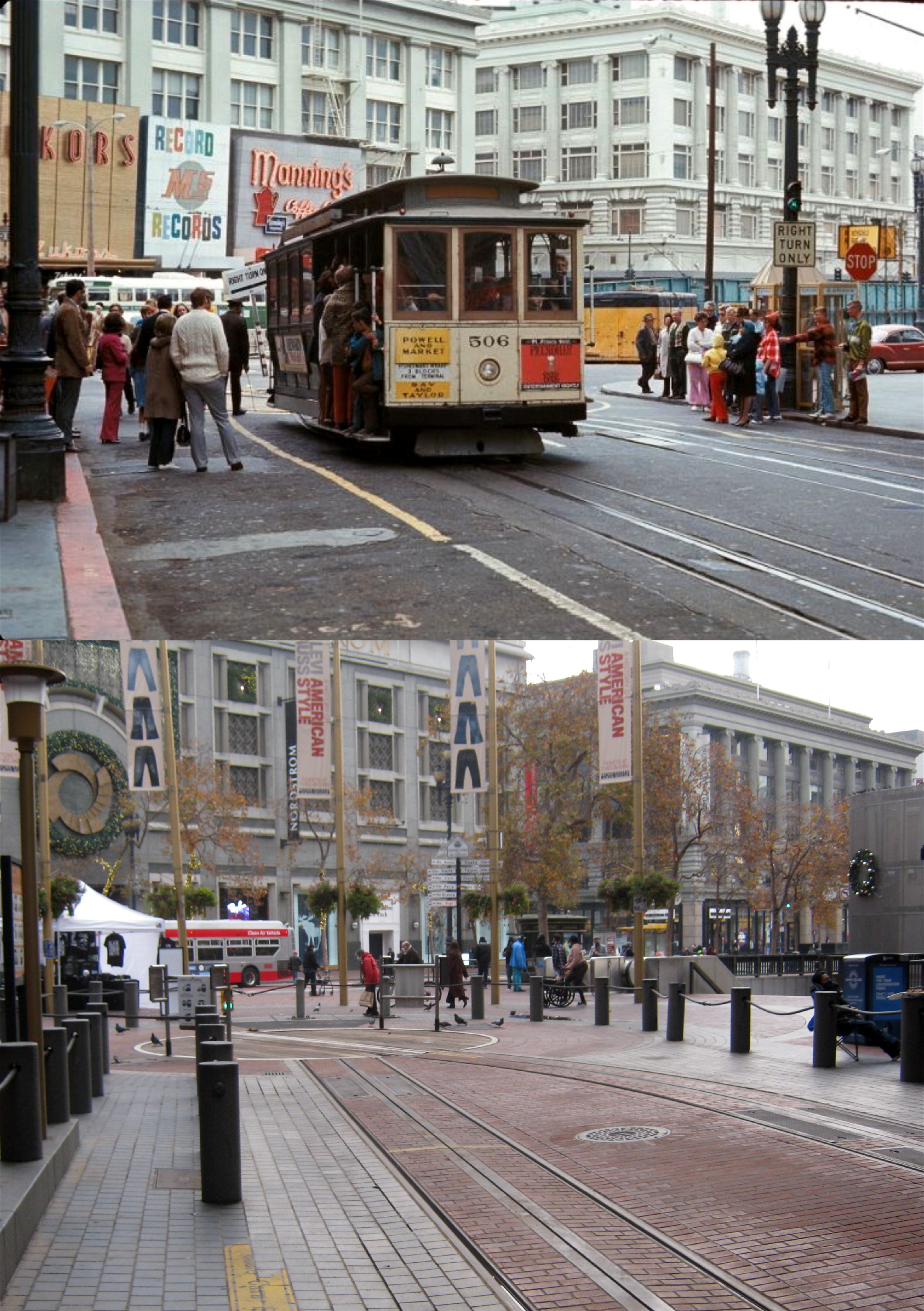
One block south and three blocks east brings us to Sacramento and Powell Streets, looking east in 1965. (Bousquairol)
We’ll step across Sacramento Street and back three years to 1962. Hmm, a full hour coverage of THE BIG NEWS from KPIX, Channel 5. A long way back from CNN and FOX.
We’ll travel south along Powell Street to Bush Street in a terrific picture from the SFMTA Photo Archive looking north up Nob Hill in 1914.
Looking east along Bush Street from Powell in 1967: I suddenly have a terrific urge to buy a six pack! (Douglas Campbell)
East to Stockton Street and down to Geary St. looking toward Union Square in 1928: It’s nice to see trucks that are older than the one I still own. (Gordon Morales)
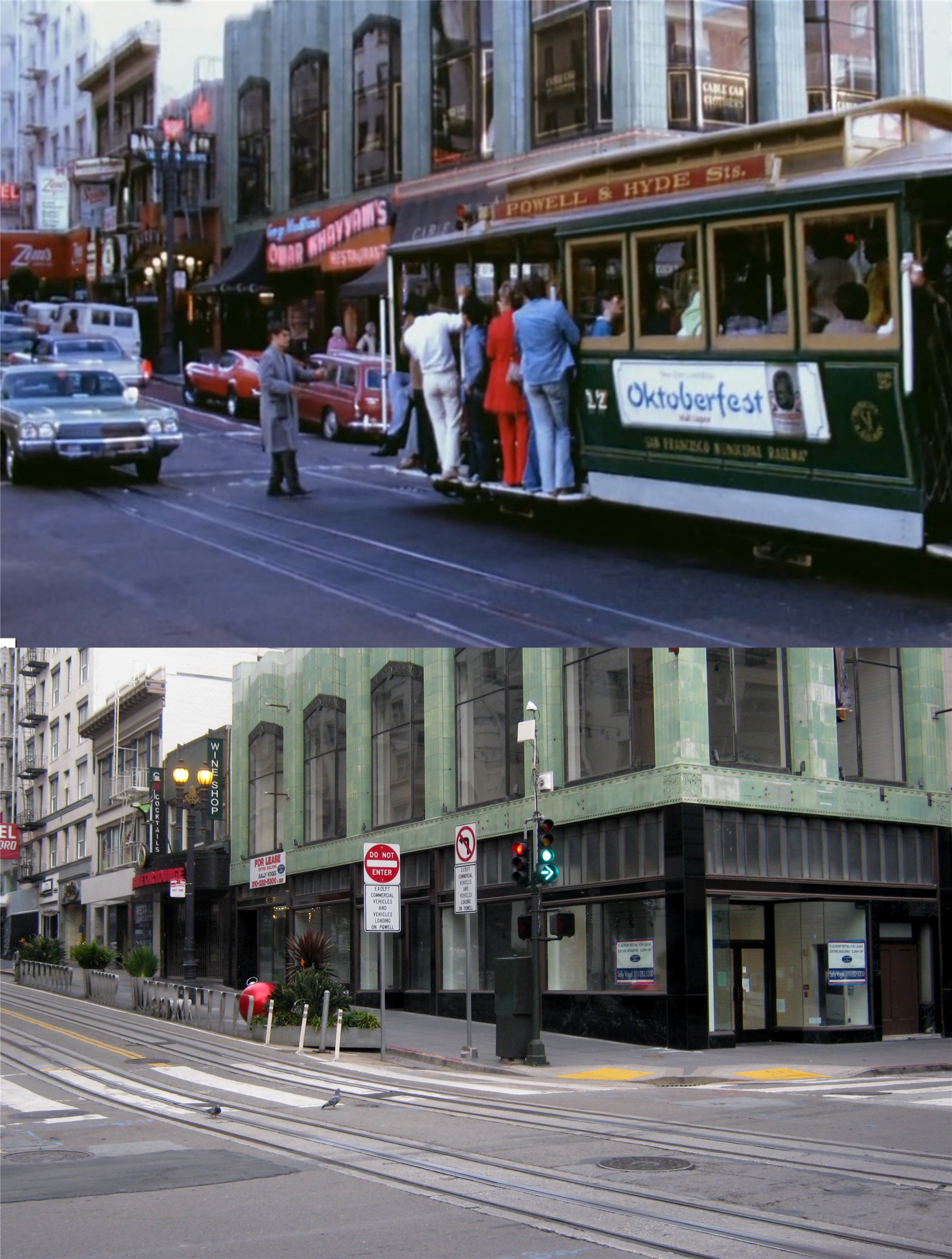
One block south to O’Farrell and one block west brings us back to Powell Street looking north in 1961: I’d like to have got a shot over the hood of my car, but I take DO NOT ENTER signs personally. The green building on the right, I know, most of the buildings in the old photo are green, was where the old Omar Khayyam Restaurant used to be.
One block south on Powell and east on Ellis Street brings us here, looking southeast down Ellis Street toward Market Street and the old Humboldt Building in the 1940s: Just behind me is John’s Grill where Sam Spade ordered lunch in the novel ‘The Maltese Falcon’. They’ve opened up with sidewalk dining again. I’ll have to stop by there again for lunch next time I’m in the area and buy a Brigid glass that they sell as souvenirs, named after Brigid O’Shaughnessy, the femme fatale of ‘The Maltese Falcon’. (Bennett Hall)
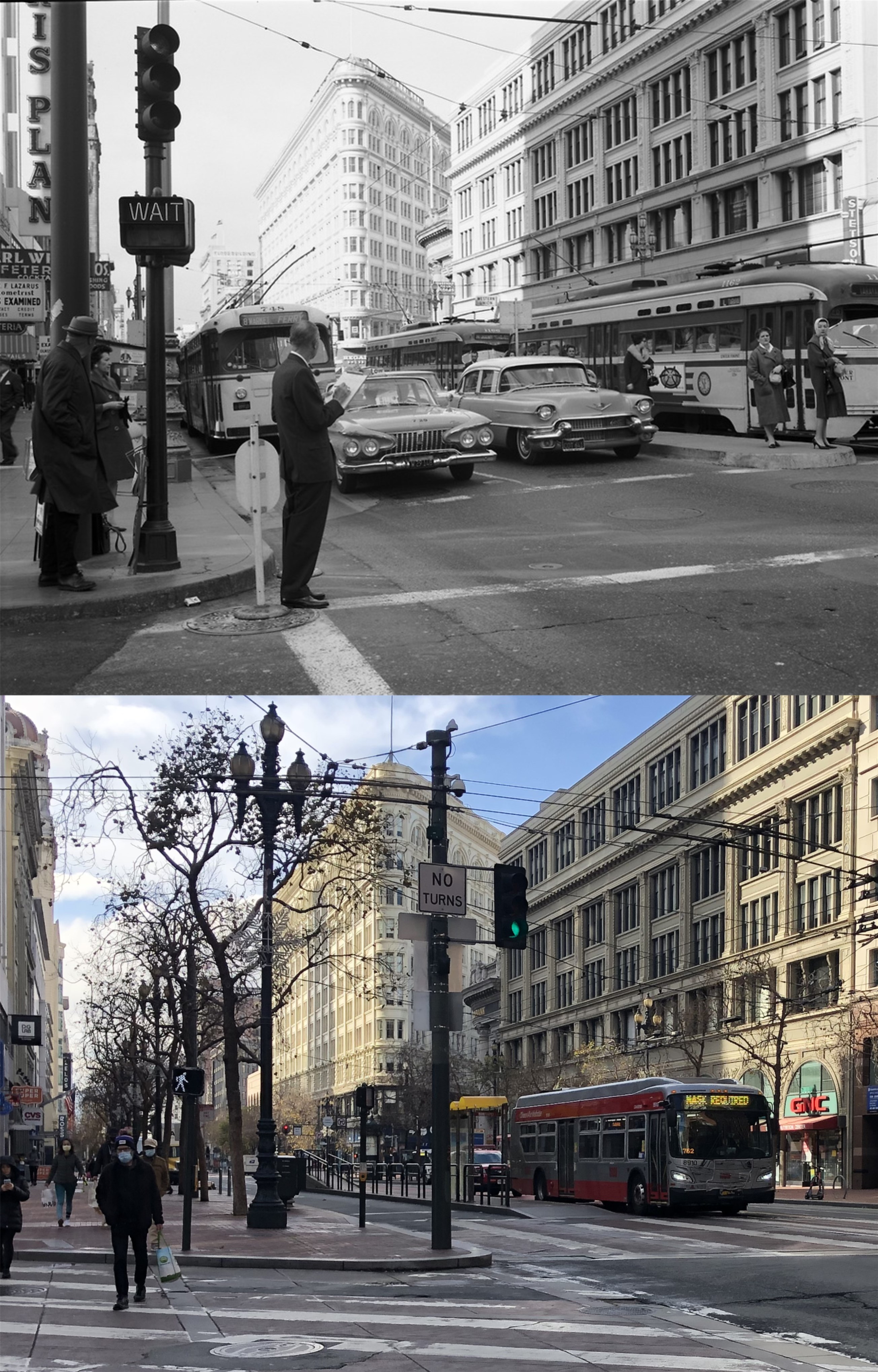
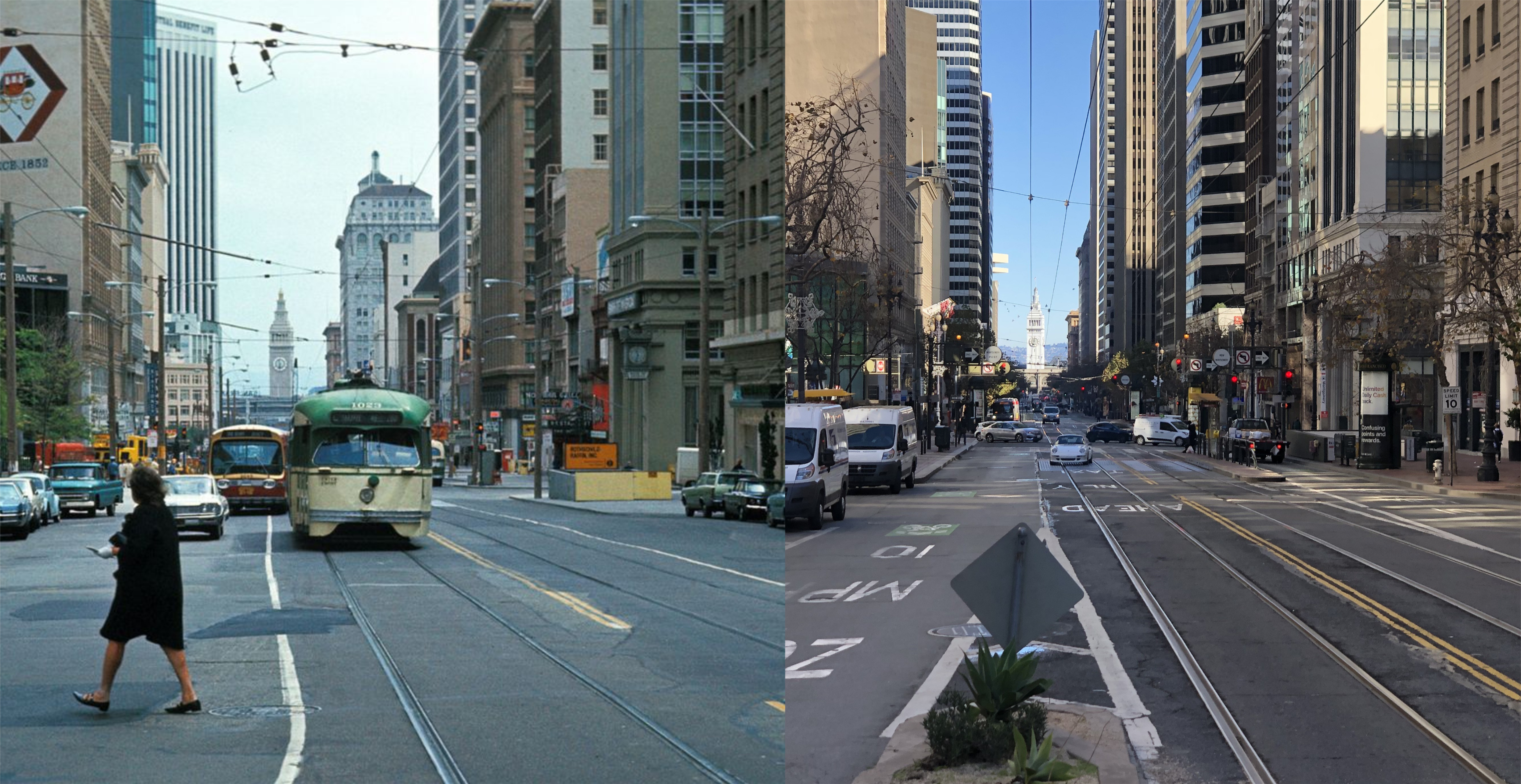
We’ve headed east on Market Street to Sanome and Sutter Streets in 1963: That looks like a red Ford Fairlane Station Wagon on the right in the vintage photo. (JF Ciesla)
We’ll double back north to Clay Street looking north along Sansome Street in 1929: Why, It hasn’t changed a bit! Actually, you’re not going to find anything left in the vintage photo from this spot today. Some of the buildings in the far background on Sansome may still exist today, but they can’t be seen in my photo. I couldn’t catch a speeding car zipping past in a blur in my picture. (SFMTA Photo Archives)
Celebrants climbing the Admission Day Monument at Turk, Mason, and Market Streets: The view is looking west along Turk Street. The monument was moved to Montgomery and Market Streets in 1977. (San Francisco Chronicle)
The opposite view of the previous picture of the Admission Day Monument from ground level, looking back toward Market Street: (West Virginia & Regional History Center)
A crowd passes by the old Paramount Theater between Jones and Taylor Streets in a scene from wonderful color footage by C. R. Skinner: ‘Junior Miss’ wasn’t getting that much attention that day. Eh, Leonard Maltin only gives the film two and a half stars anyway. The Paramount was just east of the old Crocker Anglo Building on the corner of Jones and Market Streets and is blocking out the view of the Golden Gate Theater, seen in my picture.
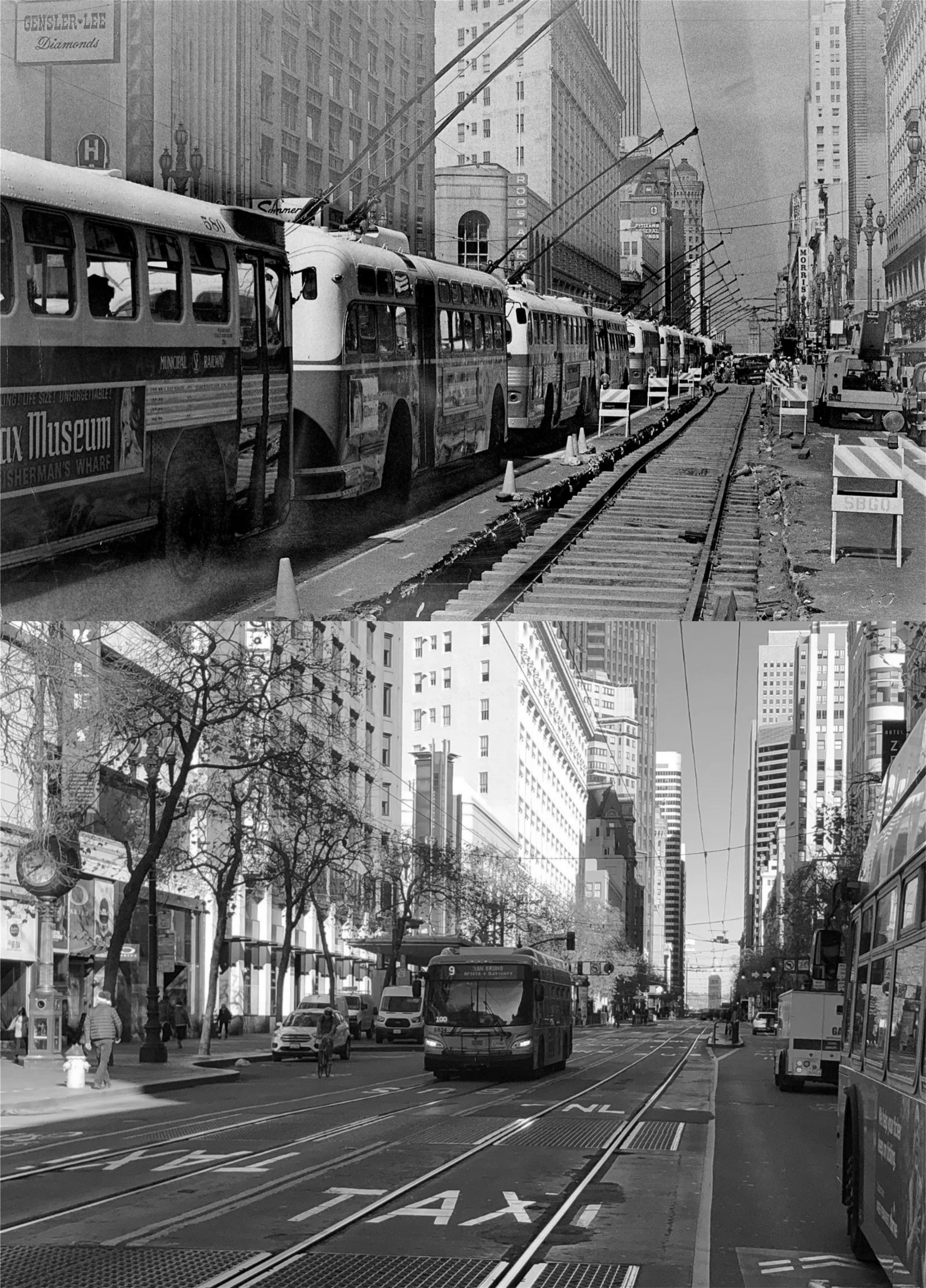
Looking past sailors and stalled streetcars toward Mason and Market Streets in more film footage from C. R. Skinner:
Revelers on top of a streetcar stopped at Market and Mason Streets: Behind them is the Golden Gate Theater. (SF Chronicle)
Looking southeast across Market Street toward 6th in more footage from the C. R. Skinner film: The streetcar on the right has the message KEEP FAITH WITH OUR FIGHT. Many of the buildings in the vintage image are still around, including the tall white building at 6th and Market Streets, remodeled and green today.
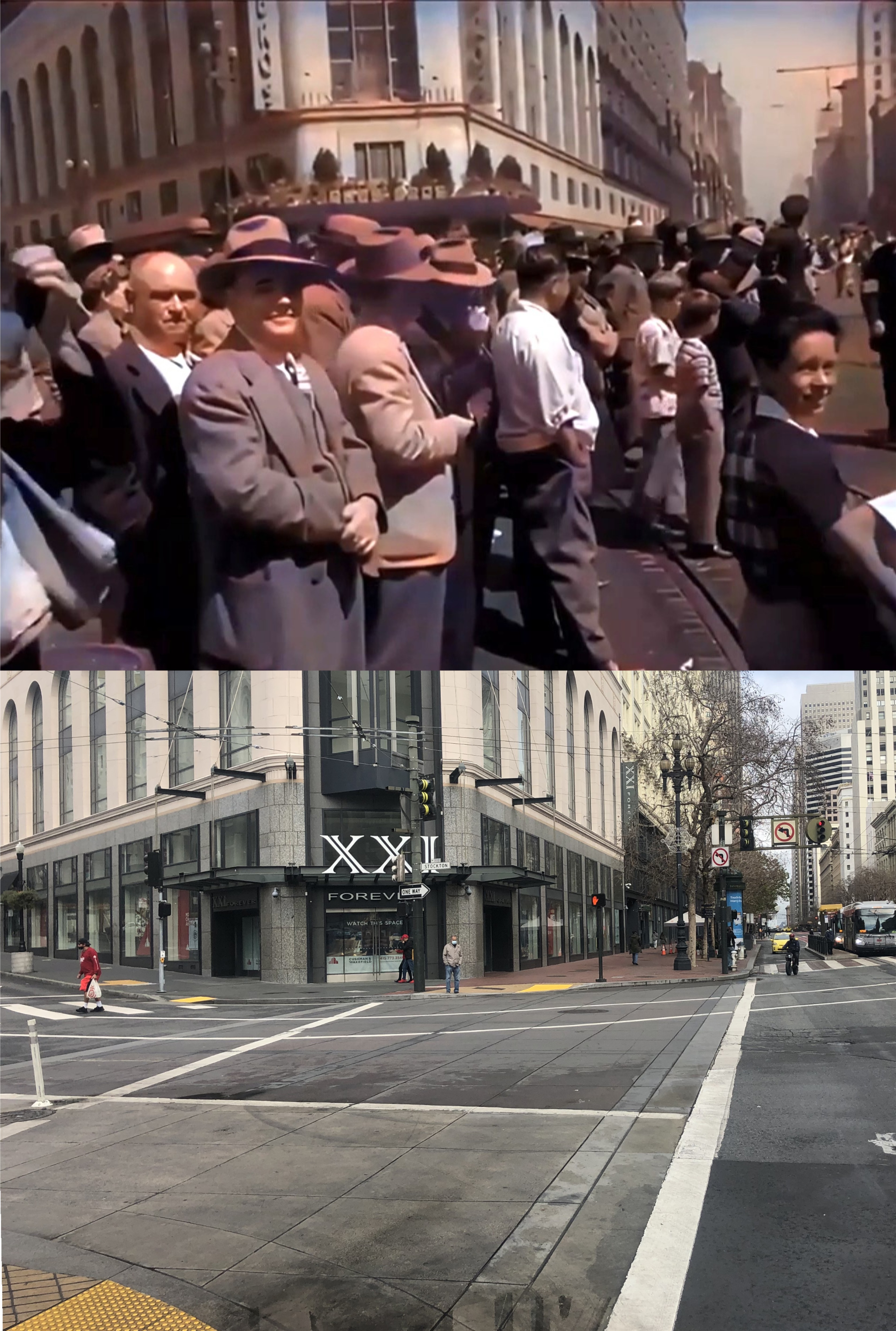
More Streetcar partiers on Market Street looking north toward Stockton Street: West Virginia & Regional History Center)
At the same intersection as the previous picture, a fellow picks up the rear portion of a streetcar, broken off and left on Market Street: (opensfhistory.org)
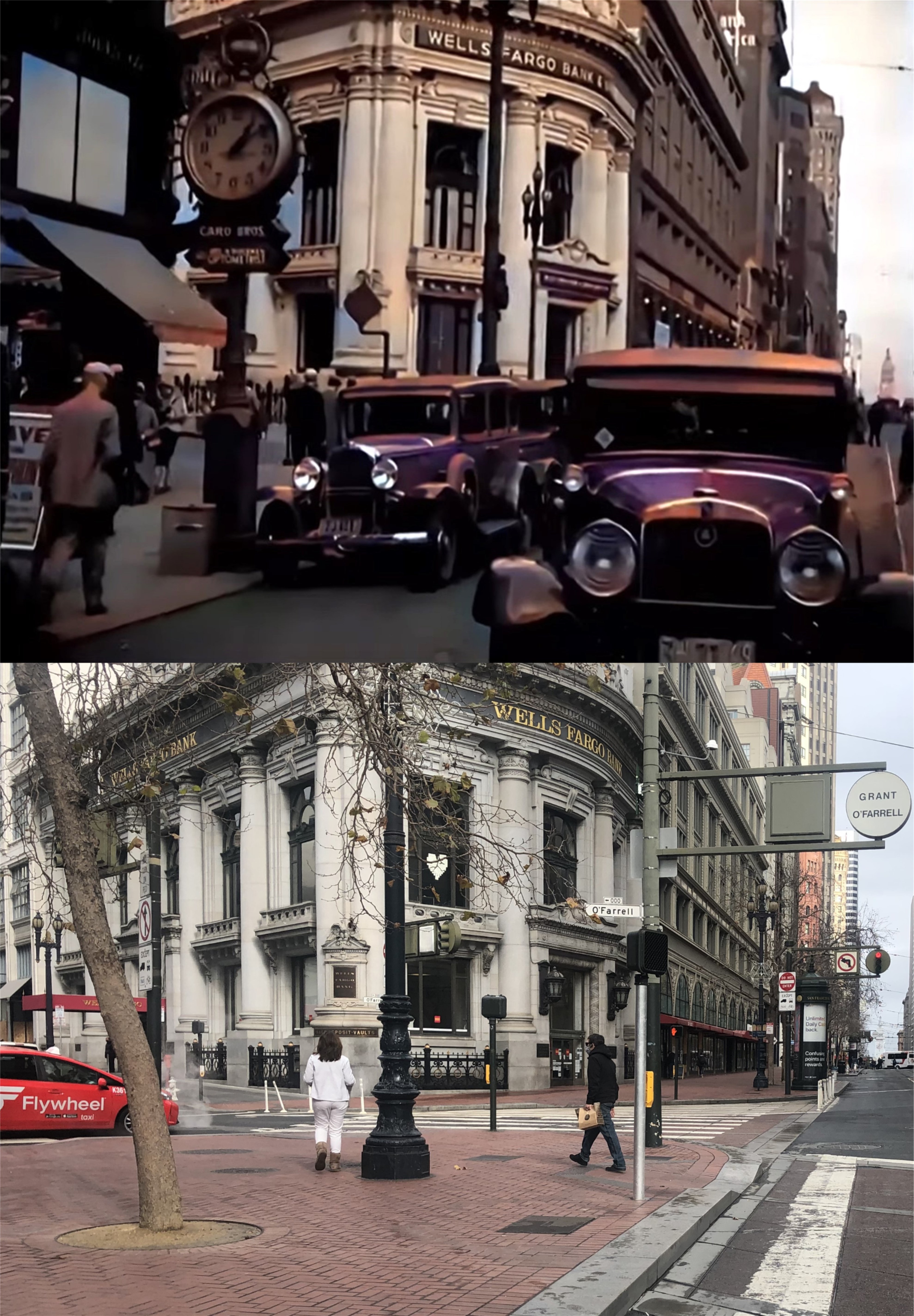
Looking east along Market Street from Grant Avenue: (worthpoint.com)


I’ve posted this series of images from C. R. Skinner’s footage in the past, but it really is a wonderful period piece. It took place on Market Street at Jones. In the top two photos, the girl in pink doesn’t seem too bothered when a lady near her is hugged by a passing sailor. In the third image another sailor grabs the girl in pink for a hug, placing a cap on her head. In the fourth image, the sailor has the girl in pink bent over in his arms and might being going a little too far. “Hey, buddy, no means no!” In the fifth and bottom picture, she breaks away and throws the cap back at him, angrily. “What’d I do? What’d I Do?”
Here’s the same spot today where “pretty in pink” valiantly fought for her honor.
Many people know about the famous Times Square New York picture of the sailor kissing a nurse on V-J Day. Well, there was a lot of kissing going on in San Francisco on August 14th 1945 too. This picture was taken at the intersection of Market and Taylor Streets with the Warfield Building in the background. They were a little farther out in Market Street, but if I took my picture that far out a tree would have blocked the Market Street entrance to the Warfield Building, seen in both photos. You can see part of the Warfield sign of Loew’s Warfield Theater that would later become the Fox Warfield Theater, and not to be confused with the glamorous Fox Theater, in the upper right of the vintage picture. I know, you may be wondering the same thing I was; did they get married? Maybe they were dating and did, but possibly they never saw each other again after August 14th 1945. The little jerk behind them almost spoils the picture. (West Virginia & Regional History Center)