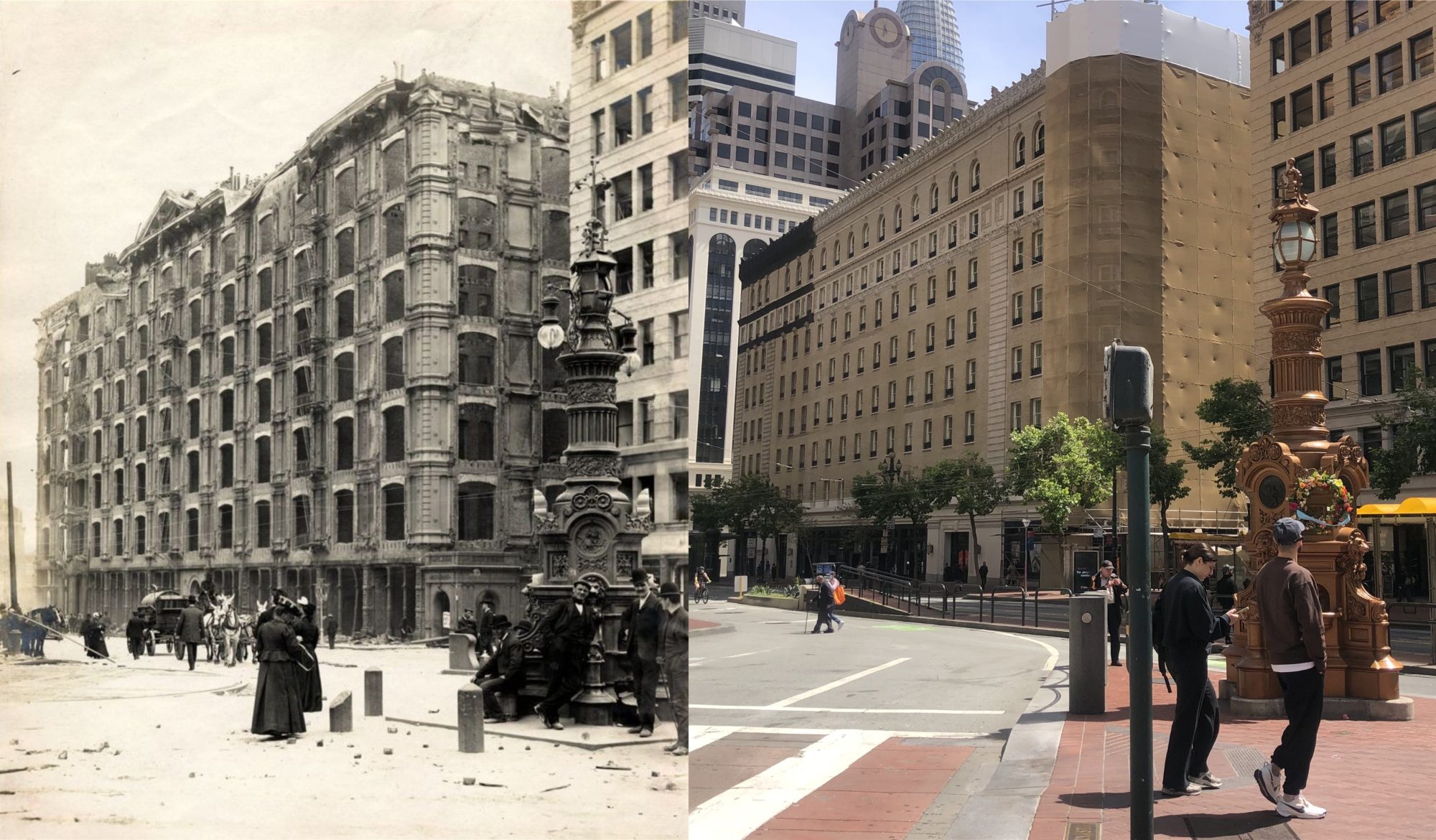
Residents and visitors alike know about San Francisco’s big streets, like California Street, Broadway, the Embarcadero, Columbus Avenue, and, of course, Market Street. However, there’s just as many little streets in the City, some of them relatively unknown, and a few of them with interesting histories. (Thumbnail images)

New Montgomery Street, that runs from south from Market to Howard Streets in the 1920s: The Palace Hotel is on the left, the Old Poodle Dog French Restaurant, at right on the corner of New Montgomery and Stevenson Street, has an interesting story behind it, as well. In operation around San Francisco from around 1849 to the mid 1960s, the famous restaurant catered to some of the most prominent and famous residents and visitors of San Francisco, and even had a few scandals you can read about. According to Wikipedia, the Old Poodle Dog may also have a claim to fame as to where Crab Louis was invented. We’ll be back to take a look at Stevenson Street shortly. (UC Berkeley Library Archives)
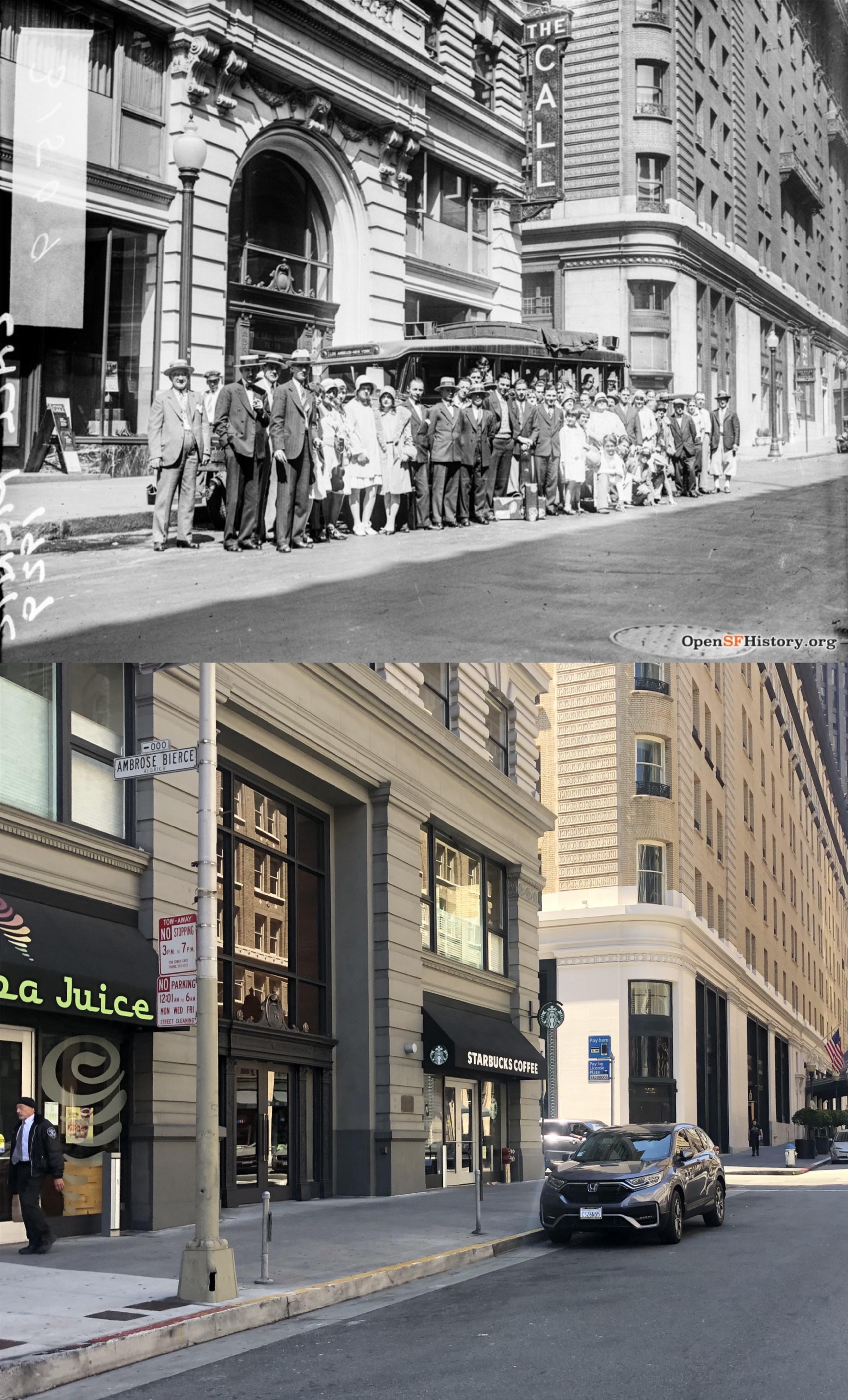
On the corner of New Montgomery and Jessie Street, behind the Palace Hotel, is the building that served as the headquarters for the San Francisco Call Newspaper that officially went out of business in 1965. The vintage picture is the staff of the Call assembling outside the building in 1929. We’ll see another portion of Jessie Street that isn’t this nice later. (opensfhistory.org)

There is a marker here today on the New Montgomery side of the old Call Building
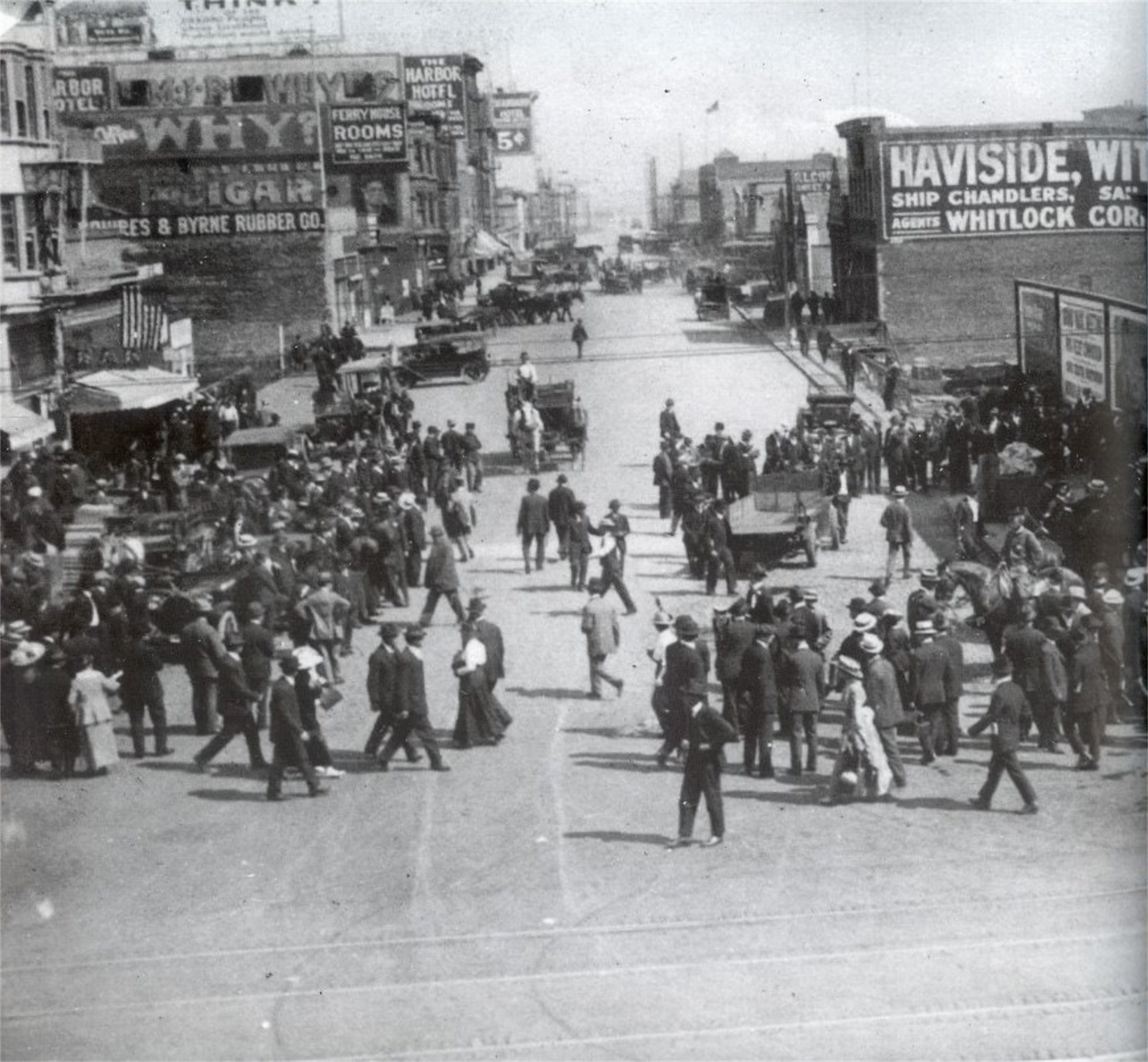
Just across the Embarcadero from the Ferry Building is a short street that runs south from Market Street to just past Howard named Steuart Street. On July 22, 1916 one of the largest parades ever organized in San Francisco was progressing up Market Street from the Ferry Building. Referred to as the ‘Preparedness Day Parade’, it was assembled in an attempt to urge Americans into getting involved in World War l that was raging in Europe. At 2:06 PM a bomb exploded on the western side of Steuart Street, just south of Market Street, killing ten people and maiming dozens of others. It remains the most deadly terrorist attack in San Francisco history. Two men, Thomas Mooney and Warren Billings, were arrested for the crime and served twenty three years in prison before being released when it was confirmed that the evidence against them had been fabricated. Nobody else was ever arrested for the bombing. The above picture, taken from a building across Market Street looking south along Steuart, shows the confusion after the explosion. Some of the dead, covered up with sheets, lay beneath billboards on the right near where the bomb, inside of a suitcase, was placed.
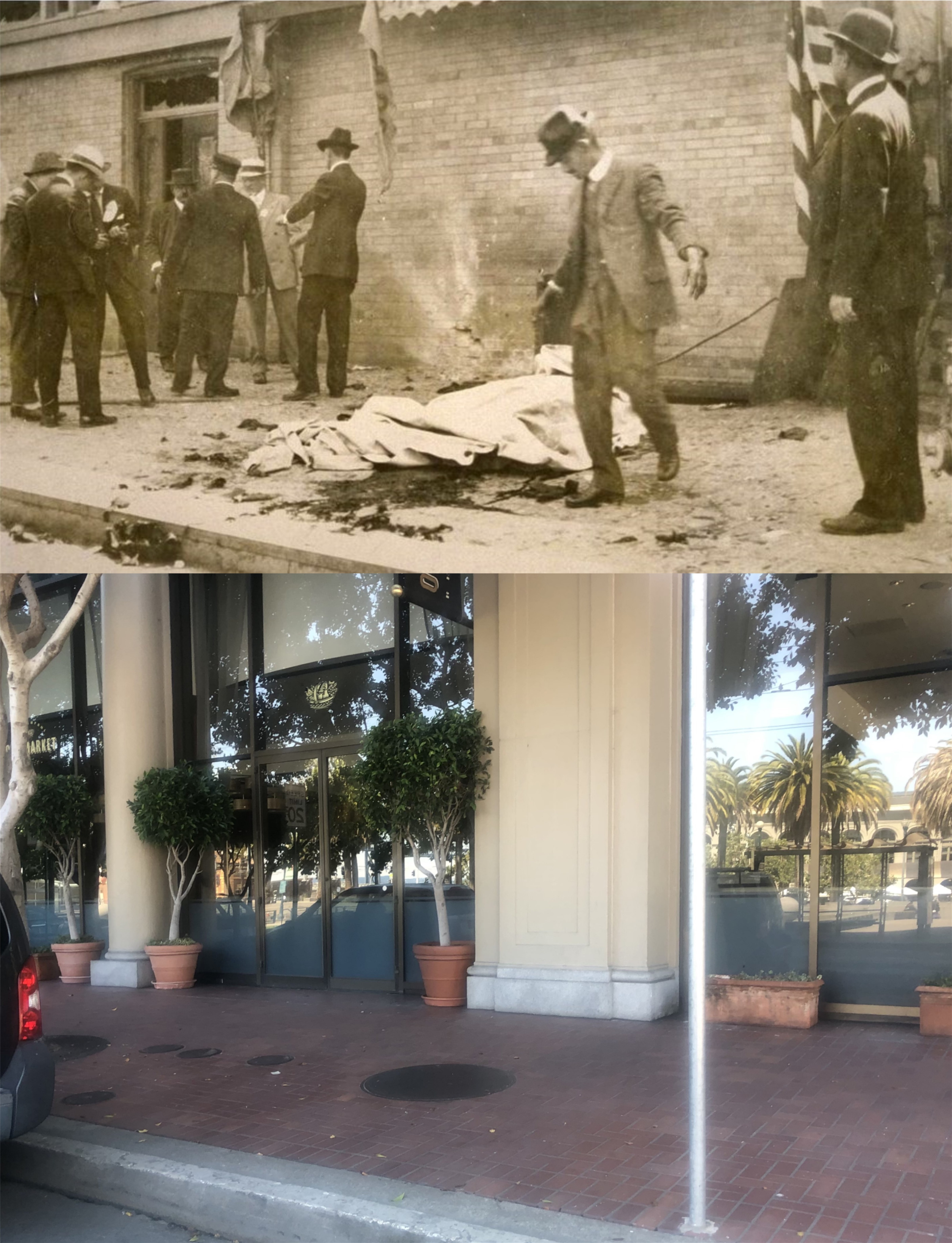
Another photo, taken at the exact spot where the bomb detonated, shows more of the bodies that have been covered up. The Southern Pacific Building now occupies the corner where the bomb went off, and my picture is at the approximate spot where the explosion occurred. (UC Berkeley Library Archives)

Looking back along Steuart Street from Mission Street in 1915, one year before the Preparedness Day attack: The bomb detonated in front of the building in the left background of the vintage picture with the NOB letters showing. (opensfhistory.org)
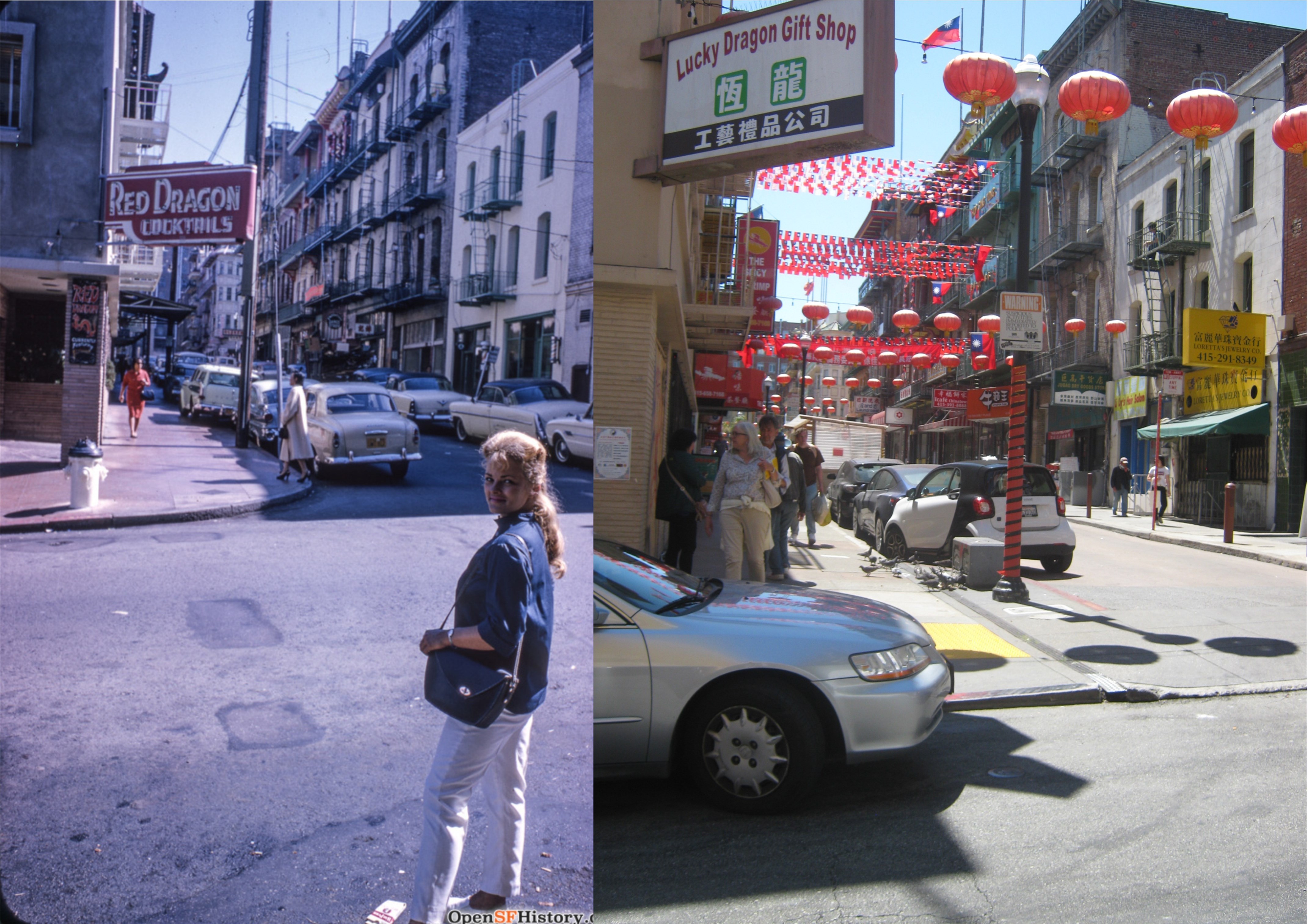
Now off to a little more pleasant picture at Waverly Place in Chinatown during the 1960s: Too wide to be an alley, this two block street is one of the most visited areas of Chinatown. The Red Dragon Cocktails has been replaced by the Lucky Dragon Gift Shop. (opensfhistory.org)

Commercial Street, looking down toward the Ferry Building from Chinatown during the 1930s: Commercial Street is one of only two streets in San Francisco that run directly toward the Ferry Building, the other being Market Street. The building of the Embarcadero Center in the 1970s blocked part of the view of the Ferry Building from here now, but you can still see it, covered up with black scaffolding, in the modern picture. (opensfhistory.org)

Maiden Lane has lost a lot of its charm since when they used to hold Spring Festivals and the famous two block street had a flower shop, a pet store, and was crowded with shoppers, or with people meeting in the lane when the Union Square Lounge was still open. Today it’s mainly quiet now, with little foot traffic. (San Francisco Public Library Archives)

Another one of the establishments in Maiden Lane gone now is the Union Square Lounge, a popular watering hole that went back as far as the 1940s. Jack Lemmon falls off the wagon at the Union Square Lounge in the movie ‘The Days of Wine and Roses’ from 1962. The Union Square Lounge sign can be seen behind the Anthony’s sign in the vintage picture looking toward the Dewey Monument and the St. Francis Hotel. (San Francisco Public Library Archives)

The entrance door to the Union Square Lounge is still there.

South of Market Street between Market and Howard Street are four little lanes that visitors don’t often explore, including me. Starting from 1st Street, Stevenson, Jessie, Minna and Natoma Streets, run southwest to 10th Street, and Minna and Natoma extend past 11th Street. The alleys, which is what parts of them could be called, are broken up at portions by development, and some of the blocks of a few of the streets are not pleasant to visit. Most old photographs of the four streets, when you can find some, do not show the streets to be glamorous, at best, and shady, if not sleazy, at worst. They were probable laid out as byways for delivery to the larger buildings on Market Mission, and Howard Streets, and are kind of obsolete now, although there are a few nice looking restaurants and businesses throughout the streets. The first one above is Stevenson, looking from 1st to 2nd Streets toward the Palace Hotel in 1921. The crosswalk is where a little alley called Ecker is. The little stretch of Stevenson between 2nd Street and New Montgomery is worth walking along for those great neon signs at the Palace Hotel Parking Garage. (opensfhistory.org)

Jessie Street at 6th, looking toward The Golden Gate Theater during the 1970s: My picture doesn’t match up perfectly, but I didn’t want to stay around here any longer than I had to. The nicest thing you can say about this portion of Jessie Street is that this is not the nicest portion of Jessie Street, and that’s being extremely complimentary. (San Francisco Public Library Archives)

The northwest corner of Minna and 4th Streets in the 1950s: The caption to the vintage photo reads that the man on the corner was named Reverend Avery Heisey. Well, if the eminent Reverend Heisey wants to stop by the SUZ-Z-Q CLUB for a quick one after Services, I’m not going to castigate him. (San Francisco Public Library Archives)

Natoma Street, looking west from 2nd Street in 1920: Much of this portion of the little alley still remains. (UC Berkeley Library Archives)
 San Francisco Film Locations Then & Now
The binding of the sycamores on Maiden Lane is impressive. Horticulture was still respected at that time. Of course, the scrawny trees must have looked silly like that for quite a while. The specimen in the picture does not seem to be old enough to be one of the originals, but has the same form, and is in the same location.
Are you familiar with Squid Row in Santa Cruz?
No I’m not, Tony but what a great name! I’ll look it up.
There is not much to it. There are more signs point towards it than there are street signs on it.