Keeping time in San Francisco

There was an article in the San Francisco Chronicle by Aldo Toledo last September 18th about the old Samuels’ Jewelers Clock on Market Street. The clock has been neglected and vandalized, and it’s a shame because it’s a part of San Francisco history that goes back to the days of Sam Spade, although it hasn’t been running since the 1970s. It made me think of other clocks, both gone and still around, throughout San Francisco, so I looked back through my archives for some clock pictures, and stopped by the “Samuels Clock” last Friday. (Thumbnail images)


Geary St. at Kearny near Market during the 1950’s: The entrance to the old Chronicle Building is on the right in both photos. My update was taken in July of 2020 when most everything in the area was still closed due to the Covid Shutdown. (worhtpoint.com)


The Ghirardelli Clock Tower, from Larkin Street, in a late 1920s, or early 1930s, in a picture from the Shorpy Archives: This was one of the streets used in the ‘Bullitt’ chase scene.


The Bay Bridge Toll Plaza: Not only was the clock from the 1960s picture nicer than the digital message today, but the fare was on twenty five cents to cross back then.


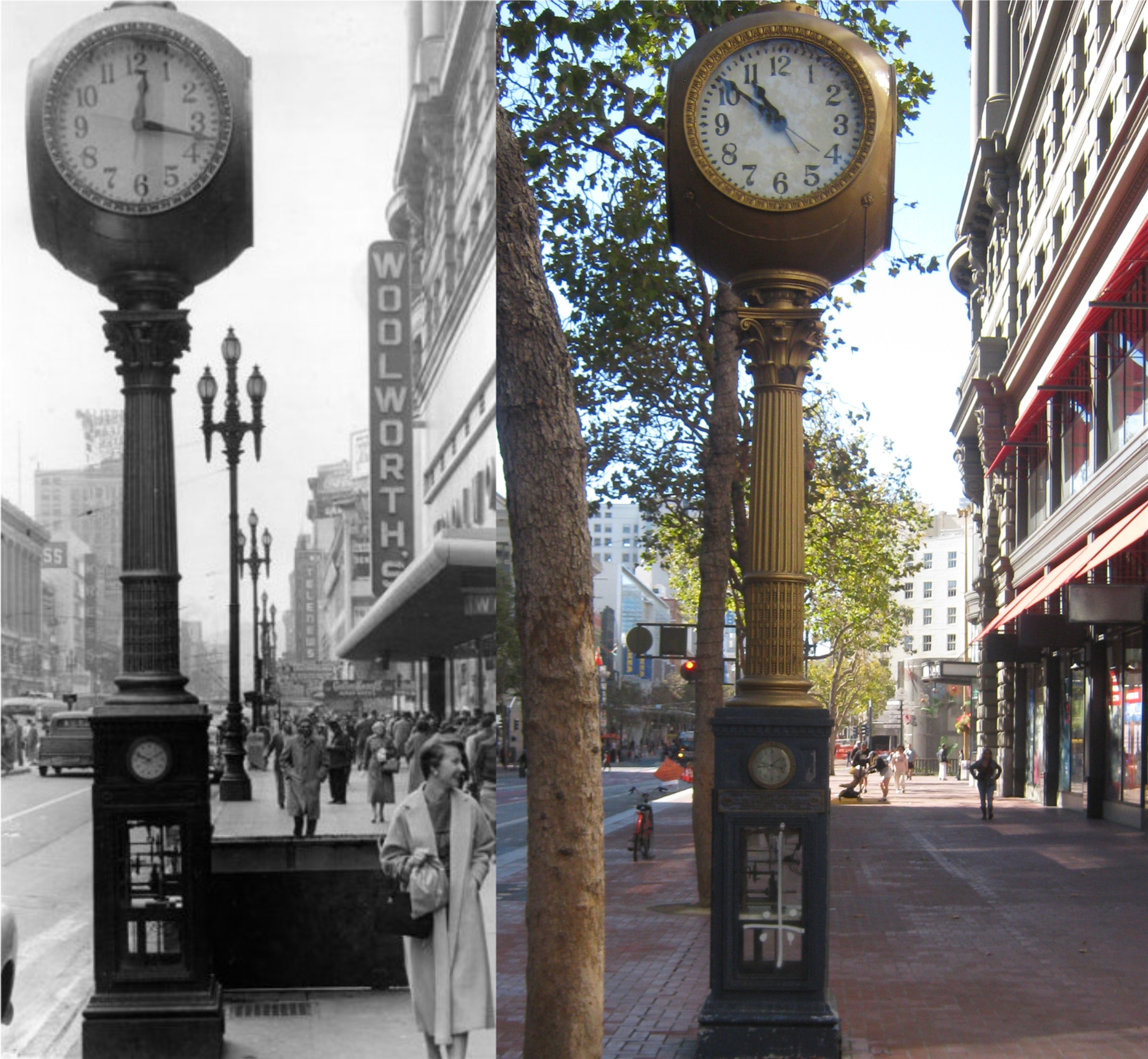
They make the street clocks much smaller nowadays, like the one here on Market Street at Grant Ave. My picture was take on March 22, 2020, less than one week after the Covid 19 shelter in place order was activated. The guy in the 1940s pictures always makes me think, ‘An American Werewolf in San Francisco’. (SF Chronicle)


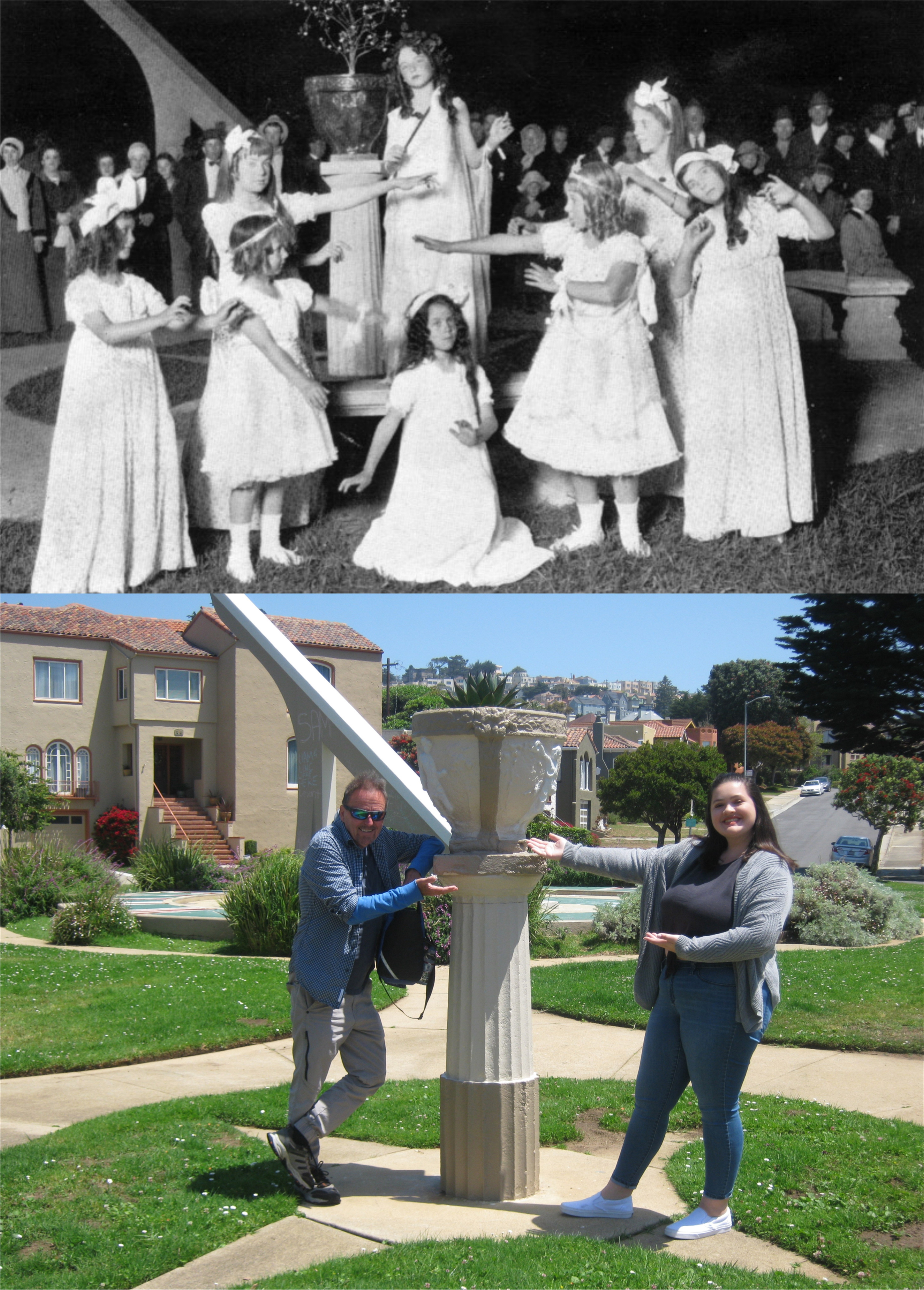
The Urbano Sundial counts too. (artandarchitecture-sf.com)


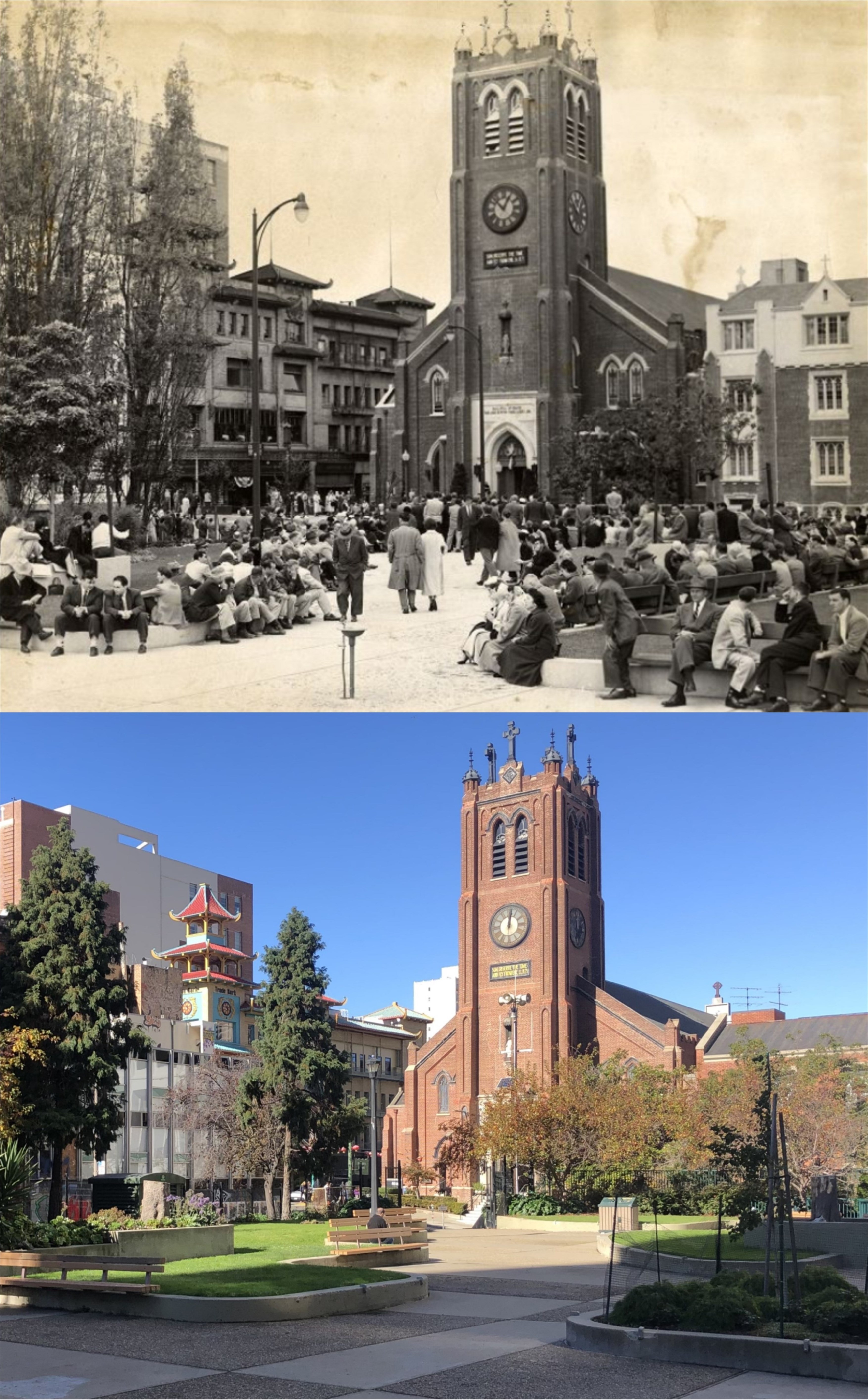
Old St. Mary’s church spire, with its biblical message ‘Son, observe the time and fly from evil’, something that I never hesitate to plan on doing someday: (San Francisco Public Library Archives)


A couple of pictures from the Westin St. Francis Hotel on Union Square Facebook Page of the St. Francis Lobby Clock: I posed in front of the clock in 2013. Neither I nor, I’m sure, that Shirley Templeish kid, look that young anymore.


An update I did last New Year’s Eve on Market Street between Grant Avenue and Stockton, with that classy Caro Bros clock: (San Francisco Public Library Archives)


Probably everyone’s favorite clock in San Francisco is in the Ferry Building Tower. These are a couple of nighttime pictures I took of the Ferry Building; the first was in October of 2010, when the San Francisco Giants were about to win their first ever World Series, and the second was in January of 2013, when the San Francisco 49ers were about to lose their first ever Super Bowl. The Giants would go on to win two more World Series after my 2010 photo, and the 49ers would go on to lose two more Super Bowls after the 2013 loss.


The Samuels Clock was originally installed on the south side of the 800 Block of Market Street in 1915, seen in the January, 1939 picture when Samuels’ Jewelers was located at 879 Market Street, about where the, now closed, Nordstrom portion of the Westfield Centre Building is. As Mr. Toledo point out, Dashiell Hammett worked at Samuels’ Jewelers, and his famous detective Sam Spade refers to the clock in one of the stories Hammett wrote featuring him. (UC Berkeley Library Archives)


In 1941 or 1943, I’m getting two dates on this, Samuels’ Jewelers moved, along with the clock to the north side of Market Street next to the Flood Building. The clock is not only referred to in literature, but also played a part in San Francisco’s largest terrorist attack in 1916, so I’ll include a link to the Chronicle article below. (San Francisco Public Library Archives)

https://www.sfchronicle.com/sf/article/samuels-clock-flood-building-19758243.php

The view from the SkyStar Wheel (For Becka)

Well……. if you don’t like stunning, never before available views of the Golden Gate and Bay Bridges, Fisherman’s Wharf, Pier 39, the Embarcadero, Telegraph, Nob and Russian Hills, Aquatic Park, Alcatraz and the Bay, then you probably won’t like the SkyStar Ferris Wheel at Fisherman’s Wharf. The weekend after Labor Day, I finally took a ride  on the attraction since it was moved from Golden Gate Park to Fisherman’s Wharf. After I landed safely, which one does because it’s not dangerous and it’s not necessarily scary, I searched the internet and my archives for vintage photos that were taken approximately, sort of, looking toward the same direction as the photos I took. (Thumbnail images)


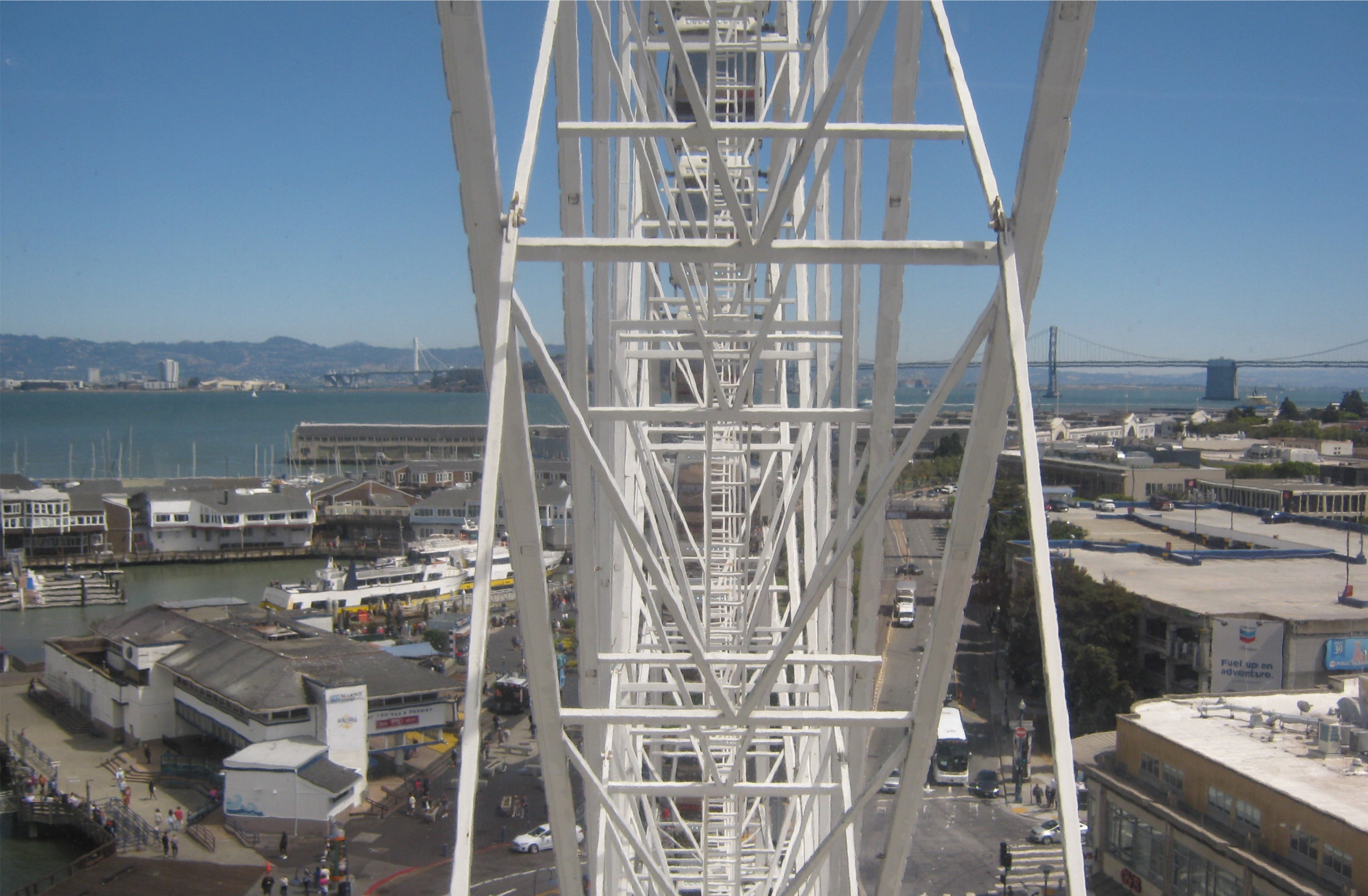
Heading up to the top, looking east toward Treasure Island and the Bay Bridge:


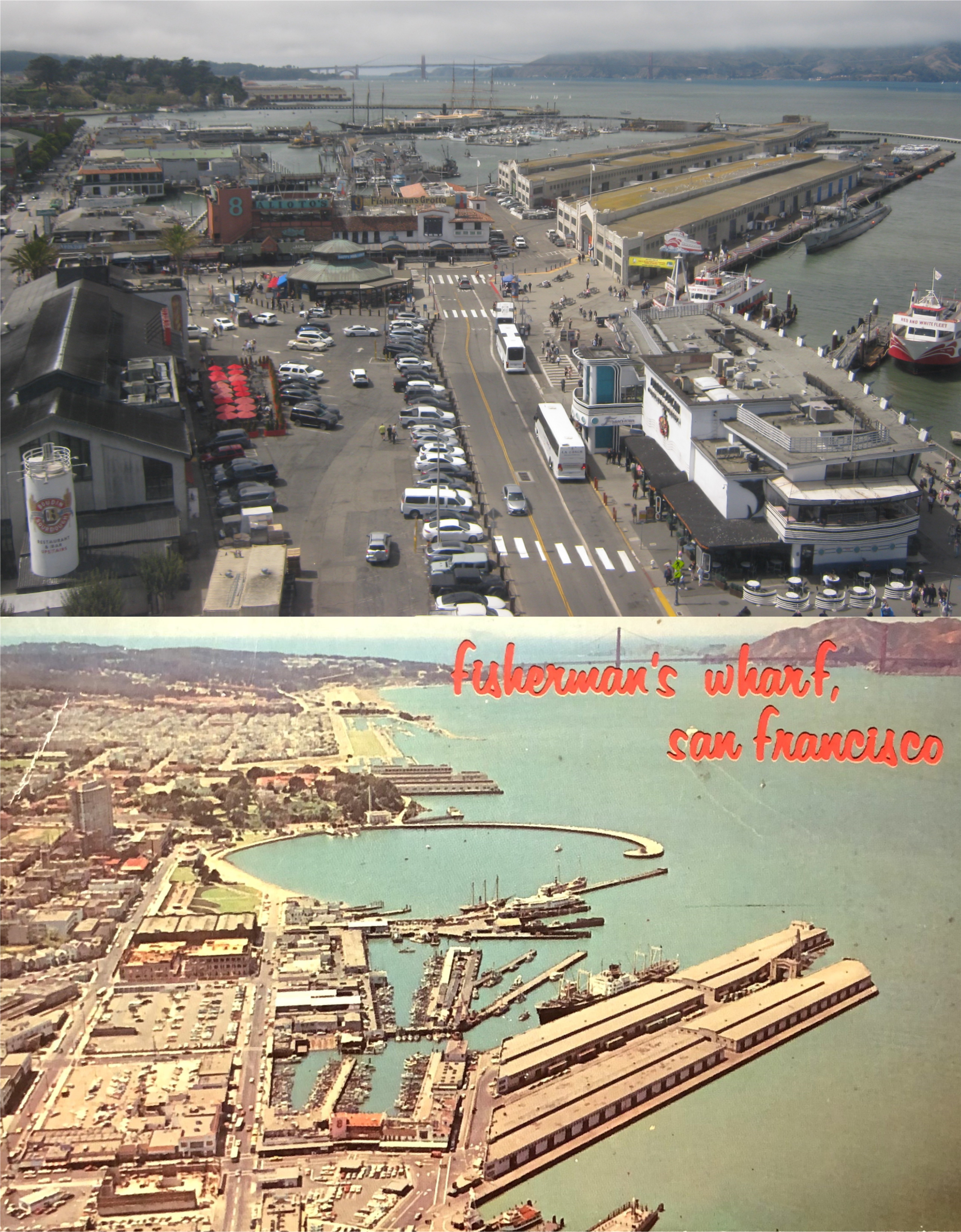
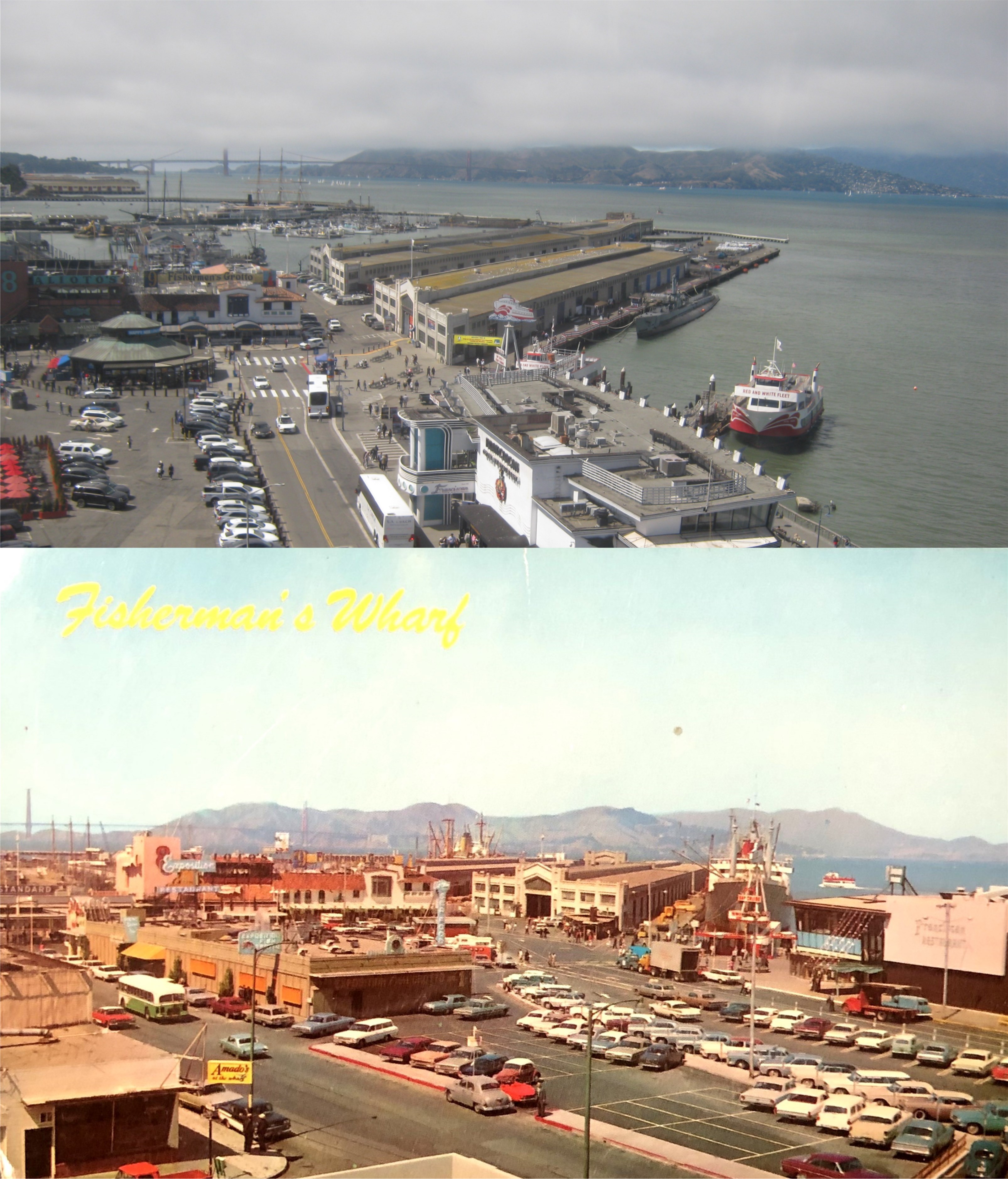
The view of Fisherman’s Wharf from hundreds of feet lower than an old postcard taken during the 1960s:


You have two similar views here that match my picture closer; one from the postcard on top, and also a scene from the opening credits  of every episode of the 1970s television show ‘The Streets of San Francisco’.


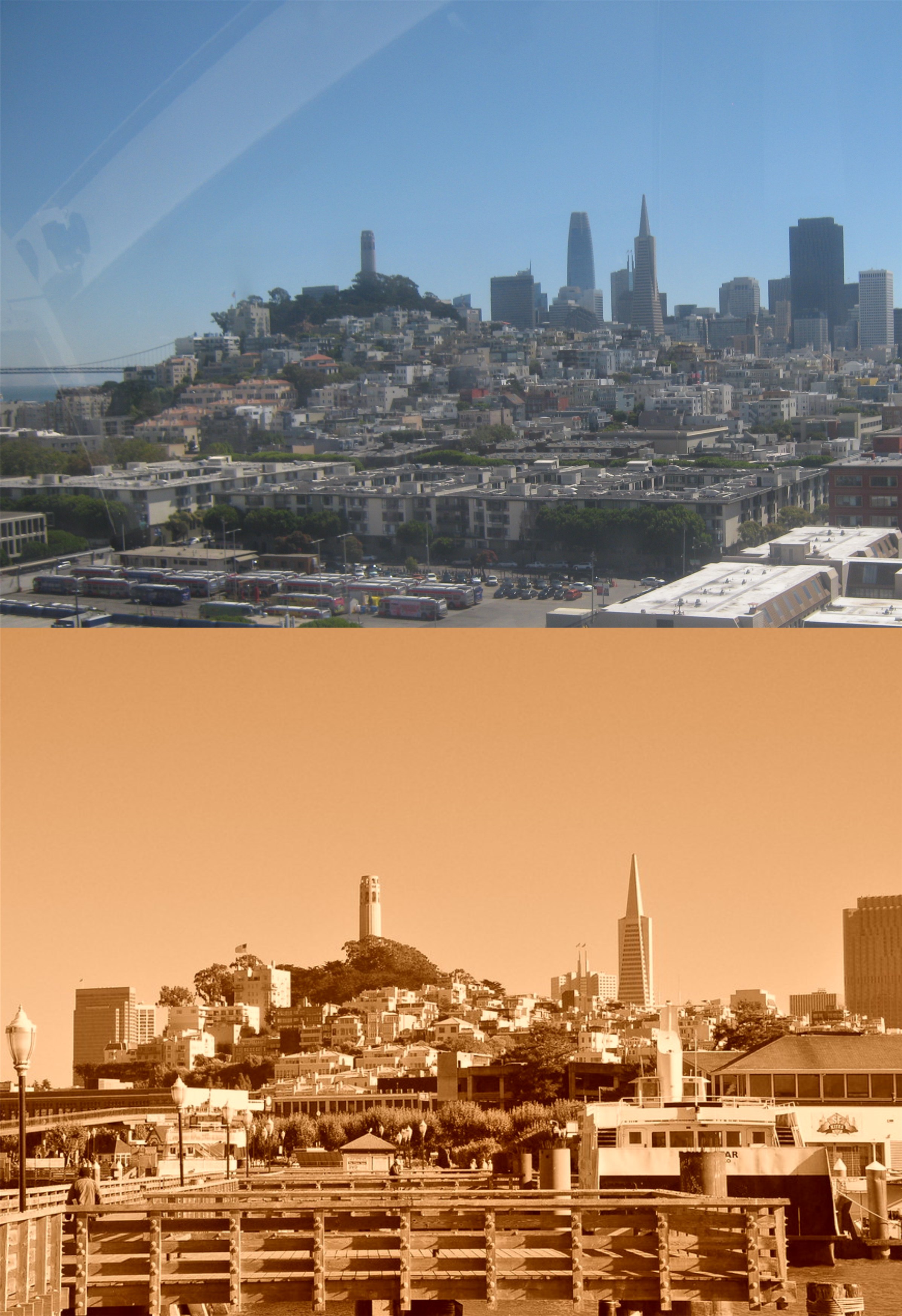
Looking toward Telegraph Hill and Downtown San Francisco: The older photo from Flickr looks like it’s from the 1980s:


Looking over Pier 39 toward Pier 35 and the World War Two Liberty Ship, the Jeremiah O’Brien: The old Pier 39 is at the bottom of the vintage picture from opensfhistory.org, taken in 1923: Pier 37, between Piers 35 and 39, has been demolished.

I didn’t get too bad of a lineup of Nob and Russian Hills with this 1960s photo from opensfhistory.org.


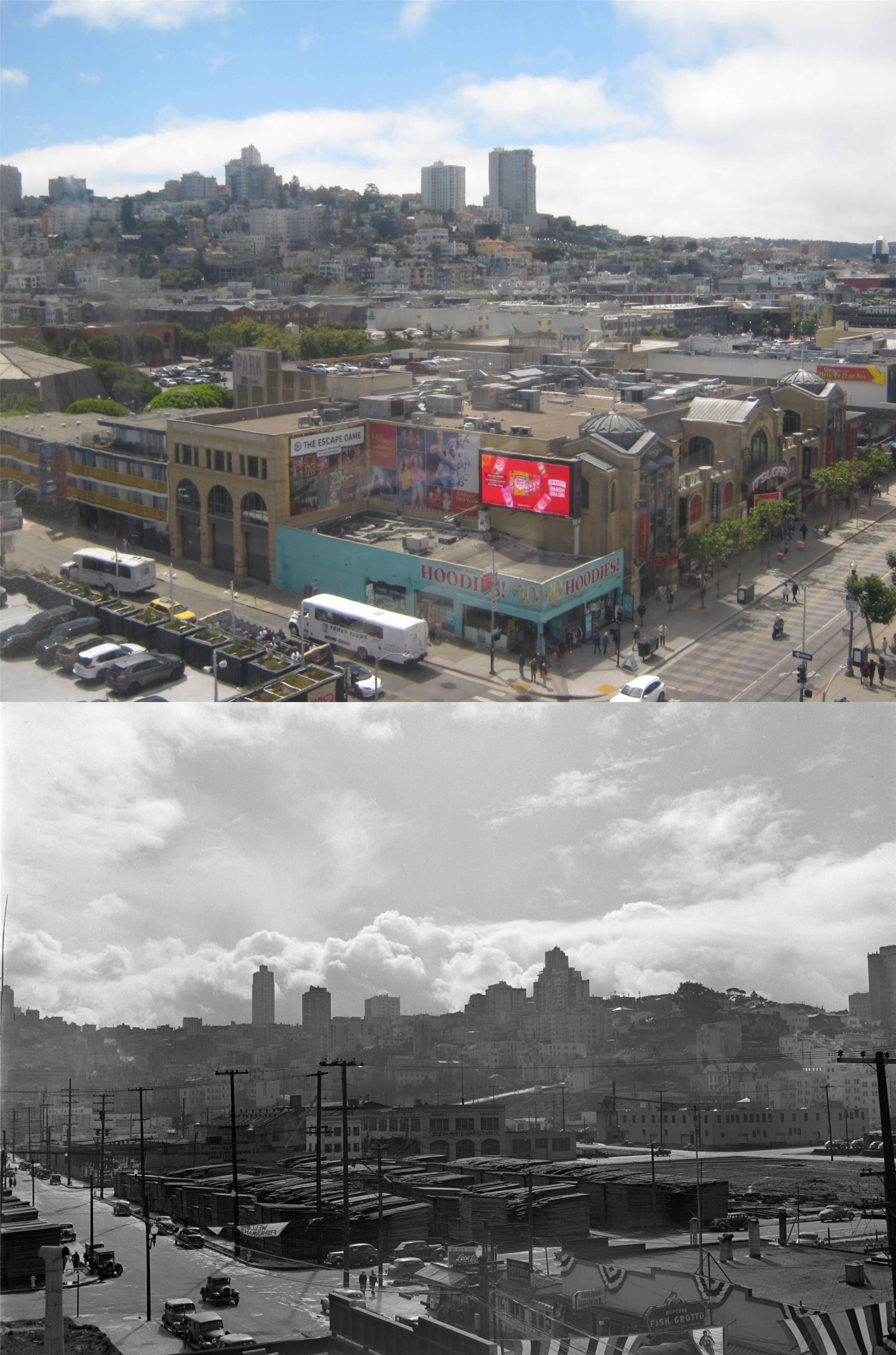
Looking toward Russian Hill: My photo is looking over the intersection of Mason and Jefferson Streets. I’m not sure where the crossroads are in the 1930s picture from the UC Berkeley Library of Russian Hill from Fisherman’s Wharf, but I think they’re a block southwest at Beach and Taylor Streets.


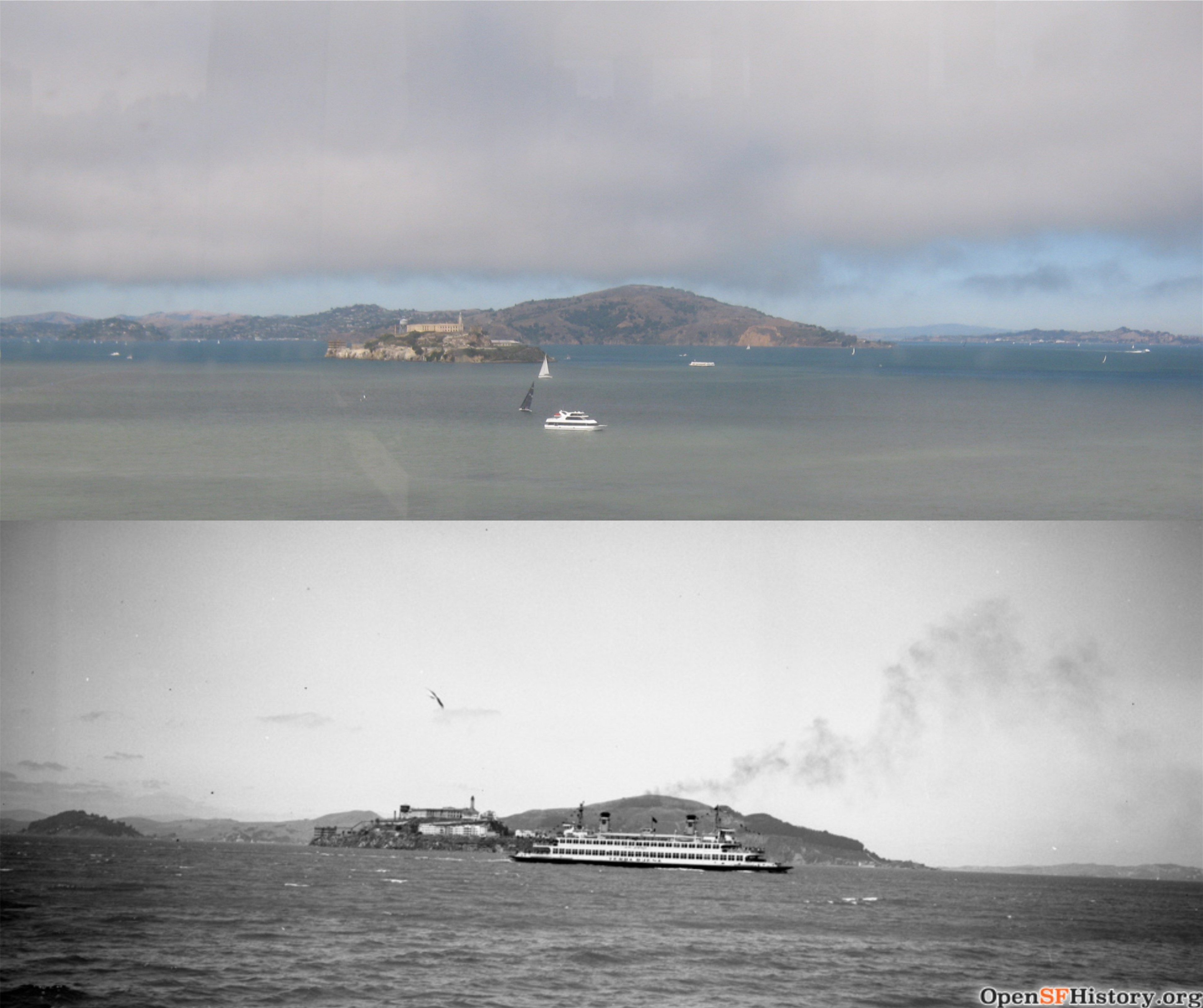
There’s also a terrific view of Alcatraz Island and the Bay, looking north. When the 1946 picture from opensfhistory.org was taken, there were still quite a few “bad boys” in that penitentiary building.


Looking toward Pier 45 and the Golden Gate Bridge in another old postcard from the 1960s:

Gliding down past the old Pier 43 Archway: This picture from the San Francisco Library Archives is as close to a match up that I could get. I’m going to have to research to see what that other pier arch on the left was. It would have been about where the pier that you catch the Red and White Fleet tour boats is located.


Walking back to catch the MUNI streetcar, I snapped a picture of the Fisherman’s Wharf Boat Lagoon. The 1939 picture is from the UC Berkeley Library Archives. The building on the right in the vintage picture was demolished. The little chapel, on the right in my photo, is there now.

3rd St. (Third Street) and Market (For Revin)

“Now, I’m standing on the corner of Third and Market. I’m looking around. I’m figuring it out. There it is, right in front of me. The whole city. The whole world. People going by. They’re going somewhere. I don’t know where, but they’re going. I ain’t going anywhere.” – From ‘The Time of Your Life’ by William Saroyan.

Whenever I pass by Third Street at Market, I think about Saroyan’s passage. He understood San Francisco for what it is; a fabled and exciting city. Although few writers are of Saroyan’s caliber, there are still some (San Francisco Columnist, Carl Nolte, comes to mind) who look at the City the way Saroyan saw it. However, the day before I took my updates for this post, a San Francisco 49er football player’s season is over, although he’s in stable condition, because some punk tried to rob him and shot him less than two blocks from Third Street and Market. If Herb Caen was still alive, he’d probably write, “Could have happened anywhere.” But San Francisco’s going to get the blame. (Thumbnail images)


The Call Building, on the northwest corner of Third Street at Market, shortly after the 1906 Earthquake and Fire: In 1939, for reasons that are hard to understand, the top crown was removed from the Call Building, and it was streamlined into looking like the Daily Planet Building where Clark and Lois work. It’s now called the Central Tower Building. You can see half of it behind the rebuilt William Randolph Hearst Building. (UC Berkeley Library Archives)

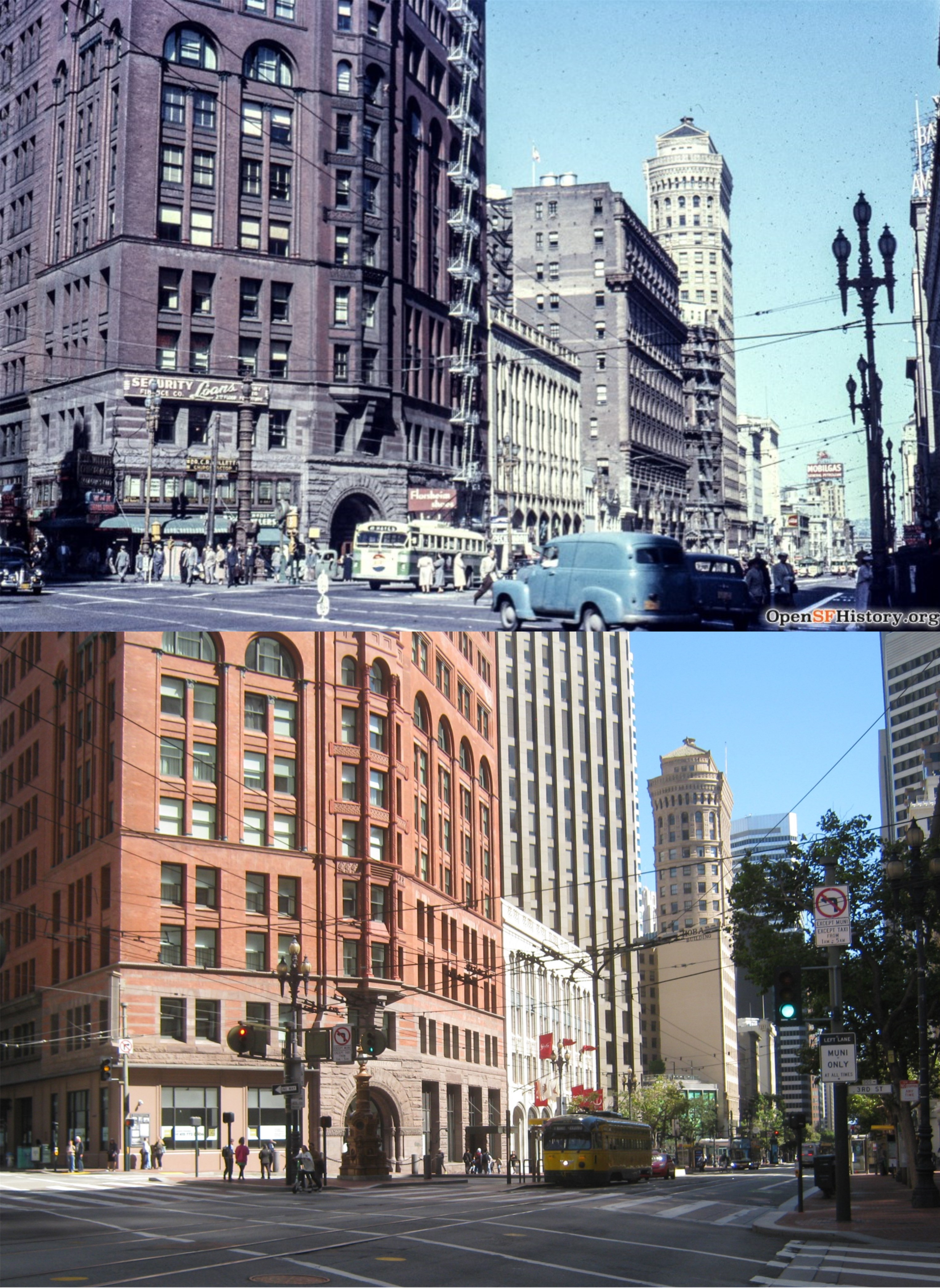
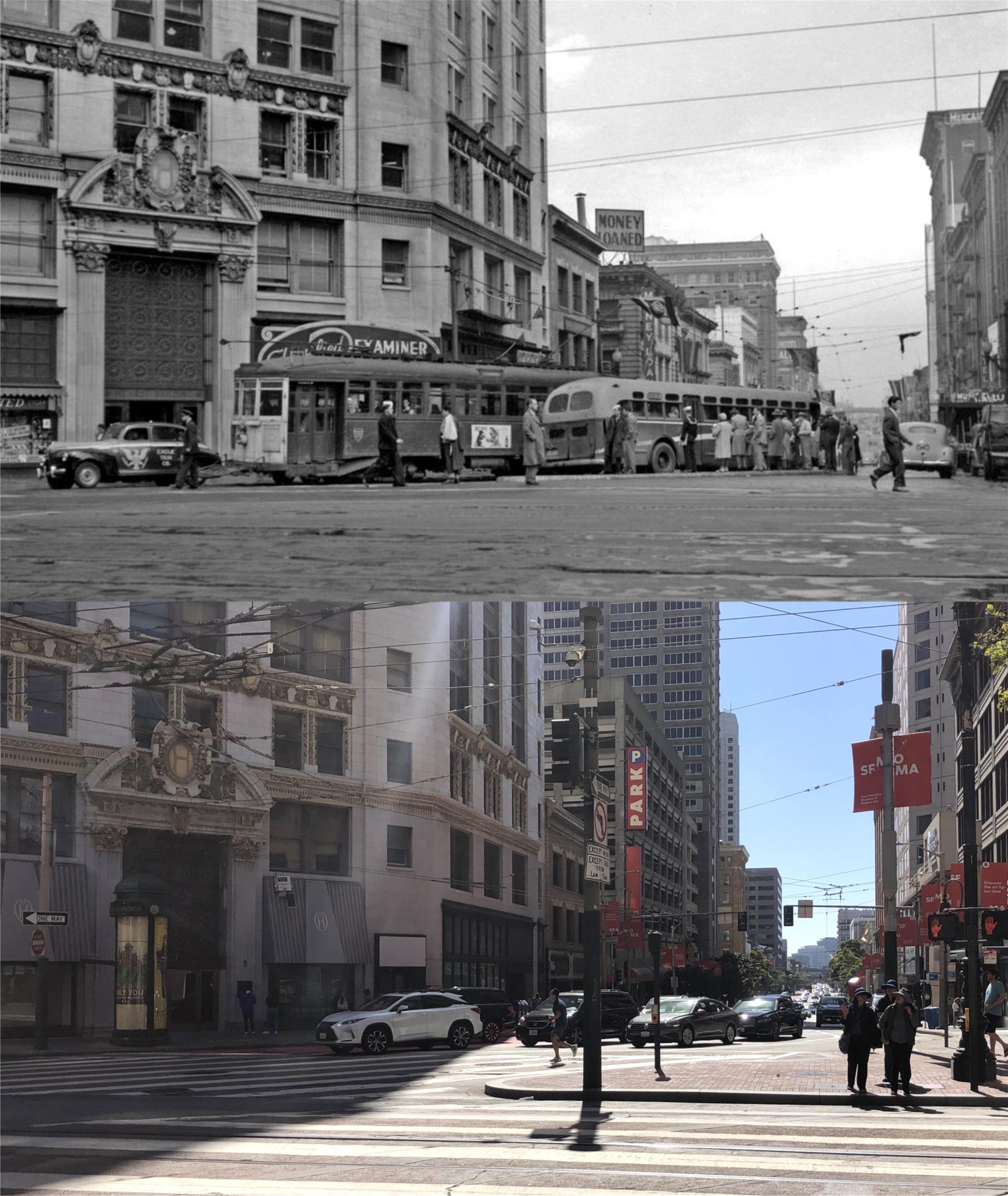
Looking to and from Third and Market in these two comparisons from opensfhistory.org. First is looking southwest toward Third and Market and the Central Tower in 1970: Morris Plan; I remember taking out a loan from the one on Broadway in Oakland when I worked there long ago. I wonder if I ever paid that back? Oh, I must have or I’d have heard from them by now. Second is looking northeast toward the Chronicle Building in 1956.


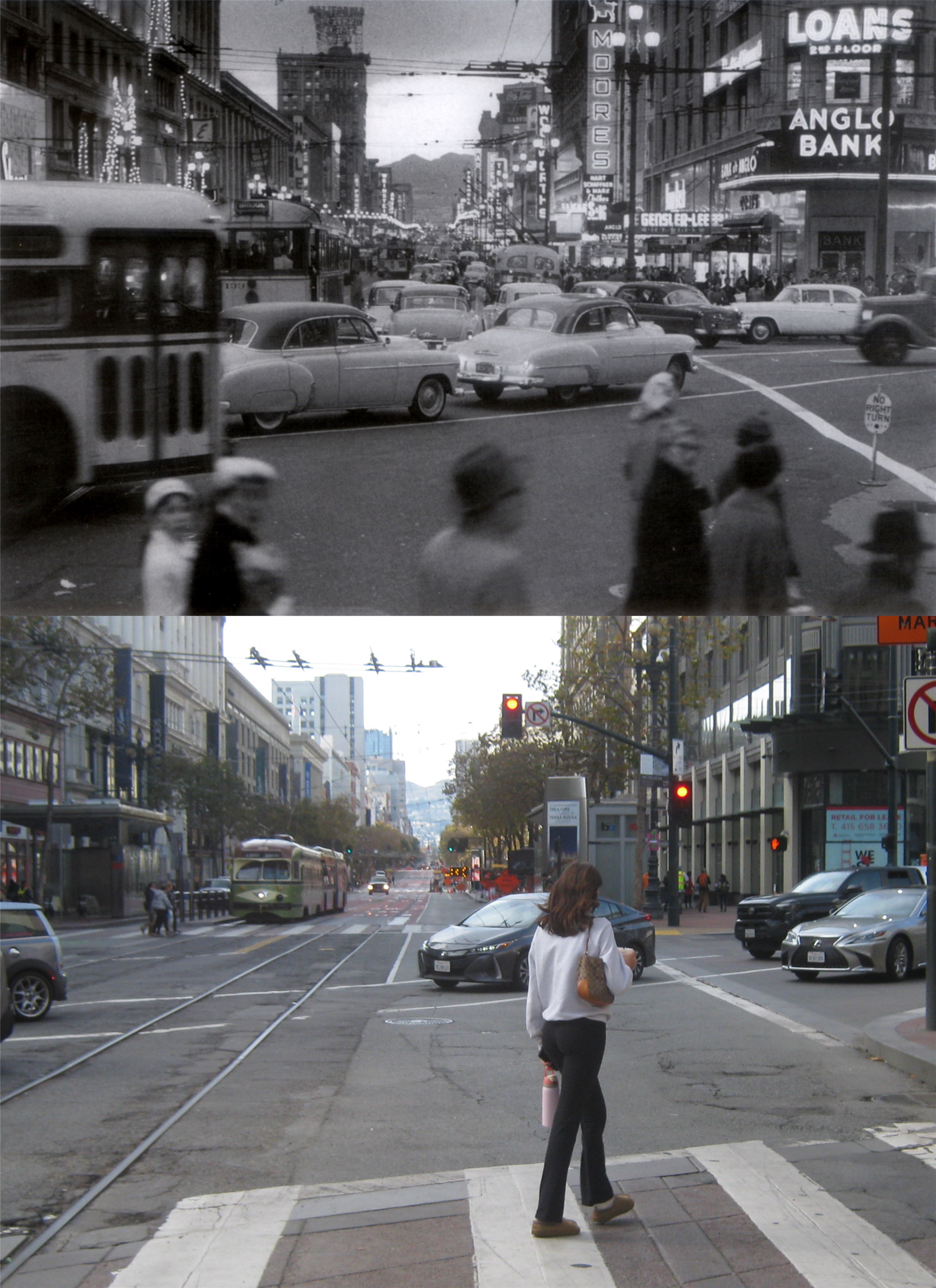
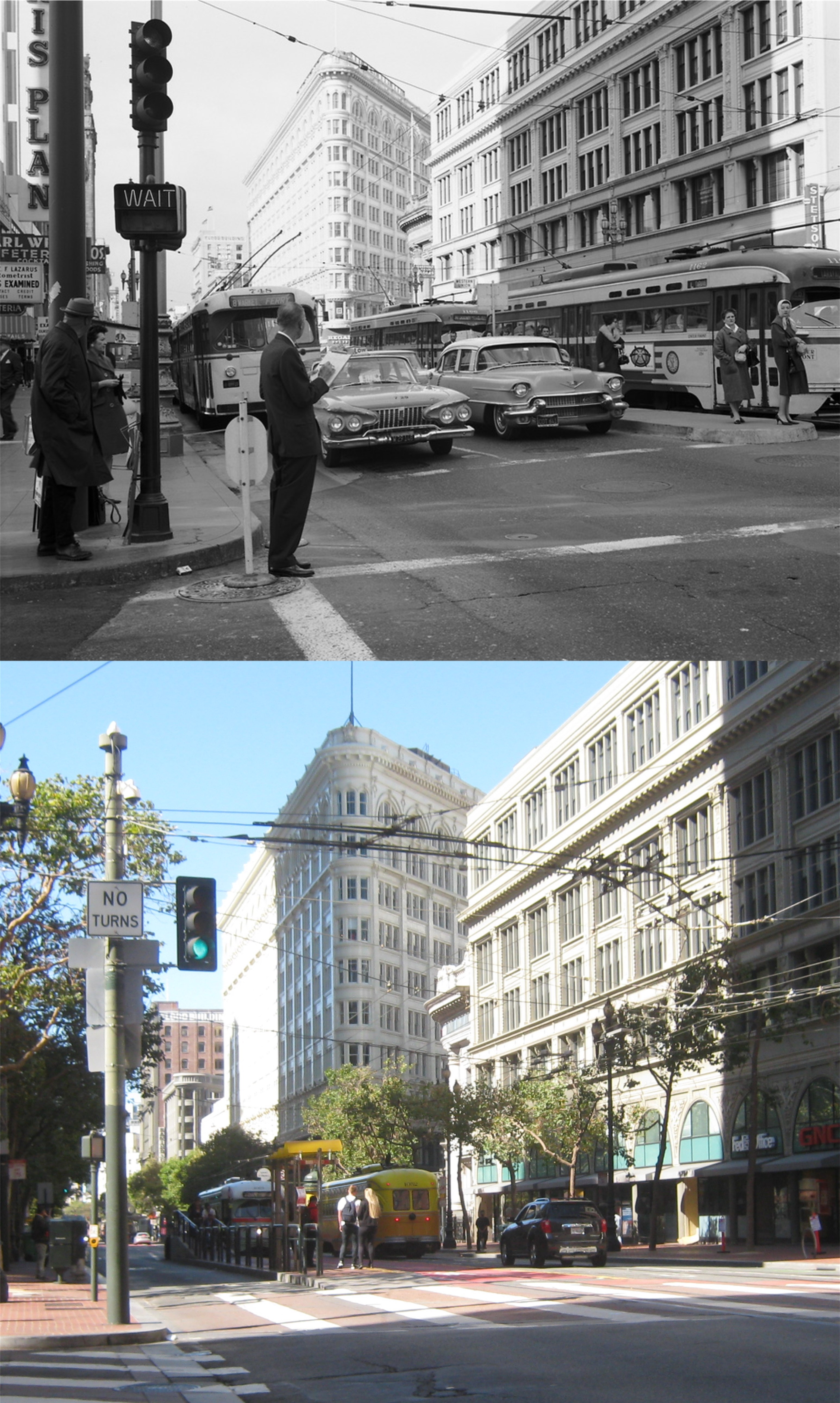
Third and Market Streets, looking west along Market during the late 1950s: “Now, I’m standing on the corner of Third and Market with a clipboard. I’m looking around. I’m figuring it out.” Nah, that doesn’t have the same class. (San Francisco Pictures Blog)


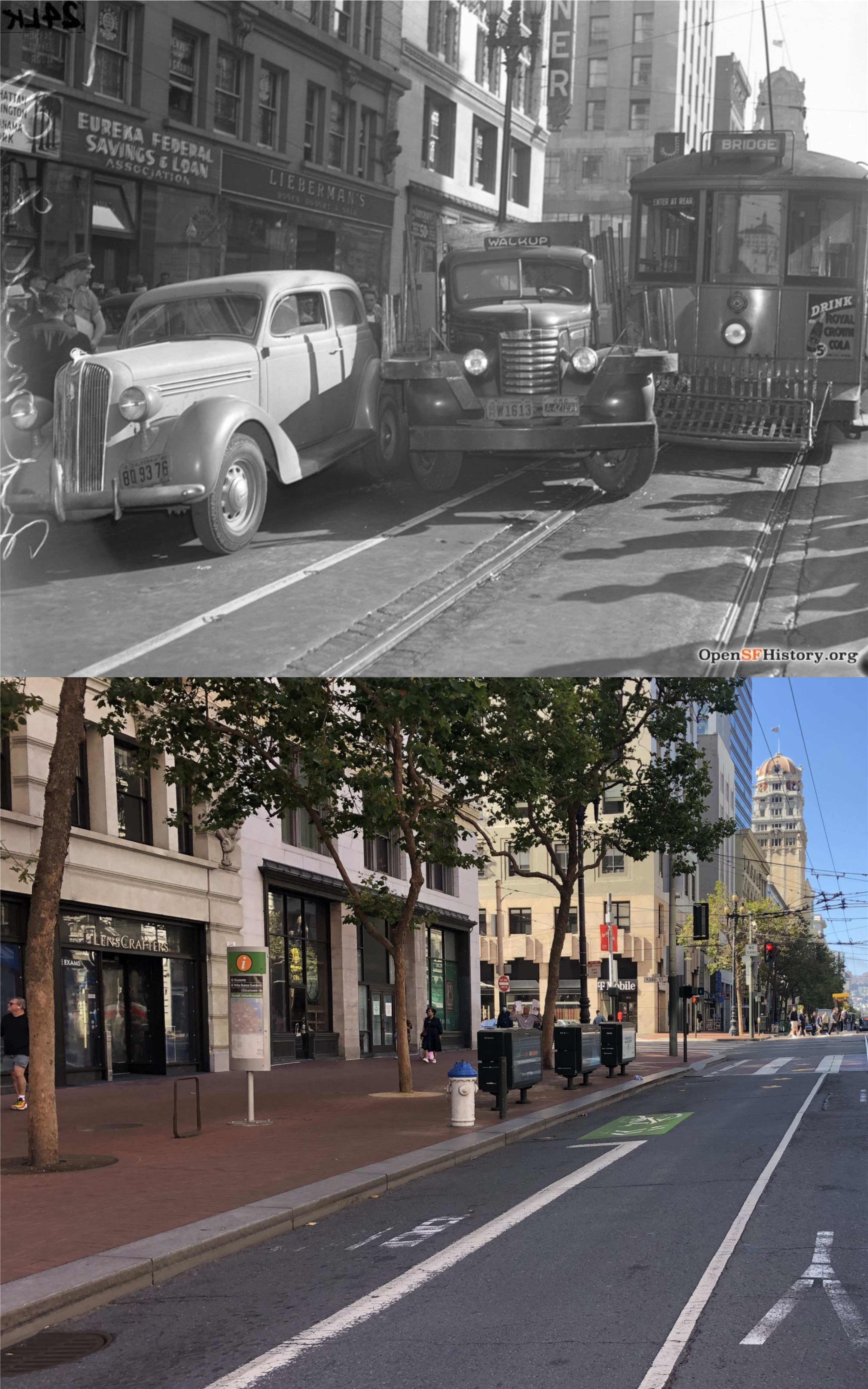
An accident at Third Street and Market in 1940, around the time of Saroyan’s play; I’m blaming this one on the truck driver. The accident happened in front of where LensCrafters is now. (opensfhistory.org)


‘Harry’ doesn’t make it clear in the play whether he was watching the world go by standing on the west side of Third and Market in front of the Call Building on the right, or the east side of Third and Market in front of the Hearst Building on the left. The vintage picture from opensfhistory.org was during 1946.


Looking toward the Hearst and Call Buildings at Third and Market Streets in an undated picture from the San Francisco Public Library Archives; I’m guessing that it was around 1967 and that’s Market Street BART construction.

A great picture from the 1960s, looking toward where Third Street comes into Market, from south of Mission Street during the 1960s: The Call Building is on the left. The Gothic looking Mutual Savings Bank Building is in the center. (San Francisco Public Library Archives)

  • Addendum, November 23,2024: Ricky Pearsall, the 49er player shot near Third Street and Market, has fully recovered and is back on the playing roster for the San Francisco 49ers.

Playland-at-the-Beach

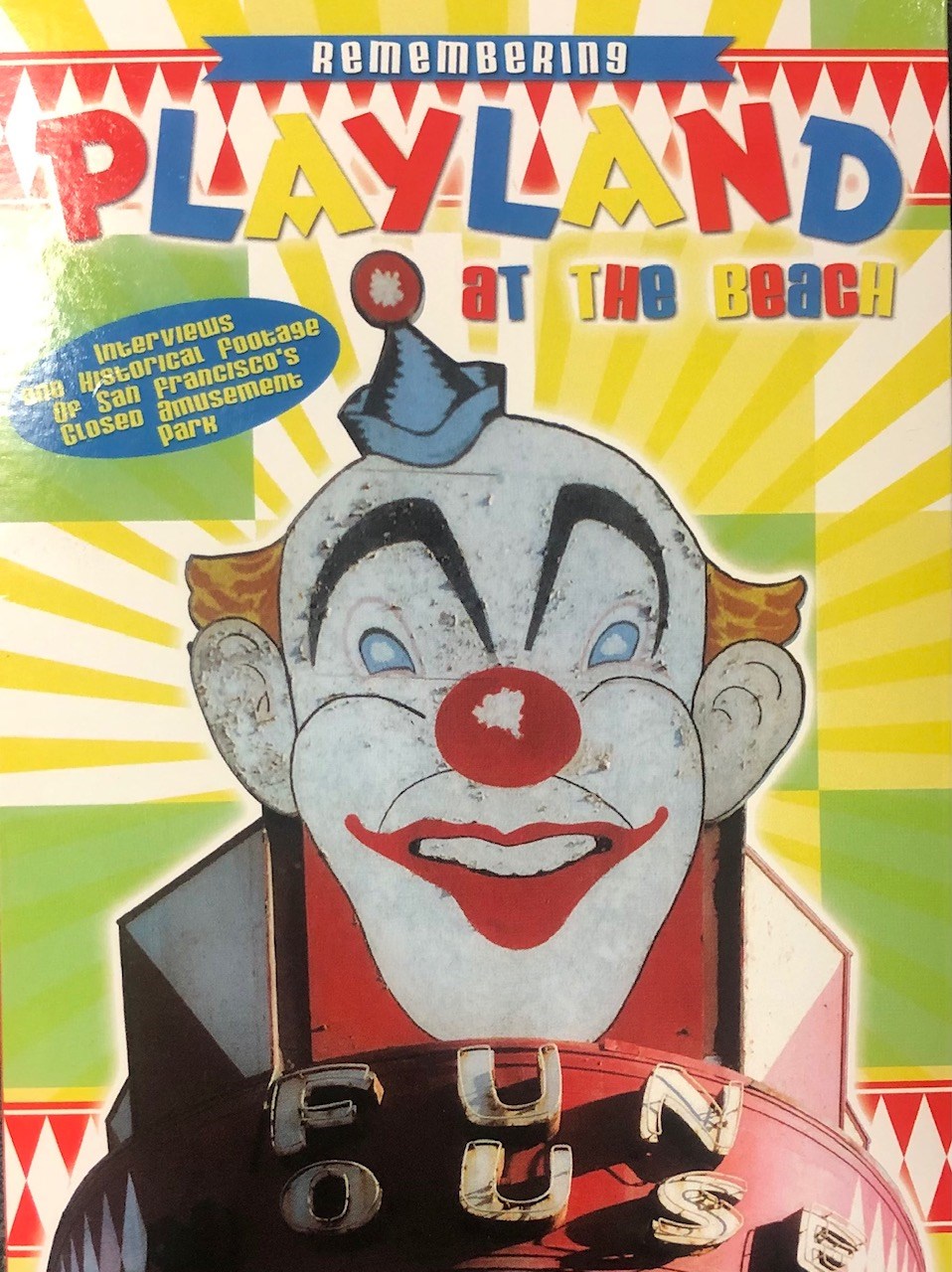
In July, they had a screening in the Niles, CA Museum of ‘Remembering Playland at the Beach’; a tribute to San Francisco’s Coney Island, available on DVD. The film includes a brief clip from Balboa Street to Cabrillo shortly before the amusement park closed. (Thumbnail images)


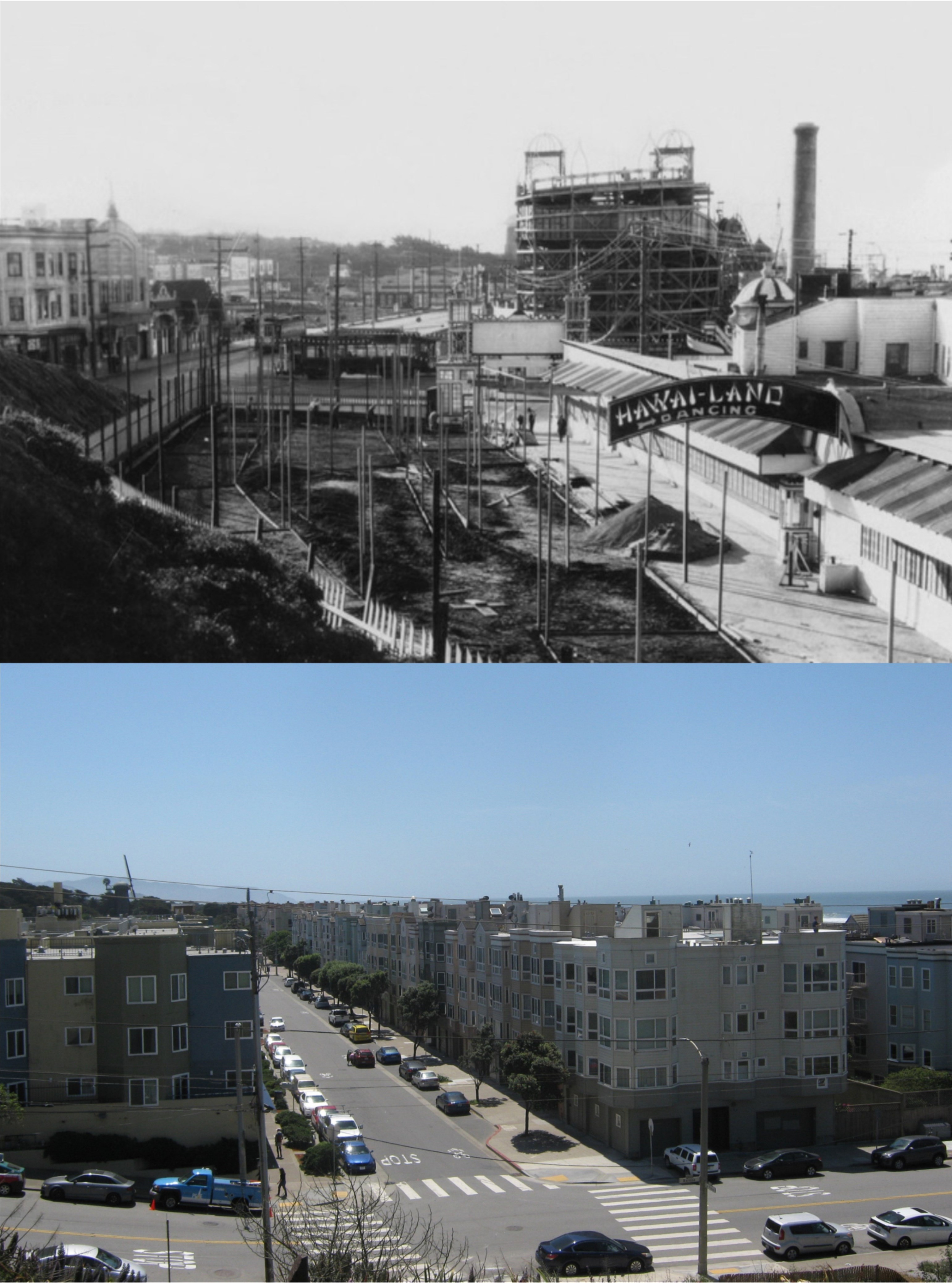
La Playa Street from Sutro Heights: La Playa is to the left of the Shoot the Chutes ride in the vintage picture; Hawai-land (spelled wrong) was behind where Topsy’s Roost was, and was farther to the right in my picture.


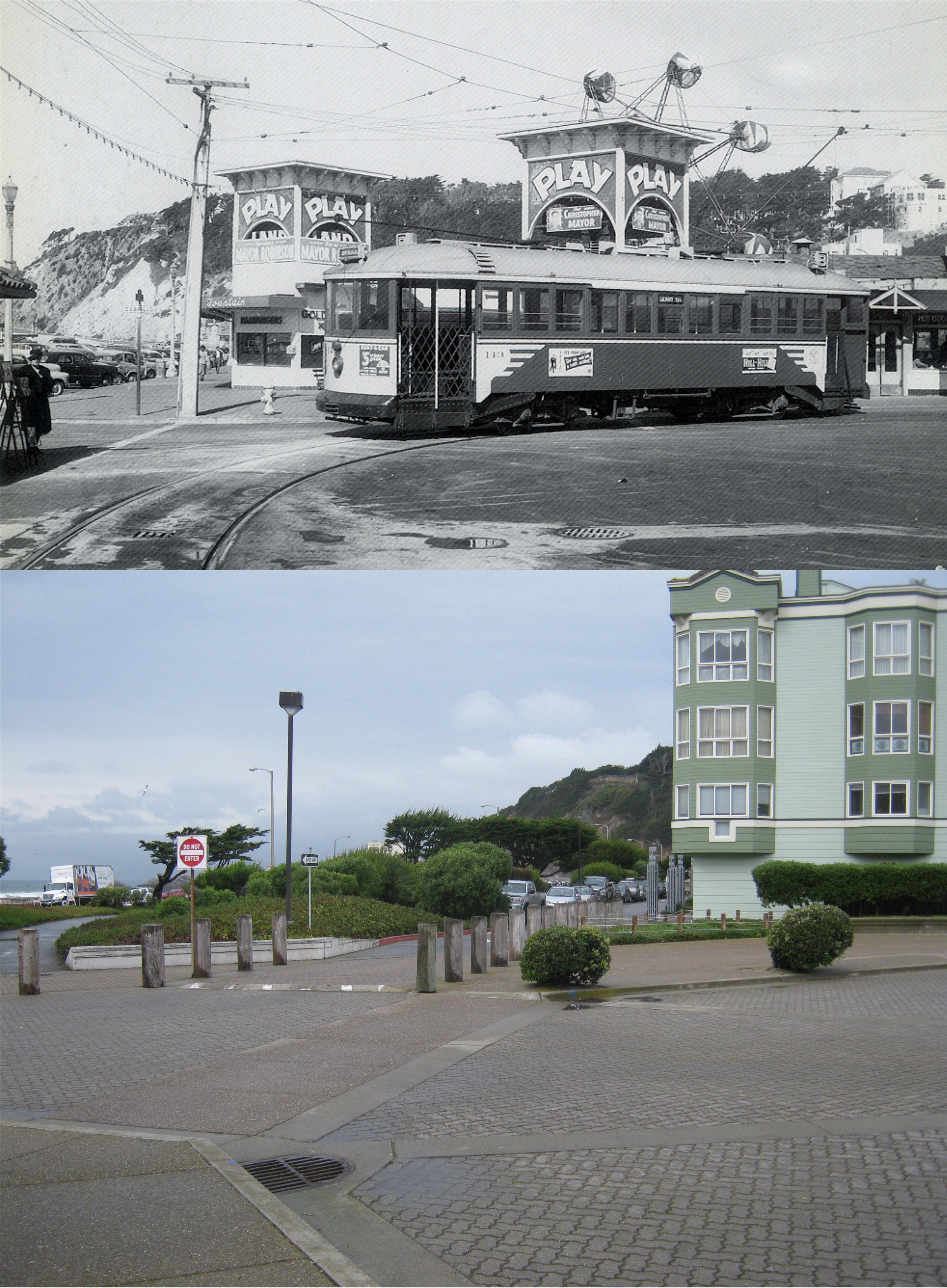
The Cabrillo Street turnaround during the 1950s:


Playland had a live boa constrictor at a sideshow once. Eh, I wrestled with a live alligator at the Alameda County Fair in July.


The approximate spot where the Funhouse and Merry-Go-Round were located: (Flickr)

The Playland Merry-Go-round thrilled kids and parents alike until the park closed in 1972. Moms still wave to their kids today on the Playland Merry-go-round relocated to Fourth & Howard Streets in Downtown San Francisco. (SF Chronicle)

Rather a tawdry marker is all that’s left.


Another view of Playland-the-Beach from Sutro Heights; dating to 1972: This stretch of Playland, from the yellowish building at the lower left to the Carousel on the upper right, is what you see in following film clip from the DVD. The following clips are on the Great Highway, scanning from Balboa to Cabrillo Streets shortly before Playland closed in 1972 and August of 2024

Murder on Joice Street

Joice Street is another interesting little known San Francisco Street. It’s actually a little more than an alley that runs three blocks from Pine Street to Clay, and I’ve posted a few updates on it in the past, but I became interested in exploring it again after reading about it in the opening chapter of Gary Kamiya and Paul Madonna’s wonderful book ‘Spirits of San Francisco’, published just at the opening of the Covid-19 Pandemic that shut San Francisco and most of the world down in the spring of 2020. The street runs in sort of a hill-and-dale from, as Gary Kamiya points out, the “glamour” of Nob Hill to the “drabness” of Chinatown. I revisited a little of  street’s history, and also remembered a little known claim to fame, if that makes any sense, that I saw in a 1972 episode of the television show ‘The Streets of San Francisco’ that featured Joice Street. (Thumbnail images)


The Joice Steps, descending or ascending, depending on your point of view, Pine Street, seen in Edward H. Suydam’s 1930s drawing.


Children and guardians posing in front of the Occidental Board Presbyterian Mission House, more commonly known as the Cameron House, in 1908: The Cameron House got its more prevalent name after Donaldina Cameron, who lived in the building and was famous for rescuing women forced into prostitution in Chinatown. (Wikimedia)


Donaldina Cameron stands at the bottom of the ladder in this staged photo of a Chinatown rescue from FoundSF:


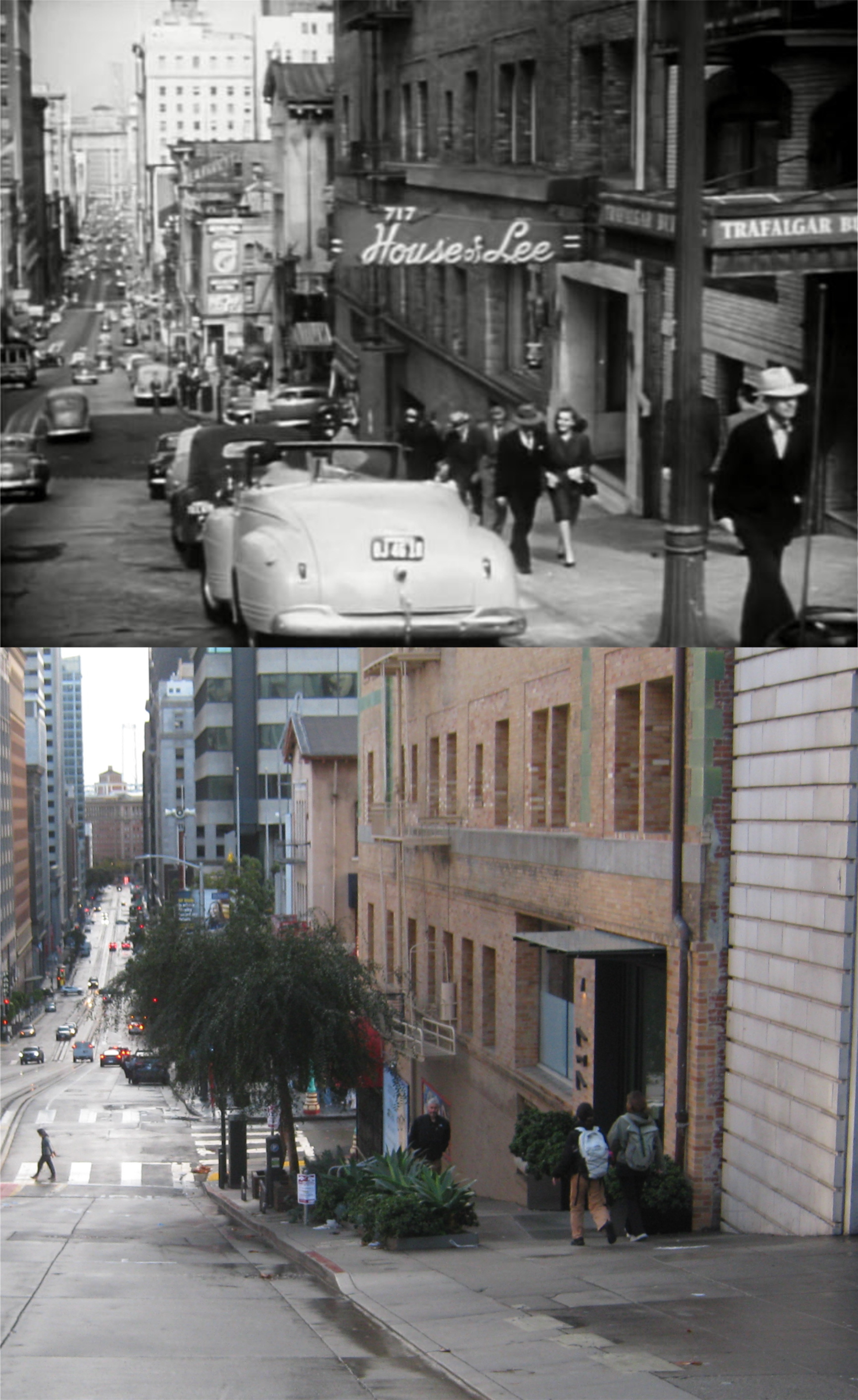
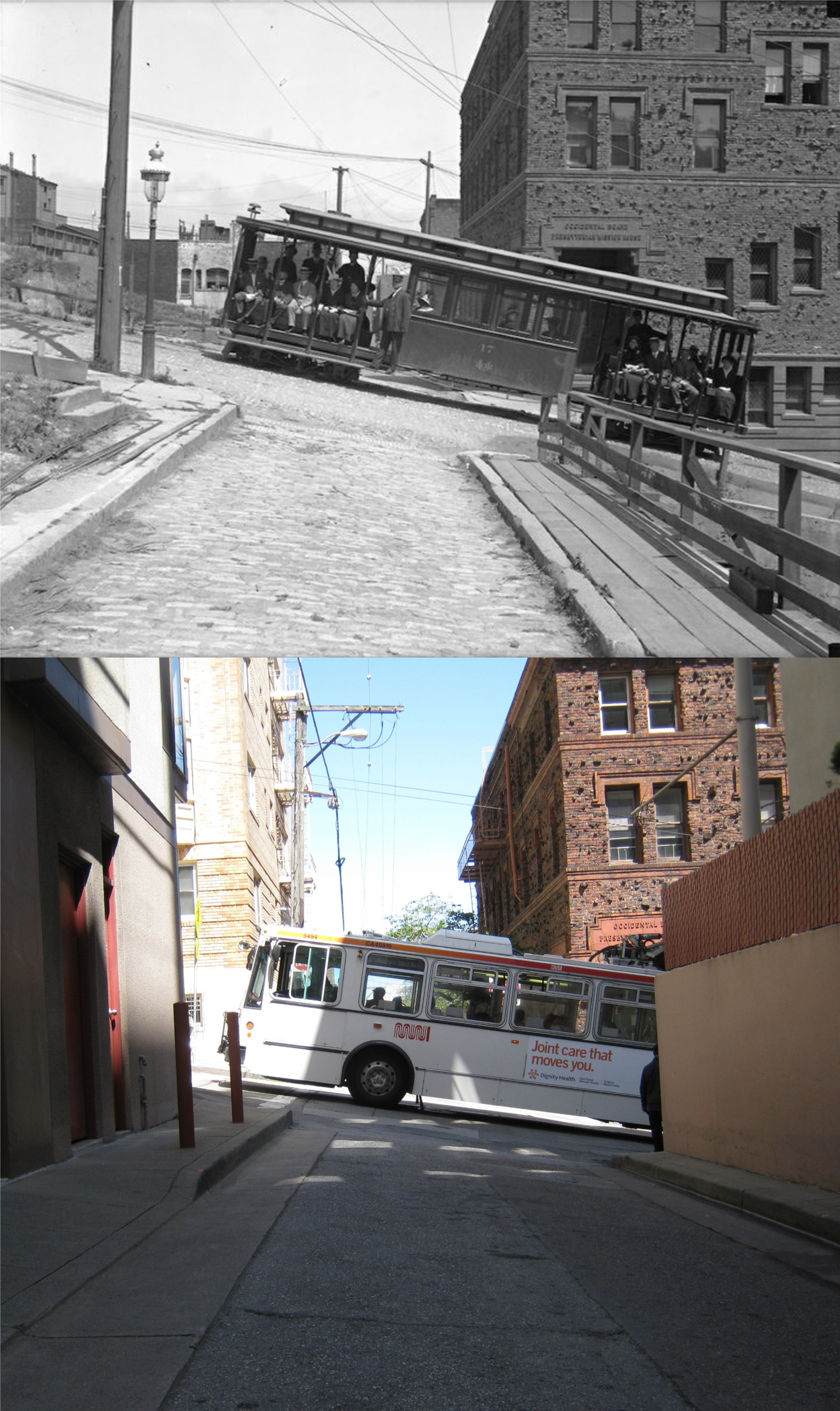
Believe it or not, I wasn’t trying to line this bus up with the cable car in the older photo, taken from Joice Street looking toward Sacramento Street, but the MUNI #1 came by at just the right time to make a nicer comparison. The Cameron House is on the right in both photos.


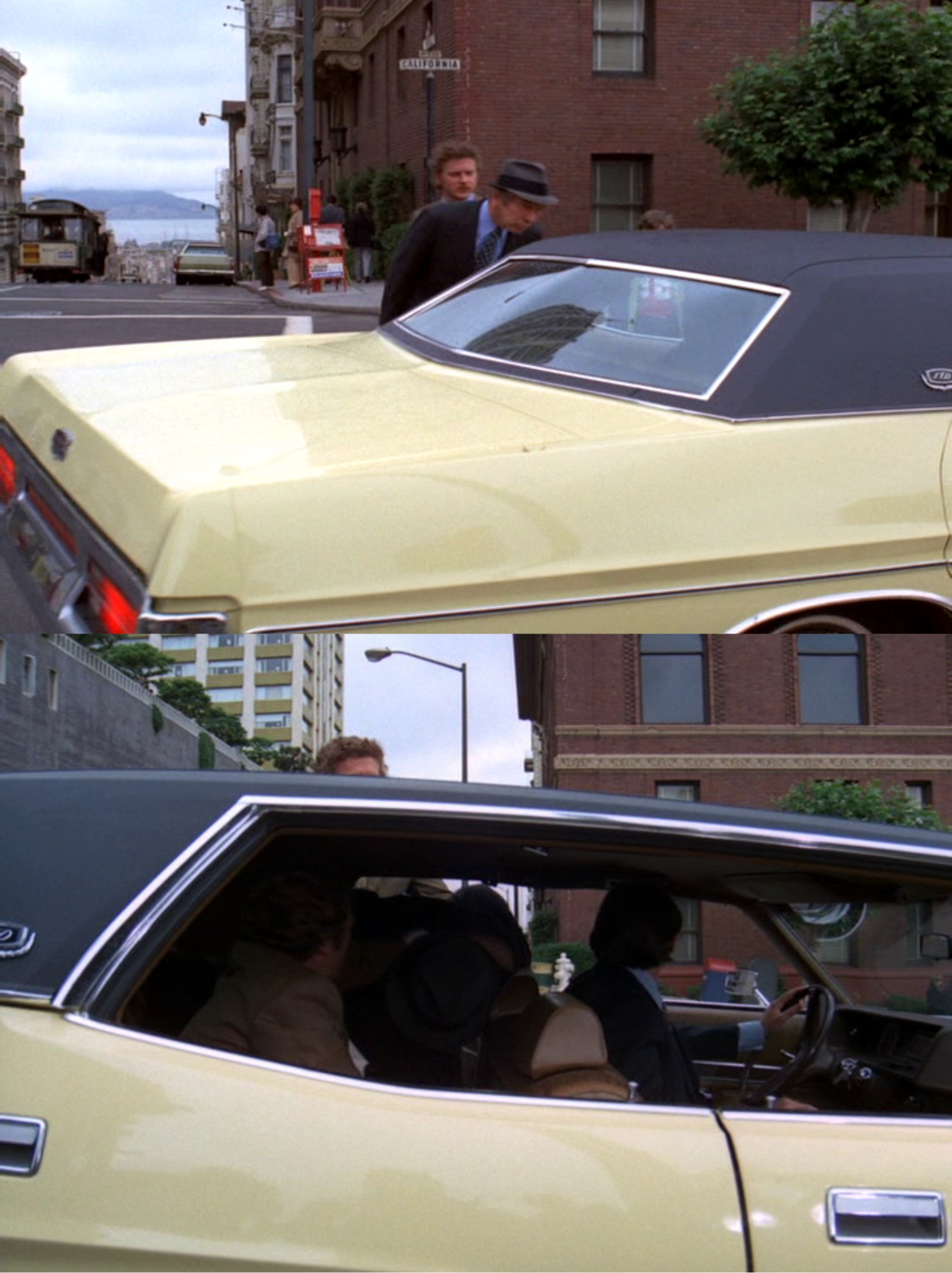
And now, to the main Joice Street story. I did a post in 2018 that covered, in part, what I think was one of the best episodes from the 1970s TV show ‘The Streets of San Francisco’ entitled ‘In the Midst of Strangers’ that showed part of, but not the actual murder on Joice Street, of a cable car passenger. Here’s the set up. The fellow in the hat holding a newspaper has just gotten off of a cable car and is crossing California Street south on Powell Street, followed behind him by the man in the tan suit who knows that he’s carrying a lot of money. The passengers in the yellow car are accomplices of the thug following the cable car passenger.


The yellow car cuts the victim off, supposedly asking for directions, and he’s taken into captivity from behind.

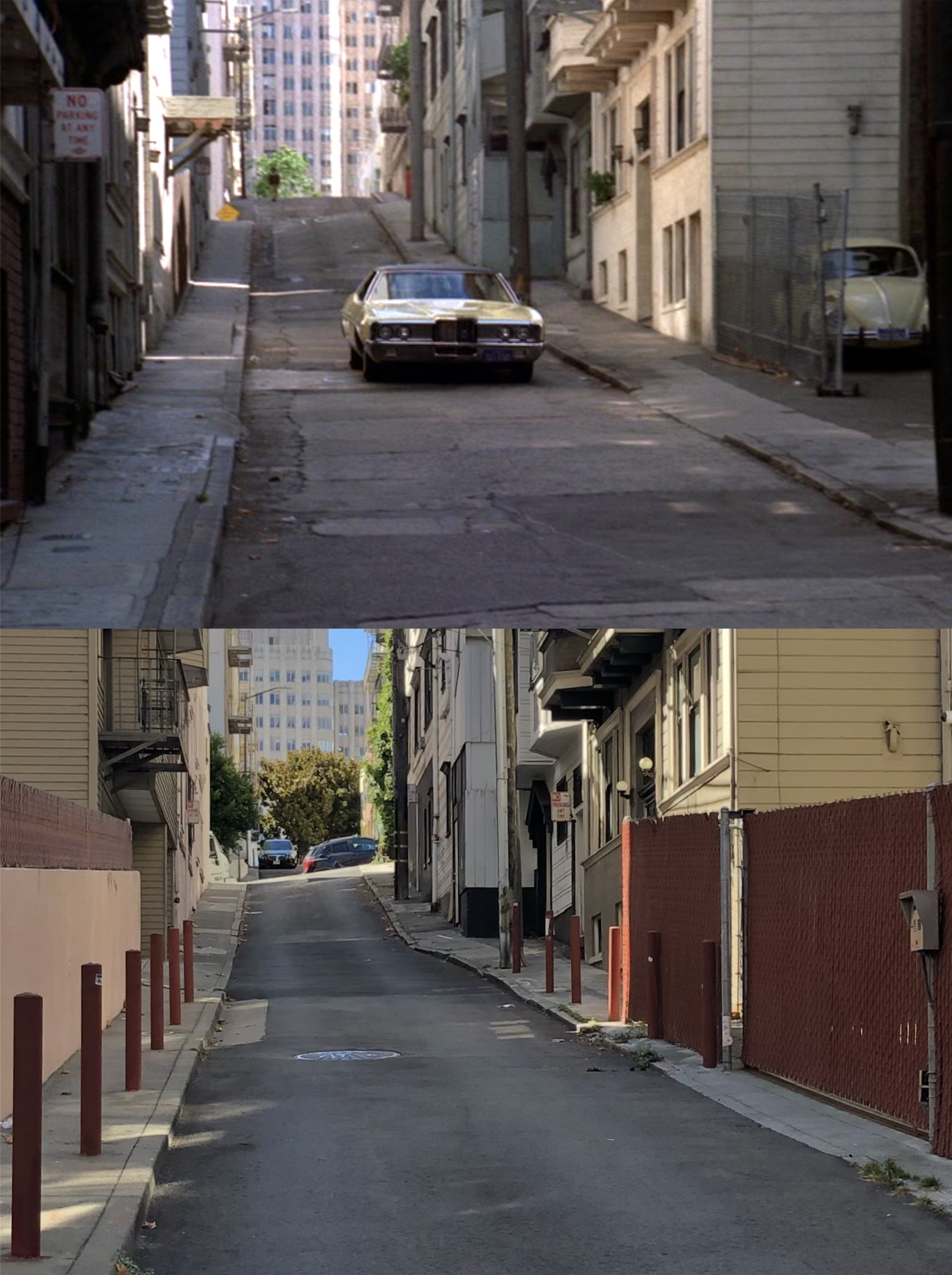
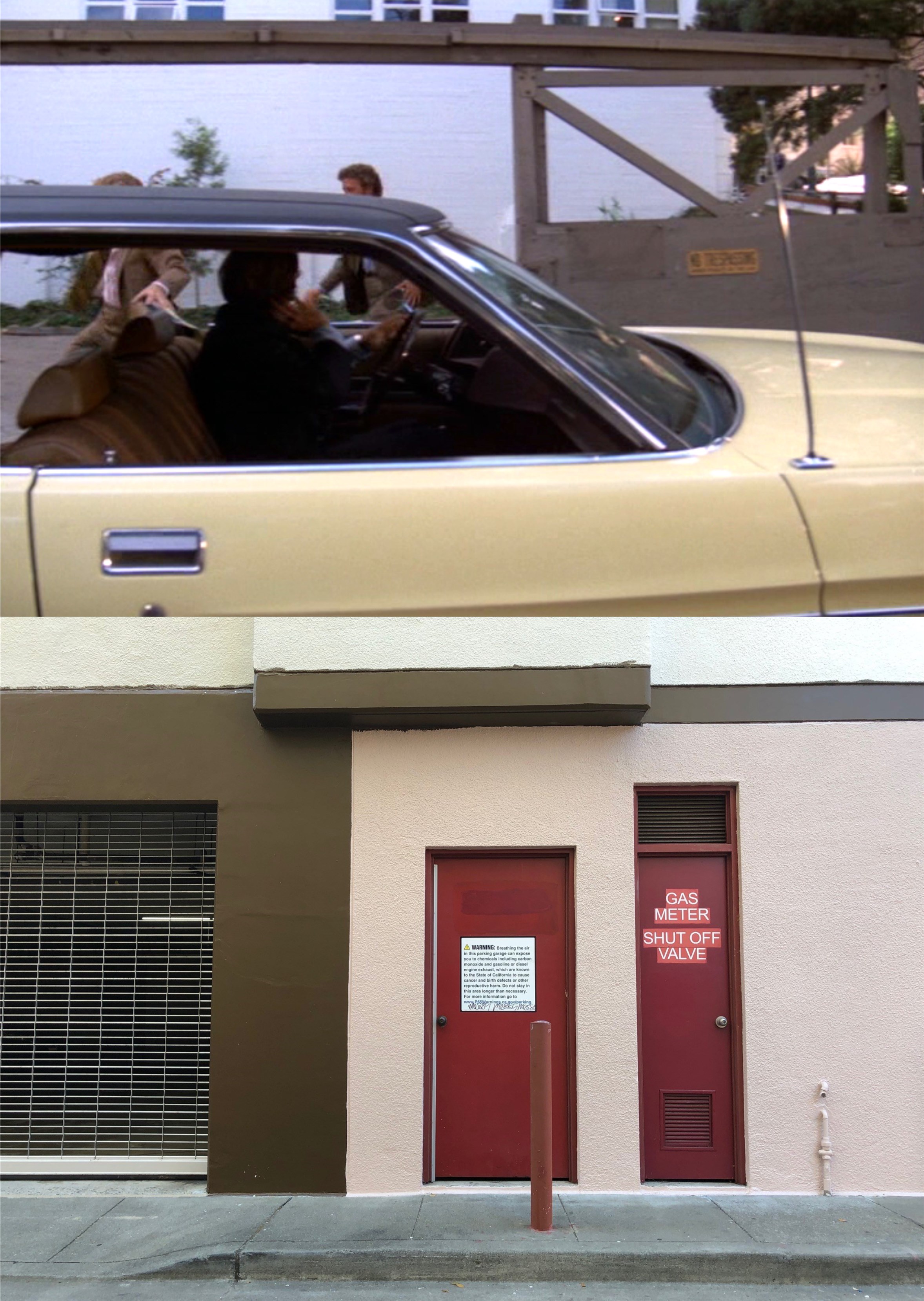
The kidnappers speed down California Street past the obligatory 1970s Volkswagen, and turn left into Joice Street. Joice Street is where the white truck is in the current picture.


They head down Joice Street toward Sacramento Street past what appears to be another obligatory 1970s Volkswagen parked on the right.


Unfortunately, things don’t turn out too peachy for the victim. As the thugs stop on Joice Street to rob the man, one of the bad guys shoots him as he struggles. There’s always somebody who has to make it worse!


The crooks dump the body of the fellow who “gave the last full measure of devotion” for his money into a building under construction. Here’s where the finished building is today, no doubt haunted.


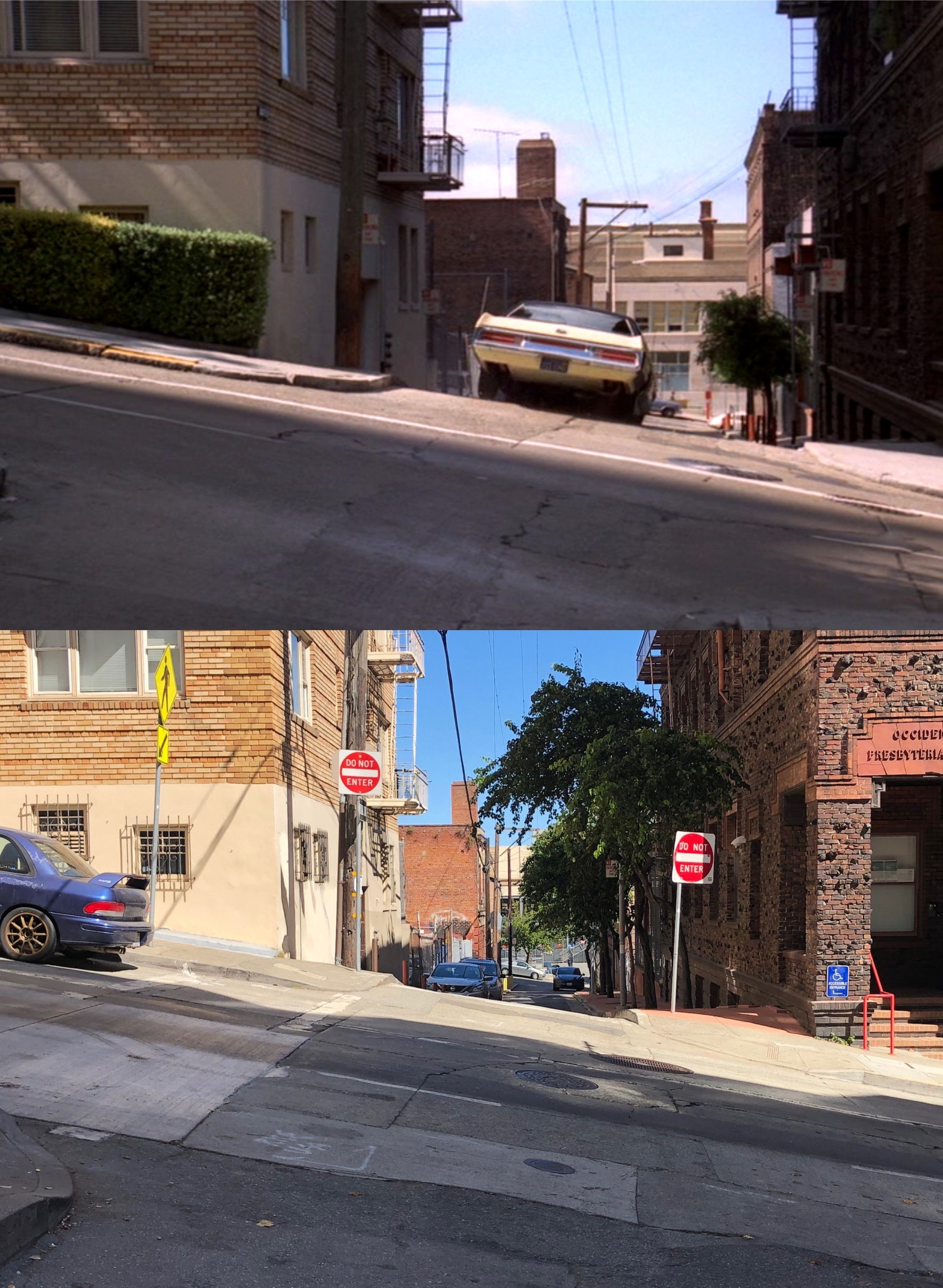
The murderers cross Sacramento Street and head down Joice to Clay Street, past the Cameron House on the right. Donaldina didn’t help that poor fellow.

Prowling around the Port (Part…… I forget)

I went to SF on Sunday to take advantage of some of MUNIs free rides along the Embarcadero they’re offering through the summer. There’s a lot of San Francisco related personalities in this old poster; Dashiell Hammett and Humphrey Bogart over by the clock, Clark Gable and Jeanette MacDonald from the movie ‘San Francisco’, Laffin’ Sal, Lillie Hitchcock Coit, Emperor Norton, Mark Twain, and probably a lot of others I haven’t spotted yet. (Thumbnail images)


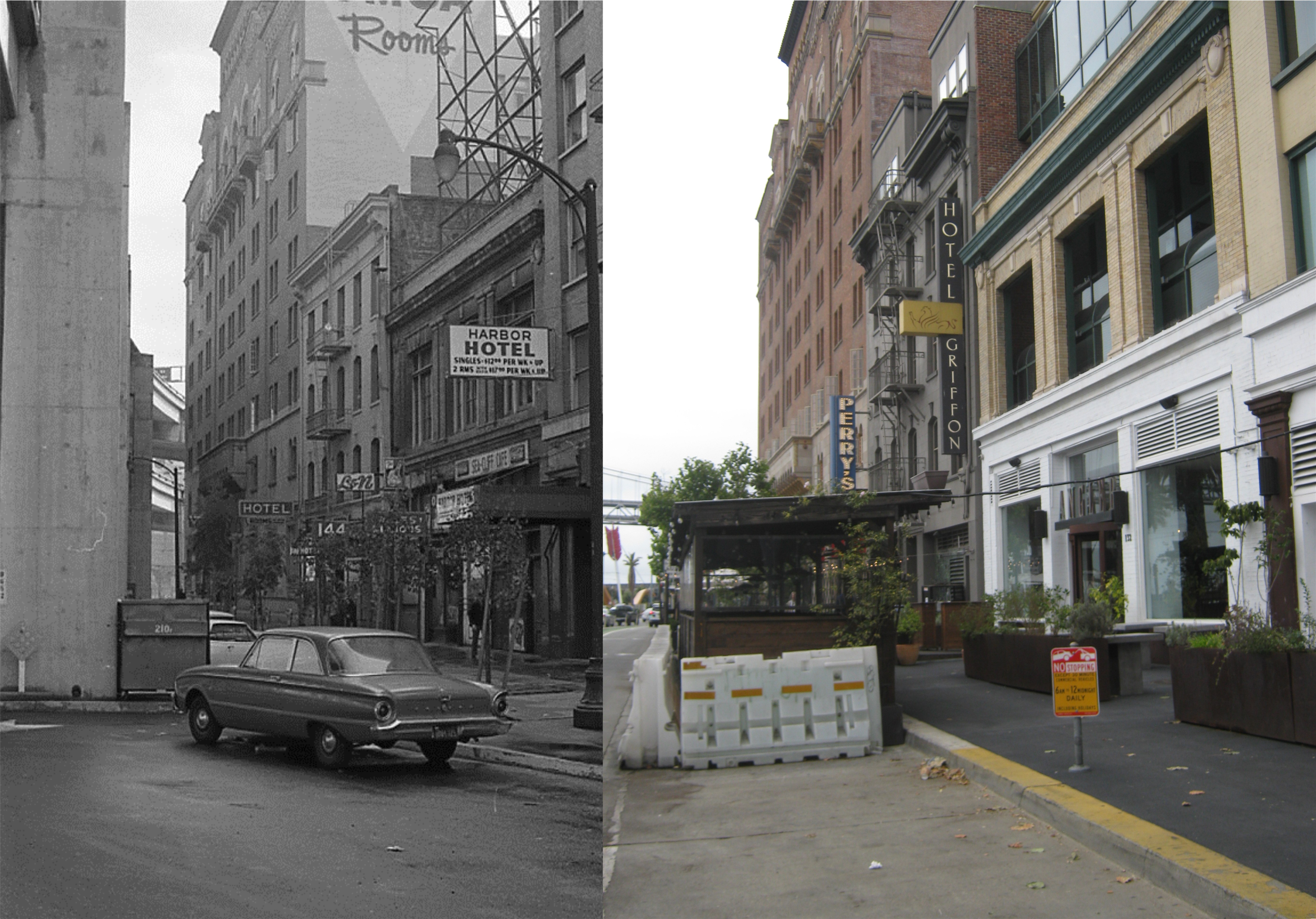
The Embarcadero, south of Market Street, and a hotel that was so seedy they didn’t even give it a name: (San Francisco Public Library Archives)


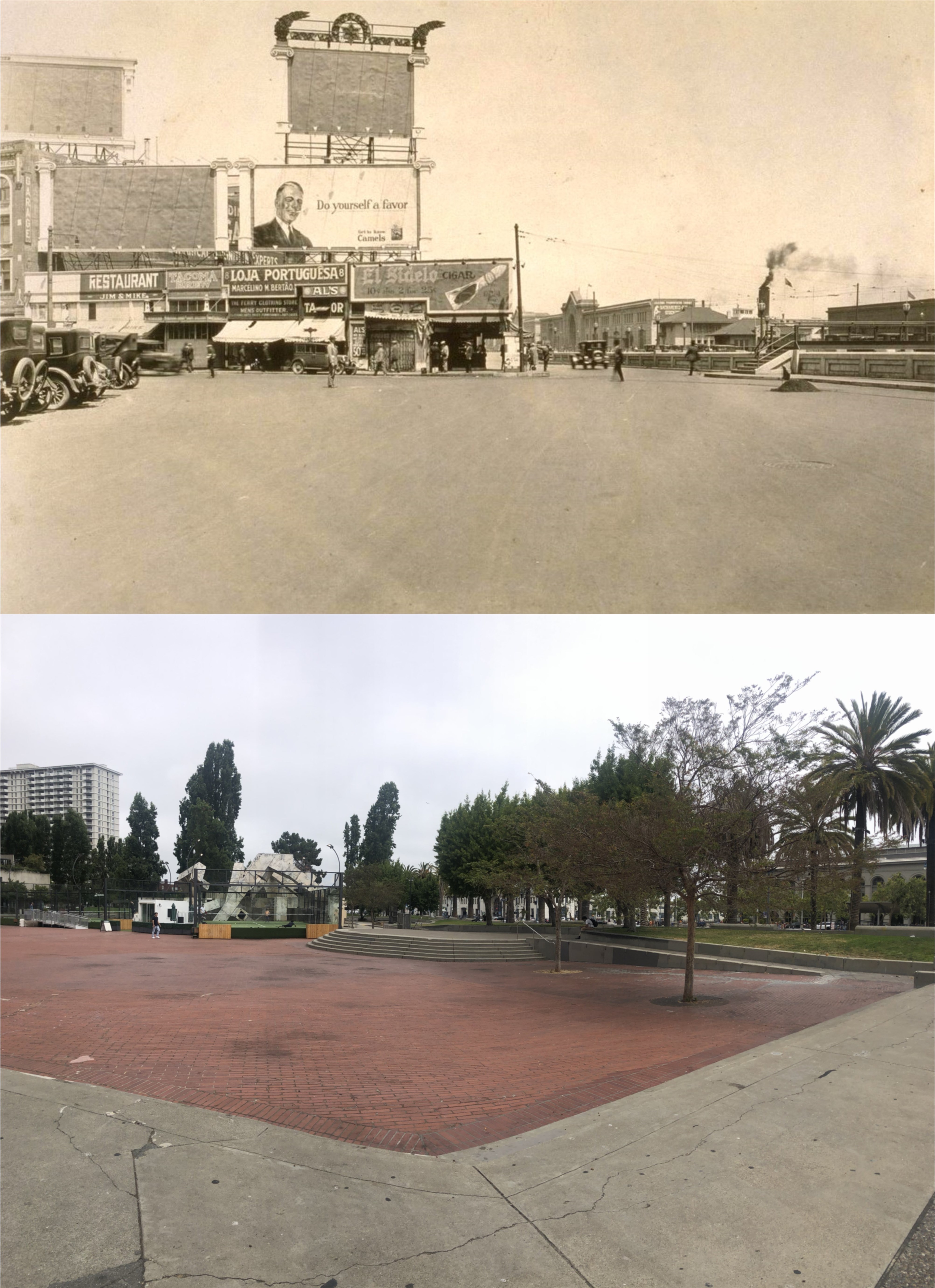
The spot where the Embarcadero Plaza is now during the 1920s: There’s a lot of talk lately about expanding the area and carpeting it with grass, and also getting rid of the Vaillancourt Fountain. (UC Berkeley Library Archives)


The Embarcadero Plaza, south of the Ferry Building during the 1970s, with the notorious Embarcadero Freeway: (San Francisco Public Library Archives)


Clay Street, when it used to come into the Embarcadero: What’s wrong with this picture? Embarkadero (!) (UC Berkeley Library Archives)


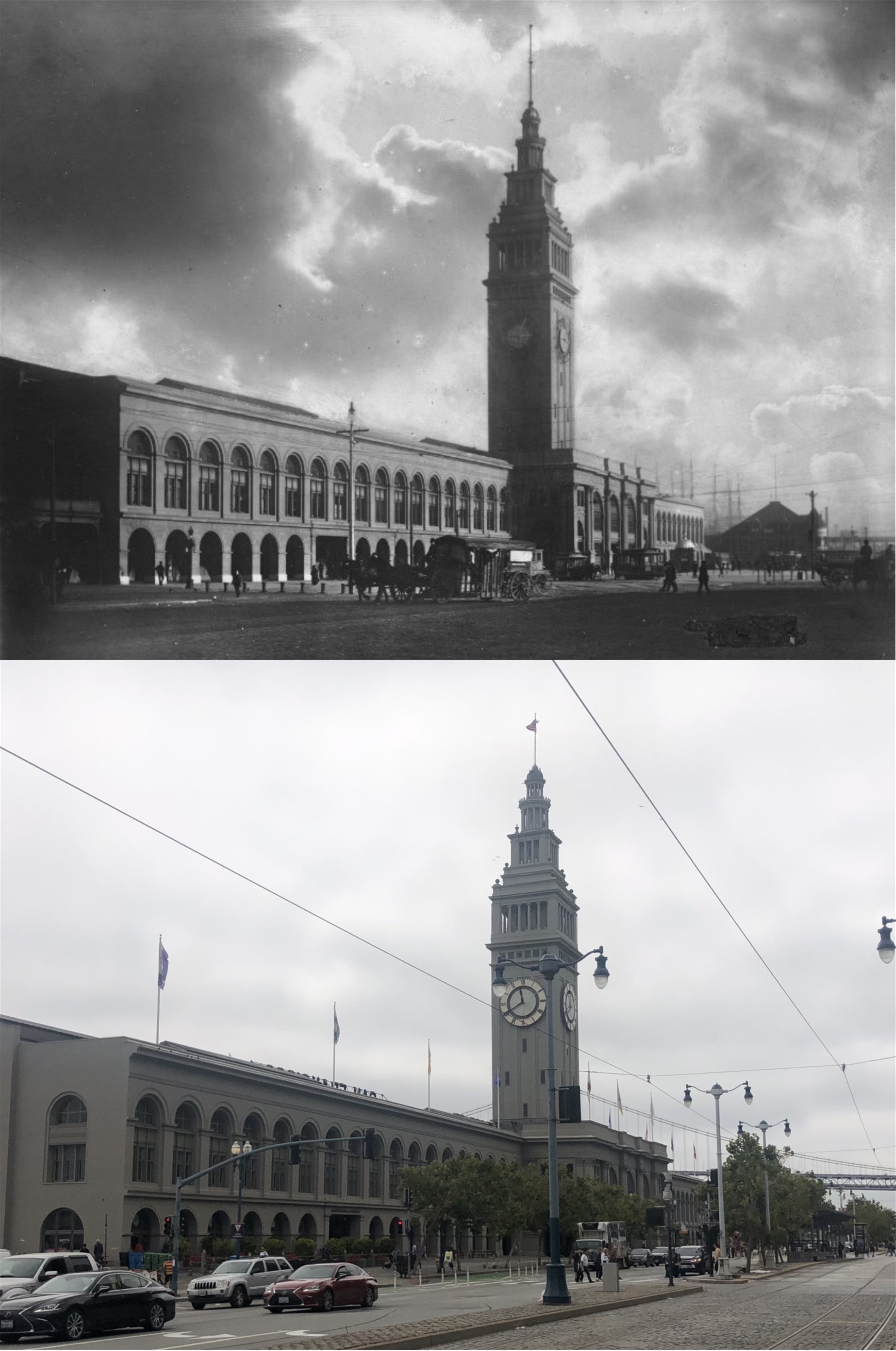
A dramatic picture of the Ferry Building on a cloudy day: (San Francisco Public Library Archives)


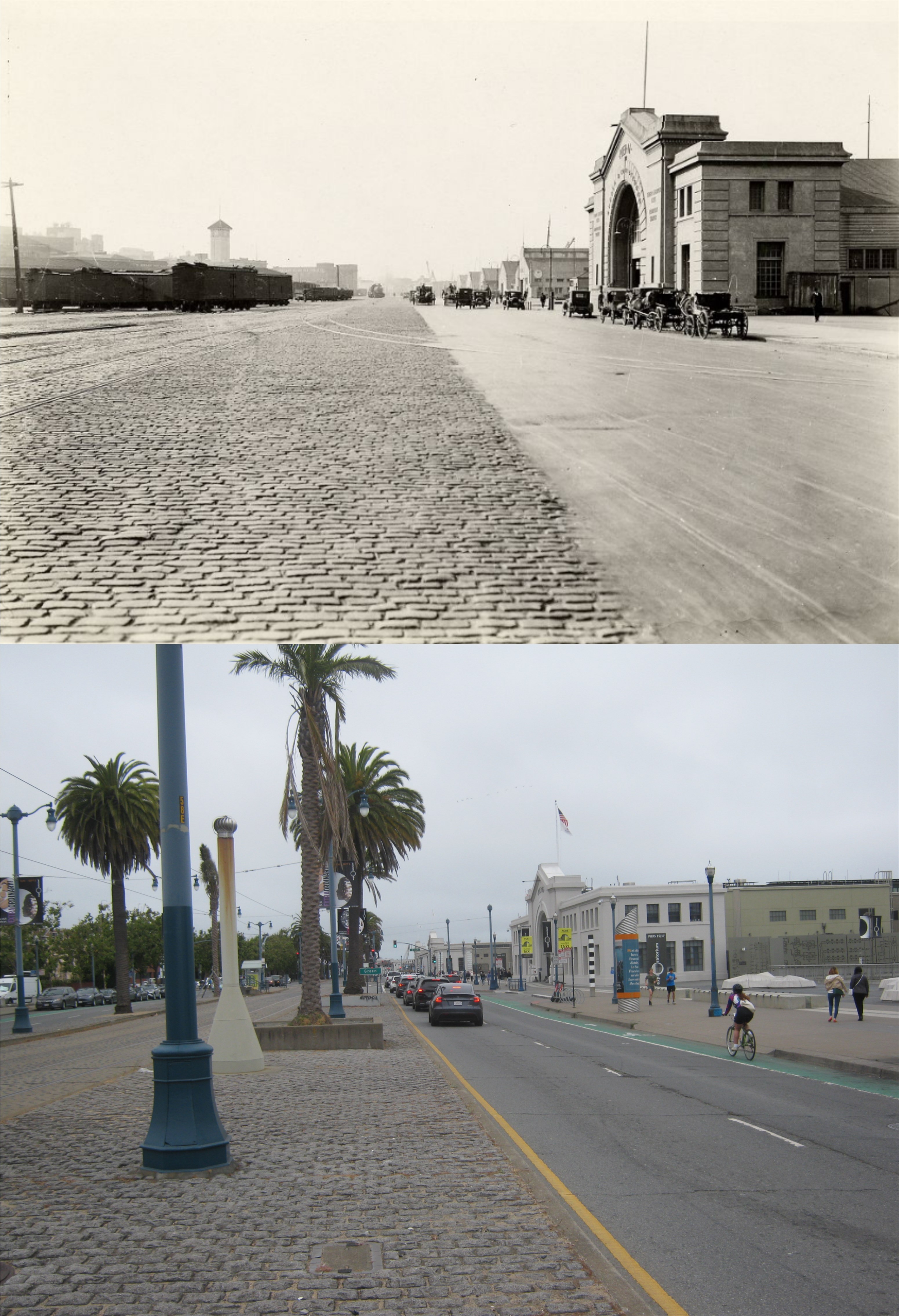
Piers 19 and 17: Pier 17 is where the Exploratorium is now.  (San Francisco Public Library Archives)


The Embarcadero, looking north from Pier 11 in 1926: Pier 11 has been demolished and was about where the girl on the bike was. (San Francisco Public Library Archives)


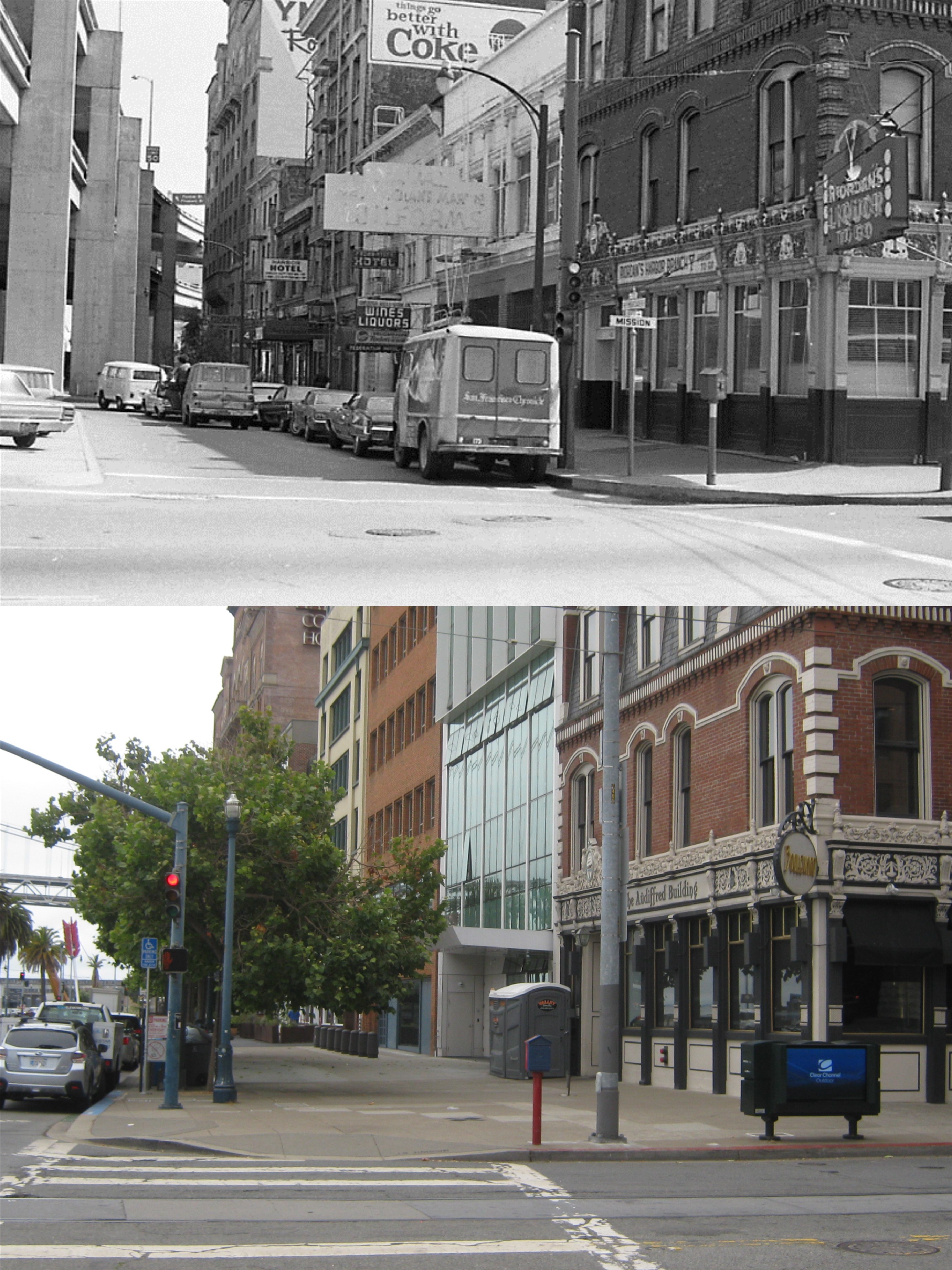
The historic Audiffred Building on the corner on Mission Street and the Embarcadero: (San Francisco Public Library Archives)


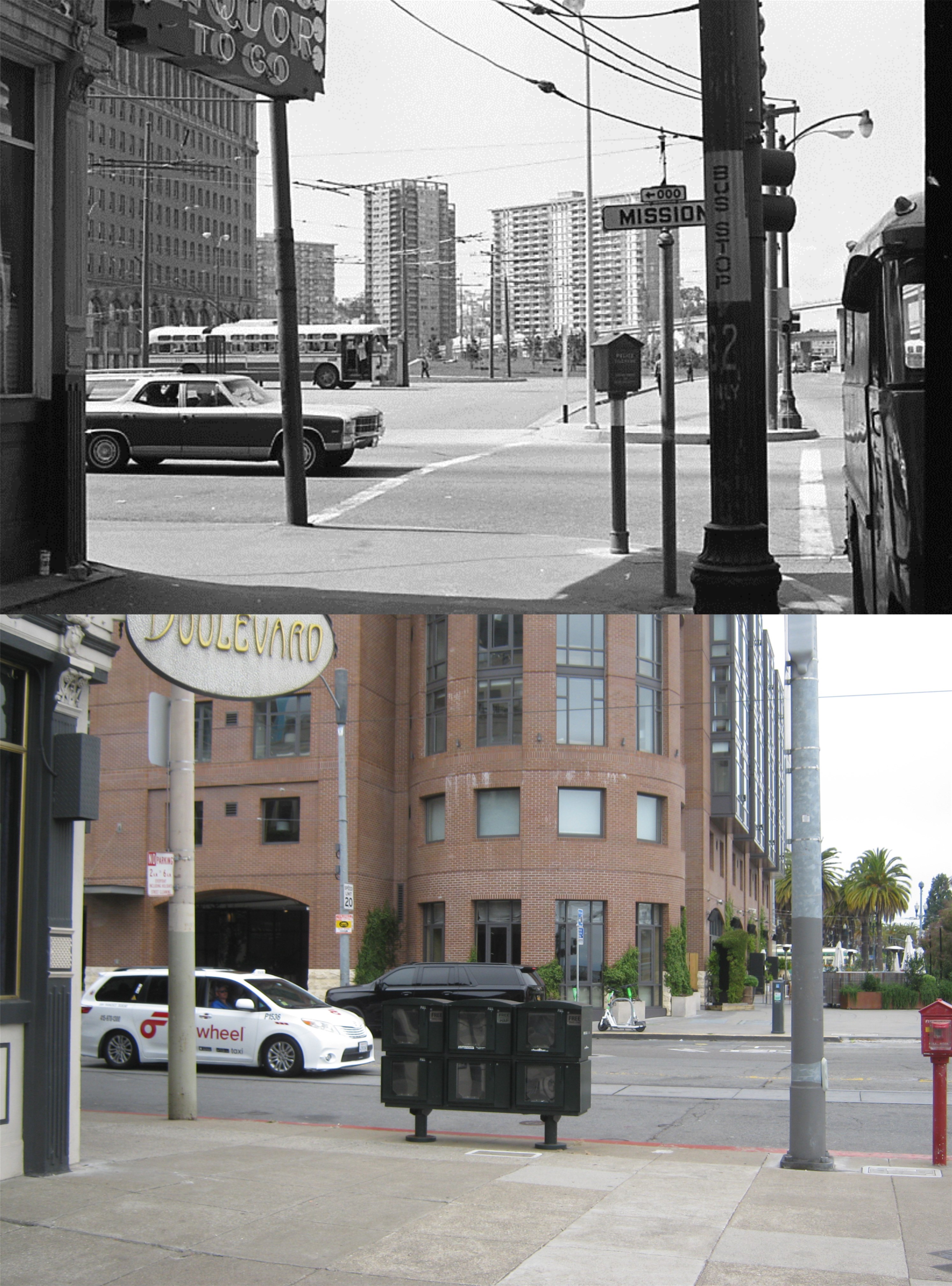
Looking back from the Audiffred Building toward a couple of station wagons: (San Francisco Public Library Archives)


A Falcon in San Francisco: Reminds me of an old movie. (San Francisco Public Library Archives)


“Pick a street, any street. Okay, Polk Street.” (For Charlotte and Amelia)

Polk Street, one block east of Van Ness, is another street I never pay much attention to. I don’t know why; parts of it are historical and entertaining. Besides, any street that connects to a cable car line deserves exploring. It runs from Market Street at the Tenderloin past the government buildings where the city’s civic leaders make all of their wise decisions, (pause for yays and boos) and ends up in touristville. (Thumbnail images)


We’ll start at the Polk Street entrance to City Hall. I don’t know what this patriotic event from long ago was, but I don’t think they do things like this around here anymore. (San Francisco Public Library Archives)


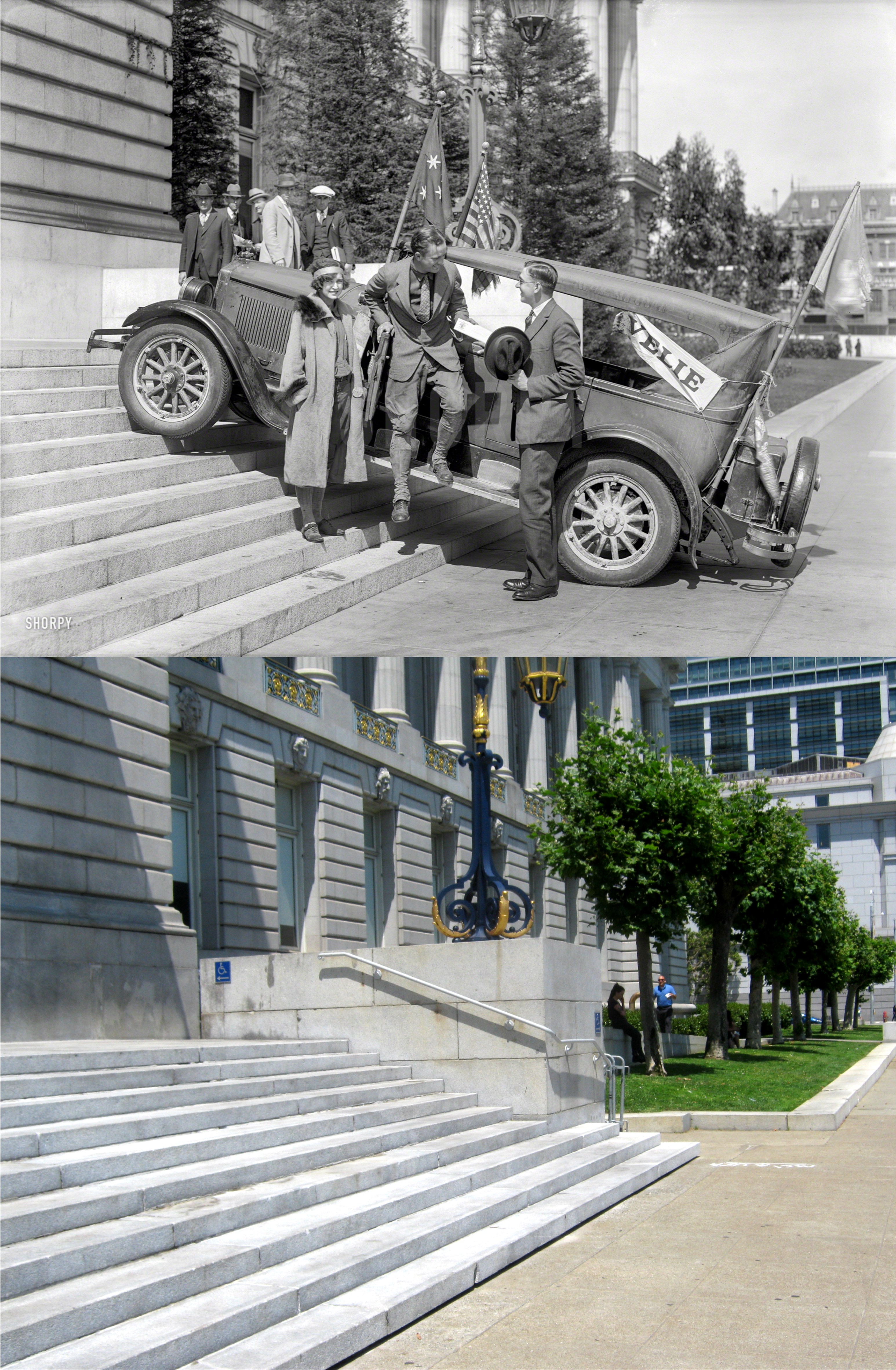
You can’t drive a car up City Hall Steps anymore, either. That, PROBABLY, wouldn’t go over too good nowadays. (Shorpy Archives)


An opensfhistorg.org picture, looking north from Golden Gate Avenue in 1920: The large building in the center background is the California Hall, a “splendid survivor” since 1912: I had to look up who George B. Seitz was from the billboard on the right. He was a screenwriter and director of films from 1914 until his death in 1944. His serial film ‘Pirate Gold’ is now considered a lost film. (Source, Wikipedia)


Polk Street looking north from California Street in 1974: Mug Root Beer ads were on MUNI buses all over town back then, including one in a scene from the 1971 film ‘The Organization’ starring Sidney Poitier. (SFGate)


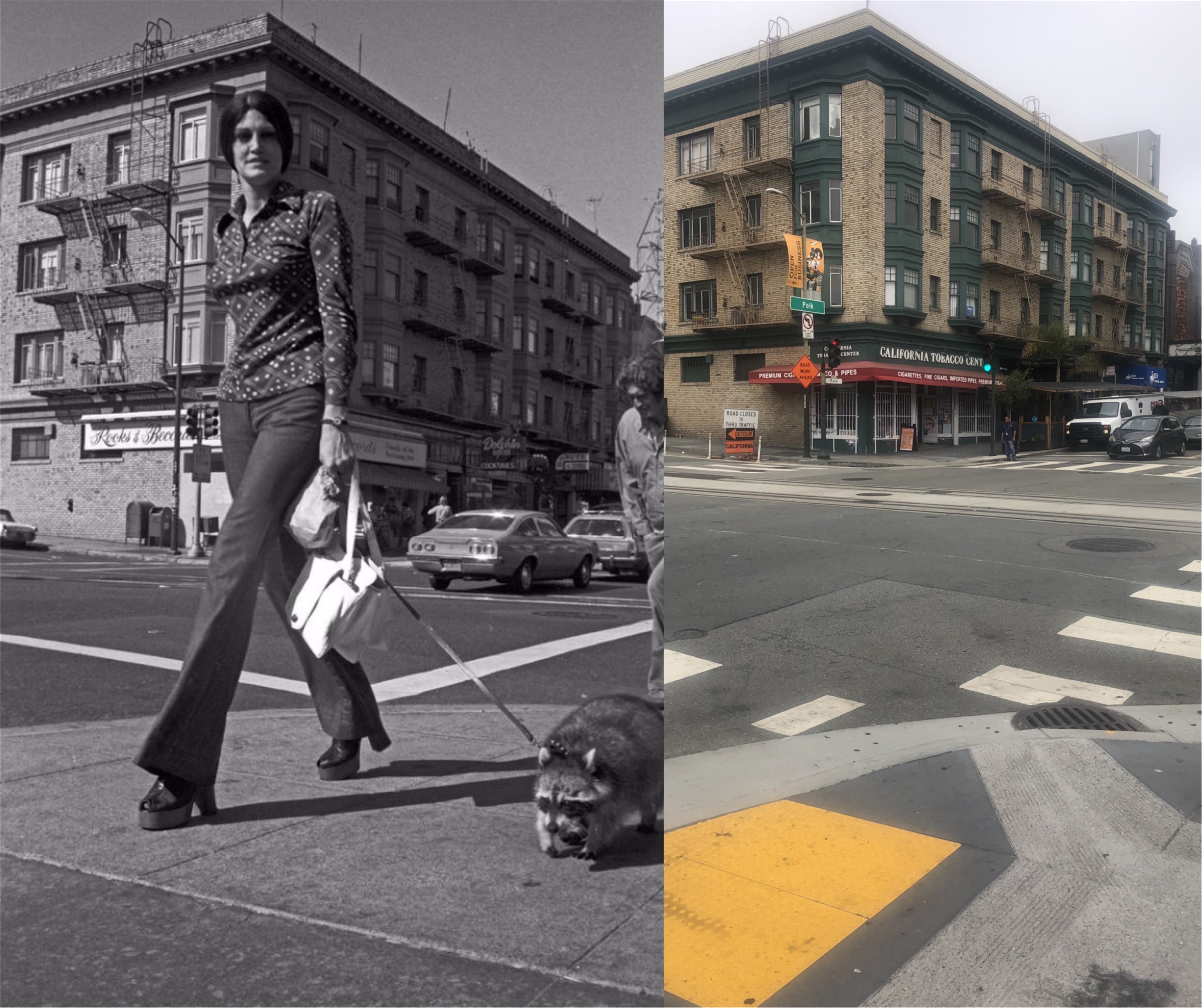
A Polk Street princess walking her pet raccoon on the southeast corner of California and Polk Streets during the 1970s: In any other city that might seem weird, but in San Francisco…… that seems weird! (Street Scenes of San Francisco)

 Well, the Littleman Grocery Store building, at 2139 Polk Street, is still around. “Little man, you’re in the dizzy Bay.” (San Francisco Public Library Archives)


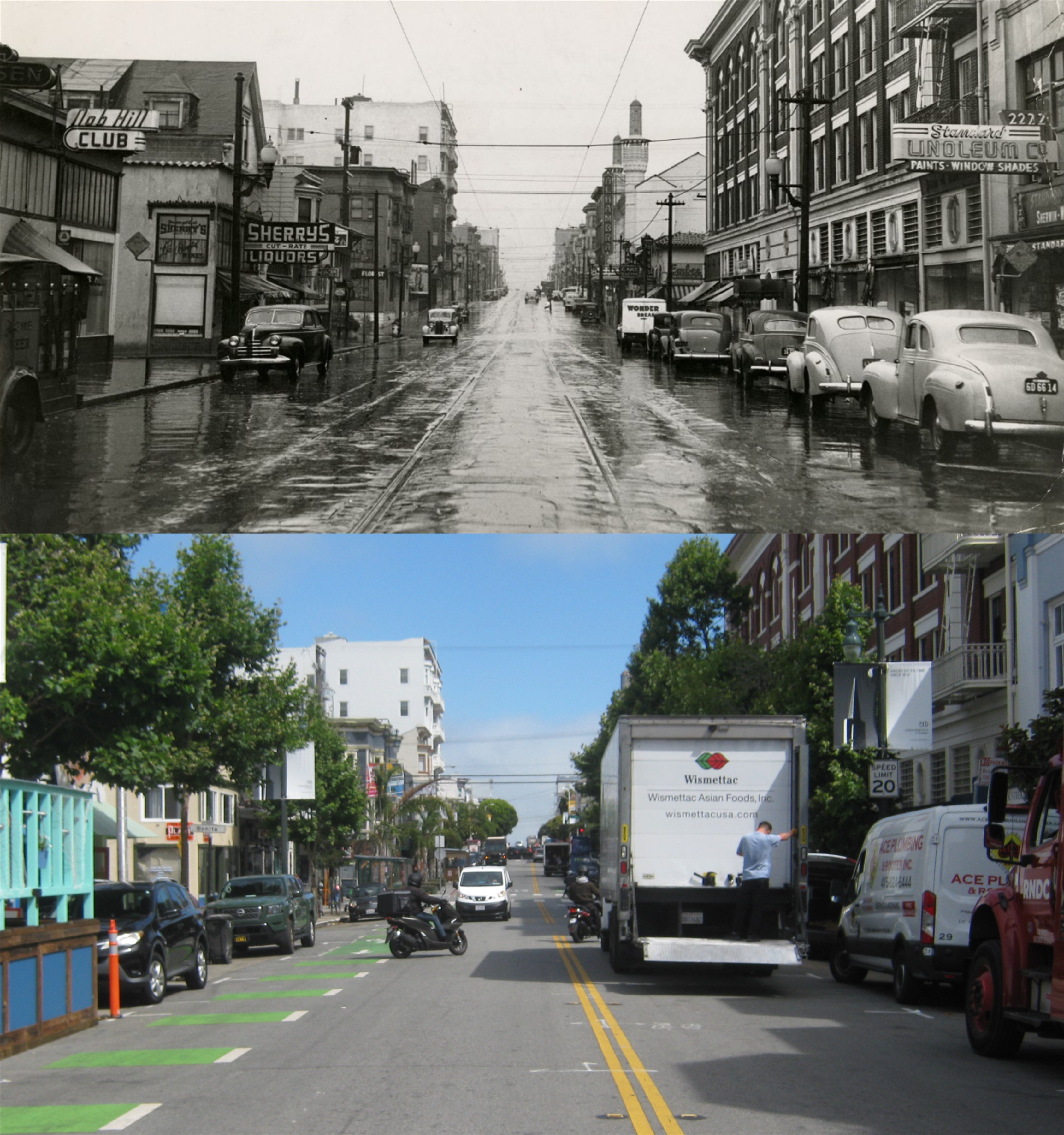
Polk Street, looking north from Vallejo Street on a rainy 1940s day: (San Francisco Public Library)


You can’t see it in the previous comparison picture, but the building where Sherry’s Liquors was is still around.


Polk Street stops northward at the Maritime Museum on Beach Street. The Ghirardelli Square Building is in the right background of both pictures. (SFMTA / San Francisco Pictures Blog)


‘EMERGENCY!’

I don’t remember watching the television show ‘Emergency!’ during the 1970s, (of course, I don’t remember much of anything about the 1970s) but I stumbled on to a 1979 TV movie of the show where the last two episodes were filmed in San Francisco; the show was usually shot in Los Angeles. The last two episodes, ‘WHAT’S A NICE GIRL LIKE YOU DOING…’ and ‘THE CONVENTION’ have some terrific location filming around San Francisco. ‘ WHAT’S A NICE GIRL LIKE YOU DOING…’ has an incredible fire and explosion scene on Pier 5 that would be impossible to film today, either economically, logistically, or in getting permission from the City of San Francisco to film it. I was able to find the episodes on DVD, so I could do some updating. (Thumbnail images)


The opening of ‘WHAT’S A NICE GIRL…’ has the obligatory aerial shot of San Francisco. Hey, Patty McCormack! Like Linda Blair as Regan MacNeil in ‘The Exorcist’, Patty will always be remembered for her opening role as Rhoda Penmark in ‘The Bad Seed’.


Later in the episode, careless workers dismantling an old ferryboat at Pier 5 accidentally touch off a fire near combustible material.


Back then the structures of Piers 5 and Piers 7 were removed, but the piers were still there. The façade of Pier 5 is still there today, Pier 7 is a walking pier now. Look at the explosion the film crew members were allowed to create on Pier 5.


The building of Number One Market Street and the Hyatt Regency can be seen from Pier 7, Number 4 Embarcadero Center hadn’t been completed yet when the scene was filmed.


A worker rushes out of Pier 5 to pull a fire alarm.


Help is on the way. This is looking toward Piers 1 and 3 from underneath the Embarcadero Freeway.


Arriving at Pier 5, the Embarcadero Freeway is on the right.


People gather as fire trucks also turn in between Piers 5 and 7. Pier 7 was a parking lot for cars back then. The orange and yellow awnings in the background are on the building where the Waterfront Restaurant is now.


An ambulance arrives from the north and turns into Pier 5 at Pacific Avenue.


Look at the controlled fire the film crew was allowed to use. Obviously there were a lot of official firefighters on the scene, as well.


The fire is brought under control with the help of trusty fire boat Phoenix, the ‘fire boat that could’. I wonder if the Phoenix is still around.


Of course, I couldn’t close without a shot of Patty McCormack. John Gage (Randolph Mantooth) is saying to her, “What would you give me for a basket of hugs?” and she’s saying, “I’d give you a basket of kisses.”


Big plans

The following are pictures of areas around San Francisco where City Hall is knocking around ideas concerning changes or improvements to. I’ll also include a few changes that have turned out for the better concerning the aesthetics of the city of San Francisco. (Thumbnail images)


First stop is the intersection of Sacramento and Front Streets, looking down from the Embarcadero Center: The older phot0 is from a slide picture I took during the 1980s. Last month, the San Francisco Chronicle ran an article stating that San Francisco has plans to change this stretch of Front Street into an ‘entertainment zone’.


Next, we’ll head out to the ocean. There are proposals being pushed forward to close this portion of the Great Highway, seen in 1919 in the opensfhistory.org picture, to automobile traffic. I don’t know how I feel about this; it’s nice to get from the Cliff House to the zoo in five minutes!


This is a rendition from the Friends of the Great Highway of how the area will look if it’s closed to cars.


And what is happening to the Cliff House? It’s scheduled to reopen by the end of this year, but no one knows how it will look. It apparently won’t be called the Cliff House anymore, although it will always be known as the Cliff House to me, and many others.


Now we’re back on the east side of the City, looking down Vallejo Street to the Embarcadero. The top picture is a slide I took in the mid 1980s. I have problems with this next proposal.

I first became interested in this view after watching a scene from the 1956 film ‘Hell on Frisco Bay’, starring Alan Ladd. Ladd portrays a disgraced police officer who went to prison for manslaughter conviction that he didn’t commit. He hides in Hodges Alley, off Vallejo, and pursues a lady who may lead him to the real killer. The film stars Edward G. Robinson, so see if you can guess who the real killer will turn out to be. Notice the building with the rooftop parking in the lower right can be seen in the film captures.


The plan is to build this frightening looking thing where the old parking garage is located that will block out most of the view of the Bay from further up Vallejo Street. Let’s hope that cooler heads prevail. (Handel Architects)


This one scares me too. Since all of the major restaurants are closed now along what used to be called ‘Fish Alley’, I’m hearing from some of the people working in Fisherman’s Wharf that there’s talk of demolishing the buildings here for some type of a promenade. I don’t think that there’s anything to the talk, because, open or closed, this view of the area at sunset is one of the things that San Francisco is all about.


This rendering from sf.eater.com doesn’t look like the plan includes demolishing the building that separate Taylor Street from Fisherman’s Wharf Lagoon.


Powell Street between Market Street and Union Square: Although it’s not as dismal as it’s made out to be, it could be made more pedestrian friendly.


This sketch from unionsquaresf.com shows what the area may look like with the changes; I’m all for places where you can just sit for awhile and watch cable cars pass by.


This drawing from Transbay Joint Powers Authority shows what the Salesforce Transit Center will look like when the Portal Project extends Caltrain to the Mission Street Terminal. This will be the first time trains have reached this spot since the old Key System was discontinued in 1958.


The entrance to the old Transbay Terminal and the new Salesforce Transit Center: Although, I have fond memories of the old terminal, the new transit terminal is nothing short of beautiful.


The rooftop of the Tranbay Terminal and the rooftop park of the Salesforce Transit Center. The park on top of the new transit hub is one of the finest things San Francisco has done in decades.


I’ll close with a slide picture I took in 1991 while they were demolishing the Embarcadero Freeway. I drove on it often. It made getting to Chinatown easier, it made getting to North Beach easier, but I don’t miss it at all.

“Pick a street, any street. Okay, Commercial Street.”

Herb Caen once wrote that Commercial Street is the only street besides Market Street that runs directly to the Ferry Building, and he was right; Sacramento Street just misses it to the south and Clay Street to the north. Commercial used to run from Grant Avenue, Chinatown, to the Embarcadero, but it stops now at Battery Street due to the construction of the Embarcadero Center. I took a walk down Commercial Street last Sunday, updating some vintage pictures that were taken along the street. (Thumbnail images)


We’ll start where Commercial Street plunges down eastward from Grant Avenue. The view is looking south down Grant Avenue in 1963. (opensfhistory.org)
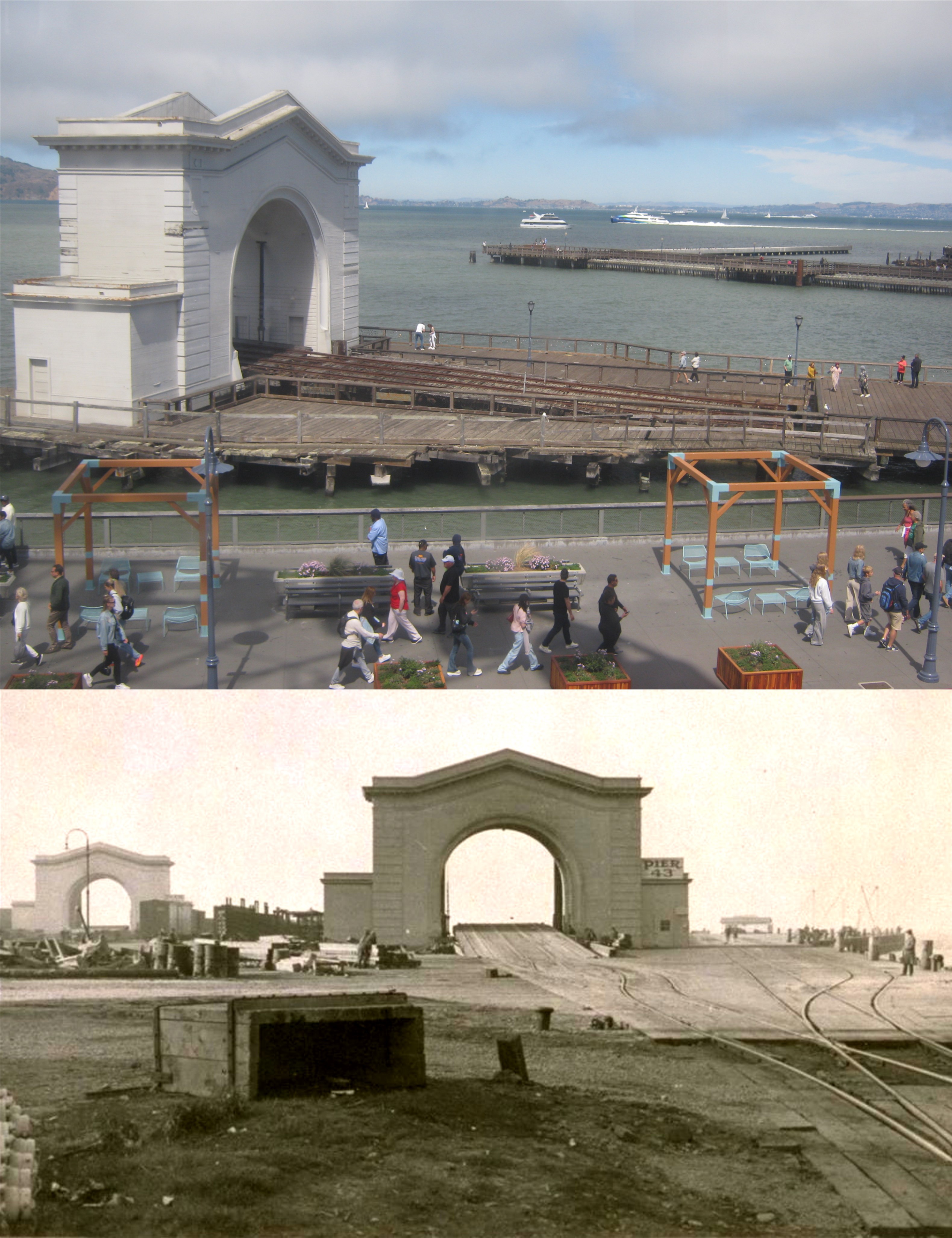
  

Looking down Commercial Street from Grant Avenue in 1960: That’s Bruce Lee on the mural at the right in the modern picture. (opensfhistory.org)


Commercial Street, looking down from Grant Avenue after the 1906 Earthquake and Fire: (UC Berkeley Library Archives)


Approaching Kearny during the 1950s: (San Francisco Public Library Archives)


Commercial Street levels out after you cross Kearny, continuing east. The photo on the left is a slide picture I took in 1983, and the update on the right was taken last Sunday.


As you approach Montgomery Street, you’ll come to the site of the first Mint established in San Francisco in 1852. A historical marker has been placed on the building commemorating the site, and another building has been build over the old Mint since the 1940 picture was taken. (Shorpy Archives)


An undated picture of an old brewery on Commercial at Leidesdorff Street, taken before the Transamerica Pyramid Building the background was constructed in 1972: (San Francisco Public Library Archives)


Commercial at Sansome Street in 1959: If you look hard enough….. you’ll notice that you can’t see the Ferry Building from here anymore. Actually, you probably still could if it wasn’t for that tree that they seemed to be so fascinated by in last Sunday’s picture. (opensfhistory.org)


Now we’ve reached what used to be the 100 block of Commercial Street. The Embarcadero Freeway is in the background of the vintage picture from Nancy Olmsted’s book ‘Ferry Building: Witness to a Century of Change’.


This is where Commercial Street emptied into the Embarcadero before the Embarcadero Center was build. The vintage picture is from the Charles Cushman Archives.