‘It was the Rialto of the desperate, Street of the Adventurers.’

That’s how the San Francisco Sun newspaper described Kearny Street three days after the 1906 Earthquake in an article called ‘The City That Was’. {Kearney Street, a wilder and stranger Bowery} or {In a half an hour of Kearney Street I could raise a a dozen men for any wild adventure, from pulling down a statue to searching for the Cocos Island Treasure} are some of the passages from the article describing Kearny Street; interestingly spelled Kearney by the long ago author. It’s not as colorful as it used to be, but you can find as many vintage pictures of Kearny Street as you can of Market Street, California Street, or the Embarcadero. I took a picture taking walk along some of Kearny Street over the Mother’s Day weekend. (Thumbnail images)


Kearny  Street at Broadway: The caption says 1905. (UC Berkeley Library Archives)


Kearny at Columbus during the 1930s: The building on the left in the vintage picture where the Pyramid Building is now was the beloved Montgomery Block Building, the hangout of writers and artists. The Sentinel Building is in the center of both pictures. (San Francisco Main Library Archives)


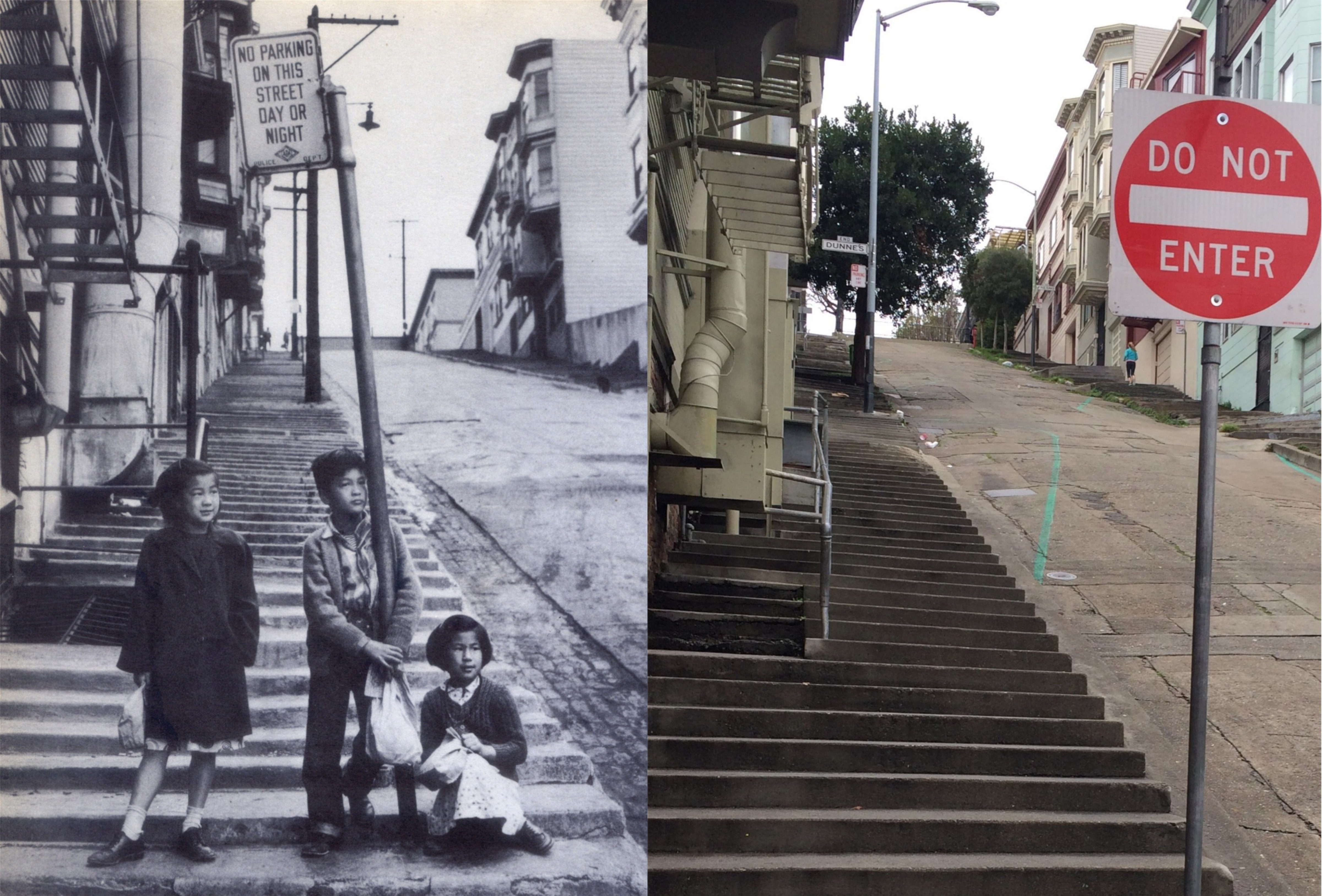
The next two sets are related. These first two are a then and now I did some years back of a picture I found in a 1949 magazine showing three children on the northwest corner of Kearny at Broadway.


This photo I found in the San Francisco Main Library Archives last week while researching for vintage Kearny Street pictures. I looked at it closer and wondered if they were the same kids as in the previous magazine picture. Yup, they sure are! The picture was taken at the same spot from the opposite direction.

An off-Broadway nightclub at Kearny Street and Nottingham during the 1960s: Kearny and Market Streets from 3rd Street in 1938: (San Francisco Main Library Archives)


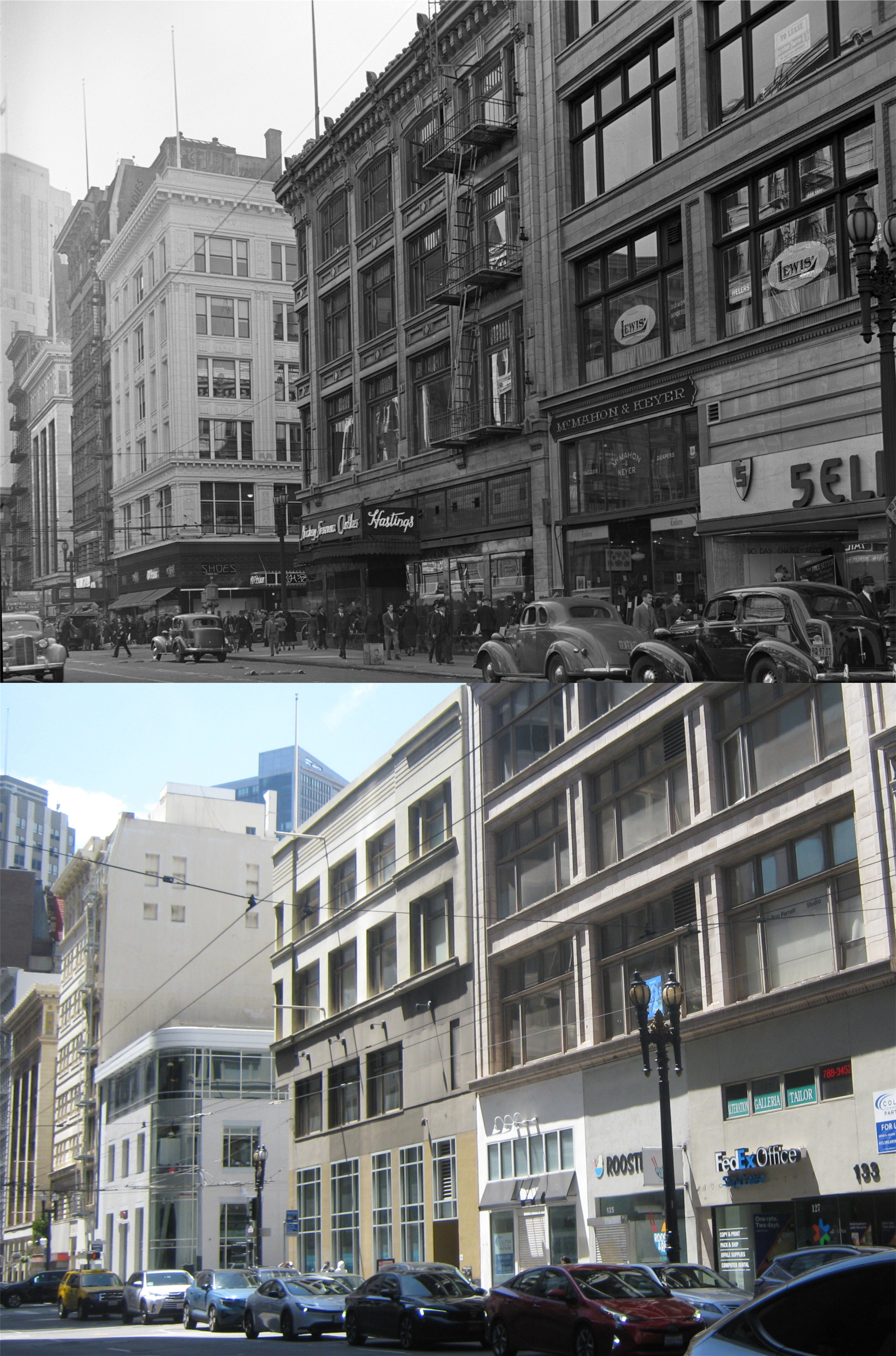
The Hastings Department Store on the northwest corner of Kearny and Post Streets in 1938: (UC Berkeley Library Archives)


Looking back past Hastings toward Post Street in 1938: You can see the Call Building, now called Central Tower, at the far left of both photos. (UC Berkeley Library Archives)


The old and new Palace Hotel, looking past Lotta’s Fountain at Kearny and Market Streets: (UC Berkeley Library Archives)


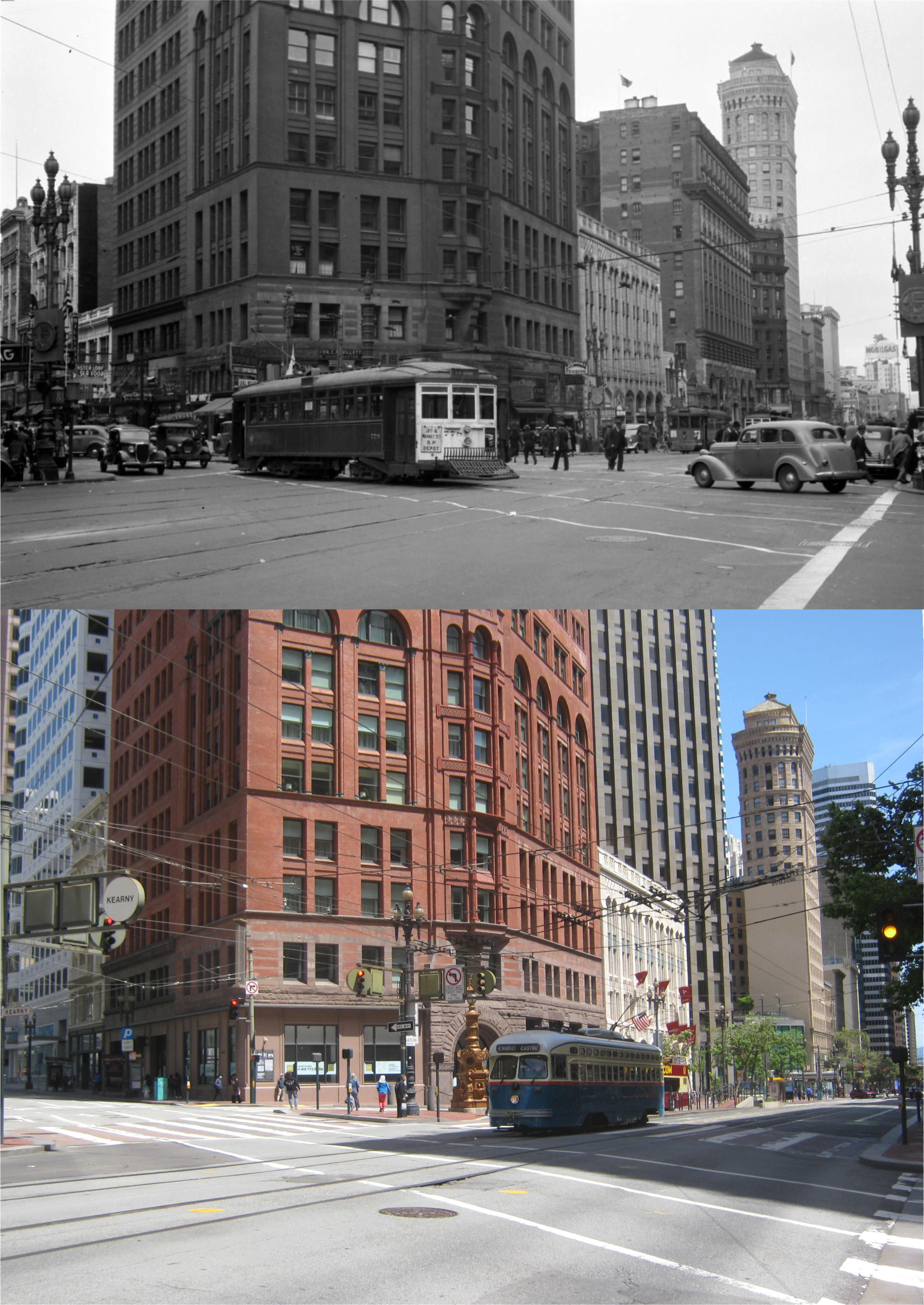
Market Street at 3rd looking towards Kearny in 1938 and a quiet Mother’s Day, 2025: You can see the then extended and in a different spot, Lotta’s Fountain, behind the old streetcar.

“Now, I’m standing on the corner of Third and Market. I’m looking around. I’m figuring it out. There it is, right in front of me. The whole city. The whole world. People going by. They’re going somewhere. I don’t know where, but they’re going. I ain’t going anywhere.” – From ‘The Time of Your Life’ by William Saroyan. (San Francisco Main Library Archives)

A whirlwind tour of San Francisco, all in 42 pages

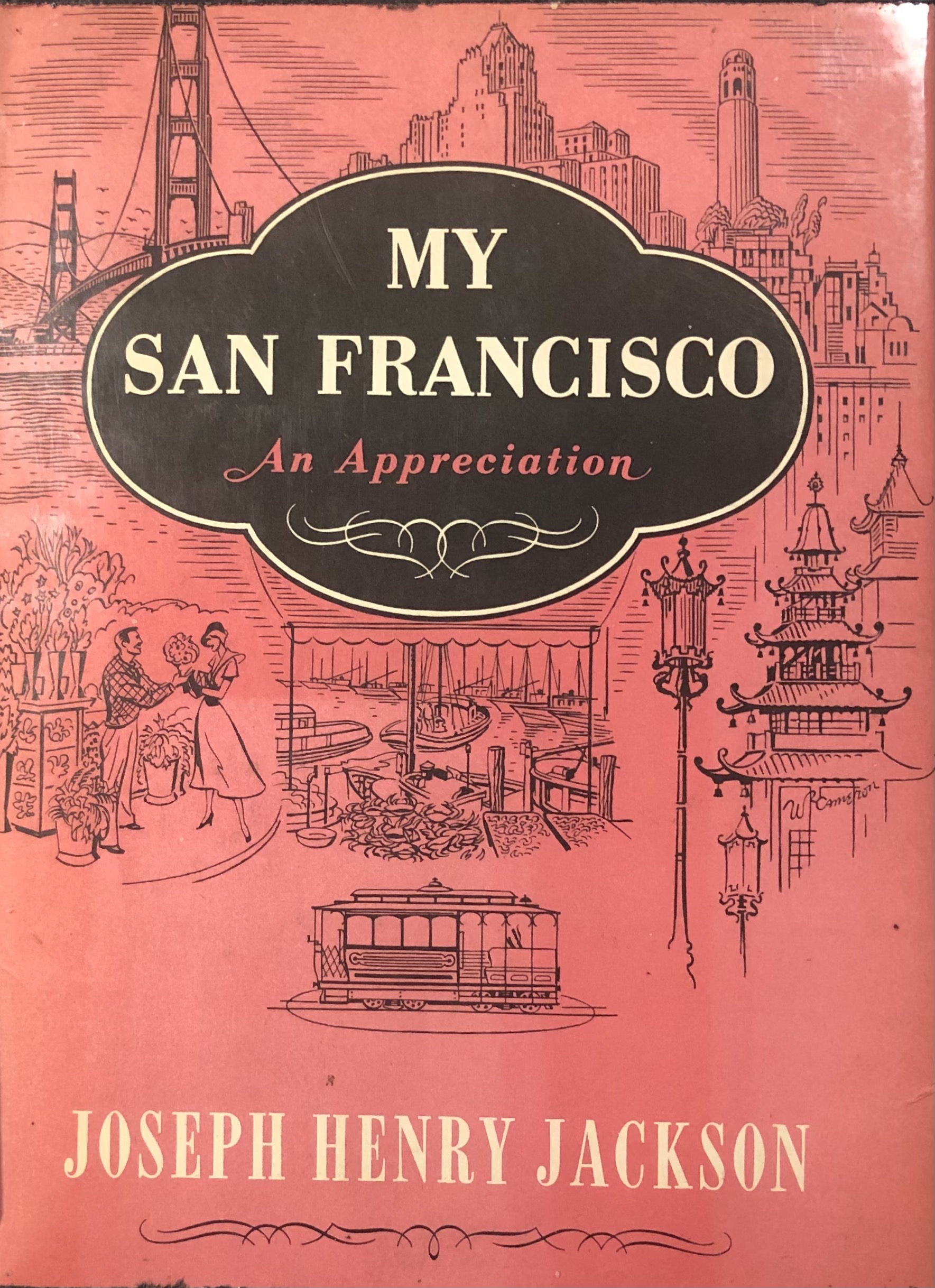
I finished reading a book titled ‘My San Francisco An Appreciation’, written in 1953 by Joseph Henry Jackson. At 42 pages, you can finish it in less than an hour. It’s a great travelogue and time capsule describing the San Francisco of 72 years ago. I’ll post some of the author’s passages, and add some update pictures I’ve done on a few of the locations Mr Jackson writes about. (Thumbnail images)


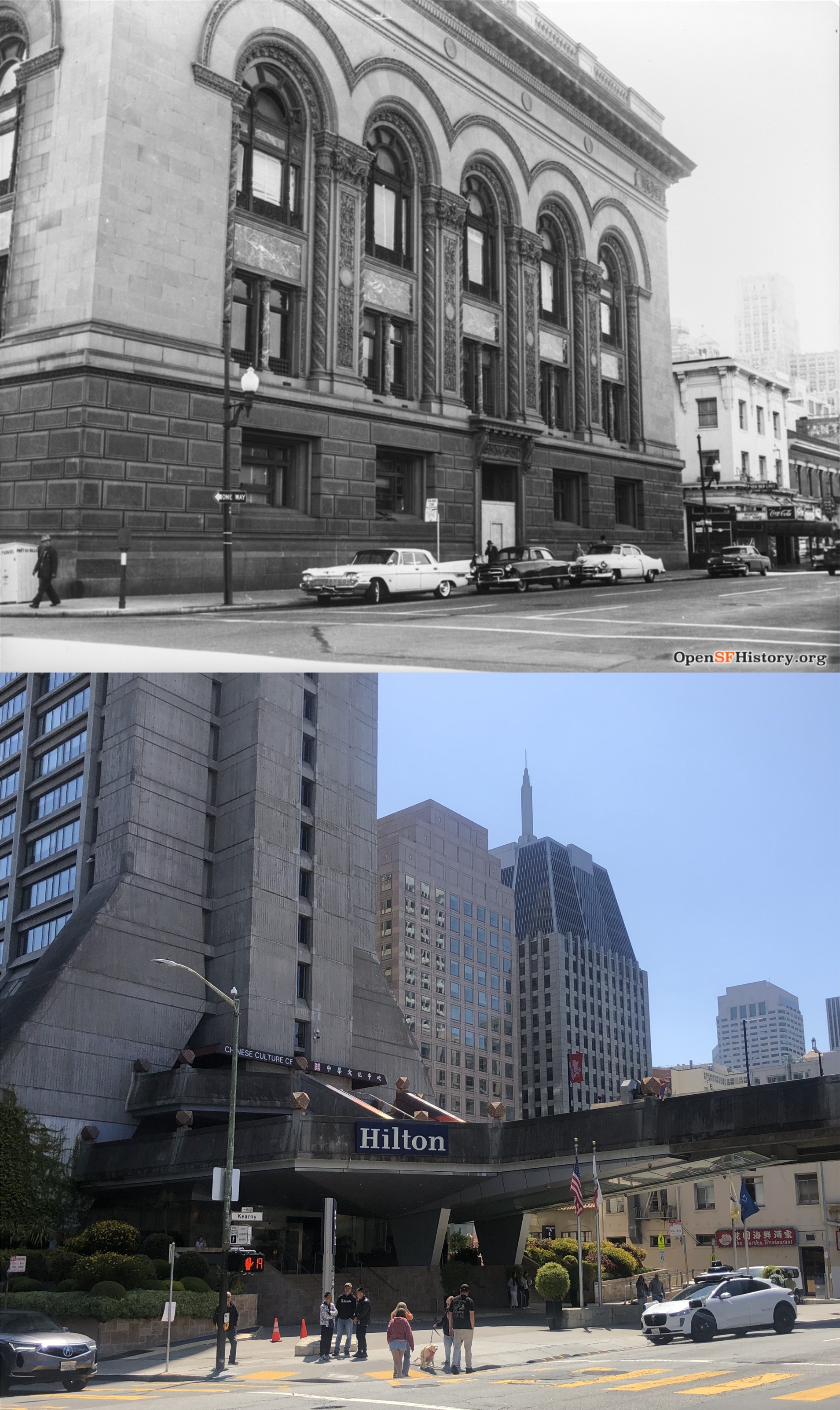
{Over on Kearny Street, the Hall of Justice process offenders day after day, facing Portsmouth Square where the Spanish customs-house used to stand.} The old Hall of Justice was torn down in 1967, and a Hilton Hotel is there now. (opensfhistory.org)

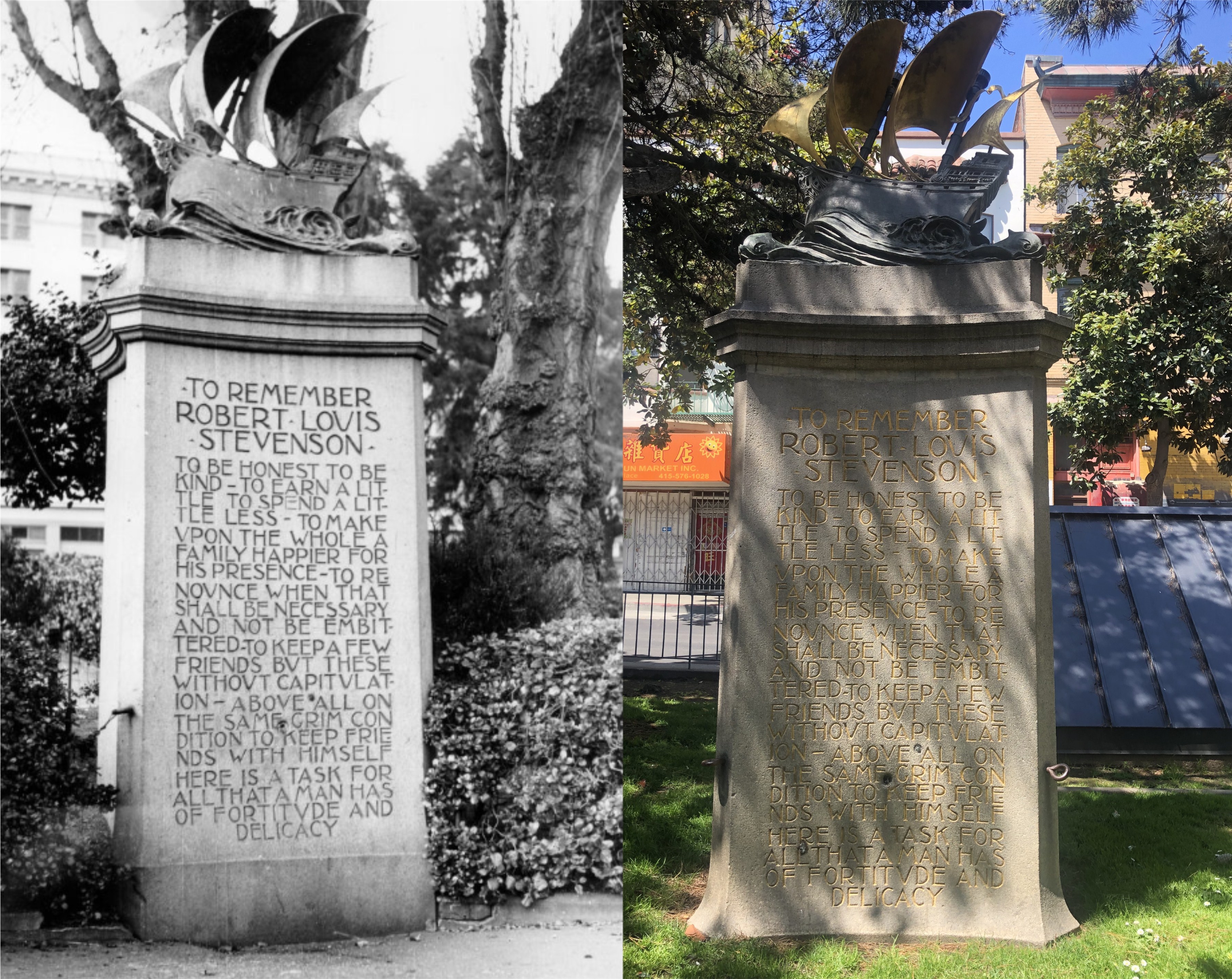
About Portsmouth Square, Jackson writes, {Across the way from the parked police cars a little galleon atop a granite shaft spreads its bronze sails over the chiseled lettering: “To be honest, to be kind, to earn a little, to spend a little less”} He’s referring to the Robert Louis Stevenson Monument in the Square.


{It was in the Presidential Suite at the new Palace Hotel, that President Harding died, seven stories above the Palm Court where General Grant had been received with wild enthusiasm half a century earlier.}


The above mentioned Palm Court is still there.


In reference to the Russ Building on Montgomery Street, Jackson writes, {On the Bush Street side, just where the tenants garage-entrance dives underground, there once stood the little tobacco shop of Mr. Thomas Ware.} The garage-entrance on Bush still dives underground. Jackson goes on to write that it’s only a short walk from here down to Montgomery Street where the stagecoach robber, Black Bart, was captured. (opensfhistory.org)


{Even The brassy International Settlement – milder successor to the city’s wild Barbary Coast, and, you would say, made to order for the tourist trap, is a haunt of San Franciscans.} Last time I was there, the posts that held the International Settlement sign up over Pacific Ave and Montgomery Street were sill there.


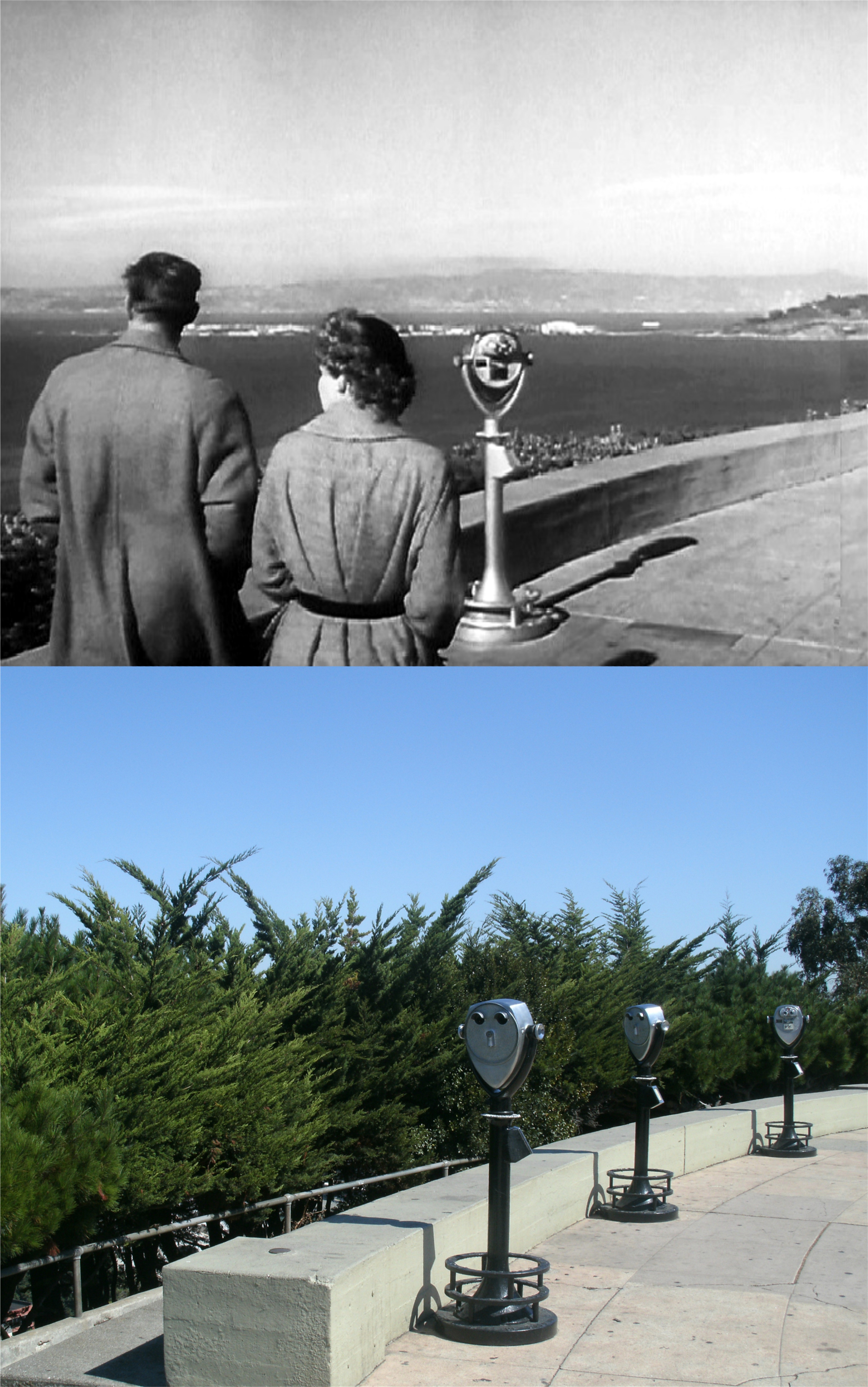
{On an evening when the winds are tempered and the air is clear, you may take a newcomer to the flattened top of Telegraph Hill where the broad parking space lies at the base of Coit Tower; he can see the sweeping curve of the Embarcadero with its jutting piers at this point better than from anywhere else} In a scene from the film ‘Woman on the Run’ with Ann Sheridan and made three years before Joseph Jackson’s book was published, that description of the Coit tower parking lot was accurate; the view through those telescopes have to be somebody’s joke now.


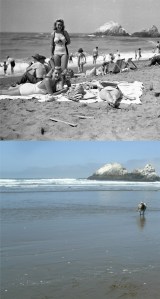
{Who are the people you find on a sunny Sunday if you make a run out to the Cliff House where the peninsula has rounded its turn into the Pacific?} Well, actually, nobody today, Mr. Jackson.

“Pick a street, any street. Okay, Battery Street.”

“I’d rather be a busted lamp post on Battery Street, San Francisco, than the Waldorf-Astoria.”

That remark is attributed to a prominent long ago man-about-town named Willie Britt right after the 1906 Earthquake and Fire. However, the statement is also quoted as coming from a prize fighter named Jimmy Britt, who was also in San Francisco during the earthquake. I don’t know if it’s that wonderful of a street, but I took a walk along Battery Street last Sunday, a street that runs from Market Street to the Embarcadero, looking for interesting buildings that have survived the sands of time. They were easier to locate than finding out information about who actually made the “busted lamp post” comment in 1906. (Thumbnail images)


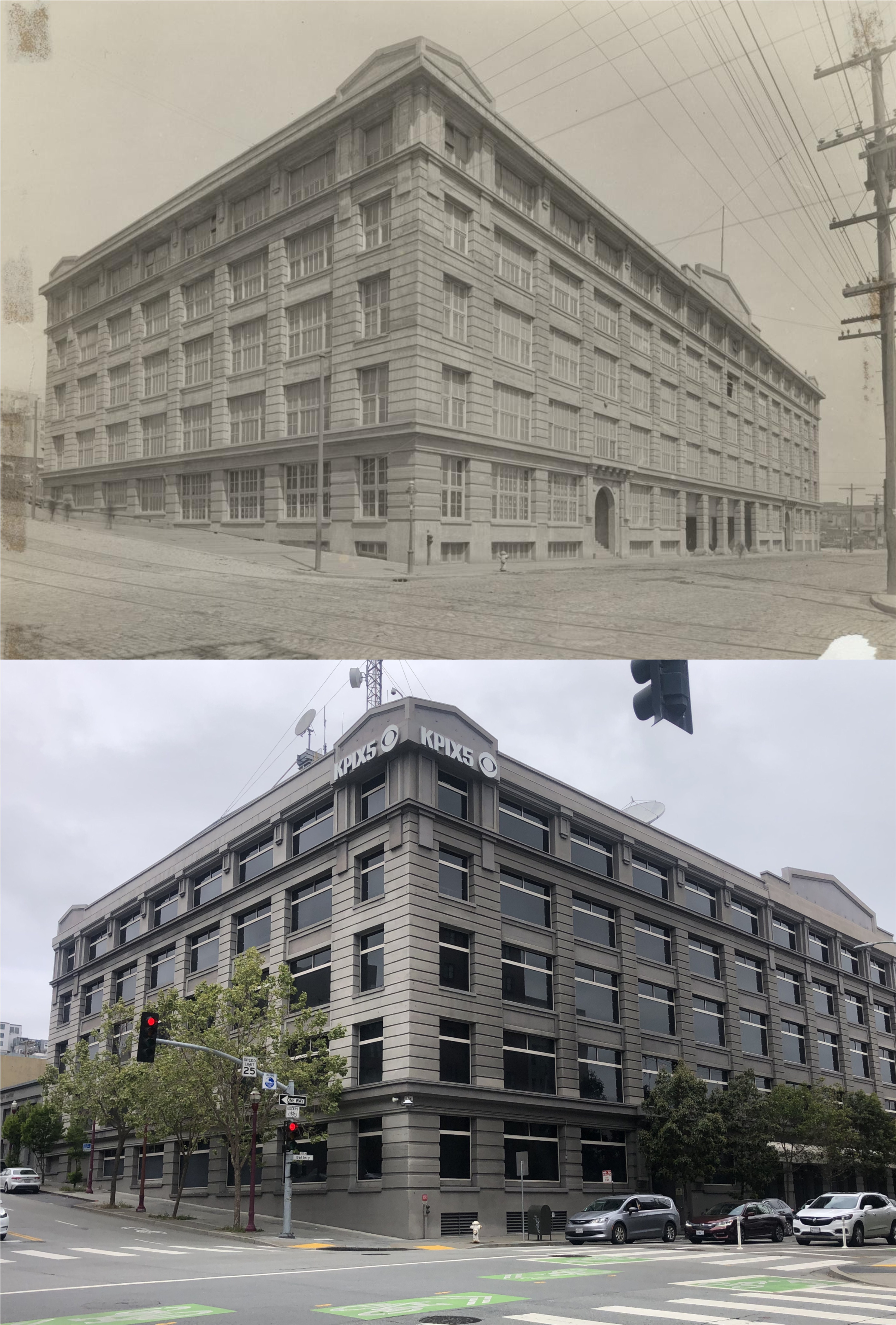
The UC Berkeley Library Archives caption refers to this old photo of the building on the northwest corner of Broadway and Battery Street as an “unidentified building”. It’s not unidentified today if you watch Channel 5.

A 1950s picture of 901 Battery Street on the northwest corner of Battery and Vallejo Streets: (San Francisco Main Library Archives)


The old RCA Communications Building on the southeast corner of Battery and Sacramento Streets: (San Francisco Main Library Archives)


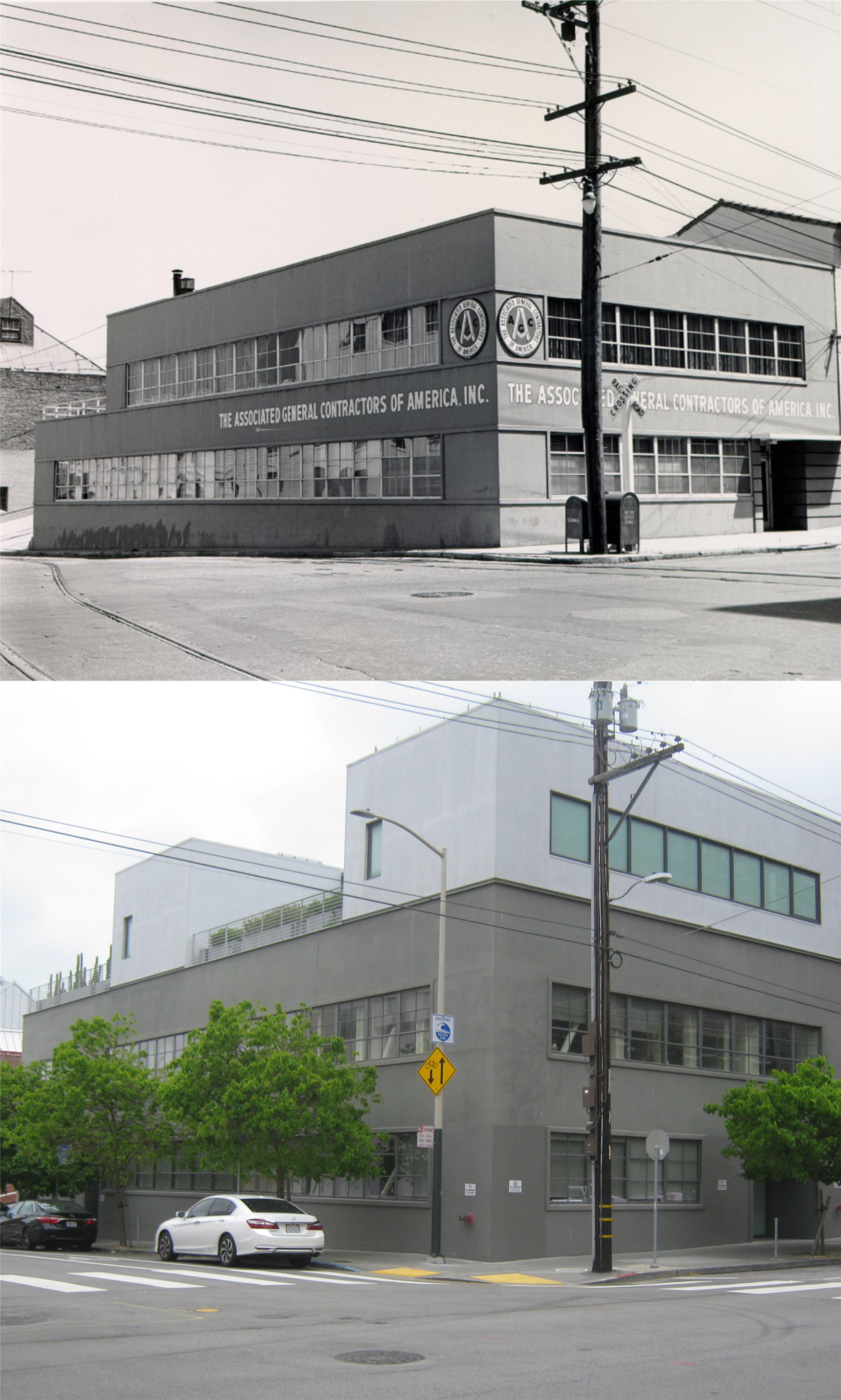
An interesting building on the southeast corner of Battery and Vallejo Streets: The old telephone pole survived too. (San Francisco Main Library Archives)


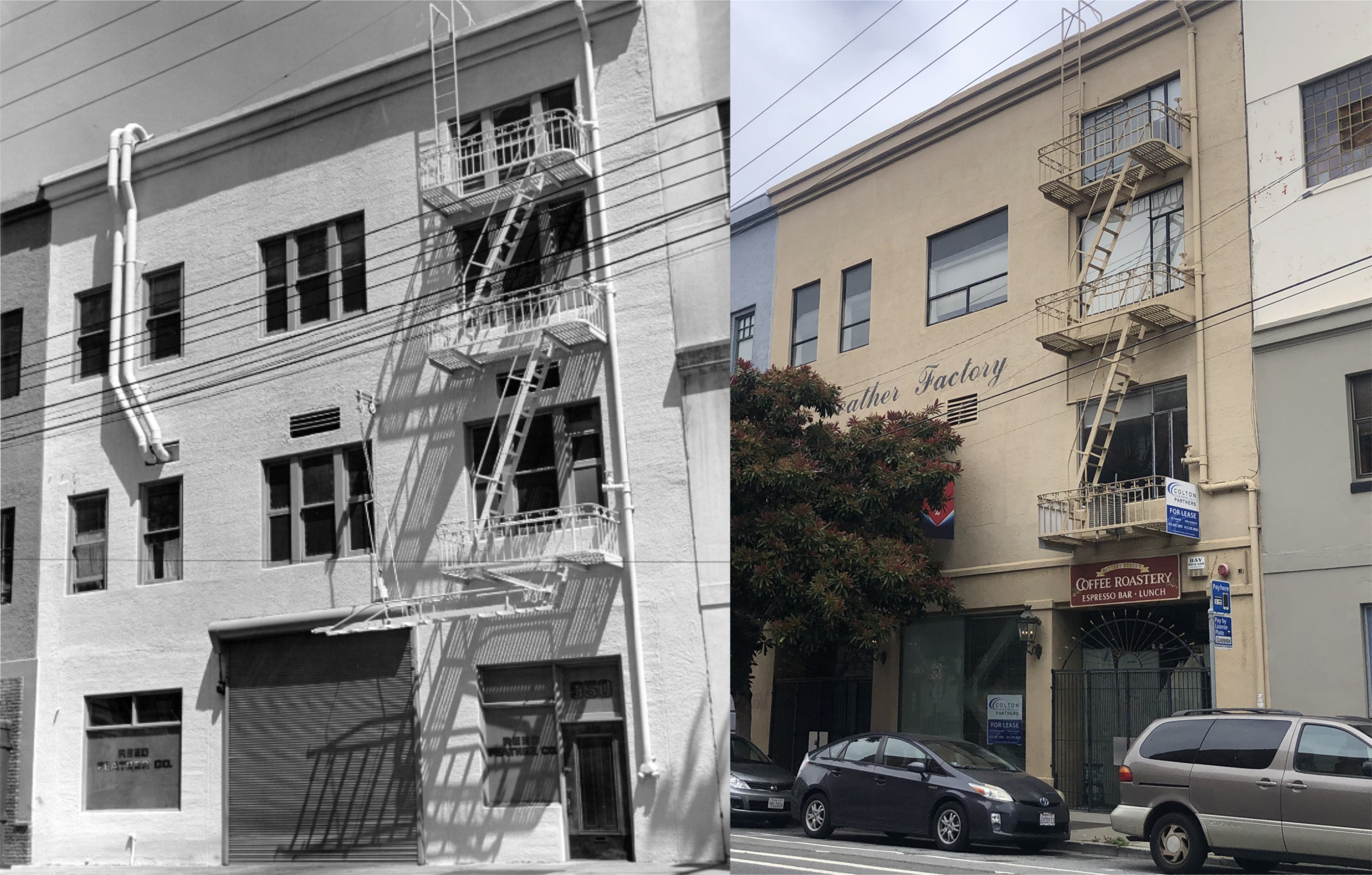
The Reed Feather Company Building at 950 Battery Street is now the Feather Factory Hotel. (San Francisco Main Library Archives)


Street work on Battery Street near Pine, looking toward Market Street in 1916: Both of the buildings on the southeast and southwest corners of Battery and Pine have survived. (opensfhistory.org)


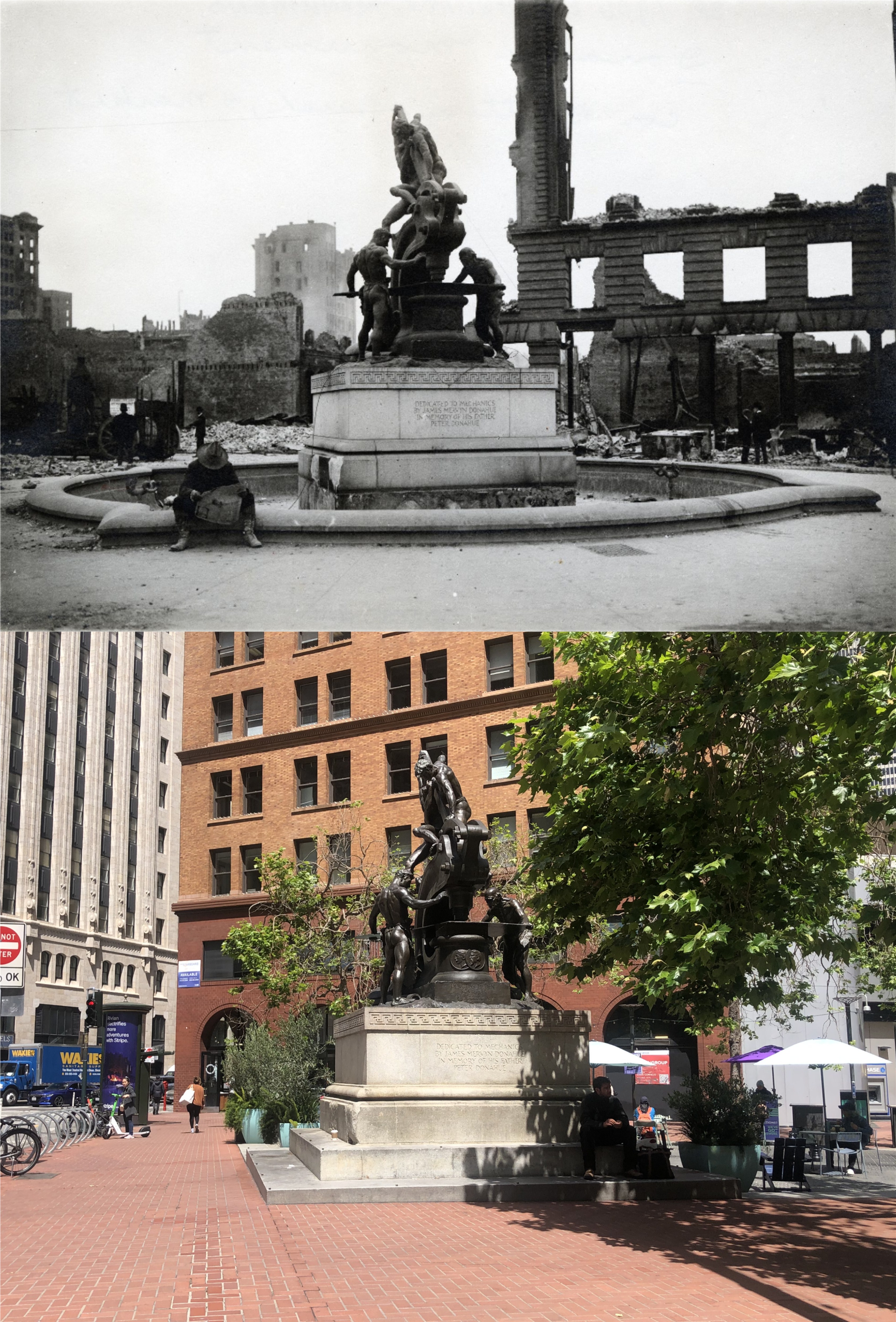
Probably the most well known man made object on Battery Street is the Mechanics Monument on the corner of Battery and Market Streets. Dedicated in 1901 as the Donahue Fountain, it was a survivor of the 1906 Earthquake and Fire, as seen in the vintage photo. In May of 1903, President Theodore Roosevelt spoke to a large crowd using the monument as a backdrop. (Source, Wikipedia). The 1906 picture is from the San Francisco Main Library Archives.

It’s all about the cars; or the lack there of

Market Street has been closed to car traffic from the Ferry Building to 10th Street since 2020. However, there’s a push by many business leaders to reopen the famous stretch to automobile traffic to help revitalize Downtown San Francisco. In April, 2025, it was announced that Waymo Service will be allowed to travel along the area, still closed to private cars, taxis, and Uber traffic. These are updates of vintage pictures featuring Market Street traffic that I found on the Historical San Francisco Facebook page. (Thumbnail images)


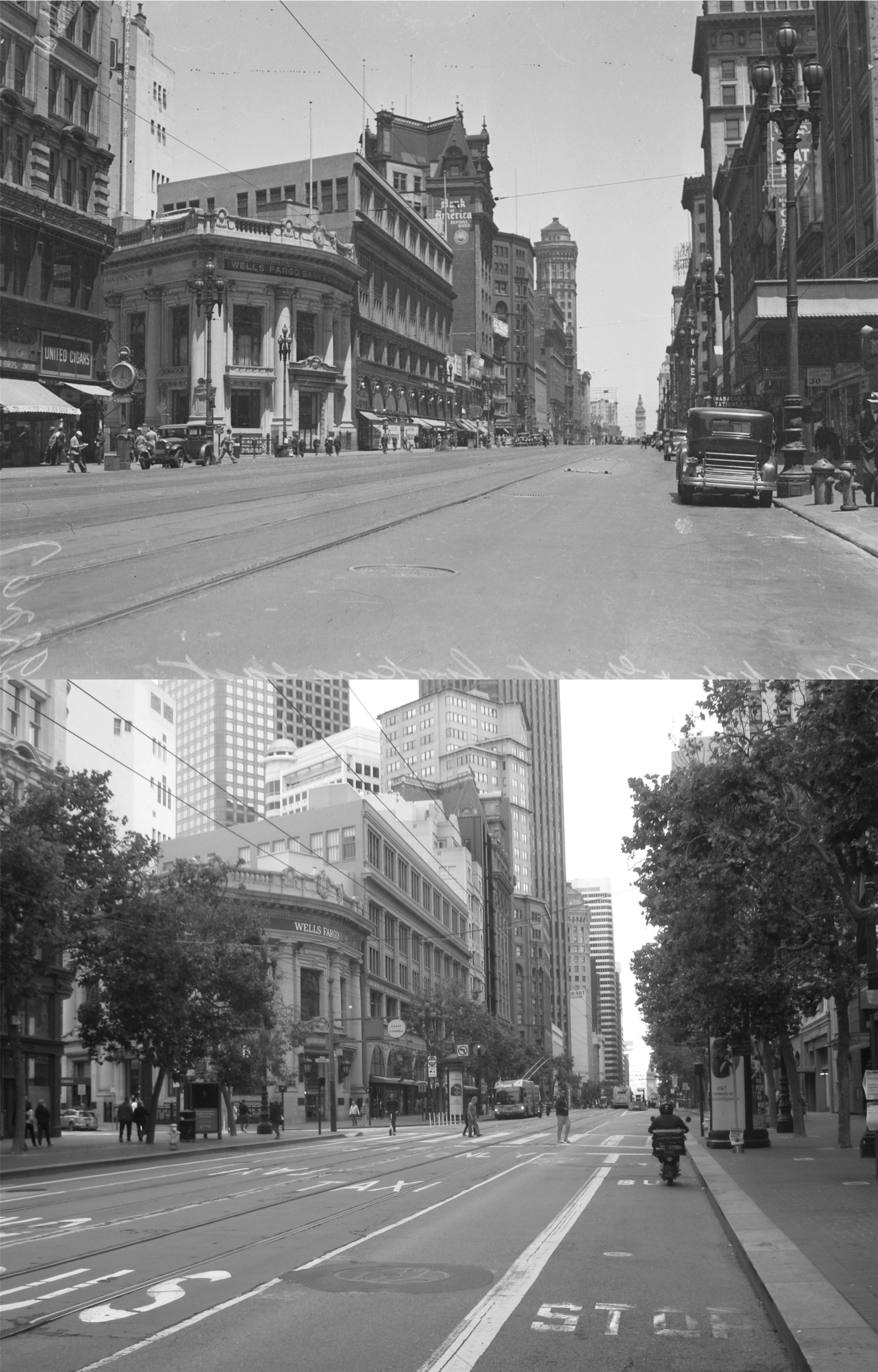
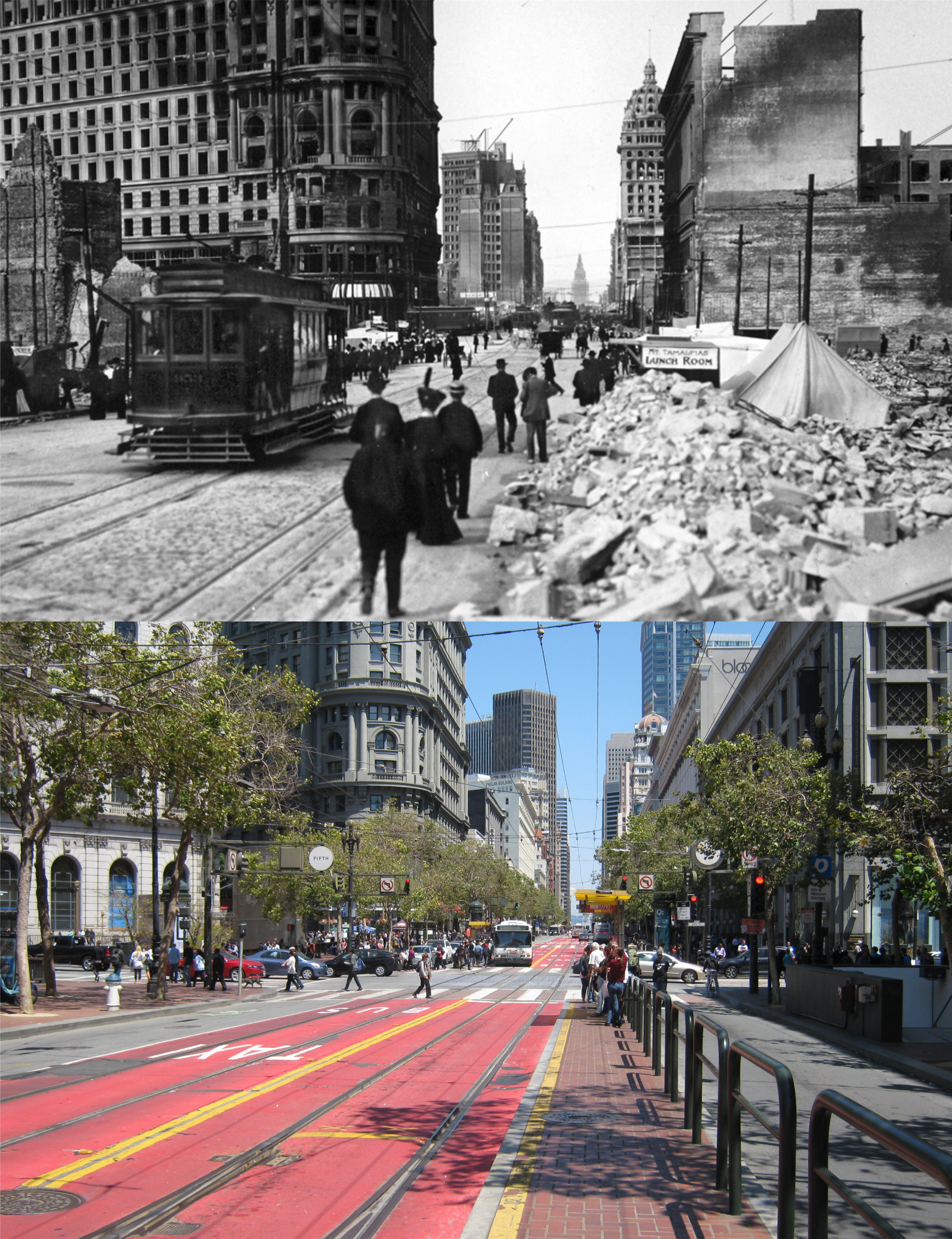
Market Street near 5th during the 1920s: You can still see the Call and Humboldt Buildings in the far left background.


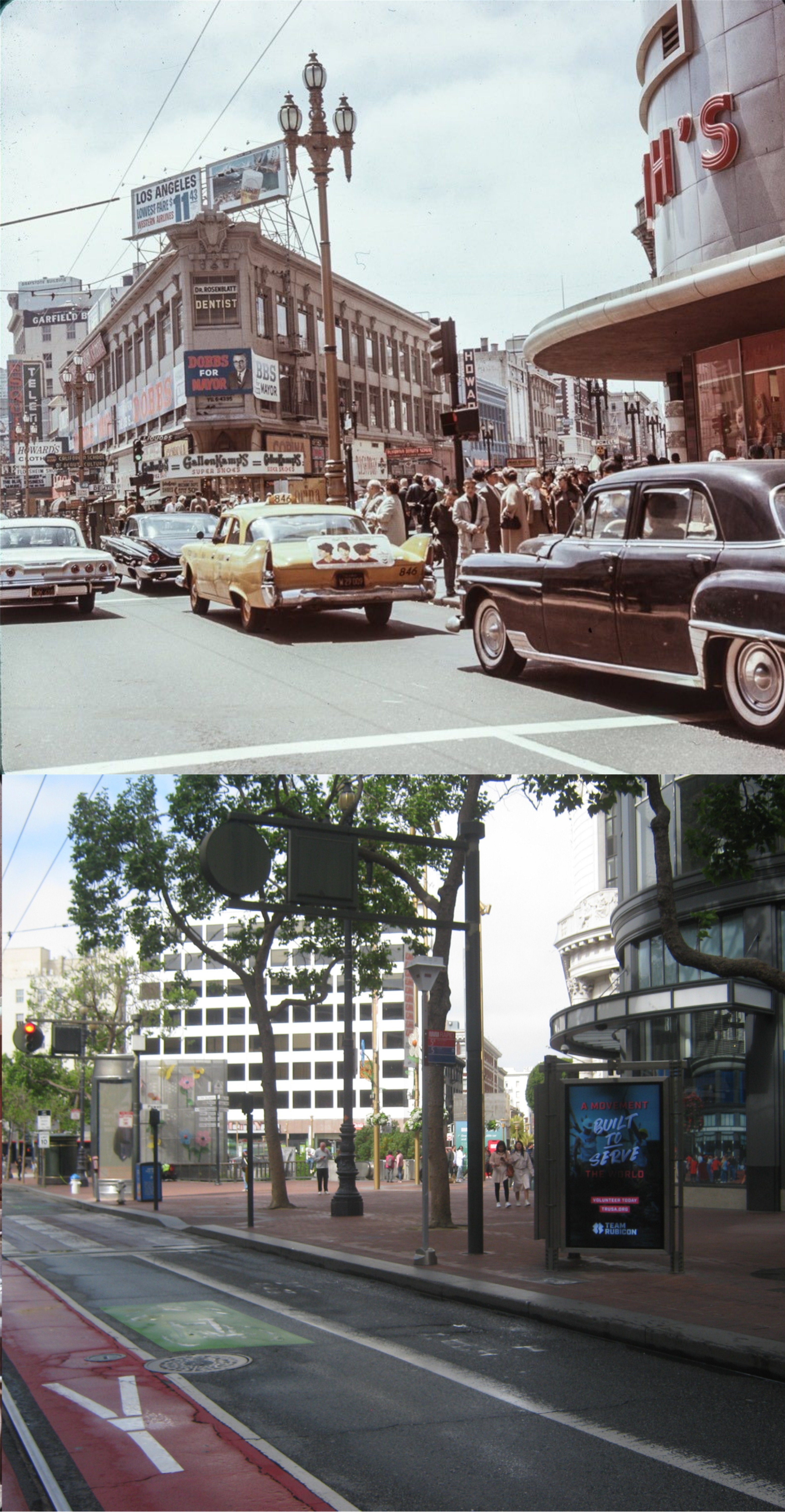
Market Street at Powell and Eddy Streets in 1963: The building with all of the interesting advertisements in the center was demolished in 1967, and was where the Hallidie Plaza and the Powell Street BART Station are now.


The green Pacific Building at 4th and Market Street in 1951: The Pacific Building was the largest reinforced concrete building in the world when it was built in 1907.


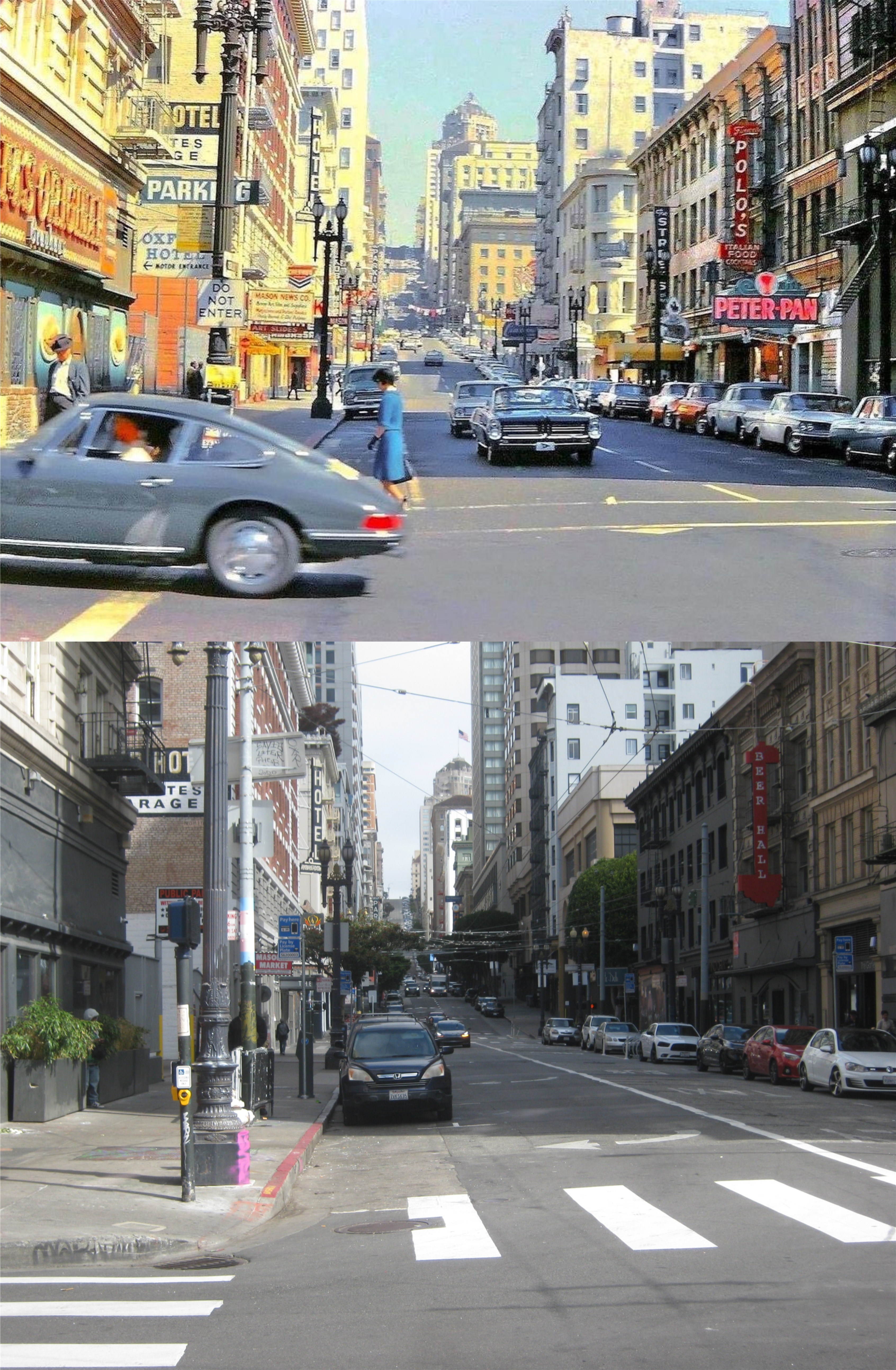
The Market, Mason and Turk Street intersection during the 1960s: The view is looking north along Mason Street. You can see the Mark Hopkins Hotel on Nob Hill in the center of both pictures.


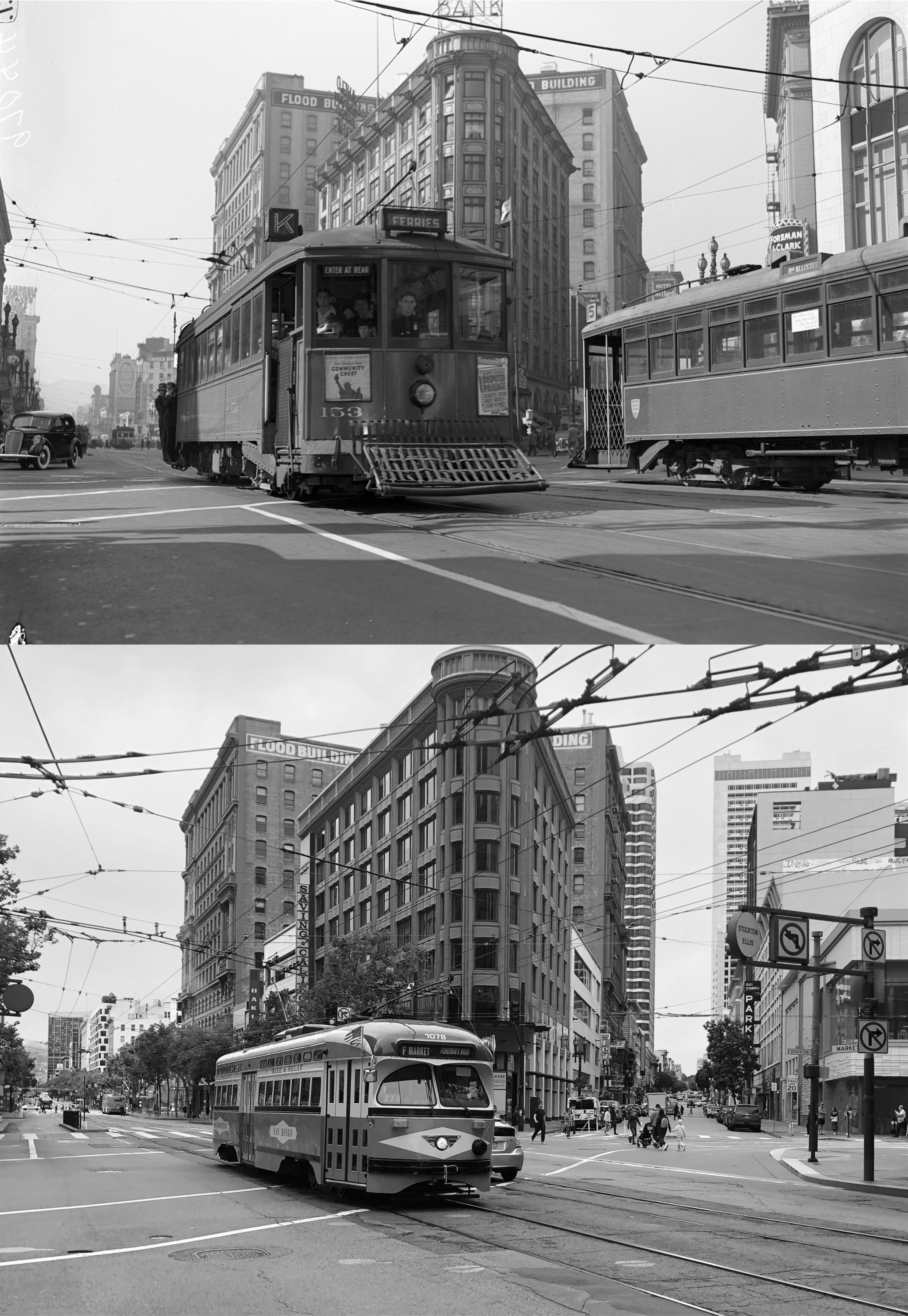
Market Street, between Grant Avenue and Stockton Street in a 1939 picture taken from the opensfhistory.org website: Now that’s more like today!


Traffic passing a boarded up Emporium Building on a rainy 1990s day: The building, which would eventually become Westfield Centre, was boarded up again in 2020 during the Covid Pandemic, and is now half empty.


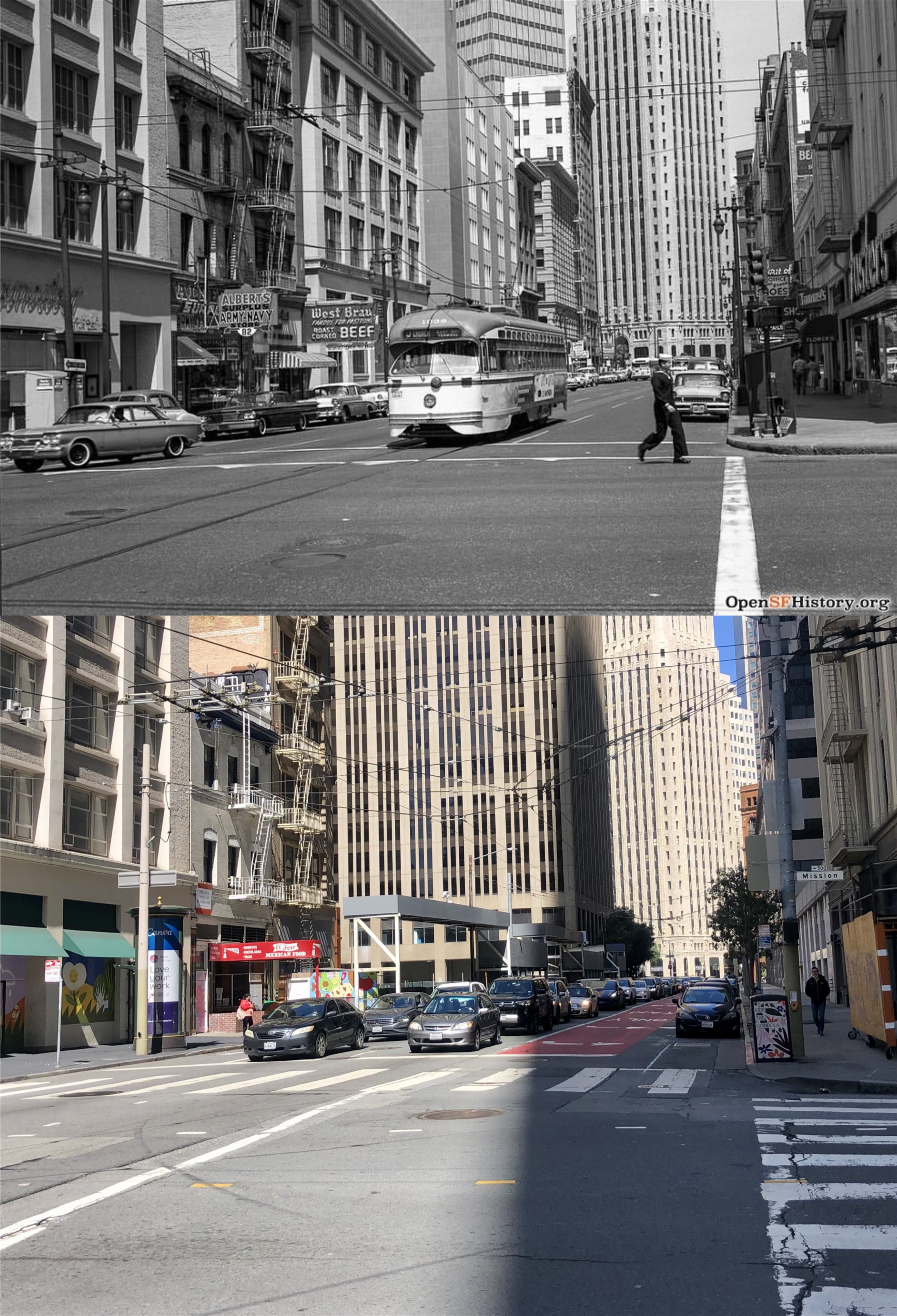
Off-Market Street traffic; 1st Street at Mission in 1962: This was the gateway for me and my friends when we explored San Francisco during high school. Behind where the photos were taken was the old Transbay Terminal, where we took the AC Transit R Bus from Hayward to San Francisco. Even if we knew how to drive then, none of us had a car.

‘EMERGENCY!’ Part two (Featuring Minna Street)

Last July, I did a post featuring one of the last episodes of the 1970s television show ‘EMERGENCY!’, entitled WHAT’S A NICE GIRL…’, which had scenes filmed in San Francisco. The last episode, ‘THE CONVENTION’ also opens with two scenes filmed in San Francisco. The first involves a rescuing a worker trapped in the sail rigging of the Balclutha, which back then was docked at Pier 43; the second part was filmed mostly at Minna Street and 4th. (Thumbnail images)


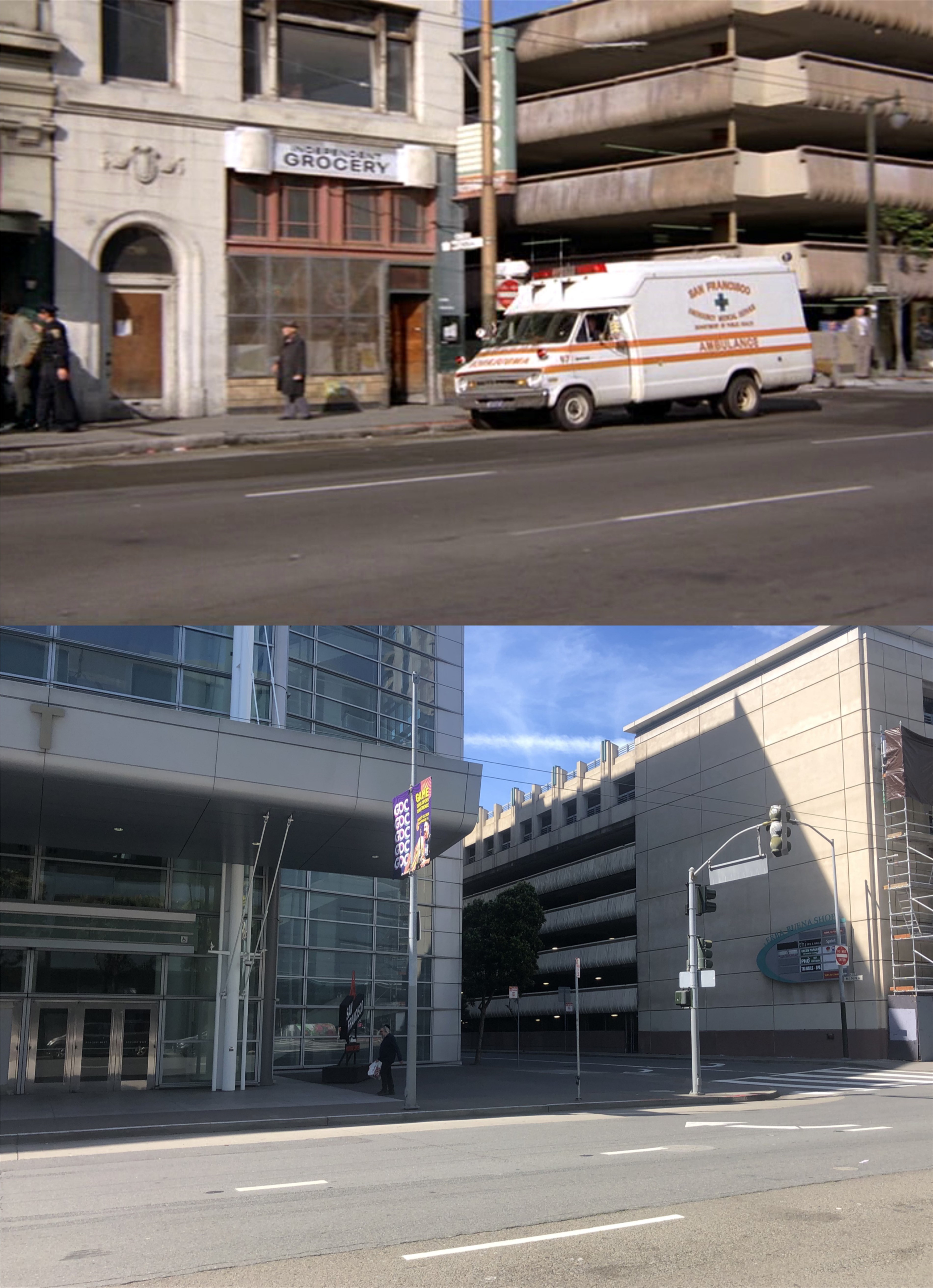
Near the southwest corner of 4th Street at Minna was the Imperial Hotel, already pretty rundown by 1979 when this episode aired. I learned later that this location was probably picked because the hotel was slated for demolition the following year. The Moscone West Building is there today.


A heartless landlord at the hotel is trying to evict a tenant for playing his music too loud in the building, and all the pleas from the tenant are ignored. Naturally, the tenant does what we know he’s going to do, and shoots the landlord. An ambulance races down 4th Street from Market Street to assist the wounded landlord. The multi-layered parking garage is still there, but has had a new façade put on its 4th Street side.


The ambulance pulls up to the hotel, passing the equally glamorous Independent Grocery store.


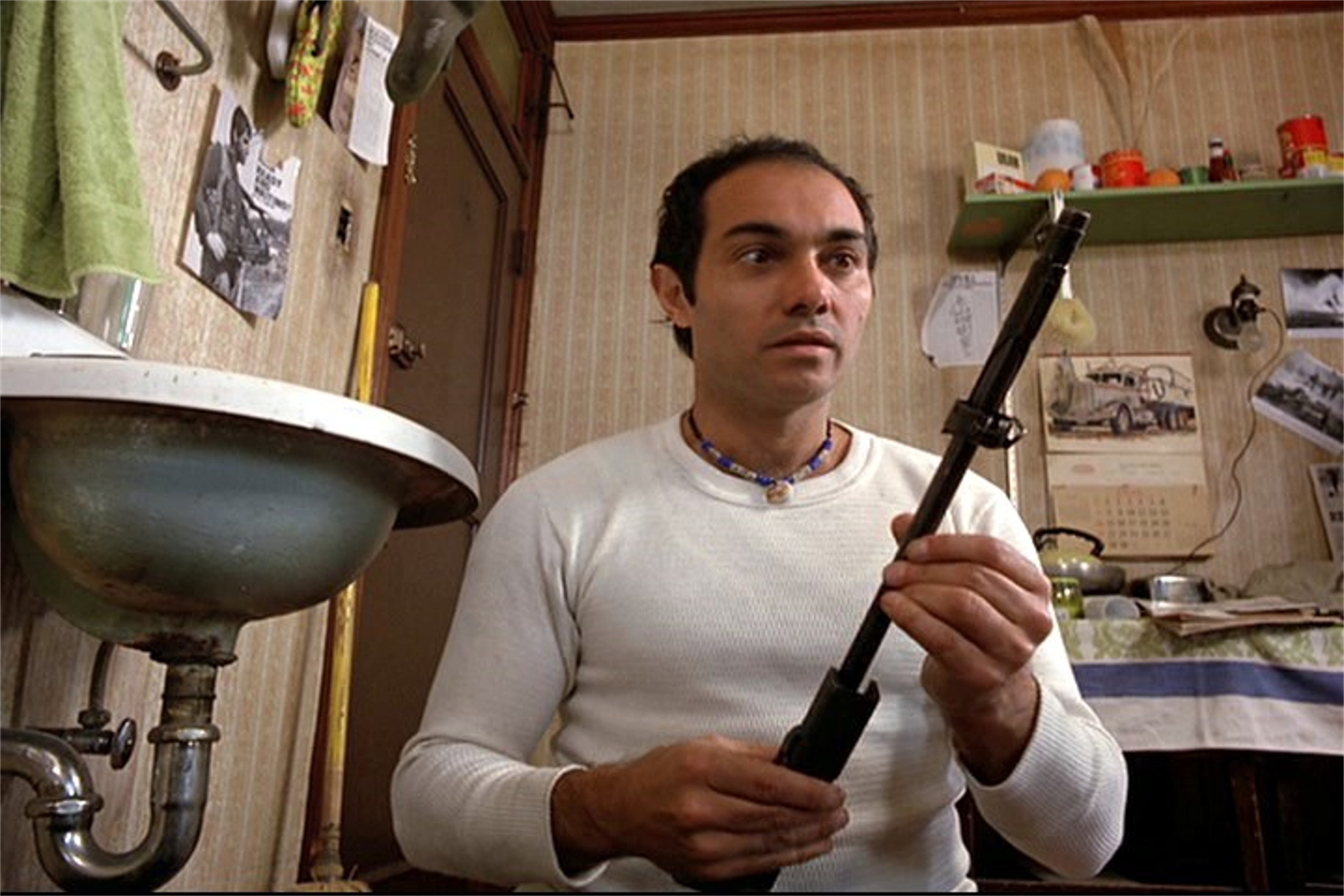
Meanwhile, the angry tenant begins sniper shooting at people on 4th Street.


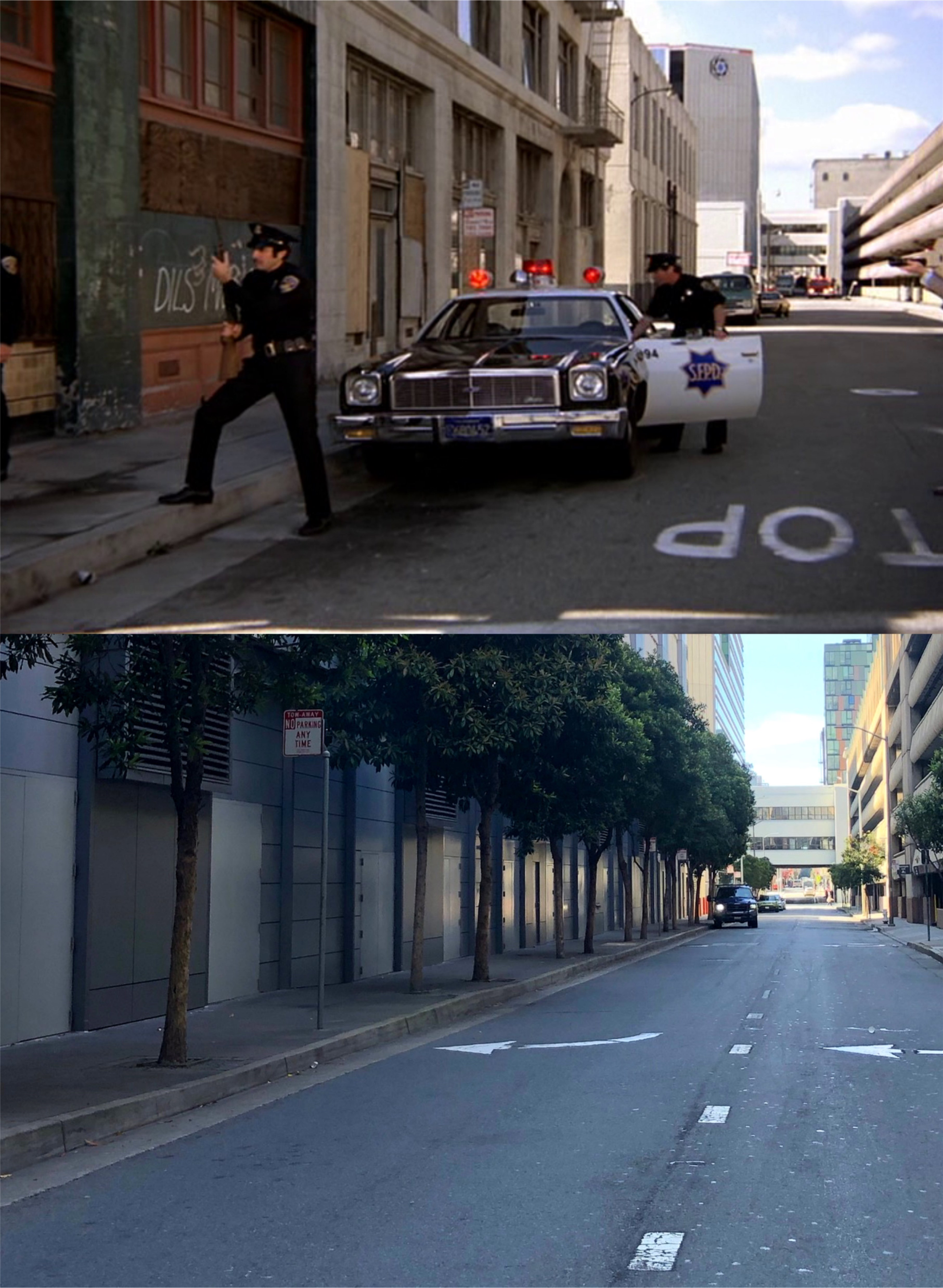
Police pull up on Minna, looking west toward 5th St. to deal with the sniper.


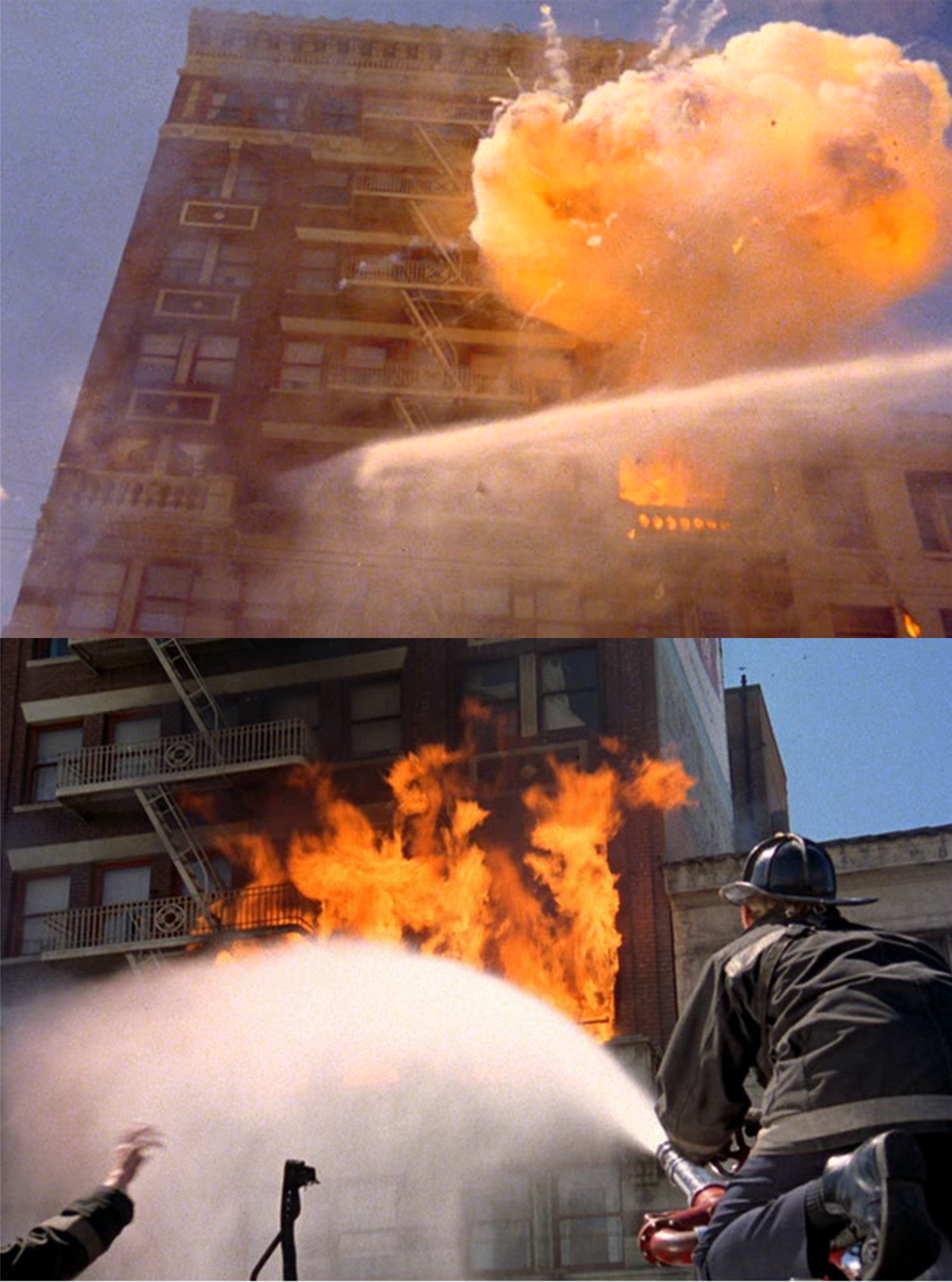
When the sniper throws a hand grenade into the hallway, it starts the building on fire after the explosion. Now the fire department is involved.


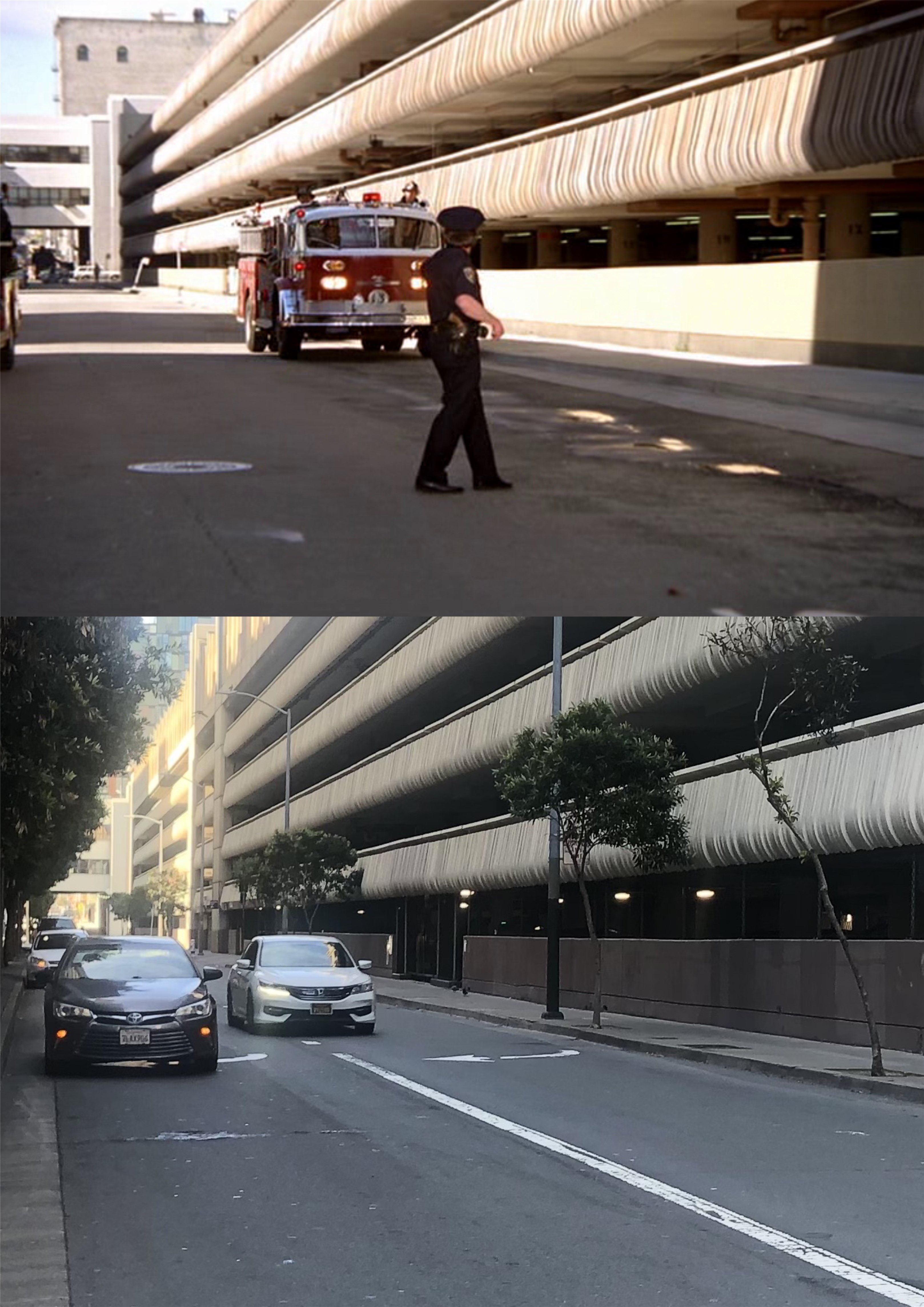
The fire truck turns onto 4th Street from Minna to hose the Imperial Hotel, as television reporters cover the unfolding drama. I didn’t get a half of a fire truck in my photo, but I got half a car.


The sniper eventually detonates another hand grenade, killing himself, as fire fighters battle the flames.


I started wondering if there were any old photographs of the Imperial Hotel before it was demolished, and found a picture on opensfhistory.org of the old hotel being wrecked in March of 1980. The vintage picture was taken on Mission Street, looking southwest along 4th St. Today, the AMC Imax Building occupies the corner on Mission Street where the old photo was taken.


Minna Street has been featured in other notable film locations. Clint Eastwood, as “Dirty Harry”, dispatches some liquor store thieves on the southwest corner of 2nd and Minna Streets in the 1976 film ‘The Enforcer’.

Buster Keaton was chased by a squad of police along Minna Street from 2nd St. to New Montgomery Street in his 1922 silent film ‘Daydreams’.

“Pick a year, any year. Okay, 1974.”

Although it was over a half of a century ago, 1974 seems like…… a long time ago! These are pictures from that mid 1970s year that I’ve posted in the past. (Thumbnail images)


B Dalton Bookseller, in a vintage picture taken on Kearny Street, posted on the San Francisco Remembered Facebook page: Bookstores like B. Dalton, Rand McNally, and Bonanza Books were all around Downtown San Francisco back in 1974.


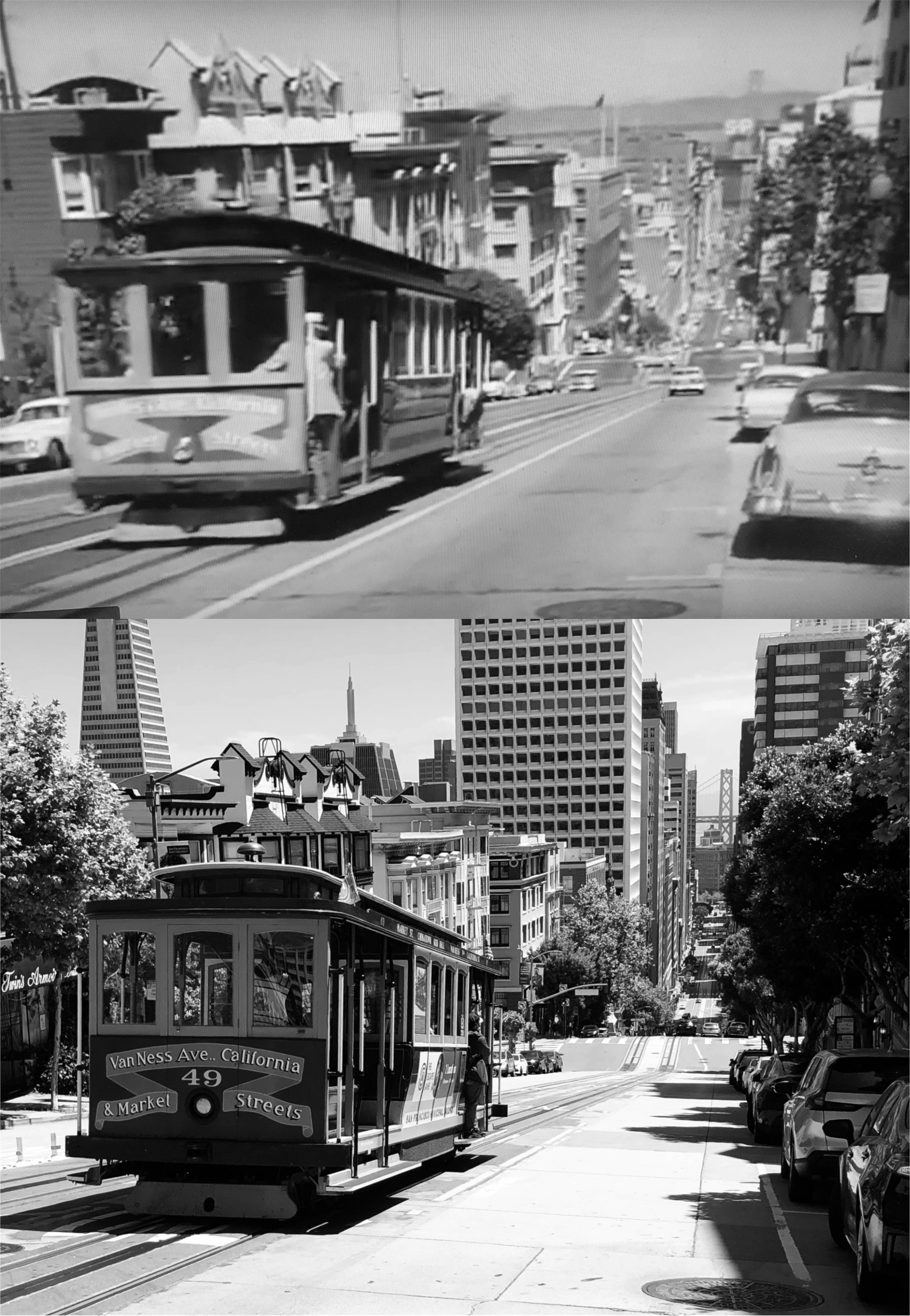
A cable car trying to sneak in the back door on a MUNI bus from a SF Chronicle picture taken at Powell and Sutter Streets.


An old J Line Street car heads down off Liberty Street toward Dolores Park, in a vintage Dave Glass photo:


Polk Street at California in a vintage San Francisco Chronicle picture from SF Gate:


The St. Patrick’s Day Parade on Larkin Street near McAllister. The Parade’s coming up again next weekend.


Looking down toward the Hyde Street Pier from Beach Street in a police chase scene from a 1974 episode of the ‘The Streets of San Francisco’:


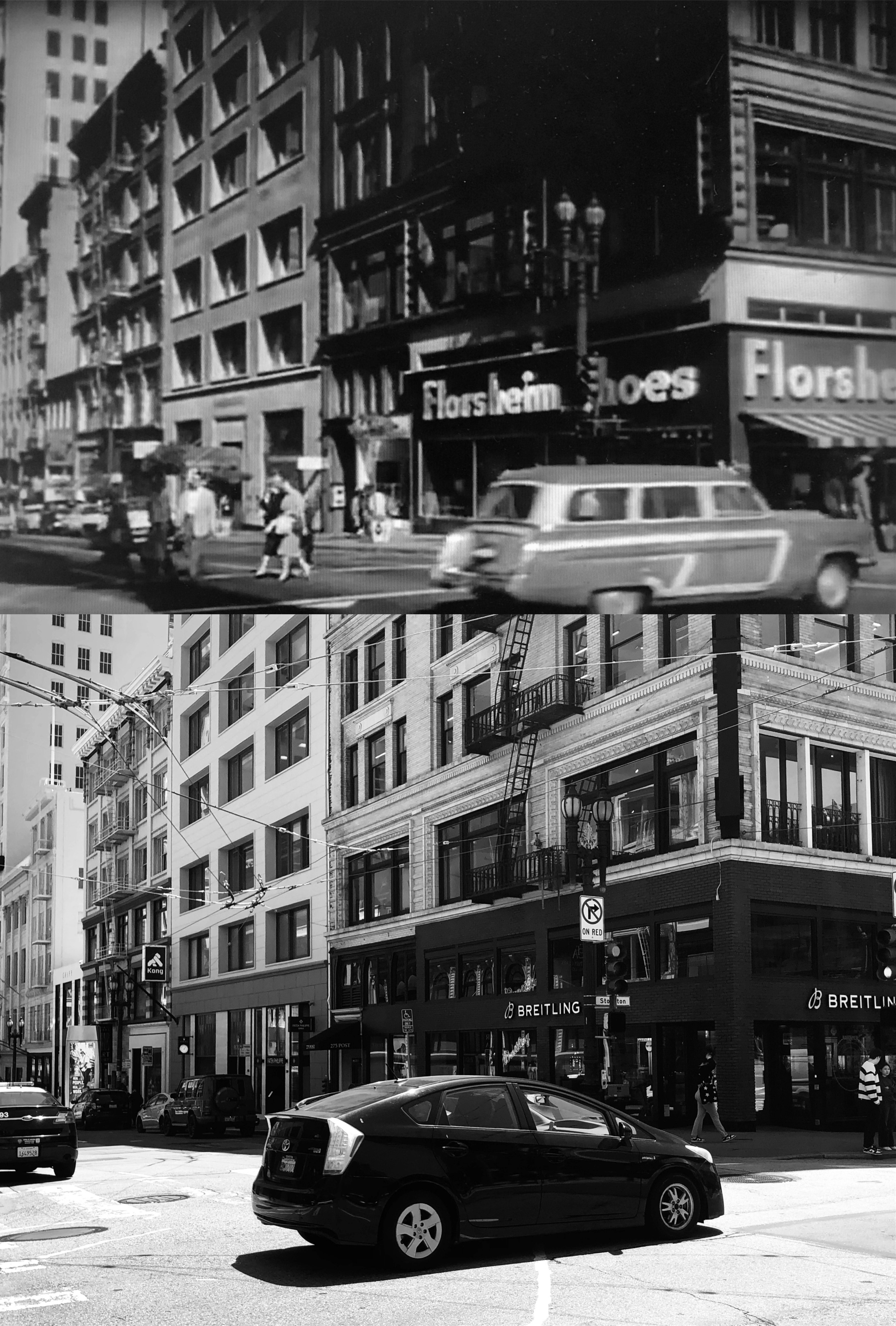
Recently departed actor Gene Hackman, on the corner of Geary  and Stockton Streets in a scene from the 1974 film ‘The Conversation’; a film many consider one of the best movies from the 1970s:


A 1974 poster that I have: If you can zoom in on this, it’s very interesting.

A follow up to my last post

This was the closing picture I posted on my last blog entry. I’m always interested when find vintage photos of the old traditional telephone booth that was stationed on the western side of old St. Mary’s Church on Grant Ave. I don’t know when it was removed, probably during the 1990s, but it goes at least as far back as the 1960s. (Thumbnail images)


In November of 2019, I posted this photo update and wrote “In my last post I showed a picture of two ladies from the late 1950s making a telephone call from a phone booth next to Old St. Mary’s Church that was designed to look like a telephone booth in Chinatown should look. This picture taken in the early 1960s is the only other picture I’ve seen yet of that old telephone booth with the red roof on the far right. The telephone booth was just behind where the cement potted tree is in my picture.” I found out later that I was wrong.


It wasn’t until I had looked back at old slide pictures I had taken in the early 1980s that I had seen another picture of the “old telephone booth with the red roof”. I think my top slide was from 1985.


Photographer Fred Lyon took the top picture of the “two ladies from the late 1950s” that I mentioned in 2019, but his picture may have been taken in the 1960s.


Ringing in the Lunar New Year (For Julianna and Lila)

I stopped by for the second day of the Grant Avenue Street Market Fair last Sunday as Chinatown begins its celebration of the Lunar New Year. (Thumbnail images)


The top picture is Chinatown at Grant Avenue and Commercial Street from a photo I took in March of 2020, on the day after the shelter-in-place order due to the Covid-19 outbreak. I was stunned at how empty and quiet San Francisco was; like a science fiction movie. This was as close of an update I could get to the picture I took in 2020.


California Street, looking up to Grant Avenue in 1907, one year after the 1906 Earthquake. Chinatown was quick to rebuild because they knew that the rich tycoons on Nob Hill wanted to relocate the Chinese community to the southeastern side of San Francisco. (UC Berkley Library Archives)


Portsmouth Square, looks like the 1970s: (San Francisco Public Library Archives)


This remarkable picture, taken in 1942, shows a Japanese midget submarine that ran aground and was captured during the attack on Pearl Harbor. It was on display on Grant Avenue between Washington and Jackson Streets. (San Francisco Public Library Archives)


Wentworth Alley in 1957: The hitching posts are gone. (San Francisco Public Library Archives)


The southwest corner of Grant Avenue and Pine Street, and the long gone Grand View Hotel: (San Francisco Public Library Archives)


The northeast corner of Grant Avenue and Pine Street, taken probably around the same time as the previous vintage picture: (UC Berkley Library Archives)


A parade at Stockton and Sacramento Streets in honor of the 32nd anniversary of the founding of the Chinese Republic: This would make the vintage picture taken in 1944. (San Francisco Public Library Archives)


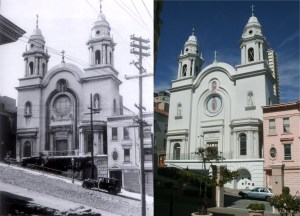
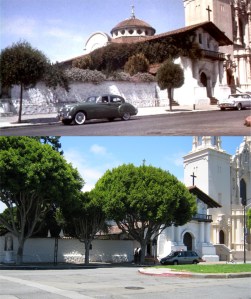
The now gone traditional Chinese telephone booth that stood next to Old St. Mary’s Church for years: The booth was directly behind where the musician was sitting in my picture. (San Francisco Public Library Archives)

“Made it Ma! Top of the world!”

In November of 2022, I found a collection of terrific photographs from the UC Berkeley Library Archive taken from the top of Coit Tower in July of 1933, three months before it was completed. When I went to the tower that month, the elevator was out of order, but I was told that if I wanted to pay the admission fee, I could walk up the 13 floors of stairs that wrap around the tower from the bottom to the top, which I did, but will never do again. It’s not an easy climb, and when you’re ready to leave, there’s 13 floors of steps to walk back down. I wasn’t happy with the way my pictures turned out, and I’ve been trying to go back to the top of the tower to redo my shots numerous times, but the elevator has always been out of service. Last Sunday, the ancient lift was up and running again and I finally got a chance to ride back up to the top, and although the lines to board were back as well, I didn’t mind. Each section of views surrounding the tower has three windows to a set, and I wanted to try to get my updates from the same window as the pictures taken over ninety one years ago. Enjoy the view, and I’ll try to point out some of the buildings, structures and locations still visible today. (Thumbnail images)


Looking south between Montgomery and Kearny Streets: If you look close, you can see the Columbus Tower/Sentinel Building along Kearny Street on the right in both pictures.


Looking toward Nob Hill, with the Mark Hopkins and Fairmont Hotels on the right: The Fairmont Tower blocks out the Mark Hopkins now.


Looking southwest across North Beach to the valley between Nob Hill on the left, and Russian Hill on the right:


Looking over Washington Square and Saints Peter and Paul Church at the lower left and center:


Looking northwest over Russian Hill and Aquatic Park: No Golden Gate Bridge yet, but the Van Ness Pier is in both photos. Pier 45 is on the far right in both pictures.

They were still putting some finishing touches on Coit Tower in this view across Fisherman’s Wharf and Alcatraz.


Looking east toward Yerba Buena Island: Pier 25, where the cruise ship is, was demolished by the end of the 1930s. Pier 23 is still there. The Pier 19 Shed was demolished and a rebuilt Pier 19 is in the approximate location now. Pier 17, the last pier on the far right, is still there and you can see part of it in my picture.


Looking southeast across the Embarcadero: The three piers visible on the right in my picture are Piers 17, 15, and 9. Pier 11 in the vintage photo was demolished and is now where Pier 9 is.


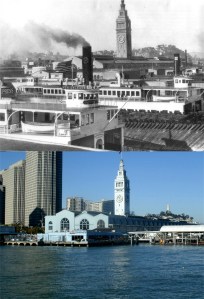
Coming back around full circle now to the Ferry Building and the foot of Market Street:


The City at twilight (For Teddi)

I feel sorry for people who avoid going to San Francisco because of the ‘Chicken Little’ talk about San Francisco being unfriendly, unsightly and dangerous. At twilight, it’s still one of the most beautiful cities in the world. (Thumbnail images)


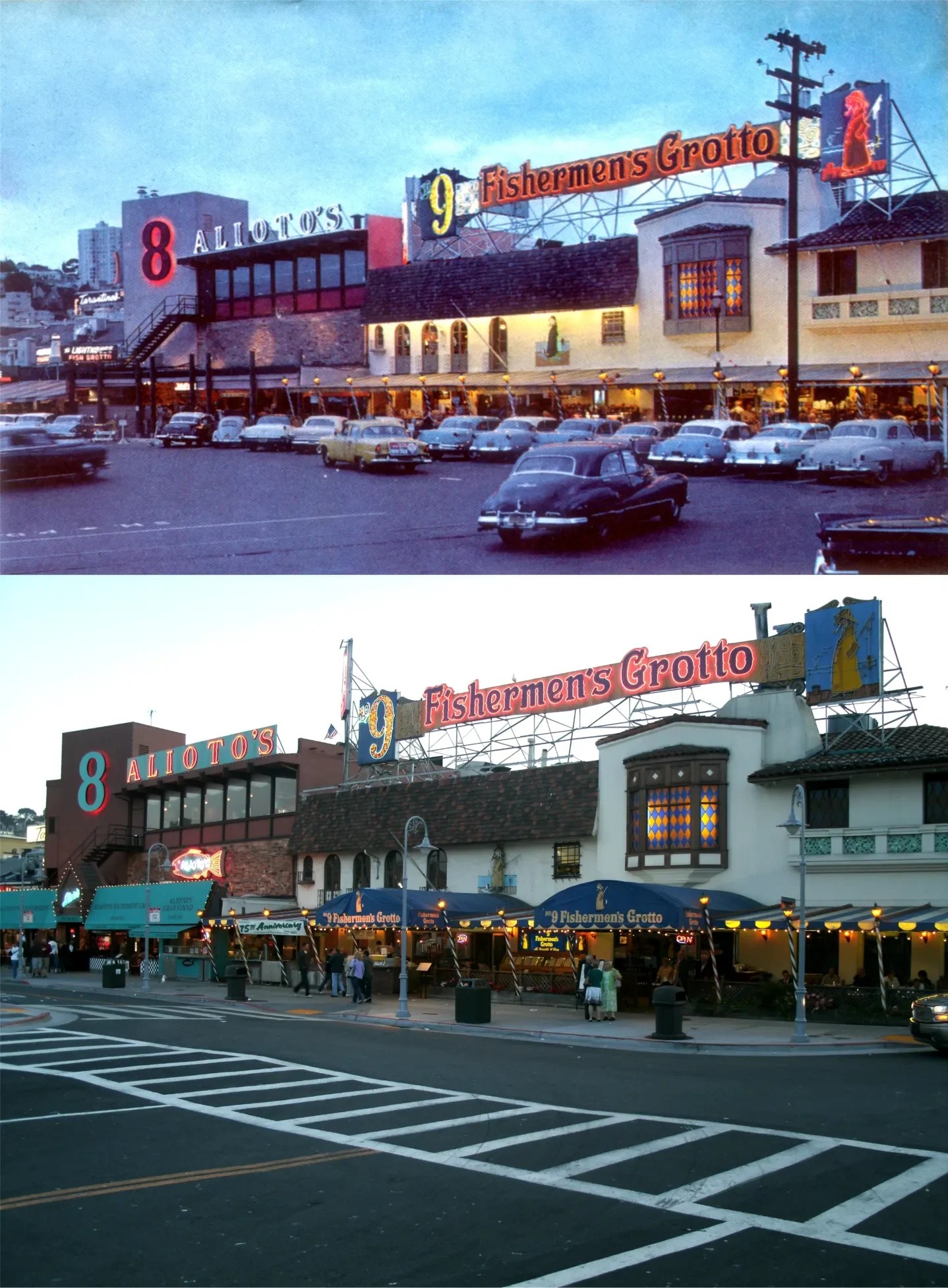
Fisherman’s Wharf at twilight during the 1950s: That top photo just might be my favorite San Francisco picture.


#9 Fishermen’s Grotto at dusk: I used to think the Fisherman’s Wharf and the top of Telegraph Hill were the two most romantic spots in San Francisco to be at during sunset. Unfortunately, Fisherman’s Wharf has lost a lot of its charm now, and I worry it will never again be like it was.


Pier 43: The old Sailing ship, the Balclutha, is now over at the Hyde Street Pier.


Looking toward Pier 43 from upstairs Alioto’s Restaurant during the 1970s:


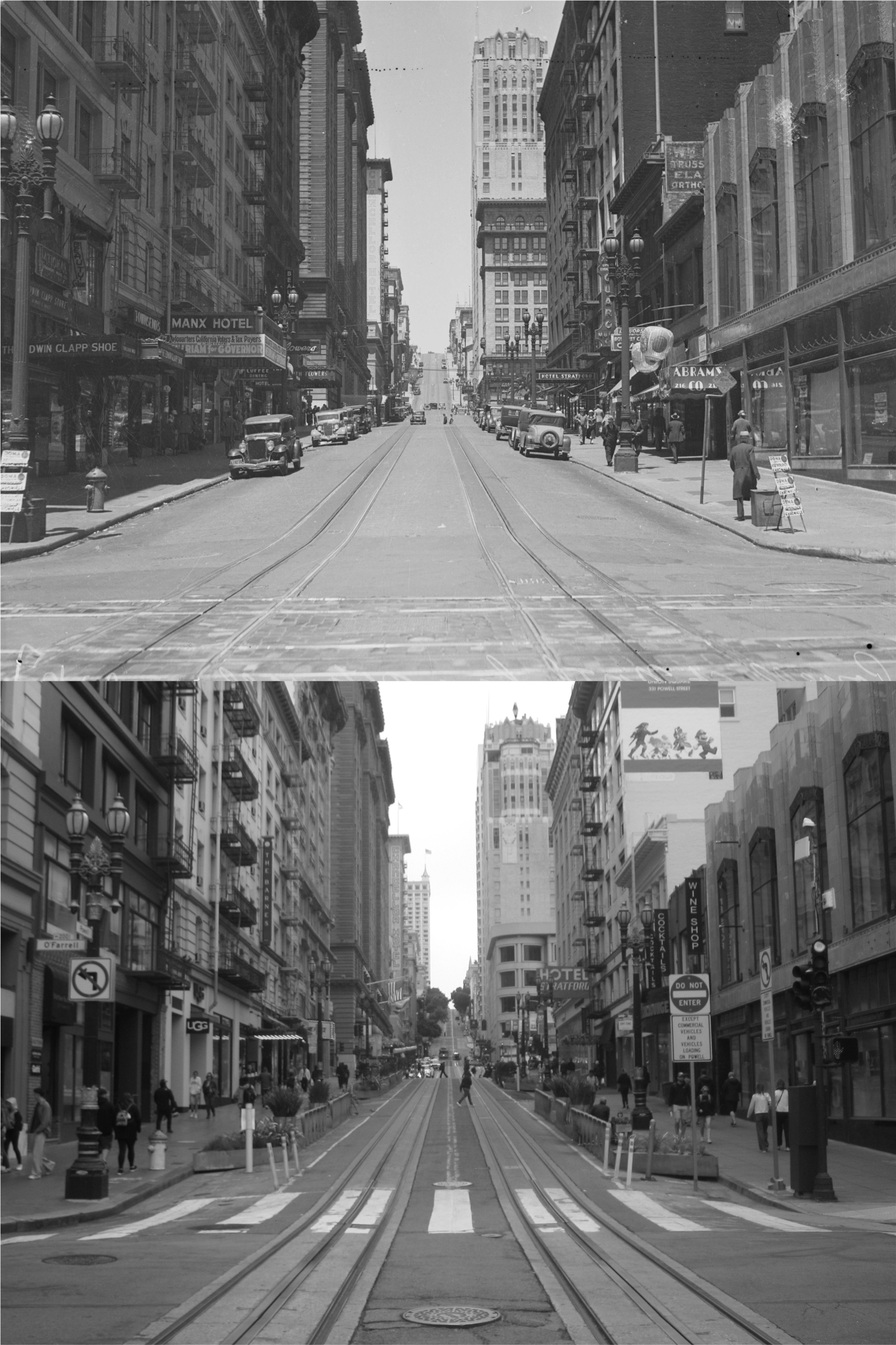
Looking up Powell Street from Market Street; looks like the early 1960s:


One block up from the previous picture at Powell and Ellis Streets:


Geary Street, west of Mason in the 1950’s: Carol Channing was appearing at the Curran Theater. I learn something new about San Francisco all the time; when I was researching this location I found out that the old Paisley Hotel, now the Union Square Plaza, is where a woman named Florence Cushing jumped to her death in 1911. It’s rumored to be haunted.


An Old San Francisco travel poster of the Golden Gate Bridge at sunset: Well, if they can make a fake sunset, I can too.


Ghirardelli Square from the old, and now closed, Van Ness Pier:


The top photo is a slide picture I took from Telegraph Hill during Fleet Week 1985. The bottom picture is a redo I did in 2020.


Kim Novak and Frank Sinatra wander off into the sunset behind the St Francis Club building at the end of the 1957 film ‘Pal Joey’. This time the sunset in my picture wasn’t fake.