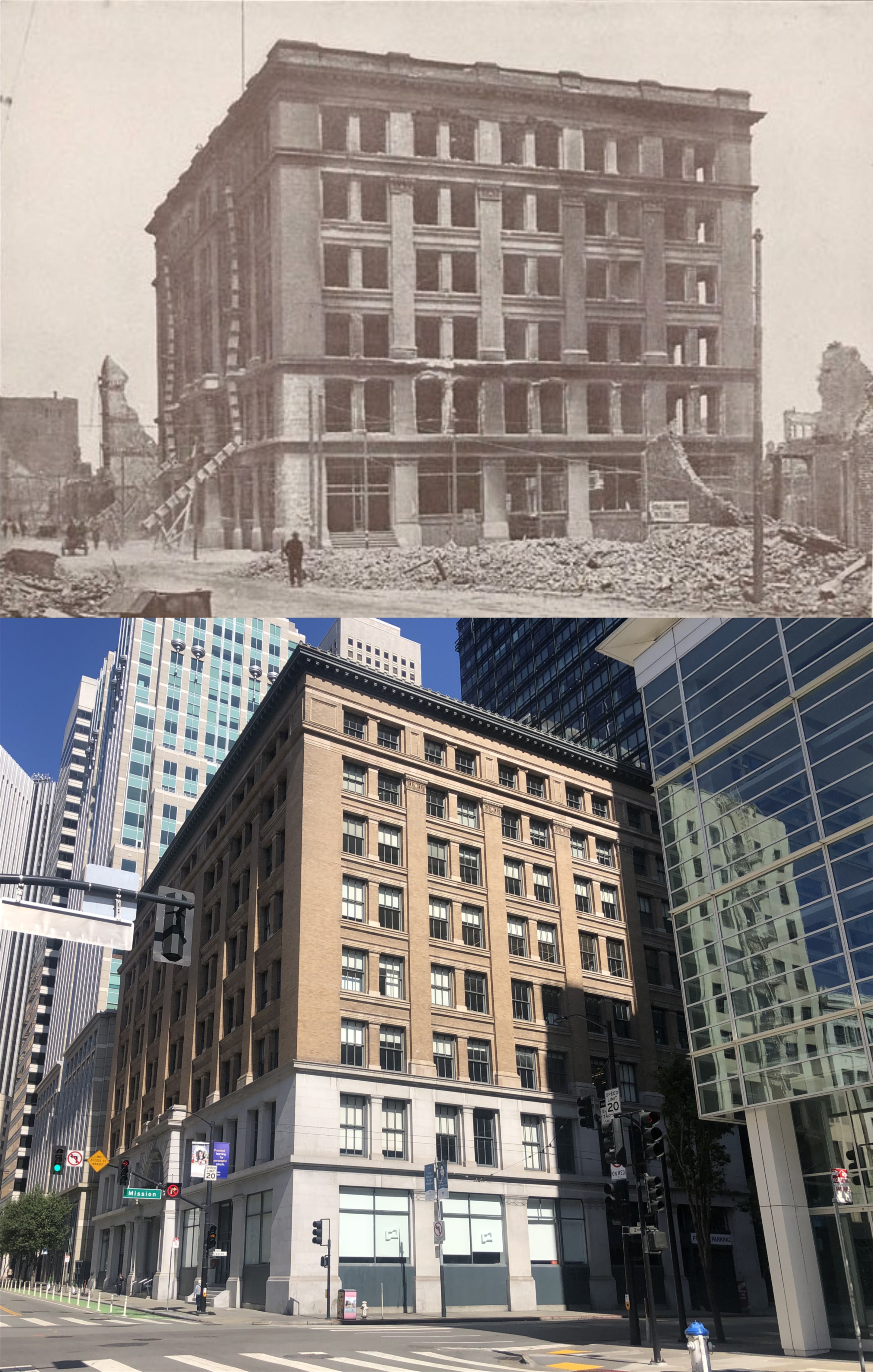
Disneyland,1958 and Disneyland, 2025:

Different styles, different crowds, different prices, same place: At least, the same place for me because I usually head to the same attractions that I’ve been enjoying since I was a kid. I was nominated by family back east coming out to Disneyland to go down there again for the Labor Day Holiday. It didn’t take much urging, I still love that place, crowds and all. I found a collection of color photographs on the internet taken at Disneyland in 1958. Though they weren’t always the best quality, I decided later that they’d be interesting to do modern updates of. I went back to the internet to find the website and give them the credit for the vintage pictures I downloaded, but I haven’t been able to find it again. They may have all been taken by the same photographer, I’ll update the due honors of the photos source as soon as I find the site again. (Thumbnail images)


Sleeping Beauty Castle; probably older than most of the buildings in Downtown San Francisco now, but not showing her age.


When you enter the park today you still have two tunnels under the Wald Disney Railroad track to take, left or right. There are more trees in Disneyland today than 1958, and this one at the right tunnel was probably transplanted, if it’s real. Right, Tony?


A big difference “where the rubber meets the road” in the Tomorrowland Autopia since 1958.


The entrance to Adventureland: I’ve seen older pictures of the park when the crowds were modest, but !this might be the only picture of Disneyland I’ve seen with nobody in it! Oh, wait, there was one person. That must have been a lonely day for him!


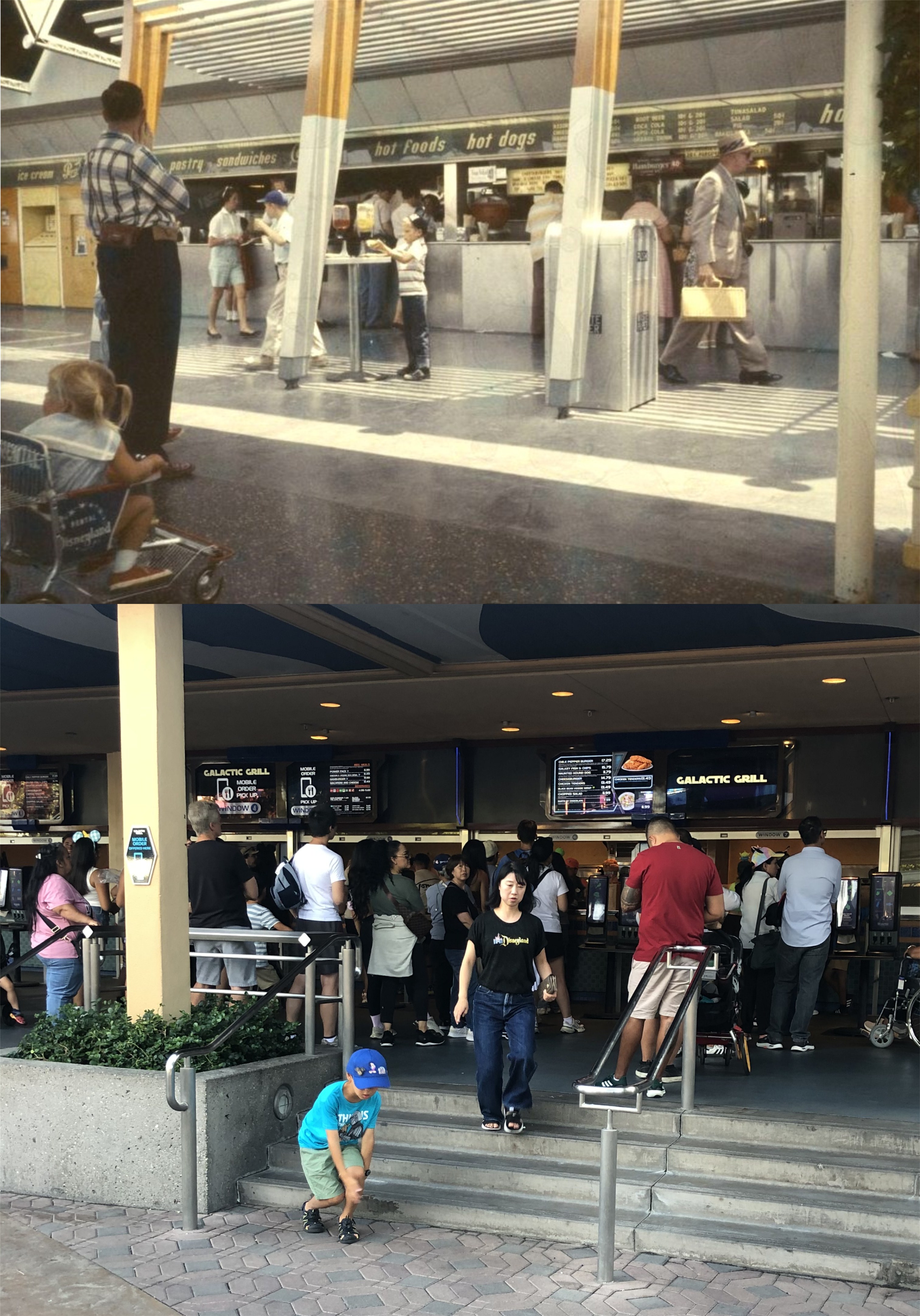
No lines and much lower prices for fast food back then. What is that, a spy on the right?


Fast food diners in 1958 and 2025: That lady with the sunglasses in the vintage picture looks so bored. That’s not allowed in Disneyland!


Not sure if the Dumbo’s get as high off the ground in Fantasyland today. They didn’t while I was watching.

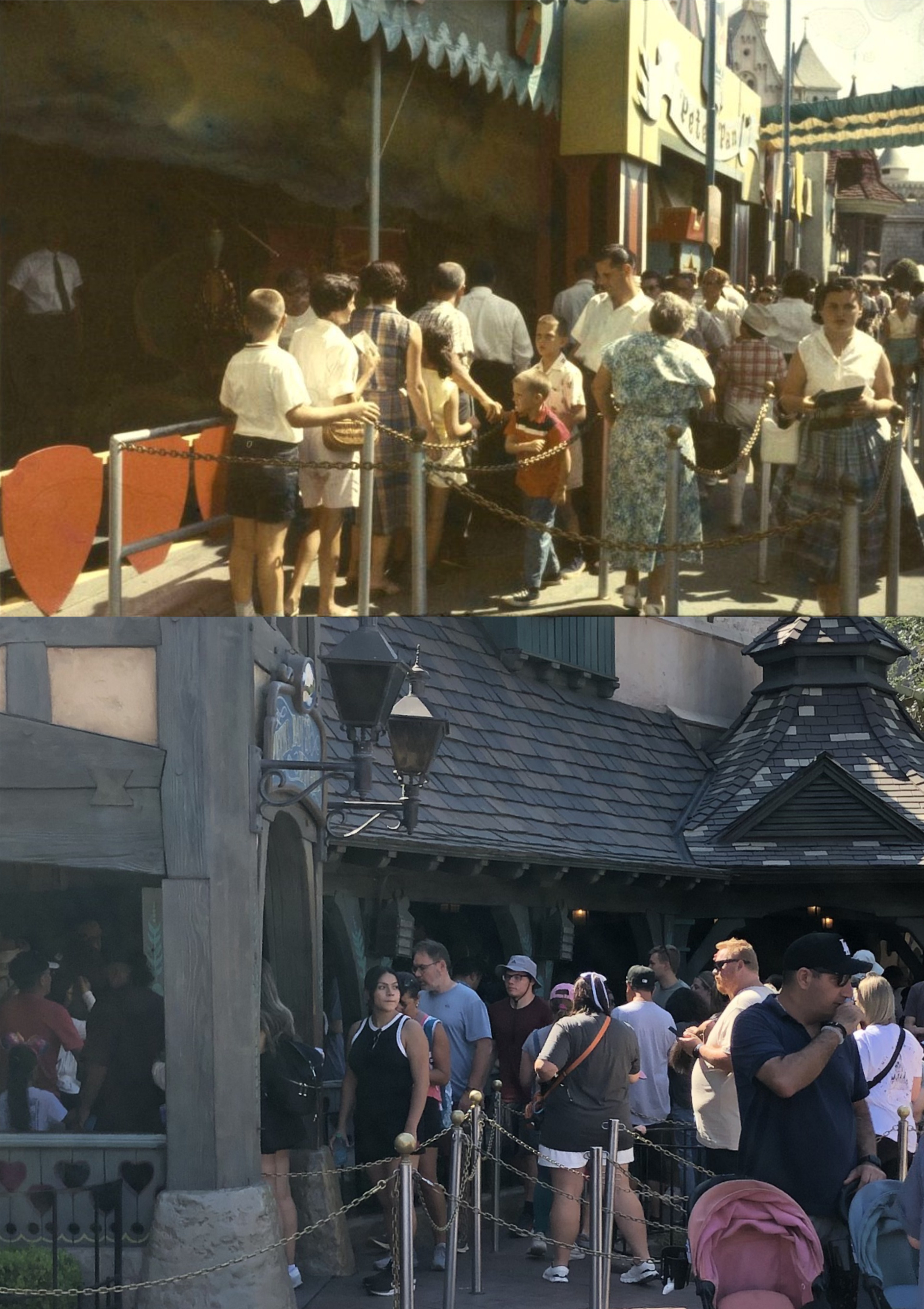
There have been a lot of remodeling changes in Fantasyland, like here at Peter Pan’s Flight.


Main Street Square and the Train Station: I imagine that’s the same car; I mean, you don’t see a lot of them around.


The Tom Sawyer Island dock for the rafts, with Fort Wilderness in the background: The original Fort Wilderness was demolished in 2007 and a smaller one was rebuilt, but is closed to the public now.


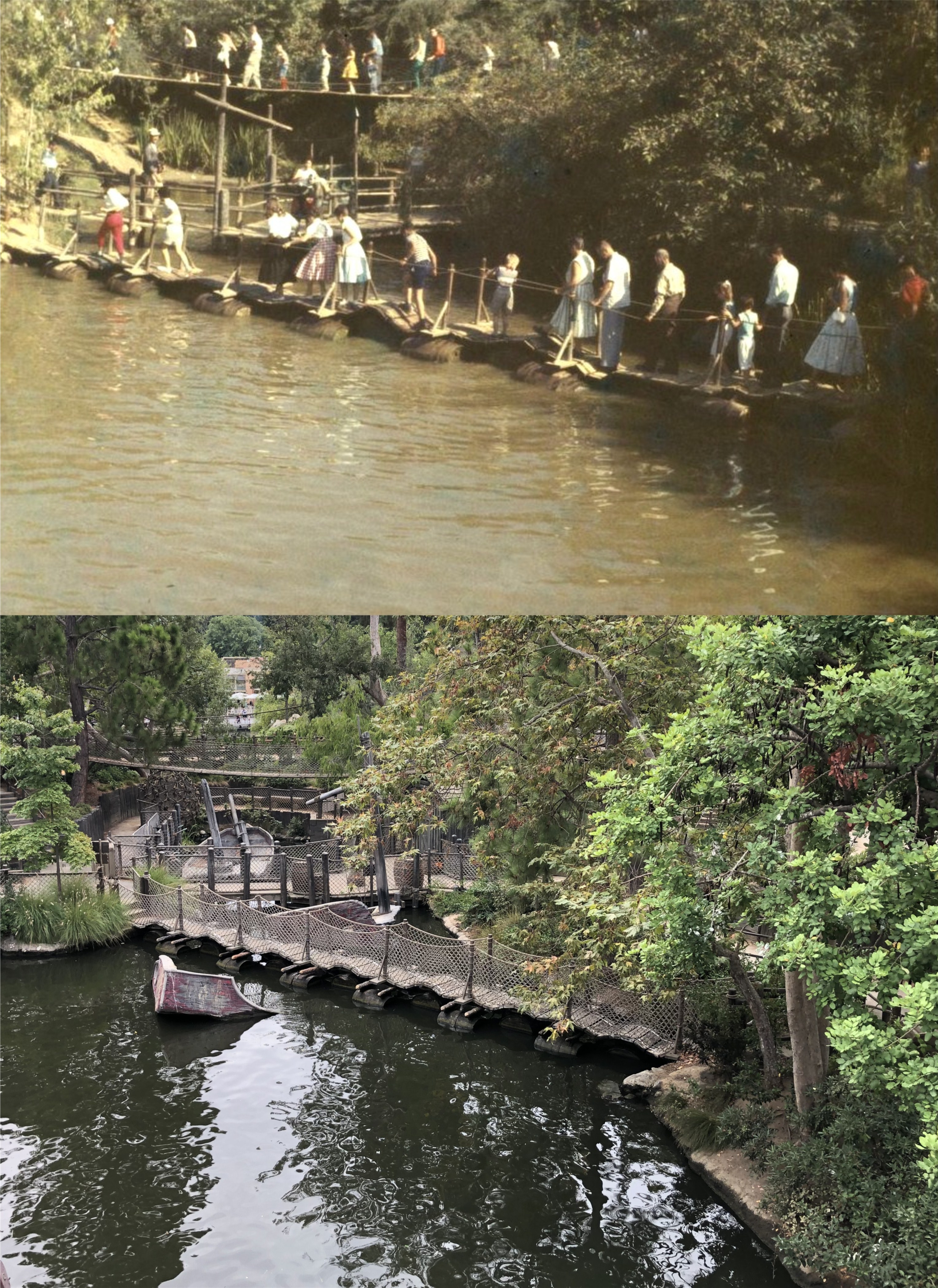
The Pontoon and Suspension Bridges on Tom Sawyer Island: Not as novel today, I guess.


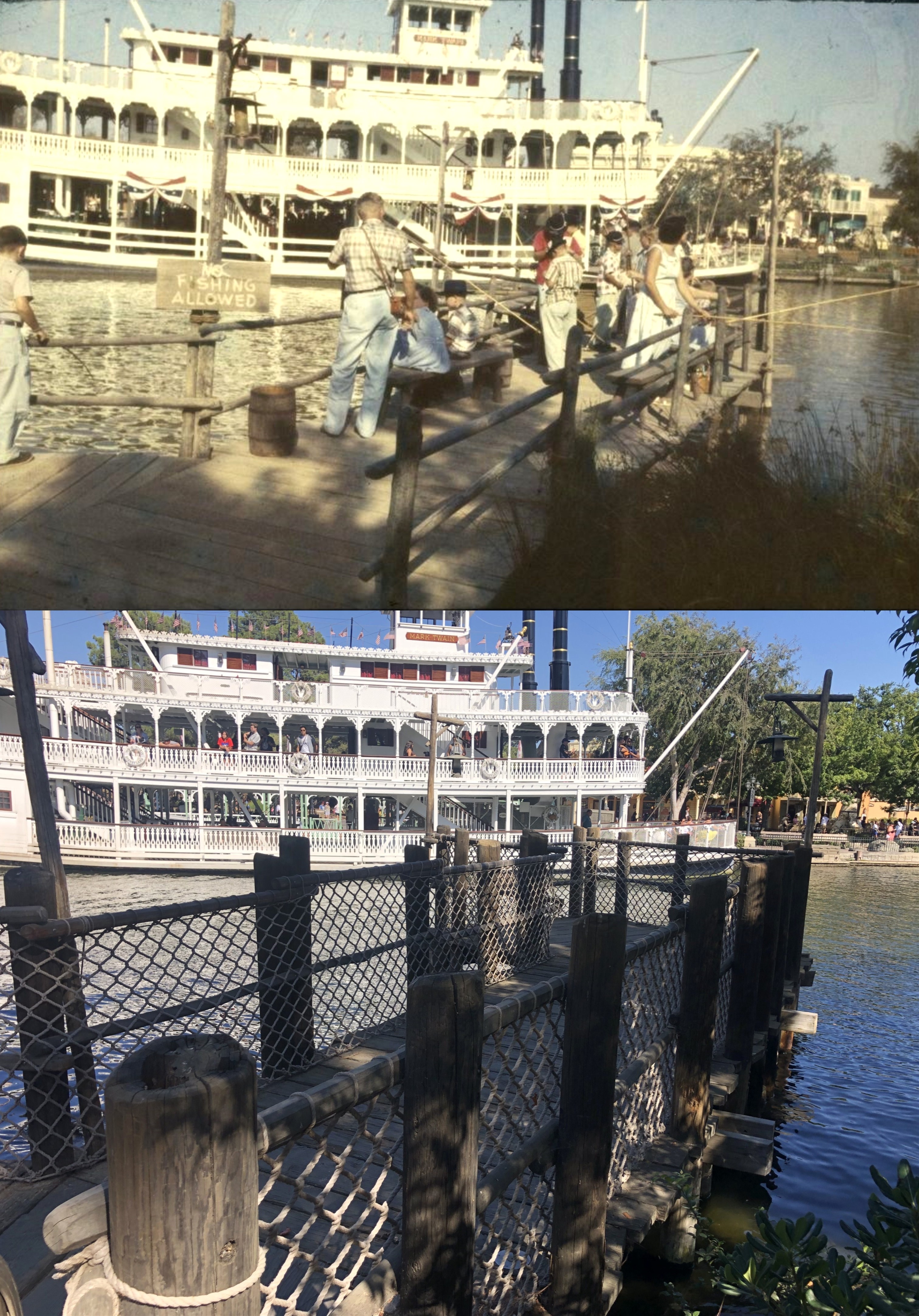
Fishing on a dock at Tom Sawyer Island, with the Mark Twain Riverboat in the background. They actually stocked this portion of the Rivers of America with catfish, bluegill, and trout, and visitors could fish of the Huckleberry Finn Fishing Pier with make-shift fishing poles and worms. The attraction lasted from 1956 to 1965.

“Alas, alack, and Alaska”

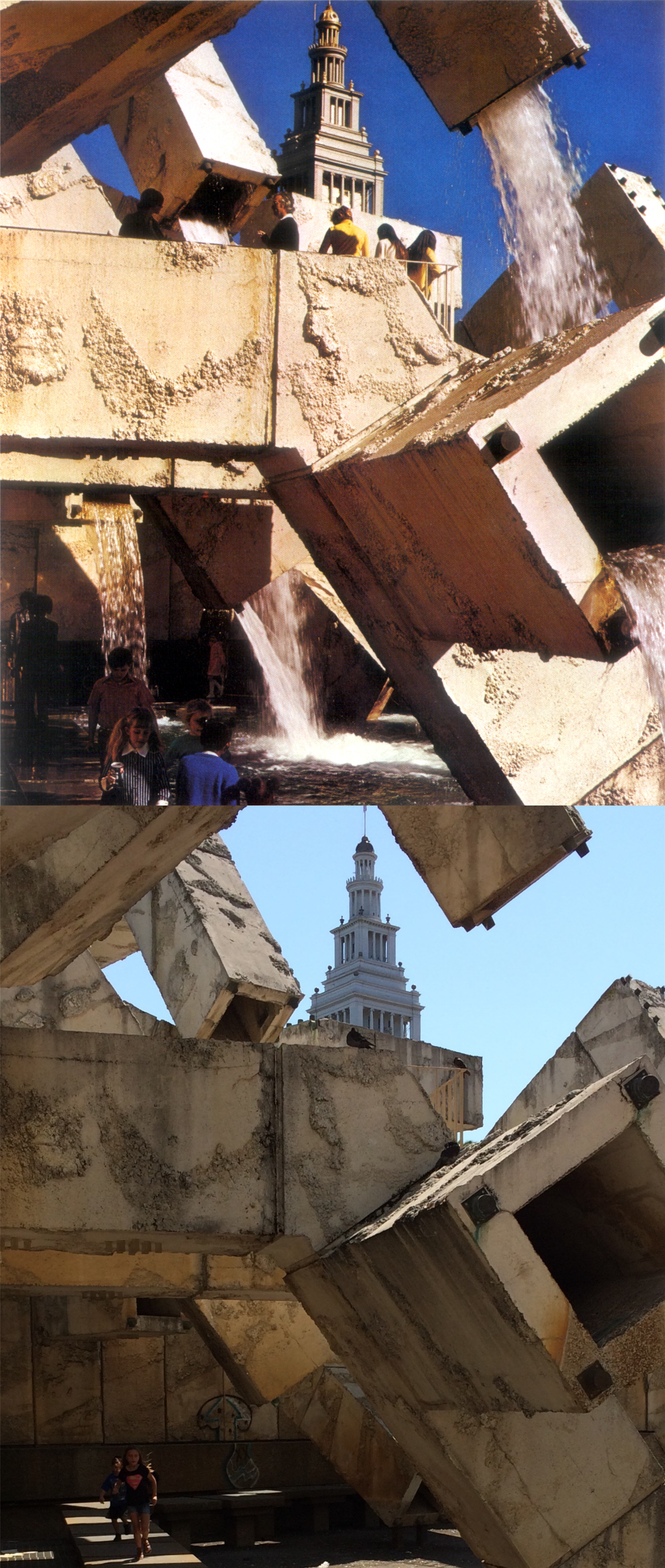
I used that expression a few posts back. The first time, and probably the only time I’ve heard that used, is the bus scene in the film ‘It Happened One Night’ when the travelers are singing the song ‘The Daring Young Man on the Flying Trapeze’. It’s more like Edward Lear “nonsense”,  and I love that movie….. Now, where was I going with this? Oh, yeah; “Alas, alack and Alaska”, the San Francisco Chronicle announced that San Francisco officials have formerly requested the removal of the 1971 structure, the Vaillancourt Fountain. Actually, although I didn’t mind it, I won’t necessarily be sorry to see it go. It resembled the entrails of a giant concrete monster, but it kind of looked pretty when they changed the colors of the water flowing from it. I looked back over my blog to see how many times I posted pictures of the fountain. (Thumbnail images)


The 1971 ceremony at the opening of the fountain: (San Francisco Public Library Archives)


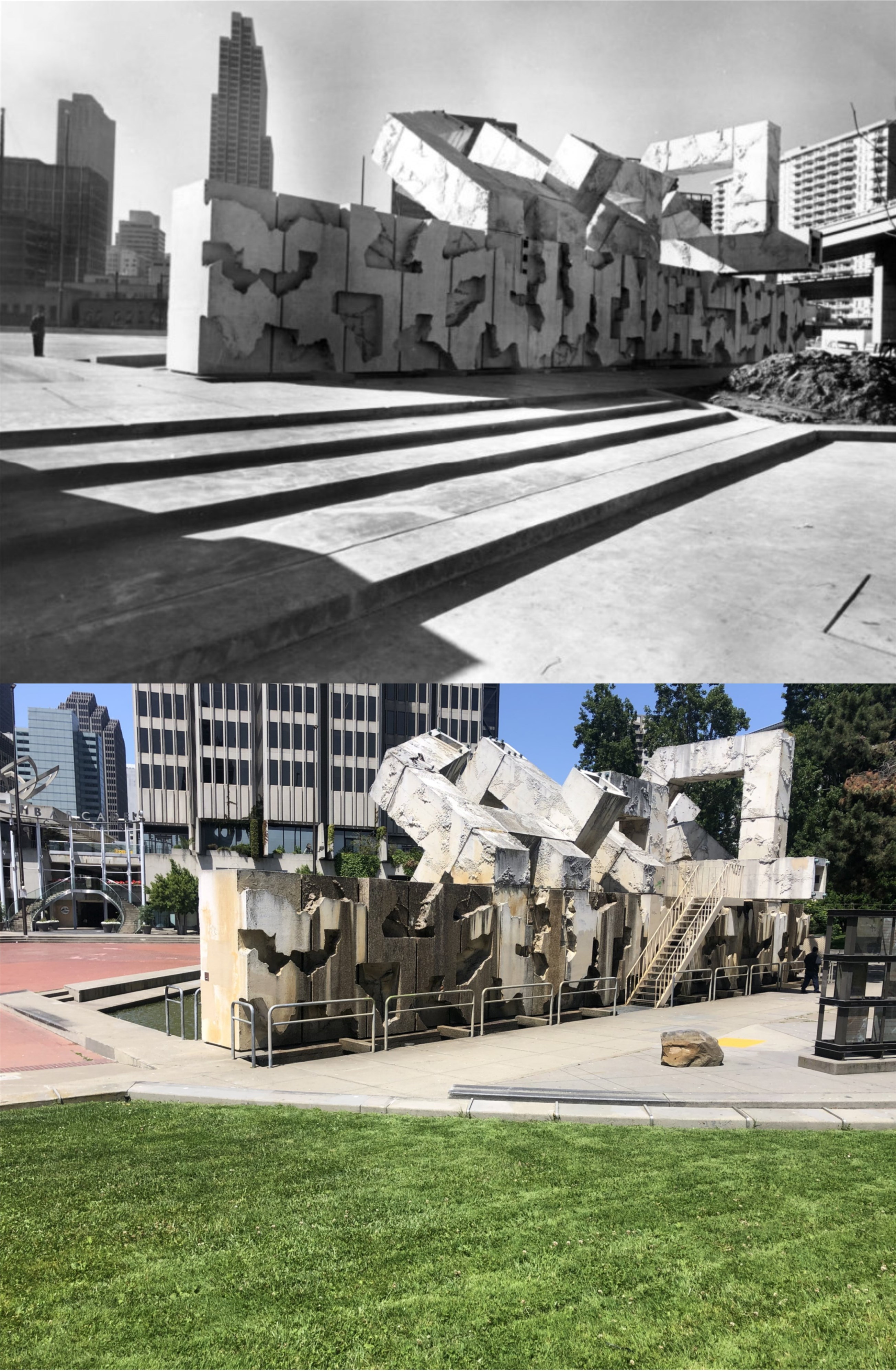
In case you’ve ever wondered what the back of the Vaillancourt Fountain looks like, and who hasn’t. (San Francisco Public Library Archives)


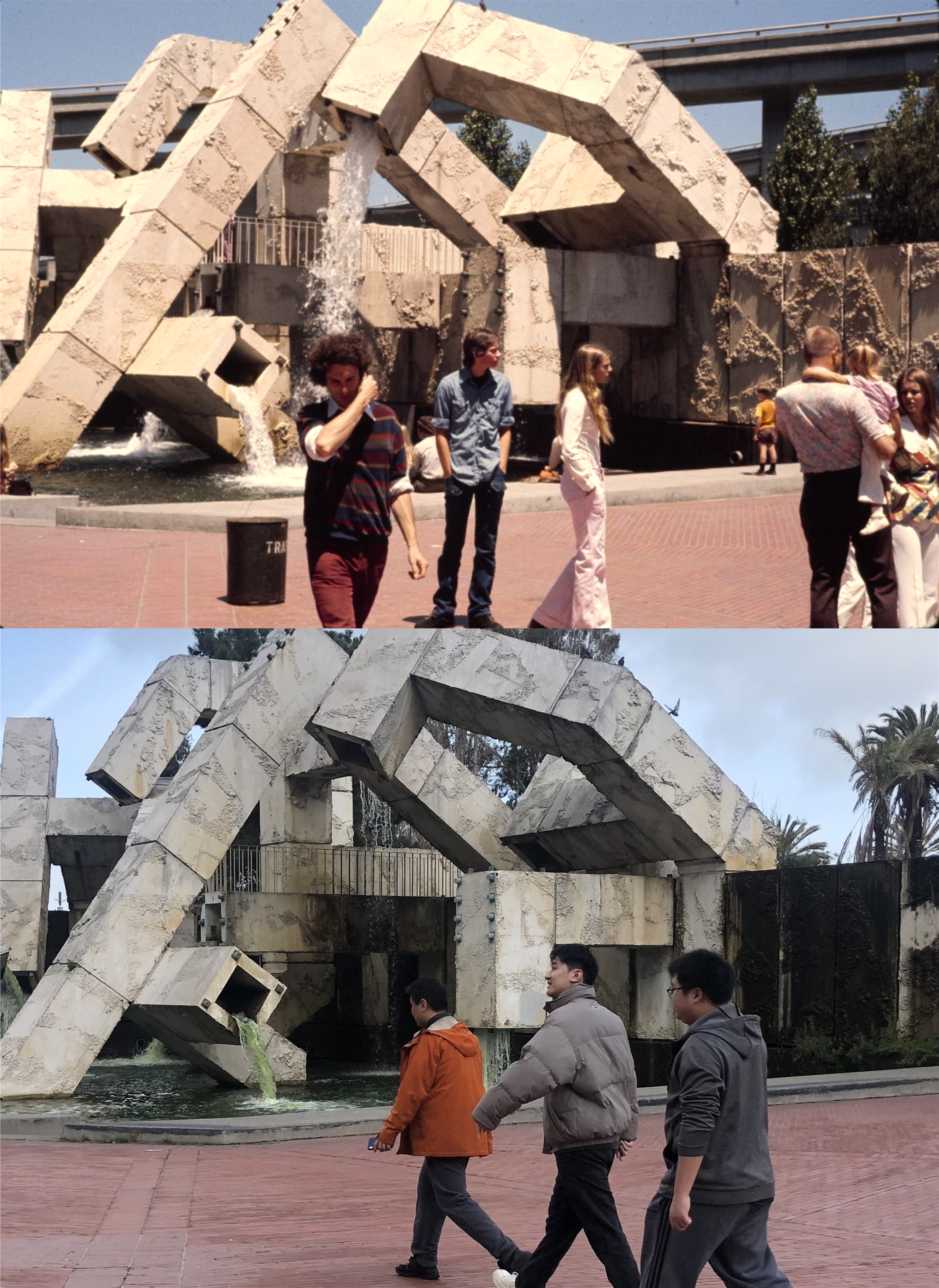
1970s and 2023 people in front of the fountain:


1970s and 2017 kids playing at the Vaillancourt Fountain:


“The Streets of San Francisco, the television show that dares to use the Vaillancourt Fountain for a backdrop.” That might have been a good promo for this episode of the TV show.


And as an added bonus, you get a view from the top of Vaillancourt Fountain in the ‘The Streets of San Francisco’ episode. Hmm, now that I think about it, I’m going to miss that ugly thing.

The Loop (For the San Francisco Railway Museum)

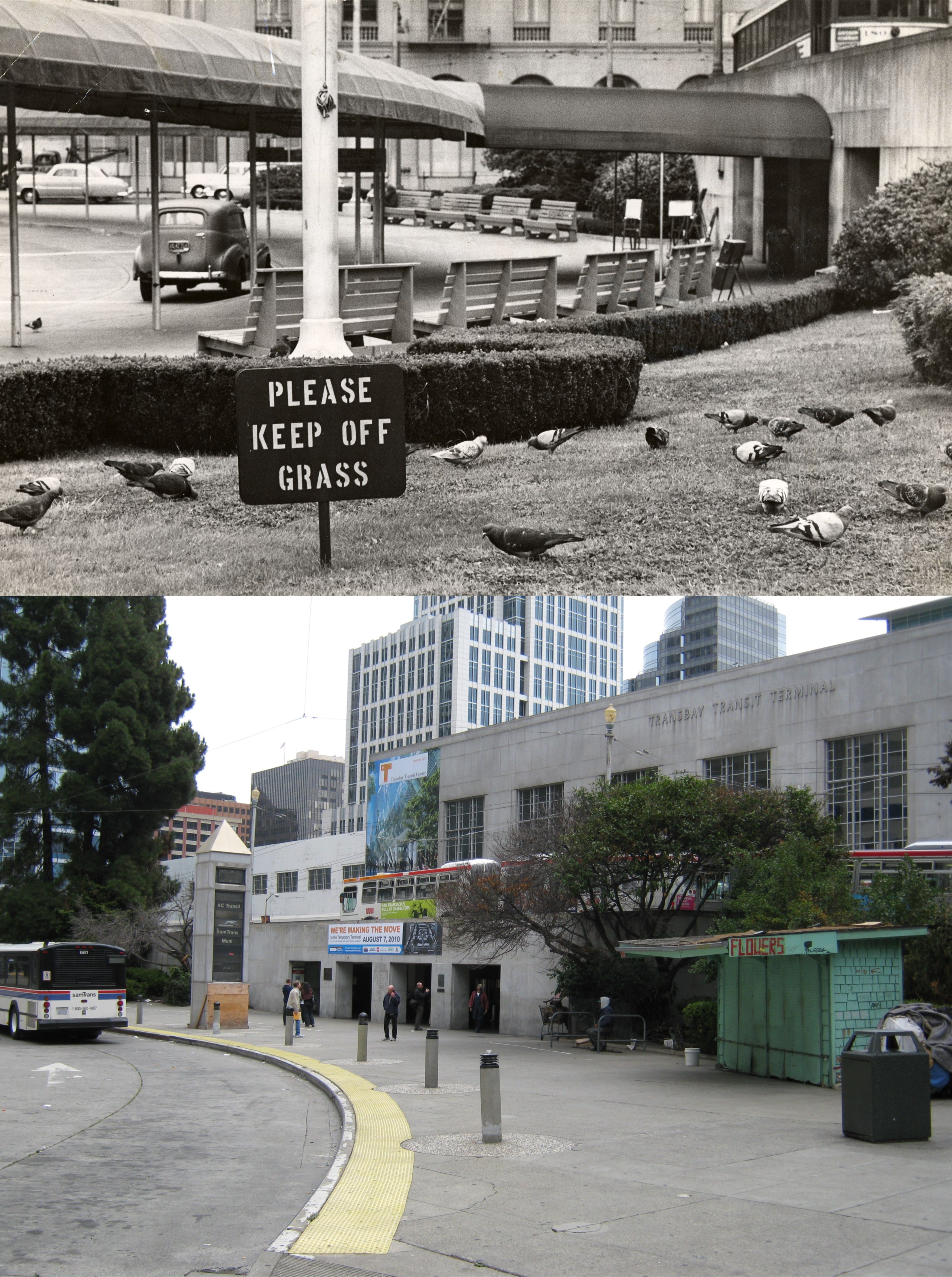
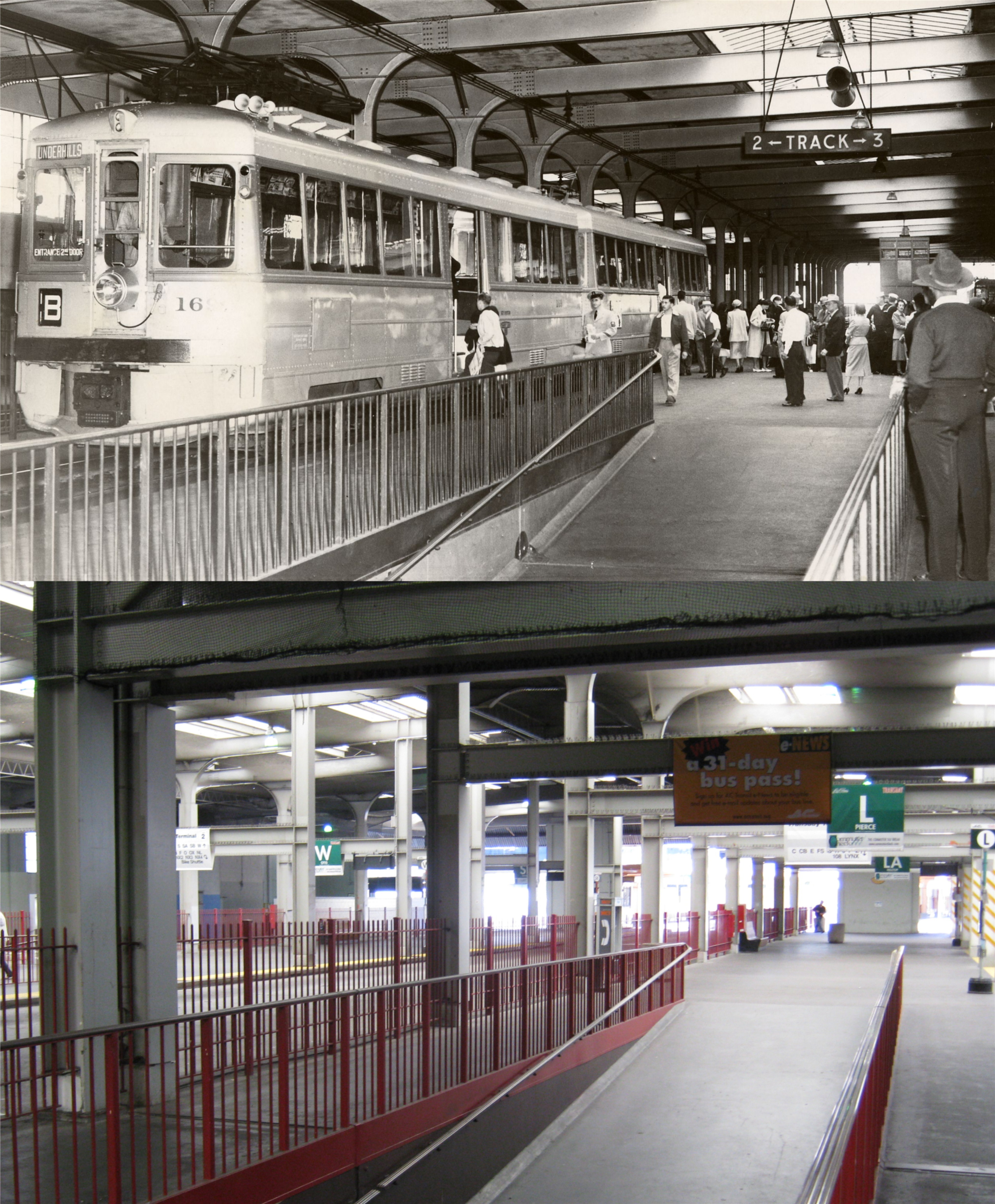
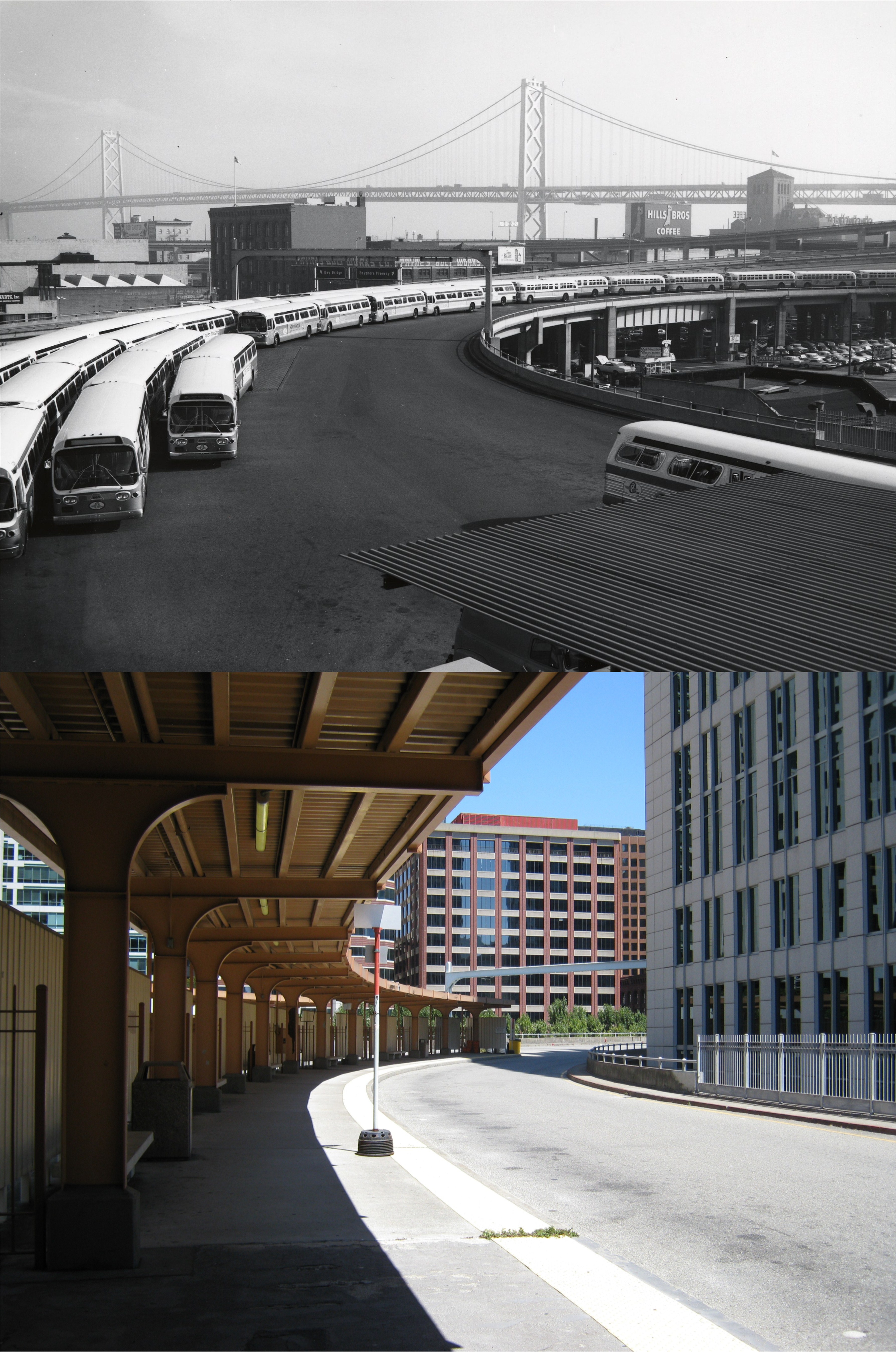
Last weekend and this weekend, I spent some time around the Ferry Building, updating some old pictures from a book I bought at the San Francisco Railway Museum called ‘Tours of Discovery’ by Anthony Perles. It was twenty bucks, but well worth it; most of the vintage pictures in this post are from the book. If you haven’t visited the Railway Museum, you should; it’s a little treasure, sure to satisfy anyone interested in the Muni, Market Street Railway, Cable Car systems. (Thumbnail images)


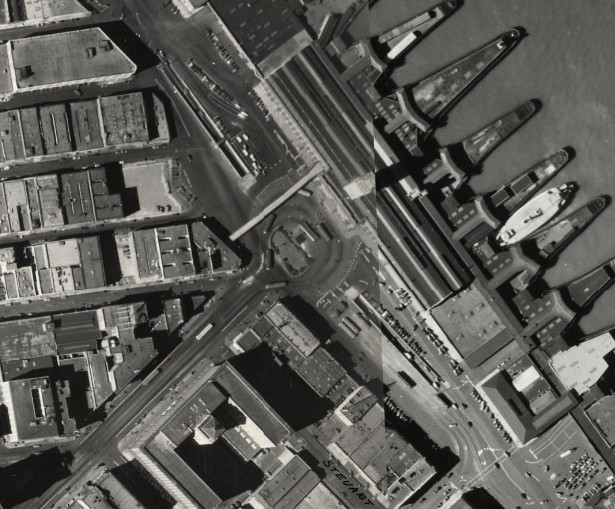
This overhead photo from David Rumsey’s 1938 overhead composition of the portion of San Francisco in front of the Ferry Building where the streetcar and eventual bus “loop” was. The first block of buildings just below the loop were demolished in the late 1950s or early 1960s. To the north of the loop, you can see the pedestrian bridge that crossed over the Embarcadero to where the Embarcadero Plaza is now. Crossing underneath the loop, from the north and south, is the automobile underpass that used to be there.


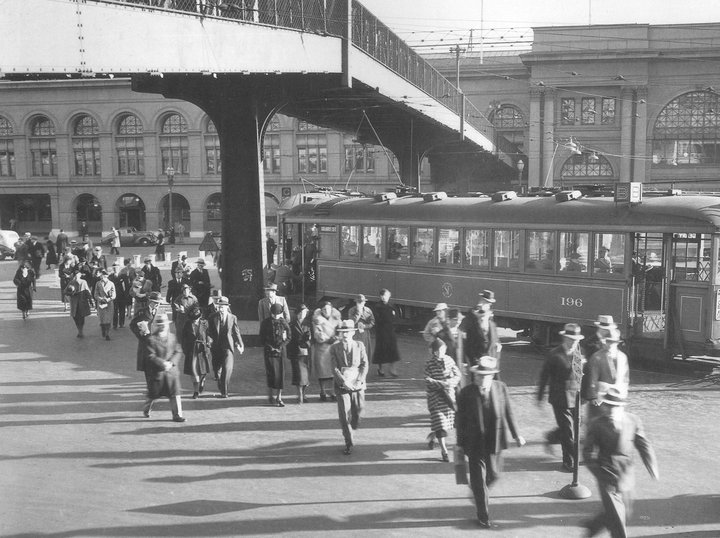
The pedestrian bridge at the northern end of the loop during the 1930s: This picture is from Nancy Olmsteds’s book ‘The Ferry Building: Witness to a Century of Change’.


A streetcar approaches the loop from the north during the 1940s: On the right is Pier One, on the left is the two way automobile underpass. I stopped in at the Joyride Pizza in Pier One for a couple slices of pizza. (Tours of Discovery)


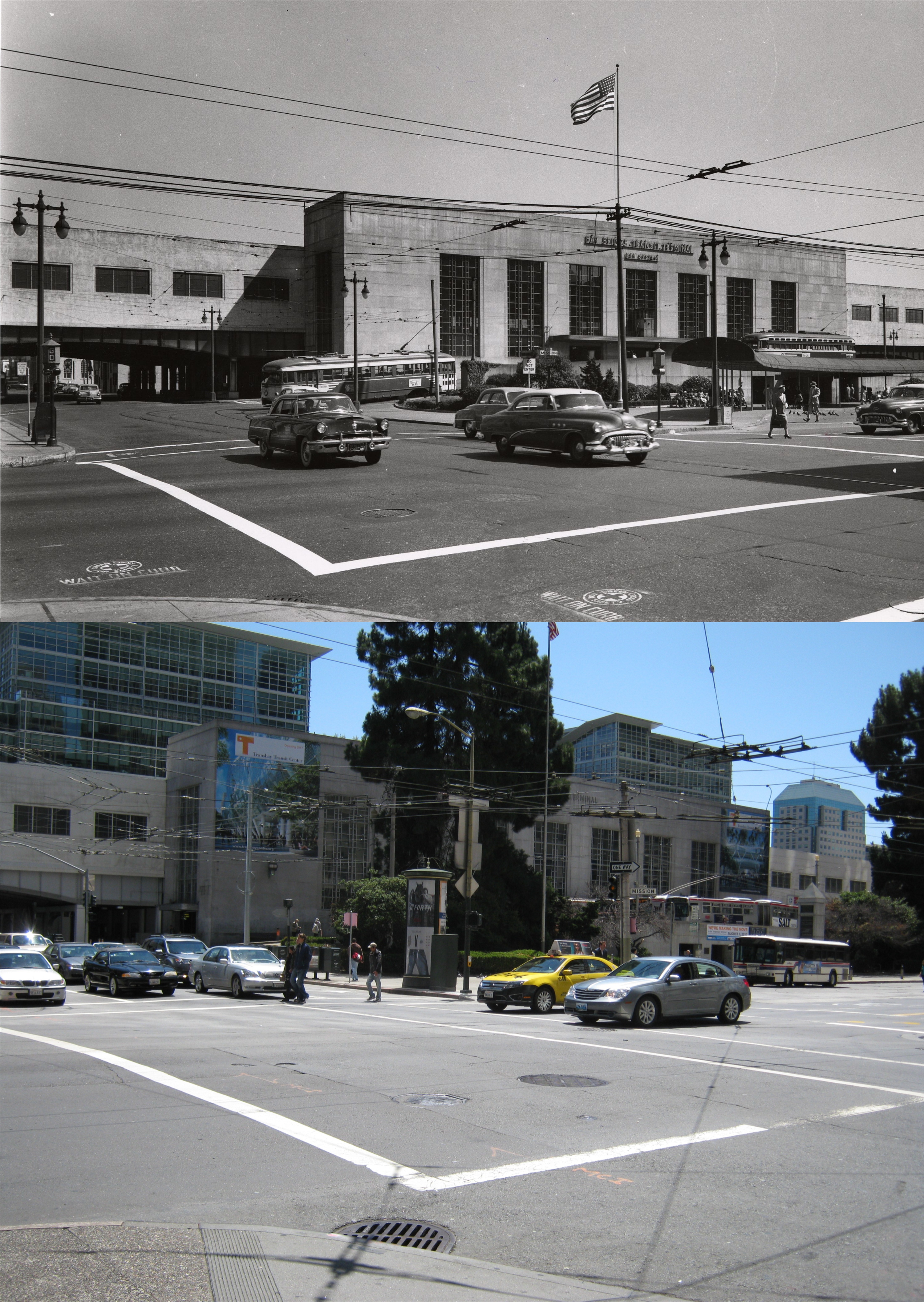
The Market Street approach to the loop when busses were using it during the 1950s, although this one is heading south on the Embarcadero: I’m pretty close to where the vintage photo was taken and the fire hydrant in my photo may be at the same spot as the old picture. Pier One is on the right in the vintage picture; you can just see a portion of the top of it through trees on the right in my picture. The sign in the upper left of the vintage picture is from the Ensign Cafe in the first building on Market Street of the block of buildings I mentioned earlier that were demolished. (Tours of Discovery)


The Ensign Cafe appears in a lot of the pictures of this area from the 1950s, and can be seen in the 1957 film ‘Pal Joey’ in a comparison picture I did years ago.


A streetcar approaches the loop from the south, past the old Ferry Post Office/Agricultural Building: That’s some interesting parking on the left in the old photo. It was a cloudy day yesterday, and you can just see the Agricultural Building through the trees in the photo I took from the F Line handicap platform. (Tours of Discovery)


Another cloudy day update of streetcars chasing each other through the loop during the 1940s: You can see the old YMCA Building on the right in both photos. (Tours of Discovery)


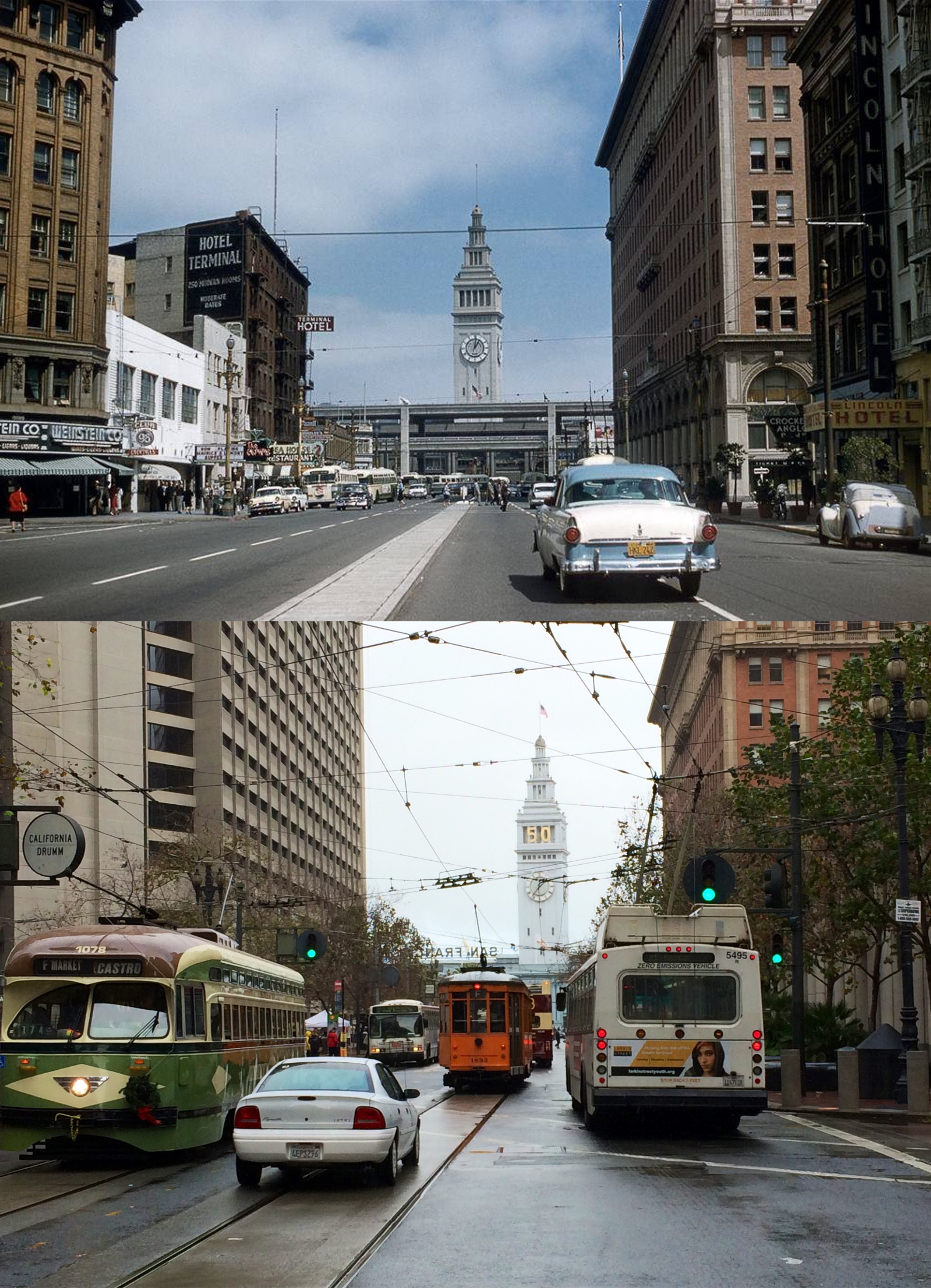
This is a cool picture of a streetcar and a bus entering the loop from Market Street during the 1950s. The first building in the background is where the Embarcadero Plaza is now. The three buildings to the left of it is now the Hyatt Regency. (Tours of Discovery)


I’ll close with a photo of the loop from the Market Street Railway in an update I did in 2019.

A 1980s Saturday

Saturday was a nice day to redo some of my 1980s slide pictures I’ve posted in the past. As I’ve mentioned in a few past posts, slide photography was very popular in the 1980s, although you had to have some type of projector to view your developed pictures. Also another plus, although I couldn’t have known it back then, slide pictures convert to CDs with much better clarity than prints. It was a picture perfect summer Saturday with events going on all over the City. These are a few redos of slide pictures I took in 1983, 1984, and 1985. (Thumbnail images)


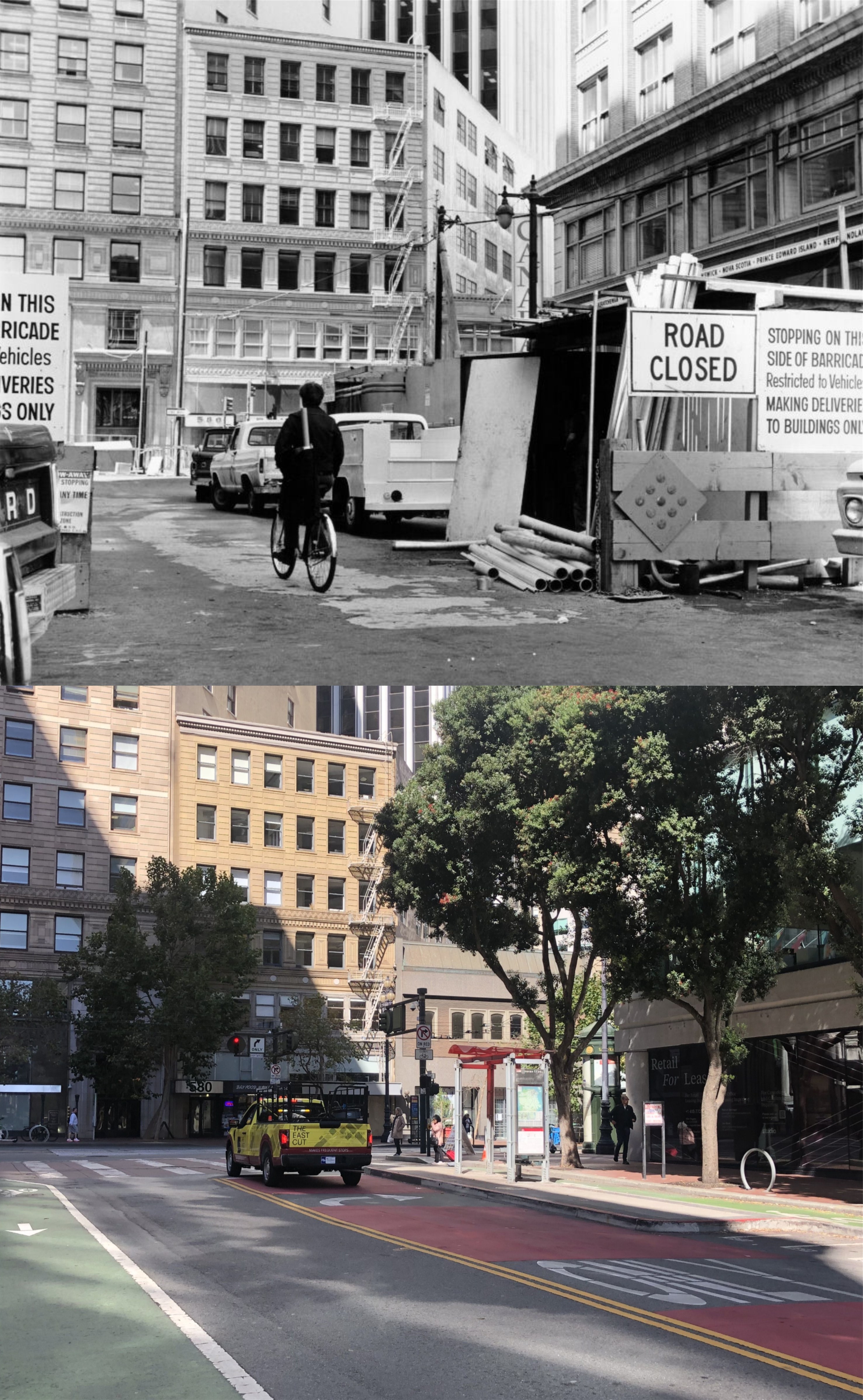
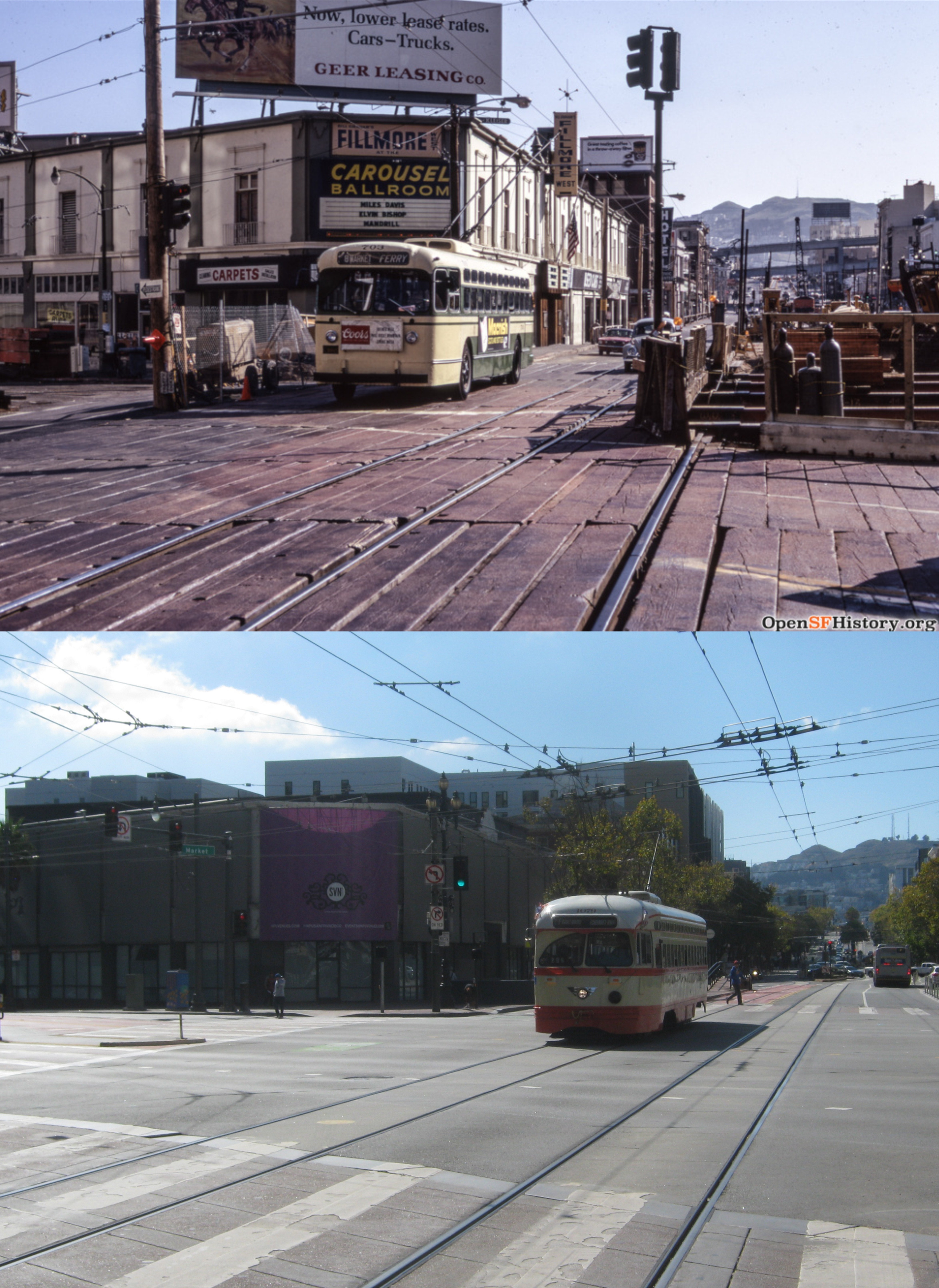
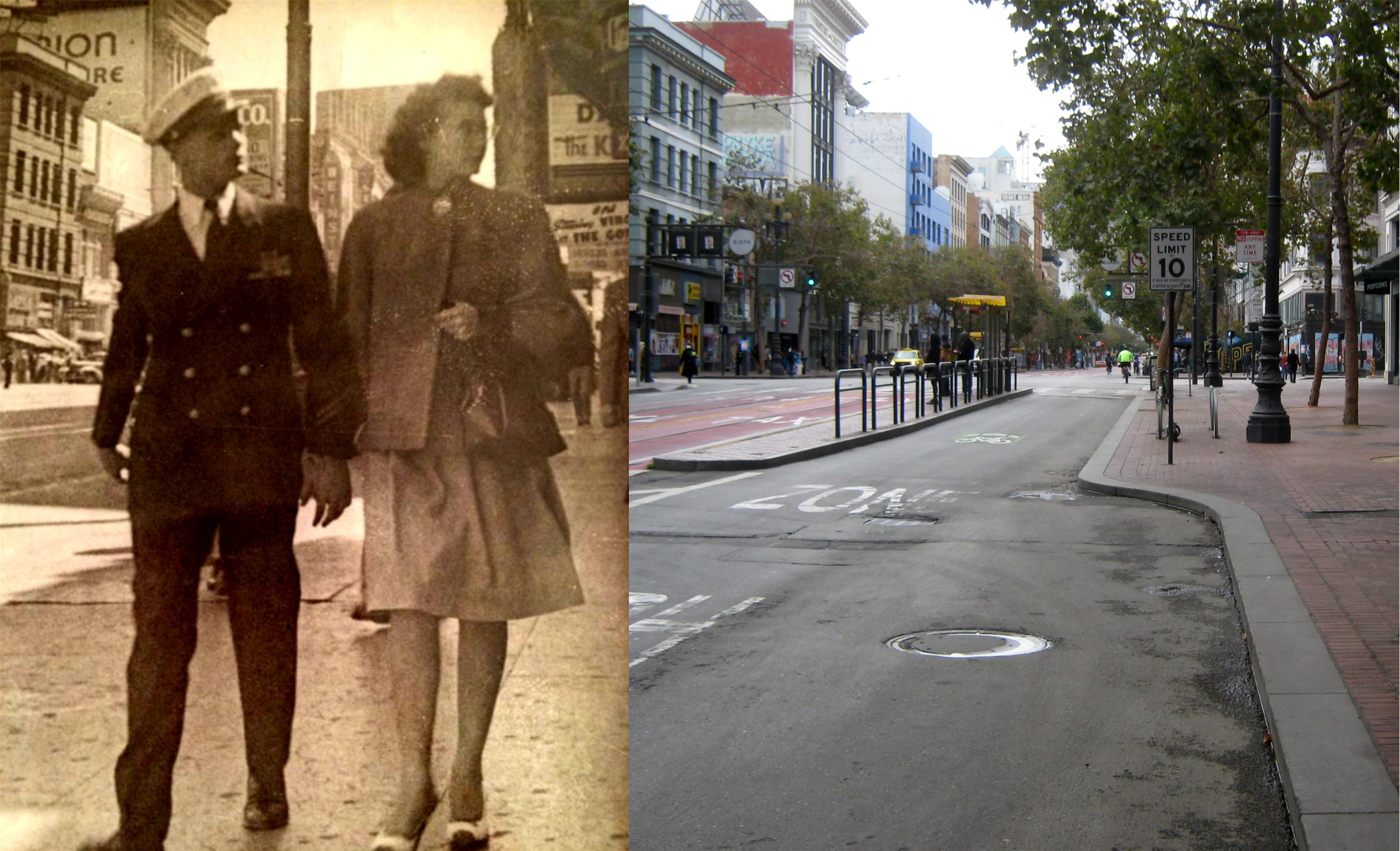
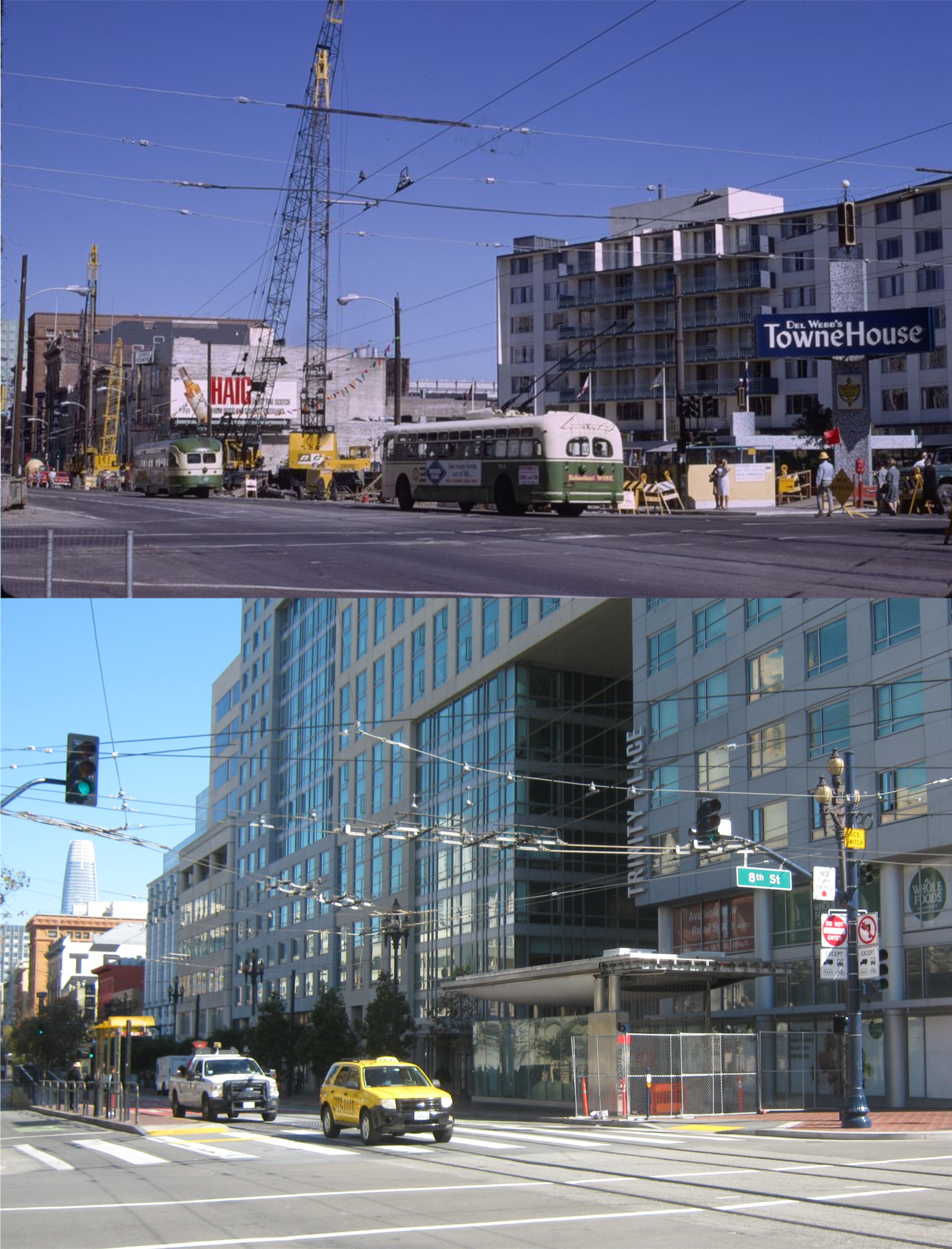
Market Street at Powell around 1984. They were just beginning to start running the old streetcars along Market Street at the time. It wasn’t a bad line up, considering that I was catching the tail end of the Pistahan Parade.


Two ladies taking a smoke break in 1983, with Union square in the background. They may have been workers from I Magnin. This was as close of a comparison to the spot as I could get Saturday.


Another person enjoying a smoke and coffee break at the corner of Powell and Geary Streets in 1983. You can see the construction work on the Powell Street Cable Car Line that shut down the entire cable car system in October of 1982.


Powell Street in June of 1984, and the return of the cable cars after all of the lines had been shut down for 20 months.


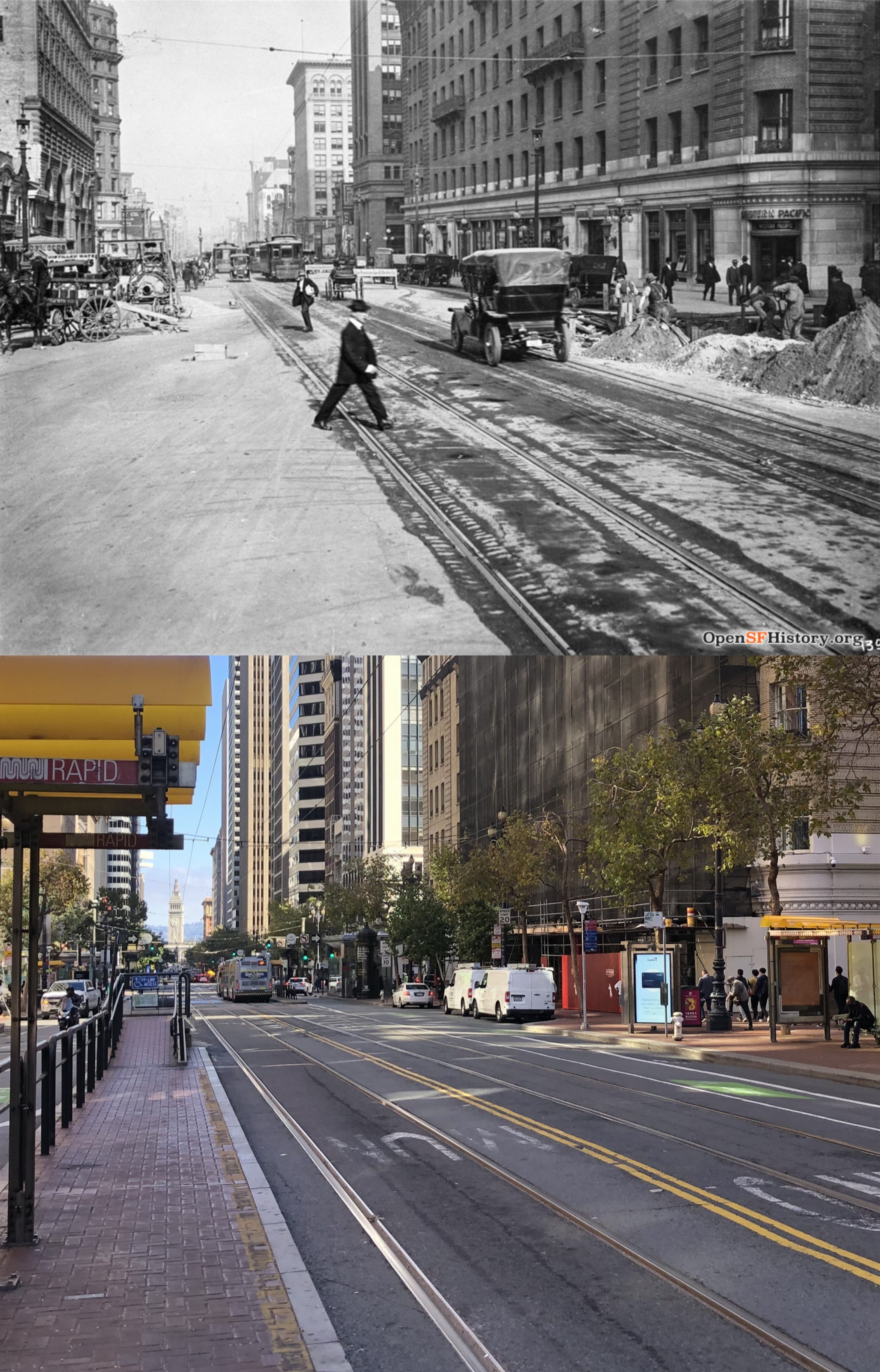
Market Street at Kearny, looking east toward the Ferry Building: I think you can see Lotta’s Fountain on the left in the 1985 slide before it was remodeled back to its original size. You can just see a part of the fountain in my update.


The Ferry Building and the notorious Embarcadero Freeway in 1983. That street off of Steuart Street is now called Don Chee Way.


Steuart and Mission Streets: The historic Audiffred Building was reconstructed in 1983-1984, but I’m not sure if my slide was taken before the work was finished. You can see both the Bay Bridge and the Embarcadero Freeway in the background of the slide.


Dear Miss Manners:

I don’t often read Miss Manners, but this one in the entertainment section of the San Francisco Chronicle recently caught my eye. It started me wondering about whether any of my photos have involved intrusion or invasion of privacy, as I don’t always pay attention to the reaction of people in some of my shots. At other times, I ask people if they would mind posing in some of my pictures, which to my recollection, has never made anyone uncomfortable. However, looking back through some of my posts I do remember a few times when my camera may not have been welcome. Still, for the most part, I think my picture taking is tactful and not invasive. Here is the Miss Manners letter and reply, and a few of my then and nows in answer to Miss Manners and her Gentle Reader. (Thumbnail images)

On the Proprieties of Public Photography

{DEAR MISS MANNERS: As a frequent tourist, I take lots of photos wherever I go. I try not to be intrusive, but it isn’t feasible to ask permission of anonymous people in public spaces, and U.S. courts have ruled that nobody has a right to privacy in such settings. Everyone carries a phone these days, and the number of people taking photos has increased exponentially as a result. Candid photos are much more interesting than posed photos or photos without people. Social realism is a movement in art and photography. I think it’s important to capture the people and settings that reflect our times. I do not sell them, but I share the best ones with friends. I avoid taking photos of people who appear to be homeless or mentally ill, because it seems exploitative. Perhaps what was once considered rude has become acceptable and prevalent. Perhaps there is a distinction between candid photos in public versus private settings among family, friends and acquaintances. In the latter case, it seems appropriate to share these with the people photographed, offer them copies and destroy any they deem offensive or unflattering. In foreign countries, I’ve encountered people who took offense at public photos, but never in the U.S.

GENTLE READER: Indeed, everyone has a camera. If you are photographing the public activity of our time, you must have countless pictures of countless people taking countless pictures — mostly of themselves. Yet Miss Manners feels obliged to tell you that there are also many in the United States who dislike being photographed in public and private gatherings, but feel forced into it by photographers who are not as sensitive to their feelings as you seem to be. Often, they are reluctant to speak up, feeling that they are being constantly captured by security cameras anyway. Prevalent, yes; but not acceptable to all. It is a matter of respect, not of law.}


I don’t think these kids on Market Street were all that thrilled about me taking their picture, but I wanted people in the match up I was doing on the Fred Lyon picture, and they just happened to wander by.


I don’t remember this officer at the Golden Gate Park Police Stables being all that excited when I asked him if I could take his picture to match it up with the 1950s picture from Images of America, but he obliged.

This was too good of a match up of people on a bench in Golden Gate Park to miss the opportunity, and I don’t remember anybody in the modern photo getting mad at me. I didn’t worry about the feelings of the people in the older picture

.   

In my eagerness to get my picture, I may have missed a mugging going at Kezar Stadium. Hope not.

You’ll usually get a wave or a smile when you take a picture of people on a passing cable car.


I don’t remember much about this slide picture I took in 1985 at the foot of the Hyde Street Pier, but I do remember that I thought the kid looked pretty cool just sitting on the post watching the 1985 traffic, and it’s one of my favorite pictures.


Haight and Cole Street in 1967: Occasionally, I share what I’m doing with people who get in my picture, and maybe the girl in the crosswalk with blue-green hair would have been interested  if I had showed her the picture of Janis on the same corner when she past by, but I didn’t.


Sometimes, I’m not paying attention to the people in my line up, and then I notice things, like the pretty girl with a Victoria’s Secret bag crossing Ellis Street at Powell, when I look at my photo later. (Peter Stratmoen)


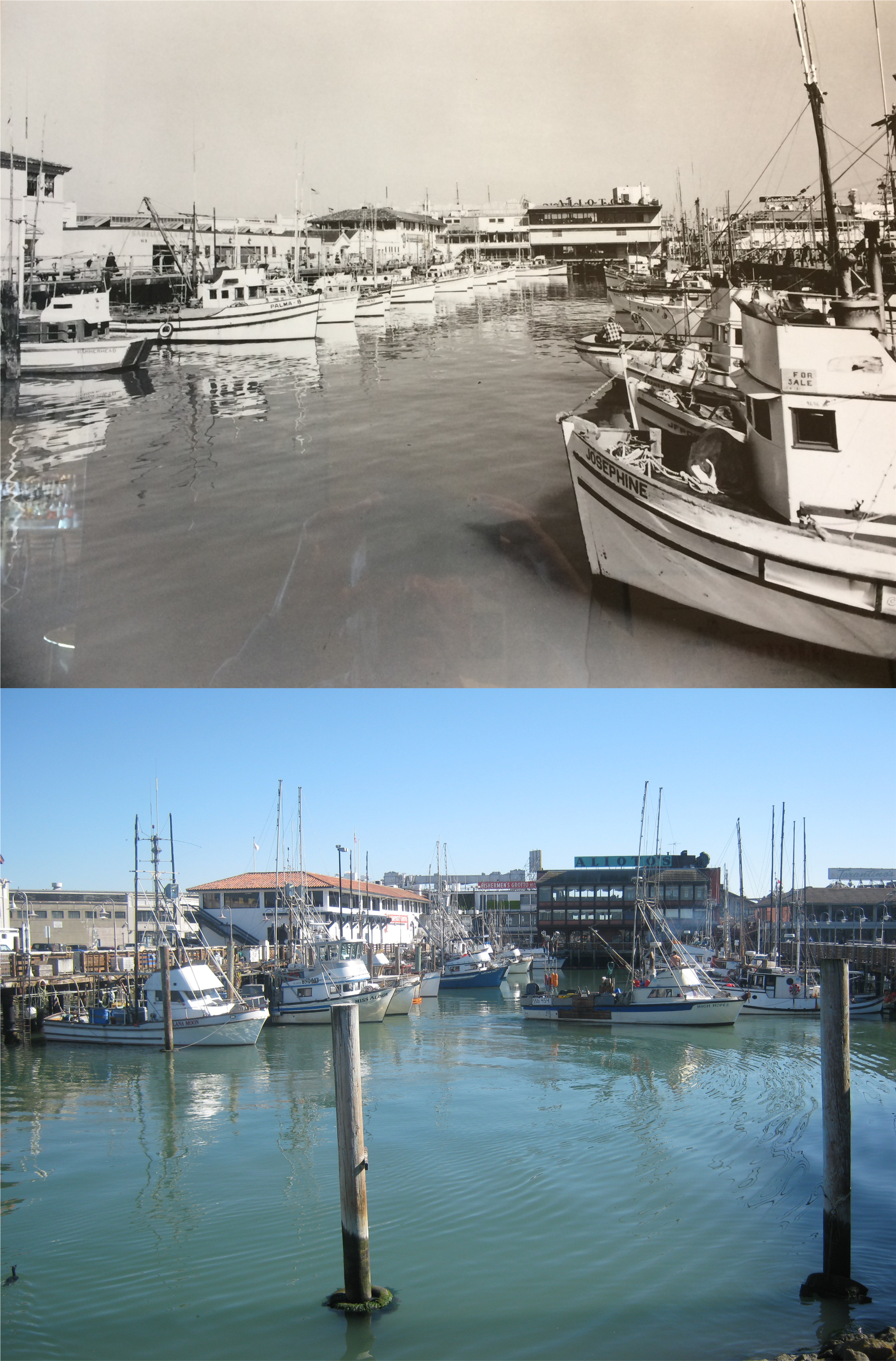
And then, there are people who don’t mind if I asked them if I can take their picture, like these three sets, and that makes me feel good. These two were kind enough to pose for me when I showed them the older photo of Fisherman’s Wharf Lagoon. The girl was named Joyce, but I couldn’t remember the fellow’s name. I hope they were able to see the post.


This fellow at Fisherman’s Wharf didn’t mind posing for me, (here he goes again with that corny line) he wasn’t crabby about it at all!


Tricia, a girl I met in the Haight on the day after Christmas in 2020, was kind enough to pose for me holding a photo taken at Haight and Ashbury Streets in 1967. She even showed me where Jimi Hendrix lived on Haight Street for awhile.


Still, there are some who are not that happy to see me, like this girl on Haight Street. She was a little concerned about why I was taking a picture of where she lives. When I went to show her the photo from Vintage Everyday I was updating, she just went back inside and closed the gate. Oh, well, maybe it was her mom in the vintage photo.


And sometimes, when you know you’re probably intruding, you just have to pretend that you’re taking a picture of something else, and look for a picture later on that closely matches yours. (opensfhistory.org)

Chinatown in the 30s, 40s, 50s, 60s, 70s, and 80s (Thumbnail images)

I like this picture from the 1939 WPA Guide to San Francisco, and I wanted to see if I could find the same spot, which isn’t hard when you use Google Maps. It’s on Grant Avenue, looking south toward Washington Street.


Sacramento Street in 1948. It amazes me that this urban children’s playground, now named Willie “Woo Woo” Wong Playground has been around since 1927. (San Francisco Public Library Archives)


Grant Avenue, next to Old St. Mary’s: I hope this Chinatown Cinderella got home before her 1956 Dodge turned back into a pumpkin. (San Francisco Public Library Archives)


Waverly place, looking north toward Washington Street in 1965: This image is from the 1965 film ‘Once a Thief’. Amy, from the Sunnyside History Project website, enlightened me about this movie, which also features scenes from Fisherman’s Wharf, the Hyde Street Pier, and SOMA among other San Francisco locations.


Washington Street, west from Grant Avenue in 1973: Anybody who is familiar with San Francisco in the 1970s will remember the terrible thing that happened here in 1977 when gunmen stormed into the Golden Dragon Restaurant and shot five innocent people to death, wounding eleven others. I think I read somewhere that all of the murderers involved in this crime have been released from prison now. (opensfhistory.org)


Old Chinatown Lane, off of Washington Street in 1984. There was a tour guide taking people down this alley when I took my picture yesterday. (San Francisco Public Library Archives)

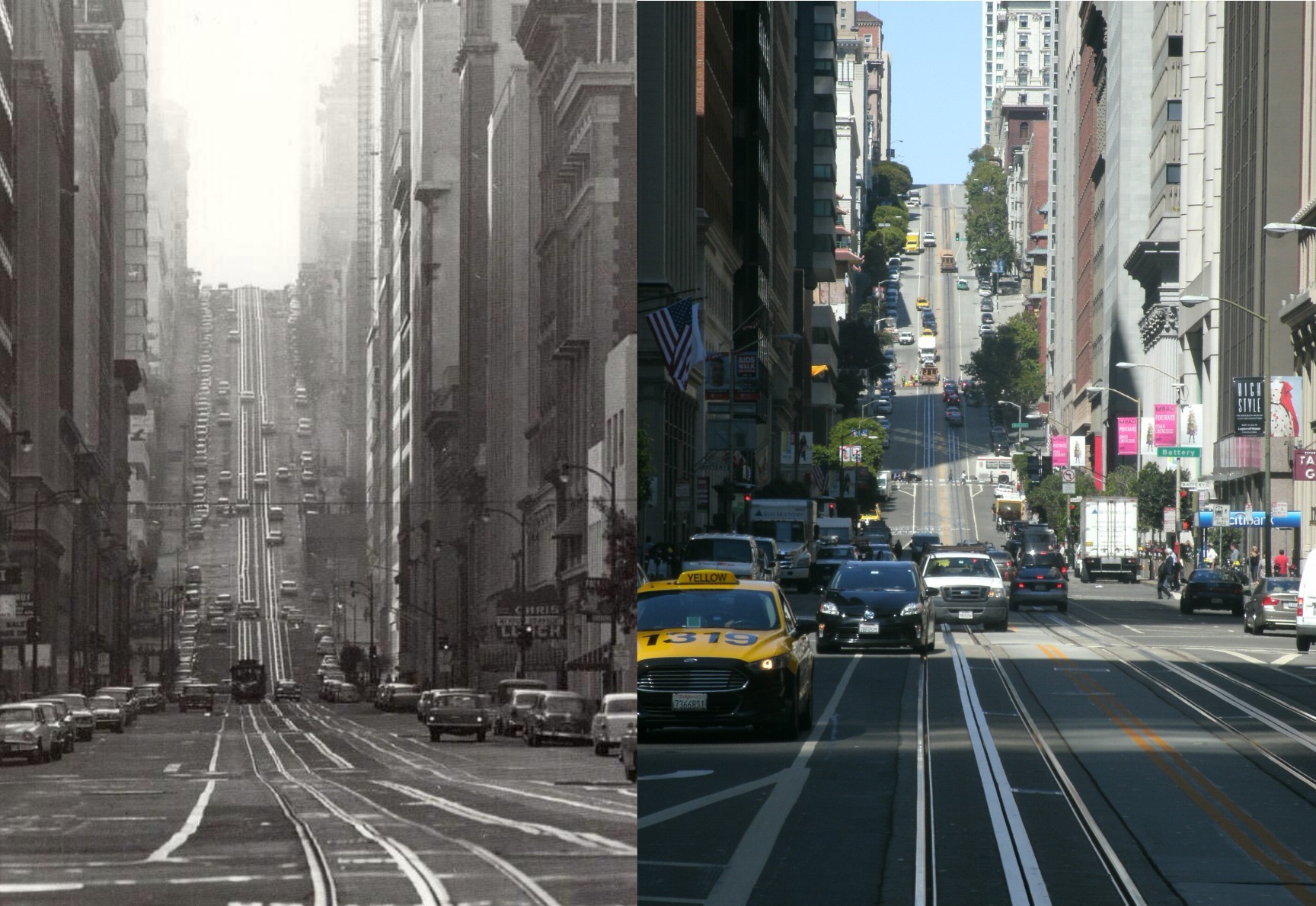
“Pick a street, any street. Okay, Geary Street, not Geary Boulevard.” (For Florence)


I’m amazed looking over past posts I have done at how many times I have referred to the portion of Geary that runs from Market Street to Van Ness Avenue as Geary Blvd. when it’s actually Geary Street. Also, I wasn’t clear on which came first, Geary Blvd. or Geary St. However, this old 1932 map of San Francisco from wikimedia.org shows that it was originally called Geary Street all the way from Market Street to Sutro Heights. I’ve included the link. I’ll have to do some research to find out when the western portion of the street/boulevard was changed to Geary Boulevard….. Just did, AI says it was in the 1970s; I thought it was earlier. I took a walk along part of Geary Street yesterday to update some vintage pictures from the internet. (Thumbnail images)

https://upload.wikimedia.org/wikipedia/commons/9/99/1932_Candrain_Map_of_San_Francisco%2C_California_-_Geographicus_-_SanFrancisco-candrian-1932.jpg


Geary Street at Market in 1945: Lotta’s Fountain was in a different spot then; it’s, reportedly, in it’s original spot now. By the way, Lotta’s Fountain’s 150th birthday is being celebrated this year. An addition to the Gothic Mutual Savings Bank Building is where the ‘The Stag’, whatever that was, used to be.


Looking down Geary toward the Palace Hotel from Grant Avenue; I think the vintage photo is from 1910: The building on the right is still named the Magnin Building.


People in the crosswalk at Geary and Stockton Streets in 1957. Ticket that grid-locker! I wasn’t sure which Stockton, Geary crosswalk this was in the vintage picture from the San Francisco Library Archives, at first. It couldn’t have been looking toward Union Square, I Magnin, or the City of Paris Department Store, but the Savings building in the background looked out of place at this intersection. (See next photoset)


So, I looked around for any vintage picture that would verify if the vintage picture in the previous set was labeled correctly. My “go to group” from opensfhistory.org came through with this picture from 1965; the crosswalk in the previous photoset was definitely the one that ran from the City of Paris to the Guaranty Savings Building.


What a great vintage picture this is of a streetcar passing Powell Street from Geary, heading east, in 1942! The St. Francis Hotel is in the background. I couldn’t get a photo with a streetcar entering the intersection, but I’ll settle for a cable car. (San Francisco Library Archives)


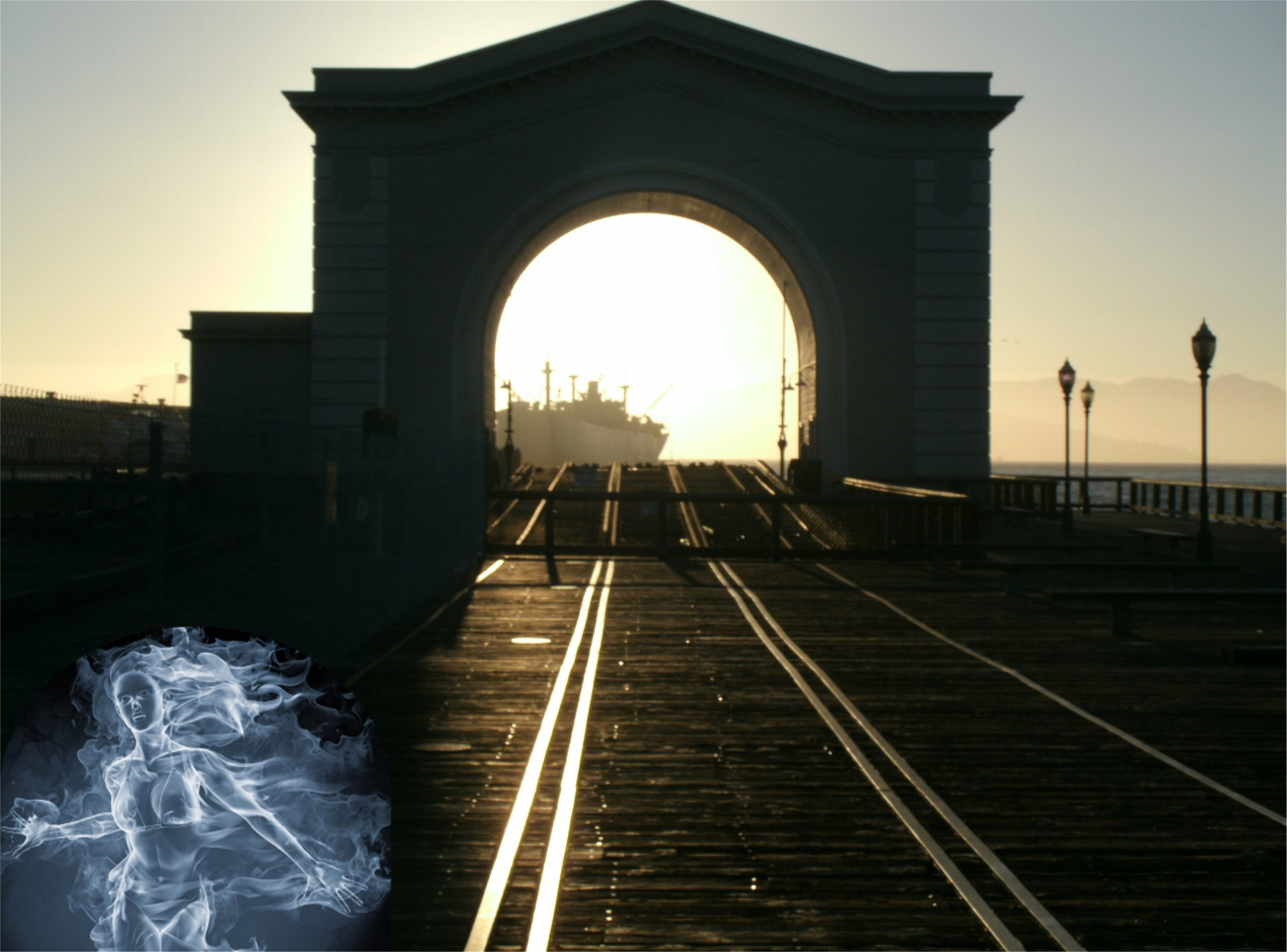
Now, we come to my dedication. Dedicating a post to a ghost might seem macabre, but I always felt sorry for Florence Cushing, the young girl who jumped to her death from the top floor of the Union Square Plaza Hotel in 1911, then called the Paisley Hotel, and reportedly still haunts the building. “(She) can check out any time (she likes), but (she) can never leave.” Here’s one of the links with a part of her story. Also in the 1971 picture from the San Francisco Library Archives is the unfinished Westin Tower of the St. Francis Hotel.

https://thehauntghosttours.com/blog/union-square-hotel-haunted-sf/


Mason Street was as far as I got yesterday; I wanted to explore Geary Street all the way to Van Ness Avenue where the twain of east Geary Street meets west Geary Boulevard, but “alas, alack, and Alaska” I’ve had an arthritis flare-up in my toe all month that’s been cutting into my “pounding the pavement” time. This vintage picture is looking east along Geary Street in 1913. The peak of the tall Whittell/Grace Building in the left background is painted white now, so sometimes it appears invisible in some of my pictures. The Hotel Stewart on the right is now the Handlery Hotel. (UC Berkeley Library Archives)
“If they asked me, I could write a book.”

“About the way you walk and whisper and look.”

In 1957, Hollywood took over Telegraph Hill for awhile to film scenes for the movie ‘Pal Joey’, starring Frank Sinatra, Rita Hayworth and Kim Novak. Herb Caen devoted one of his columns to the filming that was reprinted in his 1960 book ‘Only in San Francisco’. Here are some of his comments in brackets from that column, titled ‘Stars on Telegraph Hill’ (great title for a chapter) plus some then and nows I’ve enjoyed doing on ‘Pal Joey’.  (Thumbnail images)

{I scaled Telegraph Hill Thursday afternoon to see how they make movies, and I must say it was all pretty impressive. Frank Sinatra showed up a little late, the wind blew Rita Hayworth’s hair every which way, and they had to put up a rope to hold back the gawkers, but even so, a few seconds of an epic called Pal Joey was shot and the movie makers considered it a day well spent. Along with about $15,000.}

{Around the circle in front of Coit Tower, all was magnificent confusion. When Hollywood takes over, man how it takes over. There were wardrobe trucks. And sound trucks. And light trucks, and heavy trucks. And a long dressing-room trailer, from which Miss Hayworth presently emerged, wearing a cashmere sweater, camel’s-hair skirt, beige leather shoes and a piece of gauze around her wavy titian tresses. Her face was heavily made up and she looked younger than springtime.}

{Even Coit Tower was made up for the occasion. For one thing, a new entrance had to be built. On the lawn behind the tower, a vast terrace had been built, of wood painted gray to simulate stone. “This is Rita’s mansion on Telegraph Hill, see?” said Galanter.” (Ted Galanter, a press agent) She’s a very rich woman who’s in love with Sinatra, but it isn’t mutual.}

{At 5:15 PM. Sinatra strolled gracefully onto the set, wearing make-up and a gray suit and sipping a coke out of a paper cup. “Good morning!” he greeted. “I think I’m gonna make it.” He walked out onto the terrace, shook his fist at the skyline, and intoned with laughs, “San Francisco, I’ll lick you yet!”}

{The bells of SS. Peter and Paul, in the valley below, began ringing. “Stop that infernal clanging,” roared Sinatra. “Bells and sirens – that’s all you hear in this town. Sounds like one big jail break!” “Hey,” he called to director Sidney, “what are we waiting for – more wind?”}

{“All right, let’s do it,” suggested Sidney. “And don’t worry if the wind blows you away,” he said to Sinatra. “We’ve got an anti-aircraft crew alerted to shoot you down over the Golden Gate Bridge.” Everybody yelled, “Quiet!” and the cameras rolled.}

{And that’s how movies are made. Somehow.}


Here’s a picture of a scene from the make believe terrace behind Coit Tower that I think was left out of the film, and the spot where Rita’s back yard was today. You can vaguely see a Bay Bridge tower and the Ferry Building in the film print, just above Sinatra.


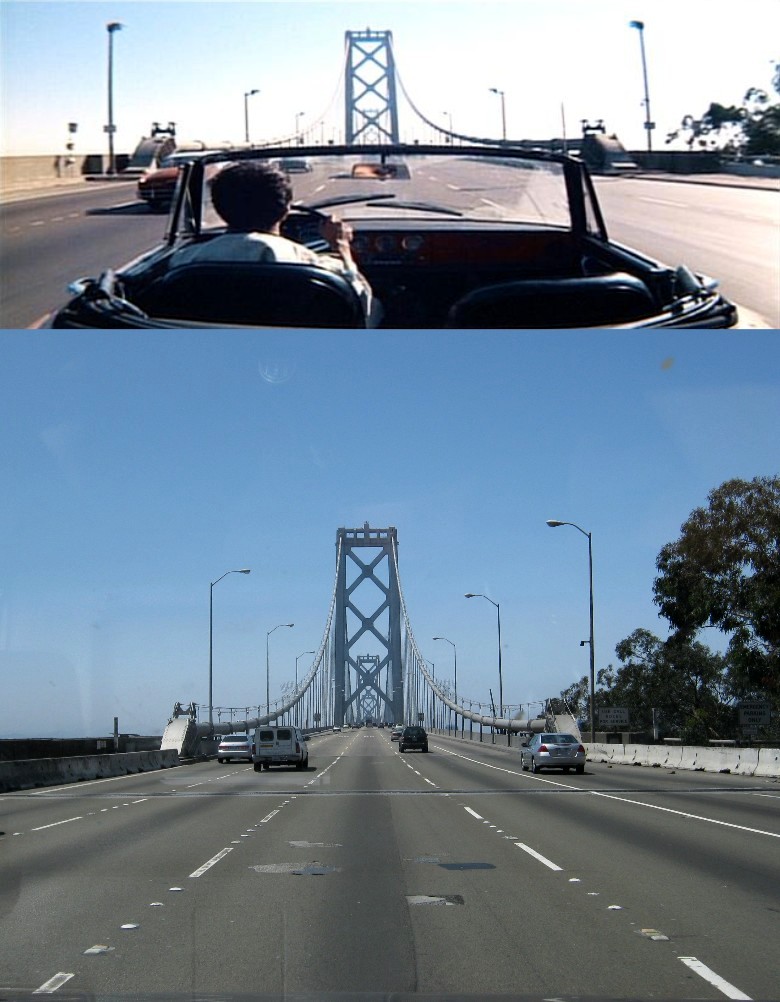
Sinatra arrives in San Francisco by a ferryboat from Oakland during the opening credits. You can just see a part of the Southern Pacific Building today, minus its enormous SP sign.


Sinatra and the classic Sinatra look, as he leaves through the south wing of the Ferry Building.


The first place Joey heads for on arriving in San Francisco is the International Settlement on Pacific Avenue between Columbus Avenue and Montgomery Street. This was the nightclub and bawdy entertainment capital of San Francisco back then, and probably the best look you’ll ever see of it on film in this movie.


Back up on Telegraph Hill where a lovesick Kim Novak leaves what is supposed to be Rita Haworth’s mansion, but is actually the entrance to Coit Tower.


But Kim Novak wins out at the film’s end, as she and Sinatra wander off behind the St. Francis Yacht Club Building into a Hollywood sunset.

Another shot from the opening credits scene of Joey coming in by ferryboat, and a great look at the 1957 skyline of San Francisco: What the heck, I don’t get to pose with a star often. “Never mind the dames, Frank, just enjoy the view.”


‘The Raging Tide’, the novel and the film

I first heard about the 1951 film ‘The Raging Tide’ from the book ‘San Francisco Noir’ by Nathaniel Rich. The movie is based on the the 1950 novel ‘Fiddler’s Green’ by Earnest K. Gann, and reprinted under the name ‘The Raging Tide’ to coincide with the opening of the 1951 movie version of the story. ‘Fiddler’s Green’ refers to a mythical afterlife associated with sailors, but the title ‘Raging Tide’ makes the film more intriguing. I ordered a paperback copy of the book, but unfortunately the only DVD copy of the film I could find isn’t of the best quality, but I’ll use some of the images from the movie when referring to it. Both the film and the book are excellent examples of a mystery story set in San Francisco. I’ll use excerpts from the novel in brackets describing some of the interesting San Francisco locations, including some then and now pictures of the areas described, and compare the handling of parts of the story in both the film and book. (Thumbnail images)

The movie opens up with a panoramic view of the San Francisco waterfront from the Coit Tower parking lot that is largely block by trees nowadays.


The novel opens up with three-time loser, Bruno Felkin, running north along the Embarcadero after shooting to death racketeer Sam Addleheim somewhere near the Ferry Building. Unlike the book the film opens with the actual shooting. We’re allowed to follow Bruno’s thoughts both in the book and the film as he runs away. Bruno is trying to get to his girlfriend Connie Thatcher’s apartment on Telegraph Hill to establish an alibi. {You cheap little tin horn. Let Sam kid around a little and you get excited. You wave a gun like a big grownup boy, and the damn thing goes off. The fact Sam grabbed you by the neck, the self-defense angle, wasn’t enough – and wouldn’t be. Not for a guy who was already a three time-loser. You lost your concrete head, so now you pound the concrete for all you’re worth.}


Bruno narrates a pretty good map we can follow as he tries to get to Connie’s Apartment. {Past Pier 5, Pier 7 behind and the cafeteria behind the Bar Pilots’ office. The cafeteria was closed. Past Pier 9 and now was the time to quite smoking. Right now. Instantly—when your realize what cigarettes can do to your wind.} The movie shows only night time scenes of part of the Embarcadero, the Filbert Steps, and some of Fisherman’s Wharf during Brono’s run. The photos are Pier 5 in a 1960s picture from opensfhistory.org, Pier 7, demolished now and a walking pier, taken in the 1950s during the building of the Embarcadero Freeway, and Pier 9 in the 1960s; the latter two pictures from the San Francisco Library Archives.


{Swing left now. Past the Merchants Ice and Cold Storage Company. Pier 27 . . . up Lombard Street. Get to hell away from the Embarcadero.} The Merchants Ice and Cold Storage Building is still around, seen here in a picture from the 1970s. (opensfhistory.org)
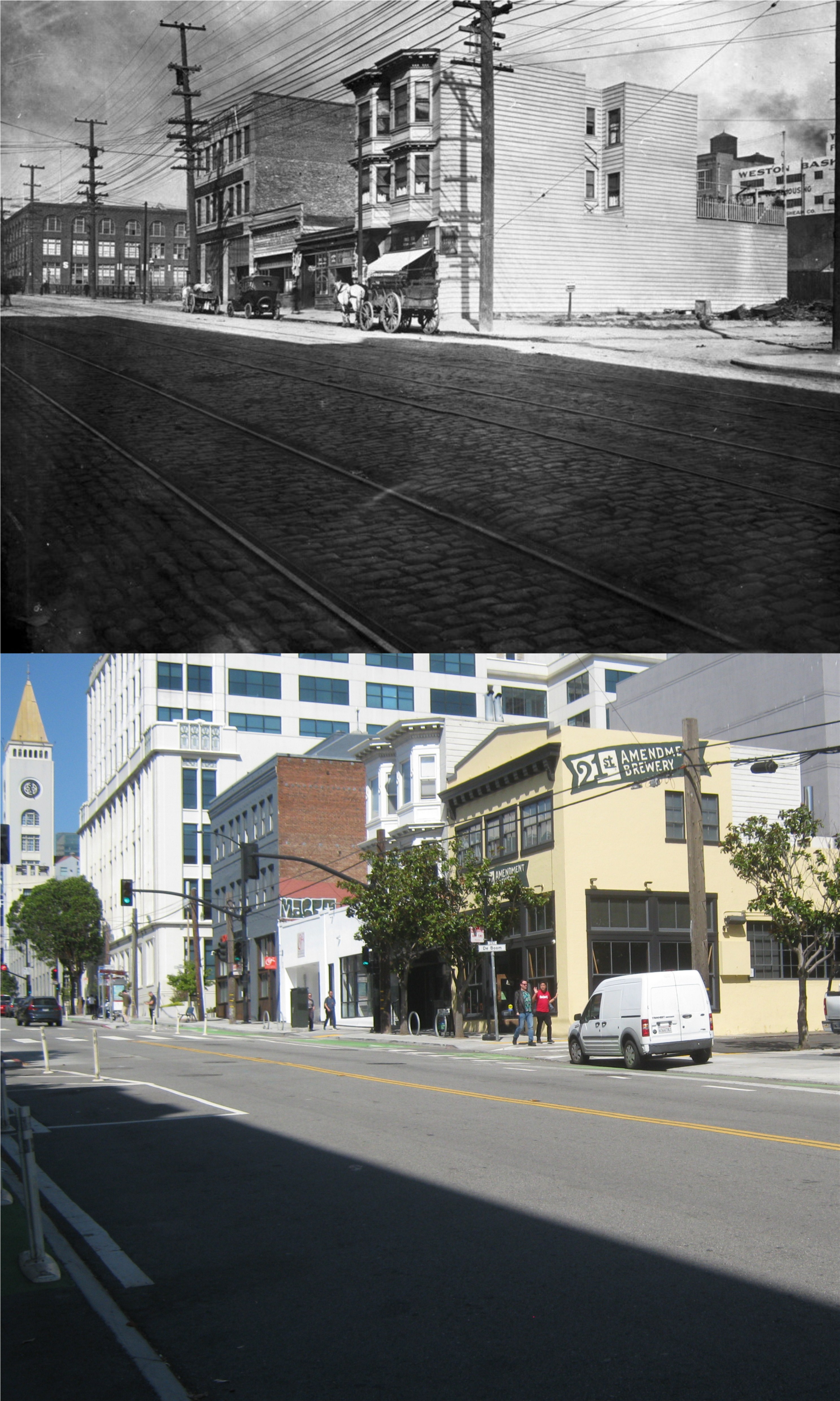
  

{Bruno ran west on Lombard, then turned to the right on Sansome Street.} Looking west on Lombard Street toward Telegraph Hill and Sansome Street which Bruno turns right on to in a vintage photo from the 1970s.(opensfhistory.org)


{He passed Vince’s hamburger stand at Chestnut, turned, ran west again. Damn! Chestnut was a dead end here. It banged strait into a cliff.} Chestnut Street still ends in a cliff here, as it did in the vintage picture from 1919, but you can get through on the right now if you’re on foot. (opensfhistory.org)

{He wheeled, ran around the Globe Flour Mills, crossed the railroad tracks on Francisco, and started up North Point Street. At Grant, the fog seemed suddenly heavier. To the left on Stockton and beat it between the two factories with the overhead bridge connecting them. The bridge looks like a crazy fake hanging up there in the fog–as if it couldn’t hold anybody.} These two close ups of David Rumsey’s 1938 aerial composite of San Francisco show the path Bruno is taking to try to reach Connie’s apartment. Bruno leaves the Embarcadero at Lombard, turns right on Sansome, and left on Chestnut, where he runs into the Telegraph Hill cliff. He doubles back to Montgomery Street, crosses Francisco to the Embarcadero, and heads north west to North Point. Bruno runs west on North Point, turning south at Stockton in the second Rumsey photographic map. The long gone overheard bridge on Stockton Street that Bruno passes under can be seen in the 1938 image. Bruno continues south on Stockton Street.


{It was ten minutes to nine and if she walked fast she would arrive at the movie theater before the second show started. She had been reading the paper and discovered that the Bella Union Theater was showing a foreign film.} However, when Bruno reaches Connie”s Telegraph Hill apartment to set up his alibi, she has gone to the movies. The Bella Union Theater was at 825 Kearny Street near Chinatown, seen in the 1970s picture from opensfhistory.org. The remodeled building is now the Self-Help Training Academy.


The 1948 Bella Union Program Advertisement here is from Cinema Treasures.


{The running was over. It was walk easy now. Make Progress, but saunter along with the tourists who cluttered the sidewalk from the cable car turntable to the restaurants on Fisherman’s Wharf. The Neptune, Sabella’s, Sabella-Latorre, and Alioto’s—one fish joint right after another, all burning up a lot more electricity than they had a right to be doing.} So in the book and film, Bruno heads to Fisherman’s Wharf from Connie’s apartment. Although his reason for going there is a little vague, this will become a perfect hide out for Bruno.


{Hold it! A damned squad car had stopped at the filling station across the street! One of the uniforms was getting out. Sure, Bruno, wait around to see if he’s just going to fill his tank, then you won’t have to worry about running. You’ll have a free ride. There will be the sound of those new-type handcuffs, the kind that hiss like a rattlesnake instead of just click. Move, Bruno. Get going.} Bruno passes through what they used to call Fish Alley on Jefferson Street, and notices a police car at the filling station across the street. The modern picture is Fish Alley in 2025, and like the movie image, the filling station can be seen across sample of cooked crab in the vintage 1950s picture. The parking lot for Boudin Bakery occupies the spot now where the old gas station was located.


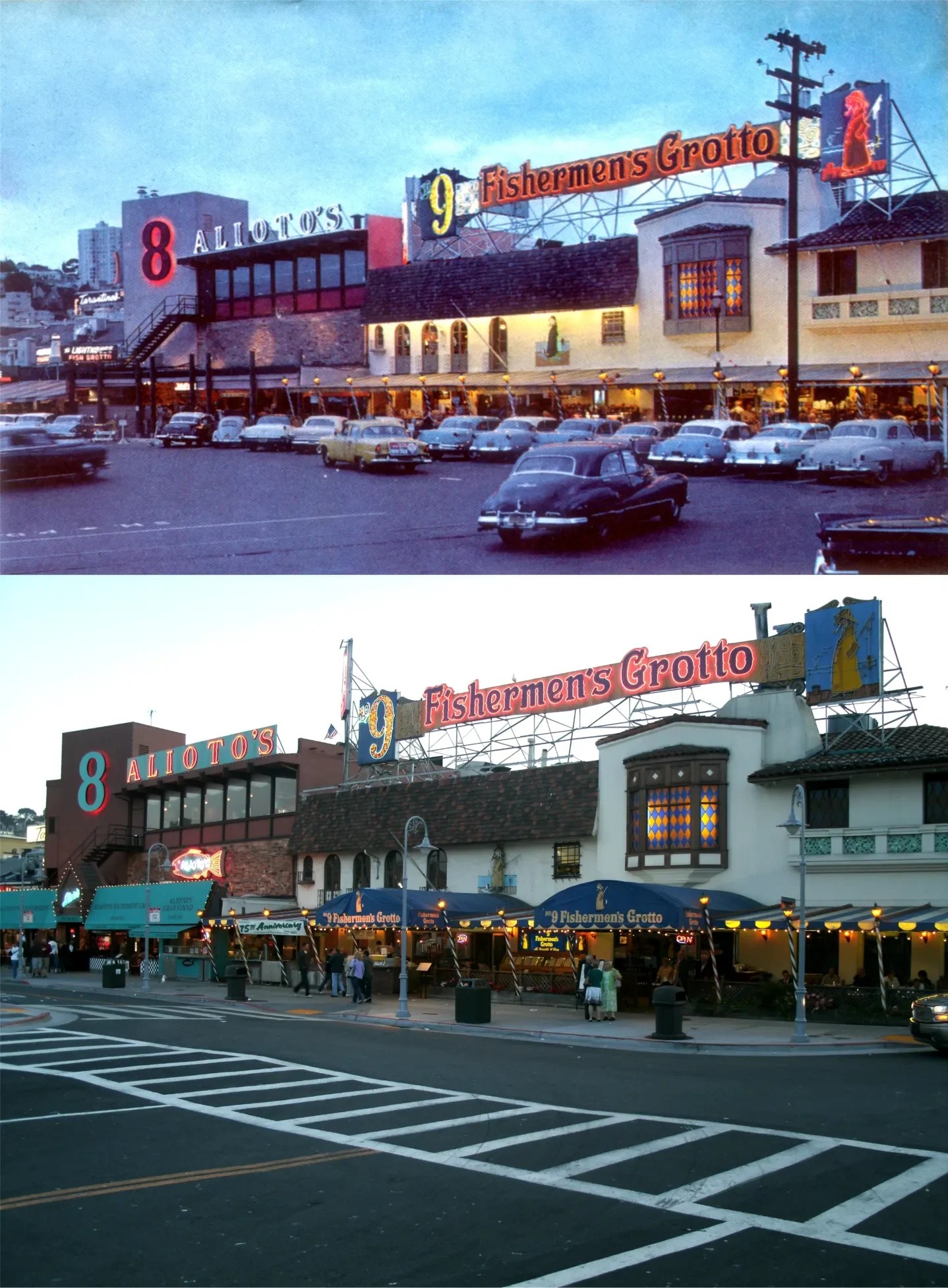
{He took a few carefully controlled steps along the lighted window until he reached a narrow alleyway between Alioto’s Restaurant and the next one in line. He took a quick look at the filling station and the motorcycles just crossing Jefferson Street. There was no time to care where the alleyway might lead. A guy couldn’t figure everything. Not when they were breathing down your neck.. Bruno took a deep breath and turned quickly into the alley. He bumped along a line of garbage cans, and started running again.} Bruno makes a dash through the alleyway between Alioto’s and #9 Fishermen’s Grotto (both now closed) and falls asleep from fatigue on one of the fishing boats in the Boat Lagoon. From here on out, Bruno will find friendship and affection toward and from a fisherman who befriends him as a Police Lieutenant named Kelsey searches throughout San Francisco for him, and Connie will have to make up her mind on how far she wants to go to protect Bruno.

{She led the way up the winding street that led to Coit Tower, breathing deeply of the fresh morning air. They reached the little park at the top of the hill. In every direction the city spread out beneath them, the hills rising and falling until they met the sea and the streets still wet with the morning fog. The wharves fingered out at the base of the city and then there was the bay looking metallic in the sunlight. The islands in the bay still floated in the fine mist and beyond them the mountains had begun to take on depth and substance.} Connie walks up to Coit Tower from her apartment, as Lt. Kelsey walks along with her questioning her as to Bruno’s whereabouts. In an image from Nathaniel Rich’s book, that I did not see in the film, Connie, portrayed by Shelley Winters, is gently being persuaded to tell him where Bruno is hiding. The scene during the opening credits that I showed at the beginning of this post was filmed from here. The bottom photo here is what you see of the waterfront from the Coit Tower parking lot today.


A now and then tour for the Texans

I had relatives from Texas last Tuesday and Wednesday, and I was honored again to be allowed to suggest their itinerary. I took my pictures over the two days, and when I was back in the office after their visit, I scouted up vintage pictures on the internet that came as close to mine as I could find. As I have mentioned in past posts, now and thens are more difficult to match up than then and nows because you don’t have control over getting a perfect line up, obviously, but they’re still fun to try. (Thumbnail images)


On the way to Treasure Island: I had to do a little cropping to get this 1983 photo from opensfhistory.org to come close to my picture. My apologies for cutting out their watermark.


The old Administration Building on Treasure Island: We had a lot of fun here. It’s hard to find many vintage pictures of this building, one of the three surviving structures from the 1939/1940 Exposition. This vintage picture is from the 1950s. (ebay.com)


Huntington Falls at Blue Heron Lake (Stow Lake) in Golden Gate Park: The vintage picture is a circa 1910-1915 postcard of the falls from the UC Berkeley Library Archives.


The alleys of Chinatown, like Ross Alley in my photo, are fun to explore. I saw a site on the internet that read that this prior to 1906 picture that I have in my archives was taken in Ross Alley; it’s possible. The site also gave credit to Arnold Genthe; this I don’t know about, I’ve never seen it in his collections.


High above Fisherman’s Wharf on the SkyStar Wheel Ride: We got pretty far up, but not as far as the old postcard from the 1960s. (ebay.com)


Back to Chinatown: It was nice of the musicians to let him sit in, particularly since he couldn’t play one note. Still, his playing was better than my singing would have been, so I kept quiet. (ebay.com)

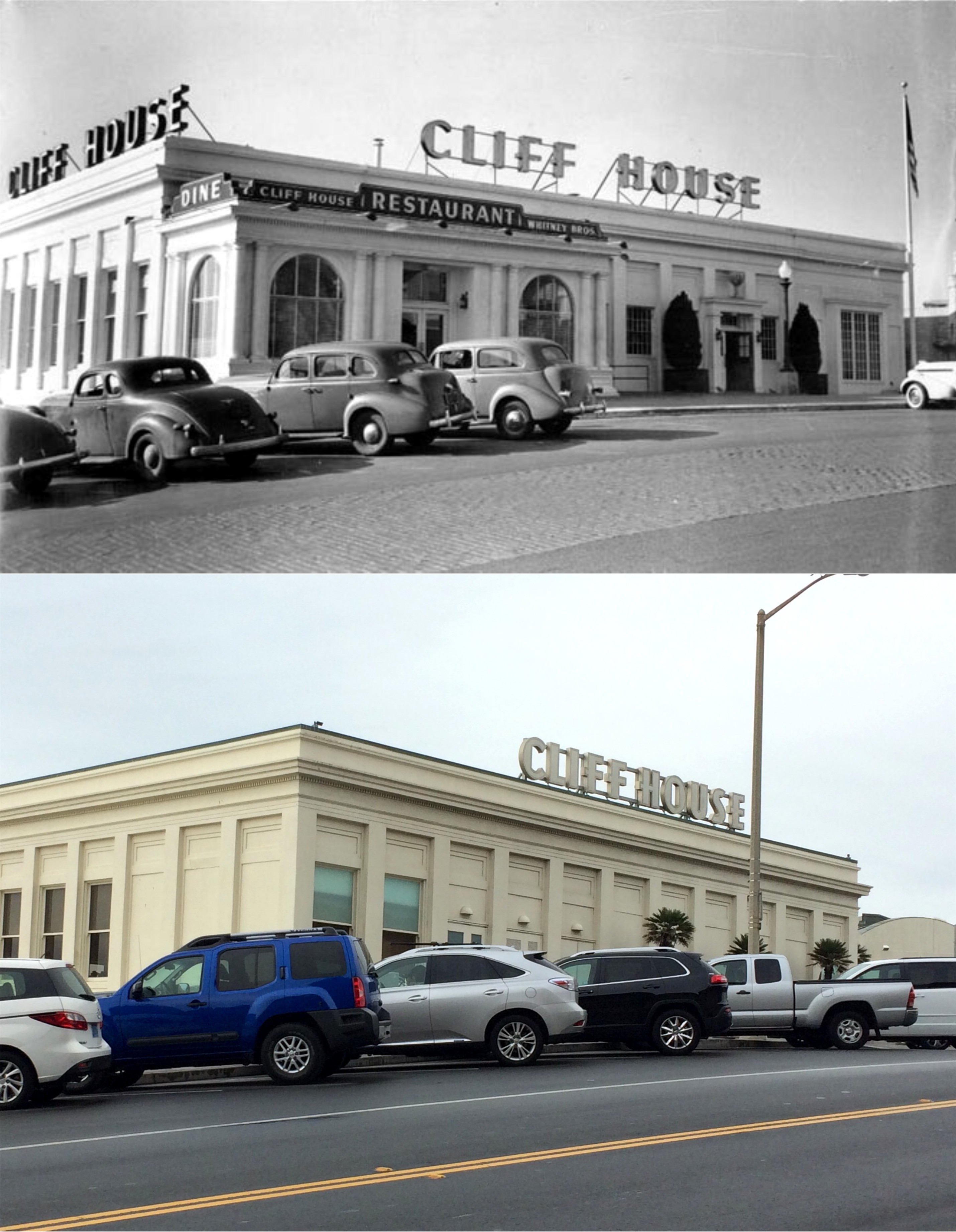
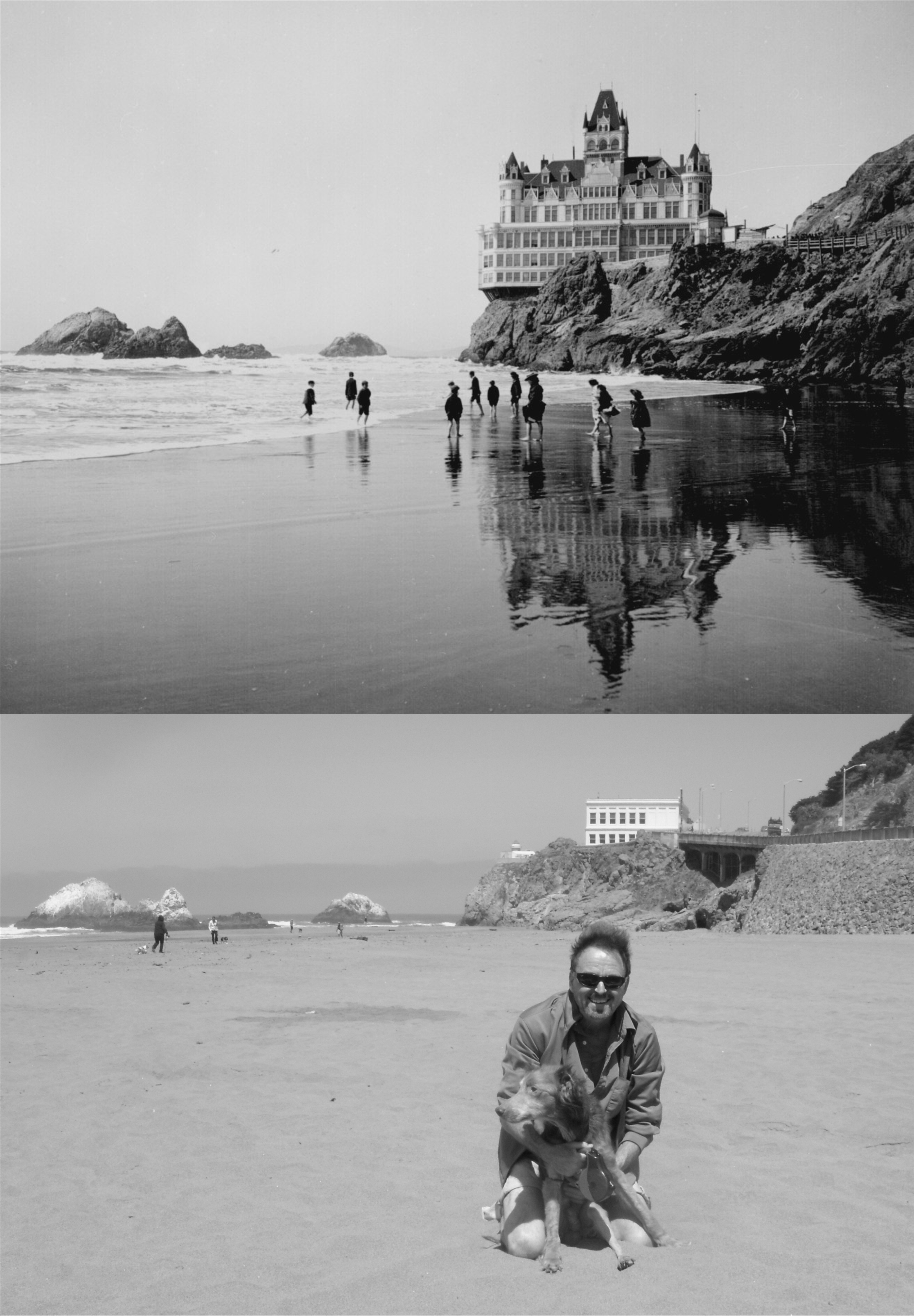
Aw, I can’t take credit for this vintage old Cliff House jigsaw puzzle, only the modern picture. Class is where you find it.