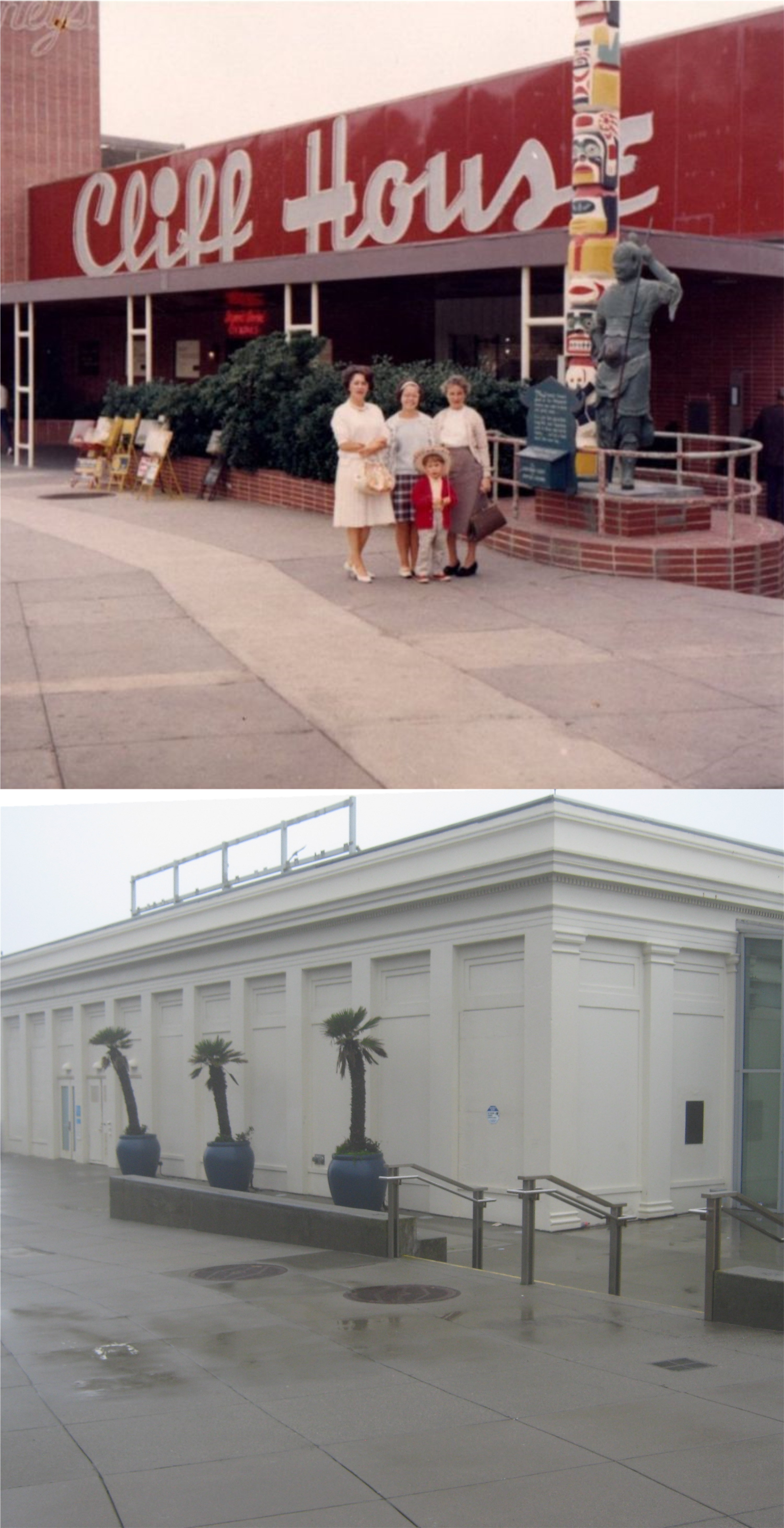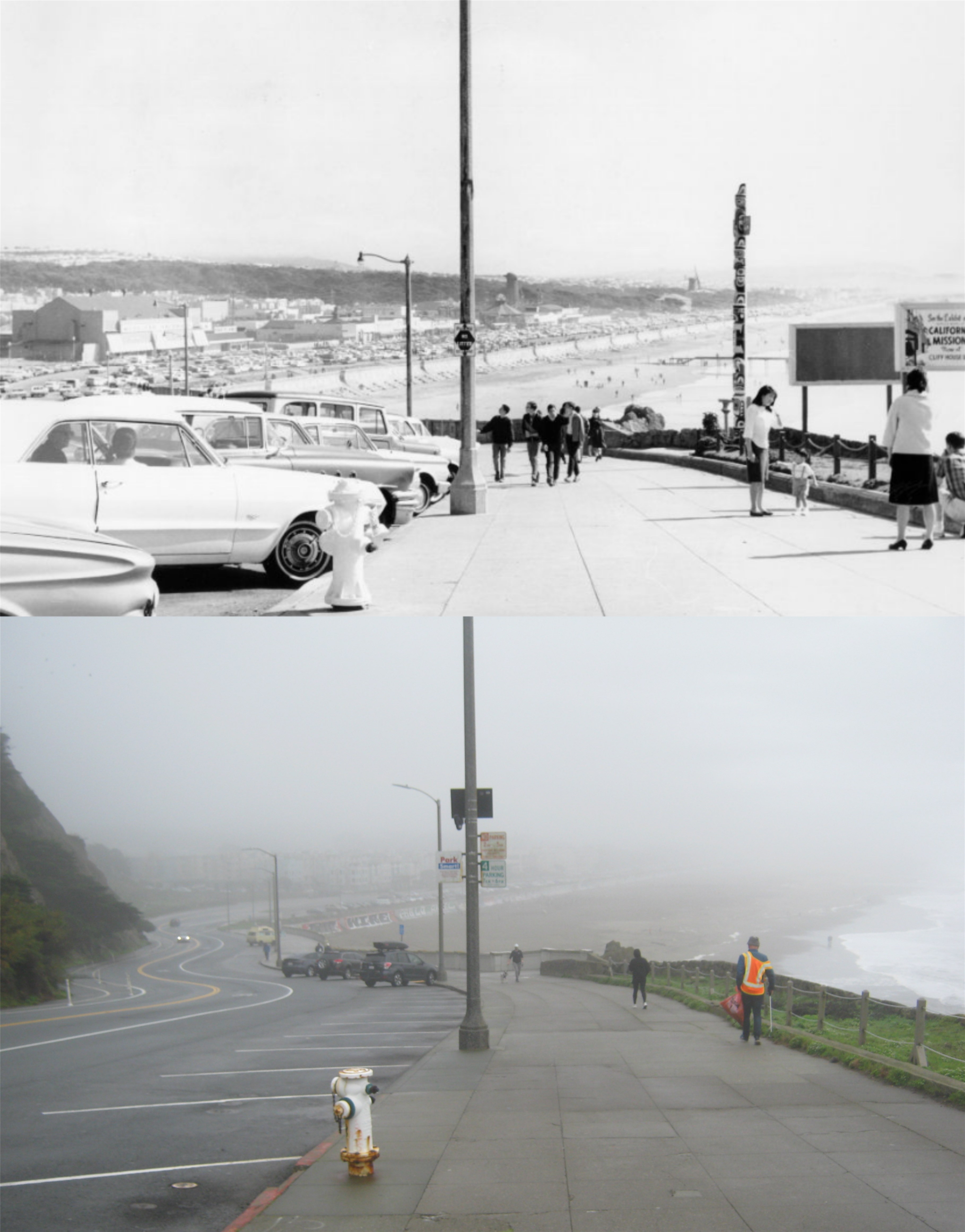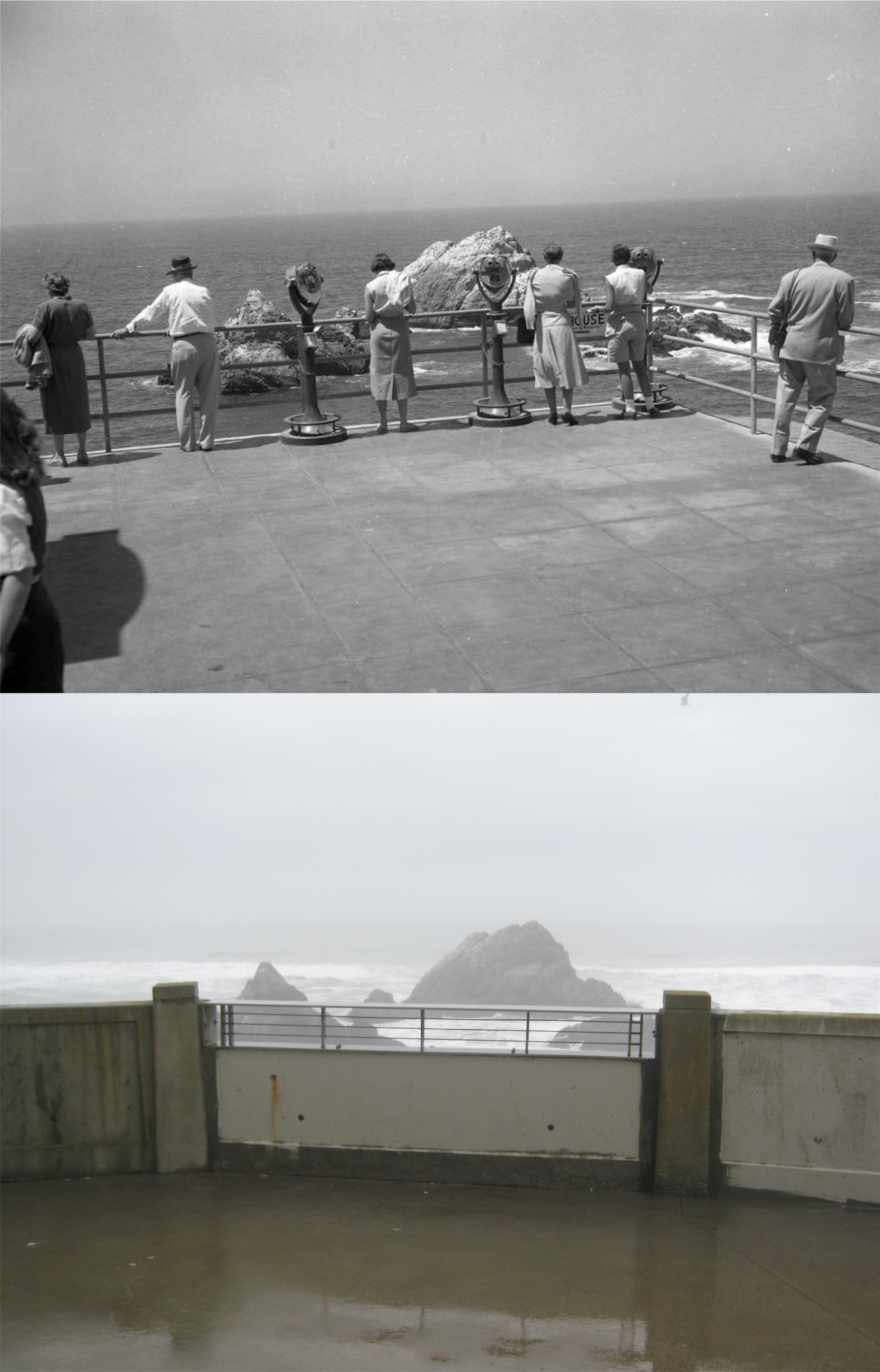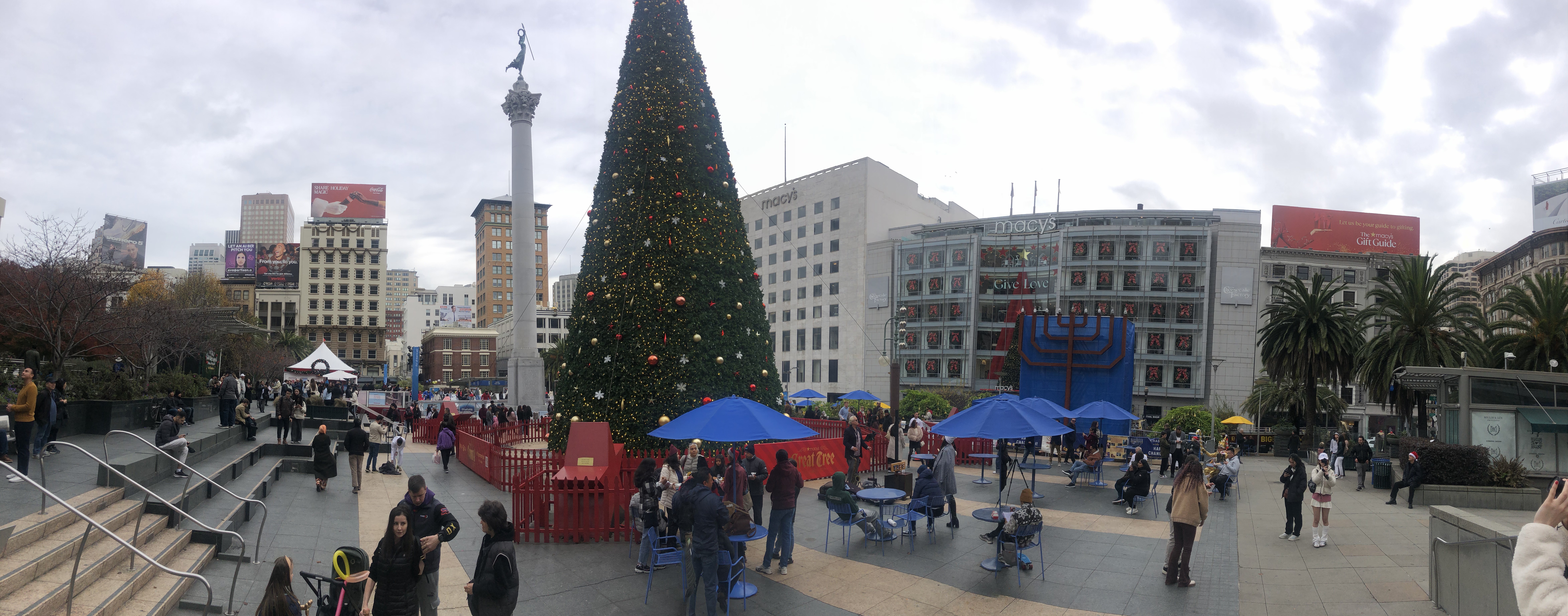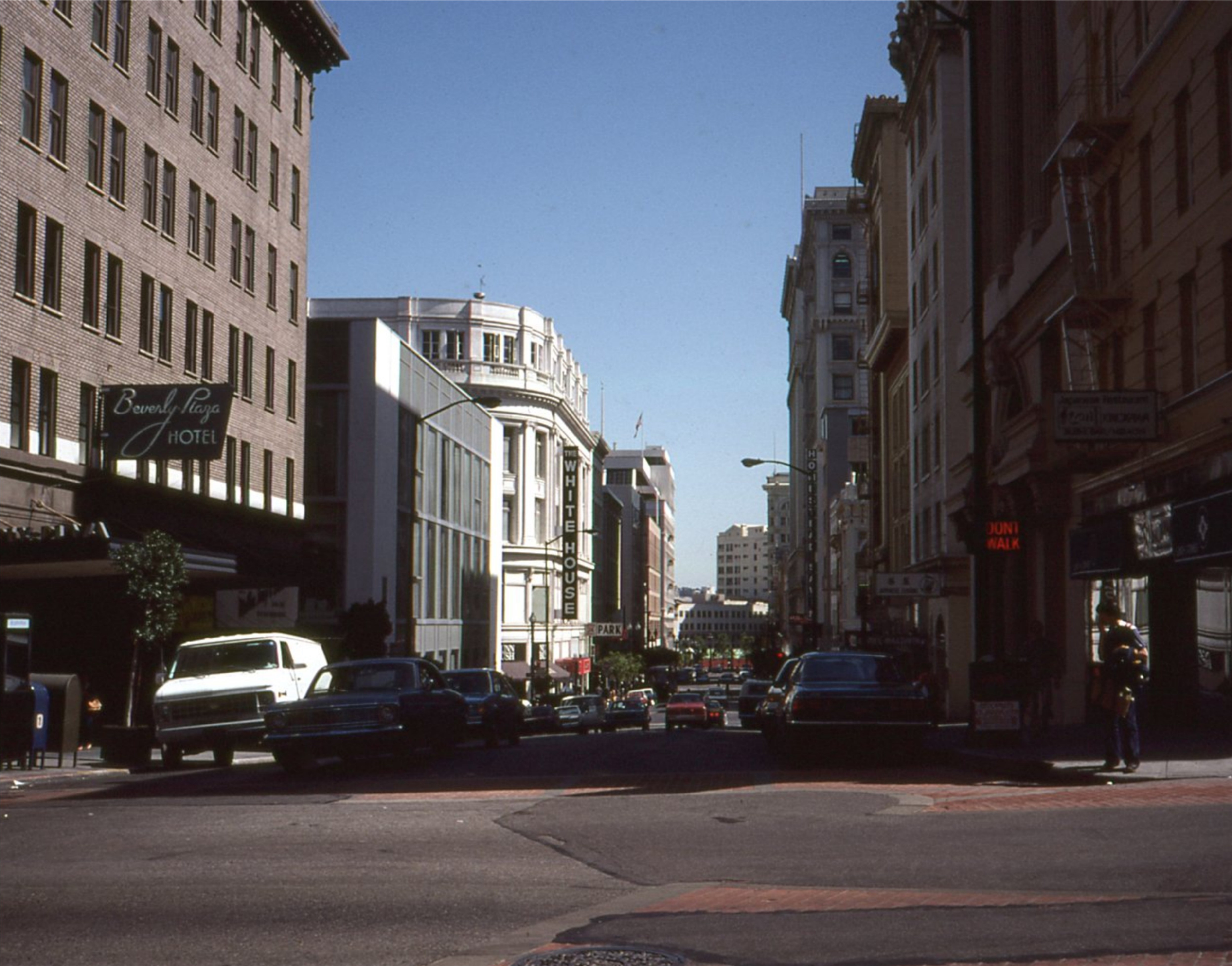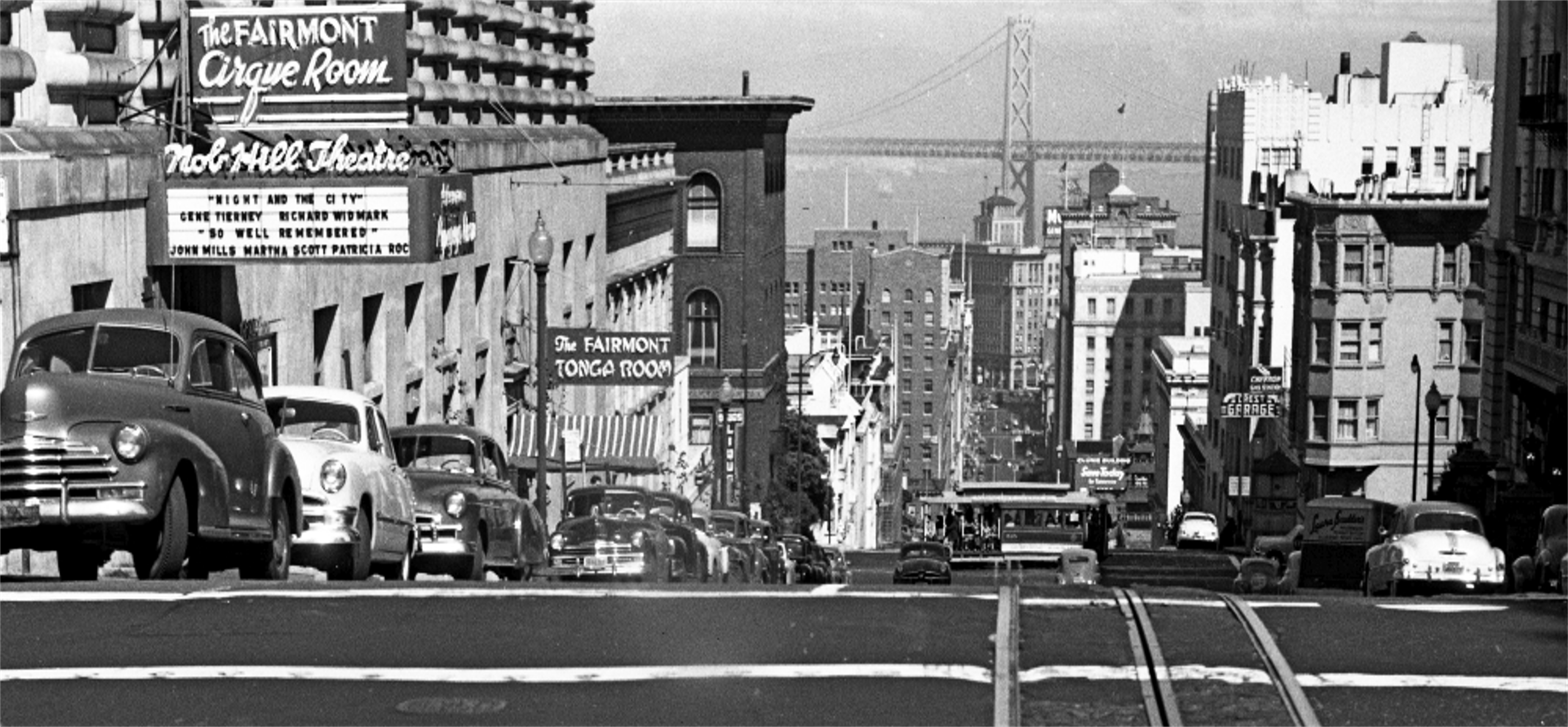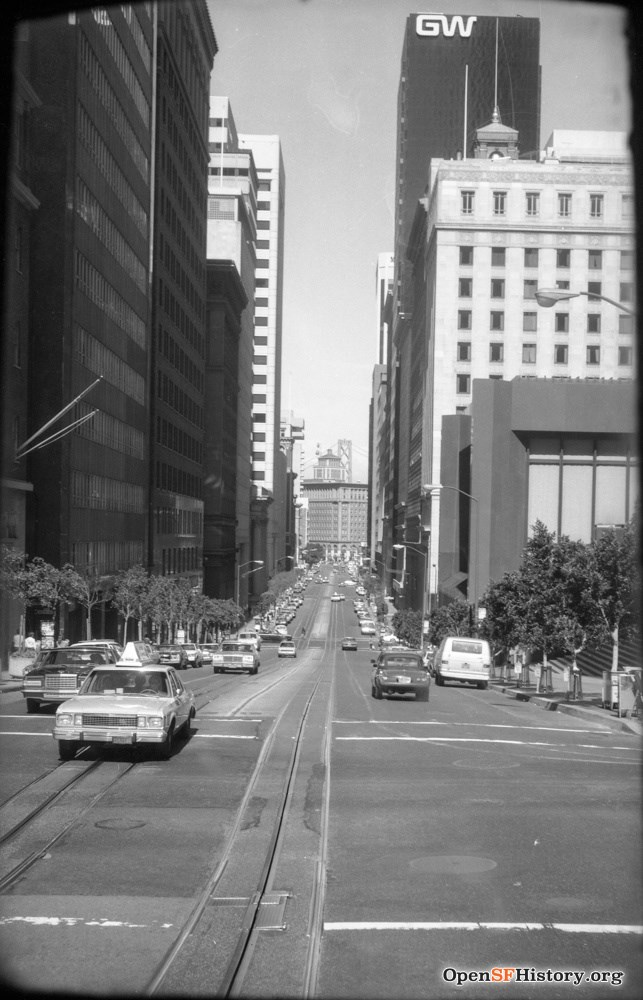
Union Square getting ready for Christmas, 2024

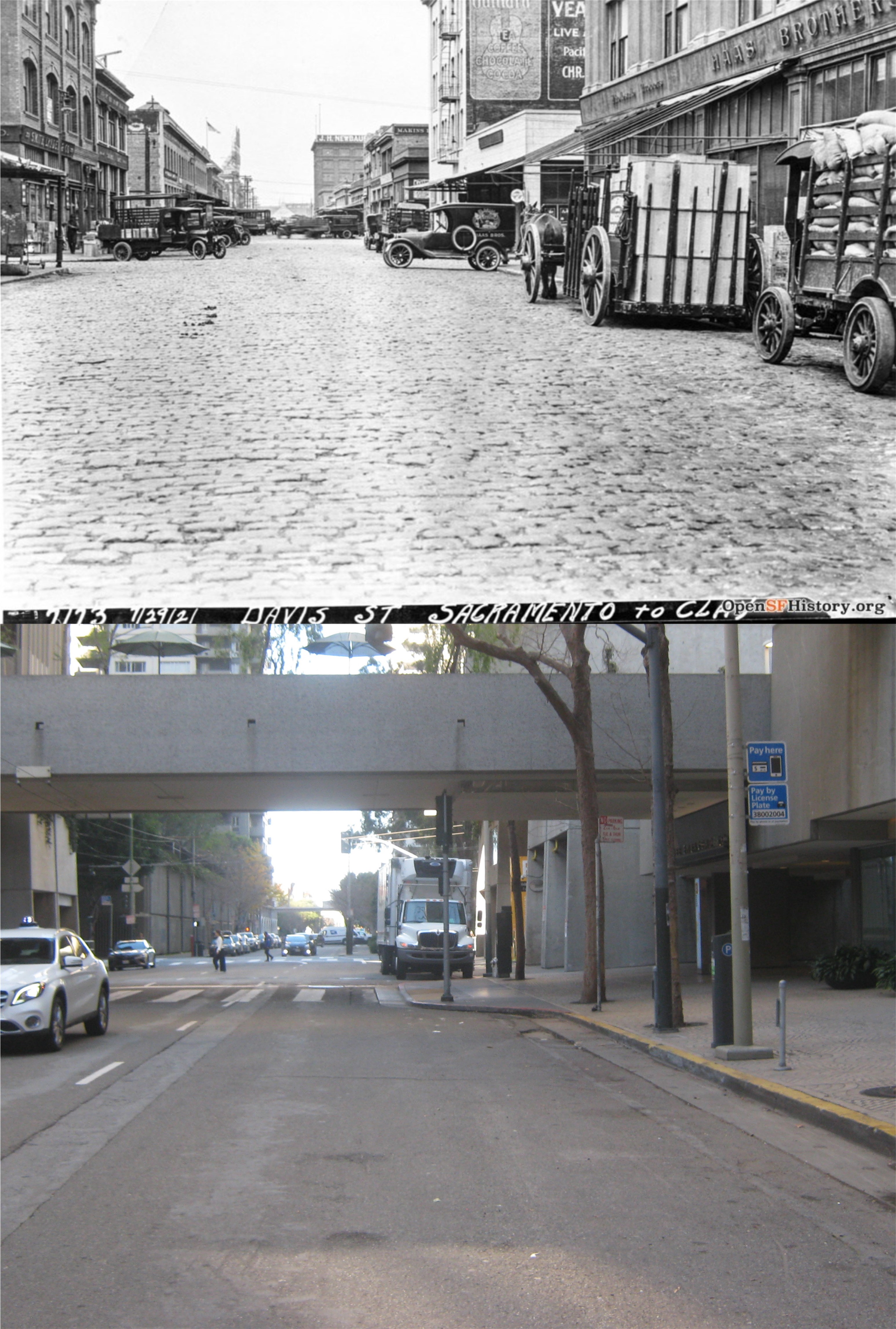
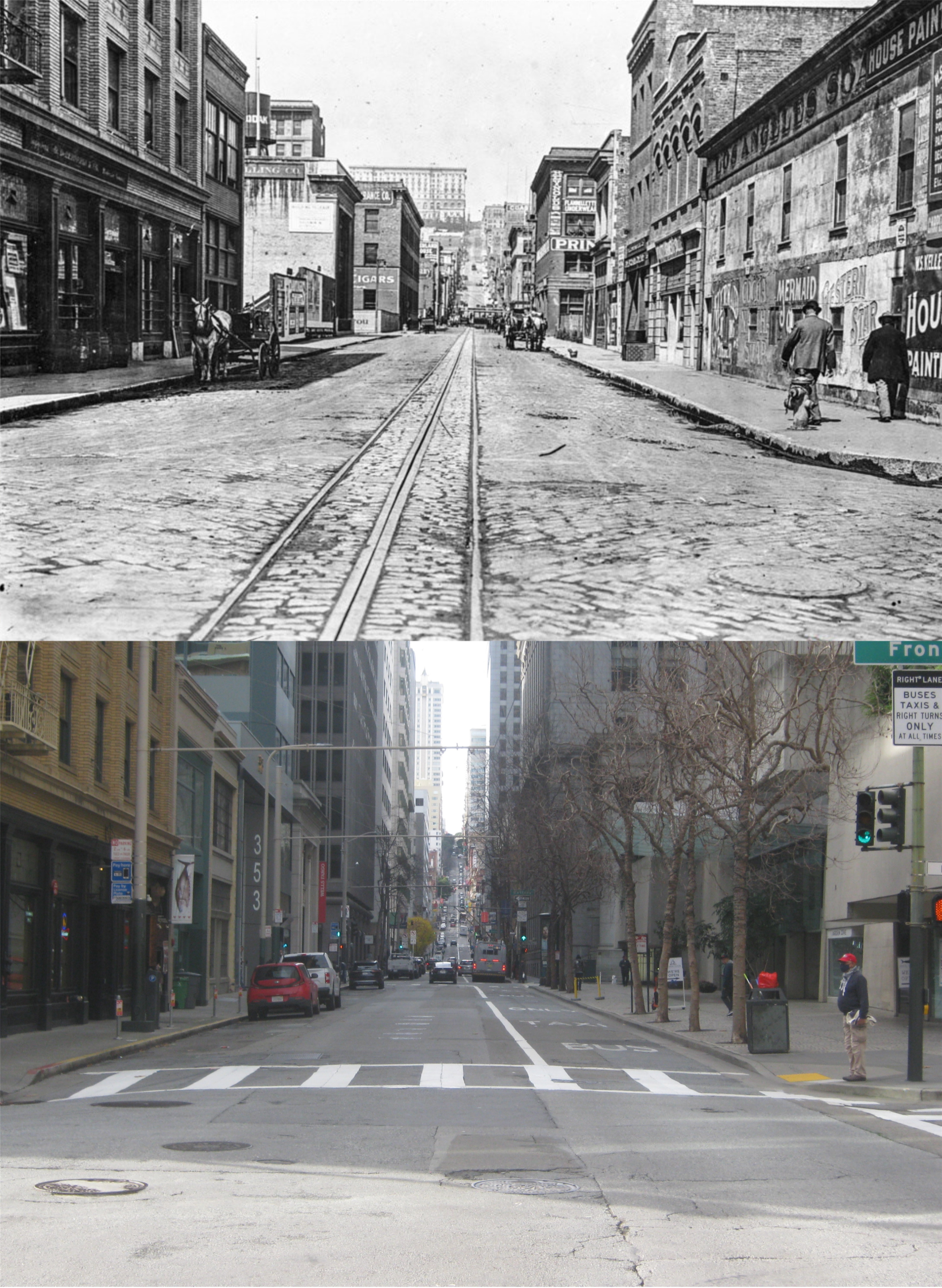
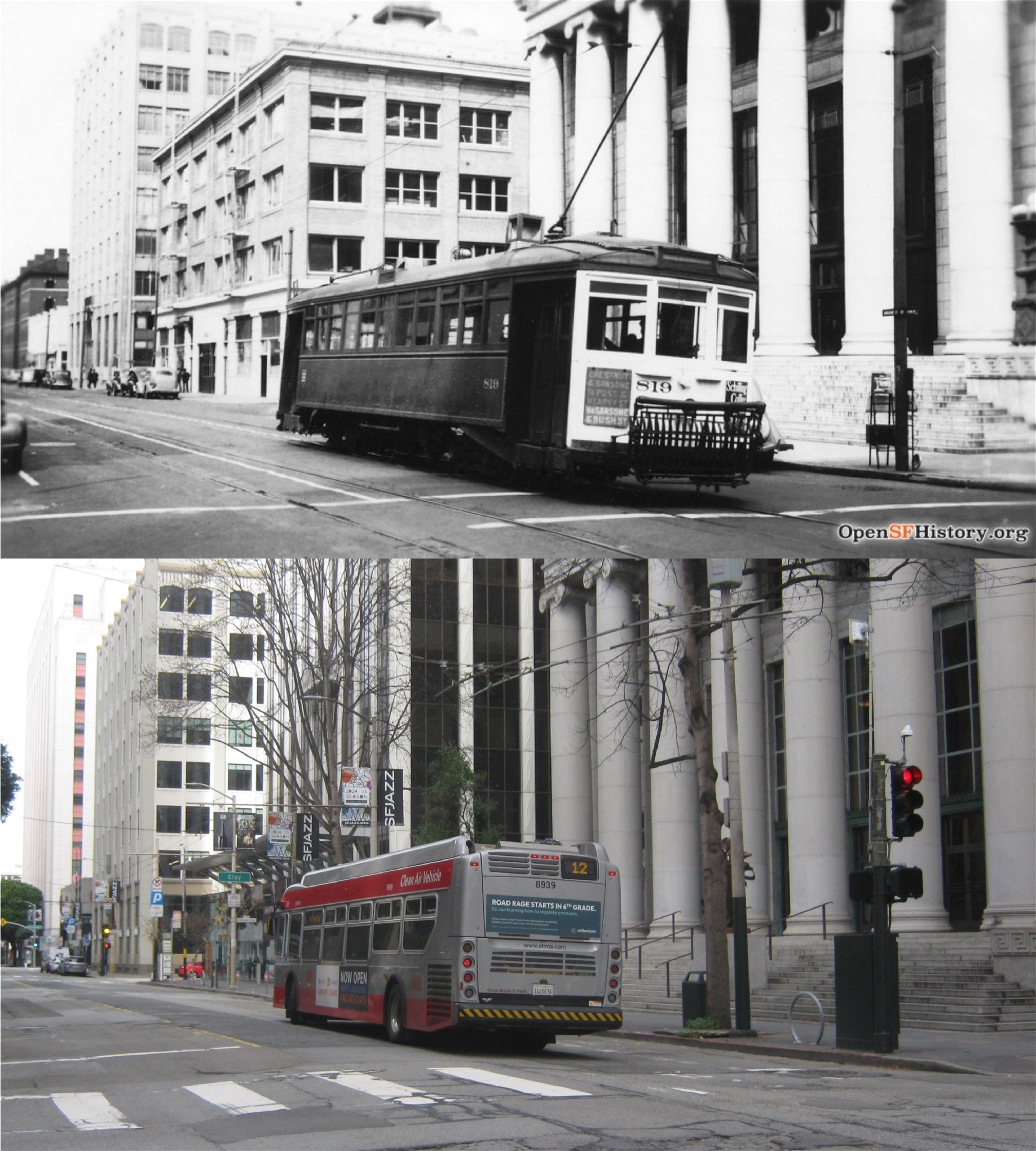
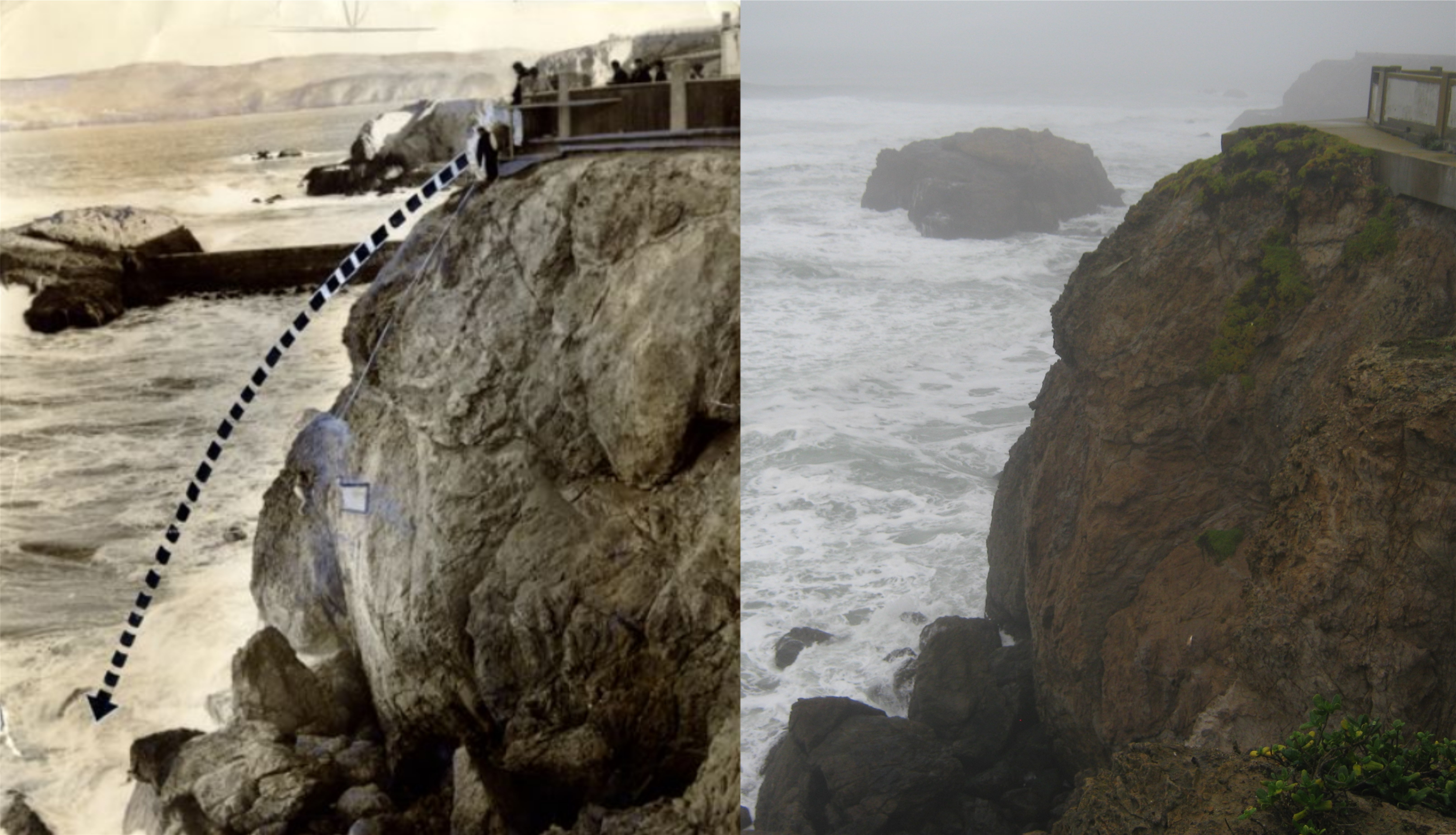
Union Square is all dialed in for Christmas again, and Friday will start another Winter Walk, where parts of Stockton Street and Maiden Lane are closed off and carpeted for foot traffic only. I went over there last Saturday to do some updates around the Square of some old pictures I found on the San Francisco and UC Berkeley Library Archives. (Thumbnail images)


The northwest corner of the Square: Looks like an art display going on. The kid probably didn’t enjoy it much; kids have more fun in Union Square nowadays.


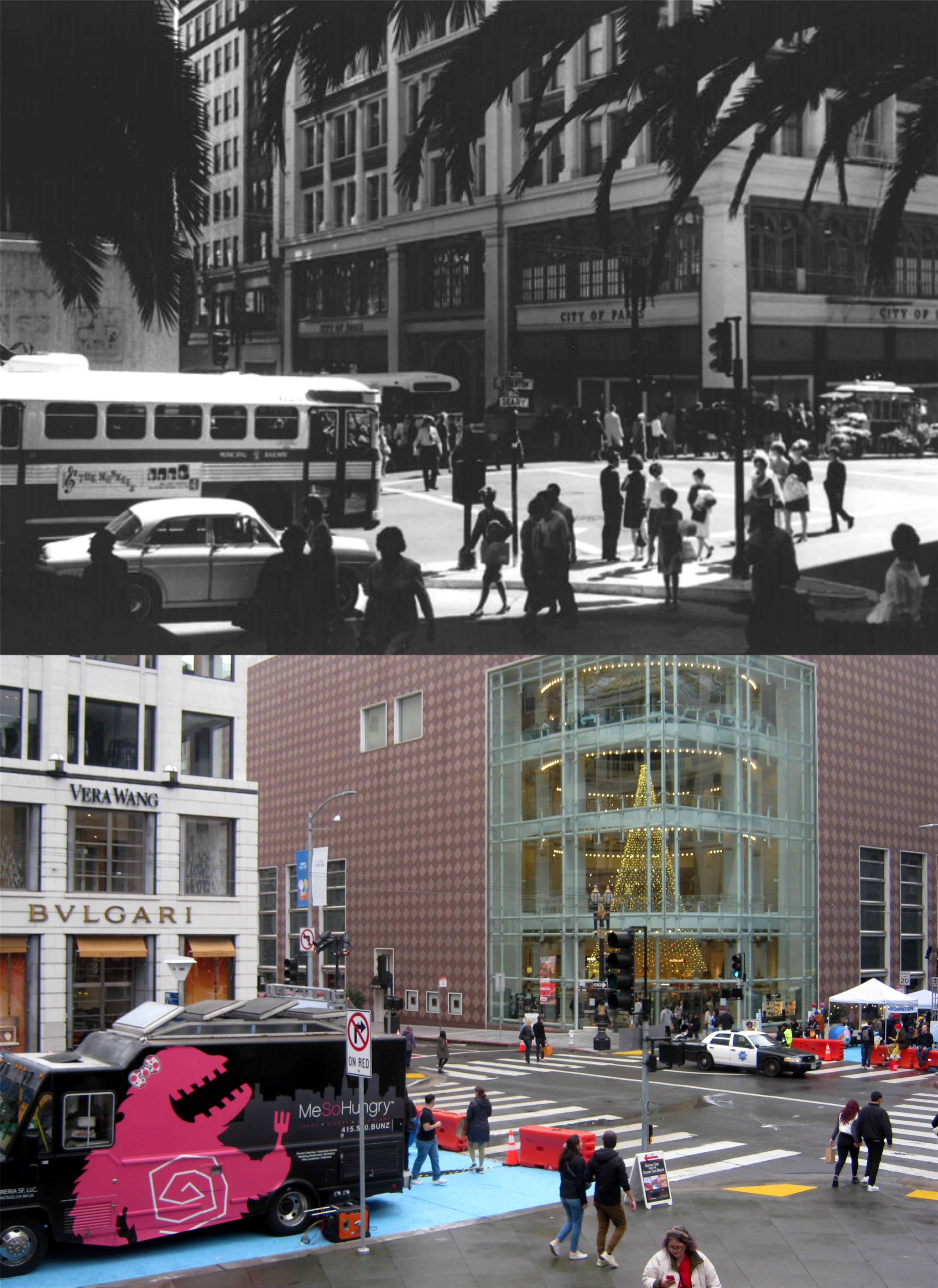
The northeast corner: Yeah, he’s digging the art displays. The Apple Building is now where the Plaza Hotel was. Lots of police presence, which doesn’t bother me at all.


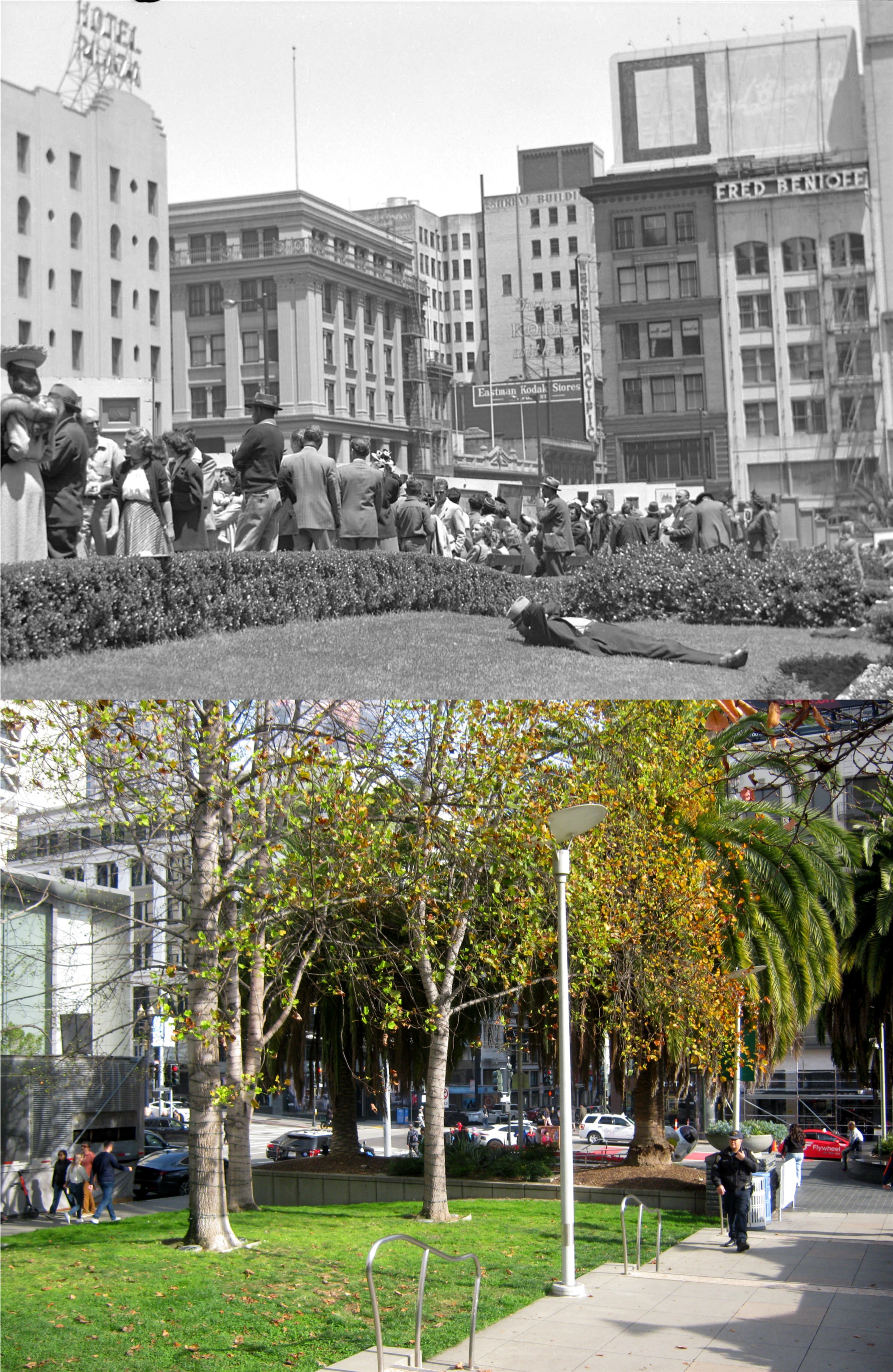
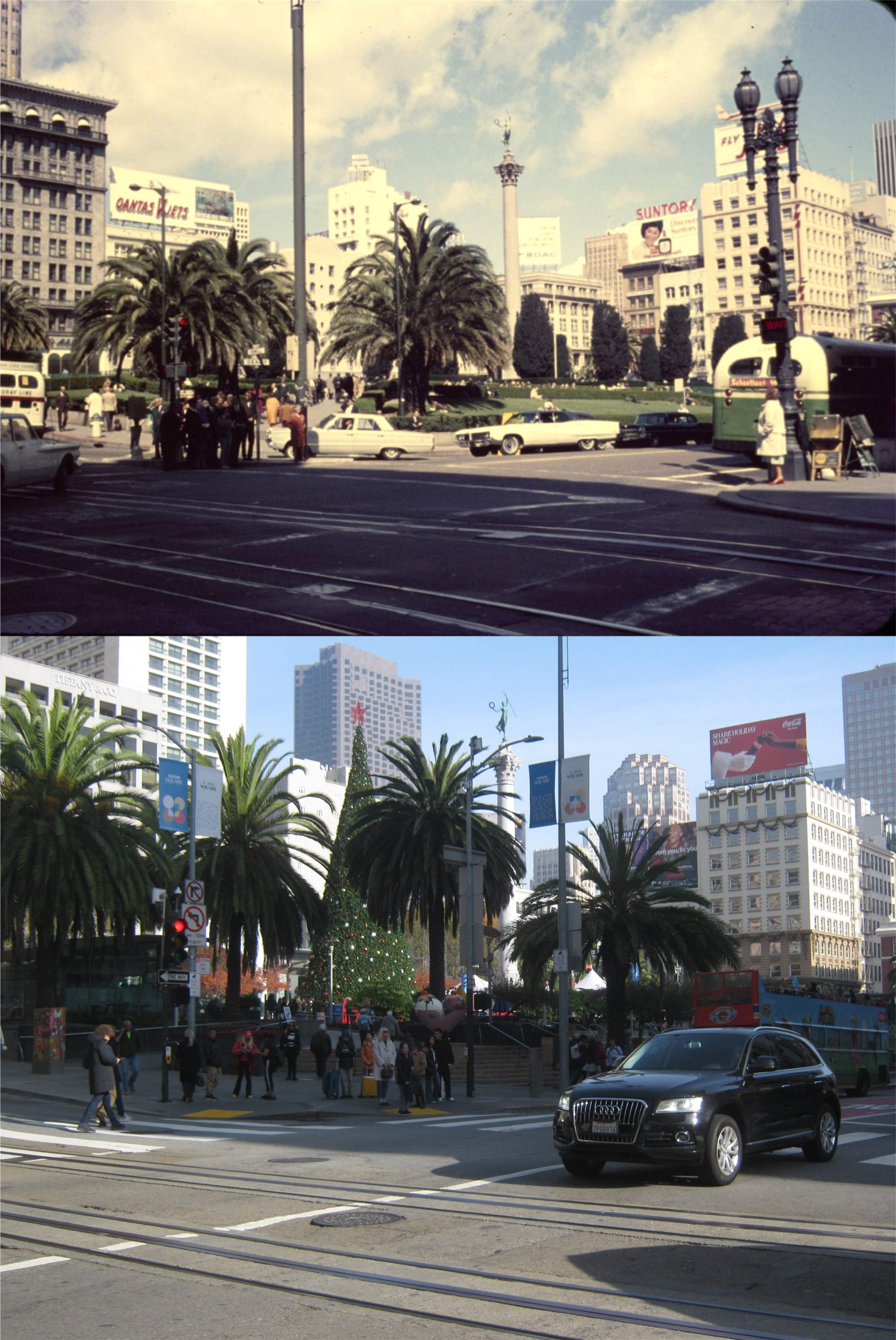
Looking west toward the St. Francis Hotel; looks the 1950s: The United Crusade, are they still around?


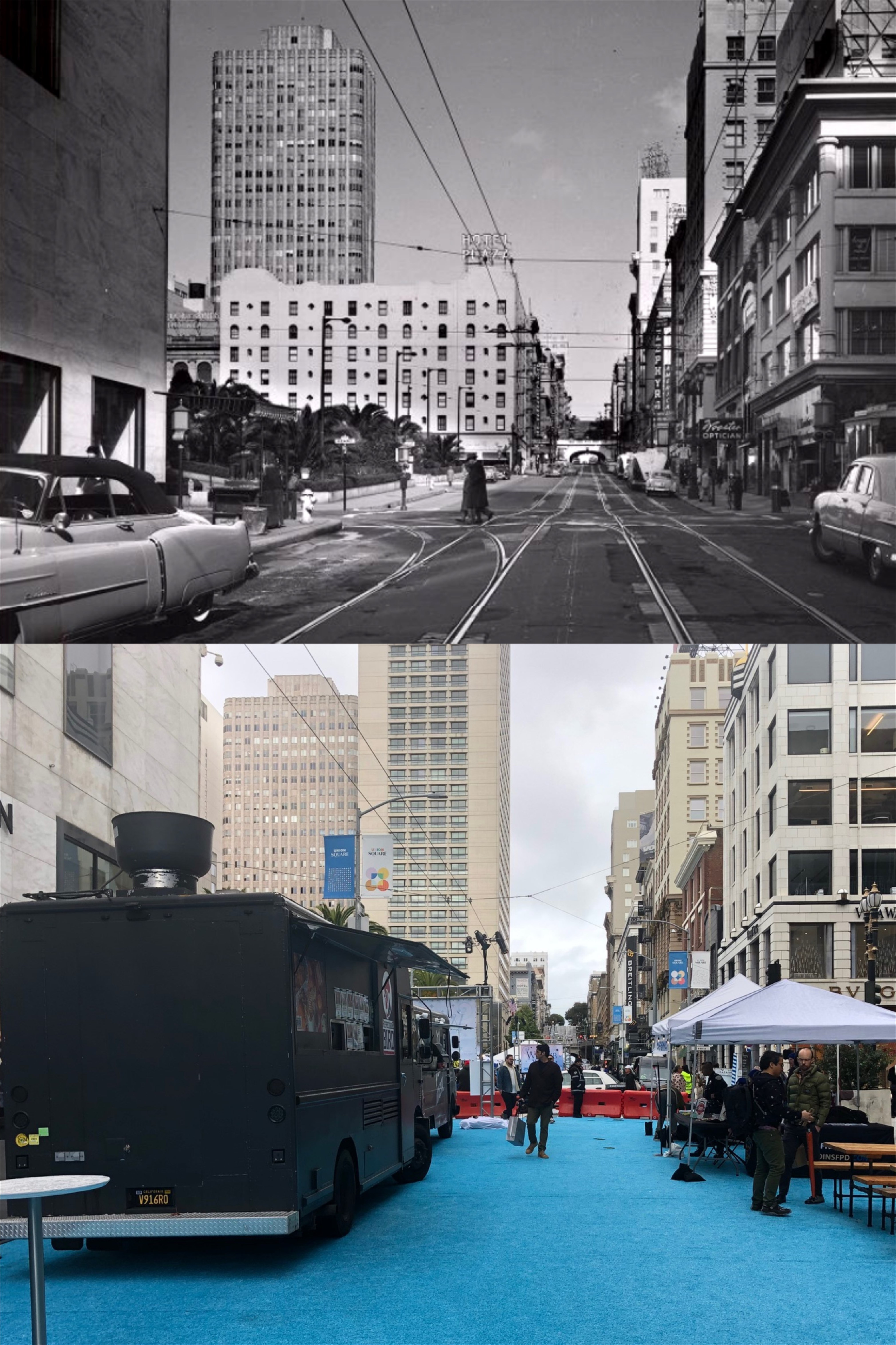
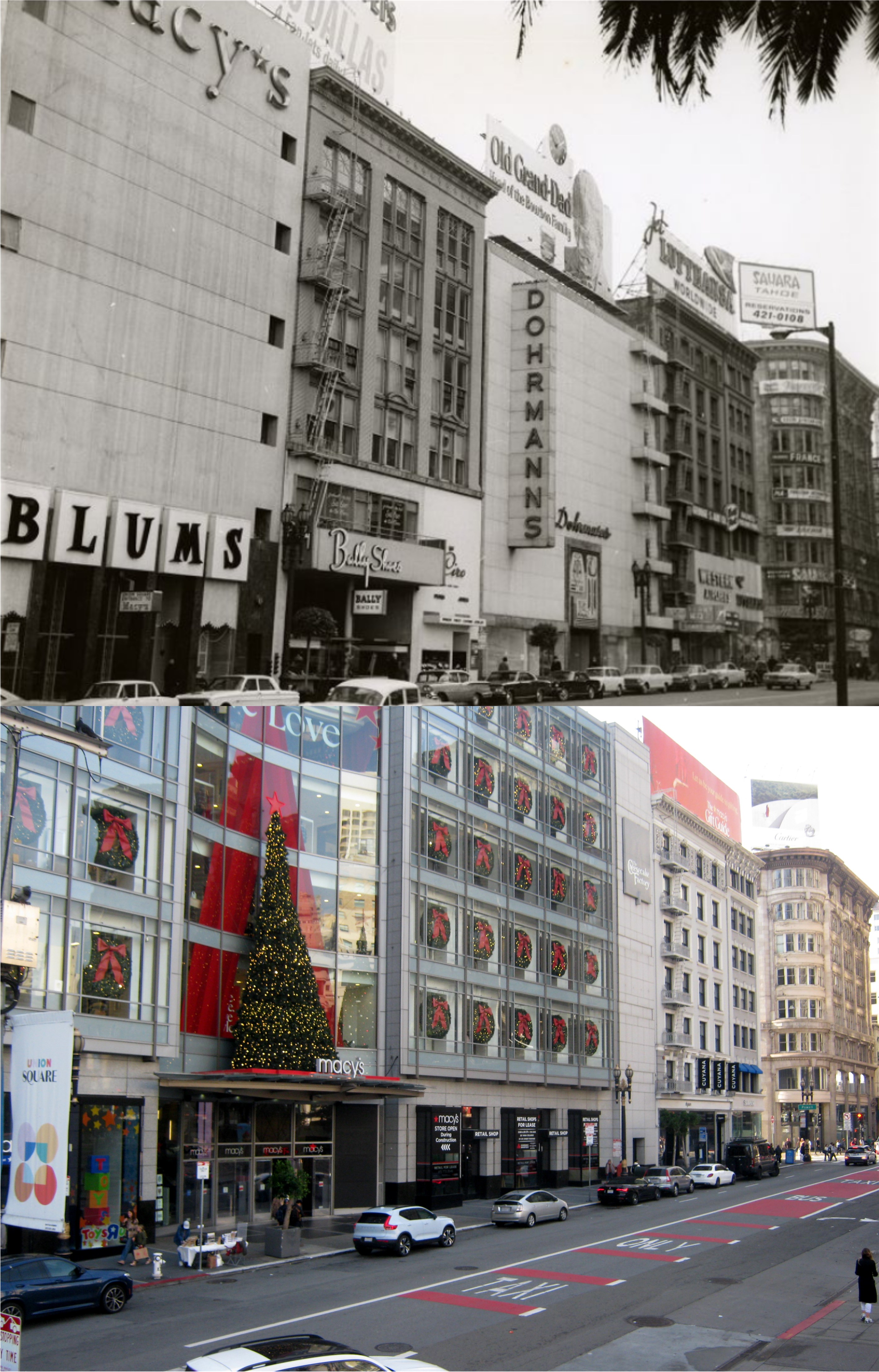
Looking down Geary toward Powell: I remember BLUMS.


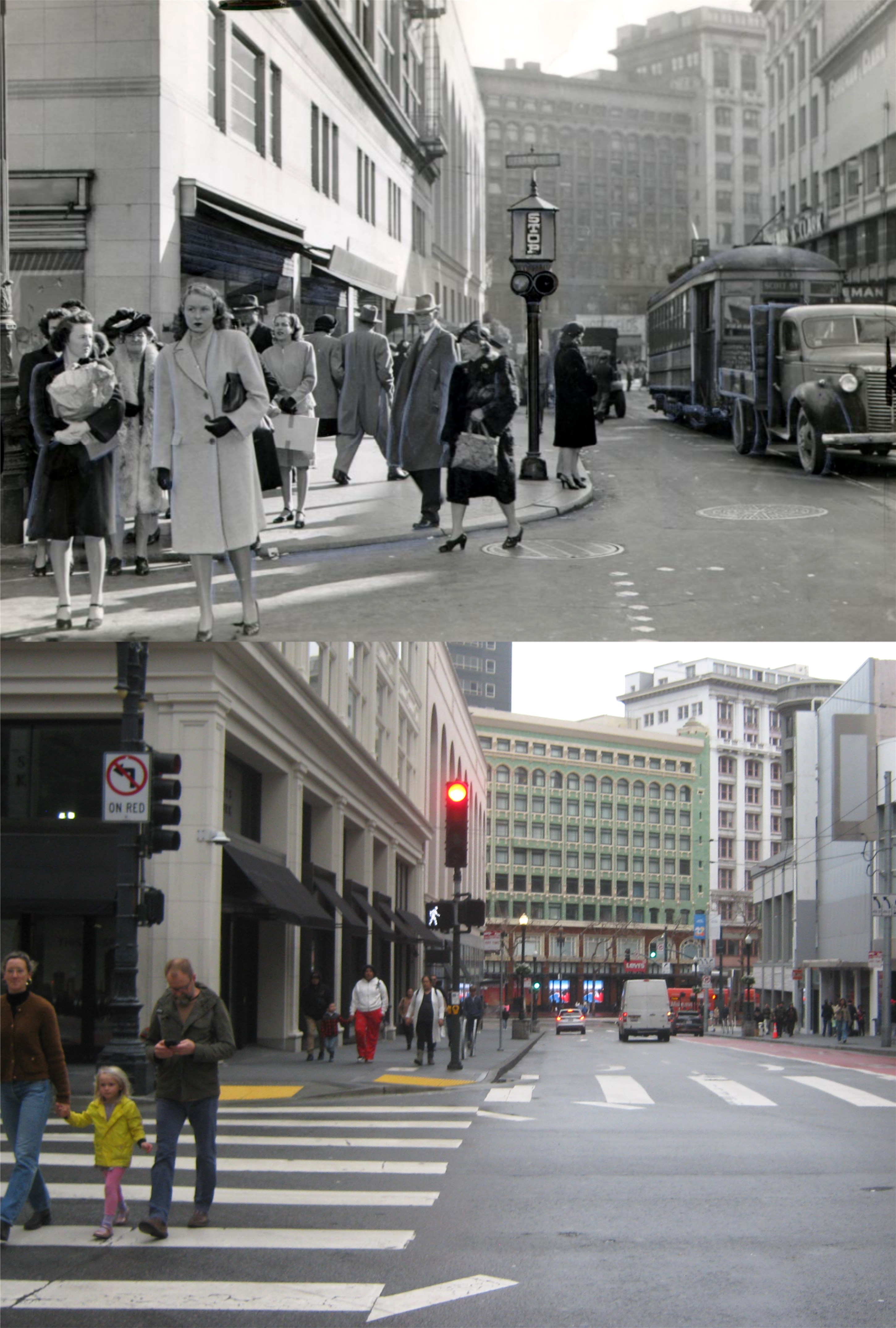
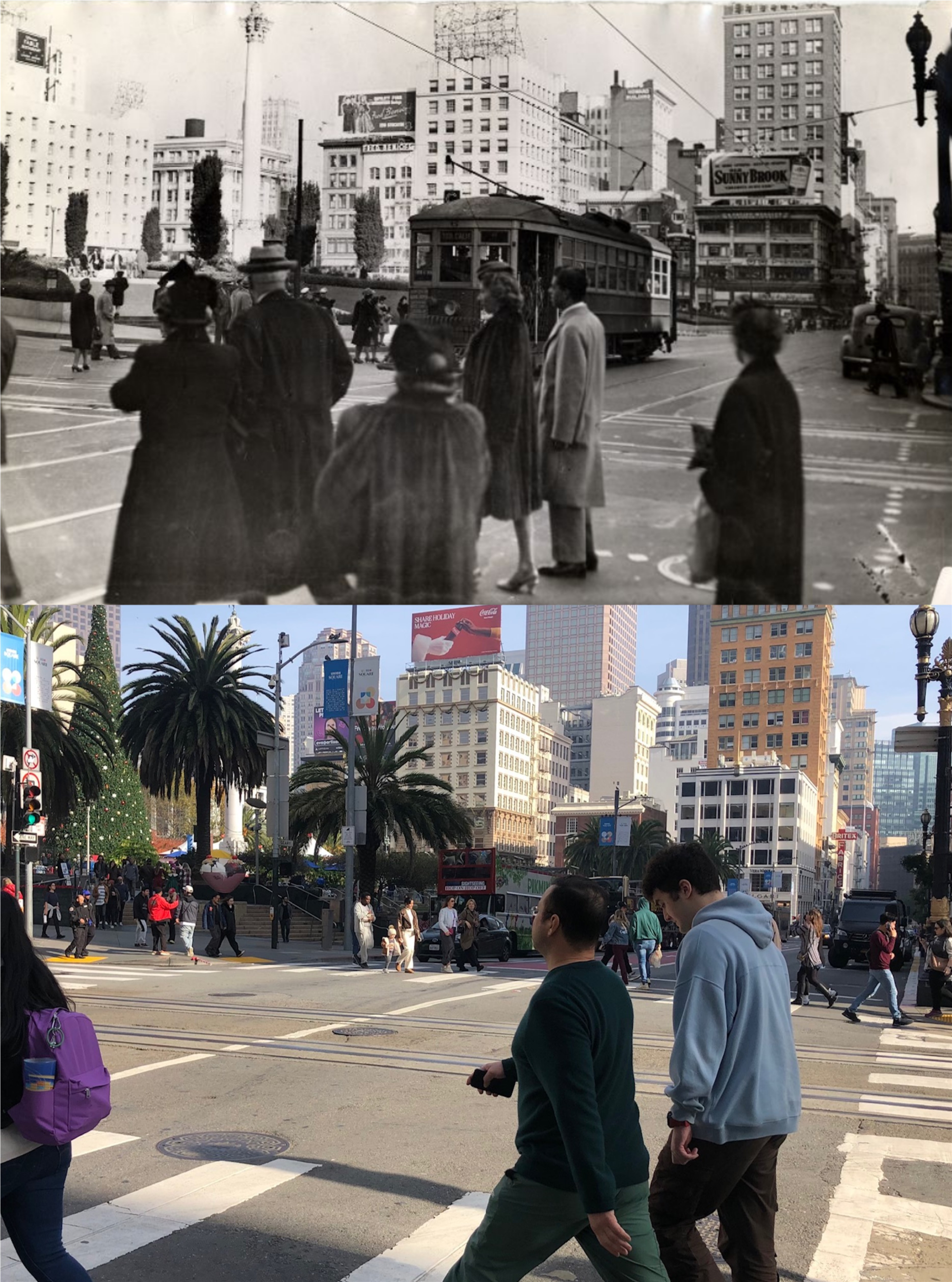
Looking toward the southwest corner of the Square from the corner of Powell and Geary during the 1940s:

Same corner as the previous picture during the 60s: I can recognize a Valiant on the far left, and a ford Fairlane, I think.


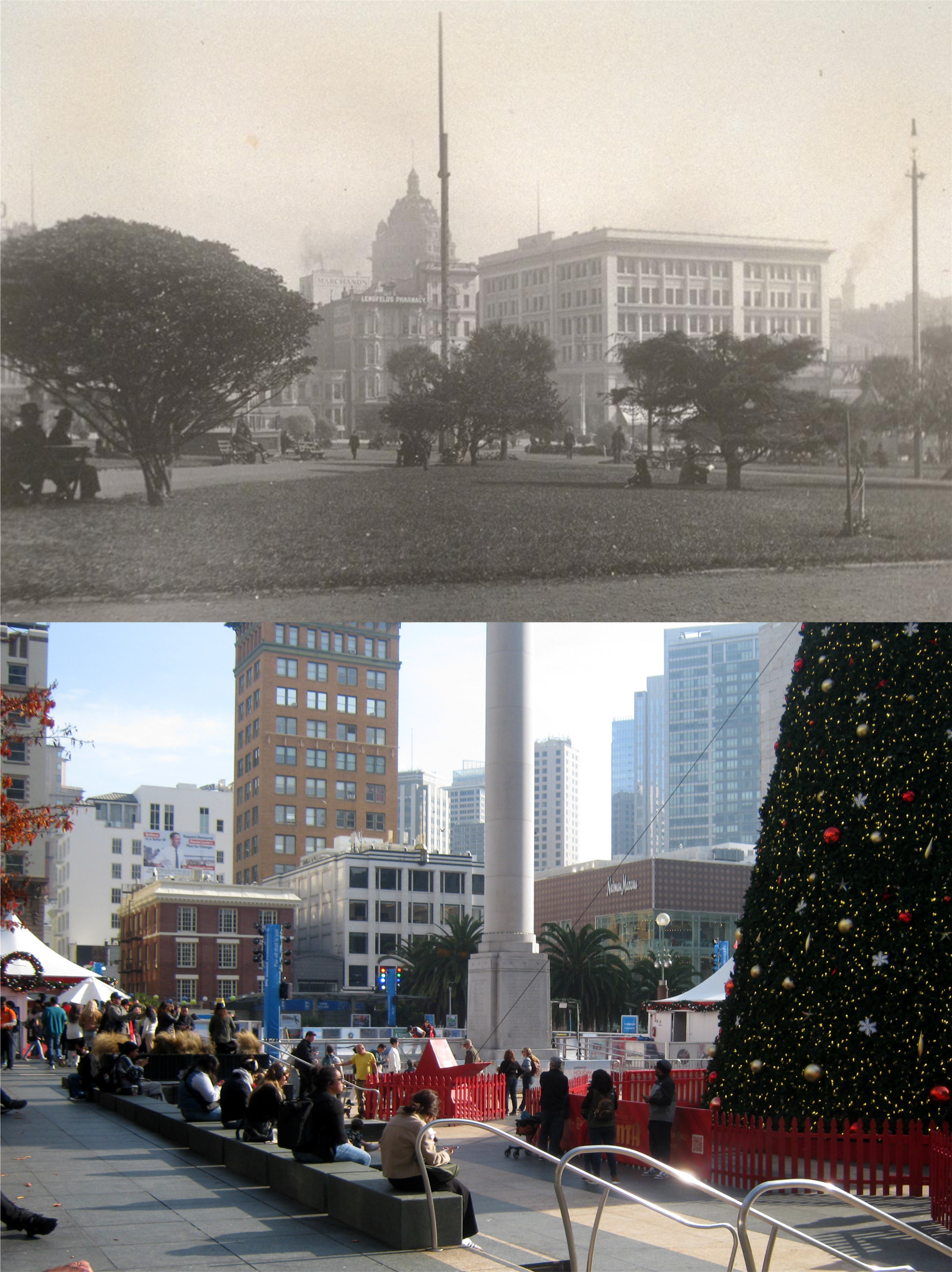
A rare picture of Union Square looking toward the southeast corner of the Square in 1898, before the Dewey Monument was installed in 1903: The domed building in the center is the Call Building. You can just barely make it out in the haze without its dome to the left of the Dewey Monument. The City of Paris Department Store is the large building on the right in the vintage picture, and is where Neiman Marcus is today.


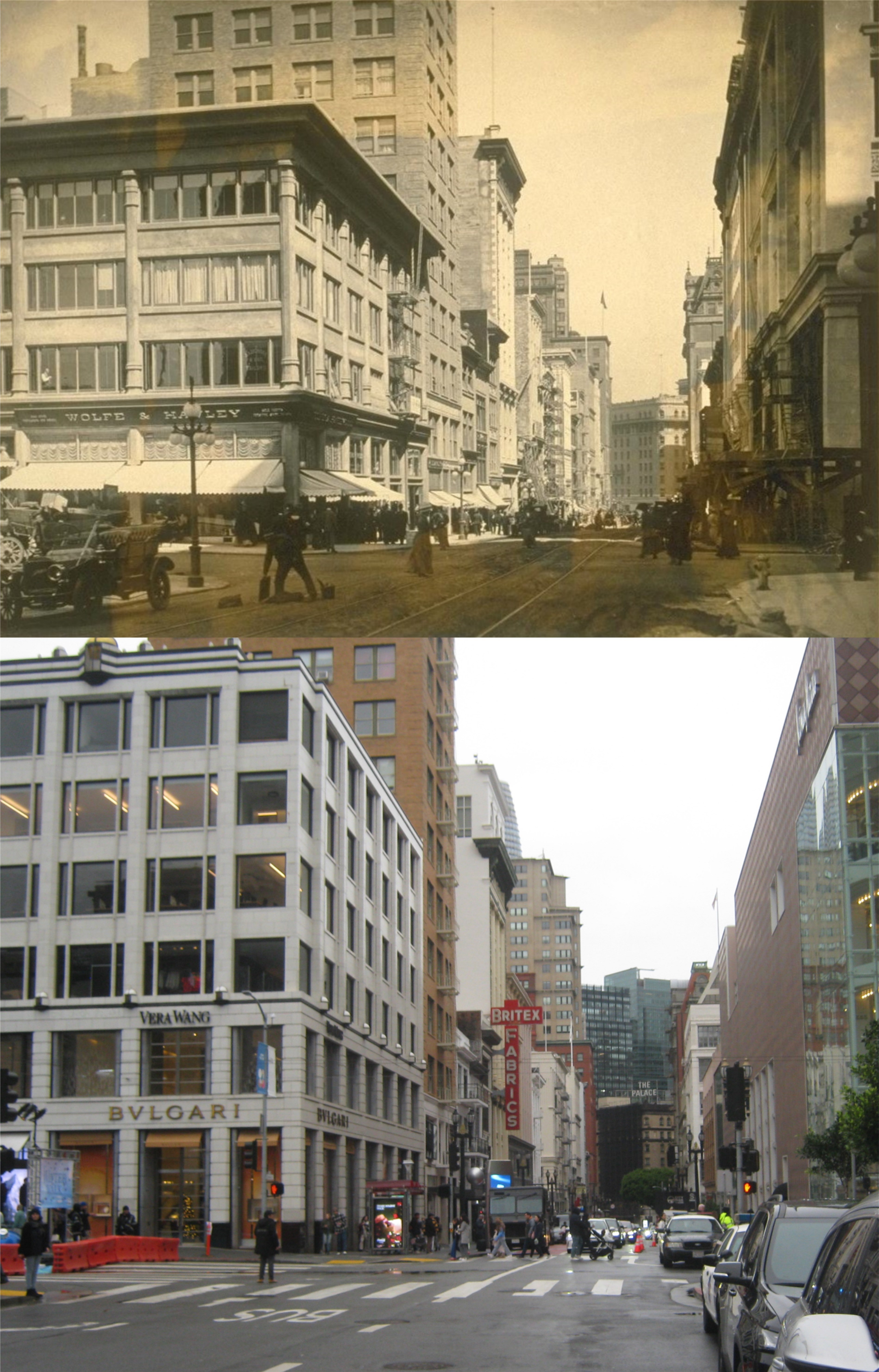
This old photo looking southeast down Geary from the UC Berkley Library Archives lines up pretty good with a picture I took from the Westin St Francis Tower a few years ago before they closed the tower elevators to the public.. It shows the rebuilding of Downtown San Francisco after the 1906 Earthquake and Fire, so it was probably taken in 1907. Some of the surviving buildings from the earthquake can be seen in my picture. The steel frame of the Whittell Building, I think it’s now called the Grace Building, is on the left. The Gothic roof of the old Mutual Savings Bank Building at Market and Kearny Streets, to the right of the Whittle Building, is in the center of the modern picture. The Call Building on the right was modernized and had its dome removed in 1939. It’s the brown and white building directly below it in my photo, and is now the Central Tower. The City of Paris Department Store, lower right center, survived, but was demolished in 1979. It’s where the Neiman Marcus Department Store is now.

Pier 9 and the old Klamath Ferryboat

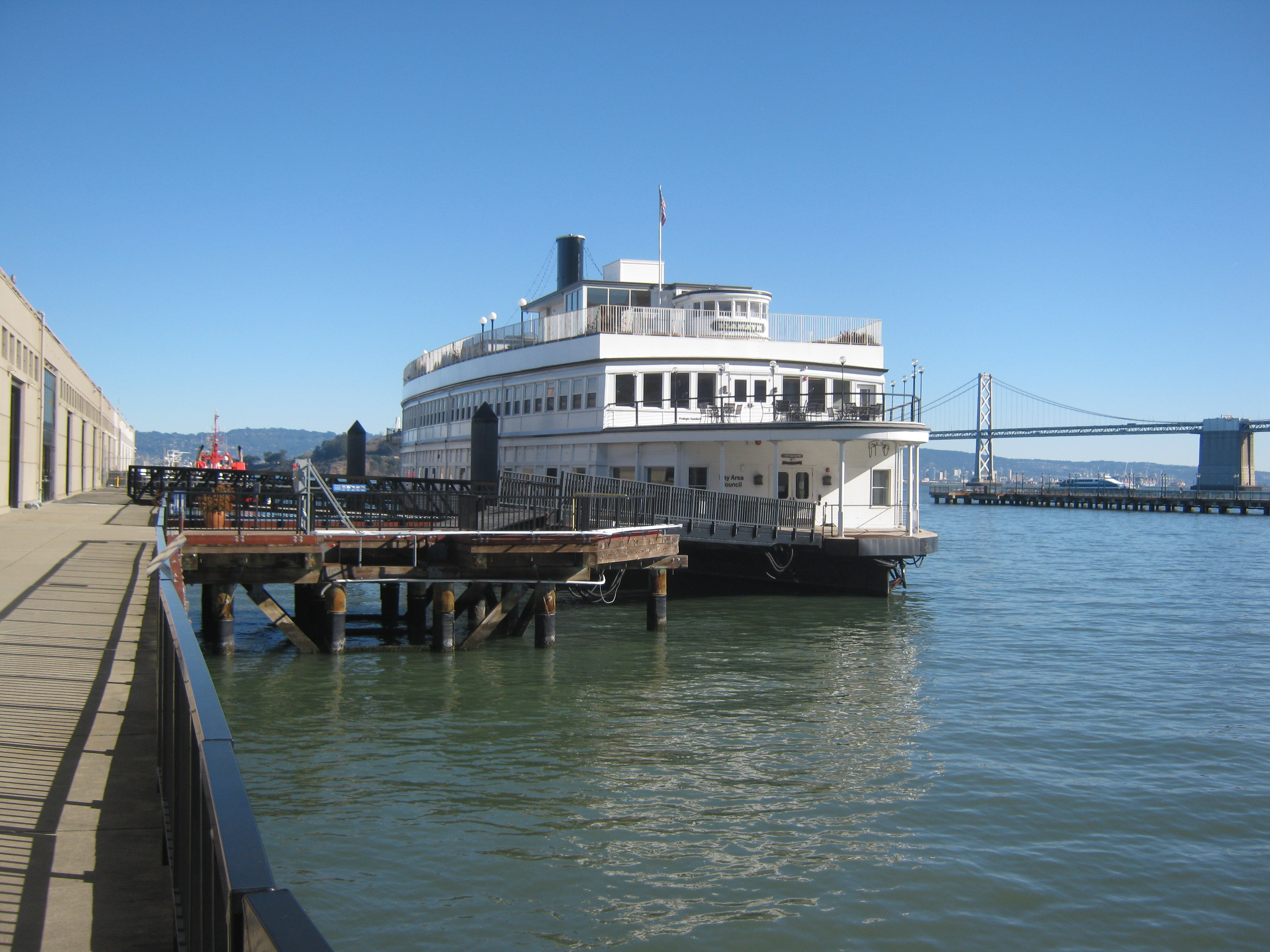
Another SF Secret: There was an article in a recent San Francisco Chronicle by Peter Hartlaub about the old ferryboat, the Klamath, retired from service in 1956. She’s now tied up at Pier 9 on the Embarcadero, open to the public and free. It’s a great spot to have your lunch, like I did last week. (Thumbnail images)


The Klamath is second from the bottom in the 1957 picture from the Chronicle.


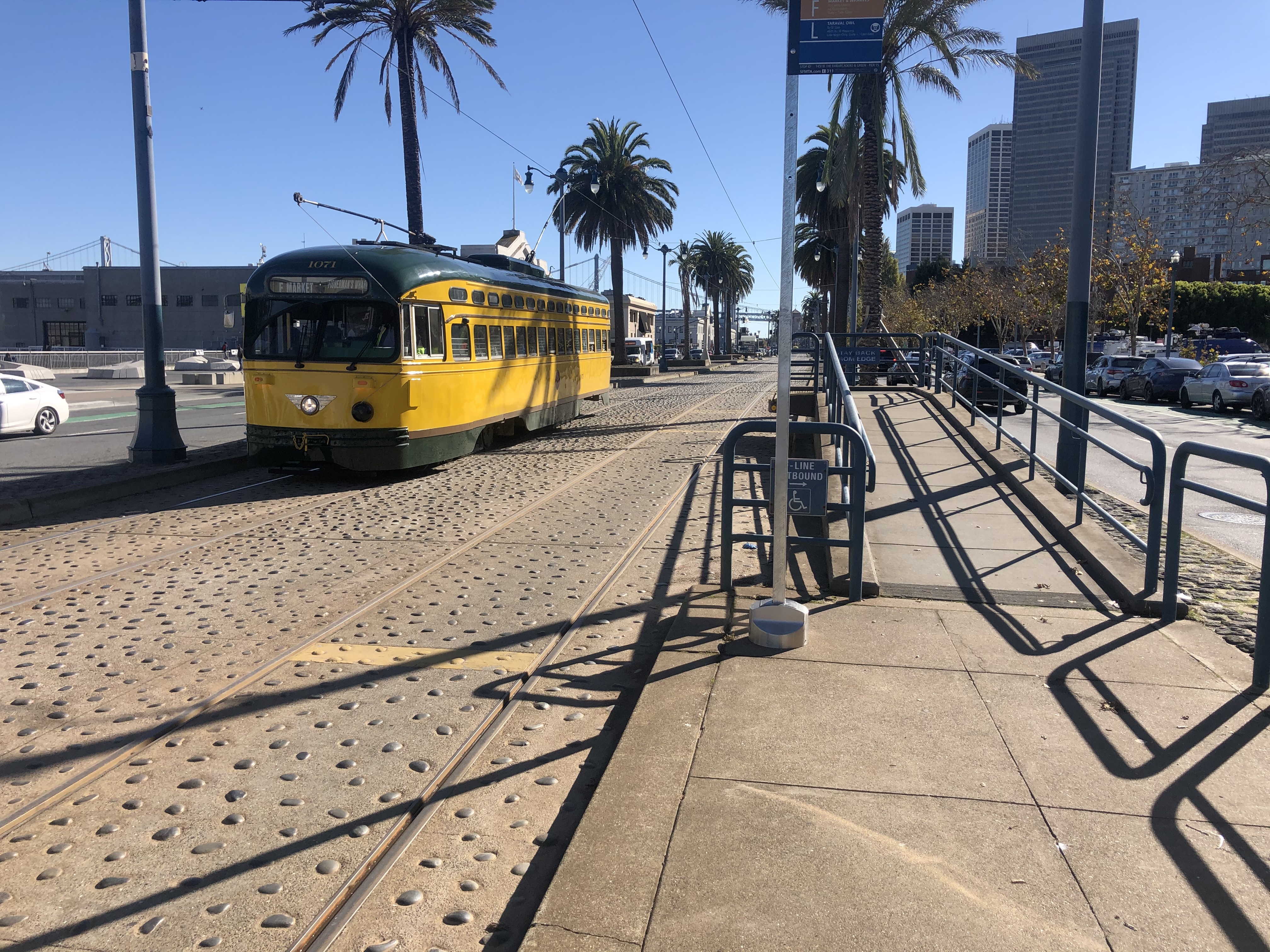
An F Line Streetcar drops you off right by Pier 9. 


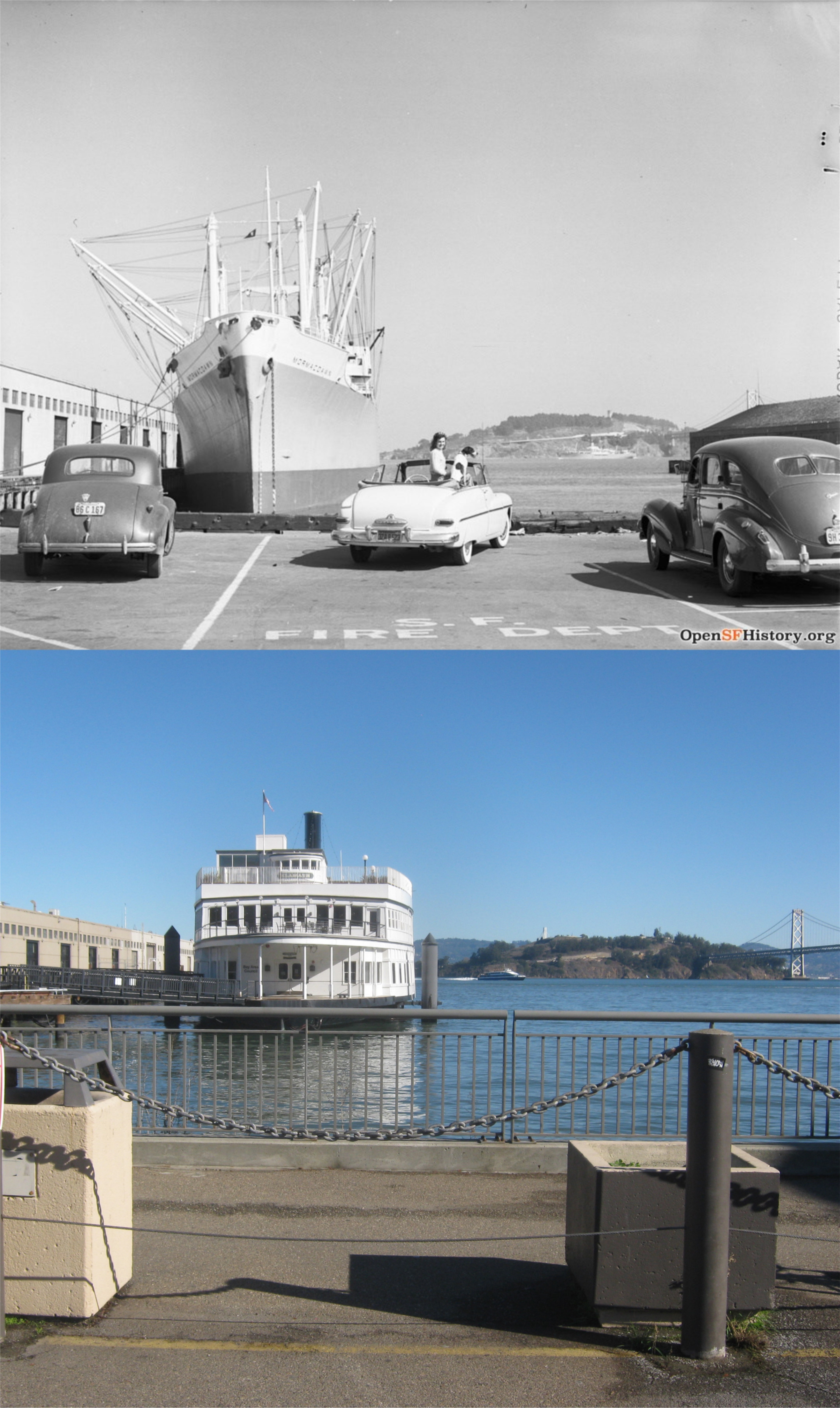
The Klamath is docked on the south side of Pier 9 where the SS Momacdawn was docked in the opensfhistory.org picture from 1949.


The south side of Pier 9 in 1966: (opensfhistory.org)


Another view of Pier 9 from the north side in the 1960s: (San Francisco Library Archives)


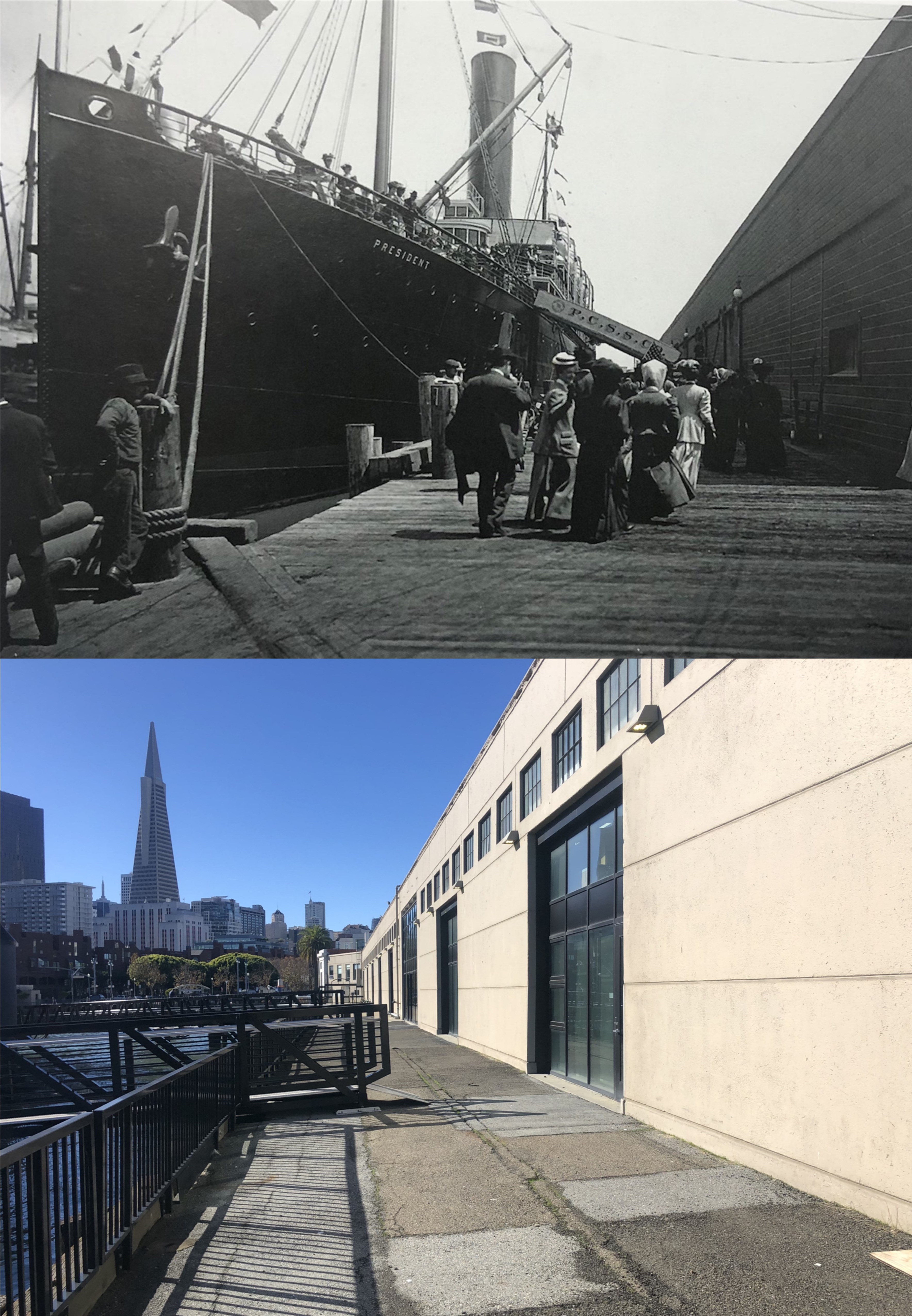
Pier 9 used to be Pier 11, built at the end of the Nineteenth Century. It was demolished in 1935 and rebuilt as Pier 9. The old photo is Pier 11 in 1907. (Vintage picture from Port City by Michael R. Corbett)


Let’s go aboard the Klamath.

The second deck is open for people to sit and relax as long as they want. There weren’t many people on the boat last Wednesday; I don’t think a lot of people are aware that the Klamath is open to the public.


There are some interesting pictures and stories on the walls of the boat, like this newspaper story of when the Klamath collided with a submarine in the Bay in 1944.


The views from the third deck are the best part of the visit.


The Ferry Building, Salesforce Tower, and the Embarcadero Center, among others, seen from the Third deck:


And a great view of the Bay Bridge.


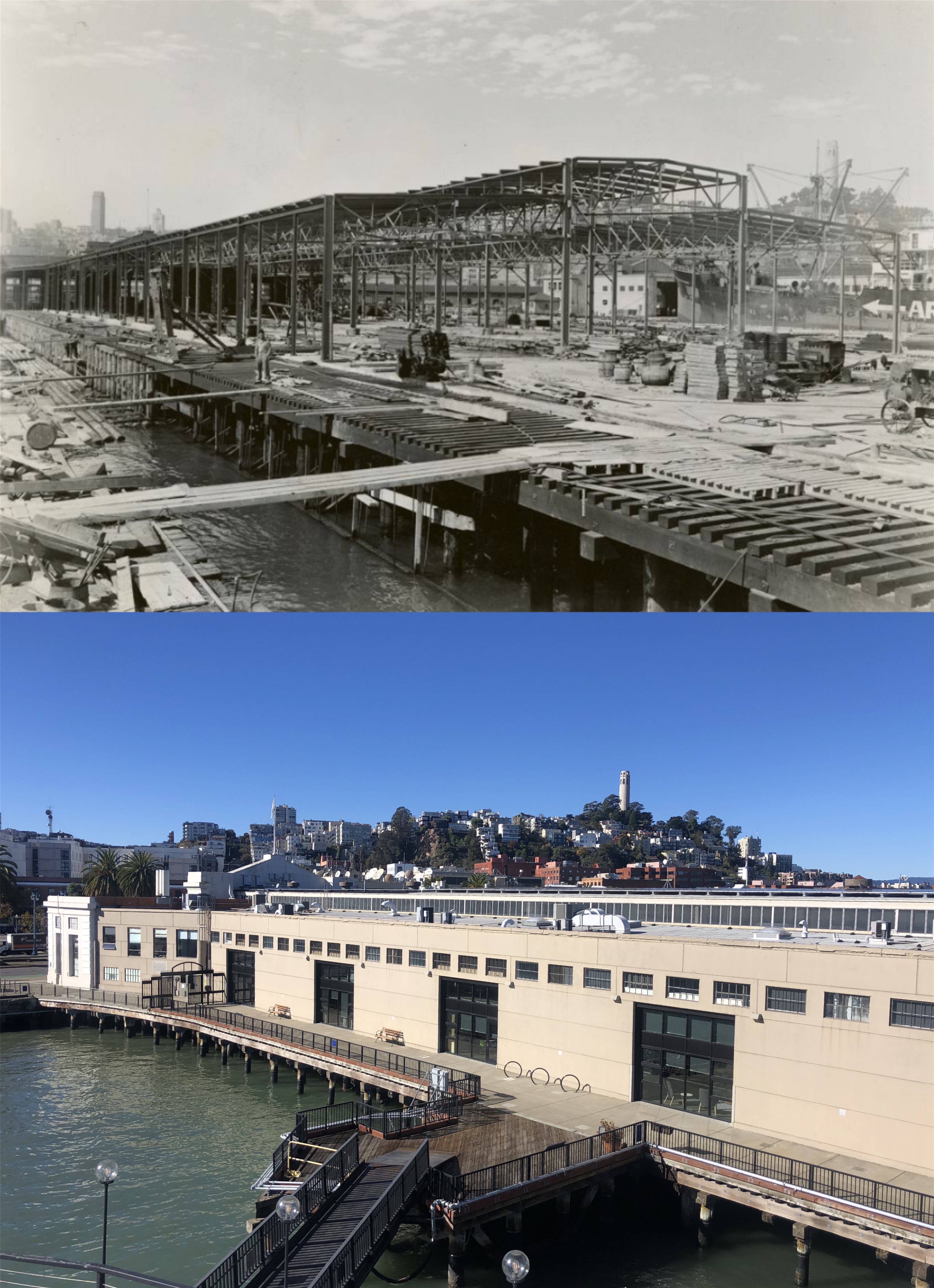
Pier 9 under construction, looking toward Telegraph Hill in 1935: (San Francisco Library Archives)


I’ll close with a television drama scene near Pier 9 in a 1957 episode of in a little known series that ran from 1957 to 1958, ‘Harbor Command’. Although the show only ran for one season, it has some great San Francisco locations from the 1950s. Here, in an episode entitled ‘Gold Smugglers’ two dental assistants have been forging the dentist’s name to order gold that they’ve been stockpiling. They murder the doctor when he finds out what they’ve been doing, and they attempt to smuggle the gold out of San Francisco. Here, they’re trying to make their escape in a taxi on the Embarcadero; Pier 9 is in the background. Of course, they didn’t get away. You can see construction work on the soon to be finished Embarcadero Freeway in the right background of the show scenes.


Some re-dids

Just for no reason, I felt like redoing some of the older photos I posted on my website. As to the results of the updated updates, some were an improvement, some might have been better left alone, but all of them were fun to revisit. Most of the vintage pictures I originally posted back when I was careless in not naming the source of many of the old pictures; my apologies for not being able to list many of them. (Thumbnail images)


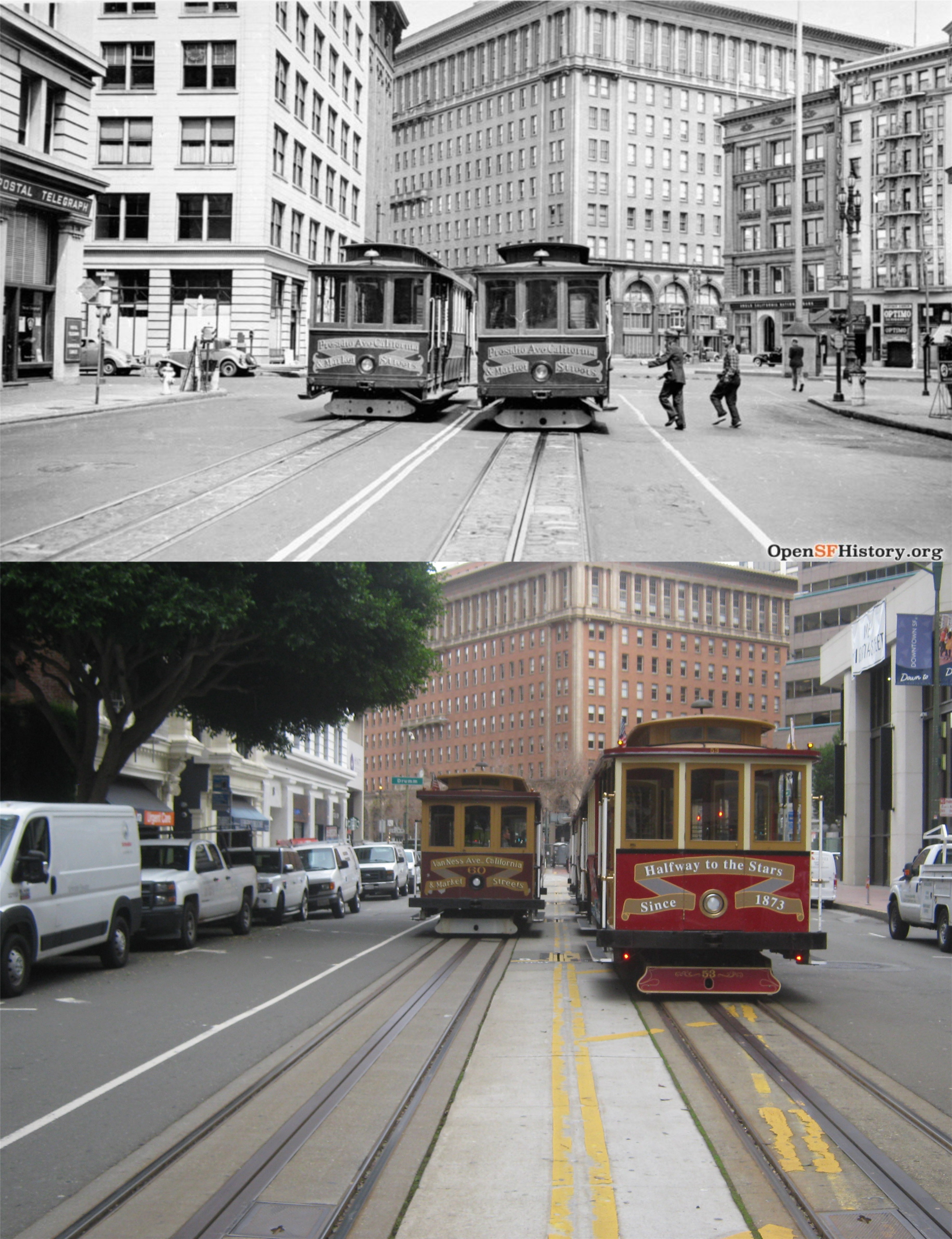
Where the California Street Cable Car Line comes into Market Street in the 1940s and now: This was as close to a line up as I could get. The Southern Pacific Building is on the right in both pictures. Back in August of 2015, when I did my first update of the old photo, the numbers 15 were on the Ferry Building  commemorating the one hundred year anniversary of the 1915 Panama Pacific Exposition.


Union Square after the 1906 Earthquake: I got a better line up with the Dewey Monument than when I originally did an update of the vintage photo in January of 2016, although I had to cut out half of the Union Square 2024 Christmas tree, which is a shame because it’s such a nice tree.


I think it’s cool that this location at 17 Street and South Van Ness hasn’t changed much at all since the 1940s; except for the gas prices.

A rainy day on the Embarcadero during the 1950s: Pier 7 is gone now, and was where the portable bathroom is now. You can see a part of the northern most portion of the Embarcadero Freeway on the right of the vintage picture.


A Life Magazine picture at Civic Center during World War Two: They were walking about where the San Francisco Library Building is now; I’m standing at the entrance to the library. The Empire Hotel Building is in the right background of both pictures. I first did an update of this Life photo on Halloween of 2014, as San Francisco was getting ready for a parade to celebrate the San Francisco Giants third World Series Championship.


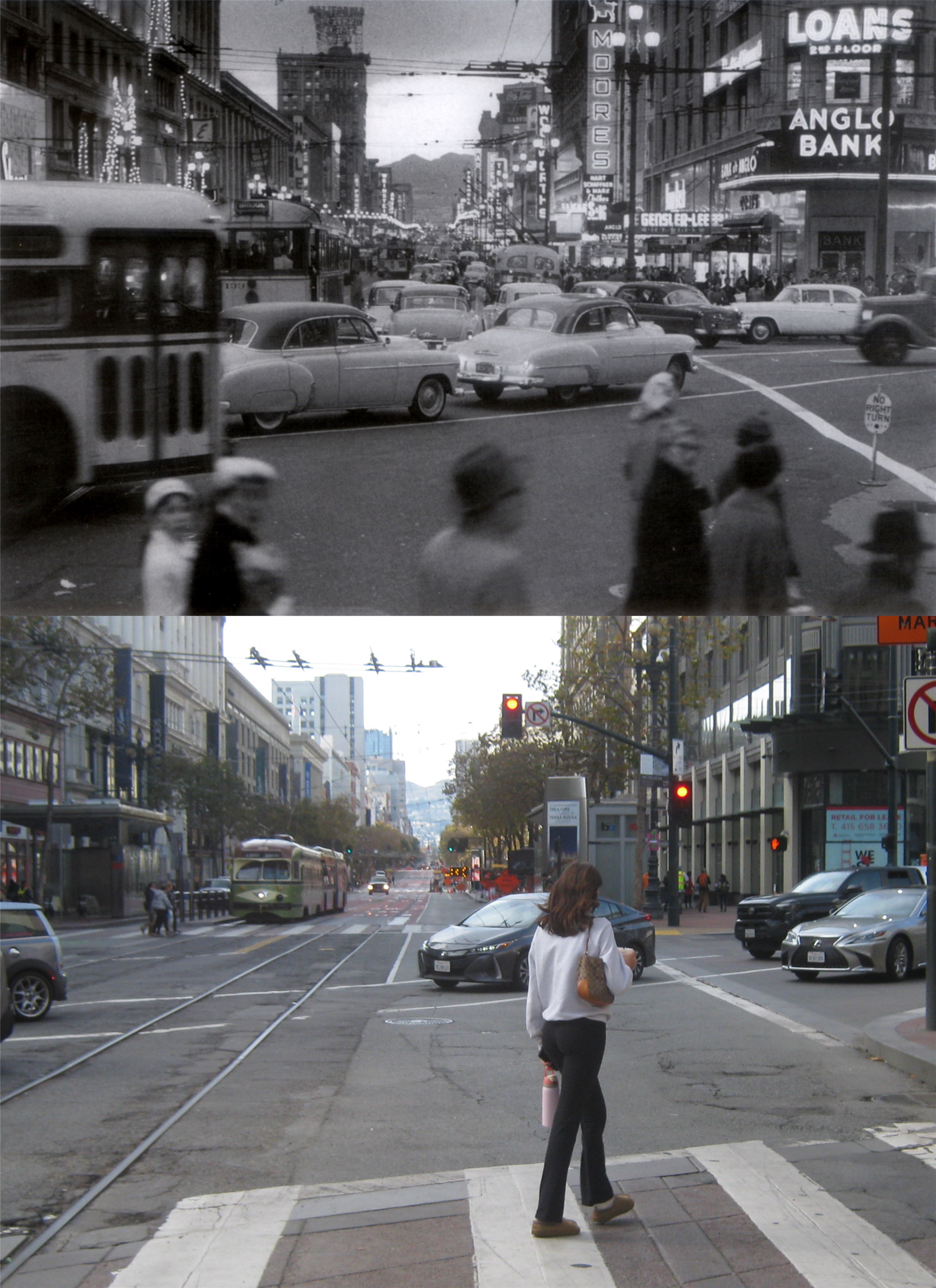
Traffic crossing Market Street from 4th Street to Stockton in the 1950s: Traffic runs only north to south from Stockton to 4th Street now.


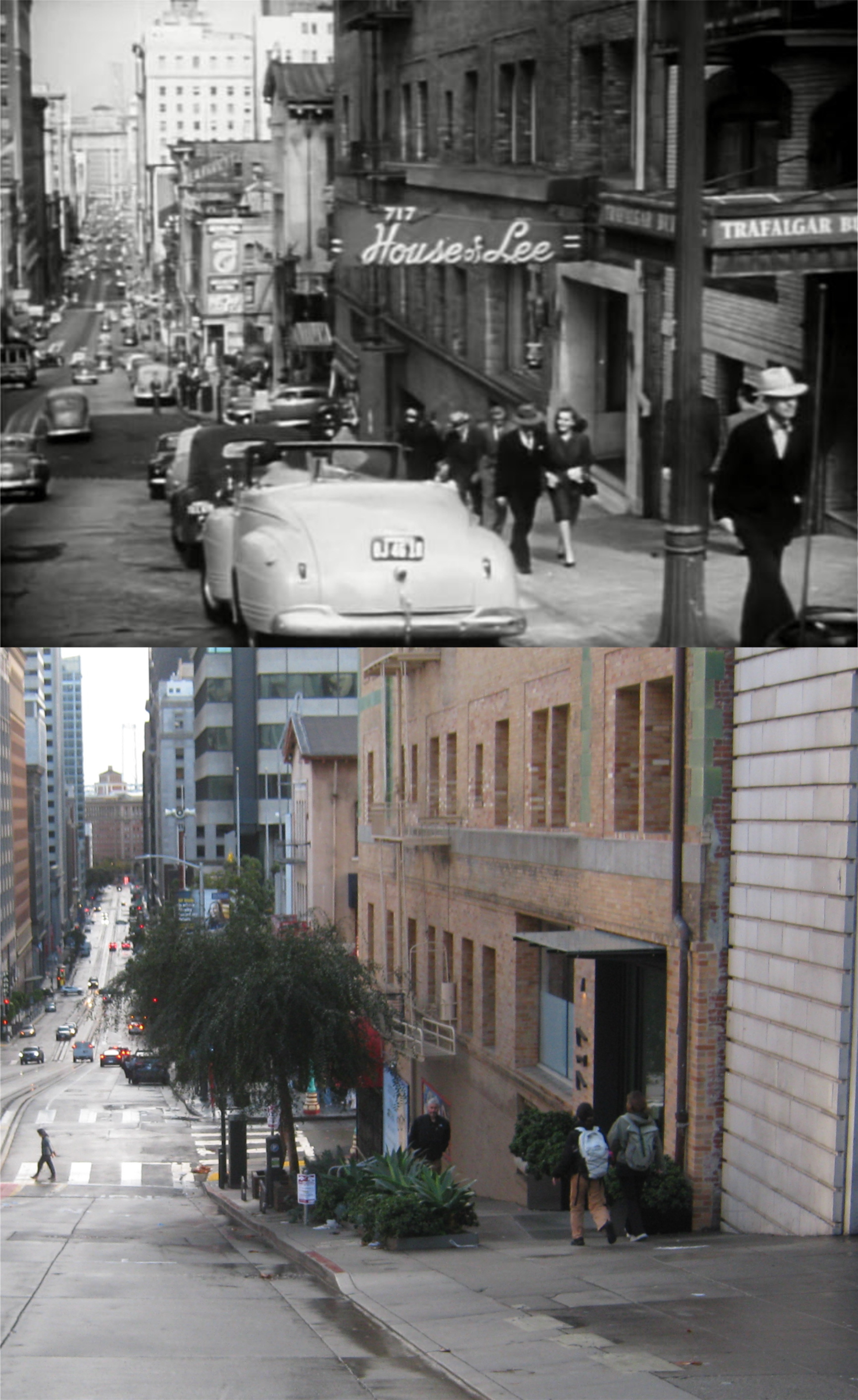
A movie scene on California Street up from Grant Ave in the 1947 film ‘My Favorite Brunette’: That’s Bob Hope, hot on a detective case, driving away from his office in the Trafalgar Building. The Trafalgar Building is gone now and was where the parking garage for the Ritz-Carton Hotel is now. Back in January of 2015 and also January of 2017, when I did an updates of this spot, the 717 entrance to the Sig Fat Building still had the white frame around the door entrance.


The entrance to the Palace Hotel on a rainy 1950s day: The clock is still there, but the Pig ‘n Whistle is gone. A blurry update on my part, but the vintage picture is too good to leave out.


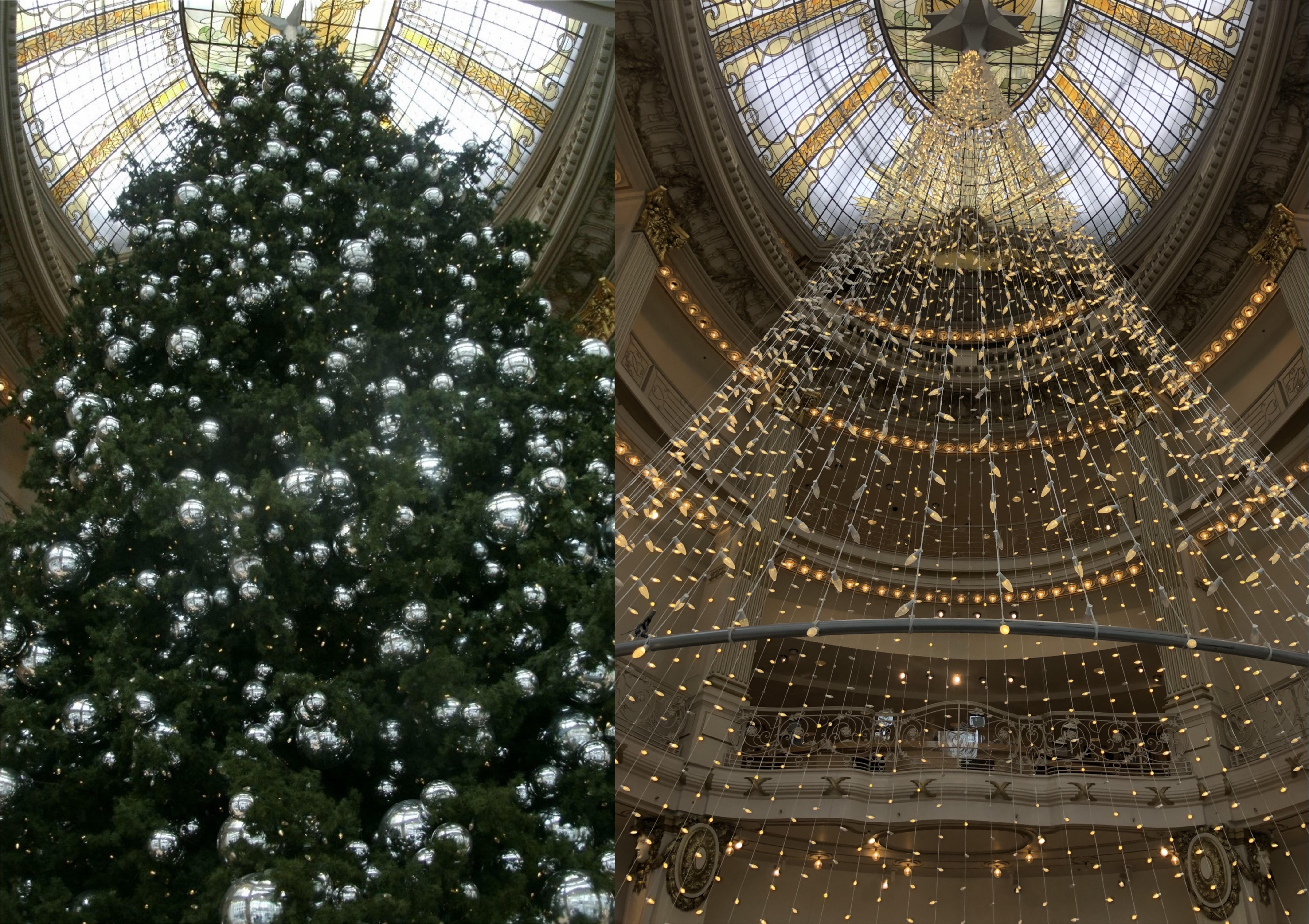
Back in 2016 I did an update comparing the Neiman Marcus Christmas tree to the one the used to be in this rotunda when the City of Paris Department store stood here. Now I’m doing an update on the 2016 Neiman Marcus Christmas tree to the 2024 Neiman Marcus Christmas tree.


A Ferryboat with Frank Sinatra aboard arrives behind the Ferry Building in the open scenes of the 1957 film ‘Pal Joey’. You can still see the old Southern Building, lost in the modern crowd of today’s skyline. This was a redo of the first then and now I posted on this blog in June of 2013.

“Pick a spot, any spot.” “Okay, South Park.”

In his unflattering description from his 1933 book ‘San Francisco, a Pageant’, Charles Caldwell Dobie doesn’t write highly of South Park. He writes, {Once upon a time, South of Market  boasted two fashionable districts that more or less merged one with the other: South Park, a frigid respectable square, lined with elm trees, and Rincon Hill…. South Park and Rincon Hill still persist as geographical units, but nothing of their former grandeur survives.}  Dobie goes on to write of South Park, {The oval circle, once planted to fresh green grass that gained the name of Park for this exclusive  inclosure, is now a thing of unpainted benches and seared  turf, shadowed by wind-bitten elms and maples. One wonders if the ghosts of old South Park ever come back to shudder of the change in its fortunes–} Probably not, and his description gets even uglier. Dobie does write that South Park is {an exact copy of Berkeley Square in London} and I didn’t know that.  Gary Kamiya writes about South Park in his two fine books ‘Portals of the Past’ and ‘Spirits of San Francisco’, but a little more flattering because the area is not at all as bad as it was in 1933.  South Park was also the scene of the capture of one of San Francisco’s most repulsive criminals. (Thumbnail images)


We’ll head into South Park from 3rd Street, seen in the 1950s photo from the San Francisco Public Library Archives. Notice the round cornered building on the right in the vintage picture; we’ll get back to that later.


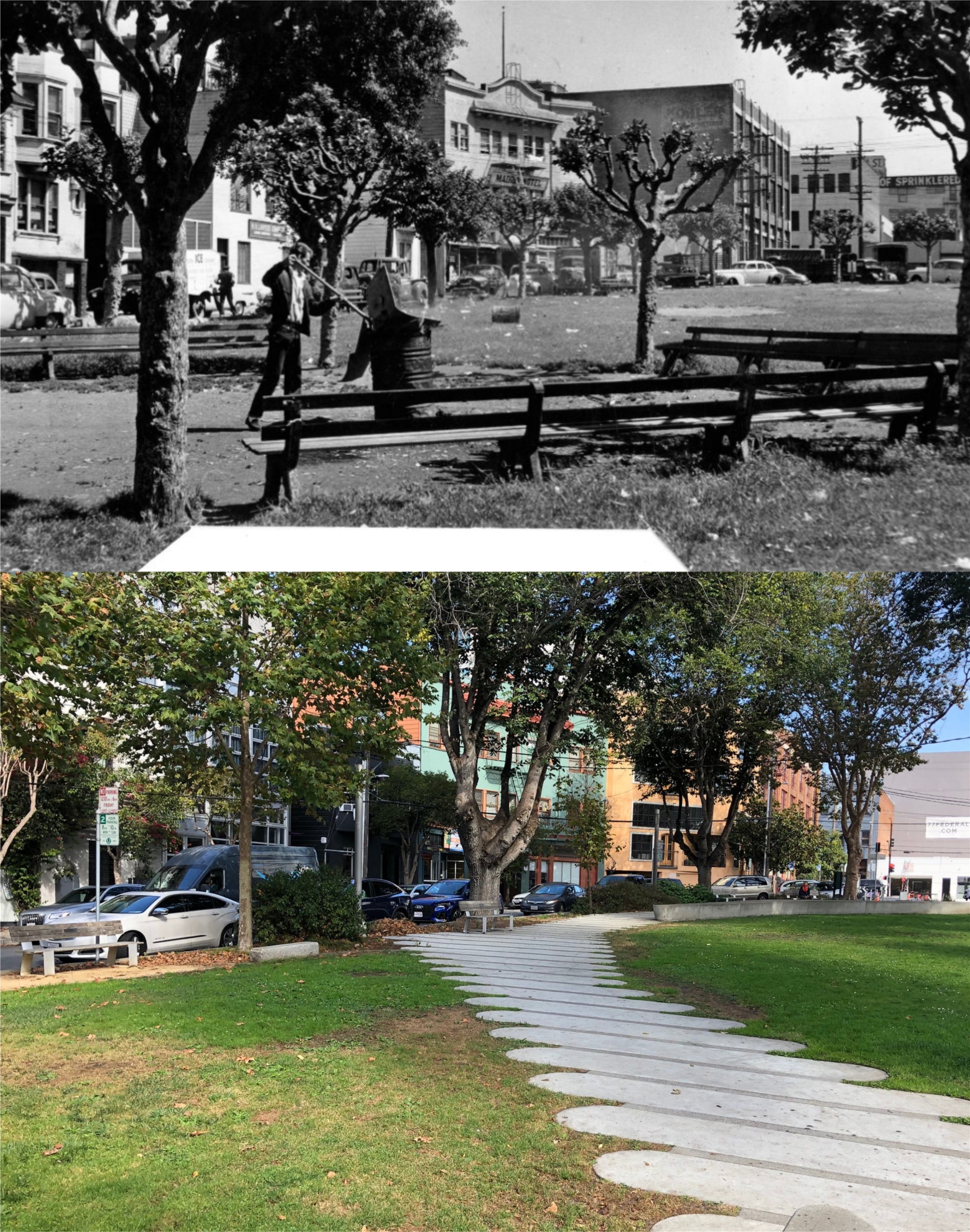
Burning leaves in South Park during the 1950s: The curved roof-top building in the center of the old photo is the aqua green color building seen through the trees in my picture. (San Francisco Public Library Archives)


Looking east from the north side of South Park during the 1950s: (San Francisco Public Library Archives)


102 South Park on the north side at Jack London Alley during the 50s: Jack London Alley extends to Bryant Street on the north side of South Park, and to Brannan Street on the south side. (San Francisco Public Library Archives)


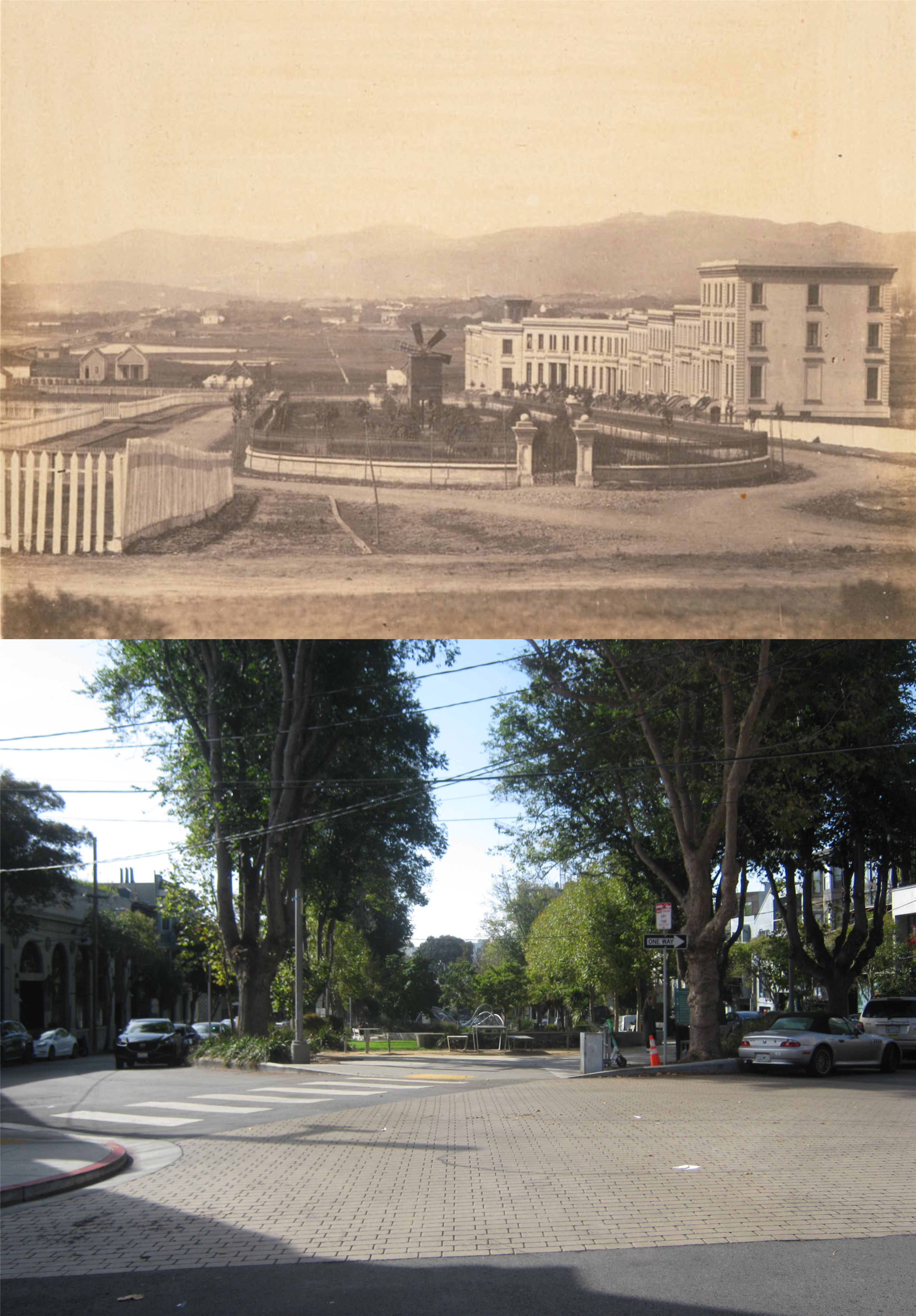
South Park, looking west from 2nd Street in 1856: (San Francisco Public Library Archives)


Now we’re on the east side of South Park looking north along 2nd Street. I had to take my picture a little further out from the Park than the 1963 photo to avoid having the tree block out the Clock tower Building at 449 2nd Street at Stillman. (opensfhistory.org)


De Boom Street, or what Herb Caen called Lower De Boom, (Oh, Herb, where are you now when we need your humor?) near the east side entrance to South Park. The vintage picture, erroneously labeled De Bloom, is from 1915. (opensfhistory.org)


Now we come to the main attraction. The round cornered building that I referred you to in the first picture of this set is where police captured one of the biggest creeps in San Francisco history. In October of 1926, Clarence Kelly Jr. and two accomplices committed robberies throughout San Francisco. During the spree, Kelly personally murdered four innocent people. (calisphere.org)


Before their capture, newspapers were referring to them as the “Terror Bandits”.


When one of the punks was apprehended by the police, he squealed on Kelly, leading police to the apartment at 47 South Park, on the corner of what is now the south side of Jack London Alley, where Kelley lived with his family. As police raided the building from the front, Kelly tried to escape down the back stairs where he was shot twice by police on the stairs, according to the San Francisco Examiner. Those stairs are on the far right in my picture. Kelly was hanged at San Quentin in 1928, and he was pronounced dead by San Quentin physician, Dr. Leo Stanley, who claimed part of Kelly’s body for a quack experiment he was practicing. I’ll just leave it at, you’ve heard the expression “You can’t take it with you.” well, for Dr. Stanley, it was more “You can’t take ‘em with you.” You’ll have to read into the story of Clarence Kelly Jr. and the “eminent” Dr. Leo Stanley yourself for more on the subject.

“They’re off!”

Horse Racing is back at the Alameda County Fairgrounds every Friday, Saturday, and Sunday through mid December. I went out to the Pleasanton Fairgrounds, last weekend, for the second day of the Fall Schedule Horse Racing. I know that for some people, horse racing, like boxing, is an outdated sport, and I don’t know how bad it is on the horses. However, it’s fun to watch, especially if you win, which, more often than not, I don’t. There’s always something depressing to me walking around the empty fairgrounds when there’s no fair going on. It’s like one of those spooky Twilight Zone shows where everybody in a whole town mysteriously disappears. Plus, there’s nothing like an empty fairground to give you an overpowering craving for a corn dog. I walked around the fairground in between races to match up some of the pictures I took last summer during the 2024 Alameda County Fair. (Thumbnail images)


Passing the empty Livestock Pavilion on the way in:


Looking toward Heritage Park from the entrance to the Racing Grandstand:


Looking in the opposite direction of the previous picture toward what used to be the main area of the Fair. The smell of chicken tacos on a flour tortilla, or roasted turkey legs was alarmingly absent.


Ah, the Midway; “Vomit Valley”. I even miss that, and I hardly spend any time there.


Looking past the kid’s area toward the Racing Grandstand:  After the horse racing area, this has to be where they take in the most money during the run of the Fair.


No 4-H Club in the Livestock Pavilion:


Those two things in the background are rides I never plan to go on when the Fair’s back, but they’re fun to watch.

Keeping time in San Francisco

There was an article in the San Francisco Chronicle by Aldo Toledo last September 18th about the old Samuels’ Jewelers Clock on Market Street. The clock has been neglected and vandalized, and it’s a shame because it’s a part of San Francisco history that goes back to the days of Sam Spade, although it hasn’t been running since the 1970s. It made me think of other clocks, both gone and still around, throughout San Francisco, so I looked back through my archives for some clock pictures, and stopped by the “Samuels Clock” last Friday. (Thumbnail images)


Geary St. at Kearny near Market during the 1950’s: The entrance to the old Chronicle Building is on the right in both photos. My update was taken in July of 2020 when most everything in the area was still closed due to the Covid Shutdown. (worhtpoint.com)


The Ghirardelli Clock Tower, from Larkin Street, in a late 1920s, or early 1930s, in a picture from the Shorpy Archives: This was one of the streets used in the ‘Bullitt’ chase scene.


The Bay Bridge Toll Plaza: Not only was the clock from the 1960s picture nicer than the digital message today, but the fare was on twenty five cents to cross back then.


They make the street clocks much smaller nowadays, like the one here on Market Street at Grant Ave. My picture was take on March 22, 2020, less than one week after the Covid 19 shelter in place order was activated. The guy in the 1940s pictures always makes me think, ‘An American Werewolf in San Francisco’. (SF Chronicle)


The Urbano Sundial counts too. (artandarchitecture-sf.com)


Old St. Mary’s church spire, with its biblical message ‘Son, observe the time and fly from evil’, something that I never hesitate to plan on doing someday: (San Francisco Public Library Archives)


A couple of pictures from the Westin St. Francis Hotel on Union Square Facebook Page of the St. Francis Lobby Clock: I posed in front of the clock in 2013. Neither I nor, I’m sure, that Shirley Templeish kid, look that young anymore.


An update I did last New Year’s Eve on Market Street between Grant Avenue and Stockton, with that classy Caro Bros clock: (San Francisco Public Library Archives)


Probably everyone’s favorite clock in San Francisco is in the Ferry Building Tower. These are a couple of nighttime pictures I took of the Ferry Building; the first was in October of 2010, when the San Francisco Giants were about to win their first ever World Series, and the second was in January of 2013, when the San Francisco 49ers were about to lose their first ever Super Bowl. The Giants would go on to win two more World Series after my 2010 photo, and the 49ers would go on to lose two more Super Bowls after the 2013 loss.


The Samuels Clock was originally installed on the south side of the 800 Block of Market Street in 1915, seen in the January, 1939 picture when Samuels’ Jewelers was located at 879 Market Street, about where the, now closed, Nordstrom portion of the Westfield Centre Building is. As Mr. Toledo point out, Dashiell Hammett worked at Samuels’ Jewelers, and his famous detective Sam Spade refers to the clock in one of the stories Hammett wrote featuring him. (UC Berkeley Library Archives)


In 1941 or 1943, I’m getting two dates on this, Samuels’ Jewelers moved, along with the clock to the north side of Market Street next to the Flood Building. The clock is not only referred to in literature, but also played a part in San Francisco’s largest terrorist attack in 1916, so I’ll include a link to the Chronicle article below. (San Francisco Public Library Archives)

https://www.sfchronicle.com/sf/article/samuels-clock-flood-building-19758243.php

The view from the SkyStar Wheel (For Becka)

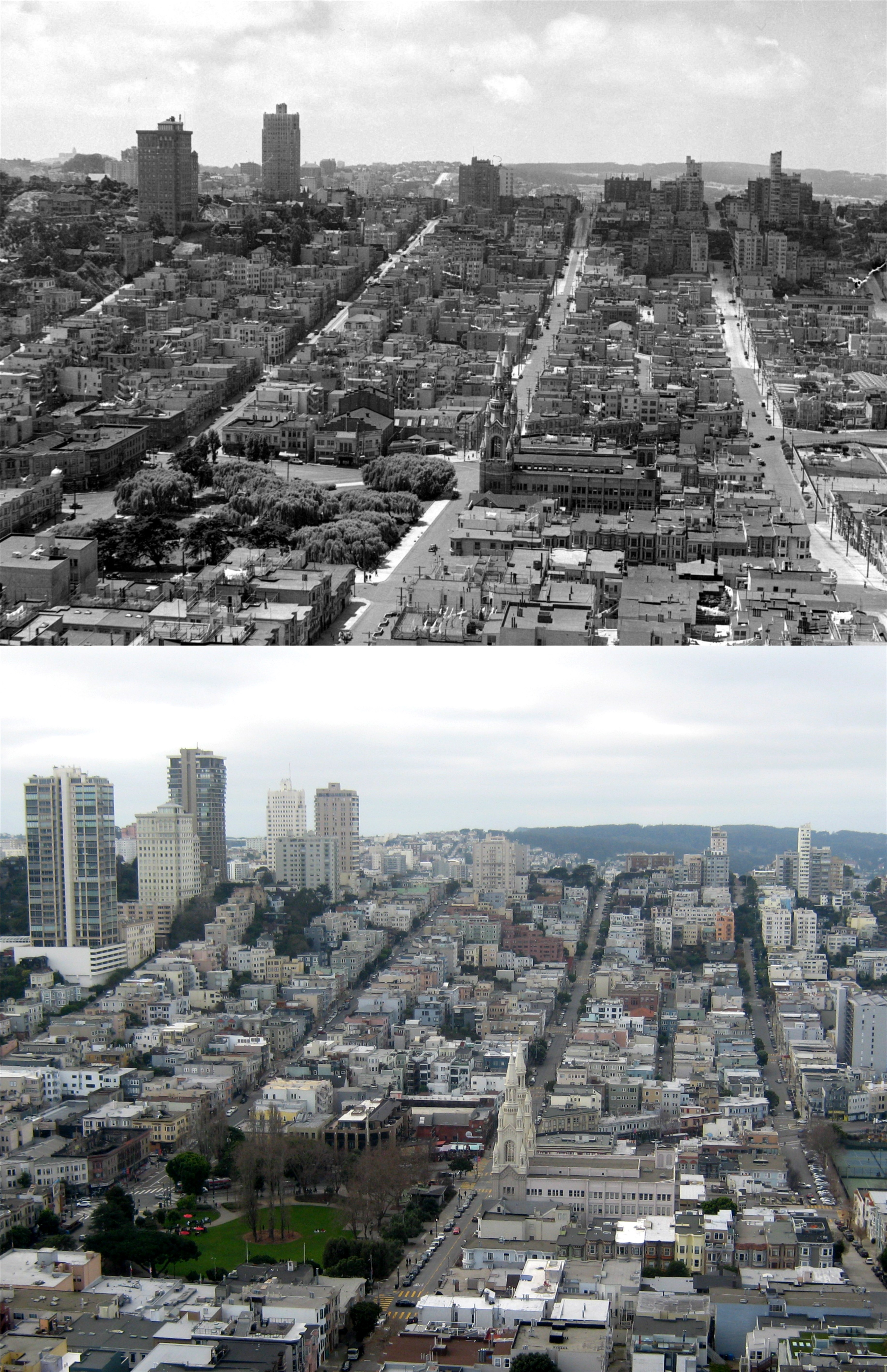
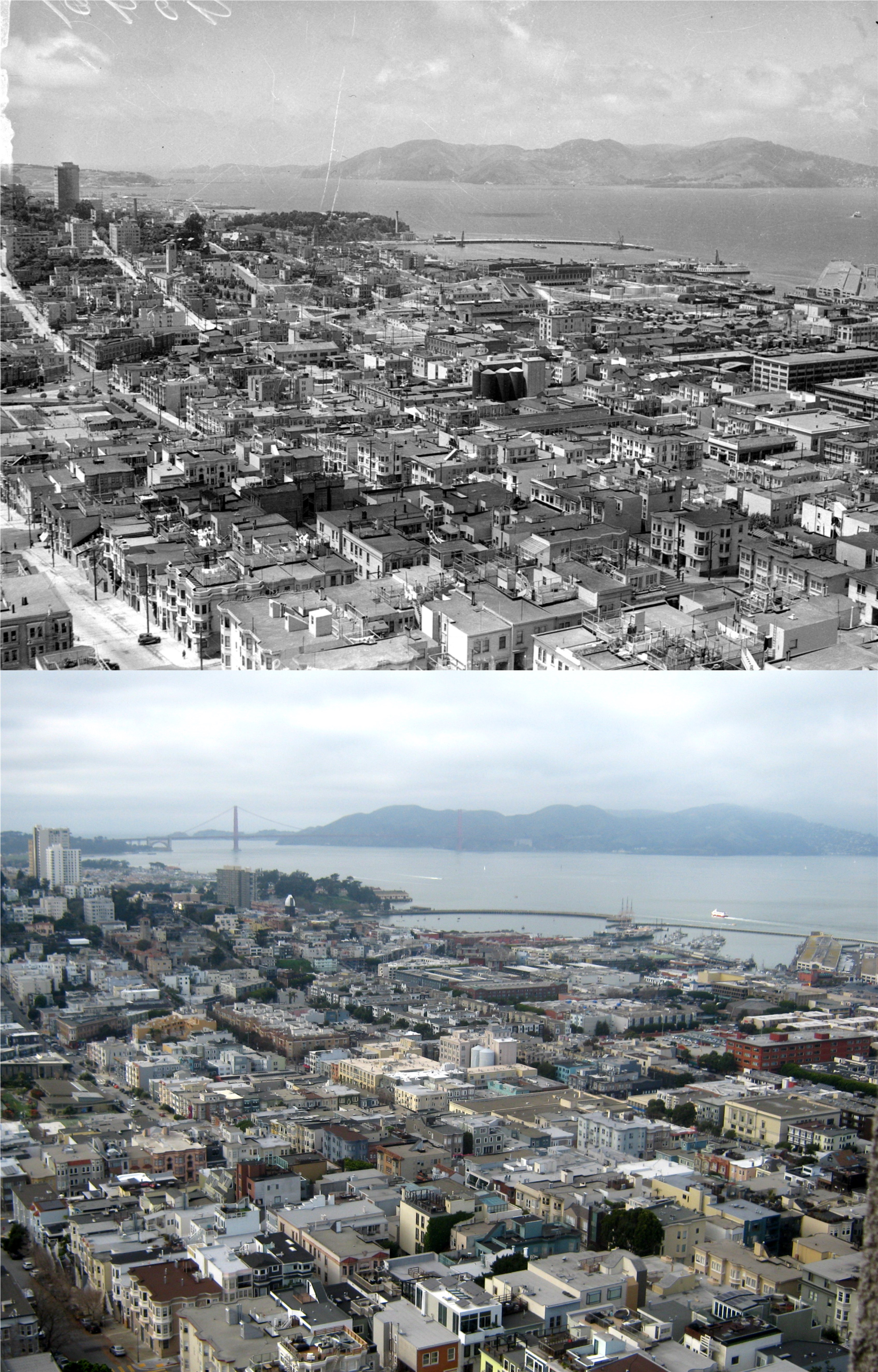
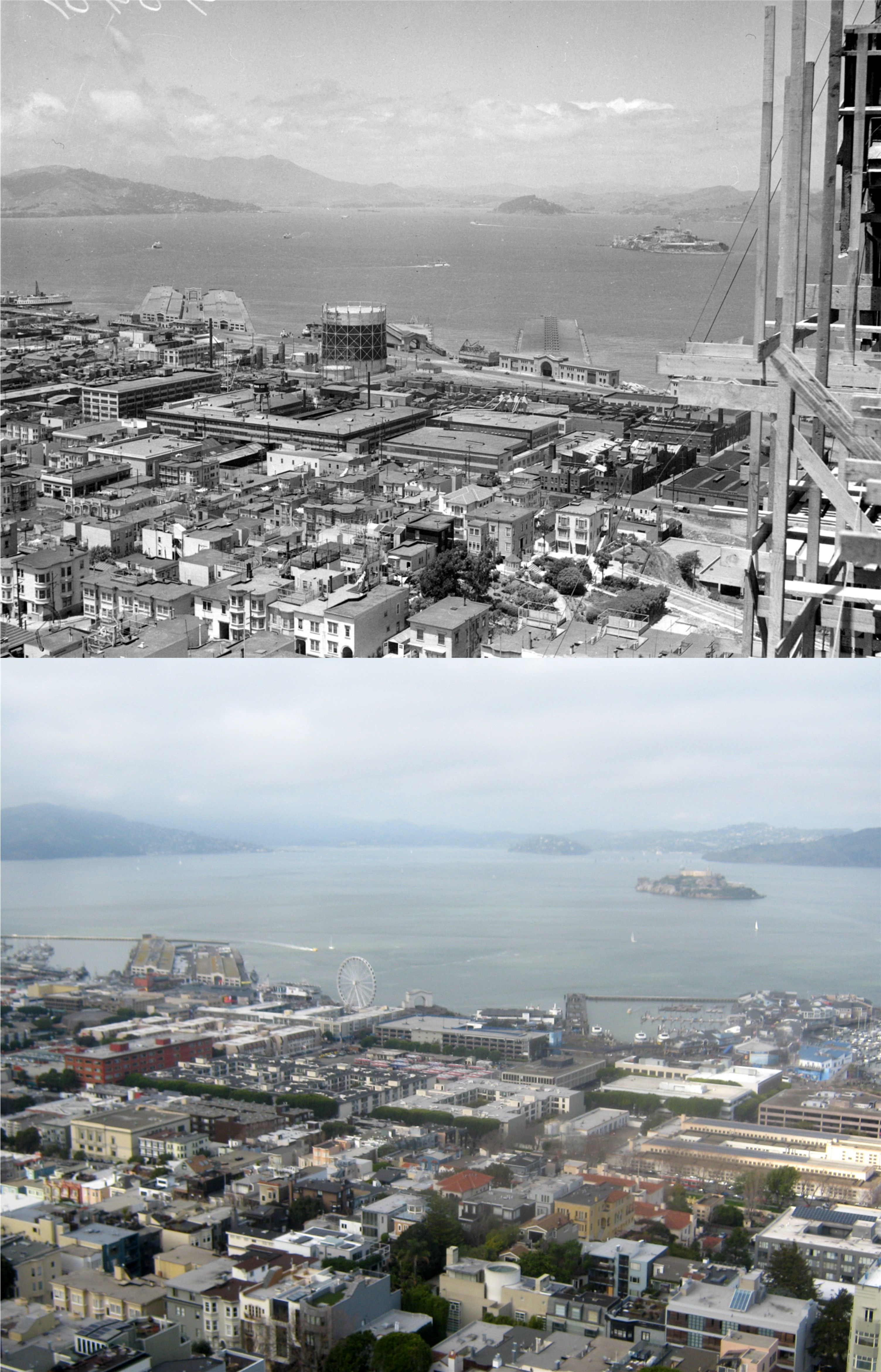
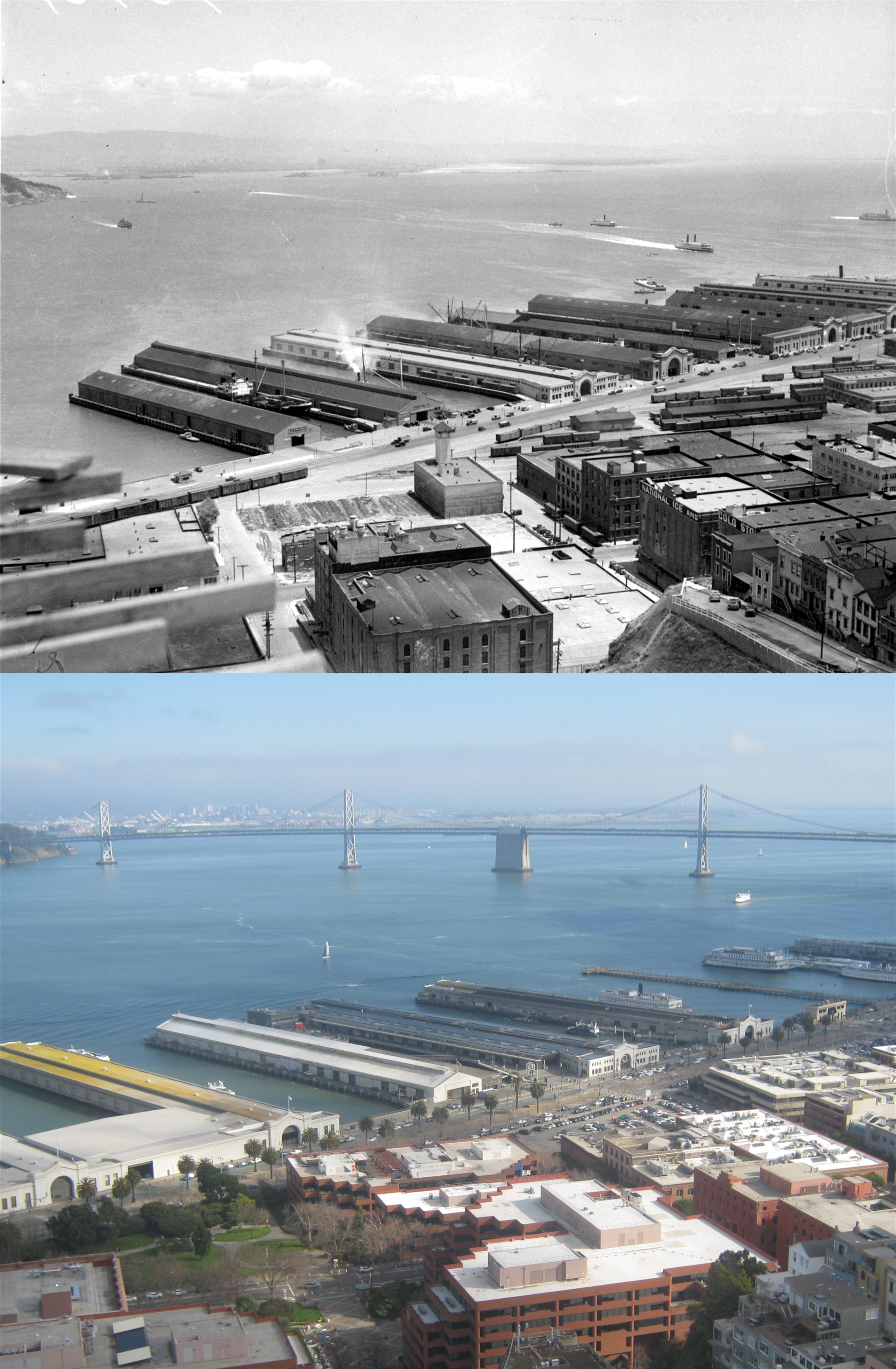
Well……. if you don’t like stunning, never before available views of the Golden Gate and Bay Bridges, Fisherman’s Wharf, Pier 39, the Embarcadero, Telegraph, Nob and Russian Hills, Aquatic Park, Alcatraz and the Bay, then you probably won’t like the SkyStar Ferris Wheel at Fisherman’s Wharf. The weekend after Labor Day, I finally took a ride  on the attraction since it was moved from Golden Gate Park to Fisherman’s Wharf. After I landed safely, which one does because it’s not dangerous and it’s not necessarily scary, I searched the internet and my archives for vintage photos that were taken approximately, sort of, looking toward the same direction as the photos I took. (Thumbnail images)


Heading up to the top, looking east toward Treasure Island and the Bay Bridge:


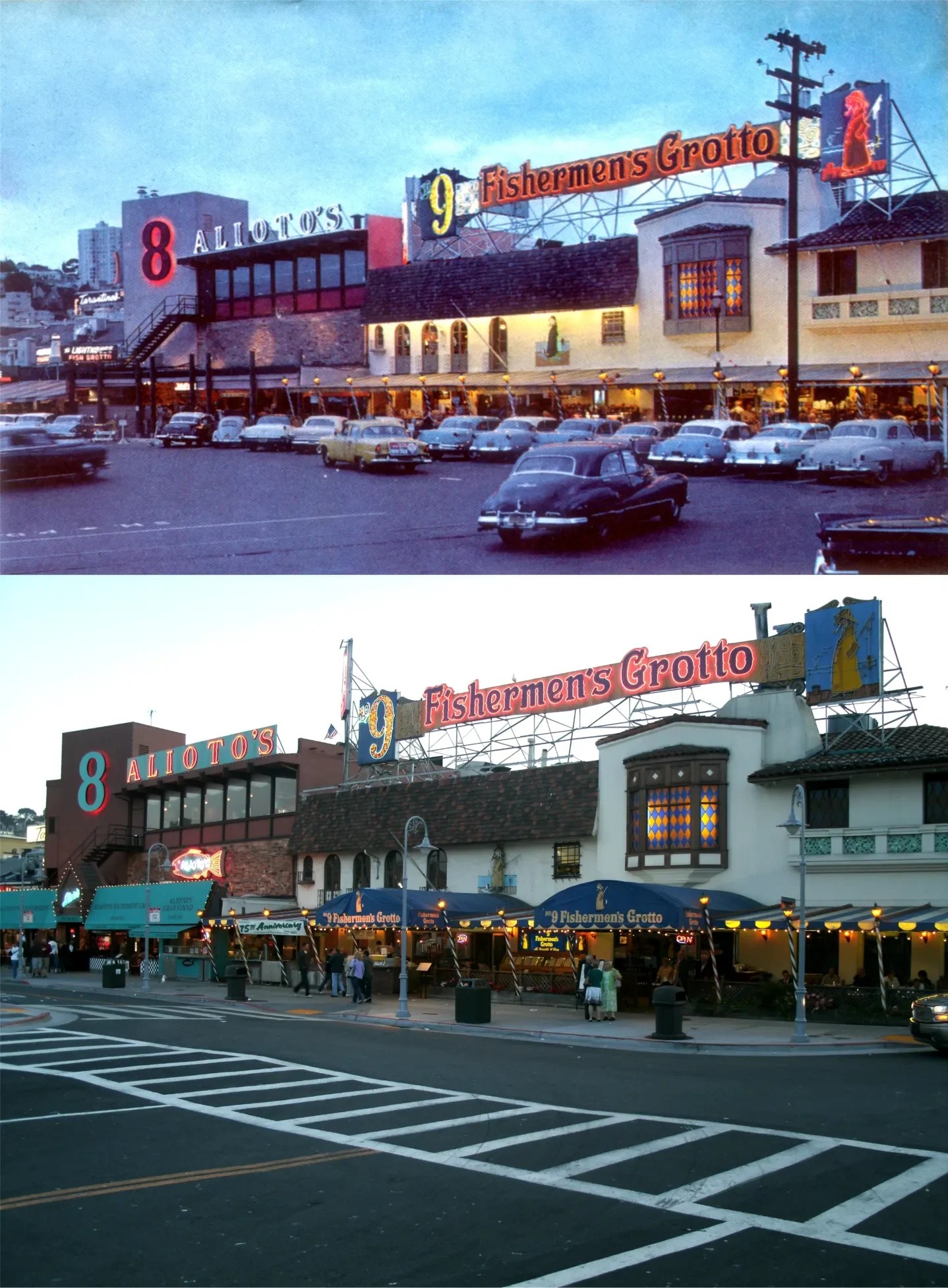
The view of Fisherman’s Wharf from hundreds of feet lower than an old postcard taken during the 1960s:


You have two similar views here that match my picture closer; one from the postcard on top, and also a scene from the opening credits  of every episode of the 1970s television show ‘The Streets of San Francisco’.


Looking toward Telegraph Hill and Downtown San Francisco: The older photo from Flickr looks like it’s from the 1980s:


Looking over Pier 39 toward Pier 35 and the World War Two Liberty Ship, the Jeremiah O’Brien: The old Pier 39 is at the bottom of the vintage picture from opensfhistory.org, taken in 1923: Pier 37, between Piers 35 and 39, has been demolished.

I didn’t get too bad of a lineup of Nob and Russian Hills with this 1960s photo from opensfhistory.org.


Looking toward Russian Hill: My photo is looking over the intersection of Mason and Jefferson Streets. I’m not sure where the crossroads are in the 1930s picture from the UC Berkeley Library of Russian Hill from Fisherman’s Wharf, but I think they’re a block southwest at Beach and Taylor Streets.


There’s also a terrific view of Alcatraz Island and the Bay, looking north. When the 1946 picture from opensfhistory.org was taken, there were still quite a few “bad boys” in that penitentiary building.


Looking toward Pier 45 and the Golden Gate Bridge in another old postcard from the 1960s:

Gliding down past the old Pier 43 Archway: This picture from the San Francisco Library Archives is as close to a match up that I could get. I’m going to have to research to see what that other pier arch on the left was. It would have been about where the pier that you catch the Red and White Fleet tour boats is located.


Walking back to catch the MUNI streetcar, I snapped a picture of the Fisherman’s Wharf Boat Lagoon. The 1939 picture is from the UC Berkeley Library Archives. The building on the right in the vintage picture was demolished. The little chapel, on the right in my photo, is there now.

3rd St. (Third Street) and Market (For Revin)

“Now, I’m standing on the corner of Third and Market. I’m looking around. I’m figuring it out. There it is, right in front of me. The whole city. The whole world. People going by. They’re going somewhere. I don’t know where, but they’re going. I ain’t going anywhere.” – From ‘The Time of Your Life’ by William Saroyan.

Whenever I pass by Third Street at Market, I think about Saroyan’s passage. He understood San Francisco for what it is; a fabled and exciting city. Although few writers are of Saroyan’s caliber, there are still some (San Francisco Columnist, Carl Nolte, comes to mind) who look at the City the way Saroyan saw it. However, the day before I took my updates for this post, a San Francisco 49er football player’s season is over, although he’s in stable condition, because some punk tried to rob him and shot him less than two blocks from Third Street and Market. If Herb Caen was still alive, he’d probably write, “Could have happened anywhere.” But San Francisco’s going to get the blame. (Thumbnail images)


The Call Building, on the northwest corner of Third Street at Market, shortly after the 1906 Earthquake and Fire: In 1939, for reasons that are hard to understand, the top crown was removed from the Call Building, and it was streamlined into looking like the Daily Planet Building where Clark and Lois work. It’s now called the Central Tower Building. You can see half of it behind the rebuilt William Randolph Hearst Building. (UC Berkeley Library Archives)

Looking to and from Third and Market in these two comparisons from opensfhistory.org. First is looking southwest toward Third and Market and the Central Tower in 1970: Morris Plan; I remember taking out a loan from the one on Broadway in Oakland when I worked there long ago. I wonder if I ever paid that back? Oh, I must have or I’d have heard from them by now. Second is looking northeast toward the Chronicle Building in 1956.


Third and Market Streets, looking west along Market during the late 1950s: “Now, I’m standing on the corner of Third and Market with a clipboard. I’m looking around. I’m figuring it out.” Nah, that doesn’t have the same class. (San Francisco Pictures Blog)


An accident at Third Street and Market in 1940, around the time of Saroyan’s play; I’m blaming this one on the truck driver. The accident happened in front of where LensCrafters is now. (opensfhistory.org)


‘Harry’ doesn’t make it clear in the play whether he was watching the world go by standing on the west side of Third and Market in front of the Call Building on the right, or the east side of Third and Market in front of the Hearst Building on the left. The vintage picture from opensfhistory.org was during 1946.


Looking toward the Hearst and Call Buildings at Third and Market Streets in an undated picture from the San Francisco Public Library Archives; I’m guessing that it was around 1967 and that’s Market Street BART construction.

A great picture from the 1960s, looking toward where Third Street comes into Market, from south of Mission Street during the 1960s: The Call Building is on the left. The Gothic looking Mutual Savings Bank Building is in the center. (San Francisco Public Library Archives)

  • Addendum, November 23,2024: Ricky Pearsall, the 49er player shot near Third Street and Market, has fully recovered and is back on the playing roster for the San Francisco 49ers.

Playland-at-the-Beach

In July, they had a screening in the Niles, CA Museum of ‘Remembering Playland at the Beach’; a tribute to San Francisco’s Coney Island, available on DVD. The film includes a brief clip from Balboa Street to Cabrillo shortly before the amusement park closed. (Thumbnail images)


La Playa Street from Sutro Heights: La Playa is to the left of the Shoot the Chutes ride in the vintage picture; Hawai-land (spelled wrong) was behind where Topsy’s Roost was, and was farther to the right in my picture.


The Cabrillo Street turnaround during the 1950s:


Playland had a live boa constrictor at a sideshow once. Eh, I wrestled with a live alligator at the Alameda County Fair in July.


The approximate spot where the Funhouse and Merry-Go-Round were located: (Flickr)

The Playland Merry-Go-round thrilled kids and parents alike until the park closed in 1972. Moms still wave to their kids today on the Playland Merry-go-round relocated to Fourth & Howard Streets in Downtown San Francisco. (SF Chronicle)

Rather a tawdry marker is all that’s left.


Another view of Playland-the-Beach from Sutro Heights; dating to 1972: This stretch of Playland, from the yellowish building at the lower left to the Carousel on the upper right, is what you see in following film clip from the DVD. The following clips are on the Great Highway, scanning from Balboa to Cabrillo Streets shortly before Playland closed in 1972 and August of 2024

Murder on Joice Street

Joice Street is another interesting little known San Francisco Street. It’s actually a little more than an alley that runs three blocks from Pine Street to Clay, and I’ve posted a few updates on it in the past, but I became interested in exploring it again after reading about it in the opening chapter of Gary Kamiya and Paul Madonna’s wonderful book ‘Spirits of San Francisco’, published just at the opening of the Covid-19 Pandemic that shut San Francisco and most of the world down in the spring of 2020. The street runs in sort of a hill-and-dale from, as Gary Kamiya points out, the “glamour” of Nob Hill to the “drabness” of Chinatown. I revisited a little of  street’s history, and also remembered a little known claim to fame, if that makes any sense, that I saw in a 1972 episode of the television show ‘The Streets of San Francisco’ that featured Joice Street. (Thumbnail images)


The Joice Steps, descending or ascending, depending on your point of view, Pine Street, seen in Edward H. Suydam’s 1930s drawing.


Children and guardians posing in front of the Occidental Board Presbyterian Mission House, more commonly known as the Cameron House, in 1908: The Cameron House got its more prevalent name after Donaldina Cameron, who lived in the building and was famous for rescuing women forced into prostitution in Chinatown. (Wikimedia)


Donaldina Cameron stands at the bottom of the ladder in this staged photo of a Chinatown rescue from FoundSF:


Believe it or not, I wasn’t trying to line this bus up with the cable car in the older photo, taken from Joice Street looking toward Sacramento Street, but the MUNI #1 came by at just the right time to make a nicer comparison. The Cameron House is on the right in both photos.


And now, to the main Joice Street story. I did a post in 2018 that covered, in part, what I think was one of the best episodes from the 1970s TV show ‘The Streets of San Francisco’ entitled ‘In the Midst of Strangers’ that showed part of, but not the actual murder on Joice Street, of a cable car passenger. Here’s the set up. The fellow in the hat holding a newspaper has just gotten off of a cable car and is crossing California Street south on Powell Street, followed behind him by the man in the tan suit who knows that he’s carrying a lot of money. The passengers in the yellow car are accomplices of the thug following the cable car passenger.


The yellow car cuts the victim off, supposedly asking for directions, and he’s taken into captivity from behind.

The kidnappers speed down California Street past the obligatory 1970s Volkswagen, and turn left into Joice Street. Joice Street is where the white truck is in the current picture.


They head down Joice Street toward Sacramento Street past what appears to be another obligatory 1970s Volkswagen parked on the right.


Unfortunately, things don’t turn out too peachy for the victim. As the thugs stop on Joice Street to rob the man, one of the bad guys shoots him as he struggles. There’s always somebody who has to make it worse!


The crooks dump the body of the fellow who “gave the last full measure of devotion” for his money into a building under construction. Here’s where the finished building is today, no doubt haunted.


The murderers cross Sacramento Street and head down Joice to Clay Street, past the Cameron House on the right. Donaldina didn’t help that poor fellow.