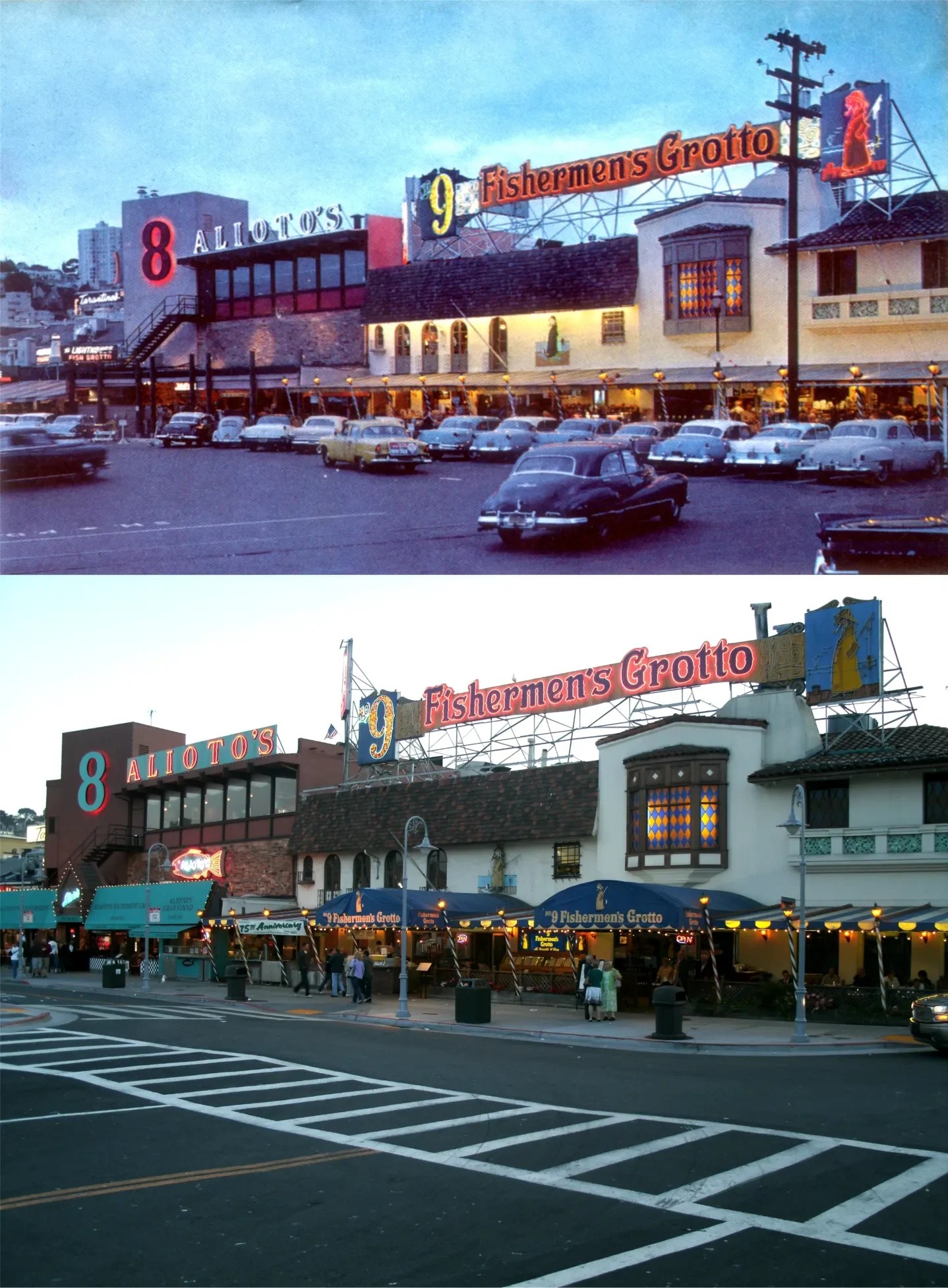
In his unflattering description from his 1933 book ‘San Francisco, a Pageant’, Charles Caldwell Dobie doesn’t write highly of South Park. He writes, {Once upon a time, South of Market boasted two fashionable districts that more or less merged one with the other: South Park, a frigid respectable square, lined with elm trees, and Rincon Hill…. South Park and Rincon Hill still persist as geographical units, but nothing of their former grandeur survives.} Dobie goes on to write of South Park, {The oval circle, once planted to fresh green grass that gained the name of Park for this exclusive inclosure, is now a thing of unpainted benches and seared turf, shadowed by wind-bitten elms and maples. One wonders if the ghosts of old South Park ever come back to shudder of the change in its fortunes–} Probably not, and his description gets even uglier. Dobie does write that South Park is {an exact copy of Berkeley Square in London} and I didn’t know that. Gary Kamiya writes about South Park in his two fine books ‘Portals of the Past’ and ‘Spirits of San Francisco’, but a little more flattering because the area is not at all as bad as it was in 1933. South Park was also the scene of the capture of one of San Francisco’s most repulsive criminals. (Thumbnail images)

We’ll head into South Park from 3rd Street, seen in the 1950s photo from the San Francisco Public Library Archives. Notice the round cornered building on the right in the vintage picture; we’ll get back to that later.
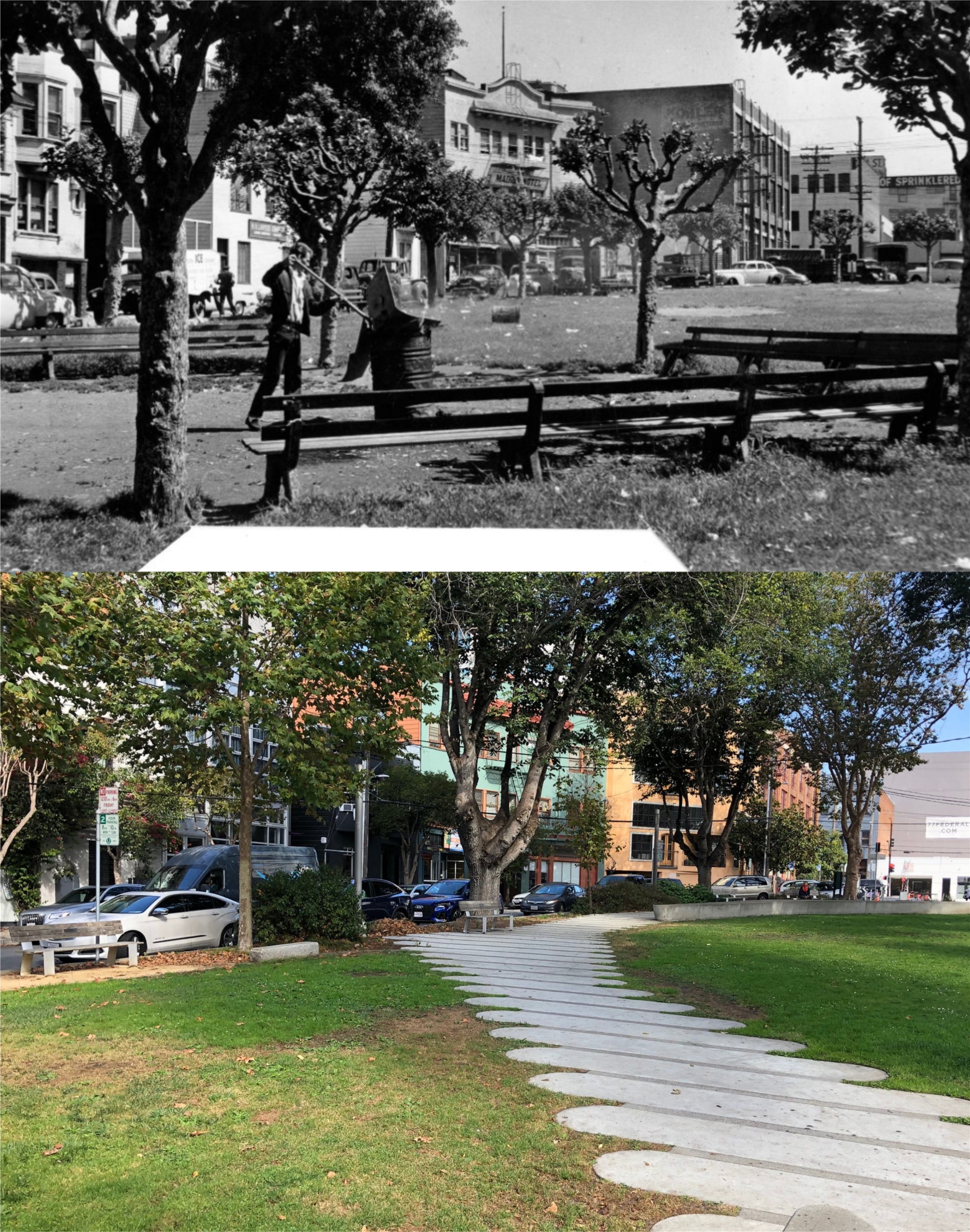
Burning leaves in South Park during the 1950s: The curved roof-top building in the center of the old photo is the aqua green color building seen through the trees in my picture. (San Francisco Public Library Archives)

Looking east from the north side of South Park during the 1950s: (San Francisco Public Library Archives)

102 South Park on the north side at Jack London Alley during the 50s: Jack London Alley extends to Bryant Street on the north side of South Park, and to Brannan Street on the south side. (San Francisco Public Library Archives)
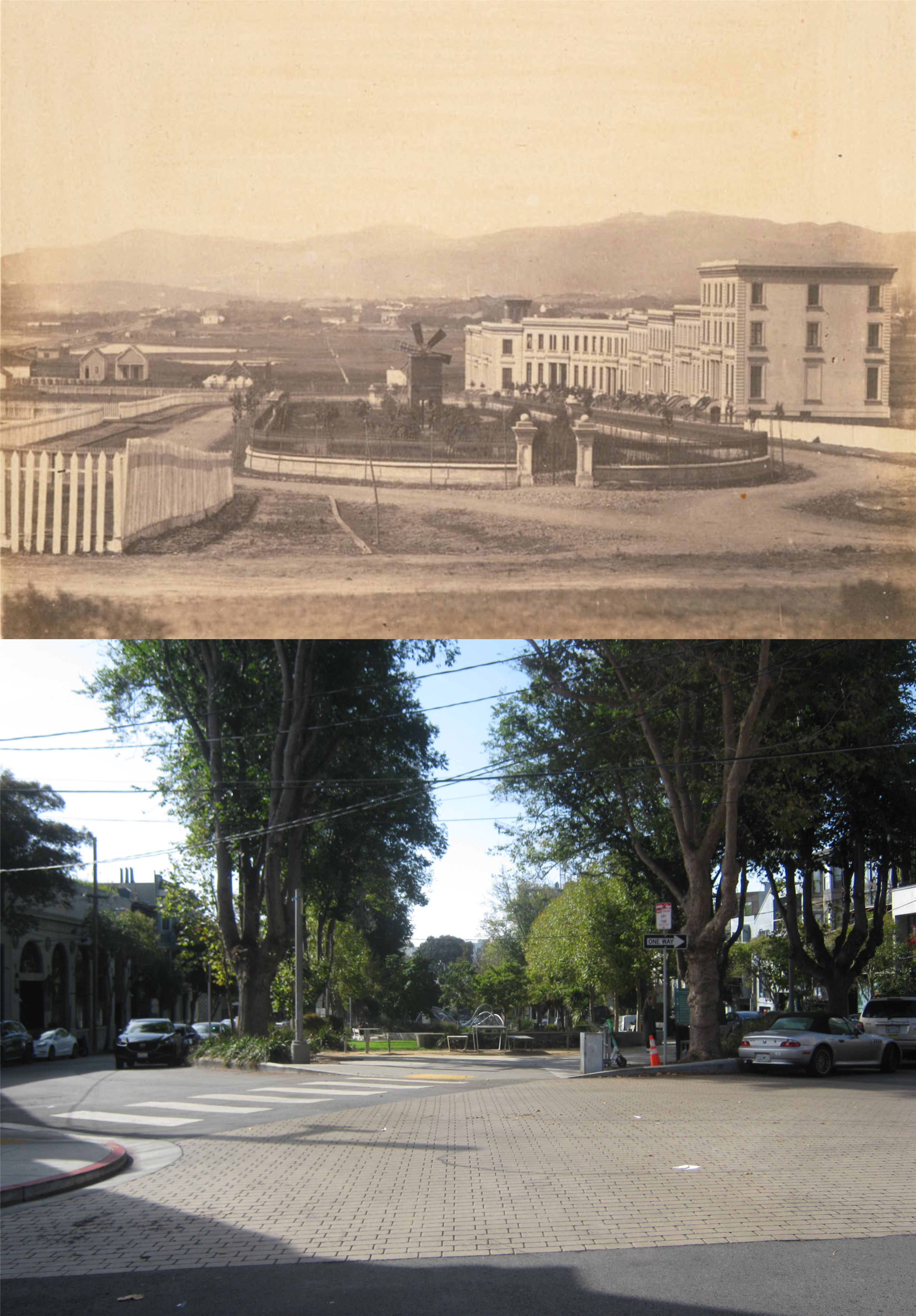
South Park, looking west from 2nd Street in 1856: (San Francisco Public Library Archives)

Now we’re on the east side of South Park looking north along 2nd Street. I had to take my picture a little further out from the Park than the 1963 photo to avoid having the tree block out the Clock tower Building at 449 2nd Street at Stillman. (opensfhistory.org)

De Boom Street, or what Herb Caen called Lower De Boom, (Oh, Herb, where are you now when we need your humor?) near the east side entrance to South Park. The vintage picture, erroneously labeled De Bloom, is from 1915. (opensfhistory.org)

Now we come to the main attraction. The round cornered building that I referred you to in the first picture of this set is where police captured one of the biggest creeps in San Francisco history. In October of 1926, Clarence Kelly Jr. and two accomplices committed robberies throughout San Francisco. During the spree, Kelly personally murdered four innocent people. (calisphere.org)

Before their capture, newspapers were referring to them as the “Terror Bandits”.

When one of the punks was apprehended by the police, he squealed on Kelly, leading police to the apartment at 47 South Park, on the corner of what is now the south side of Jack London Alley, where Kelley lived with his family. As police raided the building from the front, Kelly tried to escape down the back stairs where he was shot twice by police on the stairs, according to the San Francisco Examiner. Those stairs are on the far right in my picture. Kelly was hanged at San Quentin in 1928, and he was pronounced dead by San Quentin physician, Dr. Leo Stanley, who claimed part of Kelly’s body for a quack experiment he was practicing. I’ll just leave it at, you’ve heard the expression “You can’t take it with you.” well, for Dr. Stanley, it was more “You can’t take ‘em with you.” You’ll have to read into the story of Clarence Kelly Jr. and the “eminent” Dr. Leo Stanley yourself for more on the subject.
 San Francisco Film Locations Then & Now
Elms and maples?! Dang!; and that was back when horticulture was taken seriously. You can see how unhappy the surviving elms are. They are American elm, Ulmus american, which prefers warmer summers, such as it would experience in the Santa Clara Valley. The maples were either Norway maple, Acer platanoides, or, more likely, London plane, Platanus X acerifolia. Norway maple prefers cooler winters, such as it would experience in Portland, (although it was commonly planted during the 1950s in the Santa Clara Valley.) London plane is actually a sycamore that is often described incorrectly as a maple. It prefers cooler winters also, but performs reasonably well in San Francisco, which is why so many pollarded specimens remain at City Hall. It is not so vigorous without pollarding. (If you notice their botanical names, ‘Acer platanoides’ translates to ‘maple that resembles a sycamore’ and ‘Platanus x acerifolia’ translates to ‘sycamore with maple leaves’. ‘Acer’ is ‘maple’, and ‘Platanus’ is ‘sycamore’.) The sycamores that are there now are London plane that are not pollarded like the original ‘maples’ were.