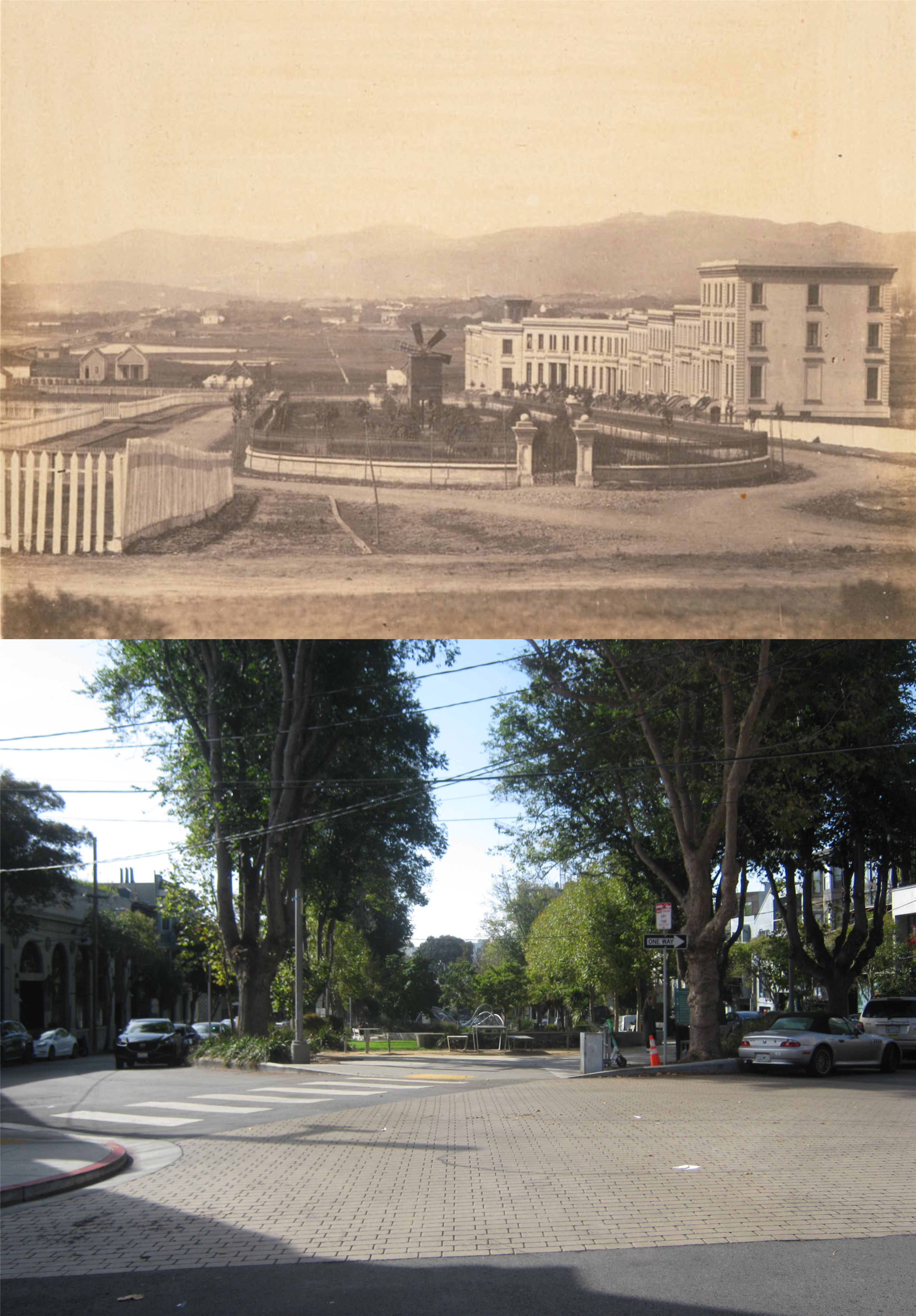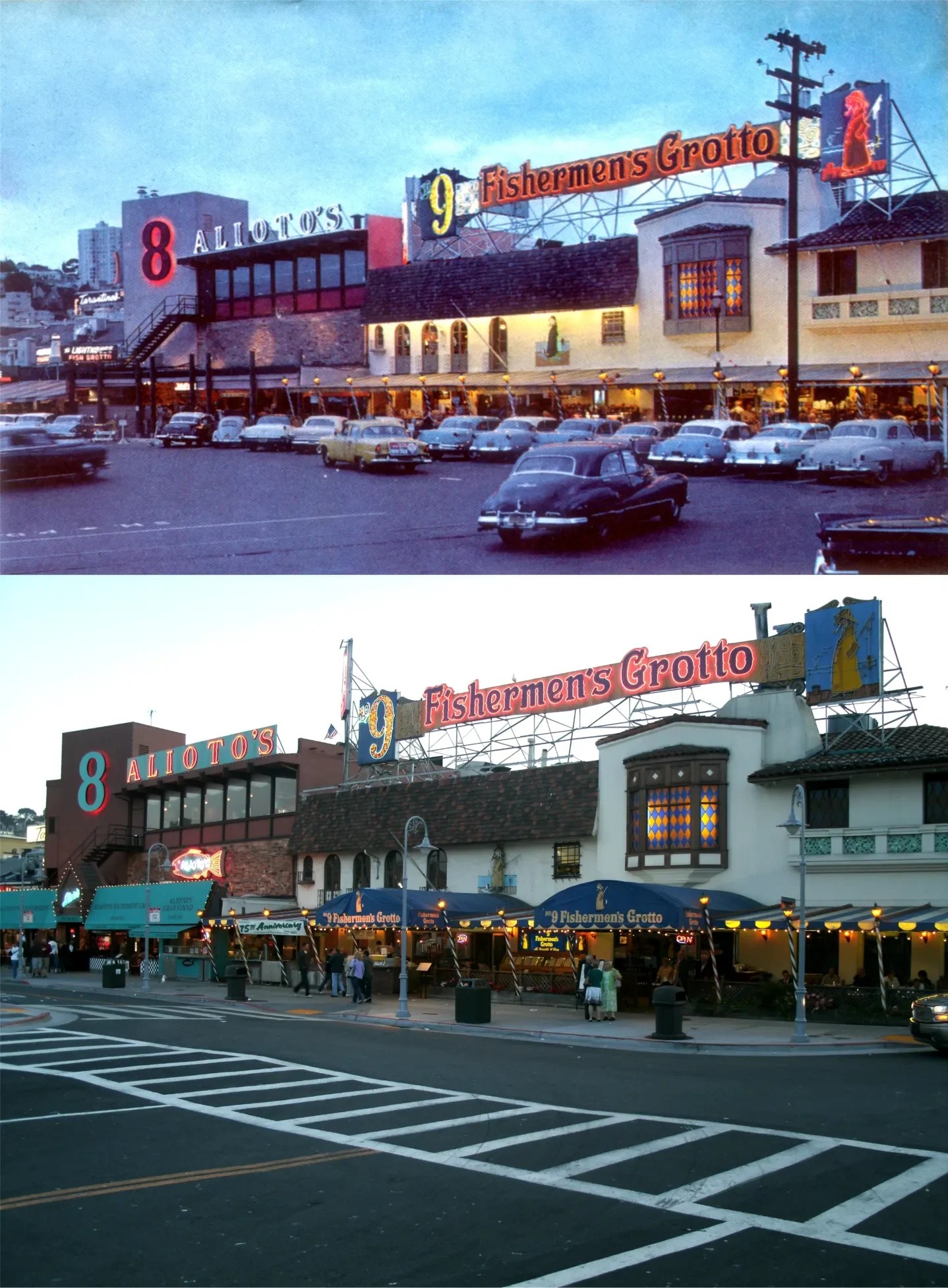
Some re-dids

Just for no reason, I felt like redoing some of the older photos I posted on my website. As to the results of the updated updates, some were an improvement, some might have been better left alone, but all of them were fun to revisit. Most of the vintage pictures I originally posted back when I was careless in not naming the source of many of the old pictures; my apologies for not being able to list many of them. (Thumbnail images)


Where the California Street Cable Car Line comes into Market Street in the 1940s and now: This was as close to a line up as I could get. The Southern Pacific Building is on the right in both pictures. Back in August of 2015, when I did my first update of the old photo, the numbers 15 were on the Ferry Building  commemorating the one hundred year anniversary of the 1915 Panama Pacific Exposition.


Union Square after the 1906 Earthquake: I got a better line up with the Dewey Monument than when I originally did an update of the vintage photo in January of 2016, although I had to cut out half of the Union Square 2024 Christmas tree, which is a shame because it’s such a nice tree.


I think it’s cool that this location at 17 Street and South Van Ness hasn’t changed much at all since the 1940s; except for the gas prices.

A rainy day on the Embarcadero during the 1950s: Pier 7 is gone now, and was where the portable bathroom is now. You can see a part of the northern most portion of the Embarcadero Freeway on the right of the vintage picture.


A Life Magazine picture at Civic Center during World War Two: They were walking about where the San Francisco Library Building is now; I’m standing at the entrance to the library. The Empire Hotel Building is in the right background of both pictures. I first did an update of this Life photo on Halloween of 2014, as San Francisco was getting ready for a parade to celebrate the San Francisco Giants third World Series Championship.
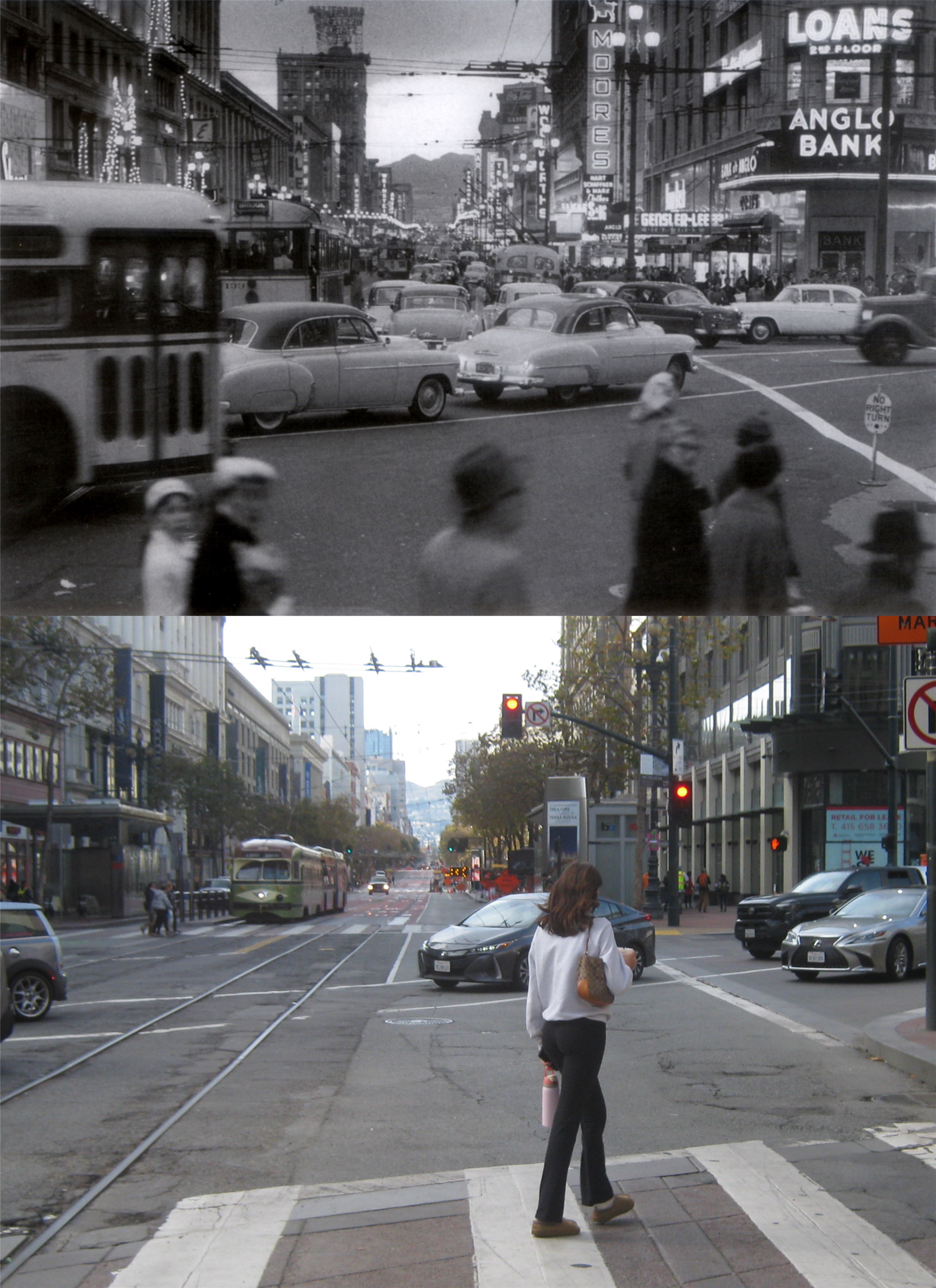
 

Traffic crossing Market Street from 4th Street to Stockton in the 1950s: Traffic runs only north to south from Stockton to 4th Street now.
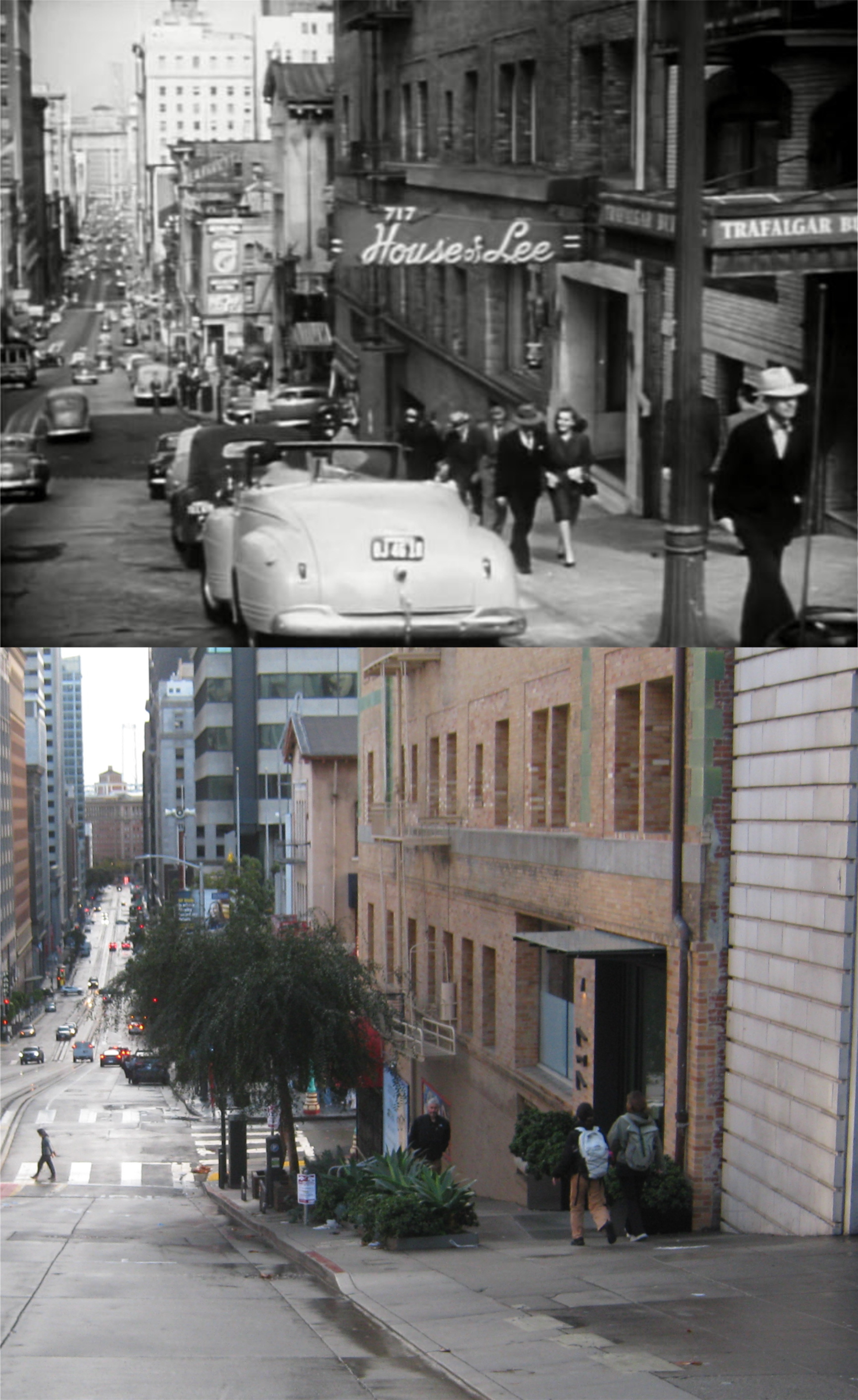

A movie scene on California Street up from Grant Ave in the 1947 film ‘My Favorite Brunette’: That’s Bob Hope, hot on a detective case, driving away from his office in the Trafalgar Building. The Trafalgar Building is gone now and was where the parking garage for the Ritz-Carton Hotel is now. Back in January of 2015 and also January of 2017, when I did an updates of this spot, the 717 entrance to the Sig Fat Building still had the white frame around the door entrance.


The entrance to the Palace Hotel on a rainy 1950s day: The clock is still there, but the Pig ‘n Whistle is gone. A blurry update on my part, but the vintage picture is too good to leave out.
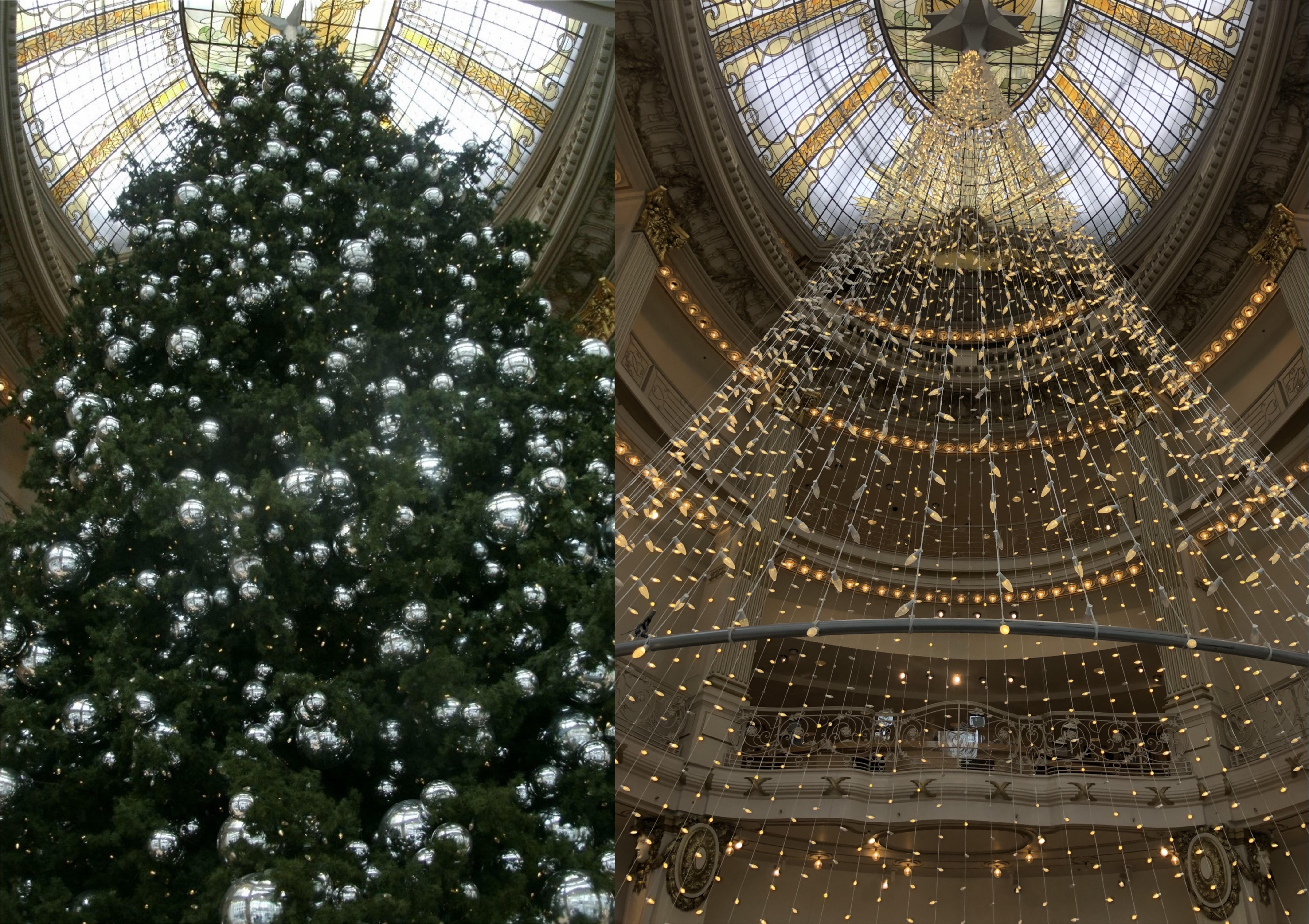
  

Back in 2016 I did an update comparing the Neiman Marcus Christmas tree to the one the used to be in this rotunda when the City of Paris Department store stood here. Now I’m doing an update on the 2016 Neiman Marcus Christmas tree to the 2024 Neiman Marcus Christmas tree.


A Ferryboat with Frank Sinatra aboard arrives behind the Ferry Building in the open scenes of the 1957 film ‘Pal Joey’. You can still see the old Southern Building, lost in the modern crowd of today’s skyline. This was a redo of the first then and now I posted on this blog in June of 2013.

“Pick a spot, any spot.” “Okay, South Park.”

In his unflattering description from his 1933 book ‘San Francisco, a Pageant’, Charles Caldwell Dobie doesn’t write highly of South Park. He writes, {Once upon a time, South of Market  boasted two fashionable districts that more or less merged one with the other: South Park, a frigid respectable square, lined with elm trees, and Rincon Hill…. South Park and Rincon Hill still persist as geographical units, but nothing of their former grandeur survives.}  Dobie goes on to write of South Park, {The oval circle, once planted to fresh green grass that gained the name of Park for this exclusive  inclosure, is now a thing of unpainted benches and seared  turf, shadowed by wind-bitten elms and maples. One wonders if the ghosts of old South Park ever come back to shudder of the change in its fortunes–} Probably not, and his description gets even uglier. Dobie does write that South Park is {an exact copy of Berkeley Square in London} and I didn’t know that.  Gary Kamiya writes about South Park in his two fine books ‘Portals of the Past’ and ‘Spirits of San Francisco’, but a little more flattering because the area is not at all as bad as it was in 1933.  South Park was also the scene of the capture of one of San Francisco’s most repulsive criminals. (Thumbnail images)


We’ll head into South Park from 3rd Street, seen in the 1950s photo from the San Francisco Public Library Archives. Notice the round cornered building on the right in the vintage picture; we’ll get back to that later.


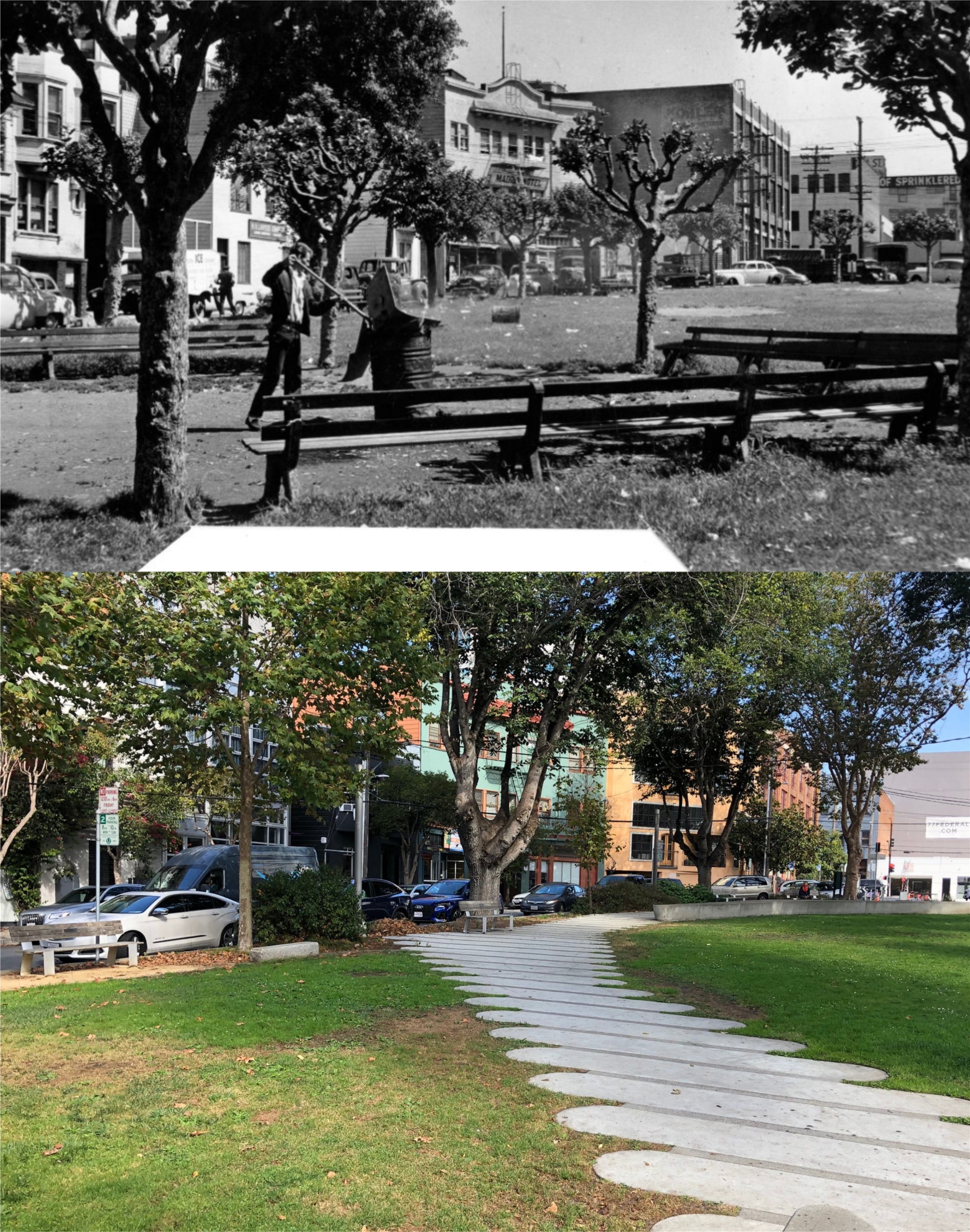
Burning leaves in South Park during the 1950s: The curved roof-top building in the center of the old photo is the aqua green color building seen through the trees in my picture. (San Francisco Public Library Archives)


Looking east from the north side of South Park during the 1950s: (San Francisco Public Library Archives)


102 South Park on the north side at Jack London Alley during the 50s: Jack London Alley extends to Bryant Street on the north side of South Park, and to Brannan Street on the south side. (San Francisco Public Library Archives)


South Park, looking west from 2nd Street in 1856: (San Francisco Public Library Archives)


Now we’re on the east side of South Park looking north along 2nd Street. I had to take my picture a little further out from the Park than the 1963 photo to avoid having the tree block out the Clock tower Building at 449 2nd Street at Stillman. (opensfhistory.org)


De Boom Street, or what Herb Caen called Lower De Boom, (Oh, Herb, where are you now when we need your humor?) near the east side entrance to South Park. The vintage picture, erroneously labeled De Bloom, is from 1915. (opensfhistory.org)


Now we come to the main attraction. The round cornered building that I referred you to in the first picture of this set is where police captured one of the biggest creeps in San Francisco history. In October of 1926, Clarence Kelly Jr. and two accomplices committed robberies throughout San Francisco. During the spree, Kelly personally murdered four innocent people. (calisphere.org)


Before their capture, newspapers were referring to them as the “Terror Bandits”.


When one of the punks was apprehended by the police, he squealed on Kelly, leading police to the apartment at 47 South Park, on the corner of what is now the south side of Jack London Alley, where Kelley lived with his family. As police raided the building from the front, Kelly tried to escape down the back stairs where he was shot twice by police on the stairs, according to the San Francisco Examiner. Those stairs are on the far right in my picture. Kelly was hanged at San Quentin in 1928, and he was pronounced dead by San Quentin physician, Dr. Leo Stanley, who claimed part of Kelly’s body for a quack experiment he was practicing. I’ll just leave it at, you’ve heard the expression “You can’t take it with you.” well, for Dr. Stanley, it was more “You can’t take ‘em with you.” You’ll have to read into the story of Clarence Kelly Jr. and the “eminent” Dr. Leo Stanley yourself for more on the subject.